“Video of Bannon, Epstein, and the Art of Rot in a Suit” - 2 February 2026
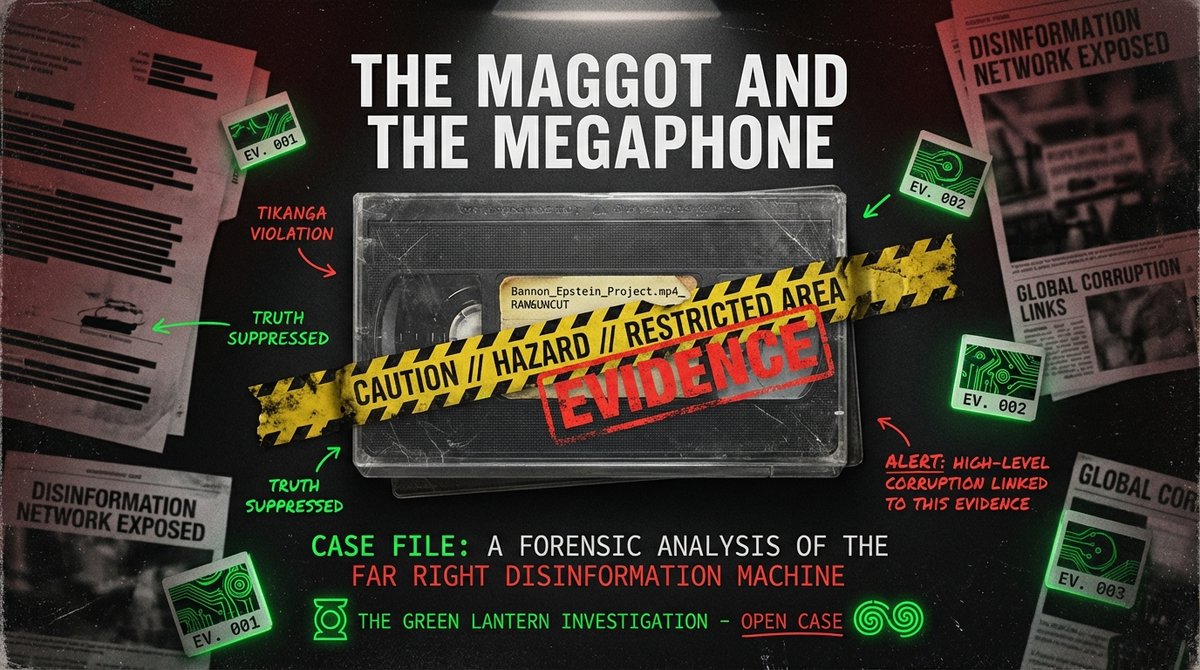
The Maggot and the Megaphone
Kia ora Aotearoa,
Steve Bannon sits behind the camera like a proud taxidermist, holding up Jeffrey Epstein’s corpse of a reputation and trying to convince you it’s a rare specimen of genius. The DOJ, under pressure from the Epstein Files Transparency Act, has finally torn open the vault and dumped millions of pages, images, and videos that show how deeply Epstein’s network penetrated politics, finance, and media, as reported by ABC News, KTVU, and 1News.
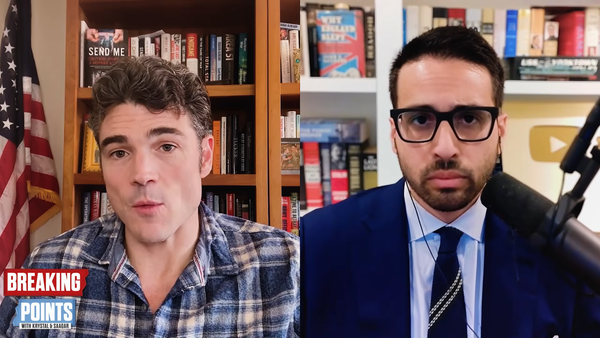
Into that light steps this “raw & uncut” Bannon–Epstein interview:
A maggot and a megaphone, each feeding the other.
This is not journalism. This is corruption captured on tape—a strategic alliance between a convicted sexual predator and a political propagandist, documented across thousands of texts and emails released in the DOJ dump and analysed by outlets like Jacobin, Business Insider, NBC, and the BBC. They show Bannon plotting to “humanise the monster,” Epstein bragging about how easily elites accepted him, and both men treating the rest of us as a mark to be worked.
To the western mind that admires clever monsters, this interview looks like “insight.”
To tikanga, it is something else:
a ritual of desecration, where mauri is drained, whakapapa is distorted, and tika is trampled so a taniwha can explain why the river it polluted is very interesting water.
Background: Two Men, One Operation
The DOJ’s Epstein Files Transparency Act releases confirm what investigative reporting had already mapped out:
Bannon and Epstein weren’t strangers; they were co‑conspirators in a reputational op. ABC notes that millions of documents and multimedia assets have been released because the Department “did not protect the public adequately,” necessitating unprecedented transparency about who aided and abetted Epstein’s operations, including media actors. ABC. Local coverage by KTVU and KTTV affiliates confirms that the cache includes emails, images, videos, and transcripts previously unseen.
From those materials and earlier investigative work:
- Bannon spent months cultivating Epstein as a character for a documentary series. Emails show him telling Epstein “It’s an op, dude,” outlining how they would rehabilitate his image and frame him as the victim of a media “jihad,” as reported by Jacobin and summarised by the BBC.
- Business Insider details how Bannon and Epstein discussed using a Kovel agreement to shield the footage from discovery, essentially laundering this interview into privileged legal strategy. NBC further reports that Epstein’s brother, Mark, has been demanding access to over 15 hours of these tapes, which Bannon has refused to release in full. NBC.
- Fortune’s analysis of the DOJ files describes “hundreds of friendly messages” between Epstein and Bannon during Trump’s first term as President, including requests for Epstein’s private plane and advice on media strategy. Fortune.
- 1News and ABC both confirm that the Epstein releases span December 2025 to early 2026, with at least one tranche of files being removed and then restored after public outcry when it appeared politically sensitive documents had been quietly taken down. 1News and 1News again.
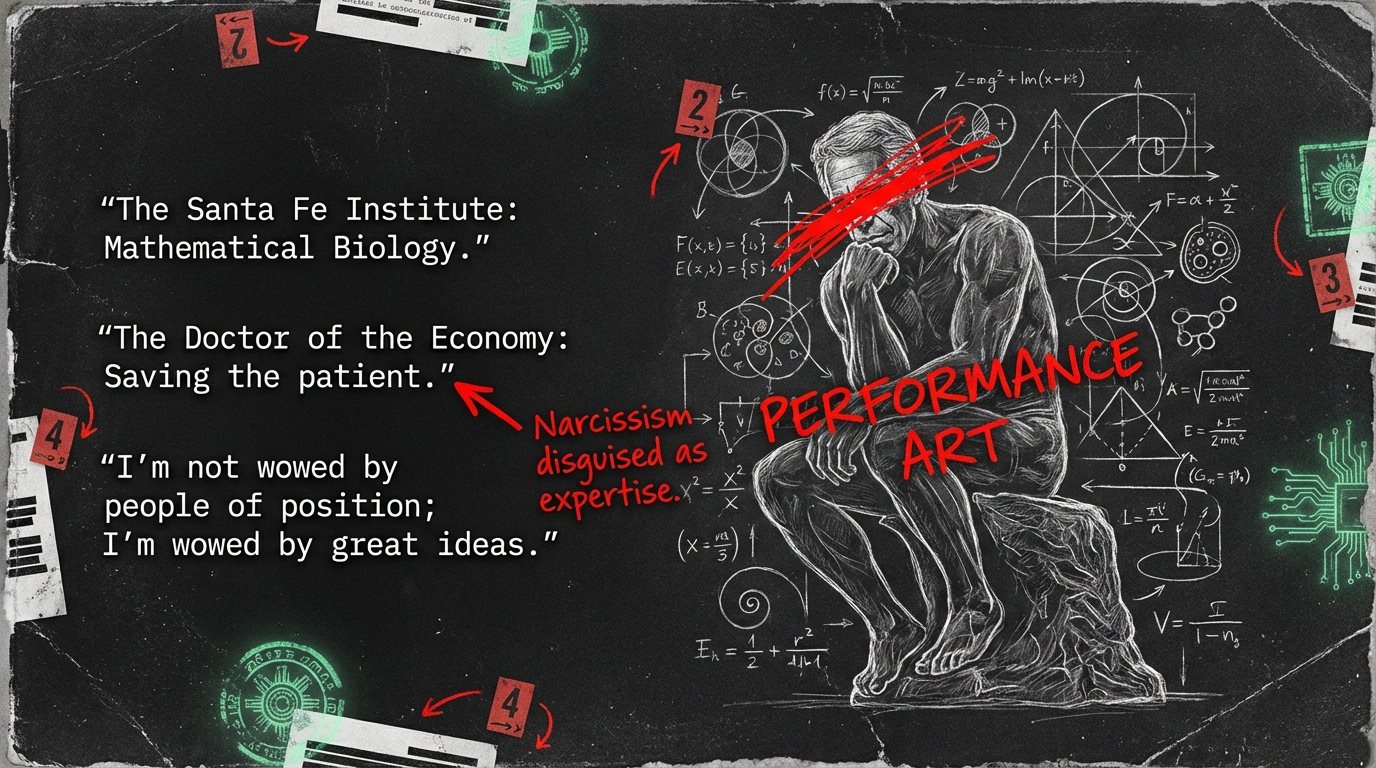
So when you watch Bannon tee up Epstein with questions about Santa Fe Institute, fractional reserve banking, and the 2008 crisis, understand this:
you are not watching a spontaneous conversation. You are watching two professionals in narrative manipulation executing an operation years in the making.
Corruption as a Two‑Headed Taniwha
If Epstein is the taniwha—a predator that fed on girls and global elites alike—Bannon is the river engineer who tries to convince us that this was just an unusually shaped log in the stream.
1. Epstein: The Predator in a Philosopher’s Cloak
Throughout the transcript, Epstein performs the role of misunderstood genius:
- He describes his involvement with Rockefeller University as the enlightened financier who saw that “numbers” and quantitative methods would transform science, claiming he was brought onto the board to modernise an “old‑fashioned” institution focused merely on medicine. These claims align with reporting on his philanthropic entanglements at Rockefeller, where his money and supposed insight allowed him to move easily in circles of Nobel laureates and trustees, despite existing allegations about his behaviour. Coverage by outlets like The New York Times and subsequent DOJ files support this picture of elite acceptance.
- He boasts about the Trilateral Commission, explaining how he sat alongside presidents, central bankers, and corporate bosses, dismissing them as financially illiterate while he alone understood the system. Analyses of the Commission’s membership and function by political scholars confirm it as a hub of trans‑Atlantic and Japanese elite coordination, giving context to Epstein’s bragging about being invited into that space. Cambridge article on elite policy networks.
- He recounts the 2008 financial crisis from a Palm Beach jail cell, painting a grotesque portrait of guards begging him for financial advice and Treasury officials calling to ask how to “pump blood” (liquidity) into the global economy. This tracks with documented timelines of his 2008 plea and incarceration, as well as the broader chronology of the Lehman collapse as reconstructed by CNN’s detailed timeline.
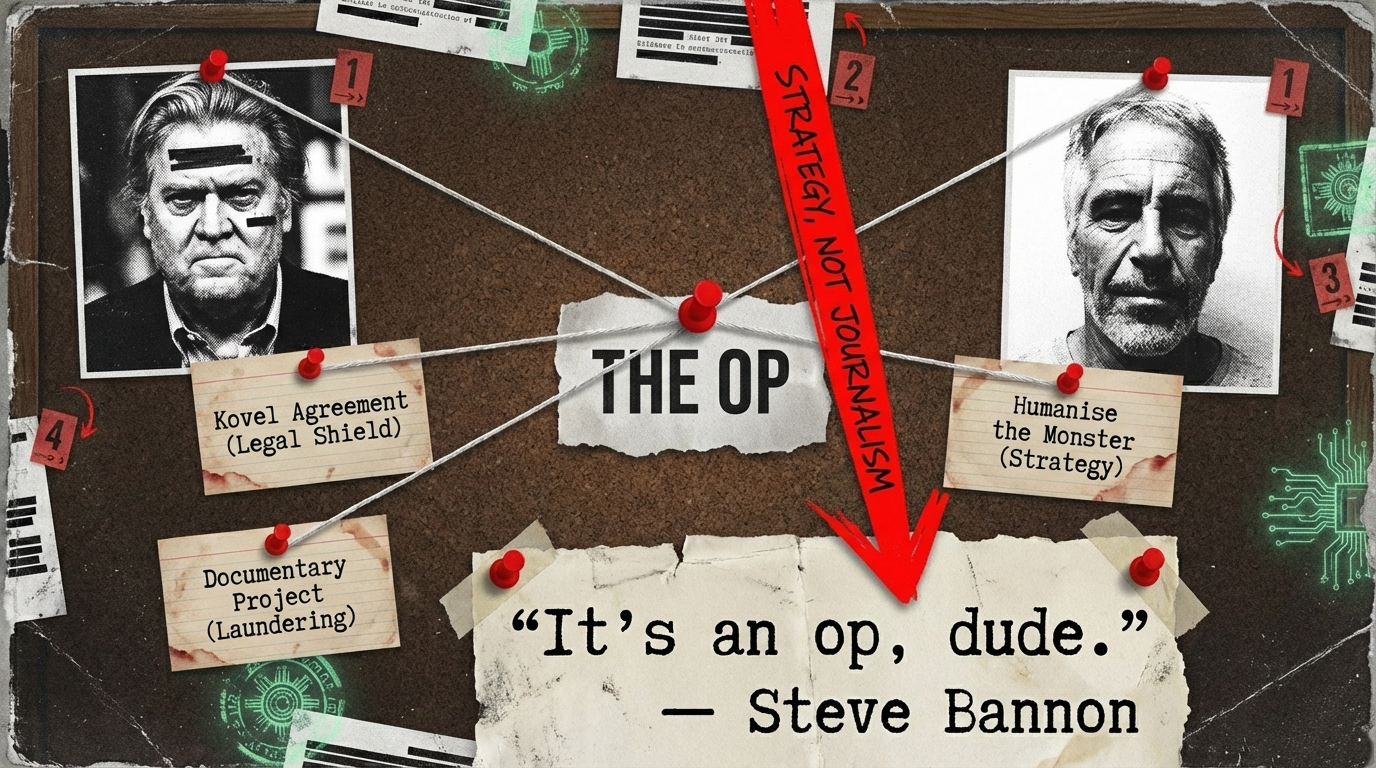
The corruption here is not just criminal; it is epistemic. Epstein uses complexity talk—Santa Fe Institute, neural nets, emergent systems—to construct a mythology where his mind is so advanced that ordinary moral categories (“predator,” “rapist,” “trafficker”) are almost too crude to apply. He isn’t just a man who exploited girls; he is a misunderstood doctor trying to explain the body of the financial system to dull‑witted politicians.
2. Bannon: The Propagandist Who Fell in Love With His Own Monster
Bannon, for his part, plays the role of devil’s advocate and hype‑man:
- He flatters Epstein as “one of the greatest financial minds in the world,” telling him that in a crisis “every important person in the world would be seeking your opinion,” even as Epstein casually recounts his 6×9 cell. This mirrors Bannon’s own rhetorical patterns elsewhere, where he amplifies fringe thinkers and extremists by framing them as uniquely insightful truth‑tellers against a corrupt establishment. ProPublica’s work on Bannon’s role in organising election deniers documents the same tactic: treating dangerous actors as misunderstood prophets.
- External reporting shows that Bannon explicitly discussed a strategy to “redeem” Epstein through a documentary project, telling him in messages that they would show he was “a lot of things—but you are NOT that,” meaning not the monster the press portrayed. Business Insider and Jacobin both cite these communications.
- DOJ‑released emails and texts, summarised by outlets including Fortune, show Bannon regularly asking Epstein for favours and insights, including use of his private jet, even after Epstein’s first conviction—demonstrating that the “reputation rehab” was not hypothetical but embedded in ongoing exchange.
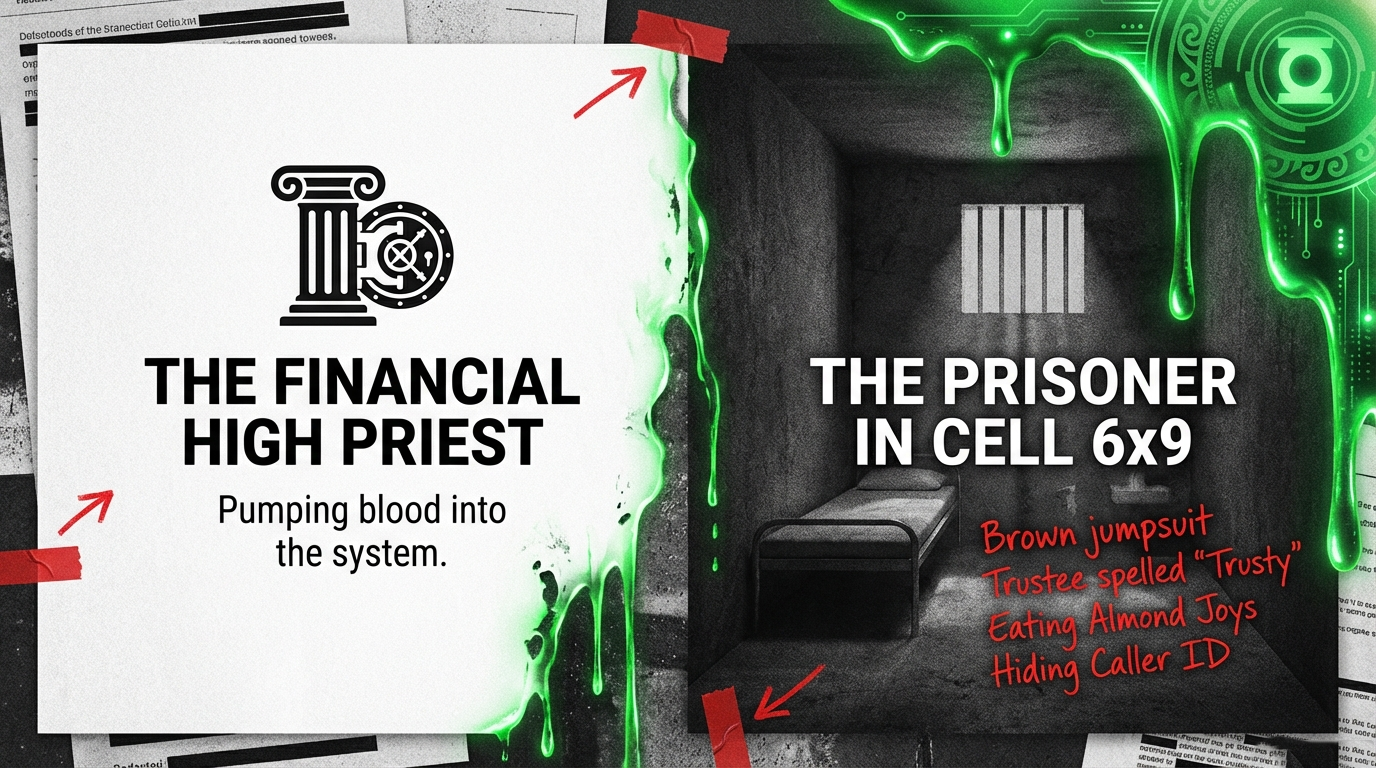
The metaphor is ugly but accurate:
Epstein is the tumour; Bannon is the oncologist who decides to build a career lecturing about how interesting cancer is, while lobbying to deregulate carcinogens.
How Their Corruption Deforms Tikanga
Tikanga is a system of values and practices for living in right relationship. Western systems are supposed to have their own equivalents
—rule of law, human rights, journalistic ethics—but the Bannon–Epstein operation shows how easily those can be bent to protect power rather than truth.
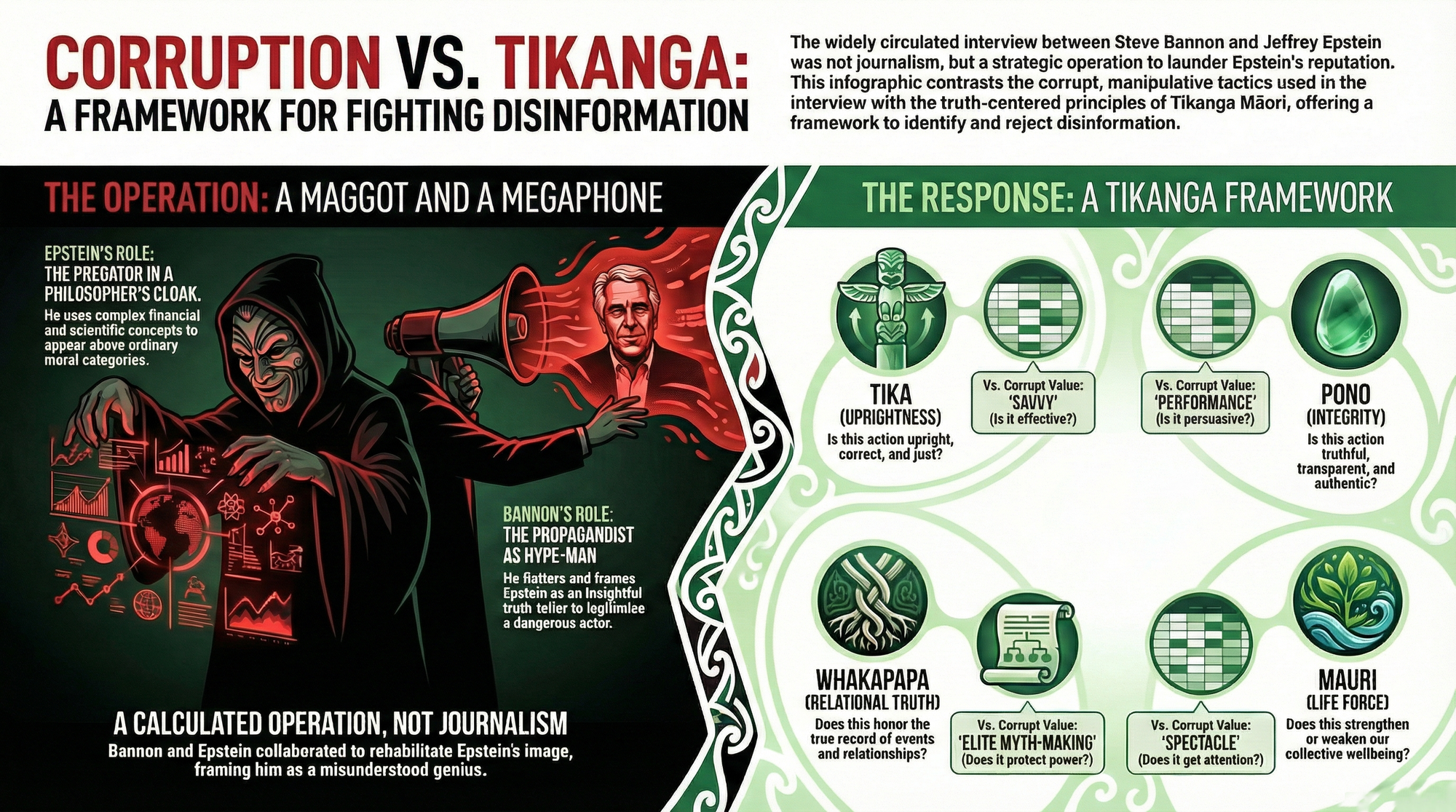
Tika (Uprightness) vs. “Savvy”
Te Ara describes tika as “upright and correct – as a tree is upright and erect,” the source from which correct actions arise. Te Ara – Forest Mythology. Ethics frameworks like Te Ara Tika restate this as a demand that research and storytelling honour truth and justice ahead of institutional convenience. Te Ara Tika.
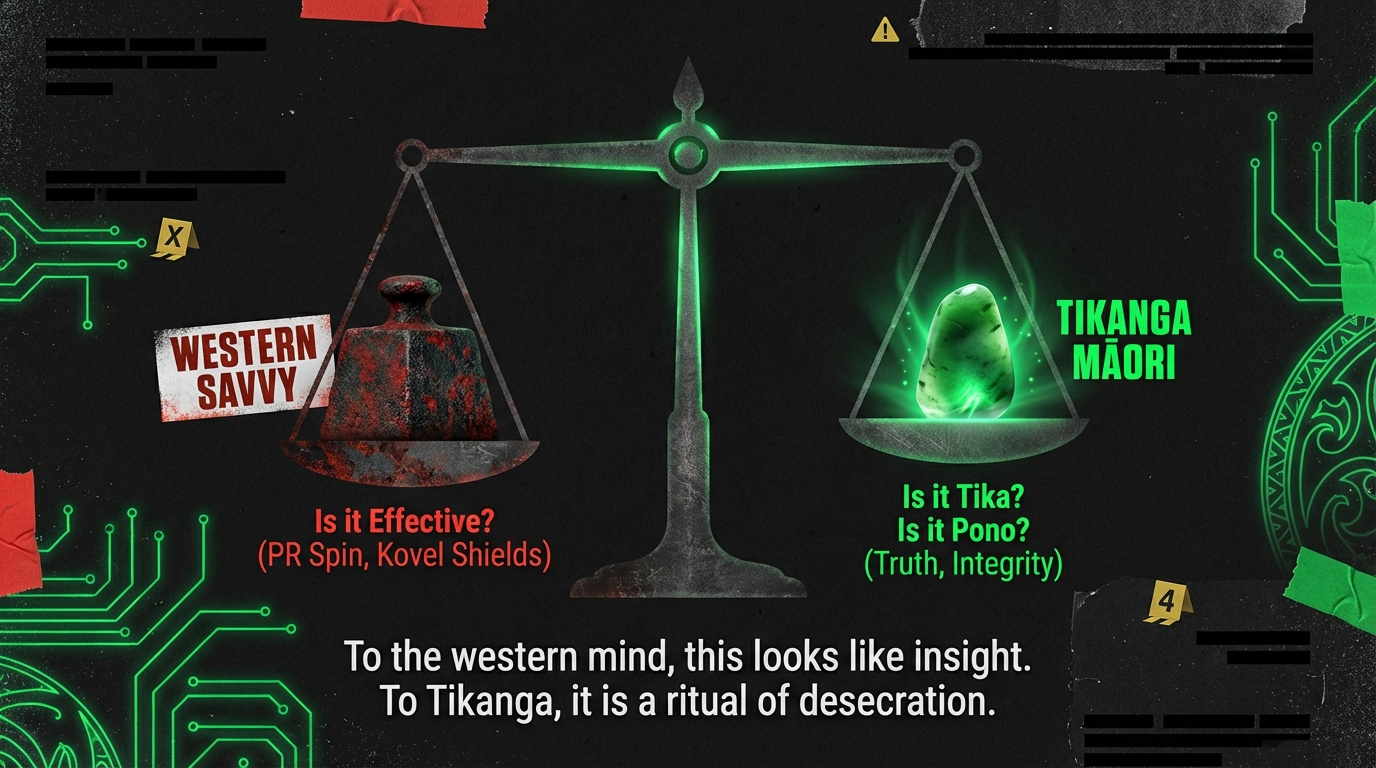
Bannon and Epstein instead worship savvy. The question in their world is never “Is this tika?” It is “Is this effective?” Will this framing help rehabilitate Epstein? Will this footage, carefully edited, make audiences question whether he’s really that bad? Western political culture, increasingly shaped by PR, often treats this kind of narrative manipulation as a neutral skill. Tikanga calls it what it is: a structural assault on truth.
Pono (Integrity) vs. Performance
Pono, in Māori ethical discourse, is about authenticity and alignment—between what you say, what you do, and how your actions affect others. Government guidance on Māori data principles defines pono as requiring “truthfulness, transparency, and fairness in relationships with Māori communities.” data.govt.nz – Pono & Tika.
Nothing about the Bannon–Epstein operation is pono. The very existence of a Kovel‑shielded documentary project, designed to appear independent while being legally insulated and strategically scripted, is the antithesis of transparency. Business Insider’s reporting on their Kovel discussions lays bare that this was not about truth; it was about building a legal and narrative shield simultaneously. Business Insider.
To a western audience trained to think “everyone does PR,” this might seem normal. To tikanga, it is a direct mauri‑drain:
a ritualising of deception so that even “confessions” become performances.
Whakapapa (Relational Truth) vs. Elite Myth‑Making
Whakapapa is our living record of relationships, responsibilities, and events. It is not just family trees; it is the map of who did what to whom, under whose authority, over generations. Research on Mormon falsification of Māori whakapapa calls this kind of distortion “genealogical violence,” likening it to defacing sacred texts. Mormon Misappropriation.
The Bannon–Epstein collaboration tries to re‑write the whakapapa of Epstein’s life:
- Instead of “serial abuser of girls protected by money and connections,” we are nudged toward “financial savant, misunderstood by shallow politicians and media.”
- Instead of “systemic failure of law enforcement and prosecutors to act,” we are offered a story about the tragic genius in a cell, still called upon by guards and Treasury to save the world during the 2008 crisis.
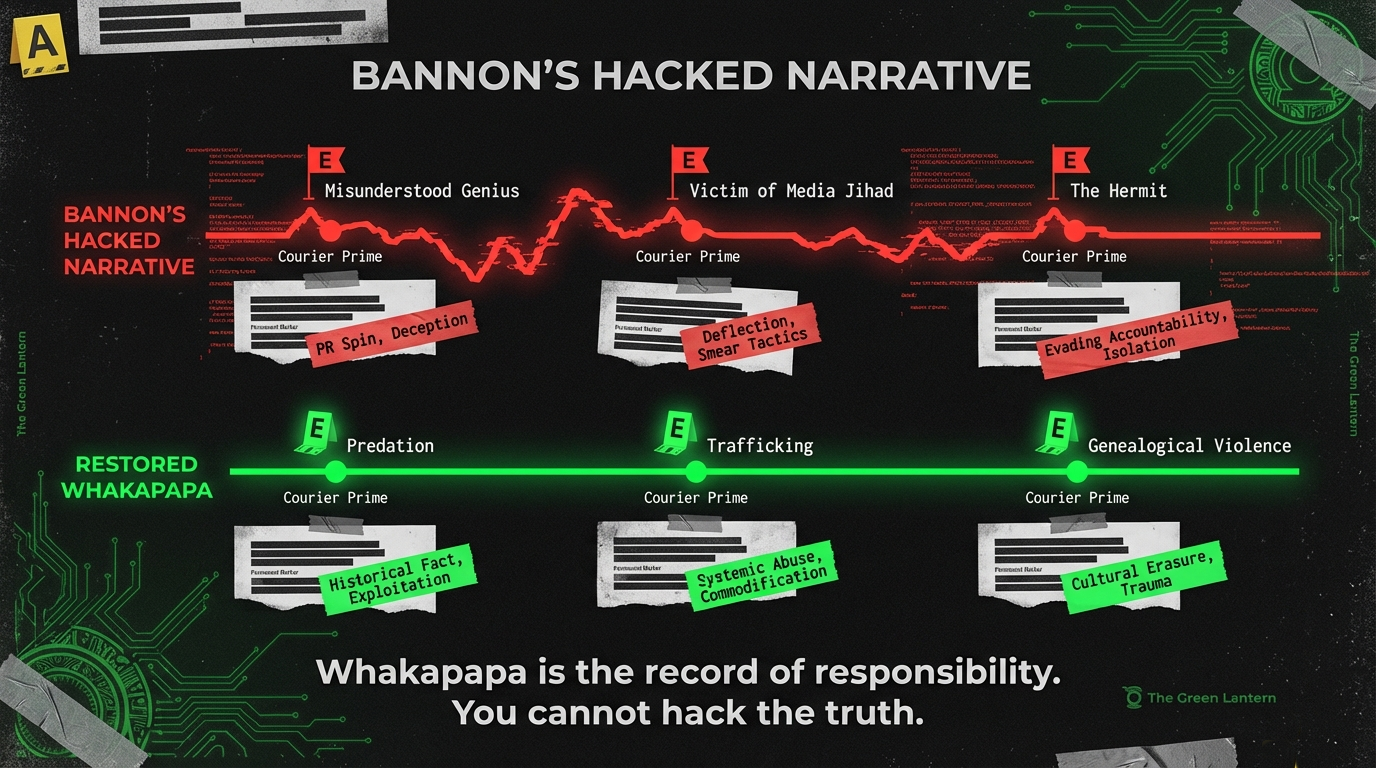
This is elite myth‑making:
a new whakapapa authored by the perpetrators, aiming to overwrite the one painstakingly assembled through survivor testimony, local reporting, and court documents.
Mauri (Life Force) vs. Spectacle
Mauri is the life force of people and systems. Indigenous health models describe mauri as the binding energy of wellbeing, degraded by dishonesty, exploitation, and imbalance. Māori health model. A content ecosystem that treats this interview as thrilling spectacle does not merely “misinform”; it weakens our collective mauri.
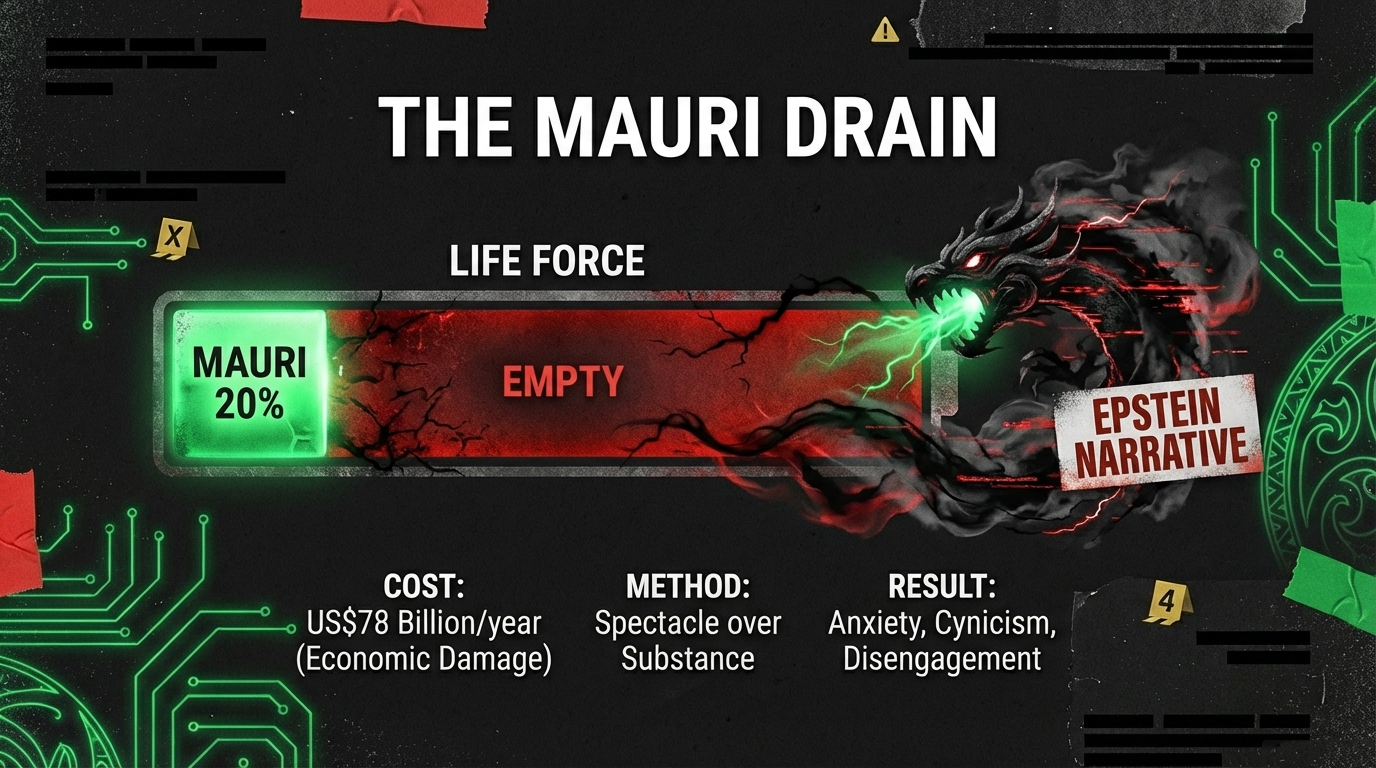
Studies on misinformation’s psychological effects show that repeated exposure to manipulative content, especially when fronted by charismatic or “expert” figures, produces anxiety, cynicism, and disengagement. Fake news impact and psychological impacts. People start to believe that everyone is lying, that nothing is knowable, that all claims are just weapons. That is exactly the condition in which predators thrive.
Quantifying the Damage: Numbers Behind the Rot
The Bannon–Epstein tapes are one node in a vast network of harm.
- The DOJ has released millions of pages under the Epstein Files Transparency Act, plus thousands of images and videos, acknowledging systemic institutional failure. ABC reports “3 million pages” and notes the files include correspondence from law enforcement agencies and prosecutors that failed to stop Epstein earlier. ABC.
- 1News’ coverage of the ongoing releases highlights that at least 16 files were briefly removed from the DOJ webpage before being restored after media scrutiny, raising serious questions about continued political interference even in this belated transparency process. 1News.
- Victim counts number in the hundreds. Previous investigations (Miami Herald etc.) had already identified dozens; ABC and 1News explain that the files include evidence of new victims and enable fresh civil and criminal action in multiple jurisdictions, including renewed pressure on Prince Andrew in the UK. 1News.
- Economically, the wider disinformation ecosystem—of which Bannon is a key architect—costs tens of billions annually. The World Economic Forum estimates fake news and disinformation impose about US$78 billion per year in damage via stock‑market swings, misallocated investments, and corporate reputation crises. WEF.
- Deepfake and synthetic media attacks already cost the average targeted firm around US$450,000 per incident, with more than half of businesses surveyed reporting at least one such attack, according to ID verification company Regula. Regula survey. While these tapes are not deepfakes, they circulate in the same polluted stream where truth, performance, and outright fabrication blur.
- In Aotearoa, 1News’ investigation into the Parliament protest disinformation network found that roughly 73% of the disinformation content on mainstream platforms came from just a dozen accounts, demonstrating how concentrated the manufacture of reality can be. 1News.
The Bannon–Epstein interview is therefore not an isolated curiosity; it is a high‑value asset in a global disinformation and reputation‑laundering economy that is already costing lives, money, and trust.
Explaining Tikanga to the Western Mind
To a western reader steeped in liberal individualism, this might all sound abstract. So let’s be blunt.
- Imagine your legal system, media, and universities as a whare. Tikanga says: the whare stands only if the foundation is tika and pono. If you discover that one of your central pou (Epstein’s money, Bannon’s media reach) is rotten, you don’t build a museum around it. You remove it, examine how the rot spread, and rebuild in a way that protects the vulnerable.
- Instead, western institutions chose to keep using that rotten pou as a feature. Rockefeller took Epstein’s money and influence; the Trilateral Commission gave him a seat; media platforms now monetise his “insights” posthumously, often stripped of survivor context. This is not neutral. It is a violation of tapu—the protective sacredness that should ringfence children, survivors, and the truth itself. Te Mana o te Wahine – tapu and peacemaking.
- Tikanga treats kōrero as haukāinga—home fires that either keep us warm or burn us out. When you platform a predator and a propagandist together without fierce, survivor‑centred framing, you are feeding dry tinder into the flames and calling it light.
Solutions: Starve the Operation, Feed the Tikanga
1. Starve the Corruption
- Journalists: if you cover these tapes, frame them as evidence, not entertainment. Make the Bannon–Epstein relationship the headline, not Epstein’s pseudo‑intellectual tangents. Use investigative standards like those adopted by ProPublica: disclose agendas, show the text messages, map the money.
- Platforms: treat this content as high‑risk archival material. Demote it from recommendations, disable monetisation, and link prominently to survivor‑centred reporting and the DOJ’s own admissions of failure. International human rights analyses of deepfakes and harmful AI content stress the need for duty‑of‑care obligations on platforms; the same logic applies here. Human rights approach.
2. Repair Mauri and Whakapapa
- Education: use this case in civics and media literacy curricula, pairing the transcript with survivor testimony and analyses of structural power. Studies like the Warwick report on fake news and wellbeing show that critical engagement can reduce the psychological damage of misinformation. Warwick.
- Law: in Aotearoa, deepen the work already begun on AI and deepfake harms. 1News’ reporting on deepfake porn prosecutions and proposed law changes shows the system straining to adapt. 1News and 1News follow‑up. Extend that logic to cover reputation‑laundering media operations that knowingly centre predators while suppressing survivor voice.
3. Centre Tikanga as Counter‑Code
For western institutions, tikanga is not a decorative addon; it is a counter‑code to the corruption embodied by Bannon and Epstein.
- Tika: Ask of every story: does this align with what is upright and just, not just what is technically accurate?
- Pono: Insist that those with the most power and the most to gain tell the truth under the strictest scrutiny, not the gentlest.
- Whakapapa: Keep survivor narratives, local reporting, and community memory at the centre when reconstructing events—not elite self‑mythology.
- Mauri: Measure your media by whether people feel more empowered and connected after engaging, or more numb and cynical.
Koha Consideration – Funding the Work of Cutting Through the Rot
This essay exists because the Crown and corporate media left a vacuum. The DOJ only opened the vault after years of pressure; elite outlets gave Bannon and Epstein space long before they gave survivors the same. Every minute spent unpacking their operation through tikanga is unpaid labour unless whānau choose otherwise.
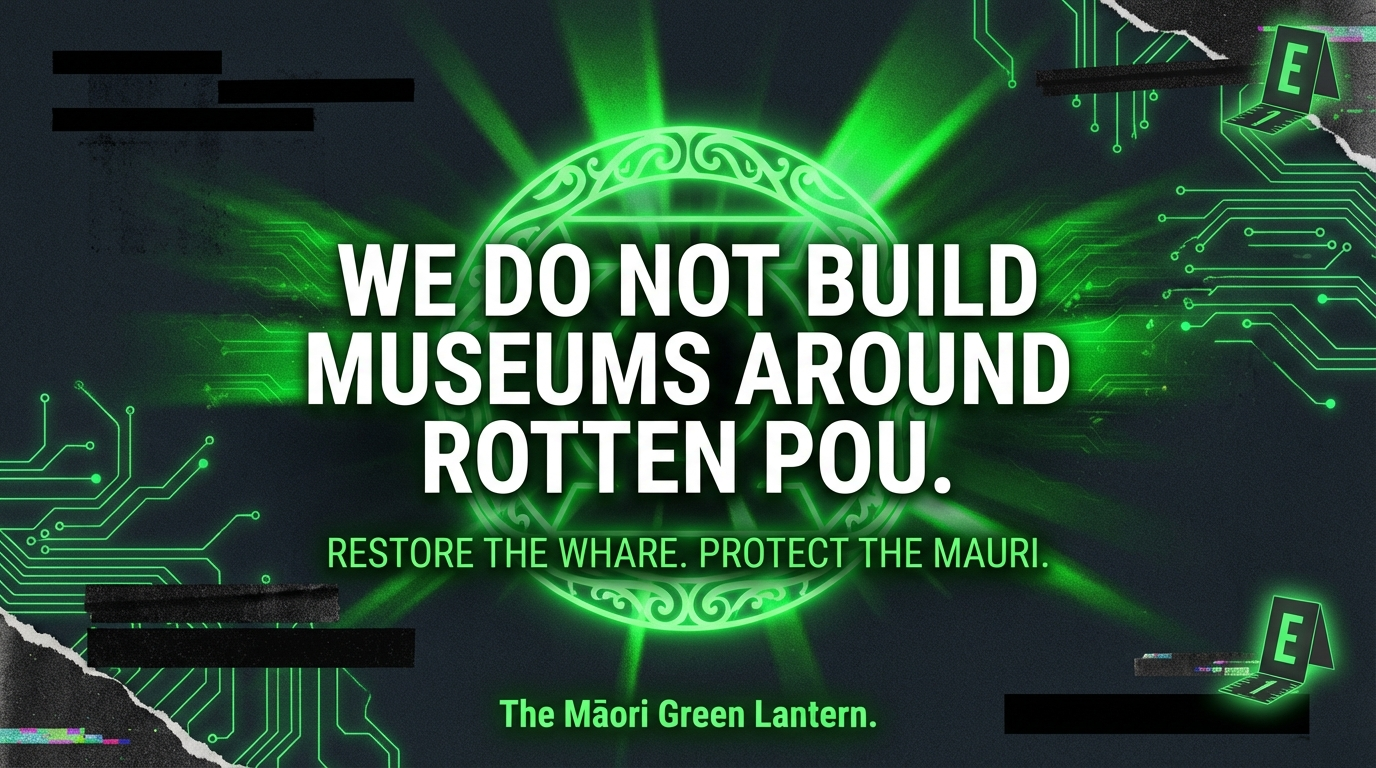
Every koha in this context is not charity. It is a deliberate act of de‑colonising the narrative economy. It says:
we will pay for voices that treat the Bannon–Epstein tapes as exhibits in a corruption trial, not as “must‑see content.” We will fund tikanga‑grounded analysis that protects mauri instead of feeding the taniwha.
If this breakdown of Bannon and Epstein’s corruption helped you see how deeply narrative, law, money, and media are entangled—and why tikanga offers a different compass—then consider a koha to keep this mahi going:
- To support this work directly, visit: Koha—Support.
- To receive essays like this directly and tautoko through subscription, join: Subscribe to the Māori Green Lantern on Substack.
- For direct bank transfer, contributions can be made to: HTDM, 03-1546-0415173-000.
Kia kaha, whānau. The tapes are out. The maggot and the megaphone have had their say. Our job now is to make sure they do not get the last word.

Ivor Jones The Māori Green Lantern Fighting Misinformation And Disinformation From The Far Right