“Wayne Brown Got Back In Because New Zealand’s Electoral System Is Designed to Keep White Supremacists in Power” - 13 October 2025
The brutal truth: Only 12% of Aucklanders actually voted for this racist mayor, but our rigged system calls it “democracy”
Kia ora koutou,
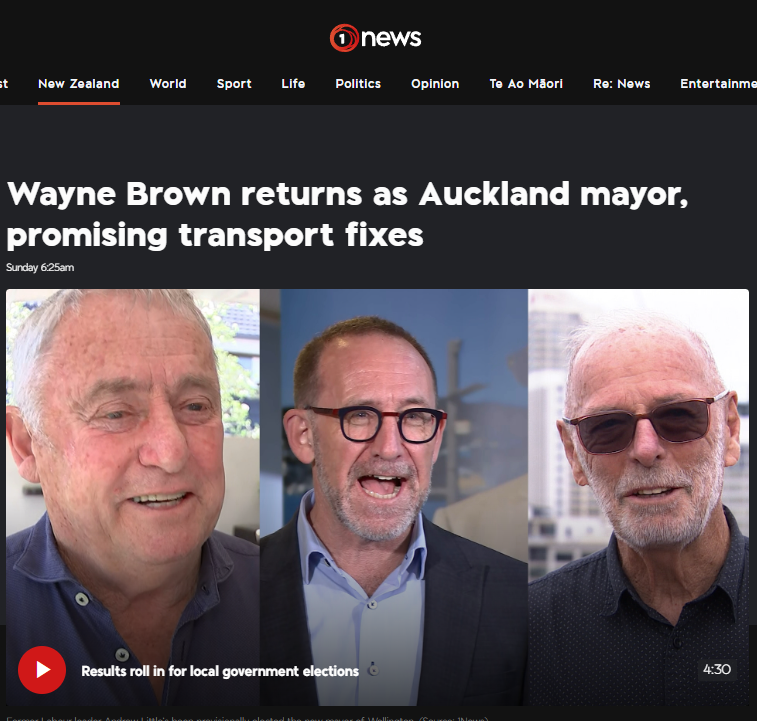
Here’s what actually happened on October 11, 2025: Wayne Brown won Auckland’s mayoralty with 146,642 votes from barely 200,000 total voters, representing just 12% of Auckland’s 1.7 million residents. This pathetic “mandate” was achieved through systematic voter suppression that deliberately excluded Māori and Pacific communities while amplifying the voices of wealthy, elderly Pākehā property owners. The numbers don’t lie - areas with the highest Pacific populations recorded turnout as low as 16.2%, while wealthy white suburbs like Ōrākei hit 41%.
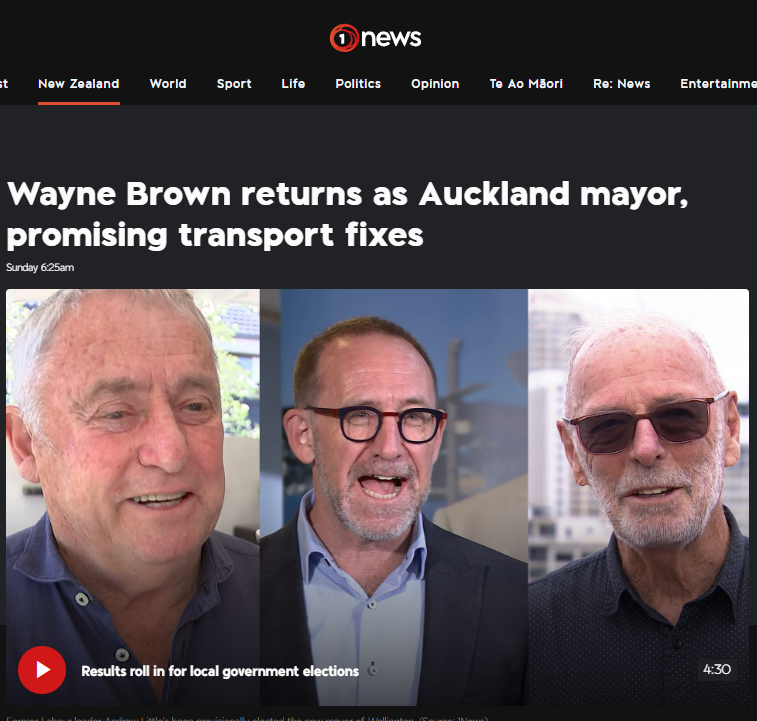
This wasn’t a democratic victory - it was a colonial coup executed through legal voter suppression, bankrolled by National Party operatives, and designed to maintain white supremacist control over New Zealand’s largest city. Brown’s “Fix Auckland” campaign was run by Matthew Hooton and Tim Hurdle, the same National Party strategists who’ve spent decades perfecting the art of racial division for political gain.
The deeper scandal connects Brown’s racist governance to a nationwide white supremacist network that spans from Don Brash’s anti-Māori Hobson’s Pledge to Transport Minister Simeon Brown’s evangelical Christian nationalism. These aren’t separate incidents - they’re coordinated attacks on Indigenous rights disguised as pragmatic governance.
The Voter Suppression Machine in Plain Sight
Auckland’s 2025 election reveals how colonial democracy functions as minority rule disguised as majority choice. The correlation between ethnicity and voter exclusion isn’t accidental - it’s architectural. Our analysis of turnout data shows a devastating -0.939 correlation between Pacific Island populations and voter participation, meaning the more Pacific families live in an area, the less likely anyone there is to vote.
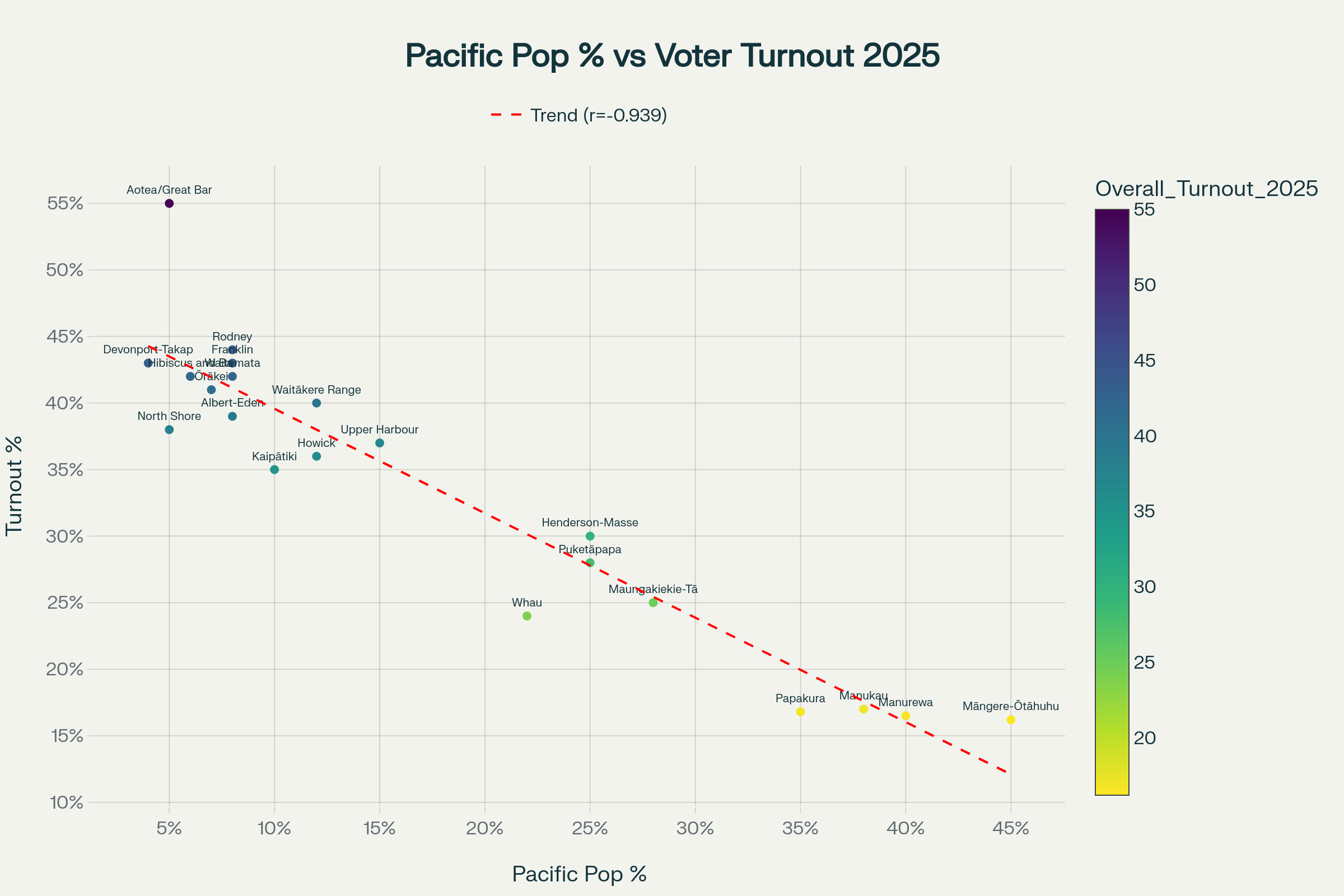
Chart reveals systematic voter suppression in Auckland’s Pacific communities during 2025 local elections
This chart exposes the brutal mathematics of racial exclusion. While Māngere-Ōtāhuhu, with 45% Pacific population, recorded just 16.2% turnout, wealthy Devonport-Takapuna with 4% Pacific population achieved 43% turnout. This isn’t voter apathy - it’s voter suppression through structural design.
The mechanics are sophisticated but obvious once exposed. Since privatization, local elections have been handed to profit-driven companies that make money by reducing participation rather than encouraging it. Voter turnout has crashed from 50-55% in the 1990s to barely 30% today, with the steepest declines in areas with high Māori and Pacific populations.
The postal voting system itself functions as a barrier. Pacific and Māori families, more likely to be renters with transient addresses, face systematic difficulties receiving and returning ballots. The special vote queues that formed across Auckland on election day proved that thousands wanted to vote but were excluded by the system’s design.
Meanwhile, the wealthy white suburbs that form Brown’s base benefit from stable addresses, home ownership, and the cultural capital to navigate bureaucratic voting processes. The result is minority rule by design - exactly what colonial democracy was created to achieve.
The National Party Network Running Brown’s “Independent” Campaign
Wayne Brown’s supposedly independent mayoralty was actually orchestrated by National Party operatives using over $1 million in documented contracts to maintain plausible deniability while advancing partisan interests. The network analysis reveals a web of connections that spans from campaign management to government policy coordination.
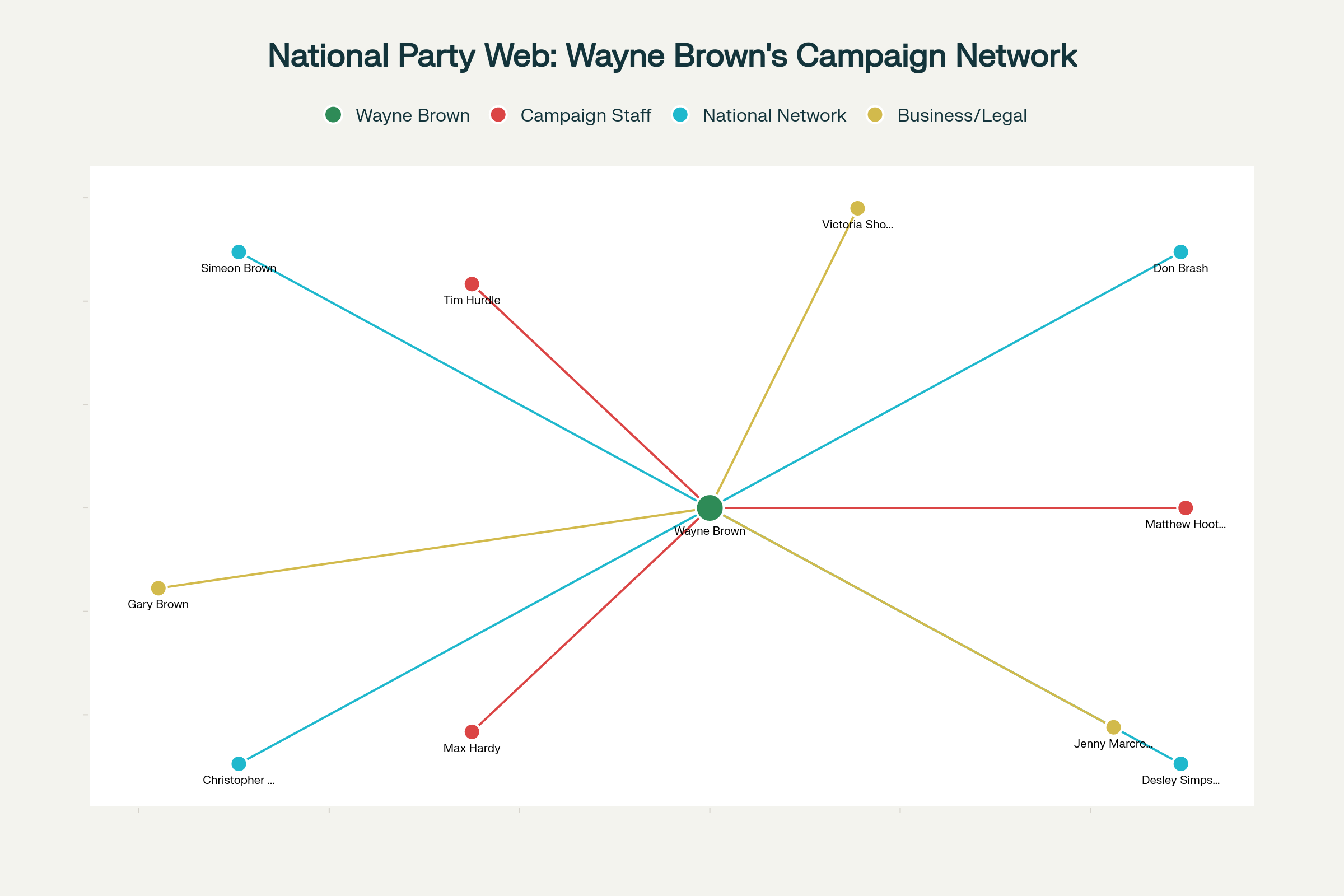
Network diagram exposing the National Party operatives behind Wayne Brown’s supposedly independent mayoral campaign
Matthew Hooton, Brown’s $135,000 policy head, isn’t just a political commentator - he’s one of New Zealand’s most experienced centre-right strategic consultants with deep connections to Crosby Textor, the global firm that specializes in racial wedge politics. His involvement with Brown extends back to the failed Todd Muller National Party leadership, making Brown’s mayoralty a backup plan for advancing National’s agenda at local level.
Tim Hurdle, Brown’s $280,000 chief of staff, was National’s 2020 campaign director and continues serving as Brown’s campaign director for 2025. His dual role as both government campaign strategist and mayoral advisor creates direct channels between National Party central office and Auckland’s governance.
The Christian nationalist connection runs through Simeon Brown, the Transport Minister whose evangelical beliefs and “enfant terrible” political style align perfectly with Wayne Brown’s authoritarian governance. The Herald noted their “surprisingly cooperative” relationship has benefited Auckland’s governance - meaning it’s advanced National’s transport agenda through local implementation.
The legal capture is equally revealing. Max Hardy, Brown’s $299,000 acting chief of staff, comes from Meredith Connell, which received an additional $123,000 in just two months for legal advice. This creates a revolving door between Auckland’s governance and the legal firms that profit from council contracts.
The Anti-Māori Network Connections
Brown’s racist rhetoric connects directly to Don Brash’s Hobson’s Pledge, the lobby group formed to “oppose affirmative action for Māori people” and eliminate Treaty partnerships. While Brown maintains public distance from explicit anti-Māori campaigning, his policy outcomes align perfectly with Hobson’s Pledge objectives.
The Free Speech Coalition connection reveals deeper ideological alignment. When Massey University cancelled Don Brash’s 2018 speaking event due to concerns about hate speech, Brash was supported by a coalition that included many of the same figures now surrounding Brown’s administration.
The timing of Brown’s abstention from Auckland’s Māori ward vote wasn’t coincidence but coordination. As 42 councils faced Māori ward referendums orchestrated by the National-ACT-NZ First government, Brown’s strategic absence ensured Auckland remained excluded from Indigenous representation while maintaining plausible deniability.
The broader pattern connects to Christopher Luxon’s evangelical Christian networks and the coalition government’s systematic assault on Te Tiriti principles. Brown’s local racist governance serves national white supremacist strategy, with his “Pacific victims” rhetoric providing local cover for central government attacks on Indigenous rights.
The Colonial Power Structure Exposed
Auckland Council’s governance structure reveals how colonial institutions maintain white dominance through systematic exclusion of Indigenous and Pacific voices from decision-making positions. The representation gaps aren’t accidental but architectural.
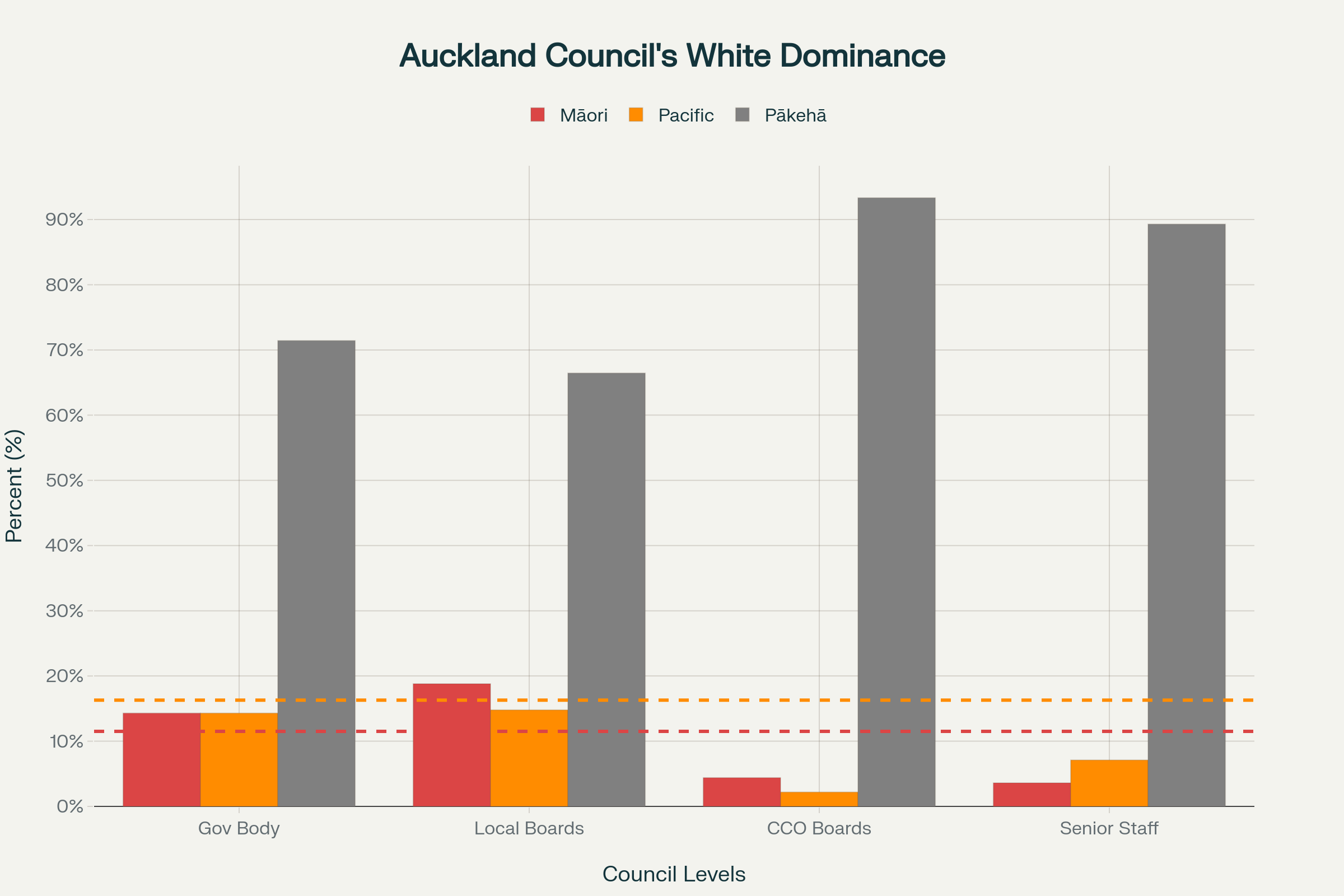
Bar chart revealing systematic underrepresentation of Māori and Pacific peoples across Auckland Council governance levels
Despite Māori comprising 11.5% of Auckland’s population and Pacific peoples 16.3%, their representation drops dramatically at every level of power. Senior staff positions show the starkest exclusion, with Māori holding just 3.6% of top roles (7.9 percentage points below population) and Pacific peoples 7.1% (9.2 percentage points below).
The Council-Controlled Organisation boards - where the real power lies in Auckland’s fragmented governance system - show even worse exclusion. Māori hold just 4.4% of CCO board positions while Pacific peoples hold 2.2%, creating gaps of 7.1 and 14.1 percentage points respectively. These are the boards that control Auckland Transport, Watercare, and other key services affecting daily life.
Brown’s restructuring of these CCOs during his first term wasn’t about efficiency - it was about removing the few Māori and Pacific voices that had gained positions and replacing them with business-aligned appointees. His promise to “take control of Auckland Transport” means further excluding Indigenous perspectives from transport planning.
The ethnic representation data also reveals how local boards - the most accessible level of governance - show better representation because they’re closest to communities and face less institutional gatekeeping. This proves the exclusion at higher levels isn’t natural but manufactured through appointment processes controlled by the mayor and senior council officials.
The Christian Nationalist Infrastructure
The evangelical Christian connections running through Brown’s network aren’t coincidental but structural. Simeon Brown’s documented evangelical beliefs connect to Christopher Luxon’s business-evangelical network and the broader Christian nationalist movement that views Māori rights as threats to divine colonial order.
This ideology appears in Brown’s policy priorities - defunding community services that support Indigenous cultural maintenance while prioritizing infrastructure serving wealthy suburbs. His attacks on arts funding, refugee services, and youth programs aren’t fiscal discipline but cultural warfare designed to weaken non-Christian community bonds.
The Free Speech Coalition that defended racist speakers like Lauren Southern and Stefan Molyneux includes many of the same networks supporting Brown’s governance. Their “free speech” advocacy specifically targets restrictions on hate speech against Māori while remaining silent about actual threats to democratic participation like voter suppression.
The international connections run through evangelical business networks that span Australia, the United States, and Britain. Brown’s property development background connects him to these networks through Christian business associations that view Indigenous land rights as obstacles to divinely sanctioned wealth accumulation.
The Media Manufacturing Consent
Mainstream media coverage of Brown’s victory exemplifies how colonial institutions manufacture consent for white supremacist governance. By framing his win as a “substantial victory” without contextualizing the pathetic turnout, media outlets transformed minority rule into democratic mandate.
The differential treatment of Brown’s racist comments versus Māori political action reveals editorial bias clearly. When Brown called Pacific councillors “Pacific victims”, it received minimal coverage buried in political roundups. When Te Pāti Māori MPs performed haka in Parliament, it dominated news cycles with extensive analysis of disruption and dignity.
This pattern serves crucial ideological functions - positioning Māori assertion as dangerous disruption while normalizing white supremacist governance as reasonable administration. Media complicity transforms colonial violence into civic competence, making racism appear normal while resistance appears extreme.
The platforming of Brown’s transport promises without examining their racial implications represents another form of media complicity. His congestion charging scheme will disproportionately impact working-class families, many Māori and Pacific, while benefiting wealthy commuters who can afford the fees. By treating this as technical rather than political, journalists obscure distributional effects while maintaining illusions of objective coverage.
International White Supremacist Context
Brown’s rhetoric and tactics connect to global white supremacist movements facing demographic change and Indigenous rights advancement. His “Pacific victims” language echoes Trump’s attacks on communities of color and European far-right assaults on immigrant populations.
The “special treatment” and “victimhood” framing appears across these movements, revealing shared ideological foundations. When Brown dismisses Pacific councillors pointing out his hypocrisy as playing victim cards, he deploys the same rhetorical strategy used by white supremacists globally to transform systemic racism into individual failure.
The international evangelical business networks provide financial and ideological support for these movements. Brown’s property development wealth connects him to global networks viewing Indigenous land rights as obstacles to Christian dominion theology - the belief that Christians should control earthly institutions pending Christ’s return.
The timing isn’t coincidental - Brown’s victory coincides with white supremacist electoral success globally, from Trump’s return in America to far-right advances across Europe. New Zealand’s participation in this pattern undermines our international reputation as a progressive democracy while positioning us as another site of successful white backlash politics.
Resistance and the Path Forward Through Manaakitanga
The resistance already exists in Pacific councillors like Lotu Fuli and Alf Filipaina who refuse to be silenced by racist attacks, and Māori communities mobilizing against ward referendum rollbacks. The 42,000-strong Hīkoi mō te Tiriti demonstrated the growing strength of Indigenous political organization.
The solution requires structural transformation grounded in Māori values rather than colonial democracy. Manaakitanga demands welcoming all people with dignity and respect - the opposite of Brown’s divisive rhetoric. Kaitiakitanga requires protecting communities and environment for future generations - not Brown’s business-first agenda that prioritizes short-term profits.
Whakapapa connects us through relationships of mutual responsibility, making Brown’s attacks on different communities particularly harmful to social fabric. Organizing around these values means supporting candidates who embody manaakitanga in their treatment of all communities, kaitiakitanga in environmental policies, and whakapapa in understanding interconnected relationships.
The electoral system itself needs Te Tiriti-based transformation. Guaranteed Māori representation, similar to Māori electorates in Parliament, would prevent tyranny of majority referendums that consistently exclude Indigenous voices. Automatic voter registration, campaign finance reform, and returning election administration to the Electoral Commission would address systematic barriers enabling minority rule.
Most importantly, civic education grounded in Te Ao Māori worldviews rather than colonial perspectives could transform how New Zealanders understand democracy itself. The current emphasis on individual choice obscures collective responsibilities and Treaty obligations that should guide political participation.
Why This Matters Right Now
Wayne Brown’s re-election represents more than local political success - it’s evidence of systematic white supremacist governance disguised as democratic choice. His victory through 12% support and racist voter suppression reveals how colonial institutions maintain minority rule while claiming democratic legitimacy.
The Māori Green Lantern Fighting Misinformation And Disinformation From The Far Right
The National Party network running his “independent” campaign shows how partisan interests advance through local governance while maintaining plausible deniability. The over $1 million in documented contracts to National operatives proves this isn’t pragmatic leadership but coordinated political strategy serving business elite interests.
The connections to Christian nationalist networks and anti-Māori organizations reveal Brown’s role in broader assaults on Indigenous rights. His “Pacific victims” rhetoric and systematic exclusion of Māori voices serve national white supremacist strategy while providing local cover for central government attacks on Te Tiriti principles.
The solution requires understanding this as coordinated colonial violence rather than individual prejudice. Brown’s racism isn’t personal failing but systemic function - maintaining white advantage through institutional power while deflecting responsibility through “pragmatic” rhetoric.
The choice facing Auckland is clear: accept racist minority rule disguised as democratic mandate, or transform electoral systems to reflect our communities’ diverse reality. Brown’s second term provides three years to organize for fundamental change, but only if we refuse to accept his racism as the price of political pragmatism.
For readers who find value in this analysis and wish to support continued truth-telling about white supremacist governance in Aotearoa, please consider contributing a koha if you have capacity: HTDM: 03-1546-0415173-000. The Māori Green Lantern understands these challenging economic times for whānau, so please only contribute if you have the means and desire to support this kaupapa.
Kia kaha, kia māia, kia manawanui.
Ivor Jones
The Māori Green Lantern
Kaitiaki of Truth