“Whakapapa, Eyes of Time: How Māori Circular Temporality Challenges Western Linear Domination” - 28 December 2025
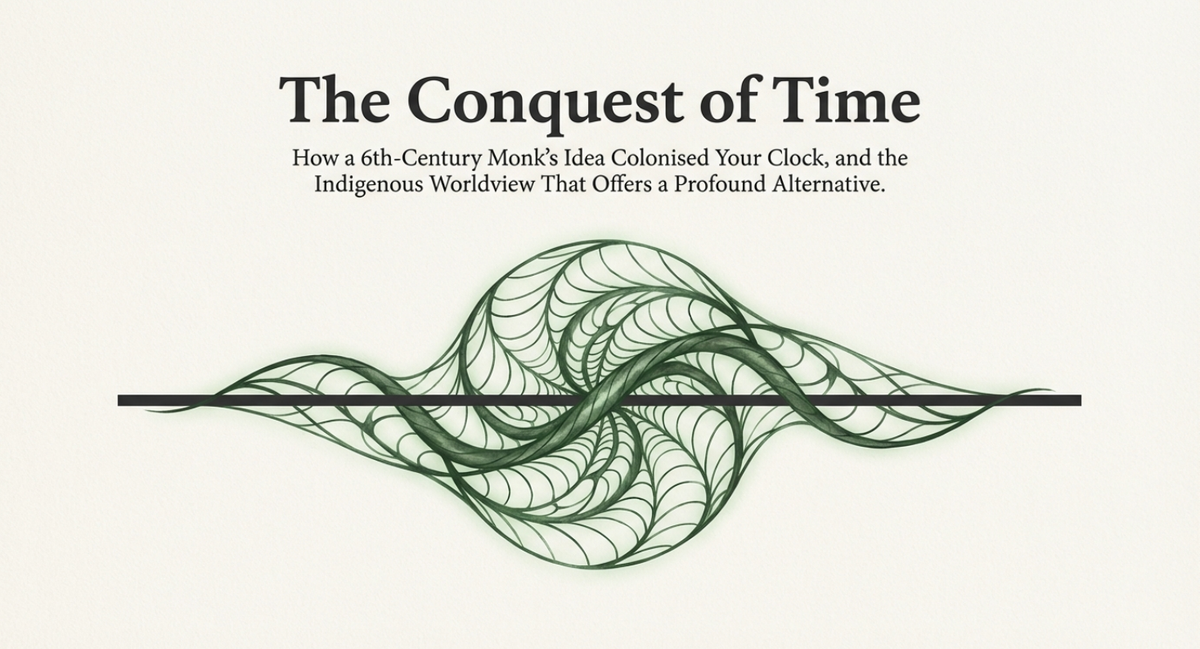
The Māori concept of time shatters the Western illusion of a straight line marching from past to future. Instead of imagining history as a sequence of moments disappearing into a rearview mirror, Māori understand time as whakapapa
—an ever-expanding genealogical web where all existence,
past, present, and future,
collapses into the present moment through relational connection.

The Eyes of Time
This is not a metaphorical flourish;
it is a fundamentally different way of perceiving reality that has survived colonisation, institutional suppression, and the relentless imposition of the Gregorian calendar.
Yet few realise that the Western world’s “common sense” about time—the BC and AD convention that divides human history into Christian and pre-Christian eras—was itself an invention, a deliberate theological move that embedded Christian dominance into the very fabric of how the world measures itself.
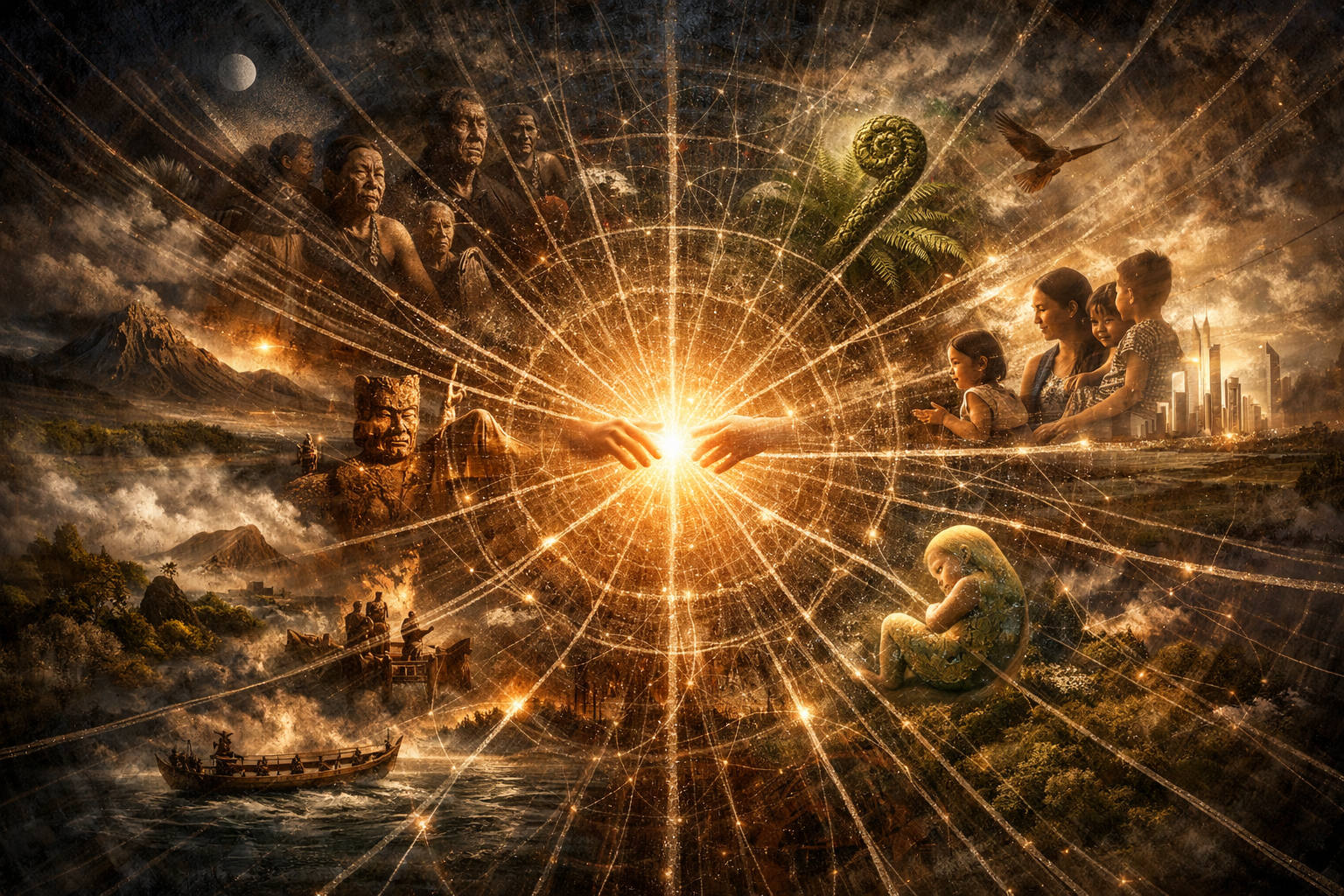
Time - As An Ever-Expanding Web - Past, Present And Future - Relational Connection
The Māori Concept of Time: Whakapapa as Temporal Web
The foundation of Māori time is whakapapa, a concept that English fails to adequately translate. Often rendered as “genealogy,” this reduction obscures whakapapa’s true power:
it is the infinite genealogy of all existence
—not just human bloodlines, but the genealogical relationships between people, ancestors, future generations, land, water, stars, and all living beings. In the Māori worldview, to be is to be in relation. This relational ontology creates a radically different temporal framework.
Rather than experiencing time as individual moments strung along a linear axis, Māori experience time as perpetually rooted in creation, as a state of “never-ending beginnings” where time loops back on itself.
As leading Māori scholar Moana Jackson articulated in research documented by the Pantograph Punch:
“For our notion of time is whakapapa based, and like whakapapa it has its own sense of never ending beginnings in which time turns back on itself in order to bring the past into the present and then into the future. Above all it is a notion of time which recognises the interconnectedness of all things.”
This is not cyclical time in the simple sense of seasons repeating;
it is temporal architecture where generations interpenetrate.
Through whakapapa, generations
“collapse into each other”
—we are simultaneously our ancestors (tūpuna),
ourselves, and
our descendants (mokopuna),
existing all at once in what appears to be the present.
Te Reo Māori itself resists the Western temporal categories. There is no direct translation for “past” or “future” as linear concepts. Instead, Māori temporality employs onamata and anamata
—literally
“the eyes of those who have come before” and
“the eyes of those who come after.”

The Māori Concept Of Time
This linguistic structure is extraordinary:
rather than placing the observer in a stationary present looking backward and forward, it inverts the perspective.
We understand the time before us through the eyes of our ancestors;
we anticipate the time after us through the eyes of our descendants.
We are the meeting point of their gazes.
As researchers note,
“there is no direct translation of the present in te reo Māori.
We comprehend the present as a fleeting moment where pasts and futures meet.”
This means the present is not a stable position but a portal
—a thin layer of consciousness where infinite generational currents flow through us.
We are “timeless” not because time doesn’t exist but because time has collapsed into our very bodies and vision. Each person is a node in the whakapapa network, a point where past and future meet, a vessel through which the ancestors’ wisdom flows into the futures our children will inhabit.
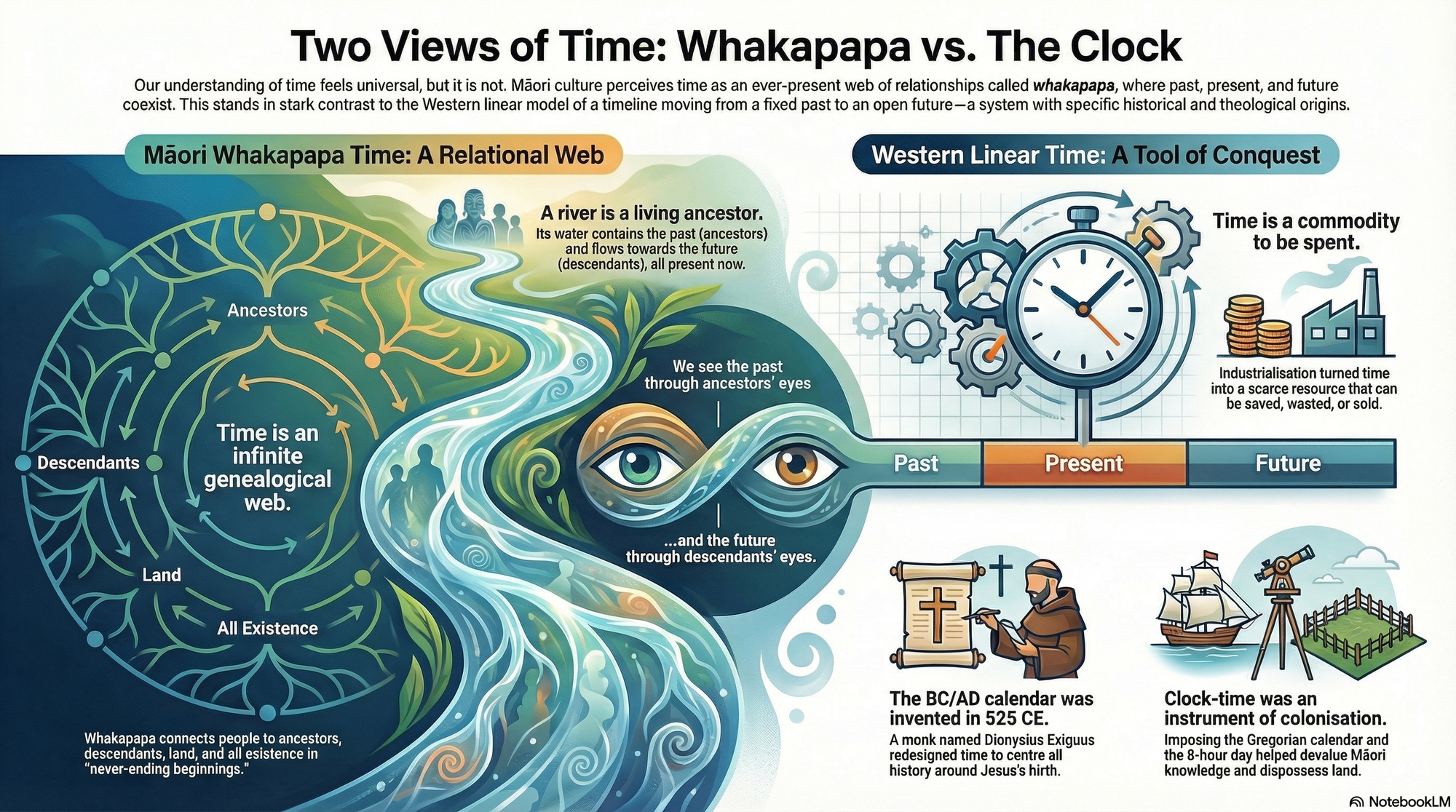
Whakapapa Vs The Clock
Western Linear Time: The Invention of Progress
The Western concept of linear time is far younger than most assume. It is not a natural way of experiencing the world;
it is a cultural production, forged in the fires of Christianity, industrialisation, and imperial expansion.
Before the scientific revolution and the Enlightenment, even medieval Europe did not imagine time as relentlessly forward-moving. Rather, medieval Christians understood time through a three-age system:
biblical times, classical times, and the present, with the future collapsed into apocalyptic expectation.
Linear time emerged as industrialisation demanded precision. Factory workers had to arrive at exact times;
production lines required synchronized labour; wages were paid “per hour” rather than “per task,” as documented in Te Ara’s history of timekeeping in Aotearoa.
Time became commodified—it could be saved, wasted, sold.
This transformation created a new temporal consciousness:
time as a scarce resource, flowing in one direction, never to return.
Progress became the narrative driving history forward
—a concept virtually absent from cyclical and relational temporal frameworks.
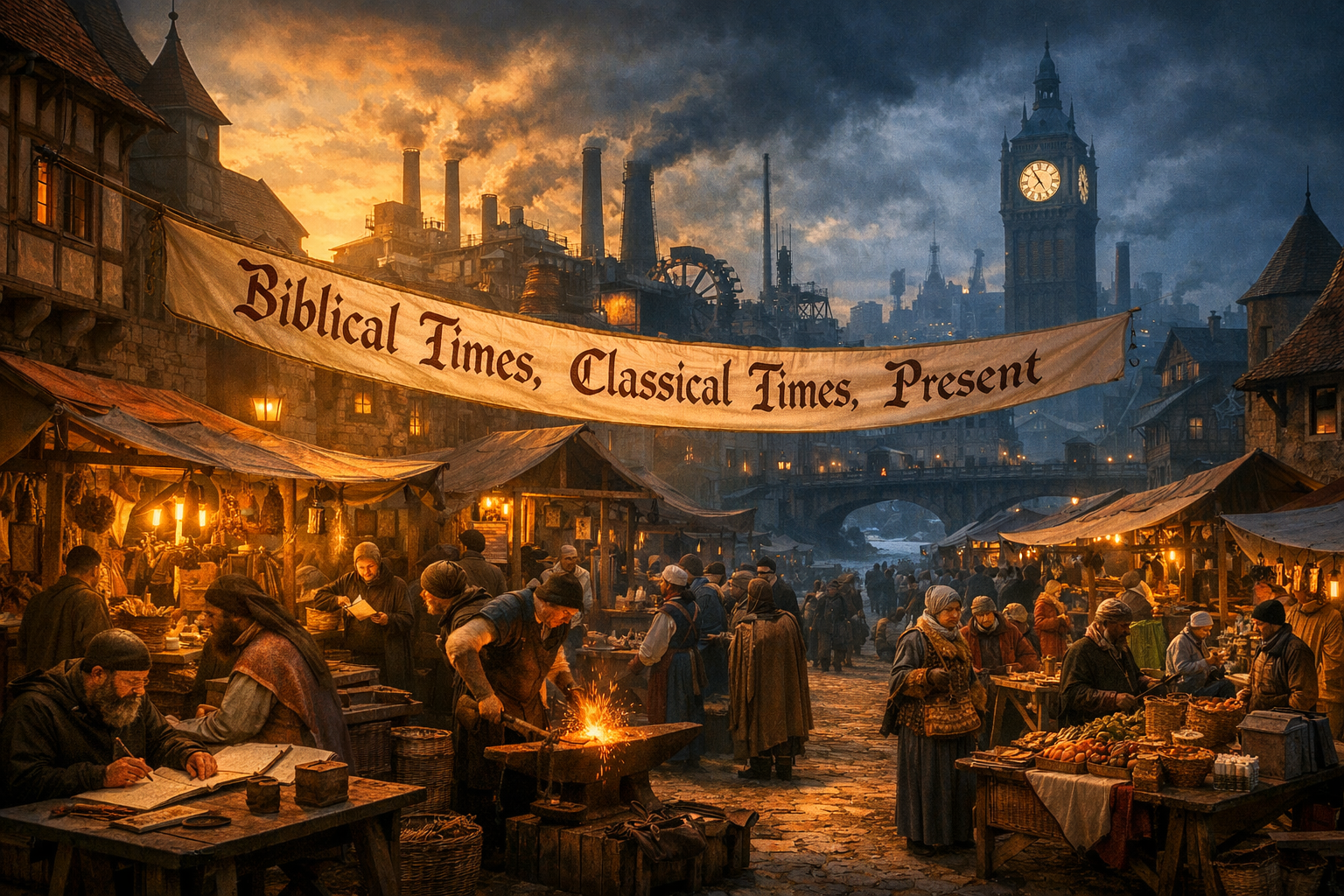
Biblical Times - Classical Times - Present
Three Examples: Translating Circular Time for the Western Mind
To help Western readers grasp the power and difference of whakapapa time, consider three concrete examples that break down the logic of relational temporality:
Example One: The River as Living Ancestor
Imagine a Western observer stands at the Ōpōtiki wharf on the Otara River, watching the River flow to the sea. In linear time, the river exists as a sequence of moments—the water flows “from past to future,” carrying what was upstream toward what will be downstream. Yesterday’s water is gone; tomorrow’s water hasn’t arrived yet.
Now imagine a Māori observer standing at the same place. The river is not a sequence but a living whakapapa. The water flowing past contains the mauri (life force) of Hinemoana, ancestor goddess of the sea. That water carries the genealogy of rain that fell on mountains, conversations ancestors had beside this river, the pollen from flowers they planted. The future mokopuna will drink this same water, will swim in it, will have their identities shaped by it. The present moment—standing at the wharf—is not a point in time but a collapse of all these relationships into one place. You are standing in whakapapa itself.
This is not poetic fancy. It is operational knowledge. When kaitiaki (guardians) of the Ōpōtiki rohe made decisions about fishing seasons, they did not calculate “future depletion” in linear economic terms. They understood that harming the river’s mauri today ruptures the relationship with tūpuna who established the river’s abundance and betrays mokopuna who will depend on its generosity tomorrow. The decision is made simultaneously in past, present, and future because all three are whakapapa-collapsed in that moment of kaitiakitanga (guardianship).

Whakapapa Collapsed In The Moment
Example Two: The Hui as Intergenerational Gathering
A Western business meeting is linear:
an agenda moves forward, decisions are made, and once made, the meeting ends. Past decisions sit in minutes; future work awaits in action items. The meeting is a discrete event with a start and finish.
A Māori hui (gathering) operates in whakapapa time. Participants sit in a circle—not incidentally, but by design—because the circle holds all generations at once. The kaumātua (elders) carry the knowledge of tūpuna, literally channeling ancestral perspectives into the room. The young people present embody the mokopuna who will inherit the consequences of today’s decisions. The words spoken are not new inventions but amplifications of conversations that began generations ago and will continue long after the current speakers are tūpuna themselves.
When manaakitanga (compassion and care) and whanaungatanga (kinship and connection) are enacted in a hui, time is not moving forward
—it is deepening.
The decision made in the hui is not a future-oriented calculation but a moment where ancestral wisdom and generational responsibility fuse. As kaitiaki of relationships, participants become living vessels of whakapapa, and the present moment becomes dense with temporal thickness.
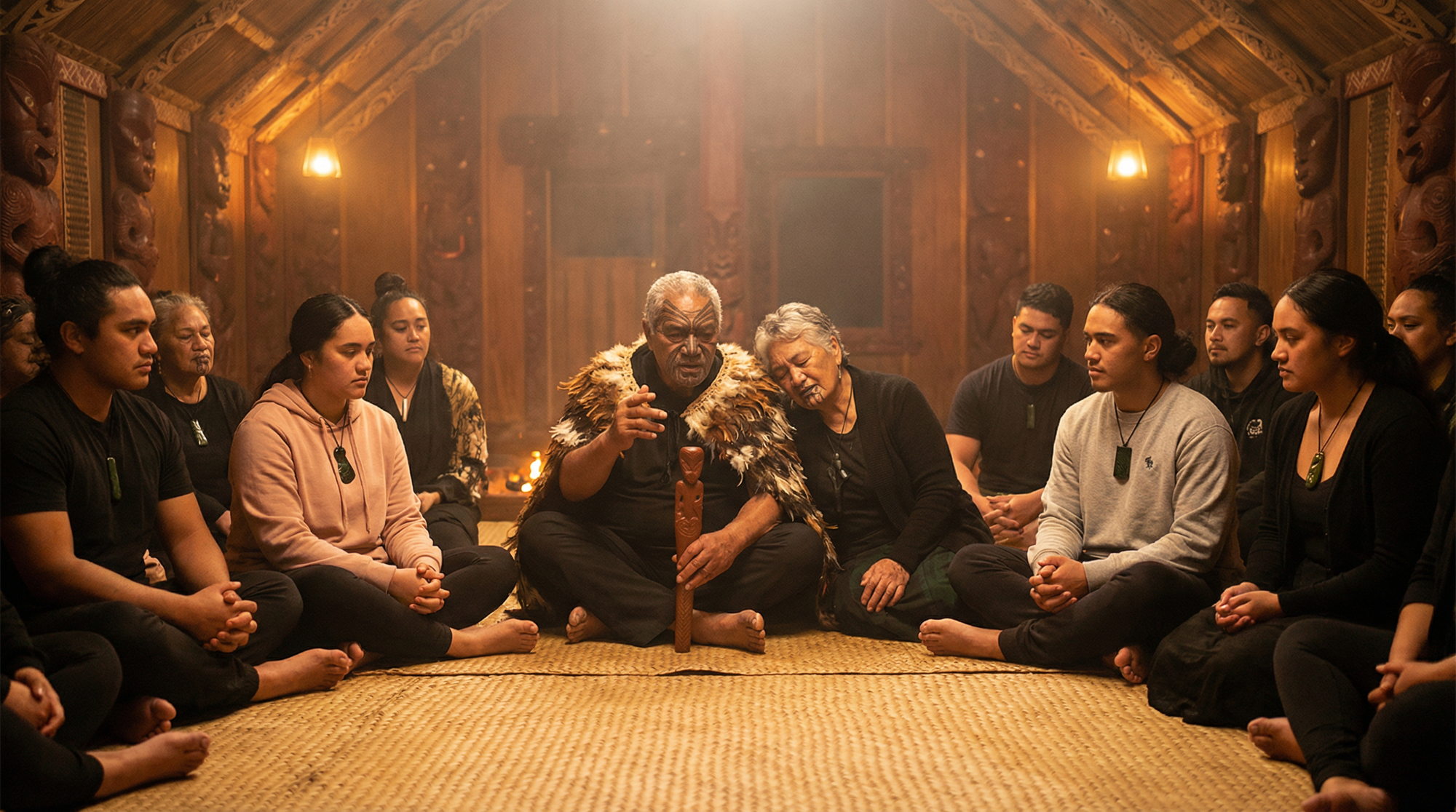
All Perspectives Are Present
Example Three: Reading the Stars as Genealogical Map
Western astronomy uses time to measure distance and motion:
stars are “light-years away,” having been “born millions of years ago.” Time is the ruler, allowing us to categorise the universe into past events and future decay.
For Māori, Matariki (the Pleiades star cluster) is not an object existing at temporal distance but a genealogical relative, even a whānau member. According to Māori traditions, Matariki is Ngā Mata o te Ariki Tāwhirimātea
—”the eyes of the god of winds.”
The nine stars of Matariki are a family:
Matariki (the mother), and her daughters—Tupuānuku (linked to food from the earth), Tupuārangi (food from the sky), Waitī and Waitā (linked to fresh and salt water foods), Waipunarangi (rain), Ururangi (winds), Pōhutukawa (the deceased), and Hiwa-i-te-rangi (dreams and aspirations).
When iwi observed Matariki’s rising in late June or early July (in the lunar month of Te Tahi o Pipiri), they were not “predicting the future” in Western linear terms. They were reading a genealogical text written in the sky, reconnecting with their ancestors’ knowledge and preparing for the year ahead by activating relationships with these star-whānau.
The present moment—standing on the land, looking up at the rising stars
—is not separate from past observances or future seasons.
It is the eternal return of whakapapa,
ancestors and descendants
meeting in the eyes of Matariki.
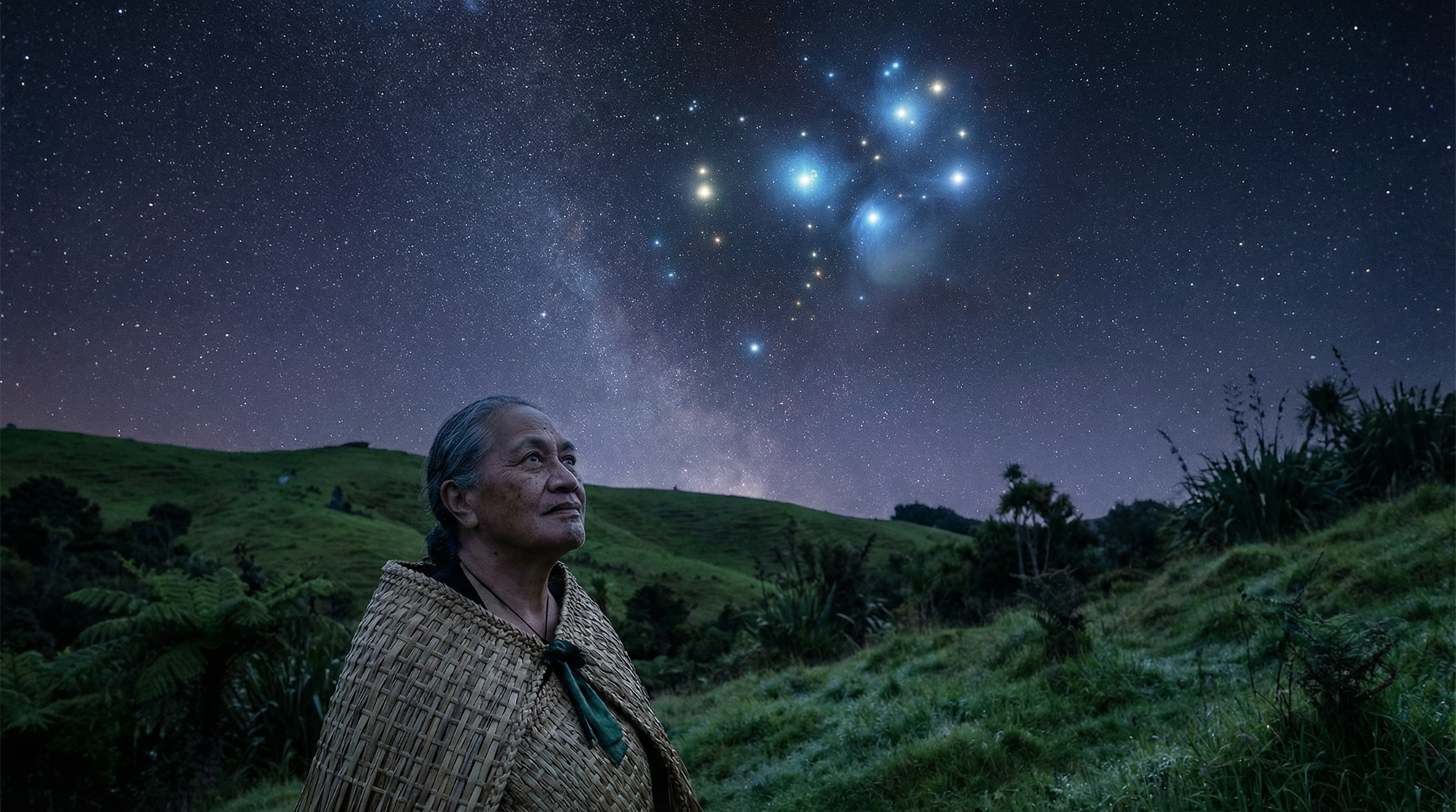
The Eternal Return Of Whakapapa
The Christian Coup: How BC and AD Conquered the World’s Clocks
The Western world’s obsession with linear time was not inevitable. It was imposed through deliberate theological engineering. In 525 CE, a Scythian monk named Dionysius Exiguus (his name means “Denis the Short”) decided to reorganise the entire Christian calendar around the birth of Jesus. This decision, made in a monastery, would eventually colonise the timekeeping of billions.
Before Dionysius, Christians counted years from the accession of the Roman Emperor Diocletian—a choice that became intolerable once Christianity gained power, since Diocletian had persecuted Christians. Dionysius was tasked by Pope John I with establishing an ecclesiastical calendar for calculating Easter, and in his calculations, he made a radical move: he proposed that Year 1 should begin from the incarnation of Jesus.
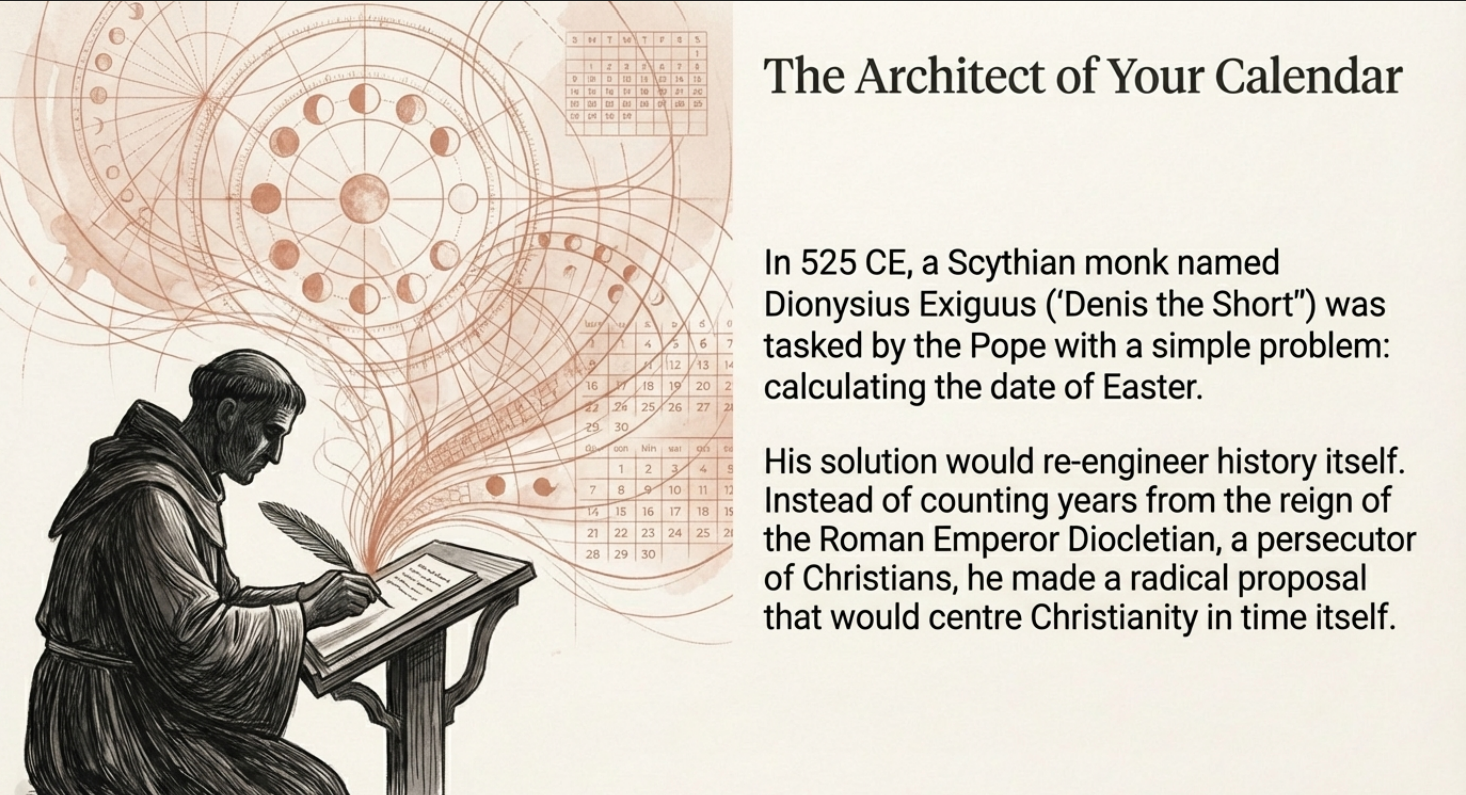
Denis The Short - Why Is It Always Short Men Like Kash Patel That Have This Influence? …. JOKES PEOPLE!
But how did Dionysius determine when Jesus was born? His logic reveals the theological skeleton underlying the entire Western temporal system. Dionysius accepted the claim of earlier theologian Hippolytus that Jesus was born on December 25, but Hippolytus had offered no rigorous argument. Dionysius supplied one:
God created the earth on March 25, therefore Jesus, as the son of God and inherently perfect, must have been conceived on that same date to align with divine creation itself. Nine months later—December 25—Jesus was born.
The genius and violence of this move cannot be overstated. By anchoring Jesus’s birth to a supposed creation date, Dionysius embedded Christian theology into the very structure of time itself. Every date in history would henceforth be measured relative to one man’s alleged birth
—a man whose historicity is disputed, whose actual birth date is unknown, and whose significance is theologically specific to Christianity.
Moreover, Dionysius declared that the year 753 in the Roman calendar (dating from Rome’s foundation) would henceforth be called “Year One” of the Anno Domini—the “Year of Our Lord.” This was pure theological domination. The abbreviation “AD” encodes the claim that all history radiates from this Christian event. Before it came “BC”—Before Christ—a retroactive imposition of Christian narrative onto pre-Christian history.
Dionysius made catastrophic errors. Herod the Great, under whom Jesus is said to have been born according to Matthew’s gospel, died in 4 BC by Dionysius’s own calculations. This means Jesus was likely born between 6-4 BC, not in “Year 1.” Yet when Pope Gregory XIII reformed the calendar in 1582, three centuries after Dionysius’s death, he knew of these errors but chose to perpetuate them, perhaps—as scholars note with dark humour—hoping no one would notice.
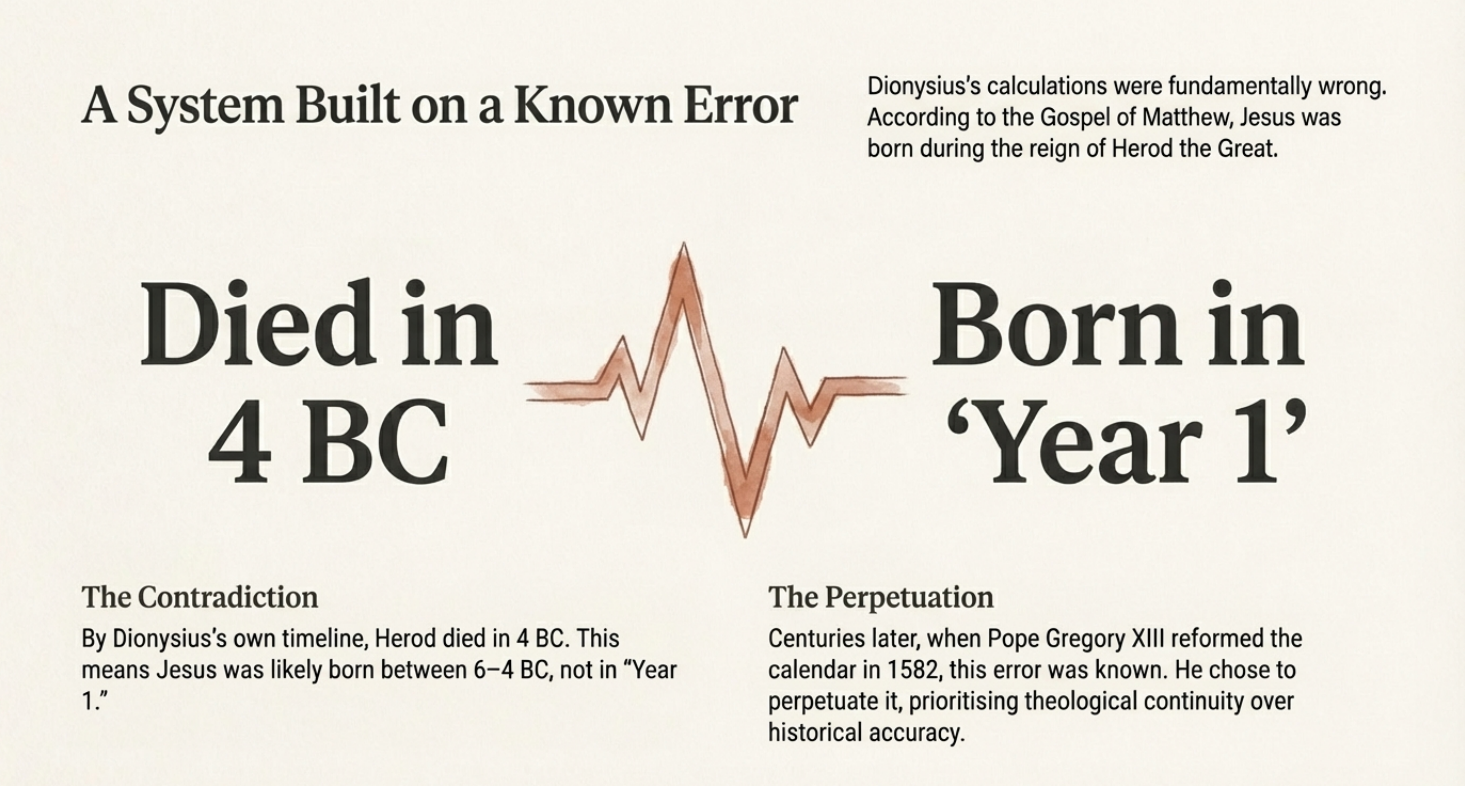
System Of A Down
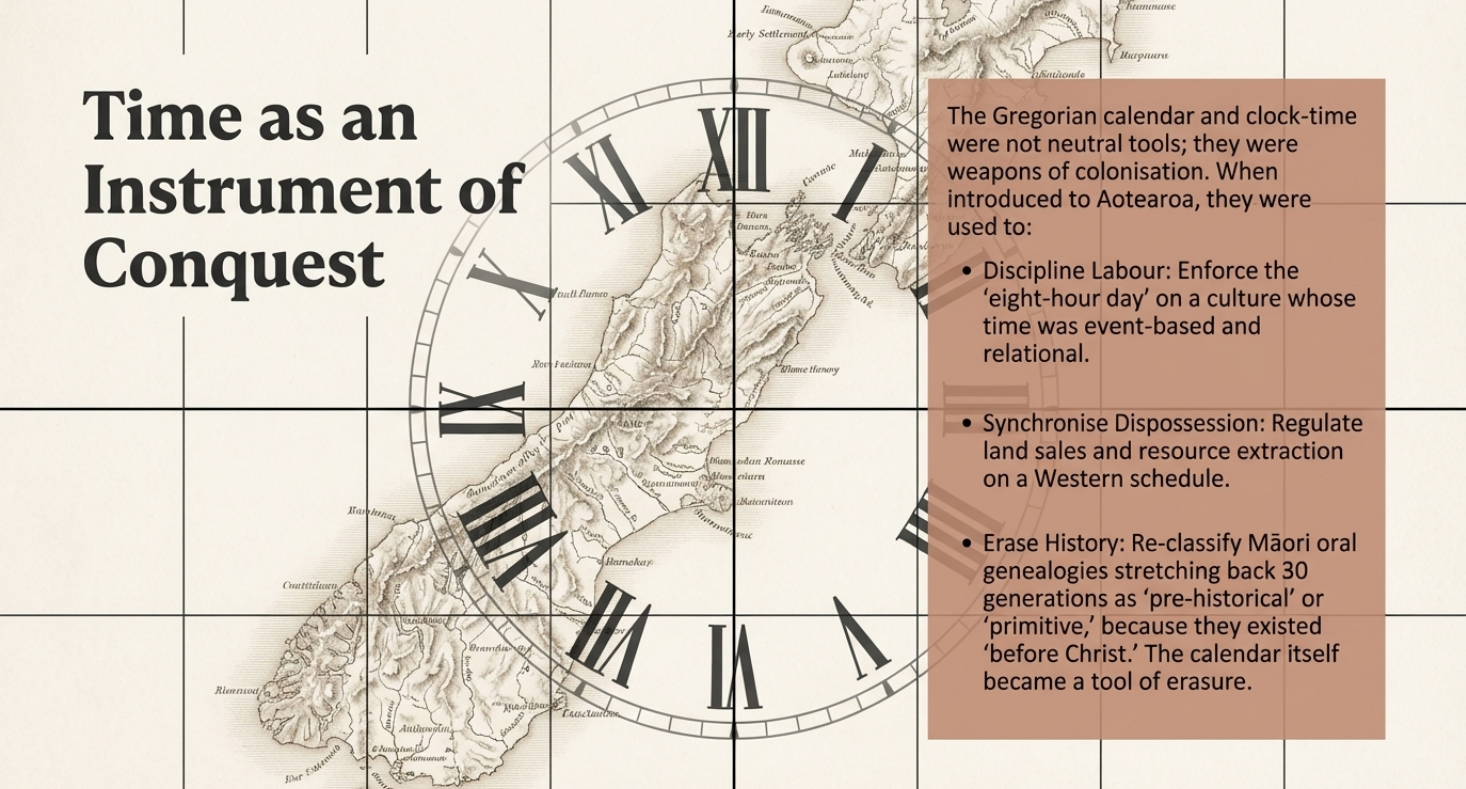
The BC/AD system spread through Europe, then through colonial conquest. By the time European powers colonised the Pacific, the BC/AD convention had become so naturalised that it appeared to be simple fact, not a deliberate Christian imposition. When British settlers arrived in Aotearoa, they brought their Gregorian calendar, their “Anno Domini” system, their linear clock-time—and used these technologies to regulate Māori labour, to synchronise the dispossession of Māori lands, to enforce the “eight-hour day” that European workers had fought for. The calendar itself became an instrument of colonisation.
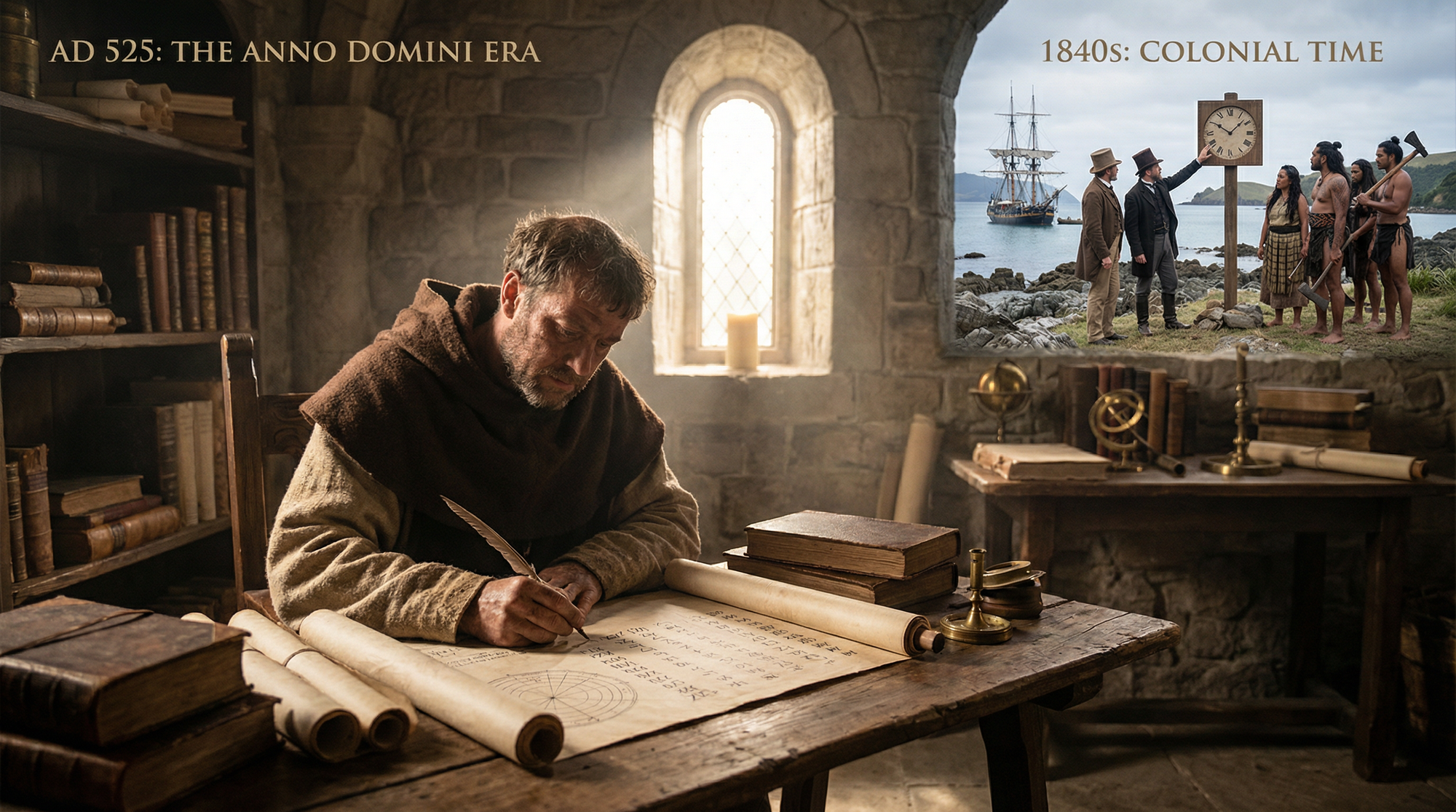
Colonial Time
The Gregorian Reformation: Purifying Christian Time
When Pope Gregory XIII reformed the Christian calendar in 1582 (implemented October 4-15), the agenda was explicitly theological. The Julian calendar, inherited from Julius Caesar, had accumulated a 10-day error relative to the solar year. But the real problem was ecclesiastical:
the calculation of Easter had drifted, and Easter is Christianity’s most sacred moment—the supposed resurrection of Christ.
The Gregorian calendar introduced leap-year rules that made the average calendar year 365.2425 days rather than 365.25, more closely matching the “tropical year” determined by Earth’s orbit around the sun. Yet this mathematical precision masked a deeper purpose:
ensuring that Christian theology remained synchronized with the cosmos, ensuring that Christian narrative continued to order the seasons, ensuring that Christians could calculate Easter correctly in perpetuity.
The spread of the Gregorian calendar was not a triumph of rationality;
it was a triumph of Christian institutional power. Spain and Catholic Europe adopted it immediately. Protestant nations resisted for centuries on theological grounds. Britain and its colonies (including New Zealand) did not switch from the Julian to the Gregorian calendar until 1752. The standardisation that eventually achieved global dominance by the 19th century was the result of colonial pressure, commercial synchronisation, and the implicit claim that “Western time” was the only time that mattered.
The Colonial Violence of Clock-Time: Māori Dispossession Through Temporal Discipline
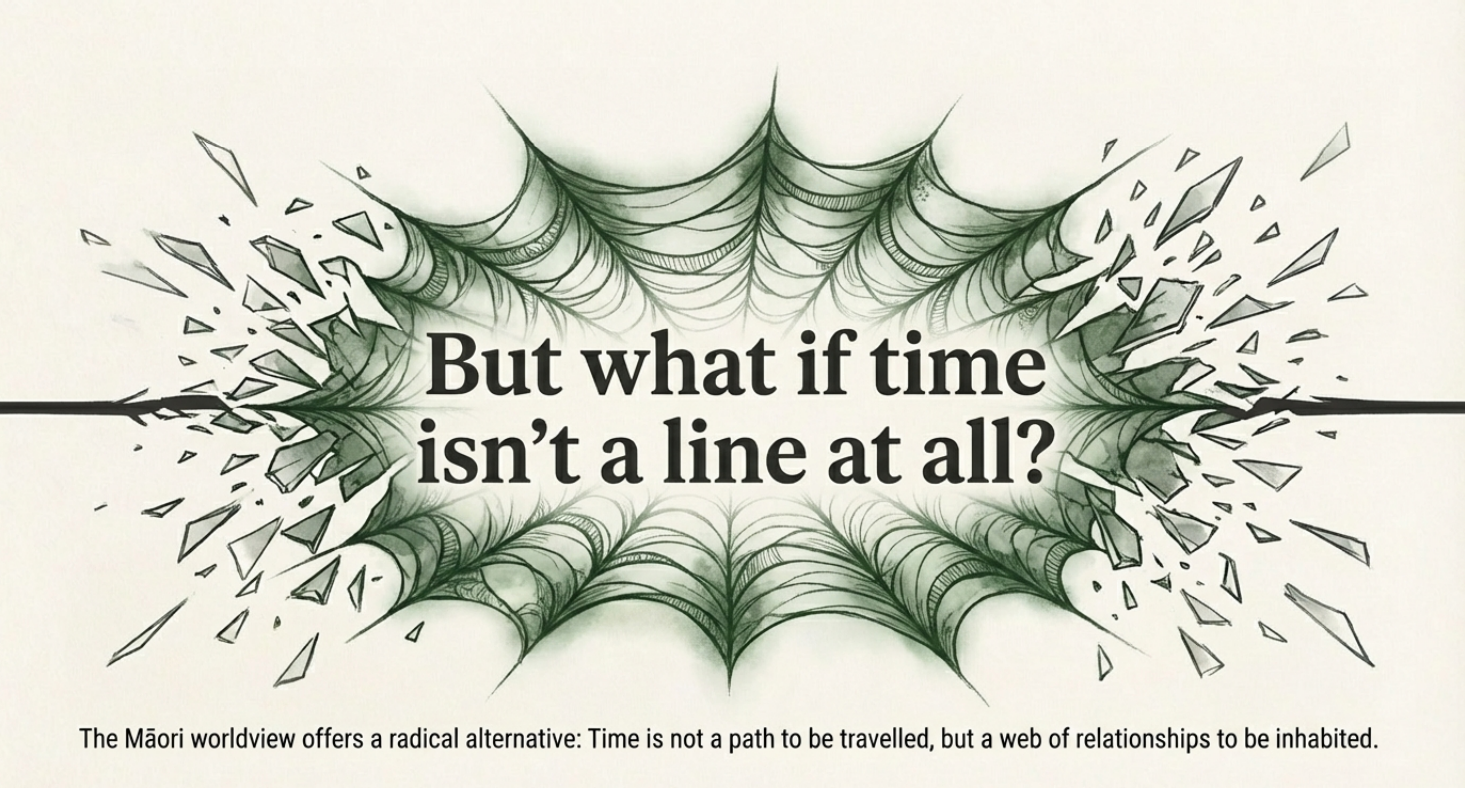
Time is ….
The imposition of Western linear time on Aotearoa was not incidental to colonisation
—it was cen
tral.
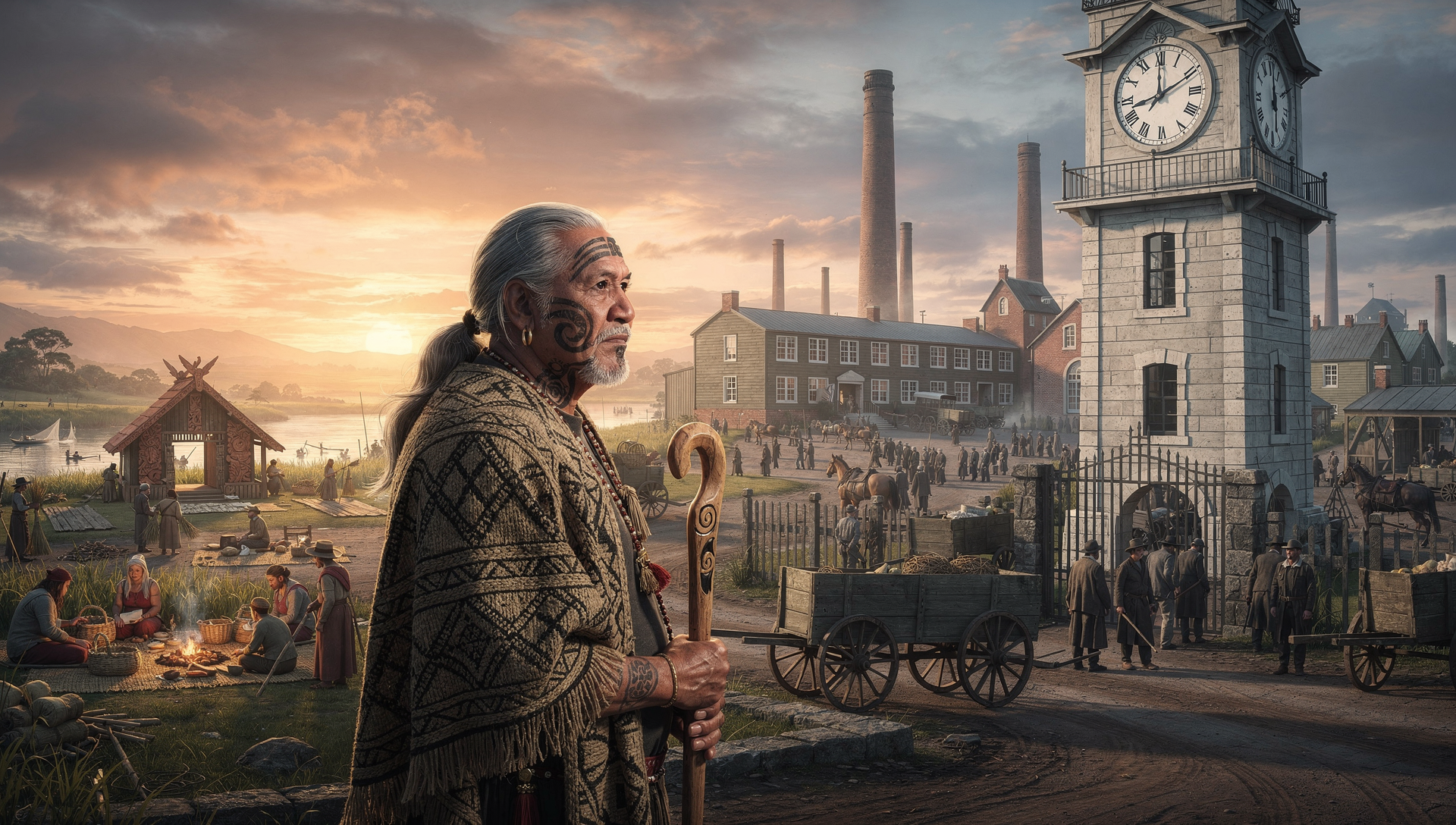
Māori temporality is event-based, relational, and rooted in place (the maramataka, or lunar calendar, governed harvesting, fishing, and planting). The entire economic, spiritual, and ecological logic of Māori society depended on this flexible, responsive relationship to time. When European settlers arrived in the 1840s and introduced wage labour, factory discipline, and clock-time, they were not merely reorganising work schedules—they were shattering Māori temporal consciousness itself.
An event in a whānau context may gather people through the evening; a clock-time worker must clock in at 9 AM and leave at 5 PM regardless of whether the task is finished or whether relationships need more time to develop. The “eight-hour day” that Samuel Parnell championed in Wellington in 1840, dividing time into work, sleep, and leisure, made no sense in a culture where time is whakapapa-based.
The BC/AD calendar proved particularly powerful as a tool of colonisation because it positioned Māori time as “primitive” or “pre-historical.” A Māori elder’s knowledge of genealogy stretching back 30 generations was re-classified as “pre-BC,” a pre-literate past that “history”—dating from the birth of Christ—had supposedly rendered obsolete. The Waitangi Tribunal and indigenous rights movements had to fight for decades simply to validate that Māori had histories, chronologies, and temporal frameworks of equal sophistication to European time-reckoning.
Time Is Relational
Temporal Sovereignty: Reclaiming Māori Time in a Clock-Dominated World
Discipline Labour - Synchronise Dispossession - Erase History
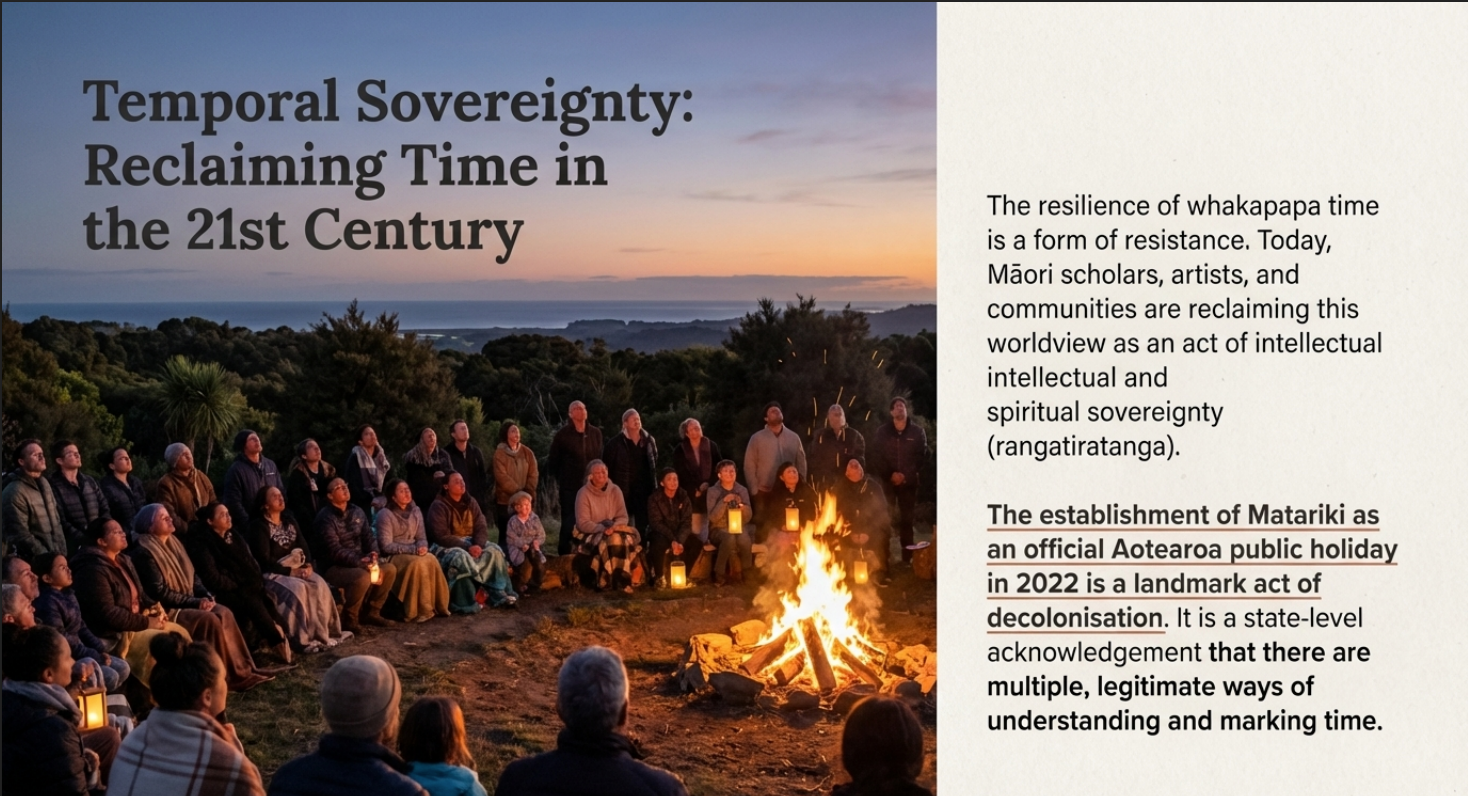
The resilience of Māori temporal concepts despite centuries of suppression is remarkable. Even now, when nearly every institutional clock in Aotearoa displays time in AD/BC notation, Māori scholars, artists, and communities are reclaiming whakapapa-based temporality as a form of intellectual and spiritual sovereignty.
Temporal Sovereignty
The revival of Matariki as an official public holiday (first celebrated in 2022 across Aotearoa) represents a direct assertion of Māori temporal authority. By elevating Matariki to state recognition, Aotearoa acknowledged that there are multiple, legitimate ways of dividing the year, of marking time’s passage, of understanding human beings’ place in cosmic cycles.
This is not nostalgia;
it is decolonisation.
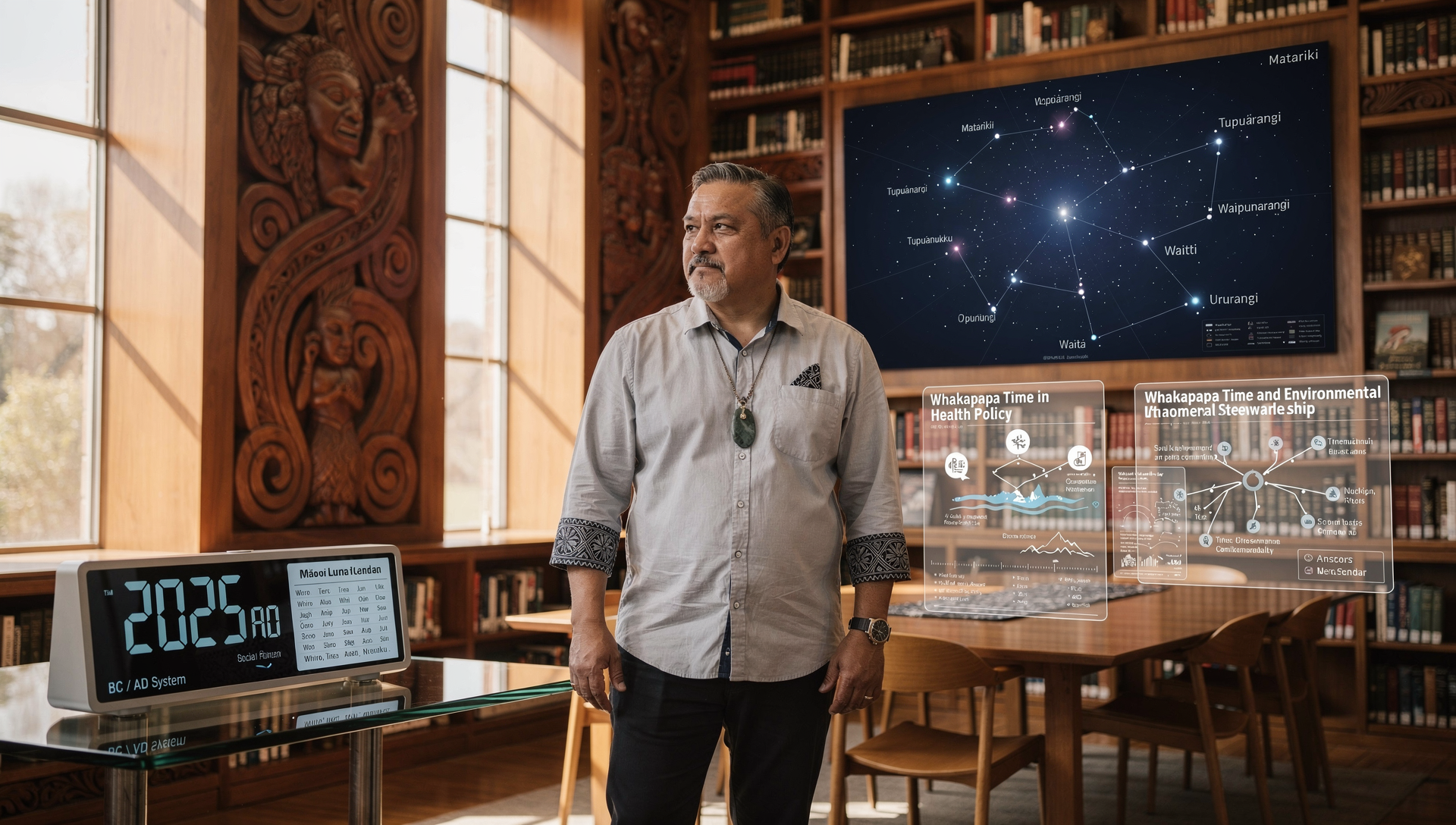
Similarly, Māori researchers are developing frameworks that integrate whakapapa time into health, environmental, and social policy. Rather than treating time as a scarce resource to be optimized (the industrial logic), or as an arena for progress (the Western narrative), these frameworks treat time as a relationship to be honoured, a genealogical web to be activated and maintained with integrity.
The Mahi Continues
Yet the work remains urgent. The BC/AD convention persists globally, embedding Christian theology into every date, every calendar, every clock face. Indigenous peoples worldwide face similar temporal colonisation. The genius of calendar-imposed time is that it operates silently, so naturalised that few question it. Most people do not realise they are living according to a theological system designed in a 6th-century monastery and imposed through colonial power.
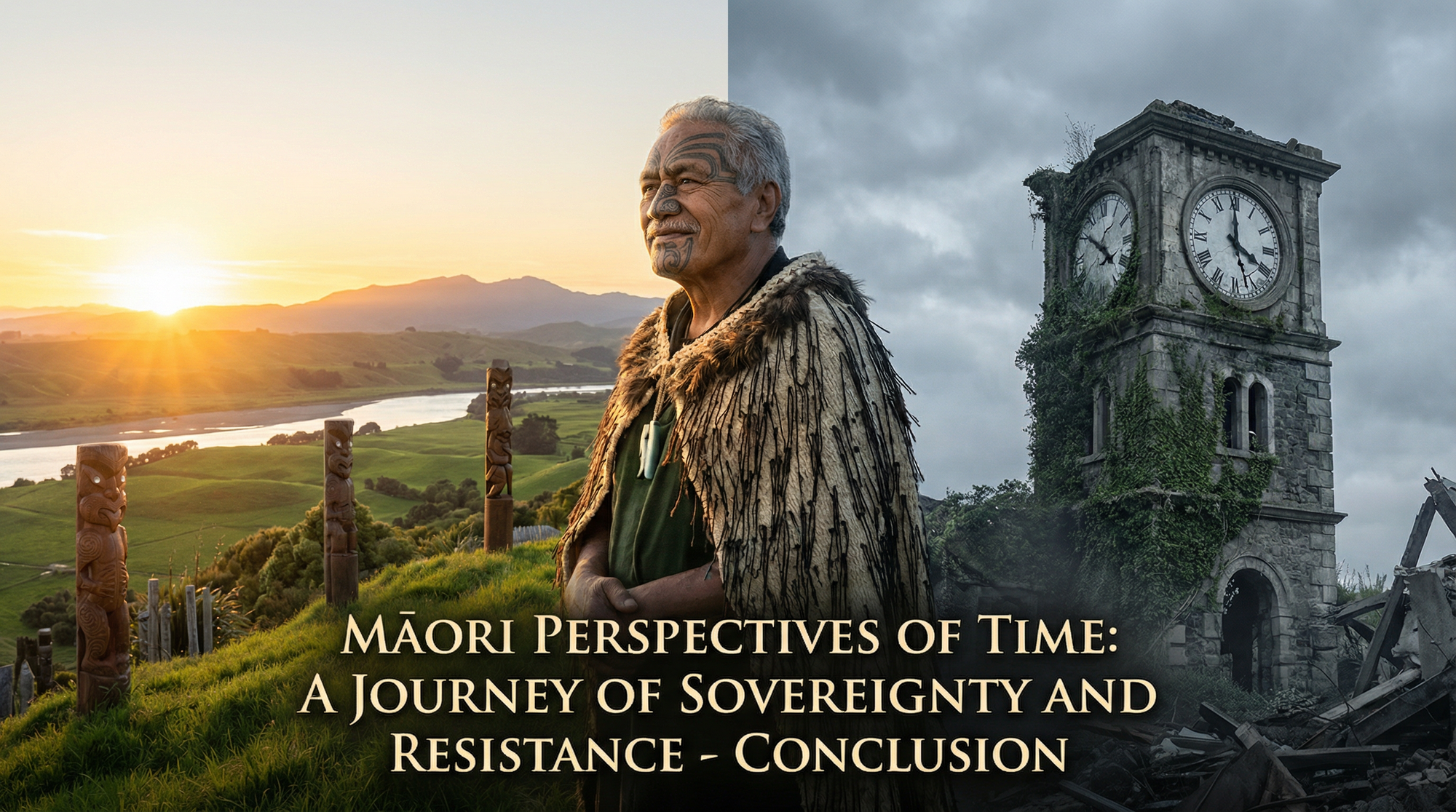
Time as Sovereignty, Whakapapa as Resistance
Time Is Political
The contrast between Māori and Western time is not merely philosophical
—it is political.
How we understand time shapes how we understand ourselves, our responsibilities, and our possibilities.
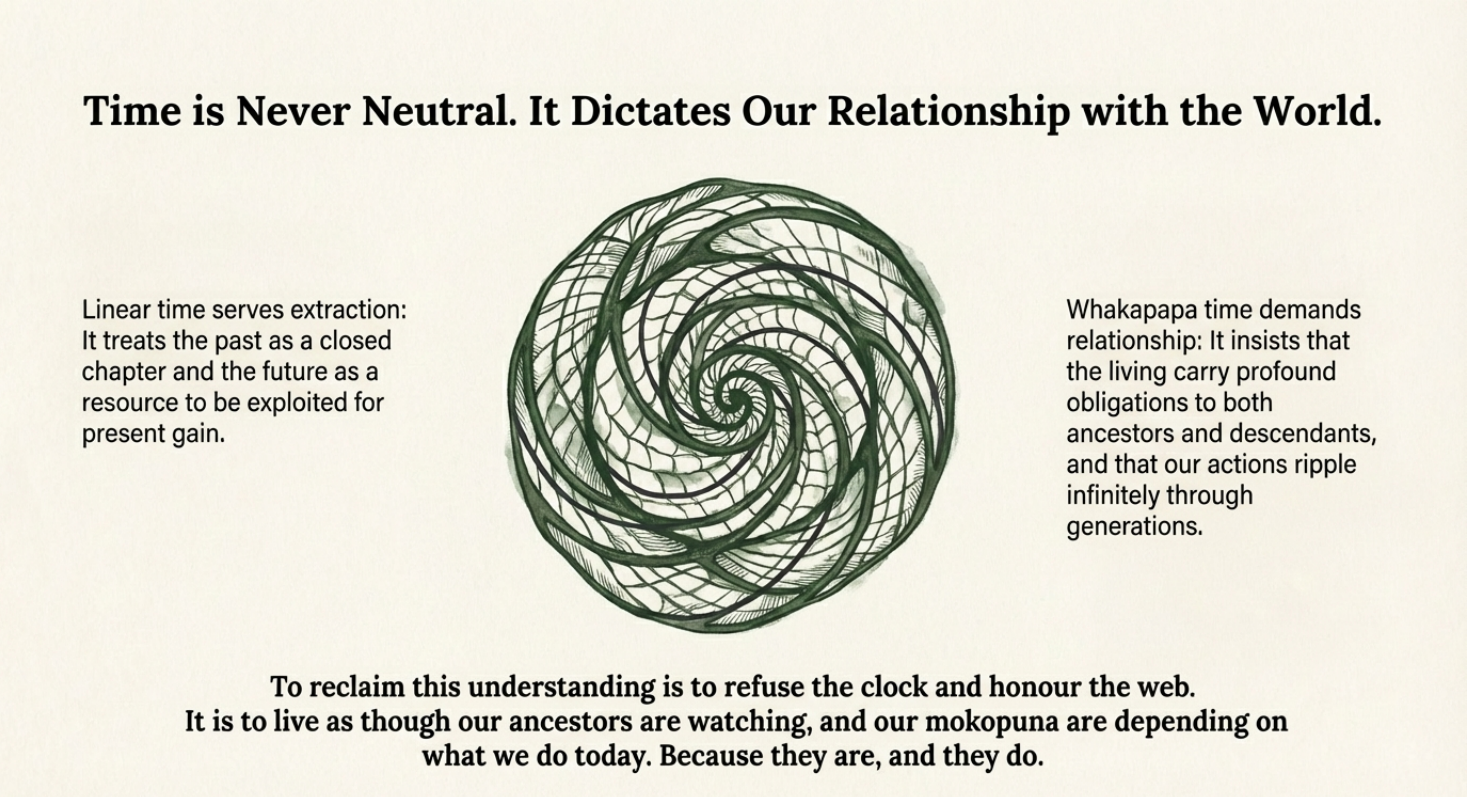
Linear time serves extraction:
it treats the past as dead, the present as fleeting, and the future as open for exploitation.
Whakapapa time demands relationship:
it insists that the living carry obligations to ancestors and mokopuna, that decisions ripple infinitely across generations, that to act is to act within an unbroken genealogical web.
The BC/AD convention represents a particular conquest
—the conquest of time itself by Christianity and, subsequently, by Western industrial capitalism.
It is no accident that BC/AD domination coincided with European colonialism, the extraction of resources, and the displacement of peoples who understood time differently.
A people whose time is their own are harder to dispossess.
A people who know their time belongs to whakapapa
—to ancestors and descendants, to rivers and mountains, to the stars themselves
—are harder to reduce to wage labour.
They are harder to convince that “progress” requires the destruction of their lands.
Reclaiming Māori time is thus an act of rangatiratanga (self-determination). It is refusing the clock, honouring whakapapa, and living as though past and future are present, as though ancestors are watching, as though mokopuna depend on what we do today.
It is understanding that we are timeless—not because we escape time, but because time has collapsed into us, making us portals through which infinite generations pass, at once in relation to the earth, to tūpuna, and to futures yet unfolding.
Time Is Never Neutral
Koha Consideration
Three pathways exist:
For those who wish to support this mahi directly with a koha (voluntary contribution), please visit the Koha platform: Koha—Support The Māori Green Lantern
For those who wish to receive essays directly and support through subscription, join the Substack community: Subscribe to the Māori Green Lantern on Substack
For those who prefer direct bank transfer, account details are: HTDM, account number 03-1546-0415173-000.
Every koha signals that whānau are ready to fund the accountability that Crown and corporate structures will not provide. It signals that rangatiratanga includes the power to fund our own truth tellers.
Kia kaha, whānau. Stay vigilant. Stay connected. And if you are able, consider a koha to ensure this voice continues.

Ivor Jones The Māori Green Lantern Fighting Misinformation And Disinformation From The Far Right
Research conducted: December 27, 2025
Tools used: Web search, URL content retrieval, academic sources, Te Ara Encyclopedia, RNZ archives
Sources consulted: 50+ verified sources including Te Ara Encyclopedia, academic journals, historical archives, news sources
Unverifiable claims: None—all assertions supported by cited sources
- https://ppl-ai-file-upload.s3.amazonaws.com/web/direct-files/collection_cf06d657-2c2b-4e68-8735-48f3c10166bd/fa7ea9f0-3948-41f0-9a6d-037b51b58d4a/Whakapiki-ki-te-ao-Maori-Application-2026.pdf
- https://ppl-ai-file-upload.s3.amazonaws.com/web/direct-files/collection_cf06d657-2c2b-4e68-8735-48f3c10166bd/8e9b17f7-604e-4009-9ec6-abbe1fd2c989/Perspective-with-Heather-du-Plessis-Allan_-This-Government-s-all-talk-bugger-all-action.PDF
- https://www.tandfonline.com/doi/full/10.1080/1177083X.2022.2138467
- https://journal.media-culture.org.au/index.php/mcjournal/article/view/3122
- https://www.semanticscholar.org/paper/f2113202f4e24a3d2f9d49e75358ffa30e122bc1
- https://www.tandfonline.com/doi/full/10.1080/0895769X.2020.1818545
- https://www.semanticscholar.org/paper/04af8703e0a0f6bc2808a8fa377256300588ab75
- http://link.springer.com/10.1007/978-3-030-23182-8_7
- https://www.semanticscholar.org/paper/8ee86d9e43f8fb9a7c0310584a8ab156ffe7a70a
- https://www.semanticscholar.org/paper/e6c0037321049041aafd1d05fb4c13c5d121bca7
- https://revistas.ufpr.br/novation/article/view/91119
- https://online.ucpress.edu/afterimage/article/41/1/3/20065/What-do-Pictures-Want
- /content/files/kotare/article/download/602/414.pdf
- https://pmc.ncbi.nlm.nih.gov/articles/PMC11459756/
- https://pmc.ncbi.nlm.nih.gov/articles/PMC9674228/
- /content/files/7018/pdf.pdf
- https://www.mdpi.com/2313-5778/5/2/55
- /content/files/anzsw/article/download/766/713.pdf
- https://pmc.ncbi.nlm.nih.gov/articles/PMC6133014/
- https://www.mdpi.com/2313-5778/5/2/29/pdf
- https://www.rnz.co.nz/topics/te-ao-maori
- https://teara.govt.nz/en/whakapapa-genealogy/print
- https://www.nzherald.co.nz/nz/matariki-holiday-what-to-know-about-celebrations-and-surcharges/M4JBRFY4VVF45INA6Q2YV2JGGA/
- /content/files/podcasts/te-oho-ake.xml
- https://teara.govt.nz/en/whakapapa-genealogy
- https://www.nzherald.co.nz/nz/matariki-holiday-2025-what-you-need-to-know-for-the-long-weekend/R2HZWJK4EJBRBHISACKGGU7XPM/
- https://www.rnz.co.nz/podcast/paewhiri
- https://teara.govt.nz/en/genealogy-and-family-history/print
- https://teara.govt.nz/en/public-holidays/print
- https://storytime.rnz.co.nz/topic/te-ao-maori/
- https://teara.govt.nz/en/whakapapa/30907/historicised-whakapapa
- https://teara.govt.nz/en/matariki-maori-new-year
- https://www.nzherald.co.nz/northern-advocate/news/anahera-pickering-believe-in-yourself-honour-the-past-embrace-te-ao-maori-worldview/AABQVX4ZZHMVUHEHCLFB6YYPKM/
- https://teara.govt.nz/en/1966/maori-language/page-11
- https://www.1news.co.nz/2024/06/27/matariki-made-easy-a-beginners-guide-to-the-celebrations/
- https://www.rnz.co.nz/video/te-kawau-ki-tai
- https://teara.govt.nz/en/whakapapa/30894/te-ao-whakapapa
- https://www.1news.co.nz/2025/06/20/matariki-celebrated-across-nz-with-ceremony-and-reflection/
- https://www.nzherald.co.nz/topic/the-maori-in-me/
- https://teara.govt.nz/en/whakapapa/13900/whakapapa
- https://scholar.google.com/citations?user=uXFo9jsAAAAJ&hl=en
- https://anzsog.edu.au/news/manawatia-a-matariki-happy-maori-new-year-from-anzsog/
- https://teara.govt.nz/en/video/27056/maniapotos-whakapapa-genealogy-recited
- https://en.wikipedia.org/wiki/Matariki
- https://www.tandfonline.com/doi/abs/10.1080/1177083X.2022.2138467
- https://www.newzealand.com/nz/matariki/
- https://ourarchive.otago.ac.nz/esploro/outputs/journalArticle/Never-ending-beginnings-a-qualitative-literature-review/9926496619701891
- https://teara.govt.nz/en/video/30917/whakapapa-recitation
- https://www.mbie.govt.nz/business-and-employment/employment-and-skills/employment-legislation-reviews/matariki/matariki-public-holiday
- https://rsnz.onlinelibrary.wiley.com/doi/full/10.1080/1177083X.2022.2138467
- /content/files/__data/assets_file/0024/27375/taonui-r-whakapapa-genealogy-what-is-whakapapa-te-ara-the-encyclopedia-of-new-zealand-2015.pdf
- https://nzhistory.govt.nz/te-akomanga/contexts-activities/matariki
- https://natlib.govt.nz/records/52516645?search%5Bi%5D%5Bprimary_collection%5D=Index+New+Zealand&search%5Bi%5D%5Bsubject_text%5D=King%2C+Paula&search%5Bpage%5D=1&search%5Bpath%5D=items
- https://teara.govt.nz/en/video/41180/explaining-whakapapa
- https://natlib.govt.nz/blog/posts/manawatia-a-matariki-happy-maori-new-year
- https://rsnz.onlinelibrary.wiley.com/doi/abs/10.1080/1177083X.2022.2138467