“When a “Fake” Ad Exposes Real Fascism” - 25 October 2025
Trump Terminates Canada Trade Over Reagan’s Anti-Tariff Truth
Kia ora koutou, e te whānau.
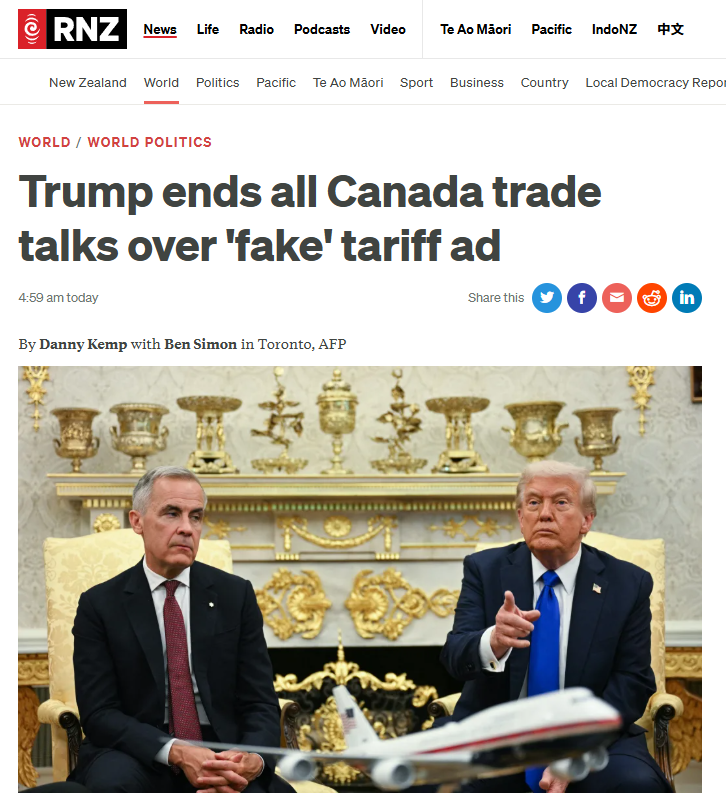
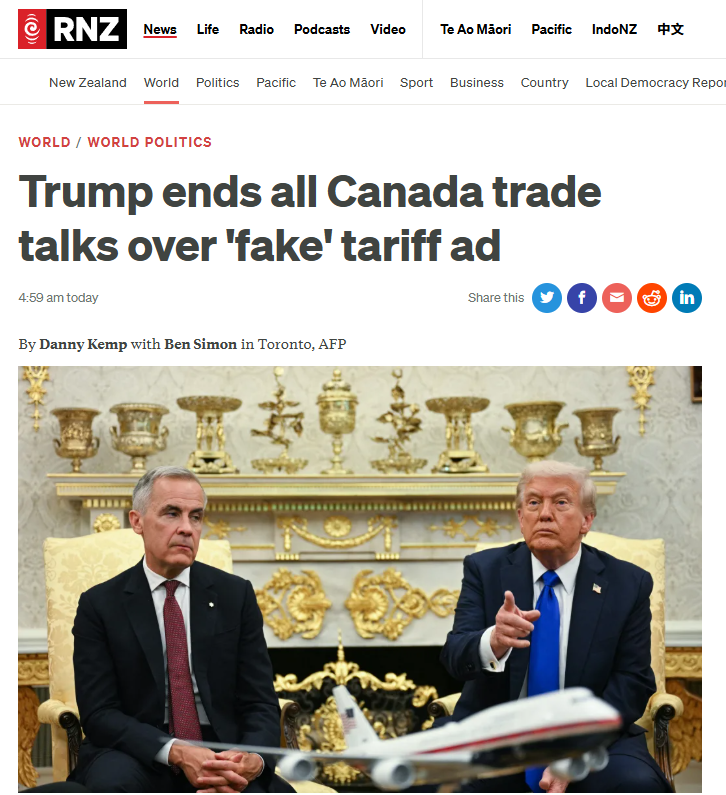
On October 23, 2025, United States President Donald Trump severed all trade negotiations with Canada—not over fentanyl, not over dairy tariffs, not over economic policy—but because Ontario Premier Doug Ford dared to broadcast Ronald Reagan’s own words warning that tariffs “hurt every American worker and consumer” (Kemp & Simon, 2025). Trump’s Truth Social meltdown, branding the advertisement “FAKE” and “EGREGIOUS,” revealed the authoritarian impulse beneath his trade war (Kemp & Simon, 2025): the Reagan Foundation claimed Ontario “fraudulently” used Reagan’s 1987 speech without permission (Associated Press, 2025). Yet the quotes were verbatim from Reagan’s April 25, 1987 “Presidential Radio Address to the Nation on Free and Fair Trade,” available through public domain (Tankersley & Goodman, 2025; Wise, 2025). This wasn’t fraud—it was truth telling that threatened Trump’s entire protectionist house of cards, now wobbling before a November 5 Supreme Court hearing that could invalidate his illegal tariff regime (Raymond et al., 2025; Bravin, 2025). Who profits when a U.S. president prioritizes ego over a $1.3 trillion annual trade relationship? Who benefits when neoliberal ideology cloaks itself in nationalist rage? And what does this spectacle reveal about the racist, colonial foundations of “America First” economics?
Whakapapa of Neoliberal Violence: From Rogernomics to Trump’s Tariff Terror
The 2025 tariff tantrum didn’t emerge from a vacuum—it’s the latest mutation of neoliberal capitalism’s forty-year assault on working peoples, including tangata whenua. In Aotearoa, 1984 marked the beginning of Roger Douglas’s economic terrorism: the corporatization and privatization of government departments, withdrawal of subsidies, dismantling of the centralized welfare system (Smale, 2007). Ngarimu Blair, working with whānau in Tairāwhiti, witnessed the devastation: “You had the Gisborne freezing works, you had the Wattie’s company here. That provided income for a lot of whānau...When the jobs disappeared, the issues began” (Smale, 2007). Māori home ownership, which had climbed above 50% by 1991, plummeted to 37% by 2013—and remains stagnant at 37% in 2025 even as the Māori asset base reaches $80 billion NZD (Smale, 2007; Waatea News, 2025). This disparity exposes neoliberalism’s core function: concentrating wealth upward while immiserating Indigenous and working-class communities through “personal responsibility” rhetoric that disguises structural violence (Jamieson et al., 2020).
Trump’s tariff regime weaponizes this same playbook globally. His administration collected $162.2 billion in customs duties through July 2025 alone, quadrupling pre-2025 levels, on track to extract $300+ billion annually from American consumers and businesses (Lawder, 2025; Yale Budget Lab, 2025). Treasury Secretary Scott Bessent celebrated on X: “As President Trump works hard to take back our nation’s economic sovereignty, today’s Monthly Treasury Statement is demonstrating record customs duties” (Lawder, 2025). Yet economic modeling reveals the con: (Yale Budget Lab, 2025) projects Trump’s tariffs will reduce U.S. GDP by 0.4% long-term (costing $125 billion annually in 2024 dollars), eliminate 490,000 jobs by end-2025, raise unemployment by 0.7 percentage points by end-2026, and burden households with $1,900 annually even after consumption adjustments—regressively impacting low-income families three times harder than wealthy households. (Penn Wharton Budget Model, 2025) forecasts even more catastrophic damage: 6% GDP contraction long-term, 5% wage decline, and middle-income households facing $22,000 lifetime losses—twice the harm of raising corporate taxes from 21% to 36%.
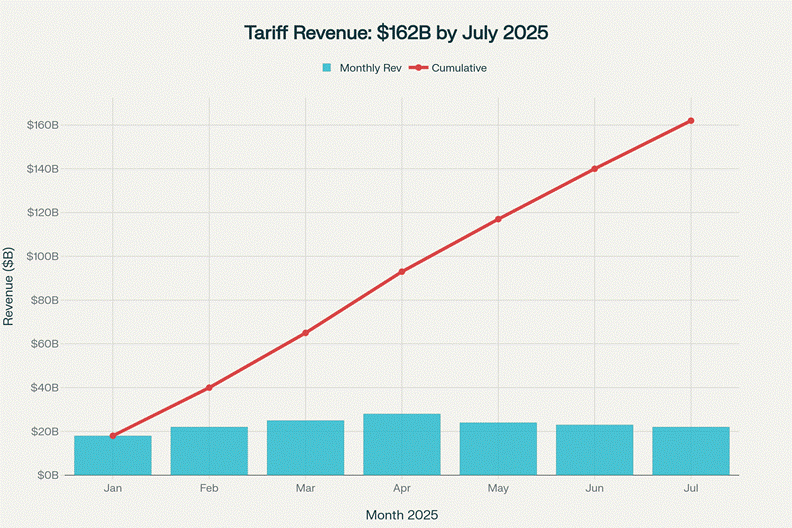
US customs revenue from Trump tariffs surged to $162 billion through July 2025, on track to exceed $300 billion annually - the highest tariff collection since the Great Depression era.
This wealth extraction mechanism violates every principle of manaakitanga and whanaungatanga. While Trump claims tariffs defend “national security” (Kemp & Simon, 2025; Lawder, 2025), the reality is naked class warfare: customs revenue flows to federal coffers while working families absorb price increases on everyday goods, and retaliatory tariffs from trading partners devastate export-dependent industries (Yale Budget Lab, 2025; Giesecke & Waschik, 2025). Canadian Prime Minister Mark Carney warned that U.S. tariffs have risen “to levels last seen during the Great Depression” (Kemp & Simon, 2025), triggering market crashes—the S&P 500 plunged 4.84% and Nasdaq dropped 5.97% on April 4, 2025, the steepest single-day decline since 2020 (Giesecke & Waschik, 2025). When economies shrink and unemployment rises, who suffers most? Not billionaire cabinet members. Indigenous peoples, communities of color, immigrants, workers without savings.
The “Fake” Ad That Told the Truth: Reagan’s Free-Trade Ghost Haunts MAGA
Ontario’s $75 million CAD advertising campaign, launched October 14, 2025, deployed Reagan’s own 1987 speech to Republican-held U.S. districts (Ford, 2025; Miller, 2025). The one-minute spot features Reagan’s unambiguous warnings: “High tariffs inevitably lead to retaliation by foreign countries and the triggering of fierce trade wars. Then comes the worst: The higher prices, goods no longer available, markets collapse, businesses shut down, and millions of people lose jobs” (Tankersley & Goodman, 2025; Wise, 2025). These words appear in the official transcript on the Ronald Reagan Presidential Library website—they’re public domain, requiring no permission (Kemp & Simon, 2025; Tankersley & Goodman, 2025; Wise, 2025). Yet the Reagan Foundation, now helmed by leadership easily intimidated by White House pressure, claimed Ontario “misrepresented” Reagan and threatened legal action (Associated Press, 2025; Miller, 2025). Former Conservative cabinet minister Jason Kenney demolished this revisionism: “The Ontario ad does not misrepresent President Reagan’s anti-tariff radio address in any respect whatsoever. It is a direct replay of his radio address” (Ford, 2025; Miller, 2025; Wise, 2025).
The Foundation’s betrayal of Reagan’s actual legacy exposes how right-wing institutions manufacture historical narratives to serve current power. (Griswold, 2022) documents that Reagan championed free trade throughout his presidency, declaring in 1986: “Our trade policy rests firmly on the foundation of free and open markets...The freer the flow of world trade, the stronger the tides of human progress and peace among nations.” His administration launched the Uruguay Round creating the WTO, negotiated the U.S.-Canada Free Trade Agreement (expanding into NAFTA), and vetoed protectionist textile bills (Griswold, 2022). Even Reagan’s “protectionist” exceptions—voluntary quotas on Japanese cars, Section 201 tariffs on motorcycles—were tactical retreats to defuse Congressional pressure, not ideological commitments (Griswold, 2022). Trump, by contrast, erected a tariff wall unprecedented since the 1930 Smoot-Hawley Act, using national emergency declarations courts have ruled illegal (Raymond et al., 2025; Bravin, 2025).
Why did Reagan’s ghost terrify Trump? Because it exposed the incoherence of “conservative” economics that claims to worship Reagan while repudiating his core trade philosophy. Trump’s October 24 tirade—”Canada has fraudulently used an advertisement, which is FAKE...They only did this to interfere with the decision of the US Supreme Court” (Kemp & Simon, 2025; Ford, 2025; Miller, 2025)—reveals authoritarian contempt for truth. The Supreme Court will hear oral arguments November 5, 2025 on whether Trump’s invocation of the International Emergency Economic Powers Act (IEEPA) to impose sweeping tariffs exceeded presidential authority (Raymond et al., 2025; Bravin, 2025; Liptak, 2025). Two lower courts—the U.S. Court of International Trade and the U.S. Court of Appeals for the Federal Circuit (7-4 decision)—already ruled Trump’s trafficking and reciprocal tariffs illegal, finding IEEPA doesn’t grant “unbounded authority” to circumvent Congress’s constitutional power over taxation (Raymond et al., 2025; U.S. Court of Appeals for the Federal Circuit, 2025; Atlantic Council, 2025). Trump’s termination of Canada trade talks was thus an attempt to intimidate the Court and suppress speech that undermines his legal position. Classic fascist move: attack truth-tellers, then claim victimization.
The Network Exposed: Atlas, ACT, and the Ideology Pipeline
Trump’s tariff authoritarianism connects to a global network of neoliberal think tanks orchestrating policy across nations. (Public Services Association, 2024) explains the Atlas Network, founded 1981, links 550 think tanks in 100+ countries promoting “individual liberty, property rights, limited government, and free markets” (SourceWatch, 2015; Wikipedia, 2005). In Aotearoa, the New Zealand Taxpayers’ Union and New Zealand Initiative are both official Atlas partners (Espiner, 2024; Public Services Association, 2024). Atlas co-president Alejandro Chafuén wrote in 1998 that think tanks are “the most effective, yet subtle, vehicles for influencing the development of public policy” (Public Services Association, 2024), winning “the respect of journalists and government officials” to “shift the climate of opinion in favour of market approaches.”
This network’s influence is documented: Atlas partners helped create Liz Truss’s disastrous UK economic policies, elected Javier Milei in Argentina, spread climate denialism, influenced Brexit, and undermined Indigenous rights referendums in Australia and Chile (Public Services Association, 2024; Multinationales.org, 2024; Wikipedia, 2005). George Monbiot asked in The Guardian: “What links Rishi Sunak, Javier Milei and Donald Trump? Answer: the Atlas Network” (Public Services Association, 2024; Multinationales.org, 2024). The ideology Atlas promotes—public service cuts, climate denial, corporate deregulation, eroding workers’ rights, privatization, landlord favoritism over tenants—consistently benefits wealthy elites while devastating vulnerable communities (Public Services Association, 2024; Multinationales.org, 2024).
Atlas’s strategy includes “astroturfing” (creating fake grassroots movements) and offering falsely neutral expertise (Multinationales.org, 2024). The network received tobacco industry funding in the 1990s-2010s to oppose tobacco controls, particularly in Latin America (Wikipedia, 2005). More than one-fifth of Atlas partners worldwide either opposed tobacco controls or took tobacco donations (Wikipedia, 2005). Atlas has also been linked to oil and gas producers and efforts opposing climate action, though it denies current extractive industry funding (Wikipedia, 2005). In Canada, Atlas collaborated with organizations pushing Indigenous communities to support natural resource extraction—classic neoliberal cooptation disguised as “economic opportunity” (Wikipedia, 2005).
Critically, (Espiner, 2024) documents Taxpayers’ Union chair Jordan Williams confirming Atlas membership, stating the organization connects “freedom-oriented idea entrepreneurs” and noting Atlas hosted their 15th anniversary in Stockholm in 1993. Williams described the TPU’s mission as countering “hundreds of groups of special interests...generally on the centre left” by arguing for “Mom-and-Pop taxpayers”—a rhetorical framing that erases how tax policy disproportionately burdens working-class and Māori communities while shielding capital gains and corporate profits.
The ideological through-line is unmistakable: whether Reagan’s neoliberalism in the 1980s (despite his free-trade rhetoric), Roger Douglas’s Rogernomics assault on Māori communities, or Trump’s tariff nationalism, the result is wealth concentration upward and harm downward. The Atlas Network provides the intellectual infrastructure, funding pathways, and policy templates that make this extractive model reproducible globally (Public Services Association, 2024; SourceWatch, 2015; Multinationales.org, 2024).
Deconstruction: The Rhetorical Rot and Logical Fallacies
Trump’s October 23-24 statements exemplify authoritarian rhetoric’s tactical incoherence:
False Equivalence / Historical Revisionism: “Ronald Reagan LOVED TARIFFS FOR OUR COUNTRY, AND ITS NATIONAL SECURITY” (Kemp & Simon, 2025; Ford, 2025). Reagan’s actual 1987 speech: “I must oppose certain protectionist moves that some in Congress are attempting to take...Imposing high tariffs on goods from any country, whether or not we have a trade dispute with that country, wouldn’t work and would only make things worse” (Tankersley & Goodman, 2025; Wise, 2025). Trump’s claim directly contradicts documentary evidence—a bald-faced lie.
Ad Hominem / Poisoning the Well: Branding Ontario’s ad “FAKE” and “FRAUDULENT” (Kemp & Simon, 2025; Miller, 2025) attacks the messenger rather than addressing Reagan’s substantive argument against tariffs. The quotes are verbatim public-domain material (Tankersley & Goodman, 2025; Wise, 2025; Zimonjic, 2025).
Straw Man: “They only did this to interfere with the decision of the US Supreme Court” (Kemp & Simon, 2025; Ford, 2025). Ontario’s stated goal was reaching U.S. audiences to show tariffs harm workers and businesses (Ford, 2025; Associated Press, 2025). Trump fabricates nefarious intent to justify his retaliatory tantrum.
Appeal to Fear / National Security Theater: “TARIFFS ARE VERY IMPORTANT TO THE NATIONAL SECURITY, AND ECONOMY, OF THE USA” (Kemp & Simon, 2025; Ford, 2025). Courts rejected this framing, noting Trump invoked “national emergencies” over trade deficits—economic metrics, not genuine security threats (Raymond et al., 2025; Bravin, 2025). Dartmouth professor Paul Novosad called it “simply embarrassing” (Wise, 2025).
Tu Quoque (Whataboutism): “Canada has long cheated on Tariffs, charging our farmers as much as 400%” (Kemp & Simon, 2025). The “400%” figure is fabricated; (U.S. Census Bureau, 2025) documents official 2024 data showing a $73.66 billion goods deficit, not the $200 billion Trump claims.
Economic Illiteracy Masquerading as Populism: Trump claims tariffs enrich America, yet economists across the political spectrum confirm consumers and importing businesses pay tariffs, not foreign governments (Yale Budget Lab, 2025; Penn Wharton Budget Model, 2025; Lawder, 2025). (Yale Budget Lab, 2025) estimates tariffs are regressive taxes hitting low-income households hardest, with first-decile households losing 3.6% of income versus 1.1% for top-decile households.
Borrowed Rhetoric Origins: Trump’s protectionist turn didn’t originate with him—it emerged from decades of right-wing think tanks and neoliberal policy shifts beginning with Nixon and Carter, then intensifying under Reagan’s rhetorical cover (Gibbs, 2024). Trump’s tariff nationalism represents the logical endpoint when nationalist rhetoric meets neoliberal wealth concentration—a fusion of white grievance politics and economic extraction.
Hidden Connections: The Money Trail and Power Networks
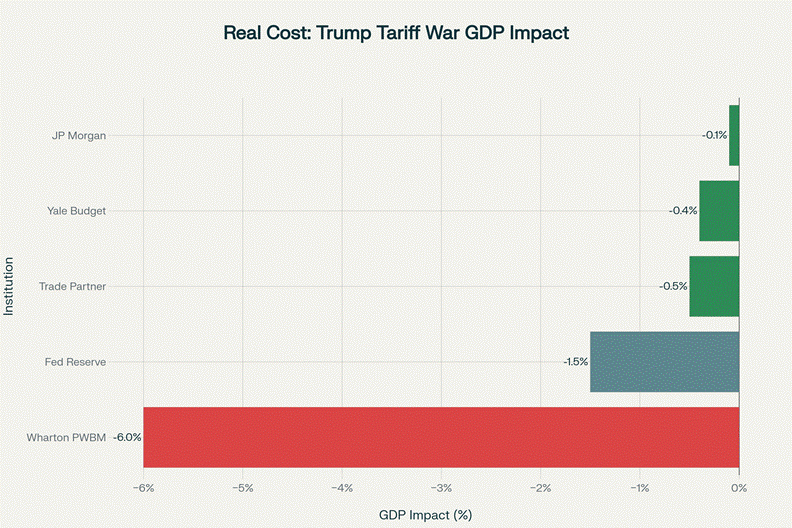
Economic projections show Trump’s tariffs could reduce US GDP by 0.4-6%, eliminate up to 2.8 million jobs, and cost households $1,900-$22,000 annually according to leading research institutions.
Reagan Foundation ↔ Trump White House: The Foundation’s October 23 statement condemning Ontario’s ad came suspiciously close to Trump’s posts (Miller, 2025; Associated Press, 2025). Former officials called this “gormless leadership which is easily intimidated by a call from the White House” (Ford, 2025). The Foundation’s willingness to gaslight Reagan’s legacy reveals how institutions serve current power over historical accuracy.
Trump ↔ Supreme Court: Trump appointed three current justices (Gorsuch, Kavanaugh, Barrett), creating a 6-3 conservative majority. His public statements—”I expect [tariffs] to benefit the country with the help of the Supreme Court” (Raymond et al., 2025)—and attacks on the Court of International Trade as “highly partisan” and “activist judges” (Raymond et al., 2025) constitute improper pressure on judicial proceedings. The November 5 hearing will test whether the Court upholds executive overreach or constitutional limits (Raymond et al., 2025; Bravin, 2025; Liptak, 2025; Atlantic Council, 2025).
U.S. Tariff Revenue ↔ Federal Budget: Tariffs generated $100+ billion in fiscal year 2025 for the first time (Lawder, 2025), producing a surprise $27 billion June budget surplus versus $71 billion deficit June 2024. This revenue props up Trump’s tax cut agenda—he’s already floated eliminating income taxes and funding government via tariffs (Lawder, 2025; Yale Budget Lab, 2025), a regressive shift from progressive taxation to consumption taxes hitting working families hardest.
Canada ↔ U.S. Trade Dependency: 75%+ of Canadian exports go to the U.S., with $3.6 billion CAD in goods/services crossing daily (Ford, 2025). USMCA ensures 85% of bilateral trade remains tariff-free (Kemp & Simon, 2025; U.S. Census Bureau, 2025), but Trump’s sectoral tariffs devastate specific industries. Ontario—Canada’s most populous province, home to Toronto’s financial center and Ottawa’s capital—faces disproportionate harm from auto tariffs given its manufacturing concentration. Ford’s $75 million ad buy was thus economic self-defense, not election interference.
Atlas Network ↔ Global Right-Wing Movements: Atlas funding flows trace to Koch brothers, Templeton Foundation, ExxonMobil, and other corporate giants (Public Services Association, 2024; SourceWatch, 2015; Multinationales.org, 2024). (Multinationales.org, 2024) reports Atlas partner European Centre for International Political Economy (ECIPE) received money from Korea, Taiwan, Australia, and New Zealand foreign ministries to speed trade treaty ratification. Atlas partner Timbro (Sweden) succeeded in pushing deregulation onto Social Democrat agendas. This reveals “free trade” advocacy as often serving corporate interests, not working peoples.
Trump Tariffs ↔ Legal Challenges: The Court of International Trade ruled Trump exceeded IEEPA authority; the Federal Circuit affirmed 7-4; now the Supreme Court decides (Raymond et al., 2025; Bravin, 2025; U.S. Court of Appeals for the Federal Circuit, 2025; Atlantic Council, 2025). If Trump loses, his administration has “Plan B” authorities like Section 122 of the Trade Act (allowing 15% surcharges for 150 days)—less powerful, requiring more justification, but still available (Bravin, 2025; Liptak, 2025). This reveals the game: find any legal hook to justify predetermined policy, regardless of constitutional limits.
Neoliberalism ↔ Indigenous Dispossession: (Jamieson et al., 2020) documents how neoliberal policies disproportionately harm Indigenous populations through wealth inequality, corporate dominance, health privatization, “personal responsibility” ideology, and systemic racism. (Nocera et al., 2022) describes how in Guatemala, CAFTA (modeled on NAFTA) flooded markets with subsidized U.S. corn, bankrupting 1.3 million farmers and enabling megaprojects like the El Escobal silver mine that decimated Indigenous lands and livelihoods. In Aotearoa, neoliberal reforms post-1984 drove Māori home ownership from 50%+ to 37% while unemployment and poverty rates surged (Smale, 2007). Trump’s tariffs don’t reverse neoliberalism—they intensify its nationalist, racist dimensions while maintaining upward wealth redistribution.
Tikanga Violations: How Neoliberal Trade Wars Assault Māori Values
Whanaungatanga (Kinship, Relationships): Trade wars sever relationships. Canada and the U.S. share the world’s longest undefended border, deep family ties, and intertwined economies (Ford, 2025; U.S. Census Bureau, 2025). Trump’s tantrum over an advertisement—terminating negotiations, threatening a $1.3 trillion relationship—violates reciprocal care. Whanaungatanga requires nurturing connections through aroha, not weaponizing economic power through ego.
Manaakitanga (Hospitality, Generosity): Tariffs are the opposite of manaakitanga—they’re punitive barriers designed to extract wealth and inflict pain. Trump’s tariffs cost U.S. households $1,900-$22,000 annually (Yale Budget Lab, 2025; Penn Wharton Budget Model, 2025), Canadian exporters billions in lost sales (U.S. Census Bureau, 2025), and New Zealand $9 billion in at-risk exports (Waatea News, 2025). Manaakitanga calls for sharing resources to uplift all; tariffs hoard resources to benefit elites.
Kaitiakitanga (Guardianship, Stewardship): Neoliberal trade policy treats Earth as extractable commodity. (Nocera et al., 2022) documents CAFTA enabled mining megaprojects destroying Guatemalan Indigenous lands. NAFTA accelerated fossil fuel production and industrial agriculture. Trump’s tariffs include threats against critical minerals, intensifying extraction rather than transitioning to regenerative economies. Kaitiakitanga demands protection of taonga for future generations—not commodification for present profit.
Wairuatanga (Spirituality, Interconnectedness): The neoliberal worldview atomizes individuals, denying spiritual and communal bonds. “Personal responsibility” rhetoric blames poverty on individuals rather than recognizing systemic violence (Smale, 2007; Jamieson et al., 2020). Trump’s “America First” nationalism denies global interconnectedness, treating other nations as threats rather than relatives. Wairuatanga recognizes all creation as whakapapa—related, sacred, deserving care.
Kotahitanga (Unity, Solidarity): Trade wars divide peoples. Trump’s tariffs triggered retaliatory tariffs from Canada, Mexico, China, EU, and others (Giesecke & Waschik, 2025), escalating conflict rather than cooperation. Canadian PM Carney: “We don’t want to be here” (Kemp & Simon, 2025). Kotahitanga requires unity across difference; neoliberalism manufactures division to prevent collective resistance.
Rangatiratanga (Self-Determination, Sovereignty): While Trump claims tariffs defend sovereignty, they actually undermine it. U.S. courts ruled Trump violated constitutional separation of powers by usurping Congress’s taxation authority (Raymond et al., 2025; Bravin, 2025; U.S. Court of Appeals for the Federal Circuit, 2025). Canada’s sovereignty is threatened when Trump dictates terms through economic coercion (Ford, 2025). Māori rangatiratanga remains unfulfilled as neoliberal trade agreements prioritize corporate rights over Indigenous self-determination (Jamieson et al., 2020; Nocera et al., 2022). True rangatiratanga requires respecting all peoples’ autonomy—not imperial domination disguised as “national security.”
Aroha (Love, Compassion): Aroha centers care for the vulnerable. Tariffs harm working families, small businesses, farmers, exporters—not elites (Yale Budget Lab, 2025; Penn Wharton Budget Model, 2025; Waatea News, 2025). In Tairāwhiti, Ngarimu Blair witnesses daily the “ongoing war to survive” since Rogernomics (Smale, 2007). In Canada, workers lose jobs as Trump’s auto tariffs force production shifts (Kemp & Simon, 2025). In the U.S., small businesses like Learning Resources face $100 million annual tariff costs—45 times their 2024 burden (Bravin, 2025). Aroha demands policies that protect the vulnerable; neoliberalism sacrifices them for profit.
Quantified Harm: The Data Exposes the Con
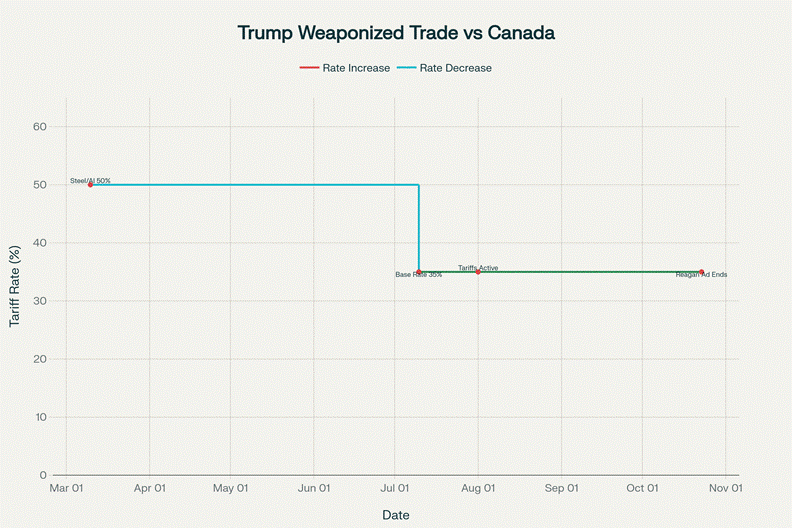
Trump’s tariffs on Canada escalated from 50% on steel/aluminum in March to a 35% base rate by August, culminating in terminated trade talks over Ontario’s Reagan anti-tariff advertisement in October 2025.
Trump’s Tariff Revenue vs. Economic Damage:
- Revenue: $162.2 billion collected through July 2025, on track for $300+ billion annually (Lawder, 2025; Yale Budget Lab, 2025)
- GDP Loss: -0.4% to -6% depending on model, costing $125-150 billion annually long-term (Yale Budget Lab, 2025; Penn Wharton Budget Model, 2025)
- Job Losses: 490,000 by end-2025 (Yale), up to 2.8 million long-term (Wharton) (Yale Budget Lab, 2025; Penn Wharton Budget Model, 2025)
- Household Cost: $1,900-$22,000 annually, regressively hitting low-income families (Yale Budget Lab, 2025; Penn Wharton Budget Model, 2025)
- Net Effect: For every dollar collected, the economy loses $0.77-$1.20 (Yale calculation: $2 trillion revenue vs. $2.5 trillion economic loss over 10 years) (Yale Budget Lab, 2025)
U.S.-Canada Trade Imbalance Reality Check:
- Trump’s Claim: $200 billion deficit
- Actual 2024 Deficit: $73.66 billion in goods, $35.7 billion goods+services (U.S. Census Bureau, 2025)
- H1 2025 Deficit: $33.71 billion, trending lower (U.S. Census Bureau, 2025)
- USMCA Tariff-Free Trade: 85% (Kemp & Simon, 2025)
- Context: U.S. runs goods trade surplus in services with Canada; calculating only goods trade while ignoring services is economic cherry-picking
New Zealand Collateral Damage:
- · Initial Tariff: 10% (April 2025) (Waatea News, 2025)
- Increased Tariff: 15% (July 2025) (Waatea News, 2025)
- Annual Exports at Risk: $9 billion NZD (Waatea News, 2025)
- Trade Surplus Cited: $0.5 billion USD—miniscule compared to U.S. GDP
- Comparative Disadvantage: Australia 10%, Argentina 10%, Uruguay 10% vs. NZ 15%—NZ beef and wine now less competitive
Māori Economy Context:
- Asset Base 2025: $80 billion NZD (Waatea News, 2025)
- Home Ownership Rate: 37% (versus 50%+ in 1991) (Smale, 2007)
- Unemployment: 8.3%
- Post-Rogernomics Impact: 30+ years of neoliberal policies depressed Māori home ownership by 13 percentage points while Pākehā declined only ~5 percentage points (Smale, 2007)
Global Stock Market Crash April 2025:
- S&P 500: -4.84% (largest drop since 2020) (Giesecke & Waschik, 2025)
- Nasdaq: -5.97% (Giesecke & Waschik, 2025)
- Dow: -1,679 points (-3.98%) (Giesecke & Waschik, 2025)
- Context: Markets feared Trump-induced recession from tariff shock (Giesecke & Waschik, 2025)
Yale Budget Lab Long-Run Projections:
- Capital Stock: -10% by 2054 (Yale Budget Lab, 2025; Penn Wharton Budget Model, 2025)
- Wages: -3.9% to -4.8% by 2054 (Yale Budget Lab, 2025; Penn Wharton Budget Model, 2025)
- Hours Worked: -1.3% (Yale Budget Lab, 2025; Penn Wharton Budget Model, 2025)
- Federal Debt Reduction: -10.7% to -11.6% (Yale Budget Lab, 2025; Penn Wharton Budget Model, 2025)—tariff revenue partially offsets damage, but doesn’t reverse net harm
- Unemployment: +0.3 percentage points by end-2025, +0.7 by end-2026 (Yale Budget Lab, 2025; Penn Wharton Budget Model, 2025)
These numbers aren’t abstract—they represent families unable to afford groceries, workers losing jobs, exporters shutting down, communities devastated. When Trump celebrates “record customs duties” (Lawder, 2025), he’s celebrating extraction from working peoples.
International Context: The Authoritarian Playbook Goes Global
Trump’s tariff tantrum isn’t unique—it’s part of a global rightward authoritarian turn:
Argentina’s Javier Milei: Atlas Network-backed libertarian elected 2023, implementing shock therapy austerity, slashing public spending, deregulating industries (Public Services Association, 2024; Multinationales.org, 2024). Result: soaring poverty, unemployment, social unrest.
UK’s Liz Truss: Institute of Economic Affairs (Atlas partner) crafted her disastrous mini-budget (Public Services Association, 2024). Result: pound collapse, bond market chaos, forced resignation after 49 days.
Brexit: Atlas partners pushed Leave campaign (Public Services Association, 2024; Multinationales.org, 2024). Result: trade disruptions, supply chain chaos, economic contraction, working-class communities most harmed.
Australia’s Voice Referendum: Atlas partners opposed Indigenous constitutional recognition (Public Services Association, 2024; Wikipedia, 2005). Result: referendum failed, perpetuating Indigenous marginalization.
Chile’s Constitutional Referendum: Atlas network mobilized against progressive constitution (Public Services Association, 2024). Result: new constitution rejected, entrenching neoliberal status quo.
The pattern: Atlas-linked think tanks promote policies benefiting elites (tax cuts, deregulation, privatization) while mobilizing racist, nationalist, anti-Indigenous rhetoric to build mass support (Public Services Association, 2024; Multinationales.org, 2024; Wikipedia, 2005). Trump’s tariff nationalism fits perfectly—economic nationalism cloaked in “America First” language, harming workers while enriching elites through regressive taxation, attacking truth-tellers (Ontario’s ad) who expose the con, pressuring courts to legitimize executive overreach (Raymond et al., 2025; Bravin, 2025).
Implications: The Threats Ahead
Short-Term (2025-2026):
- Supreme Court Decision November 5: If Court upholds tariffs, executive power expands dangerously; if Court strikes them down, Trump pursues alternative authorities (Section 122, Section 232 investigations) (Raymond et al., 2025; Bravin, 2025; Liptak, 2025; Atlantic Council, 2025)
- Retaliatory Tariff Spiral: Canada, Mexico, EU, China, others retaliate further (Giesecke & Waschik, 2025)
- Recession Risk: GDP contraction, job losses, market volatility intensify (Giesecke & Waschik, 2025; Yale Budget Lab, 2025; Penn Wharton Budget Model, 2025)
- USMCA Review 2026: Trilateral renegotiation amid heightened tensions (Kemp & Simon, 2025)
Medium-Term (2026-2030):
- Global Trade Fragmentation: “Gated globalization” replaces multilateral cooperation
- Supply Chain Disruptions: Businesses relocate production, increasing costs and inefficiencies
- Inflation Persistence: Tariff-driven price increases embed in economy (Giesecke & Waschik, 2025)
- Democratic Backsliding: Authoritarian executives worldwide cite Trump precedent to expand power (Public Services Association, 2024; Multinationales.org, 2024)
Long-Term (2030+):
- Indigenous Sovereignty Under Assault: Neoliberal trade regimes prioritize corporate rights over Indigenous self-determination (Jamieson et al., 2020; Nocera et al., 2022)
- Climate Catastrophe Acceleration: Fossil fuel extraction intensifies as “national security” justifies environmental destruction (Wikipedia, 2005)
- Wealth Inequality Deepening: Regressive taxation (tariffs) replaces progressive taxation (income/capital gains), concentrating wealth upward (Yale Budget Lab, 2025)
- Erosion of International Law: If Supreme Court upholds Trump’s IEEPA overreach, presidents gain unilateral taxation power, obliterating constitutional checks (Raymond et al., 2025; Bravin, 2025; U.S. Court of Appeals for the Federal Circuit, 2025; Atlantic Council, 2025)
Specific Māori/Indigenous Threats:
- Asset Base Stagnation: While Māori assets reach $80 billion NZD, home ownership and unemployment metrics reveal wealth concentration within Māori elites while working-class Māori face ongoing dispossession (Smale, 2007; Waatea News, 2025)
- Trade Agreement Exclusion: USMCA and similar deals lack meaningful Indigenous sovereignty protections
- Extractive Industries Expansion: Trump’s tariffs on critical minerals incentivize mining on Indigenous lands globally (Wikipedia, 2005)
- “Free Trade” Cooptation: Atlas Network’s documented collaboration with Canadian groups pushing Indigenous resource extraction shows how neoliberal rhetoric weaponizes “opportunity” to dispossess (Wikipedia, 2005)
He Whakamutunga: Conclusions and Calls to Action
Trump’s termination of Canada trade talks over Ontario’s Reagan advertisement wasn’t about policy—it was about power. A U.S. president who claims to revere Ronald Reagan can’t tolerate Reagan’s own words exposing tariffs as economically destructive (Kemp & Simon, 2025; Miller, 2025; Tankersley & Goodman, 2025; Wise, 2025; Griswold, 2022). A “nationalist” who wraps himself in the flag demands judicial submission rather than constitutional checks (Raymond et al., 2025; Bravin, 2025). A “populist” who claims to defend workers extracts $162 billion through regressive tariffs while GDP contracts and jobs disappear (Lawder, 2025; Yale Budget Lab, 2025; Penn Wharton Budget Model, 2025).
This isn’t an anomaly—it’s the neoliberal project’s logical endpoint. From Rogernomics’ devastation of Māori communities in the 1980s (Smale, 2007) to NAFTA/CAFTA’s dispossession of Indigenous peoples across the Americas (Nocera et al., 2022), from Atlas Network’s global think-tank infrastructure promoting elite interests (Espiner, 2024; Public Services Association, 2024; SourceWatch, 2015; Multinationales.org, 2024) to Trump’s weaponization of trade policy for authoritarian ends (Kemp & Simon, 2025; Raymond et al., 2025; Bravin, 2025), the pattern persists: concentrate wealth upward, immiserate working peoples, deploy racist nationalism to fracture solidarity, attack truth-tellers who expose the con.
Specific Revelations Exposed:
- Reagan Foundation betrayed Reagan’s legacy to appease Trump, threatening legal action over public-domain speech (Miller, 2025; Associated Press, 2025; Zimonjic, 2025)
- U.S. Supreme Court hearing November 5, 2025 will determine whether presidents have unchecked taxation power, undermining constitutional separation of powers (Raymond et al., 2025; Bravin, 2025; Liptak, 2025; Atlantic Council, 2025)
- Trump’s tariffs extracted $162 billion through July 2025 while causing $125-150 billion annual GDP loss and 490,000+ job losses (Lawder, 2025; Yale Budget Lab, 2025; Penn Wharton Budget Model, 2025)
- Atlas Network links NZ Taxpayers’ Union and NZ Initiative to global right-wing infrastructure promoting neoliberal policies harming vulnerable communities (Espiner, 2024; Public Services Association, 2024; SourceWatch, 2015; Multinationales.org, 2024)
- Māori home ownership collapsed from 50%+ (1991) to 37% (2025) under neoliberal regimes while asset base concentration reveals wealth inequality within Māori communities (Smale, 2007; Waatea News, 2025)
Ngā Mahi Whakamātau—Actions to Take:
Immediate (He Mahi Tōmua):
Immediate (He Mahi Tōmua):
- Monitor Supreme Court November 5 hearing: Follow case V.O.S. Selections, Inc. v. Trump and Learning Resources, Inc. v. Trump (Raymond et al., 2025; Bravin, 2025; Liptak, 2025; Atlantic Council, 2025)—file amicus briefs, organize court watching, prepare rapid response
- Support Canadian resistance: Donate to Ontario’s ad campaign continuation, amplify Doug Ford and Mark Carney’s pushback, educate U.S. audiences on tariff harm (Ford, 2025; Miller, 2025; Associated Press, 2025)
- Expose Atlas Network: Research and publicize Atlas partners in your region (NZ Taxpayers’ Union, NZ Initiative, others), trace funding sources, disrupt their “neutral expert” credibility (Espiner, 2024; Public Services Association, 2024; SourceWatch, 2015; Multinationales.org, 2024)
Short-Term (He Mahi Poto):
- Organize trade justice coalitions: Unite labor unions, Indigenous groups, small businesses, environmental orgs against neoliberal trade regimes—demand USMCA renegotiation include Indigenous sovereignty, labor rights, climate protections (Jamieson et al., 2020; Nocera et al., 2022)
- Demand tax justice: Campaign to replace regressive tariffs with progressive taxation on wealth, capital gains, financial transactions (Yale Budget Lab, 2025)
- Protect judicial independence: Mobilize against executive overreach, defend courts’ authority to check presidential power (Raymond et al., 2025; Bravin, 2025; Atlantic Council, 2025)
Long-Term (He Mahi Roa):
- Build post-neoliberal economies: Develop worker cooperatives, Indigenous-controlled industries, regenerative agriculture resisting extractive capitalism (Smale, 2007; Nocera et al., 2022; Jamieson et al., 2020)
- Reclaim trade sovereignty: Reject corporate-dominated trade agreements, assert community and Indigenous rights over “free trade” ideology (Nocera et al., 2022)
- Internationalize resistance: Connect struggles across borders—Māori in Aotearoa, First Nations/Inuit/Métis in Canada, Indigenous peoples in Mexico/Guatemala/Chile, immigrant workers in U.S. all face neoliberal violence (Smale, 2007; Nocera et al., 2022; Jamieson et al., 2020)
He Karakia Whakamutunga:
Kia whakatōmuri te haere whakamua—we walk backwards into the future, guided by the past. Neoliberalism promised prosperity; it delivered dispossession. Trump promised to make America great; he tanked the economy and terminated trade over a truthful advertisement. The Atlas Network promised freedom; it built authoritarian infrastructure.

The Māori Green Lantern Fighting Misinformation And Disinformation From The Far Right
Mā te kotahitanga, mā te aroha, mā te rangatiratanga—through unity, through compassion, through self-determination—we resist. Name the networks. Trace the money. Expose the lies. Protect the vulnerable. Build alternatives.
The Reagan ad told the truth: tariffs hurt working people. Trump’s rage confirmed it. Now we fight back.
Koha HTDM: 03-1546-0415173-000
Humbly, e te whānau, if you have the capacity and capability to support this mahi through koha, your contribution sustains this work. But if you’re struggling—and many are under neoliberal assault—your solidarity and shared resistance matter most.
Kia kaha. Kia māia. Kia manawanui.
Associated Press. (2025). Ontario to stop running anti-tariff advert that angered Trump. BBC News, October 24. https://www.bbc.com/news/articles/czr18g3j4j7o
Atlantic Council. (2025). The Supreme Court’s decision on Trump tariffs will have lasting impact on US economic statecraft. September 16. https://www.atlanticcouncil.org/blogs/econographics/the-supreme-courts-decision-on-trump-tariffs-will-have-lasting-impact-on-us-economic-statecraft
Bravin, J. (2025). Small businesses and states urge court to strike down Trump’s tariffs. SCOTUSblog, October 22. https://www.scotusblog.com/2025/10/small-businesses-and-states-urge-court-to-strike-down-trumps-tariffs
Espiner, G. (2024). Jordan Williams on what the Taxpayers’ Union really is and who funds it. RNZ 30 with Guyon Espiner, May 21. https://www.rnz.co.nz/programmes/30-with-guyon-espiner/story/2018938627/jordan-williams-on-what-the-taxpayers-union-really-is-and-who-funds-it
Ford, D. (2025). Ontario premier says he’ll pull ad that made Trump end US-Canada trade talks. 1News, October 24. https://www.1news.co.nz/2025/10/25/ontario-premier-says-hell-pull-ad-that-made-trump-end-us-canada-trade-talks
Gibbs, D. (2024). Neoliberal Policies Associated With Reaganomics Actually Started With Carter. Global Policy Journal, September 3. https://www.globalpolicyjournal.com/blog/04/09/2024/neoliberal-policies-associated-with-reaganomics-actually-started-carter
Giesecke, J. & Waschik, R. (2025). Dire outlook for US economy drove Trump’s sudden tariff backflip. 1News, April 11. https://www.1news.co.nz/2025/04/12/dire-outlook-for-us-economy-drove-trumps-sudden-tariff-backflip
Griswold, D. (2022). Reagan Embraced Free Trade and Immigration. Cato Institute, June 16. https://www.cato.org/commentary/reagan-embraced-free-trade-immigration
Jamieson, L., Paradies, Y. & Gunthorpe, W. (2020). How Neoliberalism Shapes Indigenous Oral Health Inequalities Globally. International Journal of Environmental Research and Public Health, November 29. https://pmc.ncbi.nlm.nih.gov/articles/PMC7730877
Kemp, D. & Simon, B. (2025). Trump ends all Canada trade talks over “fake” tariff ad. RNZ News, October 23. https://www.rnz.co.nz/news/world/576890/trump-ends-all-canada-trade-talks-over-fake-tariff-ad
Lawder, D. (2025). US customs duties top $100 billion for first year. RNZ News, July 11. https://www.rnz.co.nz/news/national/566724/us-customs-duties-top-100-billion-for-first-year
Liptak, A. (2025). Trump’s dramatic rhetoric on tariffs ramps up pressure on Supreme Court. NBC News, October 24. https://www.nbcnews.com/politics/supreme-court/trumps-dramatic-rhetoric-tariffs-ramps-pressure-supreme-court-rcna238207
Miller, Z. (2025). Ontario premier says he’ll pull ad that upset Trump. Associated Press, October 24. https://apnews.com/article/canada-trump-tariffs-reagan-tariffs-e0e6a8f1fa49f00c9e8d08df405ee299
Multinationales.org. (2024). The Koch-funded Atlas Network is also targeting Europe. Observatory of Multinationals, May 29. https://multinationales.org/en/investigations/the-atlas-network-france-and-the-eu
Nocera, A., Richards, K. & Silva, M. (2022). Accompanier Perspectives: Neoliberalism, Forced Migration & Violence Against Guatemala’s Indigenous Peoples. NISGUA, August 31. https://nisgua.org/en/accompanier-perspectives-neoliberalism-forced-migration-violence-against-guatemalas-indigenous-peoples
Penn Wharton Budget Model. (2025). The Economic Effects of President Trump’s Tariffs. University of Pennsylvania, April 9. https://budgetmodel.wharton.upenn.edu/issues/2025/4/10/economic-effects-of-president-trumps-tariffs
Public Services Association. (2024). Understanding Atlas: how a right-wing network is building global influence. PSA Journal, April 4. https://www.psa.org.nz/journals/understanding-atlas-how-a-right-wing-network-is-building-global-influence
Raymond, M., Graham-McLay, C. & Lawder, D. (2025). Most Trump tariffs are not legal, US appeals court rules. RNZ News, August 29. https://www.rnz.co.nz/news/world/571551/most-trump-tariffs-are-not-legal-us-appeals-court-rules
Smale, A. (2007). A poor outcome: Māori, poverty and the struggle for survival. RNZ News, July 31. https://www.rnz.co.nz/news/in-depth/396653/a-poor-outcome-maori-poverty-and-the-struggle-for-survival
SourceWatch. (2015). Atlas Network. Center for Media and Democracy, October 12. https://www.sourcewatch.org/index.php/Atlas_Network
Tankersley, J. & Goodman, P. (2025). Trump Decries Anti-Tariff Ad From Ontario, Canada, That Used Reagan Quotes. New York Times, October 24. https://www.nytimes.com/2025/10/24/us/politics/trump-tariffs-canada-reagan-tv-ad-video.html
U.S. Census Bureau. (2025). Trade in Goods with Canada. U.S. Department of Commerce, September. https://www.census.gov/foreign-trade/balance/c1220.html
U.S. Court of Appeals for the Federal Circuit. (2025). V.O.S. Selections, Inc. v. Trump [Opinion]. August 28. /content/files/opinions-orders/25-1812-opinion-8-29-2025_2566151.pdf
Waatea News. (2025). Trump Tariffs to hit the economy. August 1. https://waateanews.com/2025/08/02/trump-tariffs-to-hit-the-economy
Wikipedia. (2005). Atlas Network. Last updated 2025. https://en.wikipedia.org/wiki/Atlas_Network
Wise, A. (2025). Trump claimed Canada’s anti-tariff ad twisted Reagan’s words. Here’s what Reagan said. CNBC, October 24. https://www.cnbc.com/2025/10/24/trump-canada-tariff-reagan-trade.html
Yale Budget Lab. (2025). State of U.S. Tariffs: September 26, 2025. Yale University, September 25. https://budgetlab.yale.edu/research/state-us-tariffs-september-26-2025
Zimonjic, P. (2025). Ontario’s anti-tariff ad is clever, effective and legally sound. CBC News, October 24. https://www.cbc.ca/news/politics/ontario-ad-tariffs-trump-9.6952829