"When Anti-Vax Activism Meets Political Opportunism: The Sordid Tale of Harete Hipango's Journey to the Far Right" - 9 September 2025
The Māori Green Lantern Exposes Another Opportunist's Pipeline to Power
Tēnā koutou katoa - Greetings to you all.
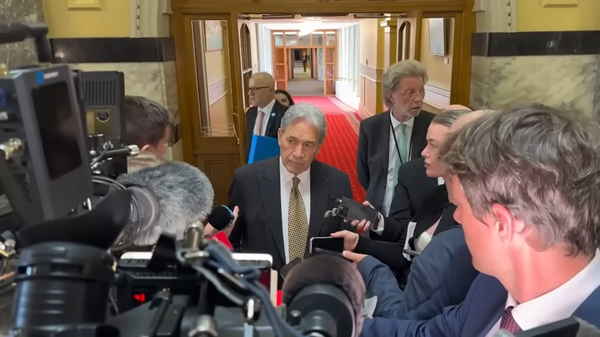
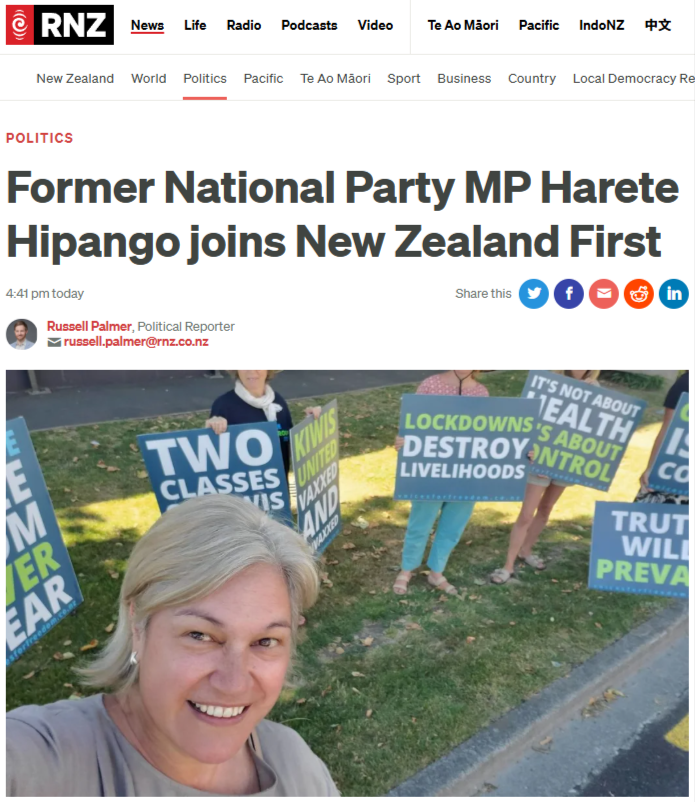
The whakapapa of political opportunism runs deep in Aotearoa, but rarely have we witnessed such a transparent example of the anti-vaccination to far-right pipeline as Harete Hipango's recent defection to New Zealand First. This is not just another political party switch - this is a masterclass in how misinformation, white supremacist rhetoric, and shameless power-grabbing converge in our contemporary political landscape.
What we are witnessing is nothing less than the colonisation of Māori identity for far-right political gain, wrapped in the rhetoric of "pragmatism" and "New Zealand First" nationalism. But let us be clear - there is nothing pragmatic about aligning yourself with a party that has spent decades scapegoating immigrants, undermining Māori sovereignty, and promoting policies that directly harm our most vulnerable communities.
Background: The Making of a Political Pariah
To understand Hipango's trajectory, we must first acknowledge what she represents: a Māori woman weaponised by the National Party to provide Indigenous legitimacy for their ongoing colonial project. Born of Te Āti Haunui-a-Pāpārangi, Ngāti Apa, Ngā Rauru Kītahi, Ngāti Tamakōpiri, and Ngāti Whitikaupeka iwi, Hipango's whakapapa was deployed as a shield against accusations of racism while she consistently voted against Māori interests.
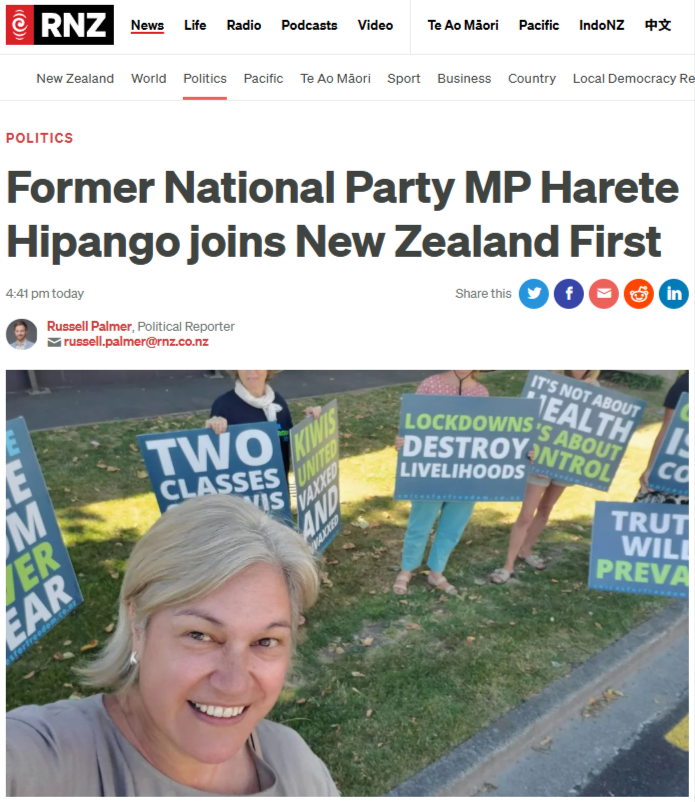
Her political career began in 2017 when she won the Whanganui electorate for National, only to lose it in 2020 before returning as a list MP in 2021. But it was her involvement with the anti-vaccination movement that revealed her true political character - and her susceptibility to far-right recruitment tactics.
The significance of her story extends far beyond one individual politician. Hipango represents a critical case study in how far-right movements have weaponised COVID-19 vaccine hesitancy to create "a pipeline from vaccine hesitancy to outright conspiracies and extremism". Her journey from respected lawyer to political pariah illustrates the insidious nature of this recruitment process.
The Anti-Vax to Far-Right Pipeline Exposed
The phenomenon of politicians moving from anti-vaccination activism to far-right parties is not unique to Aotearoa, but Hipango's case provides a particularly clear example of how this radicalisation occurs. Research has shown that "far-right extremists and anti-vaxxers have increasingly found that they are natural bedfellows, sharing anti-government beliefs and indulging in a range of conspiracy theories".
This matters profoundly for Māori communities because it represents the co-option of legitimate concerns about medical autonomy and historical medical racism into vehicles for white supremacist ideology. When Māori politicians like Hipango align themselves with these movements, they provide Indigenous cover for fundamentally anti-Indigenous political projects.
The scope of our analysis must therefore examine not just Hipango's individual choices, but the broader pattern of how neoliberal parties create the conditions for far-right recruitment, and how anti-vaccination movements serve as gateways to more extreme political positions.
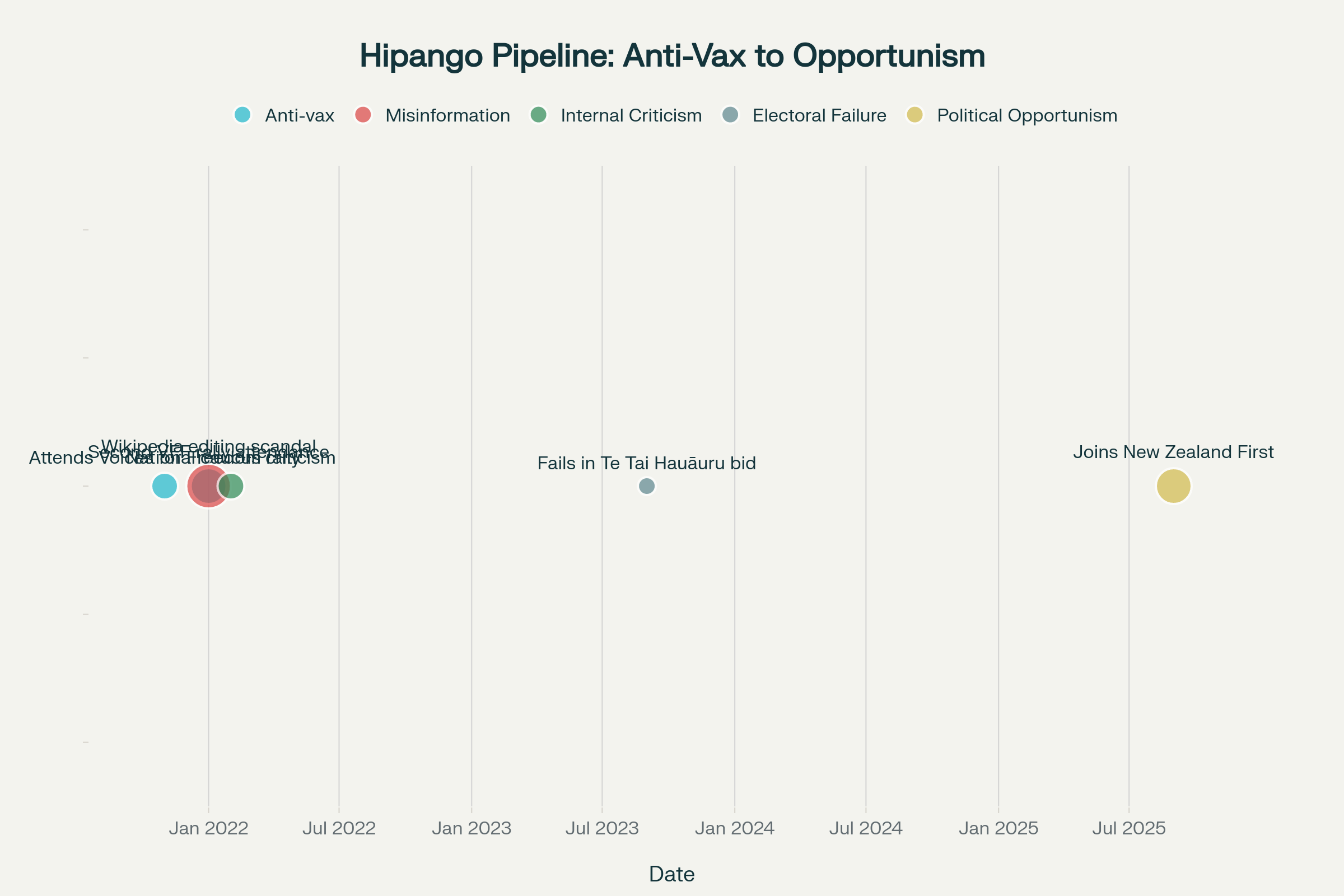
Timeline showing Harete Hipango's progression from anti-vaccination activism to joining New Zealand First
The Timeline of Opportunistic Descent
November 2021: The First Red Flag
Hipango's descent began with her attendance at a Voices for Freedom anti-vaccination rally in Whanganui. Voices for Freedom, according to research, is "an anti-vaccine advocacy group in New Zealand that formed in December 2020" and "has been criticised by NZ Skeptics, The Spinoff editor Madeleine Chapman, and FACT Aotearoa for spreading misinformation about COVID-19 and vaccinations".
What makes this particularly insidious is that Hipango, as a trained lawyer, would have understood the legal and ethical implications of associating with a group spreading medical misinformation during a global pandemic. Yet she chose political opportunism over public health.
January 2022: The Wikipedia Manipulation Scandal
The mask slipped completely when Hipango instructed a staff member to edit her Wikipedia page to remove the "controversies" section, which included mention of her anti-vaccination protest attendance. This wasn't just about managing her public image - it was about deliberately obscuring her connections to misinformation networks.
When confronted, Hipango admitted the move was "unwise" and said she "regretted" it, but the damage was done. She had revealed herself as someone willing to manipulate information to hide her controversial associations - a hallmark of far-right political tactics.
The National Party's Complicity
Rather than taking decisive action, National Party leader Christopher Luxon merely characterised Hipango's behaviour as "silly and unwise". This weak response enabled Hipango's continued radicalisation and sent a clear message that the party was unwilling to take a strong stance against misinformation and far-right recruitment.
Internal National Party sources revealed that Hipango was criticised by colleagues for "sailing her own waka" and was "not well-liked within the caucus", yet the party continued to provide her with a platform and resources.
The 2023 Electoral Humiliation
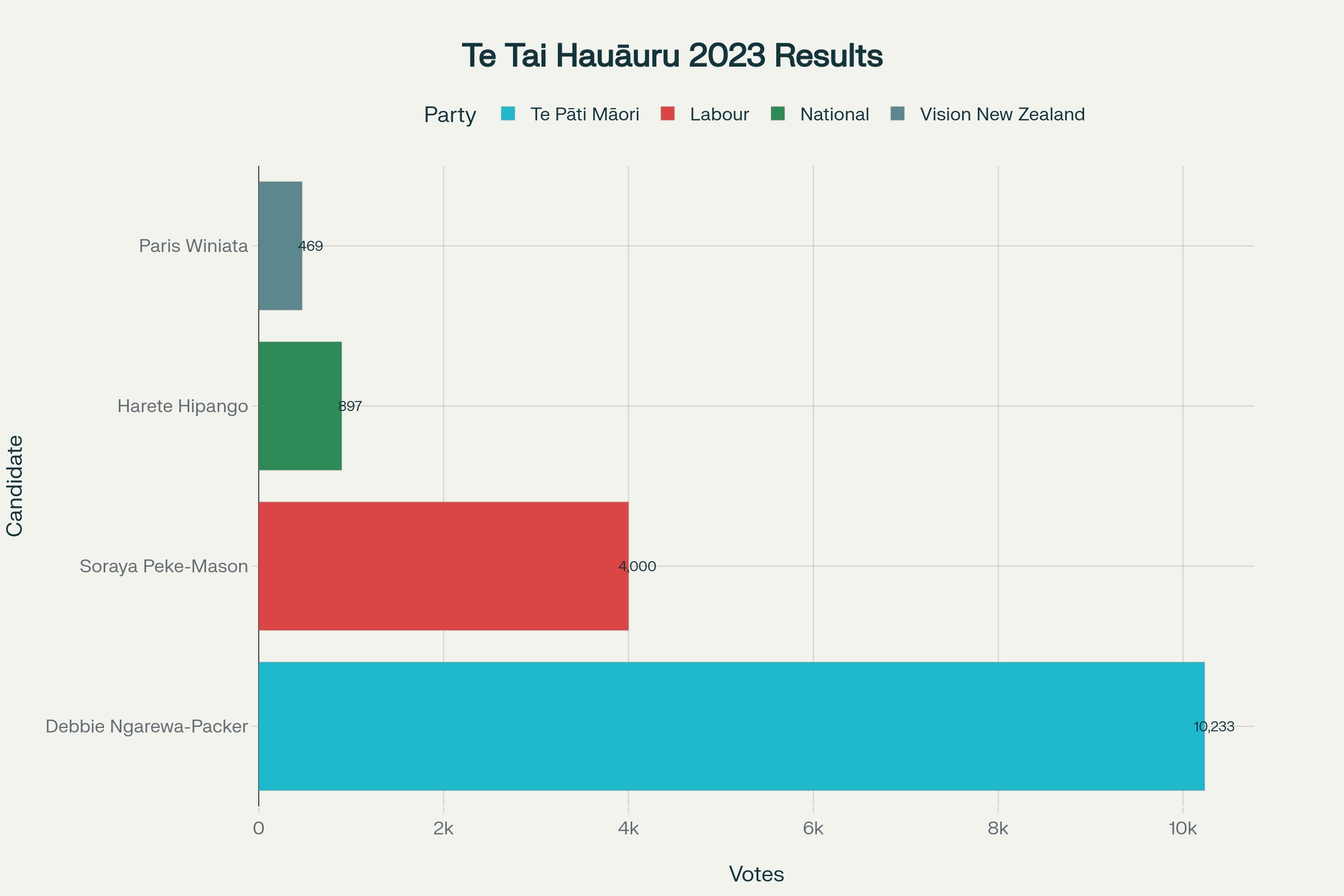
Te Tai Hauāuru 2023 election results showing Harete Hipango's dismal third-place finish
Hipango's decision to contest the Te Tai Hauāuru Māori electorate in 2023 represented both political desperation and profound disconnection from Māori communities. She became "the first National MP to contest a Māori seat since the 2002 election", positioning herself as a pioneer when she was actually a pariah.
The results speak for themselves. Te Pāti Māori's Debbie Ngarewa-Packer won decisively with 10,233 votes, while Hipango managed a humiliating 897 votes - just 5.9% of the total. This wasn't just an electoral defeat - it was a complete rejection by Māori voters who recognised her politics for what they were.
The campaign itself revealed Hipango's fundamental misunderstanding of Māori political aspirations. While genuine Māori political movements focus on tino rangatiratanga, environmental protection, and addressing colonisation's ongoing impacts, Hipango offered only the tired National Party line of individual responsibility and economic conservatism.
New Zealand First: A Natural Home for Far-Right Opportunism
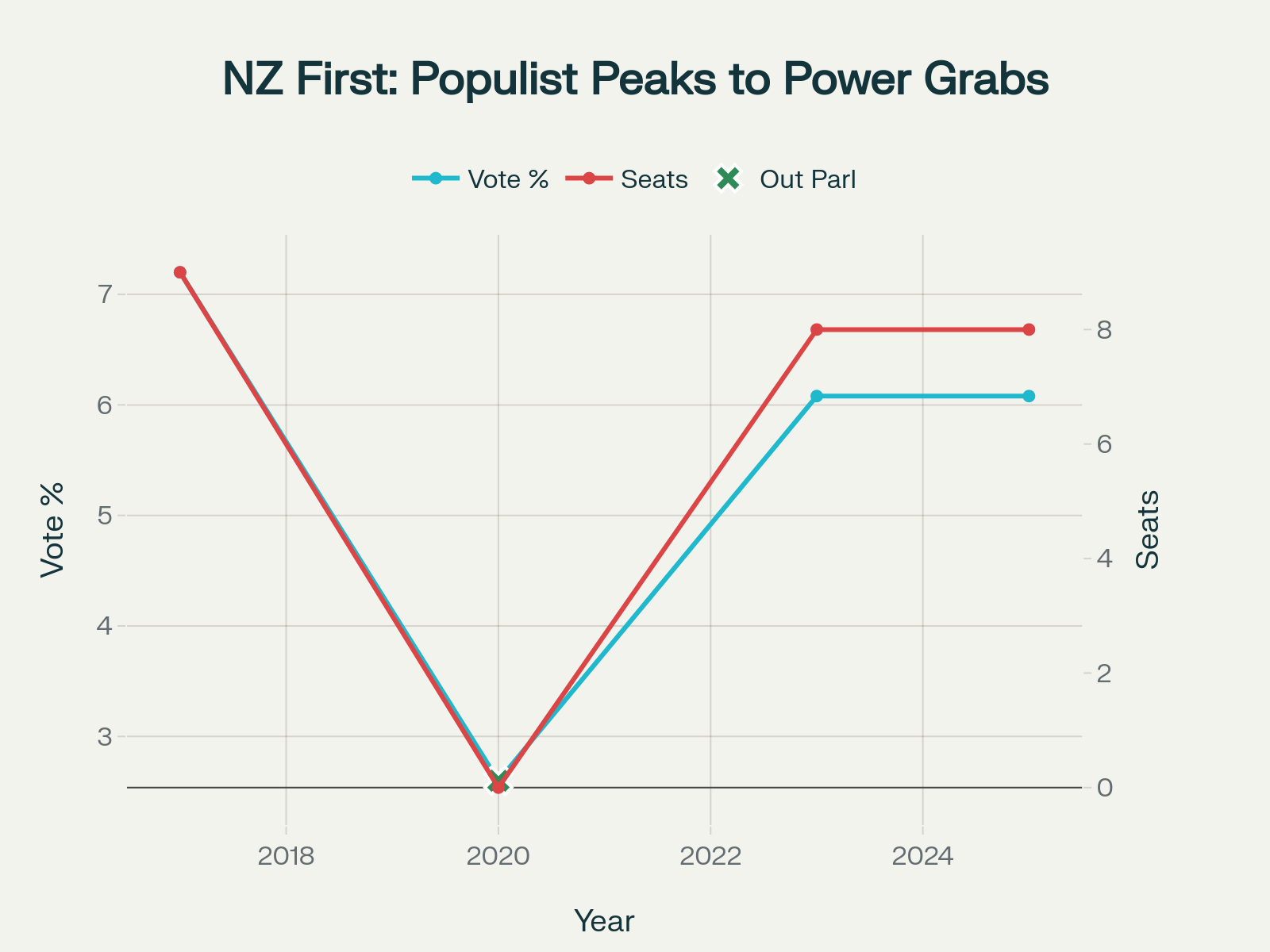
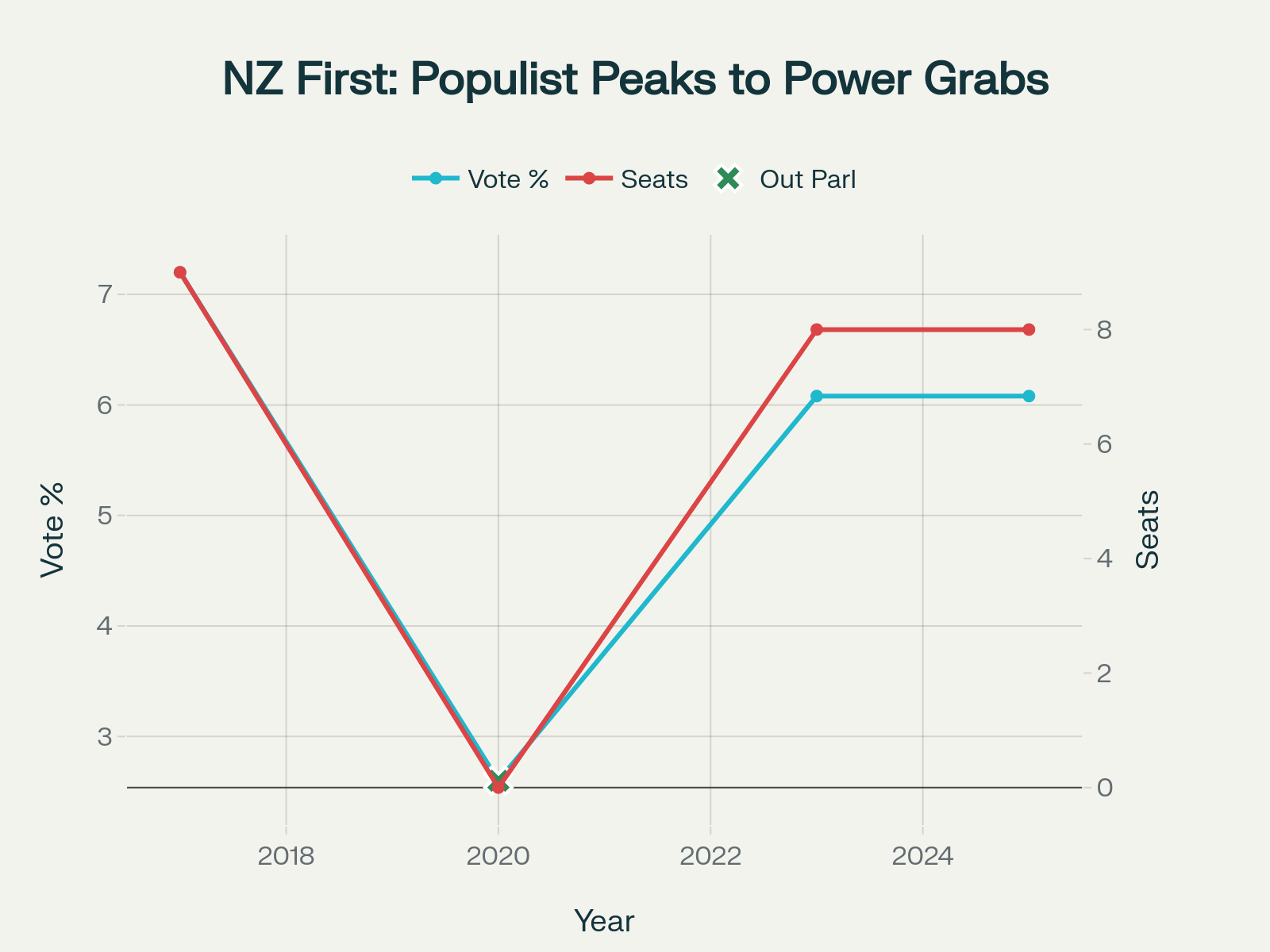
New Zealand First's electoral performance showing their opportunistic return to power
Hipango's move to New Zealand First represents the logical endpoint of her political journey. New Zealand First has a documented history of anti-immigration rhetoric, with leader Winston Peters previously stating: "We are being dragged into the status of of an Asian colony and it is time that New Zealanders were placed first in their own country".
The party's recent policies reveal their true agenda. At their 2025 AGM, members debated removing references to the Treaty of Waitangi from government documents, scrapping co-governance arrangements, and developing a "long-term Demographic and Migration Strategy" - all coded language for white supremacist policy objectives.
The Peters-Parliament Occupation Connection
Winston Peters' own involvement with the 2022 Parliament occupation reveals the direct connection between New Zealand First and the far-right movements that recruited Hipango. Peters met with protesters during their 23-day occupation and was subsequently trespassed from Parliament for two years.
Parliament occupation showing the nexus between anti-government protest and far-right politics
This wasn't coincidental - it was strategic alignment with a movement that included "Christian fundamentalists from the fringe right," people "with known links to white supremacist groups," and carried "signage and flags in support of former US President Donald Trump".
The Ideology of "New Zealand First" Nationalism
New Zealand First's brand of populism represents what academic research identifies as "welfare chauvinism" - the idea that social benefits should be restricted to the "deserving" (read: white, established) population. The party "espouses both social conservatism and welfare chauvinism" while advocating for "raising the minimum wage to a living wage" but only for those they consider legitimate New Zealanders.
This selective generosity is a classic far-right tactic - appearing to support working-class interests while simultaneously scapegoating immigrants, Māori, and other marginalised communities for economic problems created by capitalist exploitation.
The Weaponisation of Māori Identity
Perhaps most cynically, Hipango's presence in New Zealand First provides Indigenous legitimacy for their fundamentally anti-Indigenous agenda. When the party promotes policies to remove Treaty of Waitangi references from government documents and end co-governance arrangements, they can point to Hipango as evidence that Māori support their agenda.
This represents a profound violation of Indigenous political ethics. As researcher from the Amadeu Antonio Foundation noted about similar patterns in Germany: "We could see the common thread throughout these groups was conspiracy ideologies and antisemitism" - and in the Aotearoa context, we must add anti-Māori racism to this list.
The Colonial Logic of Individual Māori Exceptionalism
Colonial systems have always relied on finding individual Indigenous people willing to provide legitimacy for anti-Indigenous policies. Hipango fits perfectly into this tradition - a Māori woman with impressive credentials willing to advocate against Māori collective interests in exchange for individual political advancement.
Her justification for joining New Zealand First reveals this colonial logic: "We're meant to be a community of New Zealanders. New Zealand, first". This rhetoric explicitly rejects Māori distinctiveness and sovereignty in favour of a homogenising nationalism that benefits only Pākehā interests.

New Zealand First party meeting where political alliances are formed
The Broader Pattern: Anti-Vax as Gateway Drug
Hipango's journey illuminates a global phenomenon that has profound implications for Indigenous communities worldwide. Research shows that "far-right groups to latch onto protests and rallies, creating a pipeline from vaccine hesitancy to outright conspiracies and extremism".

Anti-vaccination protest rally showing the environment where far-right recruitment occurs
The Recruitment Strategy Exposed
The process works like this: legitimate concerns about medical autonomy and historical medical racism are amplified and distorted by far-right actors who gradually introduce more extreme ideological content. As one researcher noted: "It's almost like grooming - how anti-vaxxers, conspiracy theorists and the far-right came together over COVID".
For Māori politicians like Hipango, this process is particularly insidious because it exploits genuine historical trauma around medical experimentation and government health policies. The irony is that by joining this movement, Māori politicians end up supporting parties whose broader agenda directly harms Māori health and wellbeing.
The International Context
This pattern is not unique to Aotearoa. In Germany, researchers found that "big demonstrations in the streets" brought together "conspiracy groups and the far-right groups" with "conspiracy ideologies and antisemitism" as common threads. In Canada, "members of the sovereign citizen movement have attempted to carry out citizen's arrests of public officials over vaccine mandates, while far-right politicians have become leaders in the anti-vaccine movement".
The global nature of this recruitment strategy reveals its systematic and coordinated character. This is not organic political development - it is a deliberate strategy to radicalise people through health-related concerns and channel them toward far-right political projects.
The Neoliberal Enablement
We cannot understand Hipango's radicalisation without examining how neoliberal parties like National create the conditions for far-right recruitment. National's own history shows how centre-right parties have embraced populist rhetoric when it serves their interests, as seen in Don Brash's 2005 "Iwi/Kiwi" campaign that "aimed to exploit anxiety among conservative Pākehā voters that Helen Clark's Labour-led government was privileging Māori at their expense".
By maintaining politicians like Hipango despite their clear far-right sympathies, National demonstrated that they are willing to provide platforms for extremist recruitment as long as it serves their broader political objectives. This makes them complicit in the radicalisation process.
The Failure of Liberal Democracy
The Hipango case reveals fundamental weaknesses in liberal democratic systems when confronting far-right recruitment. Political opportunism, defined as "the practice of taking advantage of every situation to maintain political support or influence, often disregarding relevant ethical or political principles", becomes the dominant mode of political behaviour.
When parties prioritise short-term electoral advantage over principled opposition to extremism, they create space for figures like Hipango to build careers while gradually radicalising. The result is a political system that actively enables far-right recruitment.
Implications for Māori and Broader Democratic Society
The Threat to Māori Political Development
Hipango's trajectory represents a direct threat to authentic Māori political development. By providing Indigenous legitimacy for anti-Indigenous policies, she undermines the collective Māori political project and confuses public understanding of genuine Māori political aspirations.
This is particularly dangerous because it occurs at a time when Māori political movements are gaining momentum. Te Pāti Māori's strong performance in the 2023 election, winning six seats and significantly increasing their party vote, demonstrates growing Māori political consciousness. Figures like Hipango provide ammunition for opponents who want to portray this development as divisive rather than democratic.
The Broader Democratic Implications
Current research shows that "two-thirds of the country think that 'New Zealand's economy is rigged to advantage the rich and powerful'" and "believe that 'New Zealand needs a strong leader to take the country back from the rich and powerful'". This populist discontent creates opportunities for both progressive and reactionary political movements.
The Hipango case demonstrates how far-right parties exploit this discontent by offering simple scapegoats (immigrants, Māori, "global elites") rather than addressing the structural issues that create inequality and alienation. Her journey from anti-vaccination activism to far-right politics shows how this exploitation process works in practice.
The Community Impact
Research shows that when politicians make "outwardly racist and xenophobic" comments, "people who wish to cause harm and violence on migrant communities end up feeling empowered and embolden". Hipango's alignment with New Zealand First therefore has real-world consequences for community safety and social cohesion.
For Māori communities specifically, her presence in the party provides cover for policies that will directly harm Māori wellbeing, from attacks on co-governance to restrictions on immigration that separate whānau and limit cultural exchange.
Revealing the Hidden Connections
The Money Trail
While the full financial connections remain opaque, Voices for Freedom's funding sources have been described as "opaque, having spent large amounts on promotion and court cases" despite claiming to receive donations from "thousands of concerned Kiwis". The organisation's ability to maintain sophisticated operations while claiming grassroots support suggests more significant financial backing.
The connection between anti-vaccination groups, far-right political parties, and international funding networks deserves serious investigation. Hipango's journey from anti-vaccination activism to political party membership may represent just one visible link in a broader network of political influence.
The International Far-Right Network
New Zealand First's policies increasingly mirror those of international far-right movements, from their "Make New Zealand Great Again" rhetoric to their targeting of diversity and inclusion programmes. Hipango's recruitment fits the pattern of far-right parties seeking Indigenous legitimacy for their agendas.
The timing of her defection, coinciding with New Zealand First's AGM where they discussed removing Treaty references and scrapping co-governance, suggests coordinated strategy rather than spontaneous political evolution.
The Media Complicity
Mainstream media coverage of Hipango's defection has focused on personality and tactics rather than ideology and connections. This represents a failure to properly contextuise her move within the broader pattern of far-right recruitment and international political trends.
By treating her switch as normal political horse-trading rather than ideological alignment with far-right politics, media outlets have obscured the true significance of her decision and its implications for democratic governance.

The Māori Green Lantern Fighting Misinformation And Disinformation From The Far Right
Exposing the Pipeline, Protecting Our Communities
Harete Hipango's journey from respected lawyer to far-right political operative represents more than individual moral failure - it reveals the systematic nature of far-right recruitment and the complicity of established political parties in enabling this process. Her story exposes how anti-vaccination movements serve as gateways to more extreme political positions, and how Indigenous politicians can be weaponised against Indigenous interests.
The implications extend far beyond one individual's political choices. Hipango's presence in New Zealand First provides Indigenous legitimacy for fundamentally anti-Indigenous policies while demonstrating how far-right movements exploit legitimate concerns about medical autonomy and historical trauma for political gain.
For Māori communities, this represents both a warning and an opportunity. The warning is clear: we must be vigilant against the co-option of our political representatives by movements that ultimately seek to undermine our collective aspirations. The opportunity lies in using cases like Hipango's to educate our people about far-right recruitment tactics and strengthen our commitment to authentic tino rangatiratanga.
The responsibility now falls on all of us - Māori and non-Māori alike - to challenge the political opportunism that enables far-right recruitment, demand accountability from political parties that provide platforms for extremist views, and build political movements based on genuine commitment to justice rather than short-term electoral advantage.
Hipango's pipeline from anti-vaccination activism to far-right politics illuminates the path we must not travel. It is up to us to ensure that her journey serves as a cautionary tale rather than a roadmap, and that our political representatives remain committed to the collective wellbeing of all our communities rather than the individual advancement that comes from aligning with oppressive forces.
Ka whakawhetai au ki a koutou katoa - I thank you all for your attention to these critical issues.
The MGL understands these tough economic times for whānau so please only contribute a koha if you have capacity and wish to do so. For those who find value in this analysis and wish to support continued investigation of far-right recruitment and political opportunism: HTDM: 03-1546-0415173-000.
Hei konā mai
Ivor Jones - The Māori Green Lantern