“When Billionaires Play Saviour: Roger Fewtrell and the Neoliberal Theatre of Kindness” - 27 December 2025
Kia ora. Ko Ivor Jones ahau, The Māori Green Lantern. Today we wield the taiaha to expose a fundamental truth:
philanthropy should not exist in Aotearoa New Zealand. Not because generosity is wrong, but because its very necessity reveals a system designed to concentrate wealth upward while forcing those at the bottom to grovel for crumbs dressed up as kindness.
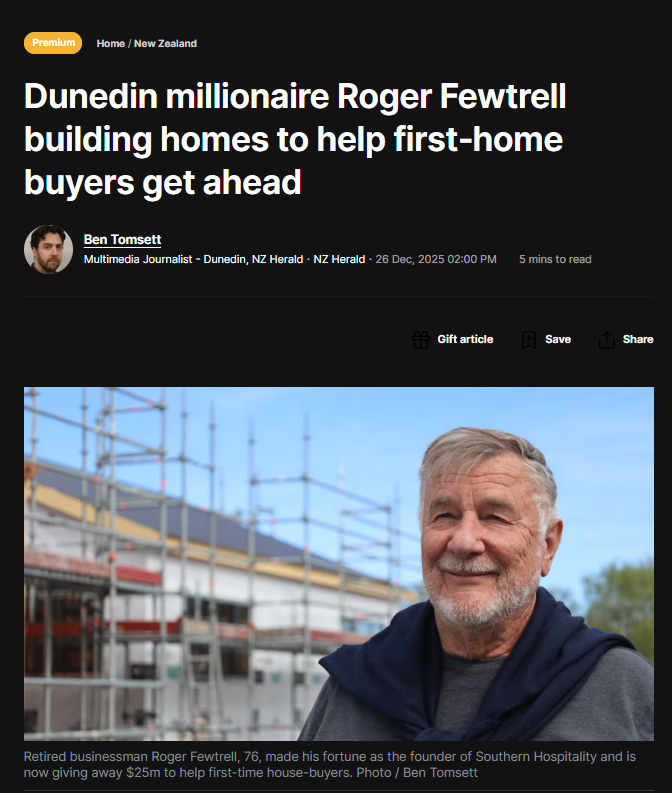
The NZ Herald recently celebrated Roger Fewtrell, a 76-year-old Dunedin millionaire who sold his hospitality supply empire to French private equity and now plans to “lose $25 million” building 250 homes with $100,000 subsidies for first-home buyers.
The piece reads like hagiography:
a self-made man giving back to the city that made him rich, helping battling families get on the property ladder while battling council “red tape”.
But peel back the PR veneer and you’ll find the same tired neoliberal script:
extract wealth via capital accumulation, sell to foreign corporates, then perform charity theatre to obscure the structural violence that made such “generosity” necessary in the first place.
Let’s be clear:
Roger Fewtrell is not the villain of this story. He’s a symptom. The real sickness is a political economy that has, over four decades, systematically dismantled the state’s role as guarantor of housing as a right, transformed homes into speculative assets, and locked an entire generation—especially Māori—out of the wealth-building vehicle that sustained their parents and grandparents.
Philanthropy is the band-aid billionaires slap on the wounds neoliberalism inflicts. And Aotearoa should have neither billionaires nor the conditions that make their charity necessary.
This Ain’t Fucking TrumpLand!
The Whakapapa of Our Housing Crisis: Rogernomics and the Dismantling of the Social Contract
To understand why a millionaire must now play housing developer-cum-benefactor in Dunedin, we must trace the whakapapa of our housing catastrophe back to 1984, when Finance Minister Roger Douglas unleashed what would become known as “Rogernomics”—the most radical neoliberal restructuring any developed nation had ever undertaken.
Douglas’s strategy was explicit:
“Define your objectives clearly, and move towards them in quantum leaps, otherwise the interest groups will have time to mobilise and drag you down”.
In his first Budget, he abolished $1 billion per year in agricultural subsidies overnight. Farm incomes fell 30%, costs rose 30%, interest rates on farm loans shot from single digits to 20%, and land values halved. The top income tax rate dropped from 66% to 48%, a GST was introduced, the dollar was floated, financial markets were deregulated, and the welfare state—built by the First Labour Government as “applied Christianity” under Michael Joseph Savage—was systematically dismantled.
As political commentator Bruce Jesson observed, the primary effect was the transformation of New Zealand
“from an economy dominated by production to an economy dominated by finance”.
State housing, once a cornerstone of social citizenship, became subject to market logic. By 1991, Ruth Richardson’s “mother of all budgets” imposed market rents on state housing tenants, privatised the State’s $2.4 billion mortgage portfolio, and introduced the Accommodation Supplement—a demand subsidy that functioned as a wealth transfer from taxpayers to landlords.
The philosophical basis was “tenure neutrality”:
the state would no longer “distort” people’s housing preferences by favouring home ownership.
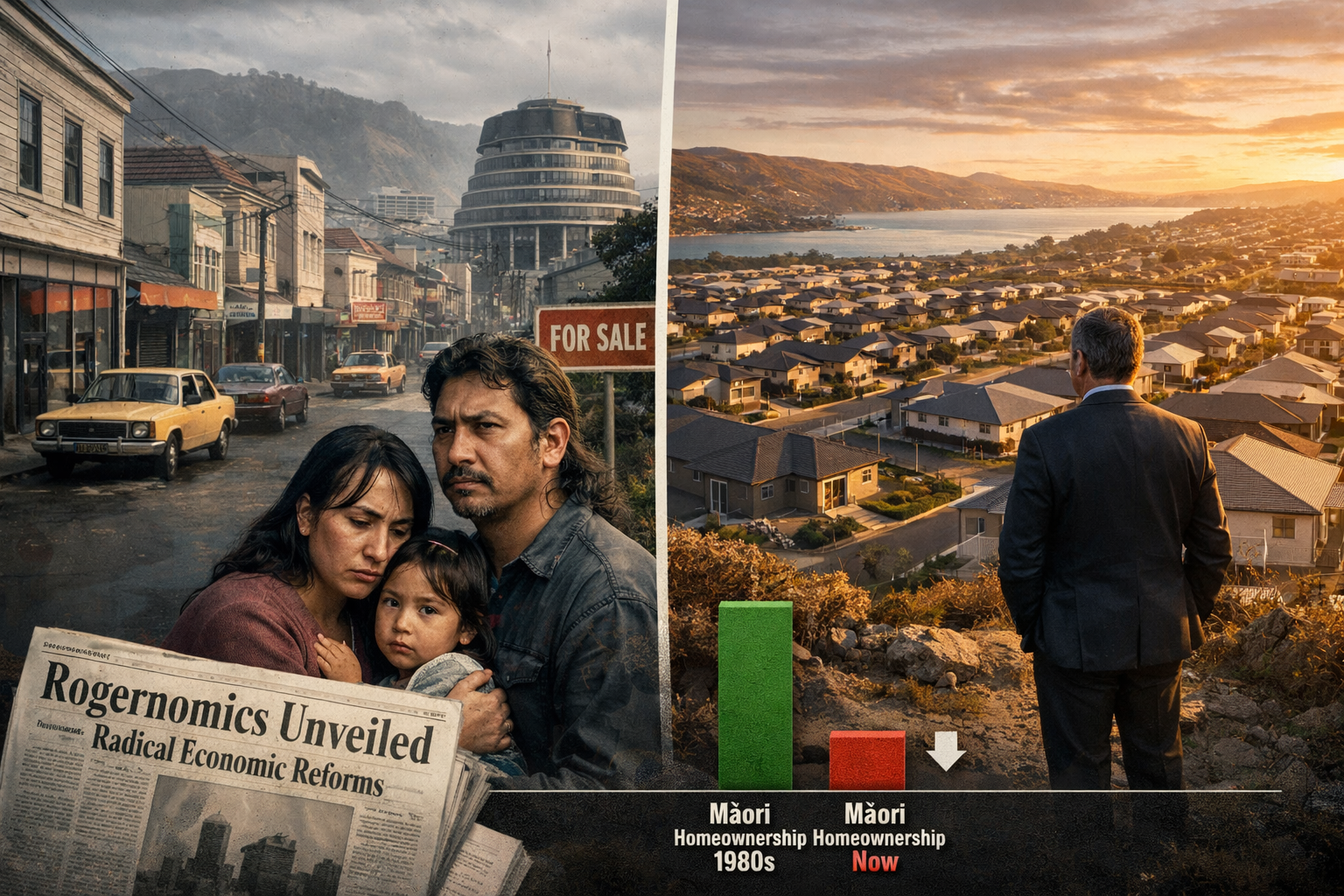
The results have been catastrophic. Home ownership rates, which peaked at 73.8% in 1991, fell to 66% by the 2023 Census. For Māori, the collapse has been even more severe: just 27.5% of Māori owned or partly owned their homes in 2023, down from 31.2% a decade earlier.
ANZ research projects that if current trends persist,
“almost all Māori in Aotearoa New Zealand will be renters by 2061”.
Māori Home Ownership Collapse vs. National Decline (1991–2023)
Roger Douglas Needs To Go To Jail
The Waitangi Tribunal’s Verdict: The Crown Has Failed
This is not merely an economic failure. It is a breach of Te Tiriti o Waitangi. In 2023, the Waitangi Tribunal found the Crown had breached its Treaty obligations in its housing policy and homelessness response. The Crown formulated a definition of homelessness that excluded Māori concepts of home and whānau, failed to prioritise Māori in policy design despite their disproportionate representation among the homeless, and systematically ignored its Article 2 guarantee to protect Māori in the “full exclusive and undisturbed possession of their Lands”.
The numbers are damning:
more than 60% of those experiencing homelessness in mid-2025 identify as Māori. Māori are 394.0 per 10,000 severely housing deprived, compared to national averages.
Research shows that merely “looking Māori”
—displaying physical features that identify someone as Māori to others—predicts decreased rates of home ownership, even after controlling for income, education, and area deprivation.
This is institutional racism, pure and simple:
the lending industry discriminates based on perceived ethnicity.
Structural barriers compound this violence. Māori wanting to build on collectively-owned whenua face a Kafkaesque process:
prove whakapapa, obtain a Māori Land Court license to occupy, convince banks to lend on land they cannot legally seize (houses must be removable, typically on piles or stilts, because if the mortgage defaults, the house must be moved). Banks treat homes on Māori land as inherently temporary, stripping away the ontological security that is supposed to be the whole point of home ownership.
As one researcher put it: “Only on Māori land do you see that kind of restriction”.
This, too, is whakapapa:
colonial building laws have restricted Māori housing autonomy for 180 years. Before colonisation, kāinga were self-determined, sustainable, organised at hapū level; homelessness was “virtually unimaginable”. Māori had dedicated areas for gathering raupō, nikau, and timber, and knowledge about harvesting cycles
—systems the Crown actively dismantled to impose a “British” mode of living.
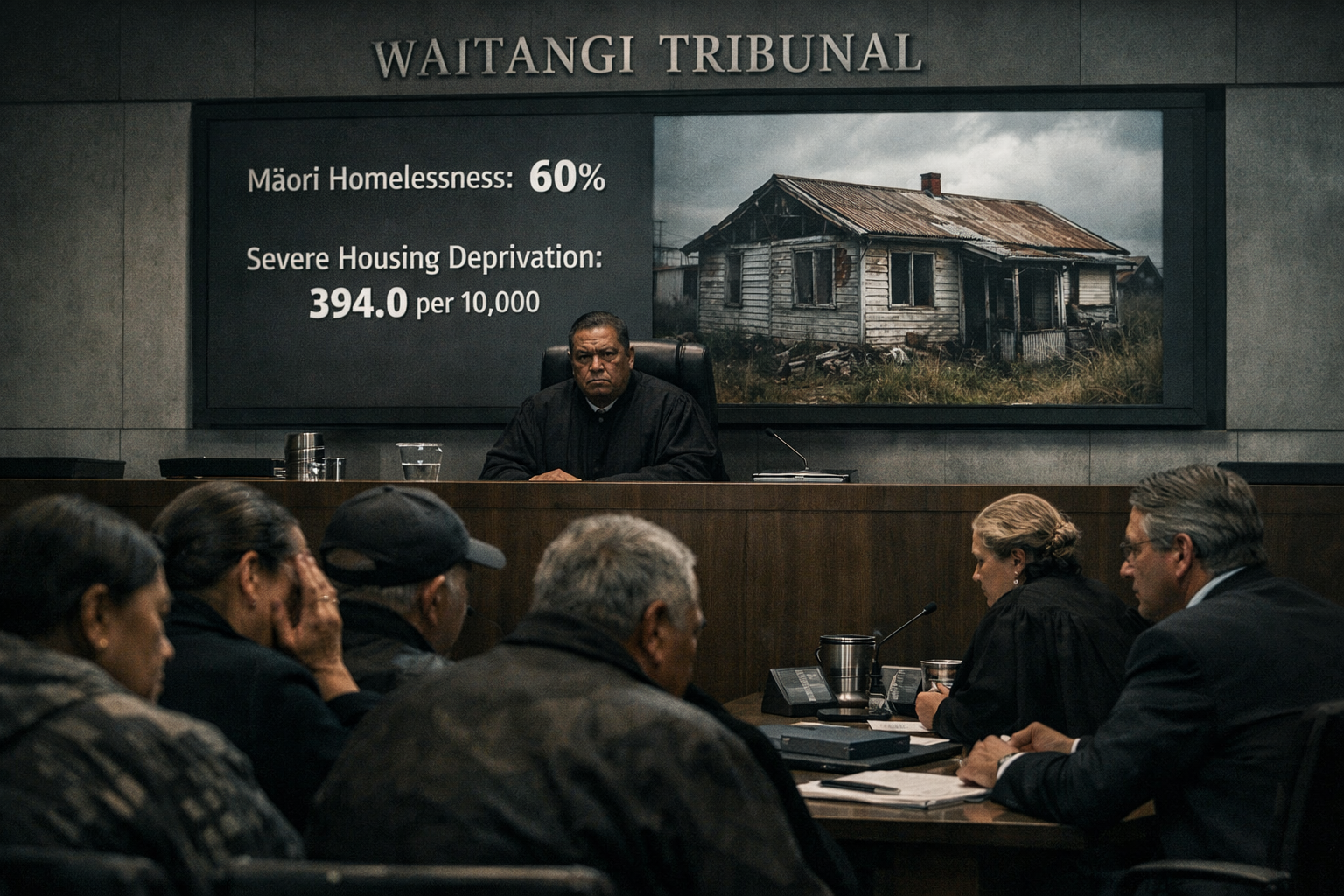
The Numbers Are Damning
The Billionaire’s Theatre: Deconstructing the “Gift”
Against this backdrop of systemic failure, Roger Fewtrell’s project appears heroic. He is building 250 homes and “giving” buyers $100,000. But let’s apply the forensic lens of a forensic accountant to this “charity.”
Fewtrell made his fortune by selling Southern Hospitality—a company he co-founded—to ECF Group, a French multinational private equity firm, in February 2023.
This is the classic neoliberal wealth extraction cycle:
build a local asset, sell it to global capital, and then “give back” a fraction of the proceeds to the community you extracted value from.
The math of his “loss” is revealing. The median house price in Dunedin is roughly $635,000. Building costs in Otago are around $2,950 per square meter, meaning a standard 150sqm home costs roughly $442,500 to build, plus land. Developers typically aim for a 20% margin.
If Fewtrell builds 250 homes and sells them at market value ($158 million total revenue), his “loss” of $25 million ($100k per house) is likely just a reduction of his developer profit margin.
He is not “losing” money in the sense of going bankrupt;
he is arguably just making less profit than a ruthless developer would.
The Developer’s ‘Gift’: How a $100k Subsidy Still Generates Profit
Moreover, by subsidising deposits, he is effectively subsidising the banks.
That $100,000 equity injection allows a low-income family to take on a $500,000 mortgage they otherwise couldn’t get. Who wins? The Australian-owned banks (ANZ, Westpac, BNZ, ASB) who get a new 30-year interest stream. The system remains perfectly intact. The “gift” doesn’t challenge the market; it lubricates it.

These Billionaires Need To Be Put In Their Place
The Wealth Chasm: Why We Need a Wealth Tax, Not Charity
The existence of 18 billionaires in a country of 5 million people is a policy failure. The 2025 NBR Rich List reveals that New Zealand’s wealthiest 119 individuals and families hold a collective $102.1 billion—more than 40% of the country’s GDP. Meanwhile, the bottom 50% of the population holds just 2.1% of the wealth.
The Great Wealth Divide: Median Wealth of Māori vs. Pākehā and the Top 1% in Aotearoa (2025)
This wealth isn’t “earned” in the sense of hard work. It is accumulated through capital gains, untaxed inheritances, and monopoly power. Oxfam reports that 60% of billionaire wealth comes from unearned sources. In New Zealand, we tax wages—the fruit of your labour—at up to 39%, but we tax capital gains—the fruit of your assets sitting there—at 0% (excluding the bright-line test).
This is why we have a housing crisis. Housing is the primary vehicle for wealth accumulation in New Zealand. When you tax work but not wealth, money floods into property, driving up prices and locking out workers. Roger Fewtrell’s $25 million “gift” is a drop in the bucket compared to the billions extracted from working families by this tax system every year.

The Top 10% hold 50% Of The Wealth
The Solution: Rangatiratanga, Not Philanthropy
We don’t need billionaires to save us. We need a government that governs for people, not capital.
We need:
- A Comprehensive Capital Gains Tax and Wealth Tax: To stop housing being a speculative casino and fund public infrastructure.
- Māori Housing Autonomy: The Crown must devolve power and resources to iwi and hapū to build papakāinga on their own whenua, exempt from colonial red tape that assumes Pākehā ownership models.
- The Restoration of the Ministry of Works: To build affordable, high-quality homes at scale, driving down costs and breaking the private sector’s stranglehold on supply.
- A Constitutional Transformation: Implementing the recommendations of Matike Mai Aotearoa to create a political system based on Te Tiriti, where Māori have real power to design housing solutions that work for whānau.
Roger Fewtrell’s heart may be in the right place. But we should not be grateful for a system where one man’s whim determines whether 250 families get a home. That is not justice. That is feudalism with better PR.
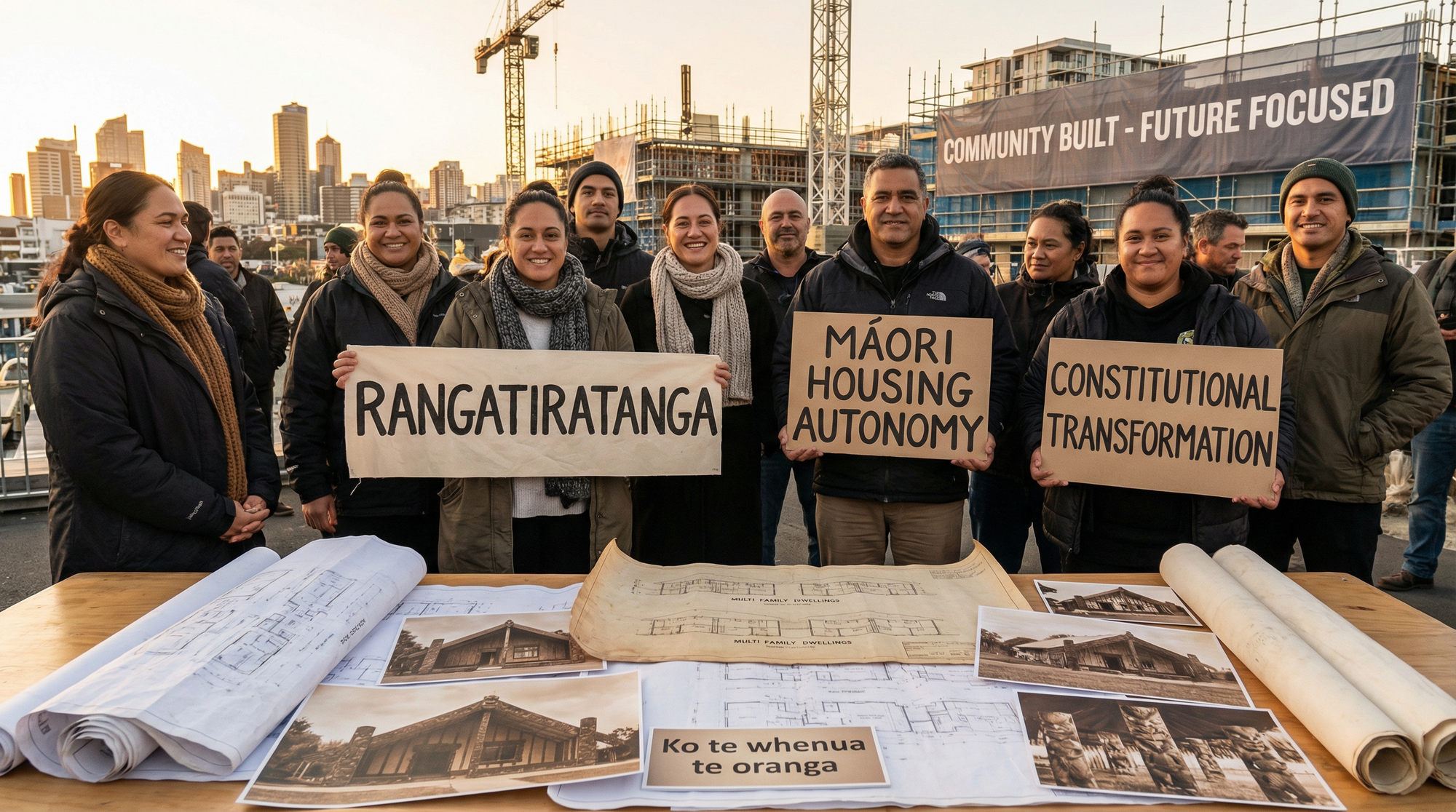
Rangatiratanga = Māori Housing Autonomy = Constitutional Transformation
Koha Consideration
Three pathways exist:
For those who wish to support this mahi directly with a koha (voluntary contribution), please visit the Koha platform:
Koha—Support - https://app.koha.kiwi/events/the-maori-green-lantern-fighting-misinformation-and-disinformation-ivor-jones
For those who wish to receive essays directly and support through subscription, join the Substack community:
Subscribe to the Māori Green Lantern on Substack - https://themaorigreenlantern.substack.com/subscribe
For those who prefer direct bank transfer, account details are: HTDM, account number 03-1546-0415173-000.
Every koha signals that whānau are ready to fund the accountability that Crown and corporate structures will not provide. It signals that rangatiratanga includes the power to fund our own truth tellers.
Kia kaha, whānau. Stay vigilant. Stay connected. And if you are able, consider a koha to ensure this voice continues.

Ivor Jones The Māori Green Lantern Fighting Misinformation And Disinformation From The Far Right