“When Children Are Just Budget Line Items to Cut” - 24 October 2025
The Statistical Sleight of Hand That Betrays Our Most Vulnerable
Kia ora koutou.
Ko te mea tuatahi me kōrero ināianei: Karen Chhour and her government handlers are playing a sick numbers game with the broken bodies of our tamariki while pretending to be their saviors. The real story buried in their self-congratulatory press release is not that three fewer children were harmed in residential care this year. The real story is that 530 children suffered abuse in state care over twelve months, that harm in residential facilities has exploded by 436 percent since 2021, that community services protecting our whānau had $30 million ripped away, and that Chhour openly admitted she cherry-picked statistics to manufacture a political win. This is not incompetence. This is calculated cruelty dressed up as reform, neoliberal austerity with a brown face selling it, and white supremacist policy repackaged as child protection.
Background
To understand how thoroughly Chhour and RNZ reporter Russell Palmer have manipulated this narrative, we need to establish what Oranga Tamariki actually does and what the recent data actually shows. Oranga Tamariki, the Ministry for Children, tracks harm across four categories of state care: non-family care, care of wider family, return or remain home with parents, and residential care facilities. The October 2024 annual report revealed 530 children experienced reported harm in the twelve months to March 2025, with 896 total findings of harm meaning one in five harmed children suffered multiple incidents of physical abuse, sexual abuse, emotional abuse, or neglect.
On October 21, 2025, Chhour issued a press release celebrating the first recorded drop in harm within Youth Justice and Care and Protection residences, trumpeting a 14 percent decrease since 2024. What she concealed in that announcement is that this represented exactly three fewer children harmed, dropping from 118 in 2024 to 115 in 2025, while harm in residential facilities had skyrocketed from just 22 children in 2021. More critically, her statement made no mention whatsoever of the overall four percent increase in recorded harm across the wider state care system.
The context demanded includes understanding that Māori children are grossly overrepresented in every harmful statistic. The Royal Commission of Inquiry into Abuse in Care found that between 1950 and 1999, up to 42 percent of Māori children placed in state residential care went on to receive prison sentences later in life. Current Oranga Tamariki data shows 81 percent of children abused in care are Māori, despite Māori making up 69 percent of children in care. This is not coincidence. This is structural racism embedded in policy, colonisation by another name, genocide on the installment plan.
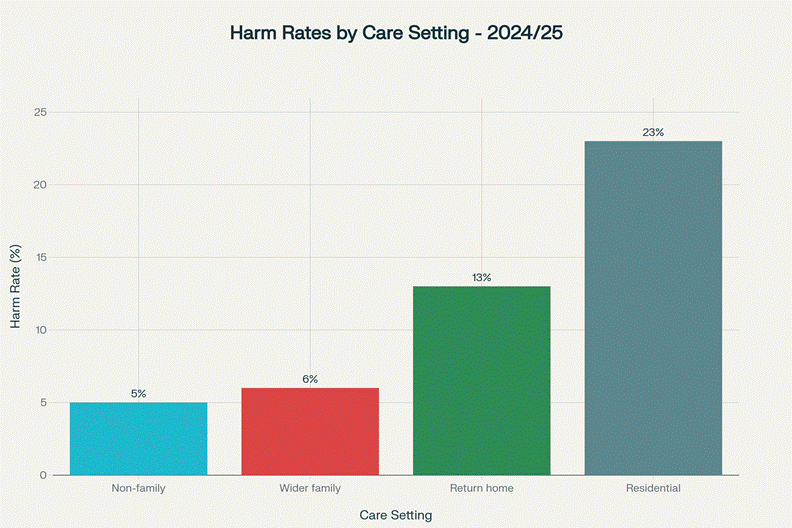
This chart reveals that children in residential care facilities experience harm at rates nearly five times higher than those in non-family care, exposing the failure of government-managed facilities despite Minister Chhour’s cherry-picked celebration of a mere three-child reduction.
What is really going on here?
The issue demanding exposure is threefold: First, Chhour’s deliberate statistical manipulation to manufacture political capital from child suffering. Second, Palmer and RNZ’s complicity in initially amplifying this deception without proper contextualization. Third, the systematic dismantling of community-based prevention services while residential harm spirals upward. This matters profoundly to Māori because we are the ones filling these facilities, suffering these harms, and watching our tamariki cycled through systems designed to break rather than heal them.
When Children’s Commissioner Claire Achmad and the Independent Children’s Monitor released their statement within hours of Chhour’s announcement, they emphasized what the minister concealed: overall harm in state care had increased, 530 children were harmed with 896 findings meaning repeated abuse, and the celebrated reduction represented exactly three children. Achmad told RNZ it was unacceptable to see harm increase, stating we are talking about really serious harm including physical abuse, sexual abuse, emotional abuse and neglect.
This analysis matters because it exposes how ACT Party neoliberal ideology operates: slash community services that prevent harm, celebrate marginal improvements in facilities you directly control, blame external factors for increases everywhere else, and present yourself as the solution to problems you deliberately created. The scope covers not just this single statistical misrepresentation but the entire architecture of austerity policies disguised as child protection reform.
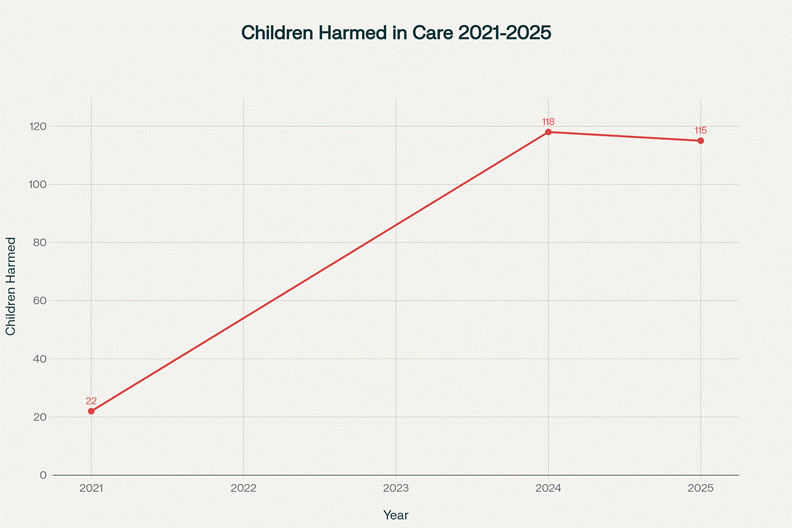
This chart exposes Minister Chhour’s statistical manipulation - celebrating a drop from 118 to 115 harmed children while concealing the catastrophic 436% increase from 22 children harmed in 2021 under the previous government.
The Numbers Game: How to Lie With Statistics While Children Suffer
Chhour’s October 21 press release exemplifies a propaganda technique called selective data presentation. By focusing exclusively on the 14 percent reduction in residential care harm while omitting the overall four percent increase, she practiced what Labour spokesperson Willow Jean Prime correctly identified as cherry-picking data to score political points. The mathematical reality demolishes her narrative: harm in residential facilities increased from 22 children in 2021 to 118 in 2024, a 436 percent explosion under policies she and her coalition now own, before dropping to 115 in 2025. Celebrating three fewer harmed children while concealing that you presided over nearly 100 additional children being harmed compared to four years ago is not transparency. This is fraud.
The harm rate disparities across care settings reveal where the system fails most catastrophically. Residential facilities show 23 percent of children harmed, return or remain home placements show 13 percent, care of wider family shows 6 percent, and non-family care shows 5 percent. Children in residential facilities face abuse at rates nearly five times higher than those in non-family care. Yet Chhour defended her focus on residential care by claiming that area was underinvested in for so long that we need to actually talk about the wins. What wins? A facility system that harms nearly one in four children in its care?
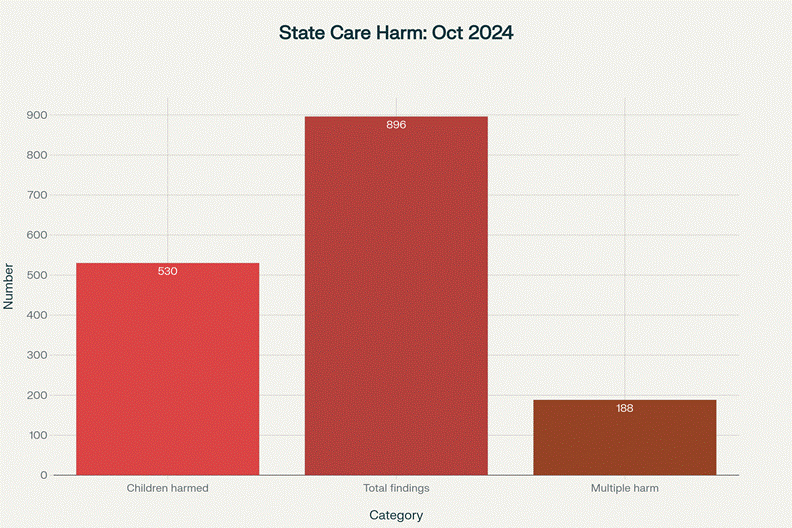
This chart reveals the system’s repeated failures - 896 total findings of harm mean that one in five children in state care experienced abuse more than once, a pattern of systematic re-traumatisation that Chhour’s media statement conveniently omitted.
More damning is what happens to children the system claims to protect through return or remain home placements. These showed the highest proportion of harm on record, accounting for 24 percent of all harm findings despite representing only 1,019 total children. Chhour argued that 60 percent of harm happens out in the community, not by caregivers, claiming it could include things like a young person going to school and getting beaten up at school or a child walking to school and getting attacked by a stranger, therefore that is kind of out of the hands of Oranga Tamariki. This is breathtaking deflection. When you return children to unstable home environments, cut the community services that provided wraparound support, and then blame community violence for the resulting harm, you are manufacturing the crisis you claim to be helpless against.
The Thirty Million Dollar Betrayal: Austerity as Child Abuse
Follow the money, because Chhour’s statistical games become comprehensible when examined through the fiscal decisions her government made. Oranga Tamariki’s annual report shows $30 million was cut from the agency’s contracting spend in 2024, part of a $45 million total reduction in baseline spending. Prime questioned whether cuts to community service providers who provide wraparound services and support had perhaps had some impact on those harm numbers, noting this minister has cut $30 million a year from social services in our community for prevention and early intervention work, with community providers warning that more children would be harmed.
Chhour disputed this characterization, claiming we are still spending exactly the same amount of money, what we have done is we have actually reprioritised the areas where it is most needed. This is a lie wrapped in technocratic language. The reality documented by RNZ is that Oranga Tamariki cut funding for 236 social services providers to save $30 million, with the budget for contracted services unchanged at $500 million for five years, meaning a 21 percent cut in real funding after consumer price inflation. Auckland’s North Shore Women’s Centre closed after 38 years providing support to 500 women and almost as many children annually when its $118,000 Oranga Tamariki contract was cut.
The Auditor-General’s report found decisions were not adequately informed by evidence of how they would affect children and their families, with effects on children still not known, stating given that this is the core role of Oranga Tamariki, it is unacceptable. Children will have been impacted as providers had to stop services or move children to other providers at short notice. This is neoliberalism’s core operation: defund prevention, let crisis proliferate, then celebrate marginal improvements in crisis response while blaming everyone except yourself for the catastrophe you engineered.
The ACT Party Ideological Machine: White Supremacy With a Brown Spokesperson
Understanding Chhour requires understanding the party she represents. ACT New Zealand was founded as the Association of Consumers and Taxpayers by Roger Douglas, architect of Rogernomics that transformed New Zealand’s economy from protectionist to free market through extensive deregulation. ACT’s platform emphasizes reducing government programs seen as unnecessary, increasing self-reliance by encouraging individuals to pay for services traditionally paid for by governments, and tough-on-crime policies focused on controlling gangs. The party wants to abolish Māori electorate seats, hold a referendum on Māori co-governance arrangements, and believes the Treaty of Waitangi was not a partnership.
Chhour herself presents as someone with lived experience of state care, of Ngāpuhi descent, regularly running away from home before ending up in foster care. Her maiden speech recounted harrowing childhood experiences and why she has interest in Oranga Tamariki change. Yet she now implements policies that critics identify as racist, including military-style academies where nine of ten young people are Māori. This is how colonization adapts: recruit brown faces to implement white supremacist policy, then claim any criticism is attacking indigenous achievement.
The coalition agreement between National, ACT, and New Zealand First committed to scrapping Labour’s Fair Pay Agreements, co-governance policies, and Māori Health Authority while establishing ACT’s Ministry for Regulation to review legislation quality. This is structural adjustment targeting the infrastructure of indigenous rights and worker protections. When Chhour cuts community services while celebrating residential care improvements, when she tells disgruntled providers that she expects a more rigorous approach to contracting, when she diverts accountability for harm to community violence, she executes ACT’s vision of a minimal state that abandons vulnerable populations to market discipline.
RNZ’s Failure: Stenography Masquerading as Journalism
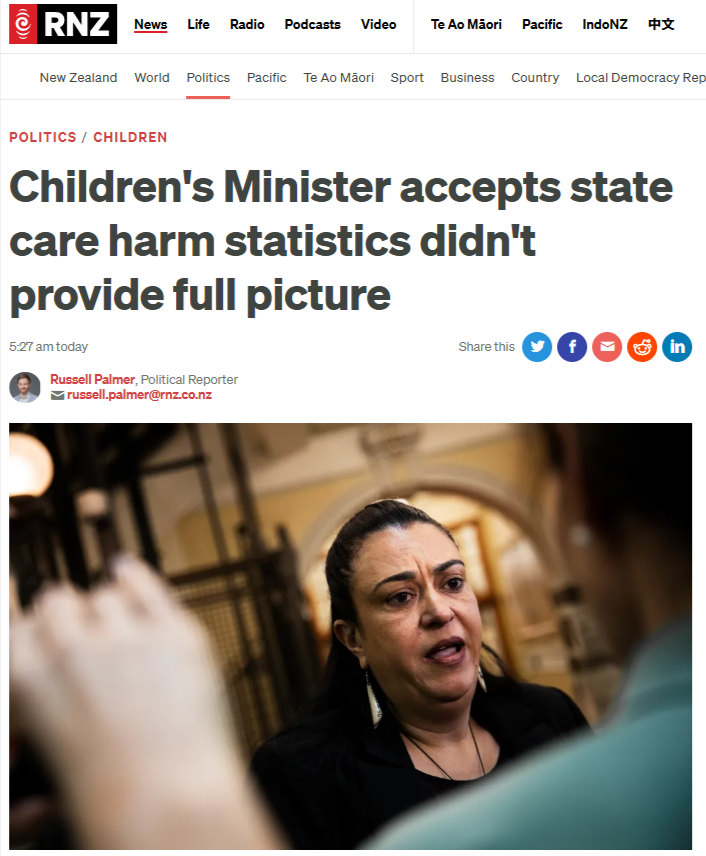
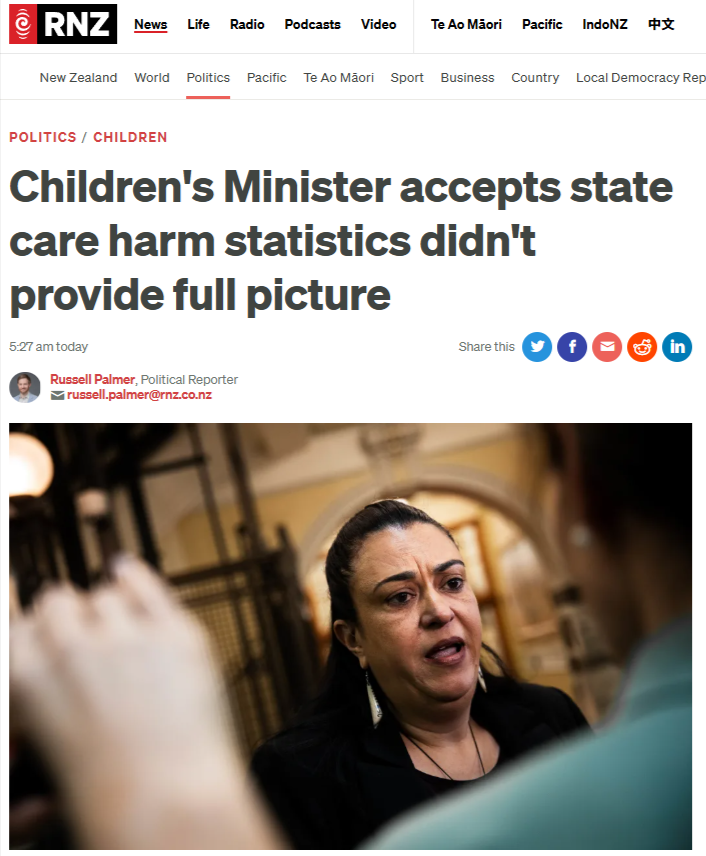
Russell Palmer’s initial reporting on October 21 amplified Chhour’s narrative uncritically, headlining that state care residences report first recorded reductions in harm and leading with the government celebrating what it says is the first recorded reduction. Only when oversight agencies released their contradictory statement did Palmer and RNZ publish the fuller picture acknowledging Chhour’s initial celebration did not provide the full picture. This is journalism in name only.
Palmer had access to the Oranga Tamariki report containing all four harm categories. He could have immediately contextualized that the celebrated reduction represented three children, that overall harm increased four percent, that residential harm had exploded since 2021. Instead he waited for official contradictors to do his job. This pattern of stenographic journalism serves power by allowing manipulated narratives time to circulate and embed before corrections arrive. RNZ receives public funding precisely to provide independent scrutiny of government claims. When it fails this basic function, when it platforms ministerial propaganda without immediate critical analysis, it becomes complicit in the harm that follows.
The broader New Zealand media environment enables this failure. Commercial pressures and resource constraints mean journalists lack time for deep investigative work. Political reporters develop relationships with sources that create incentives to maintain access rather than challenge narratives. The result is a media ecosystem where ministers can cherry-pick statistics, hold press conferences announcing victories, and count on initial coverage amplifying their message before corrections trickle out days later to smaller audiences. This is information warfare, and children are casualties.
The Royal Commission Evidence: Pattern and Precedent
Context for these failures comes from the Royal Commission of Inquiry into Abuse in Care which investigated abuse of tamariki, rangatahi, and people with disabilities in state and faith-based institutions between 1950 and 2019. The Commission estimated up to 200,000 people were abused in care, with Māori disproportionately impacted and over-represented, suffering higher levels of physical abuse compared with other ethnicities. Between 1950 and 1999, one out of every three children placed in residential care by the state went on to serve a prison sentence later in life, with up to 42 percent of Māori children in state residential care receiving prison sentences.
The Commission found Māori were more likely to be taken into care, dislocated from their culture, then faced harsher treatment because of their ethnicity and skin colour. Racist targeting by police and social workers, along with harsher sentences by youth courts, significantly contributed to this over-representation. The state’s use of formal powers and compulsory care options was often discriminatory, with legal orders more frequently used against Māori instead of supporting community-based or whānau-based care. This is not historical. This is ongoing.
Current data shows Māori babies are five times more likely to end up in state care than non-Māori, with the rate of urgent entries into state care for Māori babies having doubled since 2010 while the rate for non-Māori has not changed. In 2018, the rate of state custody for Māori under 18 was almost seven times higher than non-Māori, up from five times higher in 2014. When Chhour celebrates marginal improvements in residential harm while cutting community services that prevent Māori children entering care, she perpetuates exactly the systemic racism the Royal Commission documented. She is not reforming the system. She is refining its capacity to harm.
Implications
The broader implications extend beyond individual policy failures to questions of democratic accountability and media function. When ministers can deliberately misrepresent data to manufacture political victories, when initial media coverage amplifies these deceptions, when corrections arrive too late and reach too few, we face information crisis as dangerous as the child protection crisis itself. Research shows political parties in New Zealand use sophisticated communication strategies across multiple platforms. The ability to frame narratives, control information flow, and present partial truths as complete pictures determines which policies survive scrutiny.
For Māori communities specifically, these implications are existential. We watch our tamariki cycled through systems proven to cause long-term harm, with research showing people placed in state care between 1950 and 1999 died on average about 24 years younger than the general population, with causes of death generally more violent through self-harm, motor vehicle accidents and assaults. This is genocide’s arithmetic: take indigenous children from their families, traumatize them in institutions, watch them die young. The fact that a Māori woman now administers this system does not change its essential character. It makes the betrayal more profound.
The connection to larger patterns of neoliberal policy is direct. Cut social spending, let crises proliferate, respond with punitive rather than preventative measures, blame individuals for structural failures, privatize what remains profitable and abandon the rest. ACT’s ideology treats vulnerable children as budget line items rather than human beings requiring care. When resources get tight, cut services to those who cannot fight back. When outcomes worsen, celebrate any marginal improvement while burying overall deterioration. When critics object, accuse them of not understanding fiscal responsibility. This is austerity’s playbook, executed with precision.
Impact on Māori transcends immediate harm to children in care. Every Māori child traumatized in state institutions carries that trauma into adulthood, potentially passing it to the next generation. Every whānau destroyed by child removal suffers wounds that may never heal. Every preventable death represents not just individual tragedy but collective loss of knowledge, connection, and future potential. When 81 percent of children abused in care are Māori, when we face five times higher rates of our babies entering state custody, when 42 percent of Māori children in historical state care went on to serve prison sentences, we face systematic destruction of our people disguised as child protection.

The Māori Green Lantern Fighting Misinformation And Disinformation From The Far Right
Karen Chhour’s statistical manipulation exposes how neoliberal governments operate when defending indefensible policies. Cherry-pick data showing marginal improvements. Conceal overall deterioration. Cut prevention services that reduce crisis. Celebrate improvements in crisis response. Blame external factors for continued failures. Attack critics as politically motivated. Repeat. This pattern transcends individual dishonesty to reveal systematic governance failure where political optics matter more than child safety, where budget cuts trump human need, where ministers prioritize careers over the children they claim to protect.
RNZ and Russell Palmer’s complicity in initially amplifying Chhour’s narrative demonstrates journalism’s failure at its most critical function: holding power accountable. When reporters become stenographers, when initial coverage platforms government propaganda without immediate critical context, when corrections arrive only after oversight agencies do journalism’s job, we lose the information infrastructure democracy requires. Media that cannot immediately identify statistical manipulation in ministerial announcements cannot protect vulnerable populations from those who abuse power.
The real story buried under Chhour’s celebration is catastrophic: 530 children harmed in the past year with 896 findings meaning one in five suffered multiple incidents of abuse. Harm in residential facilities exploded 436 percent from 22 children in 2021 to 118 in 2024. Community services that prevented harm had $30 million cut with 236 contracts discontinued. Māori children face systematic overrepresentation in every category of harm. This is not reform. This is austerity weaponized against the most vulnerable, colonization continuing under new management, genocide by spreadsheet rather than direct violence.
We must demand complete transparency in Oranga Tamariki data reporting. We must require media to immediately contextualize ministerial announcements rather than amplify them. We must restore and expand community-based prevention services proven to reduce harm. We must center Māori solutions and indigenous knowledge in child protection. We must hold accountable those who cherry-pick statistics while children suffer. Most fundamentally, we must recognize that a system producing these outcomes cannot be reformed from within. It must be dismantled and rebuilt on foundations of manaakitanga, whanaungatanga, and genuine commitment to child wellbeing over political performance.
The Royal Commission documented systematic abuse across generations. Current data shows harm continuing and intensifying. Ministers celebrate marginal improvements while concealing catastrophic failures. This is not acceptable. This is not sustainable. This will not stand.
For those who find value in this mahi and wish to support The Māori Green Lantern’s work exposing these injustices, please consider a donation or koha to HTDM: 03-1546-0415173-000. I understand these are tough economic times for whānau, so please only contribute if you have capacity and wish to do so. Your support enables continued investigation and exposure of those who harm our most vulnerable.
Kia kaha, kia māia, kia manawanui.
The Māori Green Lantern
1. https://www.rnz.co.nz/news/political/576792/children-s-minister-accepts-state-care-harm-statistics-didn-t-provide-full-picture
2. https://jovacet.ac.za/index.php/JOVACET/article/view/413
3. https://www.rnz.co.nz/news/on-the-inside/576091/how-jim-bolger-became-the-master-of-the-smoke-filled-room
4. https://www.nzherald.co.nz/nz/politics/oranga-tamariki-service-provider-speaks-out-on-struggling-with-funding-reductions-greens-raise-concern/2HGBVCCPZJHM3GV7OAOUWOQOBM/
5. https://www.nzherald.co.nz/kahu/opinion-although-act-is-notionally-a-libertarian-party-it-has-little-respect-for-the-te-tiriti/IODWUFDLR5GNVMVLLBQ57YDZPA/
6. https://e-tangata.co.nz/comment-and-analysis/the-survivors-of-state-abuse-have-not-been-heard/
7. https://nzccss.org.nz/oranga-tamariki-still-owes-millions-to-care-providers/
8. https://www.acpjournals.org/doi/10.7326/0003-4819-143-4-200508160-00010
9. /content/files/anthology/2021-nlp4if-1-10.pdf
10. https://www.tandfonline.com/doi/full/10.1080/1461670X.2016.1171163
11. https://www.degruyter.com/document/doi/10.1515/opli-2020-0175/pdf
12. /content/files/anzsw/article/download/802/728.pdf
13. http://www.emerald.com/jmlc/article/26/7/224-238/238224
14. /content/files/teachers-work/article/download/148/242.pdf
15. http://www.cultureunbound.ep.liu.se/v7/a39/cu15v7a39.pdf
16. /content/files/en/download/article-file/1440230.pdf
17. https://www.tandfonline.com/doi/pdf/10.1080/23311886.2020.1731121?needAccess=true
18. https://www.rnz.co.nz/news/political/512142/deputy-pm-winston-peters-attacks-media-over-speech-reporting
19. https://www.manamokopuna.org.nz/about/people/dr-claire-achmad/
20. https://en.wikipedia.org/wiki/Sixth_National_Government_of_New_Zealand
21. https://www.rnz.co.nz/news/political/476201/media-sector-demands-more-detail-over-rnz-tvnz-mega-entity-merger
22. https://www.beehive.govt.nz/release/strengthened-oversight-oranga-tamariki-system
23. https://theconversation.com/nz-election-2023-labour-out-national-in-either-way-neoliberalism-wins-again-214723
24. https://www.semanticscholar.org/paper/1b39fb16b37828d3acfe33b85d74655d2de47074
25. https://www.rnz.co.nz/authors/russell-palmer/stories?story_type=audio
26.
https://www.manamokopuna.org.nz
27. https://www.rnz.co.nz/news/political/500479/nz-election-2023-labour-out-national-in-either-way-neoliberalism-wins-again
28. https://www.rnz.co.nz/authors/russell-palmer
29. /content/files/index-php/k/article/download/379/322/957.pdf
30. https://en.wikipedia.org/wiki/Karen_Chhour
31. /content/files/cms/assets/Documents/Periodic-Reviews/UPR-Pre-Session-7-March-2024-at-HRC-Wgtn-New-Zealand-Factsheets-and-Presentations/cooper-legal-state-care_fact-sheet_march-2024.pdf
32. https://nz.linkedin.com/in/karen-chhour-aa515b97
33. https://www.beehive.govt.nz/release/first-quarterly-oranga-tamariki-performance-data-released
34. https://www.childmatters.org.nz/media-information/statistics/
35. https://www.act.org.nz/people/karen-chhour
36. https://www.beehive.govt.nz/release/oranga-tamariki-showing-clear-progress-key-performance-targets
37. Children-s-Minister-accepts-state-care-harm-statistics-didn-t-provide-full-picture-_-RNZ-News.pdf
38. https://www.beehive.govt.nz/release/first-ever-reduction-harm-state-care-residences
39. https://www.beehive.govt.nz/minister/biography/karen-chhour
40. https://www.newstalkzb.co.nz/on-air/early-edition-with-ryan-bridge/audio/karen-chhour-childrens-minister-on-more-children-are-being-harmed-in-oranga-tamarikis-care/
41. https://www.rnz.co.nz/news/political/576661/state-care-residences-report-first-recorded-reductions-in-harm
42. https://www.parliament.nz/en/mps-and-electorates/members-of-parliament/Chhour-Karen
43. https://reimaginingsocialwork.nz/2024/07/26/close-the-boot-camps/
44. /content/files/assets/Uploads/About-us/Research/Latest-research/Understanding-the-increase-in-reports-of-concern/reports-of-concern-2024-increase-and-future-demand.pdf
45. https://www.facebook.com/karenchhourACTlistmemberofparliament/mentions/
46.
47. https://www.vine.org.nz/knowledge-hub/violence-statistics/government-data
48. https://www.semanticscholar.org/paper/c1064f537dc8e4493f2c8715ee5a3a3918425688
49. https://www.facebook.com/actparty/posts/karen-chhour-mp-is-a-māori-woman-who-survived-state-care-shes-removing-s7aa-beca/954029519612632/
50. https://www.newstalkzb.co.nz/on-air/early-edition-with-ryan-bridge/audio/full-show-podcast-23-october-2025/
51. https://www.rnz.co.nz/news/political/428434/act-party-candidate-profiles-who-might-join-david-seymour-in-parliament
52. https://www.1news.co.nz/2024/07/25/oranga-tamariki-more-children-entered-state-care-in-past-year/
53. https://www.nzherald.co.nz/nz/politics/acts-mp-bootcamp-how-the-nine-newly-minted-politicians-are-getting-match-fit/ET4OZ3GRCXW7UEKV2SFQINKZDY/
54. https://www.nzherald.co.nz/nz/politics/audrey-young-rating-the-maiden-speeches-of-parliaments-newest-mps/BKEVQ7K5G3UNWRBB4O45G3IEY4/
55. https://www.nzherald.co.nz/nz/politics/children-getting-the-bash-from-oranga-tamariki-staff-as-abuse-in-care-rises/AQXGQEZWIFFFRKU5PN5RVF4IAQ/
56. https://www.nzherald.co.nz/nz/politics/government-on-collision-course-with-waitangi-tribunal-over-karen-chhour-summons-audrey-young/R4IMCFJI3FENTDPJHQIWWEBLJY/
57. /content/files/podcasts/focusonpolitics.xml
58. https://www.rnz.co.nz/news/political/543057/number-of-children-being-abused-in-state-care-has-increased-report-finds
59. https://ejfs.springeropen.com/articles/10.1186/s41935-022-00319-w
60. https://www.rnz.co.nz/national/programmes/the-house/audio/2018776358/meet-the-new-mps-act
61. /content/files/podcasts/monday-politics.xml
62. https://www.rnz.co.nz/news/national/523014/abuse-in-care-inquiry-final-report-made-public-commissioners-call-for-reform-and-redress
63. https://www.nzherald.co.nz/nz/election-results-david-seymours-new-act/BQHTD6HAJCZQRNO5D2CKFBO5WE/
64. /content/files/arc/outboundfeeds/sitemap3/2022-10-04.xml
65. https://www.rnz.co.nz/news/national/541049/about-24-years-of-life-lost-people-placed-in-state-care-died-earlier-more-violent-deaths-study-finds
66. https://www.nzherald.co.nz/nz/election-2020-with-act-polling-at-7-per-cent-who-is-on-course-to-join-david-seymour-in-parliament/EZANCM2I6PA7SDCKSQINMOMTYY/
67. /content/files/arc/outboundfeeds/sitemap3/2024-04-23.xml
68. https://www.nzherald.co.nz/nz/election-2020-forty-newcomers-include-our-first-african-latin-american-and-sri-lankan-mps/WAU467WZ6Q2FSJ4MEUOE5BQDSQ/
69. https://www.rnz.co.nz/news/national/575038/people-can-be-harmed-while-anti-stalking-legislation-inches-through-parliament-advocate
70. http://www.canjsurg.ca/lookup/doi/10.1503/cjs.004922
71. https://link.springer.com/10.1007/s10460-023-10414-w
72. https://www.cogitatiopress.com/politicsandgovernance/article/view/4788
73. https://www.tandfonline.com/doi/full/10.1080/19491247.2019.1638134
74. https://www.tandfonline.com/doi/full/10.1080/03036758.2024.2430597
75. https://link.springer.com/10.1007/s40841-023-00278-3
76. /content/files/downloads/press/n4300/ch14.pdf
77. https://www.mdpi.com/2078-2489/14/3/152
78. http://act.maydaygroup.org/volume-20-issue-3/music-education-and-the-neoliberal-turn-in-aotearoa-new-zealand/
79. https://ojs.victoria.ac.nz/nzsr/article/view/10277
80. https://www.mdpi.com/1660-4601/19/5/2981
81. https://ascopubs.org/doi/10.1200/JCO.2024.42.16_suppl.3010
82. /content/files/anzsw/article/download/220/290.pdf
83. /content/files/anzjsi/article/download/46/25.pdf
84. /content/files/kotare/article/download/684/495.pdf
85. /content/files/anzsw/article/download/159/242.pdf
86. /content/files/anzsw/article/download/824/738.pdf
87. http://www.cultureunbound.ep.liu.se/v7/a37/cu15v7a37.pdf
88. https://onlinelibrary.wiley.com/doi/pdfdirect/10.1111/j.1468-0491.2010.01508.x
89. /content/files/anzsw/article/download/221/292.pdf
90. https://en.wikipedia.org/wiki/ACT_New_Zealand
91. https://www.vine.org.nz/news/oranga-tamariki---ministry-for-children-publishes-data-on-harm-to-children-in-state-care
92. https://www.jmir.org/2024/1/e47389
93.
94. https://www.massey.ac.nz/about/news/opinion-nz-politics-soft-neoliberal-underbelly/
95. https://www.abuseincare.org.nz/our-progress/library/v/500/care-to-custody-incarceration-rates-research-report
96. https://www.psa.org.nz/news-media/children-pay-price-of-oranga-tamariki-contracting-fiasco-auditor-general-issues-damning-indictment-of-govt-cuts
97. https://theconversation.com/acts-attempt-at-regulatory-reform-in-nz-has-failed-3-times-already-whats-different-now-220140
98. /content/files/__data/assets_file/0024/28473/royal-commission-of-inquiry-into-abuse-in-care-research-report-what-we-know-about-the-numbers-of-people-in-care-and-the-extent-of-abuse-in-care-november-2020.pdf
99. https://www.rnz.co.nz/news/political/540359/future-grim-for-intervention-services-after-oranga-tamariki-cuts
100. https://www.saanz.net/wp-content/uploads/2024/04/Roper_Neoliberalism-in-New-Zealand_NZS-391_pp-39-59.pdf
101. https://www.abuseincare.org.nz/reports/whanaketia/preliminaries/summary-of-key-findings
102. https://www.sspa.org.nz/news/article/community-based-social-services-on-edge-funding-cuts-threaten-children
103. https://account.ijic.org/index.php/up-j-ijic/article/view/9419
104. https://www.act.org.nz/policies
105. https://www.abuseincare.org.nz/reports/whanaketia/part-2/chapter-8
106. https://www.nzherald.co.nz/nz/politics/oranga-tamariki-scraps-337-service-contracts-pulls-139m-in-funding-citing-under-delivery/3Y2U4UHEGZFV7PS5BOIHAJTNKQ/
107. https://www.nzherald.co.nz/nz/election-2023-labour-out-national-in-either-way-neoliberalism-wins-again/UVJDAJVQZFGC3EFU4TVE4L4JU4/
108. https://www.abuseinquiryresponse.govt.nz/about-us/official-information/information-releases/maori-in-state-care/summary
109. https://www.beehive.govt.nz/release/minister’s-message-disgruntled-providers
110.
https://www.act.org.nz
111. https://www.abuseincare.org.nz/reports/from-redress-to-puretumu/from-redress-to-puretumu-4/1-1-introduction-2/1-1-introduction-13
112.https://www.rnz.co.nz/news/political/539921/public-service-association-calls-on-luxon-to-rule-out-privatisation-not-the-new-zealand-way
113. https://www.rnz.co.nz/news/te-manu-korihi/523020/maori-disproportionately-affected-by-state-and-faith-based-care-abuse
114.http://www.jbe-platform.com/content/journals/10.1075/ttmc.00134.pin
115. https://www.rnz.co.nz/news/political/439960/ex-act-staffer-grant-mclachlan-says-party-created-fake-grassroots-groups
116.https://www.rnz.co.nz/news/national/432925/250-000-estimated-to-have-been-abused-in-state-and-faith-based-care
117. https://www.rnz.co.nz/news/political/533476/free-lower-north-island-counselling-service-facing-uncertain-future
118. https://www.rnz.co.nz/news/political/534907/treaty-principles-bill-david-seymour-s-acknowledgement-of-rangatiratanga-raises-a-whole-lot-of-questions
119.https://www.rnz.co.nz/news/te-manu-korihi/407431/maori-babies-five-times-more-likely-to-end-up-in-state-care-stats
120. https://www.rnz.co.nz/news/national/570665/auckland-s-north-shore-women-s-centre-to-close-its-doors-due-to-funding-shortfalls
121.https://www.rnz.co.nz/news/political/563636/the-regulatory-standards-bill-what-is-it-what-does-it-propose-and-what-s-next
122. https://www.rnz.co.nz/news/te-manu-korihi/432985/abuse-in-care-interim-report-irresponsible-data-specialist
123. https://www.1news.co.nz/2024/08/02/social-service-provider-family-start-losing-14m-in-funding/
124. https://www.nzherald.co.nz/nz/royal-commission-of-inquiry-into-abuse-in-care-what-the-find-report-says/6L4RA5OD2JBHVHDBWFYDYRMSXA/