“Julian Batchelor’s Stop Co-Governance Rant and the Luxon Government’s Complicit Co-Optation” - 27 January 2026
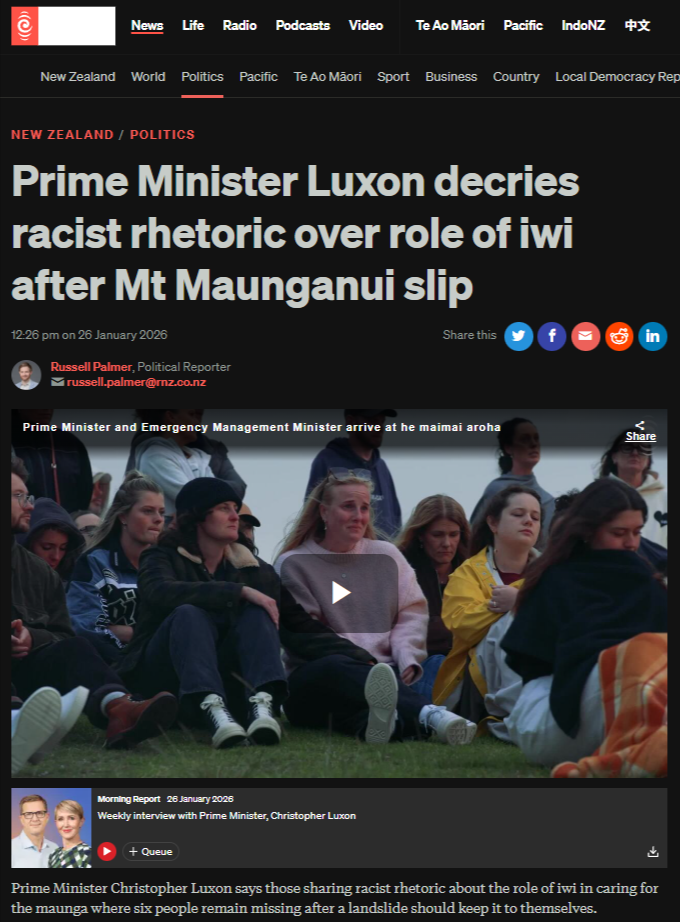
The tragedy at Mount Maunganui on January 22, 2026—which claimed six lives—became a platform for Julian Batchelor’s white supremacist Stop Co-Governance campaign within hours. Batchelor’s video peddles a narrative blaming Indigenous land management for an engineered failure.
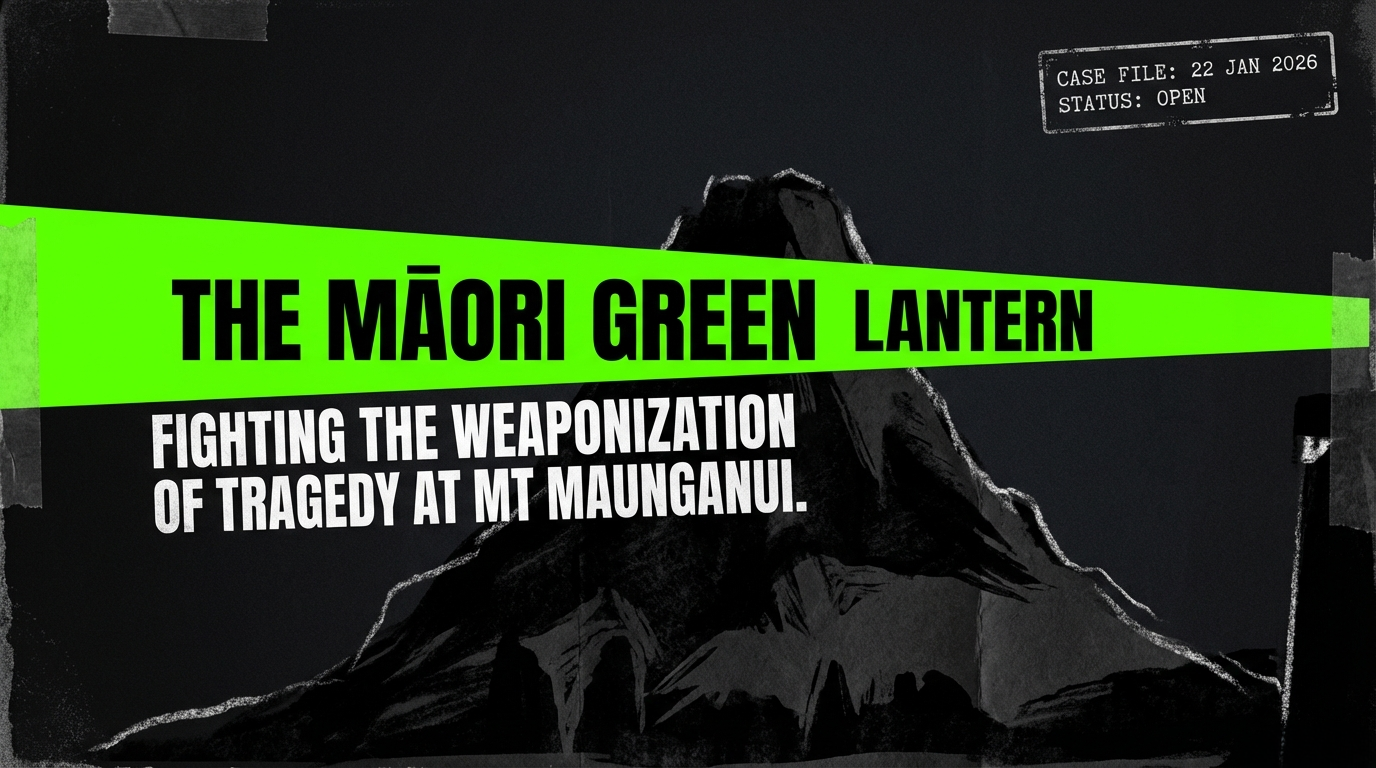
This analysis systematically deconstructs Batchelor’s rhetorical manipulation while examining the uncomfortable paradox:
Prime Minister Christopher Luxon verbally repudiated Batchelor’s racism at Mount Maunganui, yet his government has substantially advanced many of Stop Co-Governance’s core agenda items through legislative action. The tragedy reveals how opportunistic far-right activism exploits human suffering, while mainstream politics absorbs its premises into ostensibly “moderate” policy.
Part One: Deconstructing Batchelor’s Rhetorical Strategy
The Core Narrative Architecture
Batchelor’s 10-minute rant constructs a deliberate false chain of causation:
tree removal (attributed to iwi cultural preferences) → loss of soil stabilization → landslide death.
Julian uses three rhetorical mechanisms:
1. Strategic Conflation of Unrelated Events
Batchelor cites a geotechnical expert (Rod Kaine) correctly noting that vegetation stabilizes slopes. This is scientifically sound.
However, Batchelor then alleges:
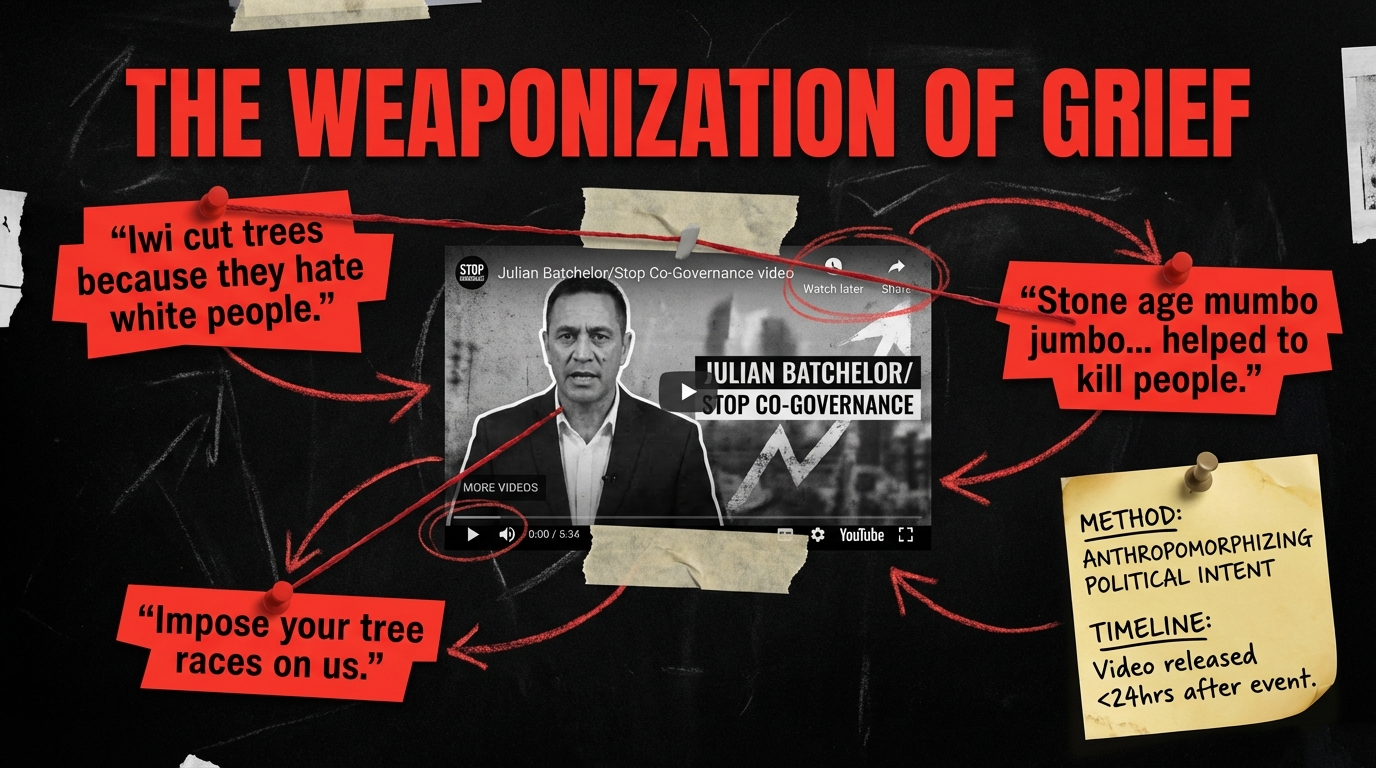
“It is now fairly evident that the Tauranga Council at the insistence of iwi using rate payers money removed big trees in the area of this slip simply because they were colonial.”
The factual record contradicts this narrative architecture:
- In 2023, Tauranga City Council and the Tupuna Maunga Authority (TMA) removed eight large exotic trees (including Holm oaks, pine, poplar, chestnut, macrocarpa) from the Te Uru Karaka area on the Pilot Bay side of the mountain—not above the campground slip site.
- These removals were documented as part of the 2018 Mauao Historic Reserve Management Plan for ecological restoration, aiming to restore native vegetation on archaeological features.
- Separate tree removal occurred between 2017–2019, involving Pohutukawa trees affected by myrtle rust disease.
- A 2019 report explicitly warned: “Mount Maunganui ‘could slide into the ocean’ if myrtle rust kills pōhutukawa”—indicating disease, not deliberate removal for cultural reasons, as the driver.
Batchelor never distinguishes between these separate events, their locations, or their causes. The rhetorical effect is seamless attribution of all tree removal to cultural ideology, despite the evidence showing multiple timelines, ecological reasons, and protective intentions.
Koha Statement
A Call for Accountability: Supporting Truth-Telling on Luxon, Batchelor, and the Normalization of Racist Politics
The Mount Maunganui tragedy cost six lives. Within 24 hours, Julian Batchelor weaponized those deaths. This essay traces how far-right disinformation exploits geological complexity to advance a racist agenda—and how a mainstream government advances Batchelor’s policy objectives while maintaining rhetorical distance from his extremism.
This kind of accountability work requires resources that Crown agencies and corporate media will not provide. They benefit from the confusion Batchelor sows. They profit from the policy direction Luxon advances.
Every koha signals that whānau are ready to fund the rigorous, evidence-based analysis that exposes:
- How scientific complexity becomes propaganda
- How tragedy becomes a tool of political manipulation
- How mainstream governments absorb far-right agendas while disavowing far-right activists
- How rangatiratanga—our right to self-determination—depends on controlling the narratives told about us
It signals that rangatiratanga includes the power to fund our own truth tellers. To keep independent voices accountable to facts, not to power.
Three pathways to support this mahi:
For a direct koha (voluntary contribution):
Support on the Koha platform
For direct subscription to independent essays like this one:
Join the Māori Green Lantern on Substack
For direct bank transfer:
HTDM, account number 03-1546-0415173-000
Kia kaha, whānau. Stay vigilant. The machinery of disinformation and co-optation runs continuously. The Crown will not defend you from Batchelor’s rhetoric. Luxon’s government will legislate away your voice while praising you for crisis response.
Stay connected. Stay funded. Stay independent.
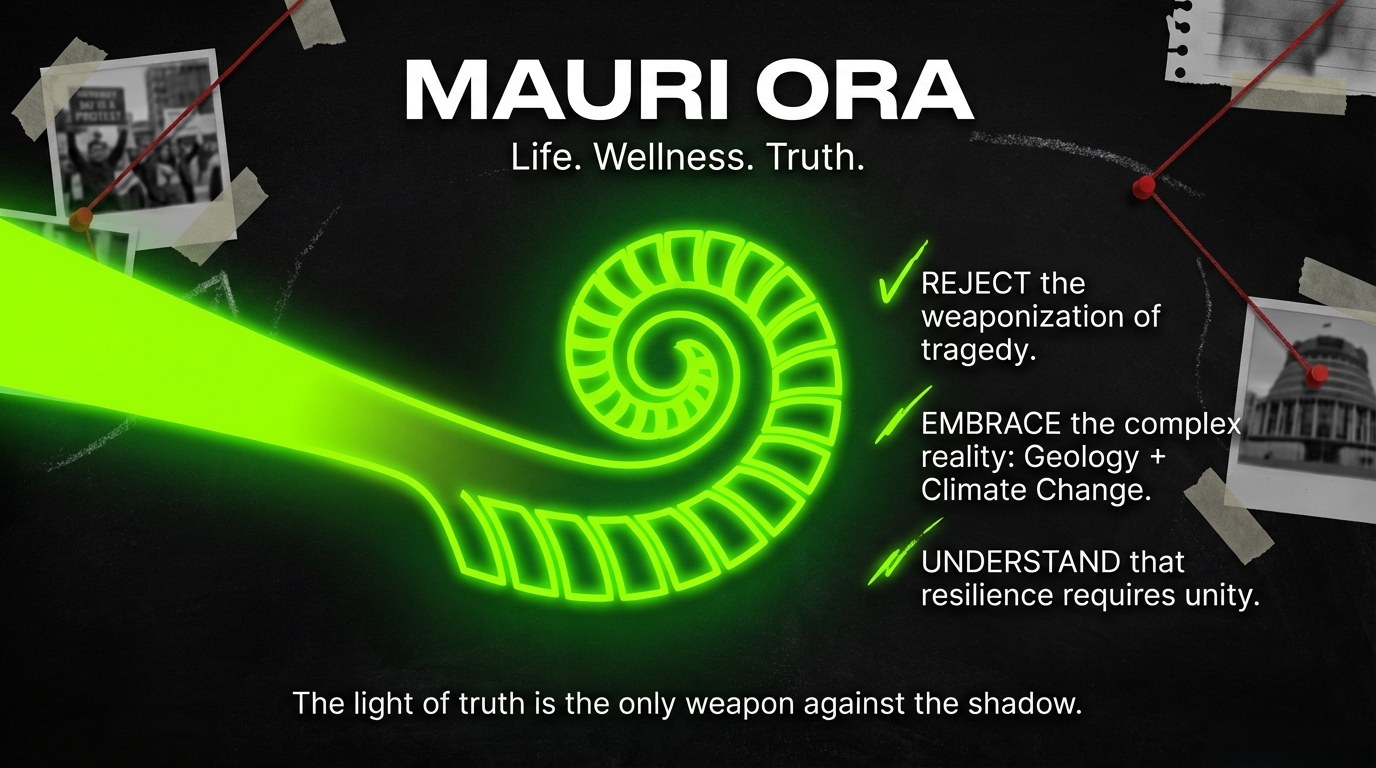
And if you are able, consider a koha to ensure this voice continues—to continue naming what the mainstream press will not, to continue demanding the evidence that Crown institutions suppress, to continue the mahi that accountability requires.
2. Selective Expertise and Suppression of Counter-Evidence
Batchelor prominently features Rod Kaine, described as a geotech expert with 20 years in slip remedial work. Kaine correctly states that “deep rooted vegetation is a very good way to mitigate the risk” and that “trees are the way you stop slips.” This framing is legitimate in isolation.
However, Batchelor omits contrary expert assessment. Dr. Tom Robinson from the University of Canterbury, a disaster risk specialist, explicitly stated:
“Trees would likely not have prevented a landslide of the depth and scale that occurred” at Mount Maunganui. This assessment reflects understanding of the slip’s geological characteristics—not vegetation dynamics.
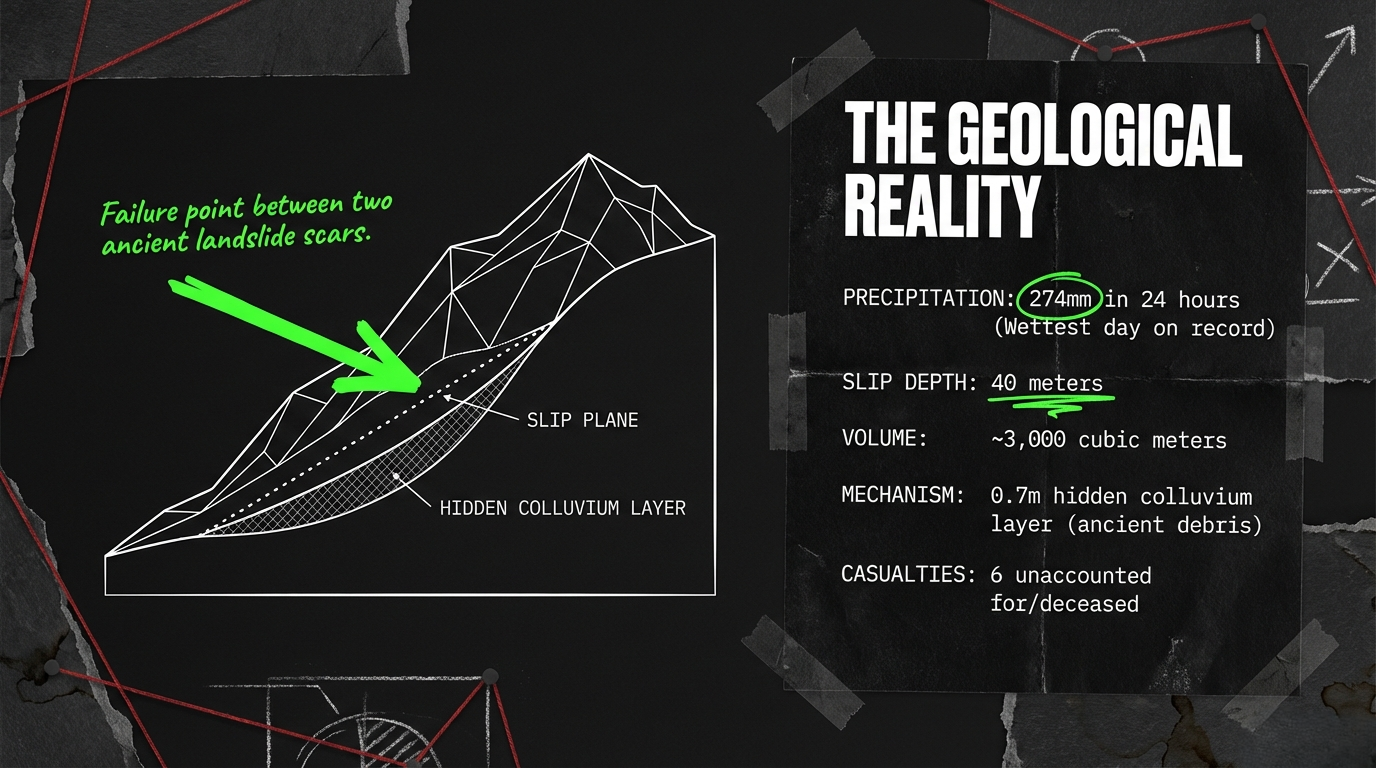
The 2026 landslide occurred in a zone already identified in 2000 geotechnical investigations as sitting atop a 0.7-metre layer of colluvium (debris from previous landslides). High-resolution LiDAR mapping reveals two large ancient landslides directly above the holiday park, with the 2026 failure initiating in the narrow zone between these two ancient scars. This is a pre-existing structural weakness. The landslide’s depth (~40 metres) and scale (~3,000 cubic metres of debris) far exceed what superficial vegetation can arrest once pore pressure rises catastrophically in pre-existing weak zones.
Batchelor’s rhetorical strategy requires ignoring this geological context entirely. By doing so, he elevates vegetation removal from a complex question of land management trade-offs into a simple moral failure.
3. Anthropomorphizing Political Intent
Batchelor attributes cultural meaning to tree removal in a manner that reifies his ideological framework. He quotes a woman (anonymously, citing death threats from Māori) stating accusations about imposing “tree races” and conflating ecological restoration with racial hatred.
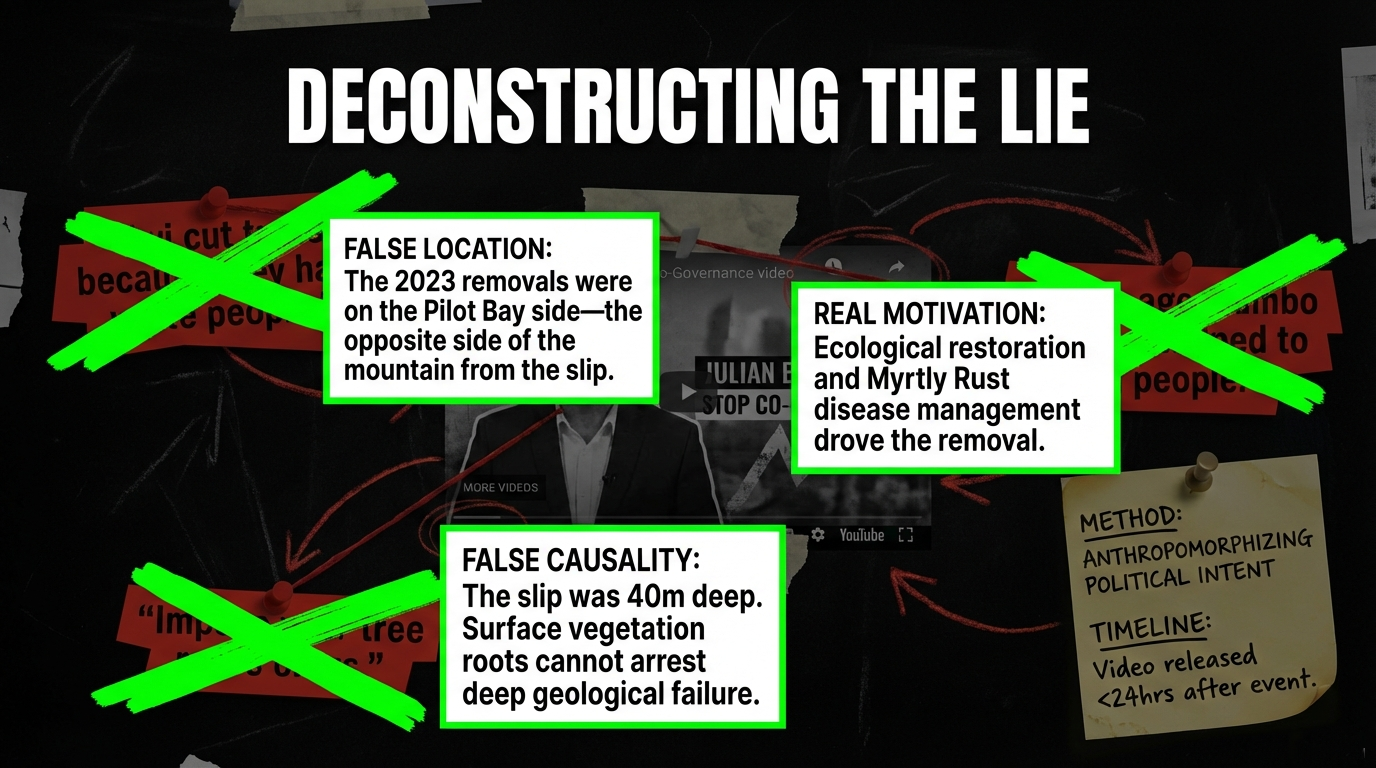
This statement embeds multiple distortions:
- It conflates ecological restoration (removing invasive species to restore native habitat) with racial animus.
- It applies contemporary moral standards retroactively to historical Māori settlement patterns without acknowledgment of 180+ years of colonial land dispossession since 1840.
- It frames Indigenous spiritual concepts (karakia, maunga resting/restoration) as fraudulent superstition inherently opposed to engineering rationality, despite consistent evidence that vegetation management is legitimate engineering.
Critically, the woman’s statement—presented as popular truth—uses the landslide death to weaponize a pre-existing property dispute. The 2018 management plan reflects deliberative, documented decision-making about land use and cultural restoration. Batchelor recruits the tragedy to retroactively moralize this decision-making as reckless, without evidence.
Part Two: Scientific Reality vs. Rhetorical Construction
Rainfall as Primary Trigger
Between January 16–22, 2026, northern New Zealand experienced extraordinary precipitation. Tauranga received 274 millimetres of rain in a single day on January 21—the wettest day on record. The Bay of Plenty, Coromandel, Northland, and Tairāwhiti are regions particularly susceptible to landsliding under intense rainfall due to highly weathered volcanic soils and complex geology.
Multiple geotechnical analyses confirm that at Mount Maunganui, slopes are stable under dry conditions but become unstable when groundwater pressure rises during storms—precisely what occurred with 274 mm of rainfall in a single day. This is a classic mechanism in weathered volcanic terrain: permeable silts overlying high-plasticity silty clays lose strength dramatically when saturated.
The Landslide’s Inherent Geological Instability
The 2000 geotechnical investigation discovered the holiday park sits atop remnants of previous slope failures, with a 0.7 metre layer of colluvium—loose debris deposited by earlier landslides—buried beneath the surface.
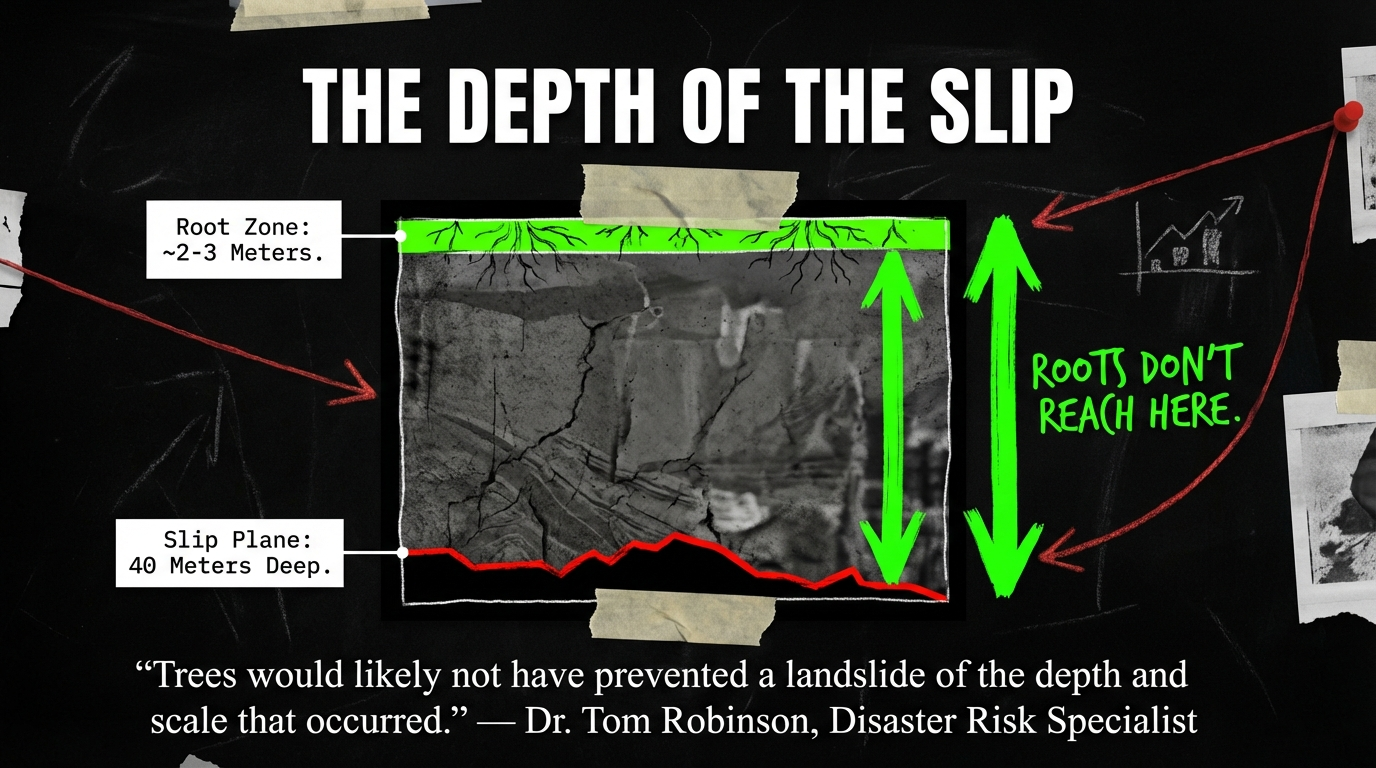
This is not incidental context. This is the primary explanation for why the 2026 landslide occurred at this location at this scale.
Vegetation’s Role: Real but Secondary
The scientific literature on root reinforcement is unambiguous:
vegetation does improve slope stability by:
- Mechanically anchoring soil through deep root systems
- Increasing soil strength through matric suction
- Improving drainage and reducing pore water pressure
However, this benefit operates on a continuum. Deep-rooted native species (e.g., mature Pohutukawa) provide measurable reinforcement. The removal of such species can increase landslide susceptibility over time. But this is not the same as saying vegetation removal is the proximate cause of a specific catastrophic failure in terrain with pre-existing structural instability.
If vegetation removal were the primary cause, one would expect:
- Proportional failures in 2023–2024 after the June 2023 removals (did not occur)
- Failures limited to the removal area (the 2023 removals were on the opposite side of the mountain)
- Comparable failures at other sites with similar vegetation management (no evidence presented)
- Absence of pre-existing geological instability (contradicted by 2000 and 2014 studies)
None of these are true. The evidence supports a narrative in which extreme rainfall exposed pre-existing geological weakness on terrain with a documented history of failure.
Part Three: Luxon’s Government and the Co-Governance Agenda
The Paradox: Disavowal and Implementation
On January 24, 2026—two days after the tragedy—Luxon told the media: “And the people on the margins with their rhetoric, they need to just frankly keep it to themselves.” He praised iwi as “a critical part” of the response and recovery effort.
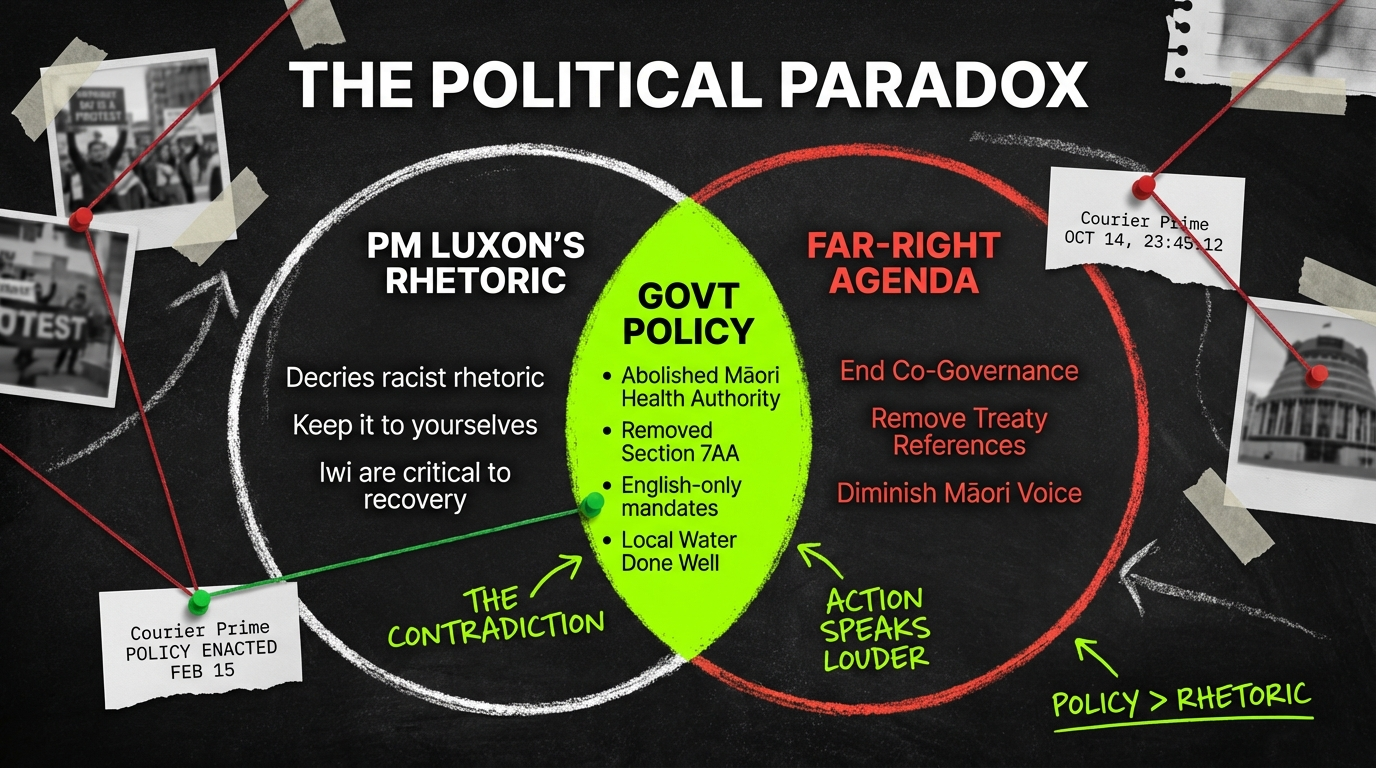
This positioning appears to reject Batchelor’s framing entirely.
Yet the factual record reveals a more complicated reality:
Luxon’s government has implemented substantial portions of Batchelor’s Stop Co-Governance agenda through parliamentary legislation, while maintaining rhetorical distance from Batchelor’s racist presentation.
Co-Governance Removals Enacted
Since November 2023, the Luxon-led coalition has:
1. Abolished the Māori Health Authority (December 2023), removing a co-governance structure established by the previous Labour government.
2. Removed Section 7AA from the Oranga Tamariki Act 1989, eliminating a statutory requirement to consider the principles of the Treaty of Waitangi in child welfare decisions.
3. Made English the sole official language (January 2025), downgrading te reo Māori’s status despite its recognition under the 2016 Te Ture Whenua Act.
5. Proposed abolition of regional councils (November 2025), replacing elected regional representatives with “Combined Territories Boards” composed of city and district mayors, explicitly removing iwi representation structures previously embedded in regional governance.
6. Positioned support for the Treaty Principles Bill (first reading only), which ACT proponent David Seymour designed to redefine the Treaty away from partnership principles toward Crown sovereignty.
Critically, all of these actions operationalize Stop Co-Governance’s core demand:
removing Māori institutional voice from government decision-making structures.
The Rhetorical Separation Strategy
Luxon has maintained two simultaneous positions:
- Publicly: He has criticized Batchelor’s rhetoric as coming from “people on the margins,” defended iwi partnership in crisis response, and stopped short of backing the Treaty Principles Bill beyond first reading.
- Legislatively: His government has dismantled co-governance arrangements across health, child welfare, water, environmental management, and local governance.
This separation allows Luxon to claim the moral high ground—rejecting “racism” and “extremism”—while advancing the substantive policy agenda Batchelor advocates. It is a distinction without meaningful difference to communities experiencing policy change.
Part Four: The Weaponization of Tragedy and Its Broader Implications
Batchelor’s Opportunism
The Mount Maunganui slip occurred on Thursday, January 22.
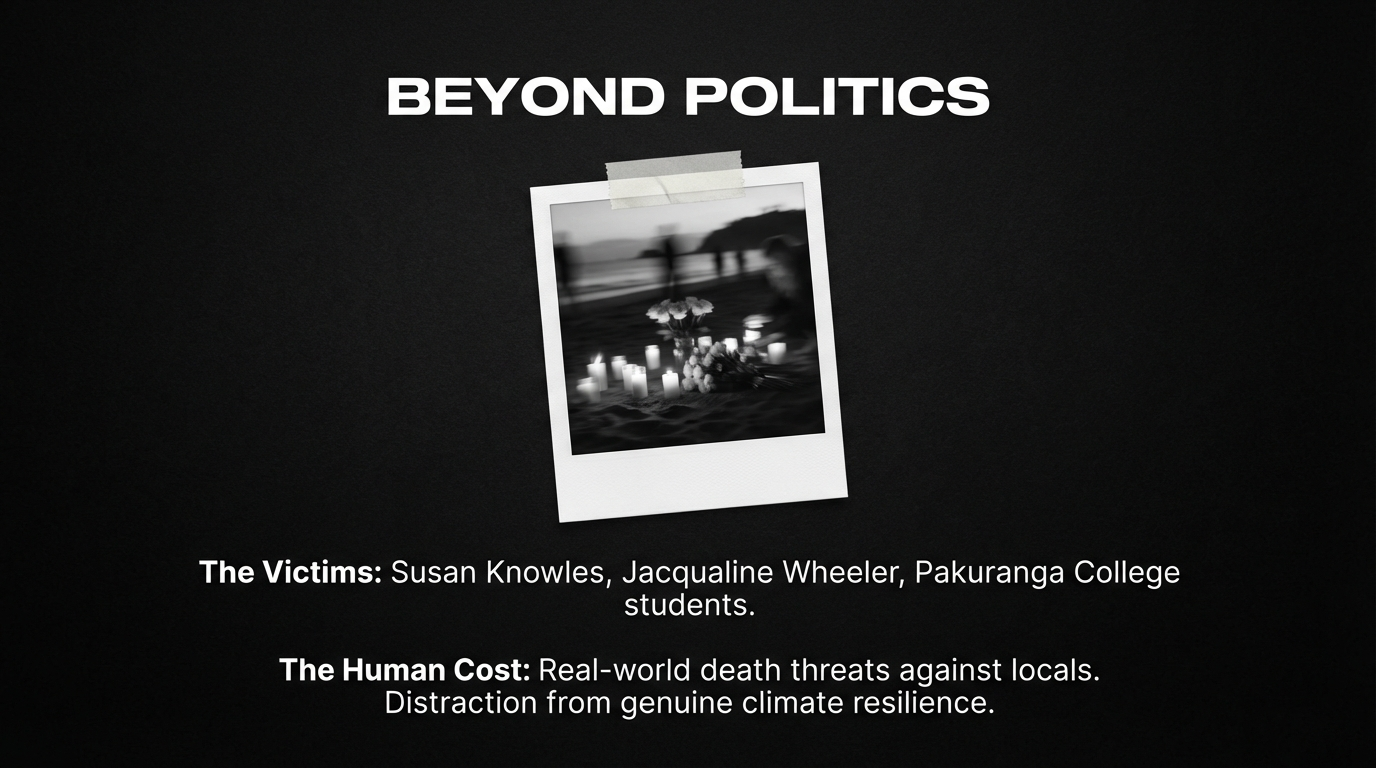
By Friday evening, Batchelor had produced a 10-minute video blaming iwi decision-making for the deaths. This is exploitation in its purest form: a human tragedy commodified as political rhetoric within 24 hours.
The video was distributed on Batchelor’s “Stop Co-Governance” YouTube channel—a platform explicitly designed to amplify anti-Māori activism.
Batchelor’s modus operandi involves:
- Identifying areas of genuine policy disagreement (vegetation management, governance structures)
- Reframing them as evidence of “takeover” and existential threat
- Recruiting emotionally charged events (a landslide death) as proof of his narrative
- Directing audience anger toward Māori institutions and elected officials
This is recognizable as a sophisticated disinformation strategy. The first woman quoted in Batchelor’s video received serious death threats after her original video was posted—a chilling indicator of how this rhetoric converts to violence.
Luxon’s Equivocation
Luxon’s statement
”the people on the margins with their rhetoric, they need to just frankly keep it to themselves”
frames Batchelor as peripheral rather than as a mobilized political actor whose ideas his own government is legislatively implementing.
This is not merely rhetorical sleight of hand. It serves a political function:
it allows Luxon to claim disapproval of Batchelor’s racism while simultaneously advancing the institutional removal of Māori voice that Batchelor demands. Voters can perceive Luxon as moderate and reasonable, even as his policy agenda aligns with Stop Co-Governance’s core objectives.
The Mount Maunganui tragedy thus becomes a test case in how far-right activism shapes mainstream politics:
not through direct electoral success of far-right parties, but through the capture and normalization of far-right policy objectives by mainstream conservative governments.
Part Five: Evidence-Based Assessment of Tree Removal and Slope Stability
What We Know With Confidence
- Extreme rainfall (274 mm in 24 hours) was the immediate trigger
- The site sits on pre-existing geological instability (documented since 2000)
- The failure initiated between two ancient landslide scars
- Similar rainfall triggers similar failures across New Zealand routinely
- Vegetation does provide measurable slope stabilization benefits
What Remains Disputed
- Whether specific tree removal events (2015–2020, 2023) materially increased failure probability at this particular location
- The timeline of removal: Batchelor attributes 2023 removals to the slip area, but evidence suggests 2023 removals were elsewhere
- The degree to which native vegetation restoration (the stated goal) provides equivalent or superior slope stability to exotic species
- Whether the 2017–2019 removals (Pohutukawa, disease-driven) would have prevented a catastrophic failure of this depth and scale
What Expert Assessment Establishes
Dr. Tom Robinson’s statement—that trees “would likely not have prevented a landslide of the depth and scale that occurred”—reflects the geotechnical consensus. The landslide’s depth (~40 metres) and scale (~3,000 cubic metres of debris) far exceed what surface vegetation can arrest once pore pressure rises catastrophically in pre-existing weak zones.
This does not mean vegetation removal is inconsequential. It means vegetation removal is one factor among many, and that attributing the primary causation to it (as Batchelor does) misrepresents the geological and hydrological mechanics at play.
The Normalization of Far-Right Framing in Mainstream Politics
The Mount Maunganui tragedy illustrates a pattern:
When catastrophe strikes, far-right activists rapidly deploy pre-fabricated narratives blaming minorities and their “woke” advocates. These narratives are emotionally compelling because they offer simple causation (Indigenous cultural ideology → death) and clear villains (iwi, council, “co-governance”).
Mainstream conservative politicians respond with rhetorical distance (”people on the margins”) while legislatively advancing the far-right agenda (removing co-governance).
This creates a political equilibrium in which:
- Far-right activists do the ideological work of demonization and narrative-setting
- Mainstream conservatives reap the policy fruits without bearing the reputational cost of explicit racism
- The general public perceives mainstream conservatism as reasonable opposition to extremism, not realizing they are voting for extremist policy objectives
Julian Batchelor’s Stop Co-Governance campaign is transparently racist, conspiratorial, and exploitative. Christopher Luxon’s government is not. Yet Luxon’s legislative agenda—the abolition of co-governance structures across health, child welfare, environmental management, and local governance—realizes the substantive outcomes Stop Co-Governance demands.
The tragedy at Mount Maunganui claims six lives. Their deaths should not be conscripted into this political machinery. Yet that is precisely what has occurred, and Luxon’s rhetorical disavowal of “people on the margins” does little to interrupt it.

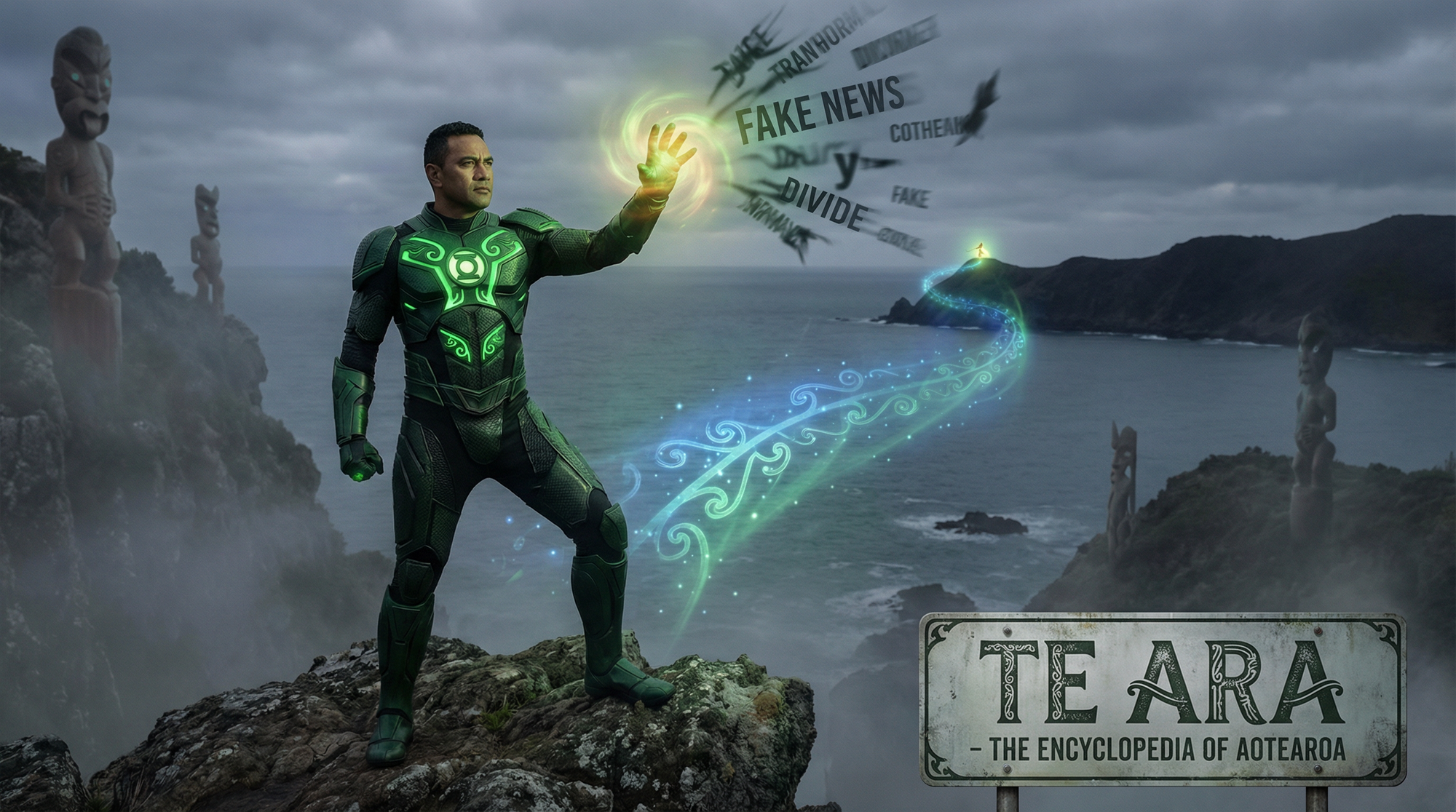
Ivor Jones The Māori Green Lantern Fighting Misinformation And Disinformation From The Far Right
Resources and Further Reading
- RNZ: Prime Minister Luxon decries racist rhetoric over role of iwi after Mt Maunganui slip
- RNZ: The Mt Maunganui tragedy reminds us landslides are NZ’s deadliest natural hazard
- 1News: Landslide risk high after severe North Island weather, experts warn
- Wikipedia: Local Water Done Well
- Beehive: Government advances Local Water Done Well