“When Colonisers Play in Tsunamis: The Reckless Symbolism of Power Without Accountability” - 18 November 2025
Taiaha wielded. The Ring activated. Here are the hidden connections.
Mōrena whānau, thank you in advance for taking an interest in this kaupapa.
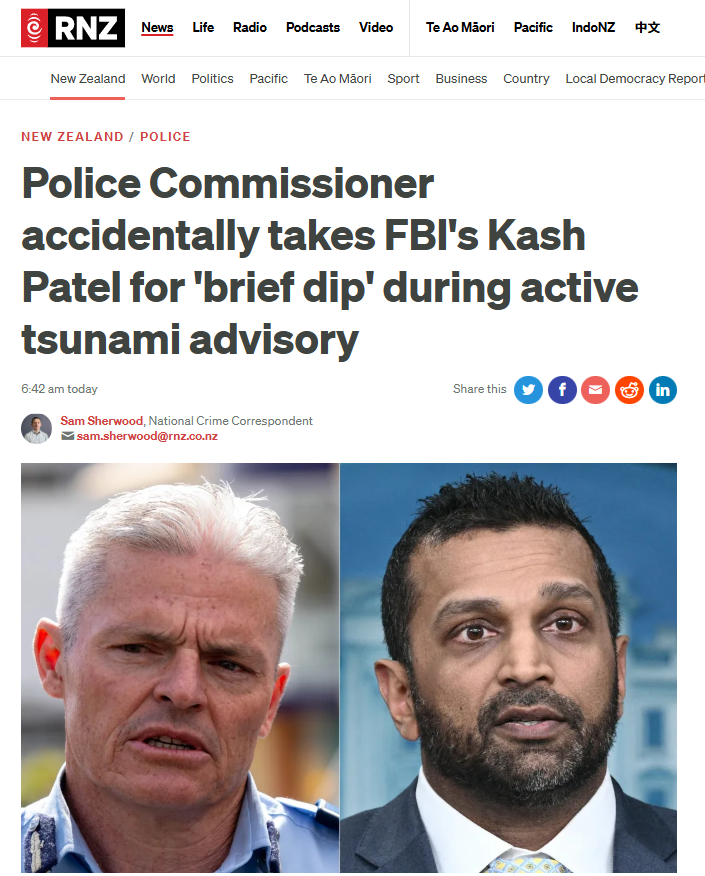
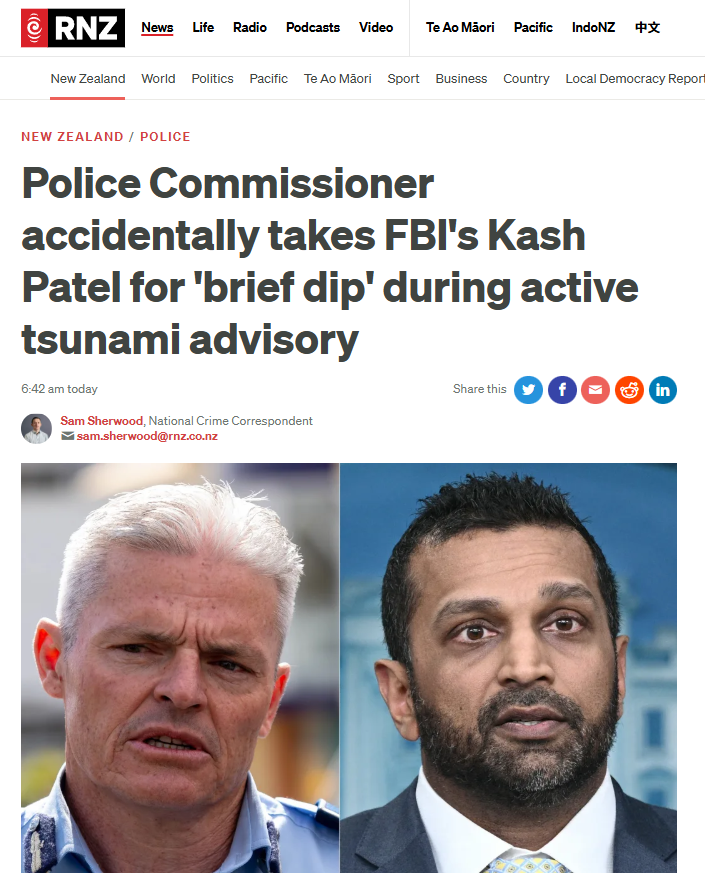
On 1 August 2025, at approximately 7:05am, New Zealand Police Commissioner Richard Chambers took FBI Director Kash Patel for an “early morning run” followed by a “very quick swim” at Oriental Bay, Wellington(RNZ, 2025). The water temperature: mid-winter cold. The context: an active tsunami advisory that wouldn’t be lifted until 8:30am that same morning(RNZ, 2025)(RNZ, 2025). The earthquake that triggered it: an 8.8 magnitude megathrust off Russia’s Kamchatka Peninsula on 30 July—among the ten strongest earthquakes in recorded history(RNZ, 2025). Chambers later admitted he “believed” the advisory had been lifted(RNZ, 2025). It hadn’t. He apologised to Police Minister and Emergency Management Minister Mark Mitchell—the same person holding both portfolios(RNZ, 2023)(RNZ, 2025).
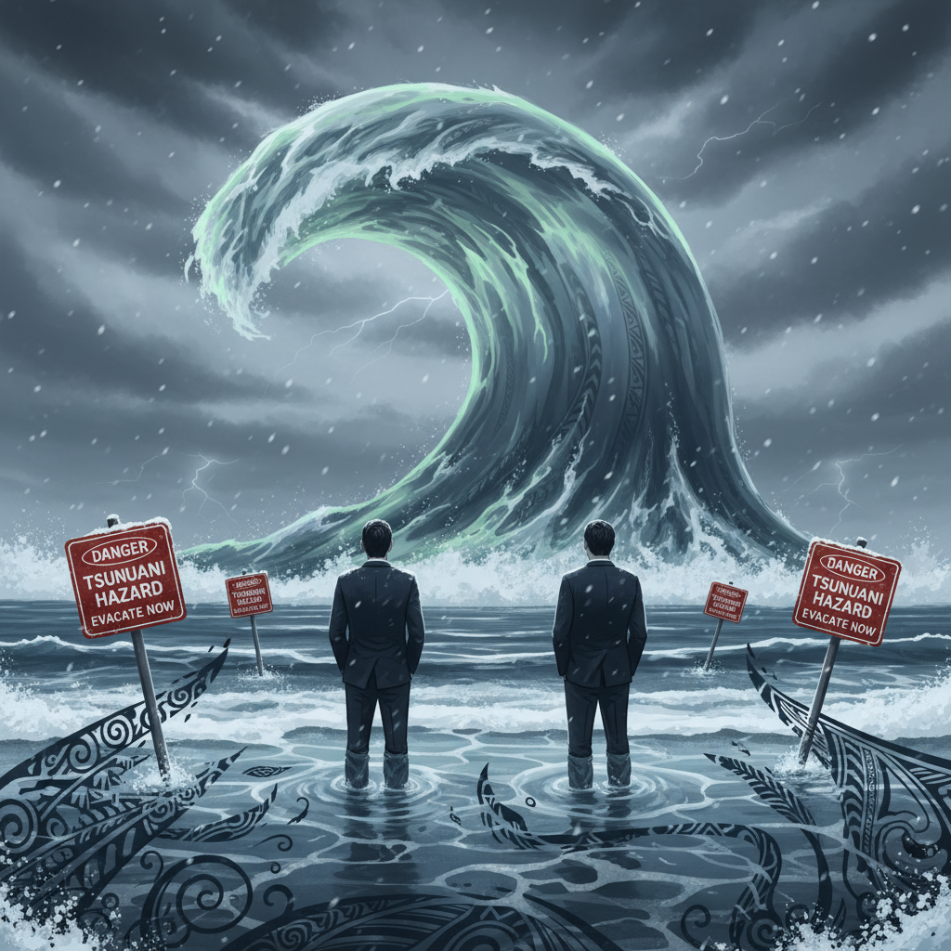
Symbolic representation of colonial arrogance: ignoring indigenous knowledge and safety warnings
This wasn’t Chambers’ only “away with the fairies” moment that month. On 6 November, he was ticketed for speeding at 111 km/h in a 100 km/h zone while returning from a police dog graduation ceremony(RNZ, 2025)(1News, 2025). He called it “the dumbest thing I’ve done” as commissioner(RNZ, 2025). Two spectacular failures of judgment within three months. But the tsunami swim deserves forensic analysis—because it reveals something more insidious than individual incompetence. It exposes the structural arrogance of settler colonial power, the entitlement of men who believe rules apply to everyone else, and the geopolitical theatre of Five Eyes militarism playing out on Aotearoa’s shoreline while Māori communities remain systematically excluded from the decision-making that shapes their own safety and are simultaneously over-policed, over-surveilled, and over-imprisoned by the very systems these men represent.
Cui bono? Who benefits when the top cop ignores emergency warnings to entertain a Trump operative who runs an agency that has historically spied on Māori activists?
Background: The Megathrust, The Militia Man, and The Minister
The 8.8 magnitude earthquake struck at 11:24:52 PETT on 30 July 2025, shallow at 19-20 kilometres depth, centred 119 kilometres east-southeast of Petropavlovsk-Kamchatsky on Russia’s Kamchatka Peninsula(RNZ, 2025)(Wikipedia, 2025). Tsunami waves reached 3-5 metres on Kamchatka’s coast(Reuters, 2025). New Zealand’s National Emergency Management Agency (NEMA) issued a tsunami advisory on 31 July, urging people to stay away from shorelines(RNZ, 2025)(RNZ, 2025). The advisory remained active until 8:30am on 1 August 2025—90 minutes after Chambers and Patel emerged from their winter dip(RNZ, 2025)(Auckland Council, 2025).
Who is Kash Patel? Not merely “FBI Director.” He is a 44-year-old former federal prosecutor, Trump loyalist, and deep state conspiracy theorist appointed to dismantle the FBI from within(RNZ, 2025)(RNZ, 2024). During Trump’s first presidency, Patel served as aide to Devin Nunes, crafting the infamous memo attacking the FBI’s Russia investigation(Al Jazeera, 2024). He later became Acting Deputy Director of National Intelligence and Pentagon Chief of Staff(Wikipedia, 2024). After Trump left office in 2021, Patel wrote Government Gangsters, which Trump declared would be a “roadmap to end the Deep State’s Reign”(RNZ, 2024). The book contains a list of 60 “deep state” actors—Trump critics—Patel claims should be investigated or “reviled”(Le Monde, 2025). He has called for “shutting down the FBI Hoover building on day one and reopening it the next day as a museum of the deep state”(RNZ, 2024).
Patel’s confirmation as FBI Director in February 2025 passed 51-49, with only two Republican senators opposing him due to concerns about his “high profile and aggressive political activity”(ABC News, 2025)(Le Monde, 2025). He has vowed to “go out and find the conspirators not just in government but in the media”(Al Jazeera, 2024). ProPublica reported in November 2025 that Patel waived polygraph security screening for Dan Bongino and two other senior FBI staff(ProPublica, 2025). His tenure represents the Trump administration’s most direct assault on FBI independence in modern history(RNZ, 2025).
Patel visited Aotearoa from 30 July to 1 August 2025 for what was meant to be a secretive trip(RNZ, 2025). He met Foreign Minister Winston Peters, Defence Minister Judith Collins, and Police Minister Mark Mitchell(RNZ, 2025)(1News, 2025). On 30 July, the US Embassy announced the FBI was opening a “standalone office” in Wellington—the first permanent FBI Legat position in New Zealand, reporting directly to Washington DC rather than through Canberra(RNZ, 2025)(RNZ, 2025). A NZSIS briefing note dated 25 June described Patel as having “significant influence” within the Trump administration and stated: “This visit provides an opportunity for New Zealand to continue to enhance the bilateral relationship with the United States by demonstrating our commitment and contributions to our intelligence partnership with the FBI, as well as wider Five Eyes constructs”(RNZ, 2025)(RNZ, 2025). Collins, as NZSIS Minister, signed off on a $10,000 budget covering accommodation, meals, flights and “tourism activities” for Patel and an official(RNZ, 2025).
Hidden Connection #1: Mark Mitchell holds three ministerial portfolios—Police, Emergency Management and Recovery, and Corrections(RNZ, 2023)(Wikipedia, 2025). He is both the minister Chambers reports to as Police Commissioner and the minister responsible for tsunami advisories. When Chambers ignored the tsunami warning to swim with Patel, he violated protocols overseen by his own minister—who then received Chambers’ apology for the breach(RNZ, 2025). This concentration of power creates conflicts of interest and accountability vacuums.
Hidden Connection #2: Mitchell, a former private military contractor in Iraq who “survived three vehicular explosions” and refuses to confirm whether he killed anyone(Wikipedia, 2025), was appointed Police Minister specifically to dismantle “policing by consent”—the community-focused model championed by former Commissioner Andrew Coster(RNZ, 2025)(RNZ, 2024). Mitchell vowed to “scrap Labour’s policing-by-consent philosophy” and return to “back-to-basics policing”(RNZ, 2024). Chambers, appointed in November 2024, immediately aligned with Mitchell, stating he does not subscribe to policing by consent(RNZ, 2024). The tsunami swim was performative masculinity: two enforcement-oriented men bonding through rule-breaking.
Deconstructing the Recklessness via Mātauranga Māori
From a mātauranga framework, the ocean (te moana) is tapu. It is the domain of Tangaroa, governed by maramataka (lunar cycles), and demands respect—especially during moments of cosmic disturbance like an 8.8 magnitude earthquake. Swimming in te moana during an active tsunami advisory is not merely “away with the fairies”(RNZ, 2025). It is a rejection of kaitiakitanga (guardianship), a violation of the sacred relationship between tangata whenua and the natural world that sustains life. NEMA’s advisory was clear: “stay away from shorelines”(RNZ, 2025)(RNZ, 2025). Chambers and Patel ignored it.
Tikanga violations identified:
- Whanaungatanga (relationships/kinship): Chambers prioritised his relationship with Patel—an American operative—over his duty to the people of Aotearoa and their safety protocols. This is colonial prioritisation: serving empire over community.
- Manaakitanga (hospitality/care): True manaakitanga involves ensuring the safety and wellbeing of manuhiri (visitors). Taking Patel into dangerous waters during a tsunami advisory is reckless endangerment, not care.
- Kaitiakitanga (guardianship): As Police Commissioner, Chambers is a kaitiaki of public safety. By ignoring NEMA’s tsunami advisory, he modelled disregard for the very systems he is sworn to uphold.
- Rangatiratanga (self-determination/sovereignty): The decision to open a permanent FBI office in Wellington, signed off during Patel’s visit, deepens New Zealand’s subordination to US intelligence imperatives(RNZ, 2025)(1News, 2025). Māori were not consulted. This erodes tino rangatiratanga—the right of tangata whenua to determine their own security priorities.
Epistemic violence: Chambers’ dismissal of the tsunami advisory as something he “believed” had been lifted(RNZ, 2025) mirrors broader settler colonial patterns of deciding which knowledge systems matter. NEMA’s warning, grounded in seismology and risk assessment, was superseded by Chambers’ belief—a subjective, colonial entitlement to override expertise. This parallels historical dismissals of mātauranga Māori as “belief” rather than knowledge(Te Ara, 2004).
Fallacy identified: Appeal to Authority. Chambers’ position as Police Commissioner does not exempt him from emergency protocols. Yet his actions suggest he believed his rank granted him immunity from the rules governing everyone else. This is the logic of colonialism: hierarchies of personhood where some lives (powerful men) are expendable risks, while others (the public) must obey.
Analysis: Five Hidden Revelations
Revelation #1: The FBI Office as Neoliberal Securitisation and Māori Surveillance
The opening of the FBI’s standalone Wellington office is not about “transnational organised crime” or “cybersecurity,” as Collins and Mitchell claimed(Beehive, 2025)(1News, 2025). It is about embedding US surveillance infrastructure deeper into Aotearoa’s intelligence apparatus. The Five Eyes alliance—established in 1946 between the US, UK, Canada, Australia and New Zealand—has expanded from wartime signals intelligence to a global eavesdropping network capable of intercepting “almost any electronic communication”(Britannica, 2025).
Edward Snowden’s 2013 revelations exposed how New Zealand’s Government Communications Security Bureau (GCSB) conducts mass surveillance on Pacific nations—including full interception of calls, emails and social media from Fiji, Papua New Guinea, Solomon Islands, Nauru, Samoa, Vanuatu, Kiribati, New Caledonia, Tonga and French Polynesia—then automatically funnels this data to the US National Security Agency(NZ Herald, 2014)(BBC, 2015). Documents showed the GCSB base at Waihopai was running “full take” interceptions, retaining content and metadata of all communications rather than just specific targets(BBC, 2015).
Leaked documents also revealed New Zealand spies on Vietnam, China, India, Pakistan and South American nations to fill gaps in US surveillance operations(NZ Herald, 2014). Most alarmingly, from 2013-2020, a foreign agency (likely the NSA) operated a spying system within the GCSB that New Zealand had “lost sight of” and didn’t know its full purpose—unchecked by Parliament, the public, or even the responsible minister(E-Tangata, 2024).
For Māori, this has devastating implications. Five Eyes surveillance has historically targeted Māori activists. The 2007 “Urewera raids” saw police use the Terrorism Suppression Act to conduct intrusive covert surveillance on Tūhoe activist Tame Iti and colleagues—without evidence terrorism had occurred(NZ Herald, 2021)(Te Ao Māori News, 2024). From the 1970s onwards, Māori land rights leaders and sovereignty movements were monitored—not because they were threats to public safety, but because they challenged crown authority(Te Ao Māori News, 2024). A University of Waikato study found that “the over-surveillance of Māori in relation to the October 15 [2007 raids] is connected to their historic struggle for land and political rights”(University of Waikato, 2024).
The FBI’s permanent Wellington office, with jurisdiction over New Zealand, Antarctica, Samoa, Niue, Cook Islands and Tonga(Waatea News, 2025), expands this surveillance dragnet. Patel, who promotes conspiracy theories and maintains an “enemies list”(CNN, 2025)(NY Times, 2025), now has direct access to intelligence on Māori communities. This violates Māori data sovereignty—the principle that Māori have tino rangatiratanga over data derived from and pertaining to them(Catalyst, 2025)(The Spinoff, 2022).
Te Mana Raraunga (the Māori Data Sovereignty Network) argues that under Te Tiriti, Article 1 establishes the Crown’s obligation to govern in ways that actively protect Māori data, Article 2 affirms Māori data as taonga and recognises iwi and hapū maintain tino rangatiratanga over information resources, and Article 3 guarantees equal protection rights while acknowledging collective rights dimensions(Catalyst, 2025). The FBI office, established without Māori consultation, breaches all three articles.
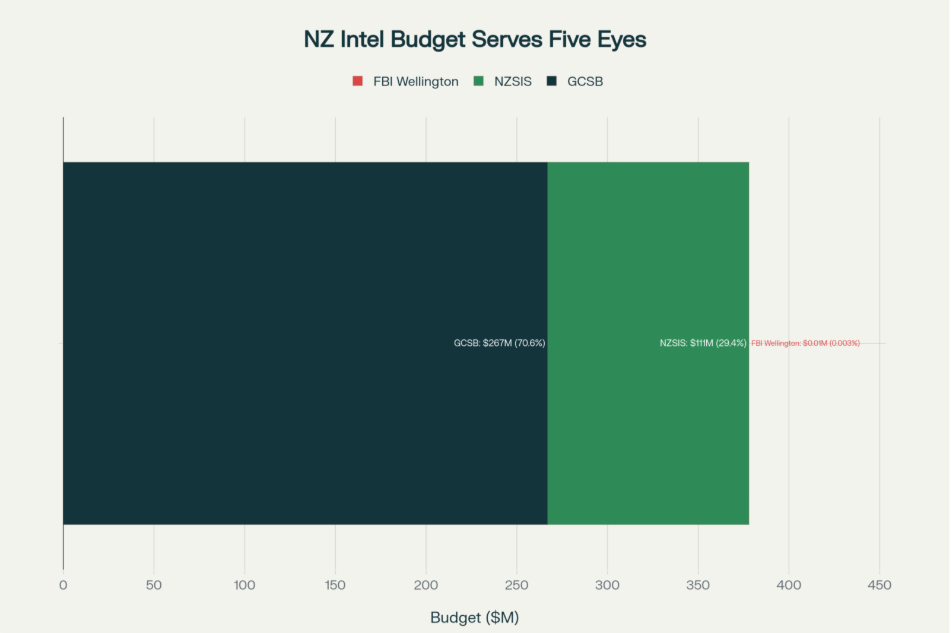
New Zealand allocated $378 million to intelligence agencies in 2025, down from $515 million in 2023, while opening its first permanent FBI office and facing what agencies call a “deteriorating threat environment”
Revelation #2: Policing Māori, Ignoring Rules—The Chambers-Mitchell Doctrine
Richard Chambers was appointed Police Commissioner on 19 November 2024 specifically to reverse Andrew Coster’s “policing by consent” model(RNZ, 2024)(Wikipedia, 2024). Coster, who reduced the use of force and prioritised community relationships, was pushed out after Mark Mitchell repeatedly criticised him for being “too soft”(RNZ, 2025)(1News, 2025). Chambers, previously Deputy Commissioner, immediately signalled alignment with Mitchell’s “tough on crime” agenda(RNZ, 2024).
This approach disproportionately harms Māori. Research by the Understanding Policing Delivery (UPD) programme found police were 11% more likely to prosecute Māori than NZ Europeans for the same offence(JURIST, 2024). Māori are five times as likely to come into contact with police as Pākehā, subject to police violence at seven times the rate, six times as likely to be stopped for no reason, and subject to warrantless search at four times the rate(People Against Prisons Aotearoa, 2024). For the same offending, Māori are more likely to be charged, have more trouble finding legal representation, are less likely to be granted bail, plead guilty at higher rates, and are convicted at higher rates(People Against Prisons Aotearoa, 2024).
The result: Māori make up 17% of New Zealand’s population but 37% of people proceeded against by police, 45% of people convicted, and 52% of people in prison(NZ Ministry of Justice, 2023)(Corrections NZ, 2025). For wāhine Māori, the disparity is even worse: 67% of imprisoned women are Māori(RNZ, 2025). This is not because Māori commit more crime—it is structural racism amplified at every stage of the criminal justice system(RNZ, 2018).
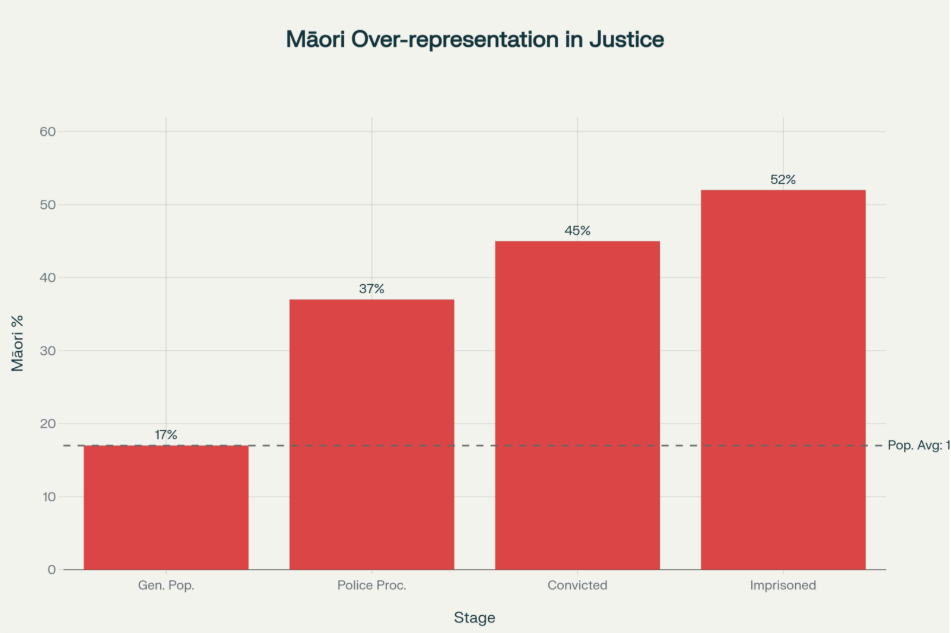
Māori representation increases from 17% of the general population to 52% of prisoners, demonstrating systematic bias that amplifies at each stage of the criminal justice system
A 2018 study by Action Station and the University of Otago surveyed 900 Māori, 90% of whom believed structural racism was responsible for Māori over-incarceration(RNZ, 2018). Participants cited intergenerational trauma, colonisation, economic deprivation, and systemic bias. Te Ara Encyclopedia documents how Māori were recruited to the Armed Police Force in the 1840s specifically to police fellow Māori during land wars, establishing a pattern of using state violence to suppress indigenous resistance(Te Ara, 2012). Throughout the 19th century, Māori were a small percentage of prisoners—until systematic land confiscation, the suppression of te reo and tikanga, and economic marginalisation drove incarceration rates upward(Te Ara, 2012). From 1980, Māori have never been below 45% of the prison population(Te Ara, 2012).
Now, under Mitchell and Chambers, it is getting worse. The coalition government’s Sentencing (Reform) Amendment Act, which limits how much judges can reduce sentences for mitigating factors, is projected to increase the prison population from 9,900 to 13,900 by 2035(RNZ, 2025). This will push New Zealand’s imprisonment rate to 263 per 100,000—higher than Iran’s current rate of 228 per 100,000(RNZ, 2025). Māori, who currently comprise 52% of prisoners, will bear the brunt(Corrections NZ, 2025). By 2035, an estimated 7,228 Māori will be imprisoned—a conservative estimate if current trends continue(RNZ, 2025).
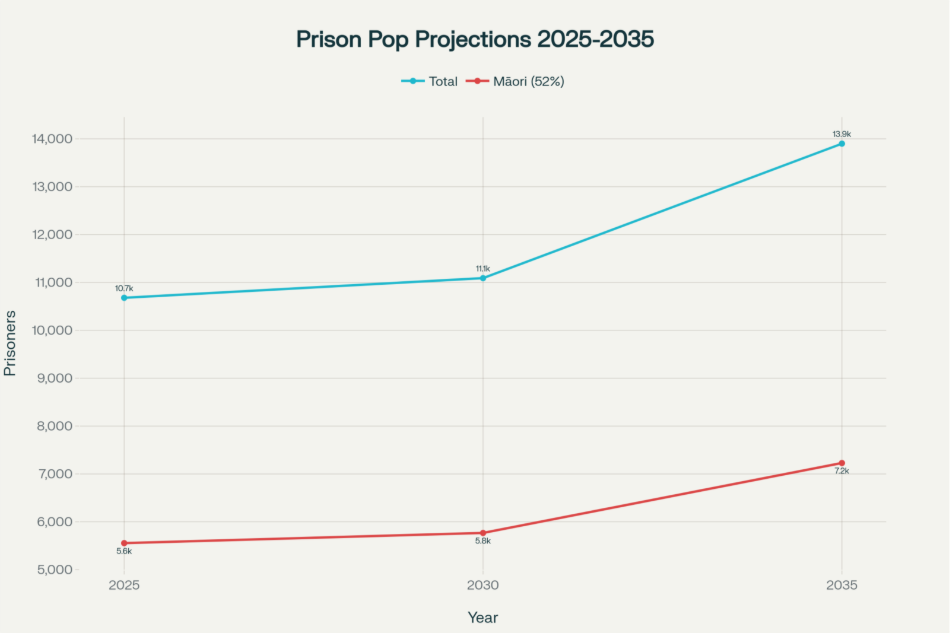
Under the Mitchell Government’s policies, New Zealand’s prison population is projected to increase 30% by 2035, with Māori prisoners increasing from 5,554 to 7,228—an imprisonment rate exceeding Iran’s
Mitchell has proudly stated the government scrapped Labour’s target of reducing the prison population by 30% and instead committed $472 million over four years to expand prisons, including 810 new beds at Waikeria and 240 high-security beds at Christchurch Men’s Prison(RNZ, 2025). Violence and riots are now common in prisons as overcrowding intensifies(RNZ, 2025). The cost of imprisoning one person is $437 per day on remand, $562 per day for sentenced prisoners—between $159,505 and $205,130 per year(RNZ, 2025). Yet funding for rehabilitation programmes and legal aid has not increased(RNZ, 2025).
This is the doctrine Chambers embodies: strict enforcement for Māori, no accountability for elites. He speeds. He swims during tsunami warnings. He calls it “away with the fairies.” But Māori whānau face jail for benefit fraud at ten times the rate of Pākehā prosecuted for tax fraud—70% of benefit fraudsters receive prison sentences compared to 18% of tax fraudsters(People Against Prisons Aotearoa, 2024).
Revelation #3: The Coalition Government’s War on Māori Rights
The FBI office opening coincided with the coalition government’s systematic dismantling of Māori rights. A report by the Aotearoa Centre for Indigenous Peoples and the Law (Te Wai Ariki), presented to the UN Committee on the Elimination of Racial Discrimination (CERD) in November 2025, found the government has breached Te Tiriti o Waitangi through policies that “negatively impact Māori rights and remove certain protections”(RNZ, 2025). The report stated: “the government is actively and profoundly aggravating New Zealand’s constitutionally racist foundation in a way we have not seen for at least half a century”(RNZ, 2025).
Policies identified as racially discriminatory include the repeal of Section 7AA of the Oranga Tamariki Act (which required the ministry to recognise Te Tiriti and partner with iwi), the disestablishment of Te Aka Whai Ora (the Māori Health Authority), the Sentencing (Reinstating Three Strikes) Amendment Act, the Fast-track Approvals Act, and the Treaty Principles Bill(RNZ, 2025). Professor Claire Charters (Ngāti Whakaue, Tūwharetoa, Ngā Puhi, Tainui), co-director of Te Wai Ariki, stated: “What they’re doing now is creating and exacerbating existing inequality... all these pieces of legislation are especially racially discriminatory”(RNZ, 2025).
The report calls for constitutional transformation centred on Te Tiriti, warning that “without transformation, Parliament remains unchecked and continues to pass laws in breach of Indigenous peoples’ rights”(RNZ, 2025). Charters noted that New Zealand is “an absolute outlier” in that “we can’t check our Parliament or make sure or overturn racially discriminatory laws”(RNZ, 2025).
In July 2025, UN Special Rapporteur on the rights of Indigenous Peoples Albert K Barume issued a letter to government ministers expressing concerns about David Seymour’s Regulatory Standards Bill(RNZ, 2025). Seymour, ACT Party leader and architect of the Treaty Principles Bill, has stated his party’s policy is “not recognising the UN Declaration on the Rights of Indigenous Peoples and reinterpreting what Te Tiriti o Waitangi means so that it is saying what it does not say”(RNZ, 2025).
Patel’s visit—and the FBI office opening—must be understood in this context. The US, under Trump, has explicitly rejected indigenous rights. The FBI, under Patel, has a history of surveilling and disrupting indigenous movements globally. New Zealand, under Luxon-Peters-Seymour, is actively dismantling Māori rights. The FBI office is not a neutral law enforcement presence—it is a Five Eyes node embedded within a government waging war on tangata whenua.
Revelation #4: Intelligence Cuts, FBI Expansion, and the Surveillance Economy
In Budget 2025, the GCSB’s funding was cut to $267 million (down from $457 million in 2024) and the NZSIS to $111 million (down from $117 million)(RNZ, 2025). Combined, they received $378 million—down from $515 million in 2023(RNZ, 2025). These cuts came amid what both agencies describe as a “deteriorating threat environment” from violent extremism, terrorism, foreign interference, espionage, and cyber threats(RNZ, 2025).
Yet at the same time, the government signed off on the FBI office. While the $10,000 hospitality budget for Patel’s visit was modest(RNZ, 2025), the operational costs of the FBI’s Wellington office—including salaries, infrastructure, and intelligence-sharing infrastructure—are unknown. Waatea News reported the FBI office will have “responsibility for partnerships in New Zealand, Antarctica, Samoa, Niue, Cook Islands, and Tonga”(Waatea News, 2025), suggesting significant resourcing.
This reflects a neoliberal pattern: cut public services, outsource to private contractors and foreign agencies. Mitchell, a former private military contractor, embodies this ethos(Wikipedia, 2025). The FBI, under Patel, has waived security protocols to fast-track political appointees(ProPublica, 2025). The result: an intelligence apparatus increasingly accountable to Washington rather than Wellington, and not at all to Māori.
Māori bear the costs. Funding for counter-terrorism research—including a centre established after the Christchurch mosque attacks—was zeroed out in Budget 2025(RNZ, 2025). Health budget increases were minimal(RNZ, 2025), while prison expansion received $472 million(RNZ, 2025). The government invests in caging Māori while outsourcing surveillance to the FBI.
Revelation #5: The IPCA Report, Police Misconduct, and the Jevon McSkimming Scandal
On 10 November 2025—six days before the tsunami swim story broke—the Independent Police Conduct Authority (IPCA) released a damning report finding “significant failings” in police handling of sexual assault allegations against senior officer Jevon McSkimming(1News, 2025)(RNZ, 2025). The IPCA found police pursued a case against McSkimming’s accuser while failing to properly investigate him, despite evidence supporting her claims(RNZ, 2025). The report identified systemic issues: police protecting their own, silencing victims, and wielding prosecution power to intimidate whistleblowers(Law News, 2025).
Richard Chambers was Deputy Commissioner during much of the McSkimming saga. The IPCA report stated police leadership must “implement reforms to rebuild public trust”(RNZ, 2025). Within days, Chambers was swimming during a tsunami warning. The symbolism is stark: police demand accountability from the public while evading it themselves.
For Māori, this pattern is not new. Research shows Māori experience police misconduct at disproportionate rates but face barriers when seeking redress(JURIST, 2024). The UPD research found 54% of taser events were against people experiencing mental distress—Māori are five times more likely than Pākehā to be secluded in mental health facilities, making them disproportionate targets(JURIST, 2024)(Tika Tangata, 2025). The panel recommended police halt the use of ethnicity data in decision-making until accuracy can be assured—a damning admission that current policing relies on racial profiling(JURIST, 2024).
Police claim commitment to Te Tiriti, stating they work to “understand how as an organisation, we can be a more proactive and an inclusive partner for Iwi Māori”(NZ Police, 2004). Yet the same police force that surveilled Māori activists in the Urewera raids(NZ Herald, 2021), that over-prosecutes Māori for the same offences as Pākehā(JURIST, 2024), and that protected a senior officer accused of sexual assault(Law News, 2025), now hosts FBI Director Kash Patel—a man who promotes conspiracy theories and maintains enemies lists(CNN, 2025).
Implications: Quantified Harm and Threatened Mana
1. Māori Data Sovereignty Compromised
The FBI office has access to intelligence gathered by the GCSB and NZSIS. This includes data on Māori individuals, iwi, and movements. Without Māori governance over this data, it can be used to profile, surveil, and suppress Māori activism. A 2025 University of Victoria study found the proposed move from a census to an “administrative census” raises major Māori data sovereignty concerns—the government collects data on Māori without consent, de-identifies it within the Integrated Data Infrastructure, and uses it for purposes Māori have no say over(University of Victoria, 2025). The FBI connection compounds this: data collected ostensibly for public services can now flow to a foreign intelligence agency.
2. Mass Incarceration as Genocide
By 2035, New Zealand will imprison approximately 7,228 Māori—up from 5,554 in 2025. This is a 30% increase in Māori imprisonment within a decade. Māori make up 17% of the population but will comprise over 52% of prisoners. At 263 per 100,000, New Zealand’s imprisonment rate will exceed Iran’s. Incarceration destroys whānau, severs connections to whenua and whakapapa, and perpetuates intergenerational trauma. The UN has been clear: disproportionate incarceration of indigenous peoples constitutes racial discrimination(Tika Tangata, 2025). New Zealand is violating the International Convention on the Elimination of All Forms of Racial Discrimination.
3. Five Eyes as Colonial Control
The Five Eyes alliance was forged to maintain Anglo-American dominance in the post-WWII order(Britannica, 2025). Its expansion into mass surveillance—exposed by Snowden—has turned it into a tool for suppressing dissent globally(NZ Herald, 2014). For Māori, Five Eyes is not about “security”—it is about control. The GCSB spies on Pacific nations, many with indigenous populations(BBC, 2015). It passes this intelligence to the US, which uses it to advance geopolitical interests that have nothing to do with New Zealand’s safety(E-Tangata, 2024). The FBI office embeds this imperial architecture deeper into Aotearoa.
4. Economic Costs vs. Community Investment
New Zealand spends $378 million on intelligence agencies, $472 million on prison expansion, and between $159,505 and $205,130 per year to imprison one person—yet cuts health, education, and rehabilitation funding. If the government redirected the $7,228 annual cost of imprisoning 7,228 Māori by 2035 (approximately $1.49 billion per year), it could fund:
- Universal free tertiary education for Māori students
- Comprehensive mental health services in every iwi
- Housing programmes to eliminate Māori homelessness
- Restoration of te reo Māori in all schools
- Economic development initiatives led by Māori for Māori
Instead, the money cages people.
5. Tsunami as Metaphor
The 8.8 magnitude earthquake that triggered the tsunami advisory represents the seismic violence of colonisation. The tsunami—delayed, unpredictable, devastating—is the intergenerational trauma that follows. Chambers and Patel swimming during the advisory is settler colonialism in miniature: white men with power ignore warnings, endanger themselves and others, and walk away with apologies while Māori communities drown in the consequences.
Rangatiratanga Action and Moral Clarity
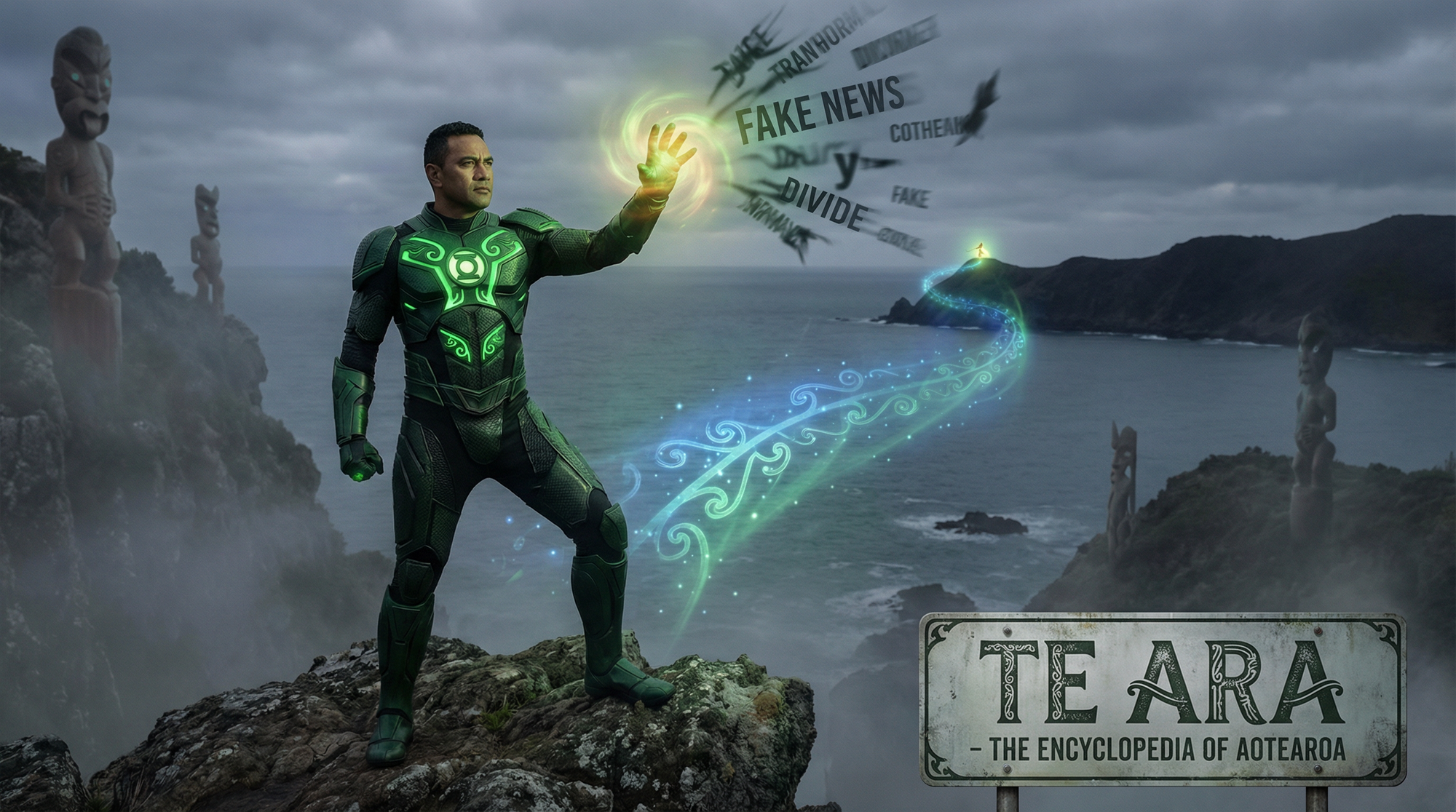
Ko Ivor Jones te Māori Green Lantern. This essay is an act of kaitiakitanga—guarding truth, naming harm, mobilising resistance.

What must happen now:
1. Close the FBI office. The FBI has no legitimate role in Aotearoa. Kash Patel is a Trump operative with an enemies list. His presence threatens Māori data sovereignty and Pacific security. The office must close, and all intelligence-sharing agreements must be renegotiated with Māori consultation and consent.
2. Investigate Chambers and Mitchell. Both men violated protocols. Chambers endangered lives during a tsunami advisory. Mitchell holds three portfolios that create conflicts of interest. Both champion policies that disproportionately harm Māori. An independent inquiry, led by Māori, must assess their fitness for office.
3. Implement the IPCA recommendations. The police force is structurally racist. The UPD research, the IPCA report, and decades of Māori testimony prove this. Police must halt the use of ethnicity data, establish external oversight, and partner with iwi to develop culturally responsive policing models.
4. Honour Te Tiriti. The UN CERD review in November 2025 found the coalition government is in breach of Te Tiriti. Every policy—from the Treaty Principles Bill to the FBI office—must be assessed against Te Tiriti obligations. Māori must have veto power over decisions affecting their data, their communities, and their futures.
5. Defund prisons, fund whānau. The projected $1.49 billion annual cost of imprisoning 7,228 Māori by 2035 is unconscionable. Redirect this funding to housing, health, education, and economic development. Implement the recommendations of Hāpaitia te Oranga Tangata and reduce the Māori prison population to match the general population.
6. Assert Māori Data Sovereignty. Establish a Māori Data Governance Authority with the power to audit, regulate, and if necessary prohibit the collection, storage, and sharing of Māori data. Te Mana Raraunga’s frameworks must be legislated. The GCSB and NZSIS must be accountable to Māori, not just to ministers.
7. Expose Five Eyes. The public has a right to know what intelligence New Zealand collects, who it shares it with, and how it is used. The Snowden revelations were a decade ago—New Zealanders still don’t know the full extent of GCSB spying. Declassify the documents. Hold inquiries. End the secrecy.
This is not a story about two men going for a swim. It is a story about empire, arrogance, and the systematic oppression of Māori. Chambers and Patel, in their brief dip, performed colonialism: ignoring indigenous knowledge (the sacredness of te moana), dismissing scientific expertise (NEMA’s tsunami advisory), prioritising imperial relationships (FBI-Police alliance) over community safety, and walking away with apologies while Māori bear the consequences.
The tsunami is still coming. Not from Russia, but from within—a wave of incarceration, surveillance, and rights violations that will drown Māori communities if we do not resist.
Kia kaha. Ka tū. The mahi is everything. The Ring empowers. Each essay: rangatiratanga manifested.
- /content/files/podcasts/mapuna.xml
- https://www.rnz.co.nz/news/te-manu-korihi/577223/absolutely-breaches-of-te-tiriti-o-waitangi-un-bound-report-warns-racial-discrimination-is-worsening-in-nz
- https://www.rnz.co.nz/sitemap/sitemap11.xml.gz
- https://www.1news.co.nz/2023/07/07/jack-tame-the-missing-piece-of-the-law-and-order-debate/
- https://teara.govt.nz/en/anti-racism-and-treaty-of-waitangi-activism/print
- /content/files/podcasts/tagata-o-te-moana.xml
- https://www.rnz.co.nz/news/te-manu-korihi/367940/study-why-do-so-many-maori-end-up-behind-bars
- https://teara.govt.nz/en/ethnic-and-religious-intolerance/page-1
- https://www.rnz.co.nz/sitemap/sitemap17.xml.gz
- https://www.rnz.co.nz/news/national/570215/violence-and-riots-now-common-in-new-zealand-prisons-staff-union-says
- https://teara.govt.nz/en/anti-racism-and-treaty-of-waitangi-activism
- /content/files/oggcasts/the-detail.xml
- /content/files/oggcasts/datelinepacific.xml
- https://www.catalyst.net.nz/stories-and-studies/catalyst-blog/data-sovereignty-in-aotearoa-navigating-how-to-protect-our-digital-taonga
- https://www.facebook.com/groups/hetangata/posts/1112568407458456/
- https://thespinoff.co.nz/internet/29-07-2022/indigenous-data-sovereignty-will-make-the-internet-a-better-place-for-maori
- /content/files/server/api/core/bitstreams/73455428-1da0-4946-91ef-0af271eb85f5/content.pdf
- https://www.wgtn.ac.nz/news/2025/06/scrapping-the-national-census-raises-data-sovereignty-and-surveillance-fears-for-maori
- /content/files/cms/assets/Documents/Periodic-Reviews/detention.pdf
- https://papa.org.nz/2024/12/01/submission-on-the-principles-of-the-treaty-of-waitangi-bill-2024/
- /content/files/assets/New-order/News/Privacy-Week/Privacy-Week-2024/140524-maori-data-sovereignty-slides.pdf
- https://www.justice.govt.nz/justice-sector-policy/key-initiatives/key-initiatives-archive/hapaitia-te-oranga-tangata/
- /content/files/podcasts/focusonpolitics.xml
- https://www.police.govt.nz/about-us/maori-police/working-together
- https://teatawhai.maori.nz/wp-content/uploads/2024/03/K_West_Storying_Māori-Data_Sovereignty_2023.pdf
- https://www.corrections.govt.nz/resources/statistics/quarterly_prison_statistics/prison_facts_and_statistics_-_march_2025
- https://www.jurist.org/news/2024/08/research-into-new-zealand-policing-finds-systemic-racial-bias/
- https://besjournals.onlinelibrary.wiley.com/doi/full/10.1002/pan3.70161
- https://www.facebook.com/maraeofficial/posts/prison-numbers-are-at-a-new-all-time-high-well-ahead-of-projections-and-nothing-/1253483086817667/
- https://www.nzlii.org/nz/journals/CanterLawRw/2018/3.pdf
- https://www.facebook.com/maraeofficial/posts/māori-are-196-of-the-nz-population-but-52-of-our-prisonersone-of-the-most-dispro/1253581893474453/
- /content/files/article/download/1045/718.pdf
- https://www.facebook.com/maraeofficial/videos/māori-are-196-of-the-nz-population-but-52-of-our-prisonersone-of-the-most-dispro/1201002751936223/
- https://www.rnz.co.nz/news/pacific/570259/cook-islands-confronts-critical-questions-on-identity-as-debate-on-deep-sea-mining-grows
- https://tikatangata.org.nz/human-rights-in-aotearoa/human-rights-and-te-tiriti-o-waitangi
- https://www.nzherald.co.nz/kahu/a-nation-divided-inside-the-urewera-four-trial/RGRON5C47E5INHYNOPBDRPCXQ4/
- https://teara.govt.nz/en/1966/maori-wars/page-2
- /content/files/webcontent/document/201425/thepeoplesreport.pdf
- https://teara.govt.nz/en/nga-tuakiri-hou-new-maori-identities/page-5
- https://teara.govt.nz/en/biographies/2t34/te-whiti-o-rongomai-iii-erueti
- https://www.rnz.co.nz/news/political/254663/key-and-dotcom-the-story-so-far
- https://www.nzherald.co.nz/nz/fbi-director-kash-patels-secretive-wellington-trip-cost-taxpayers-10k/KDR546DYMVF3FO26DLFFEZ6OLU/
- https://teara.govt.nz/en/land-ownership/page-1
- https://www.nzherald.co.nz/nz/snowden-revelations-the-price-of-the-five-eyes-club-mass-spying-on-friendly-nations/IIMOU3E4C6LSTHEUIJDVX6OOYE/
- /content/files/webcontent/document/201320/towards-better-local-regulation1.pdf
- https://www.rnz.co.nz/news/corrections/561958/budget-2025-spy-agencies-funds-cut-as-security-threats-grow
- https://www.nzherald.co.nz/nz/methods-of-the-modern-spy/XCXMA3W7JKA5YTJ6N6PKF6OUUQ/
- https://www.nzherald.co.nz/nz/us-spies-have-two-bases-in-new-zealand-snowden/AC2KR7PG6WZL3BNJ3WCCJMR63E/
- https://www.rnz.co.nz/timeline?page=60
- https://teara.govt.nz/en/manners-and-social-behaviour/page-5
- https://www.nzherald.co.nz/nz/gcsb-spies-monitored-diplomats-in-line-for-world-trade-organisation-job/ZBUANSFO3IKOKV4FMF7KPUBXHY/
- https://www.rnz.co.nz/news/political/561814/budget-2025-no-surprises-in-health-some-prescriptions-to-go-annual
- https://teara.govt.nz/en/state-services-and-the-public-service-commission/page-5
- https://www.nzherald.co.nz/nz/snowden-revelations-nzs-spy-reach-stretches-across-globe/PSQOQKVWUQCFNQJQGPUDDK7QRY/
- https://www.rnz.co.nz/news/national/576644/spy-agency-whistleblowers-raised-no-serious-wrongdoing-watchdog
- https://www.rnz.co.nz/news/on-the-inside/556381/new-sentencing-laws-will-drive-nz-s-already-high-imprisonment-rates
- https://teara.govt.nz/en/history-of-immigration/page-3
- https://www.teaonews.co.nz/2024/11/25/new-book-explores-the-impact-of-surveillance-on-kiwis-and-their-movements/
- https://www.auckland.ac.nz/en/news/2021/04/24/five-eyes-has-no-place-in-human-rights-alliance.html
- https://www.nzlii.org/nz/journals/UOtaLawTD/2022/5.html
- /content/files/assets/NZSIS-Documents/young-people-and-violent-extremism-a-call-for-collective-action.pdf
- https://www.bbc.com/news/world-asia-31741564
- https://waateanews.com/2025/07/31/fbi-director-visits-new-zealand/
- https://e-tangata.co.nz/comment-and-analysis/spying-on-our-pacific-family/
- https://en.wikipedia.org/wiki/Edward_Snowden
- /content/files/assets/GCSB-Proactive-Releases/gcsb-and-nzsis-2023-bim-v2.pdf
- https://teara.govt.nz/en/police/page-1
- https://www.reuters.com/world/asia-pacific/us-fbi-opens-office-new-zealand-2025-07-31/
- https://www.beehive.govt.nz/speech/oxford-union-debate
- https://www.vice.com/en/article/new-edward-snowden-documents-call-out-new-zealand-for-spying-on-its-south-pacific-neighbours/
- https://www.facebook.com/RadioNewZealand/videos/fbi-to-open-standalone-office-in-wellington-rnz/565575406519621/
- https://nzccl.org.nz/privacy-international-report-nz-expresses-concerns-around-five-eyes-membership/
- https://www.nzlii.org/nz/journals/AukULRev/2018/6.pdf
- https://budget.govt.nz/budget/2025/by/dept/nzsis.htm
- https://thediplomat.com/2014/09/edward-snowden-vs-new-zealand/
- /content/files/webcontent/document/201251/localgovt.pdf
- https://teara.govt.nz/en/graph/36775/maori-as-a-percentage-of-total-prison-population-1860-2008