“When Firewalls Fail: The Ferguson-Stanford Conflict of Interest Scandal and the Crisis at New Zealand’s Teaching Council” - 24 January 2026
Mōrena Aotearoa,
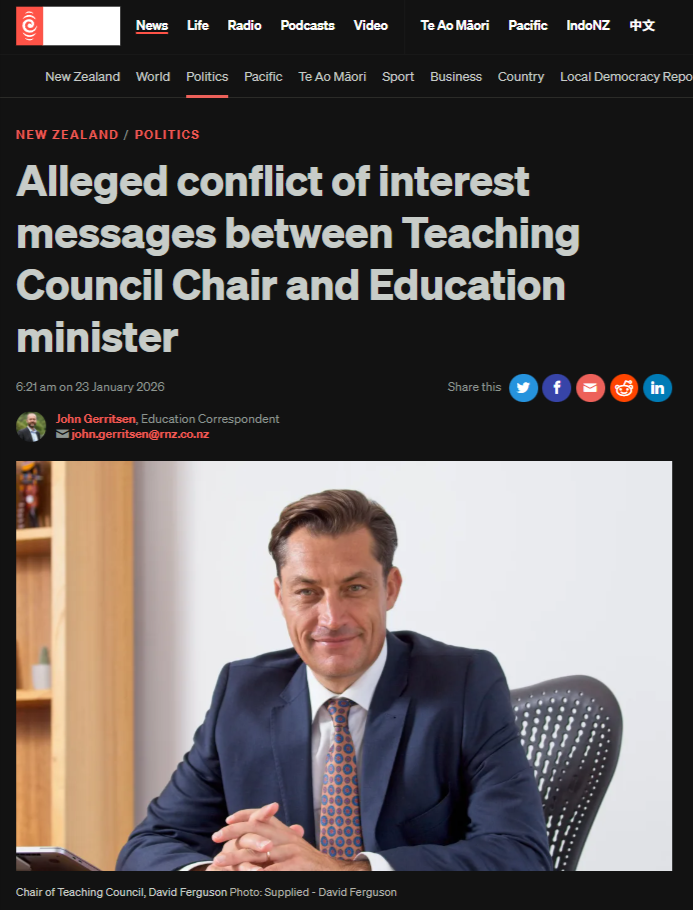
In January 2026, a conflict-of-interest scandal erupted in New Zealand’s education sector, exposing troubling relationships between private education providers, ministerial power, and the regulatory bodies meant to oversee them.
At the center:
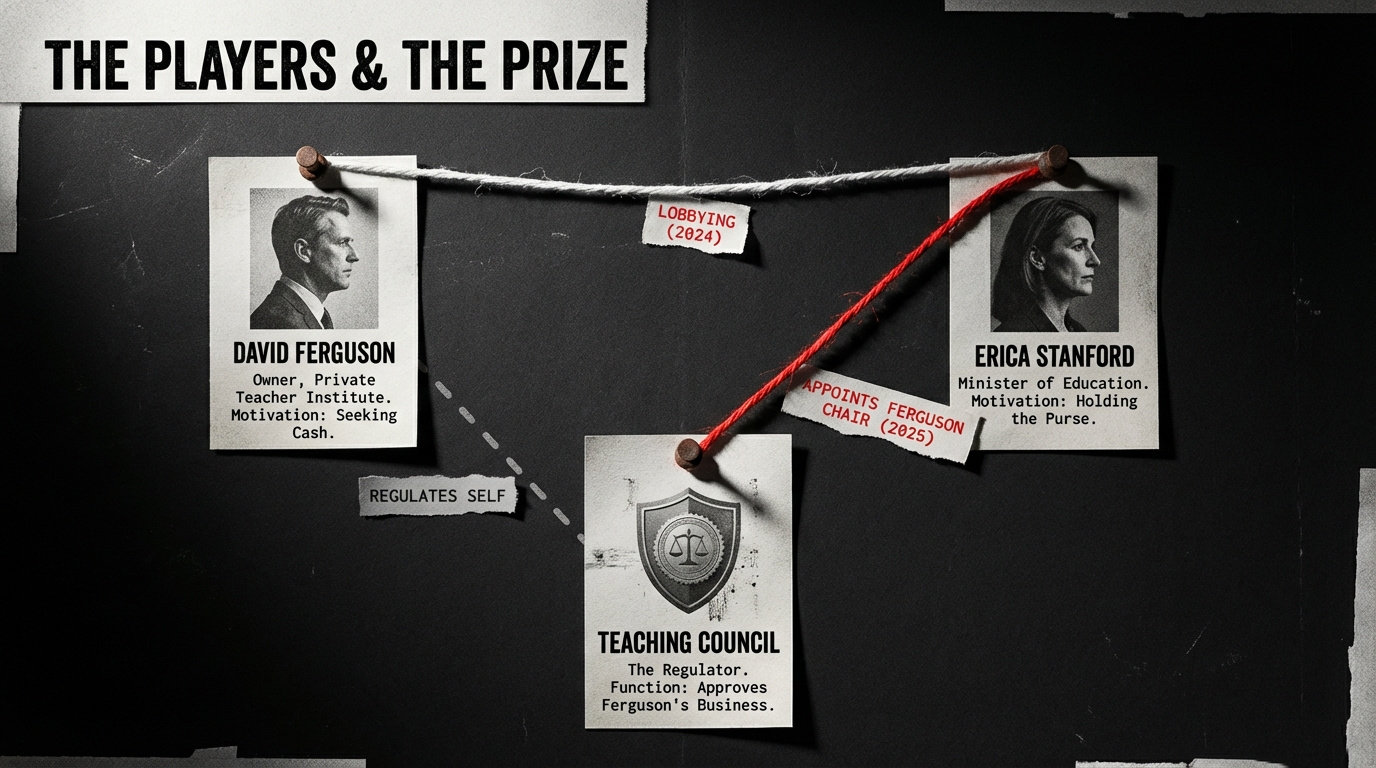
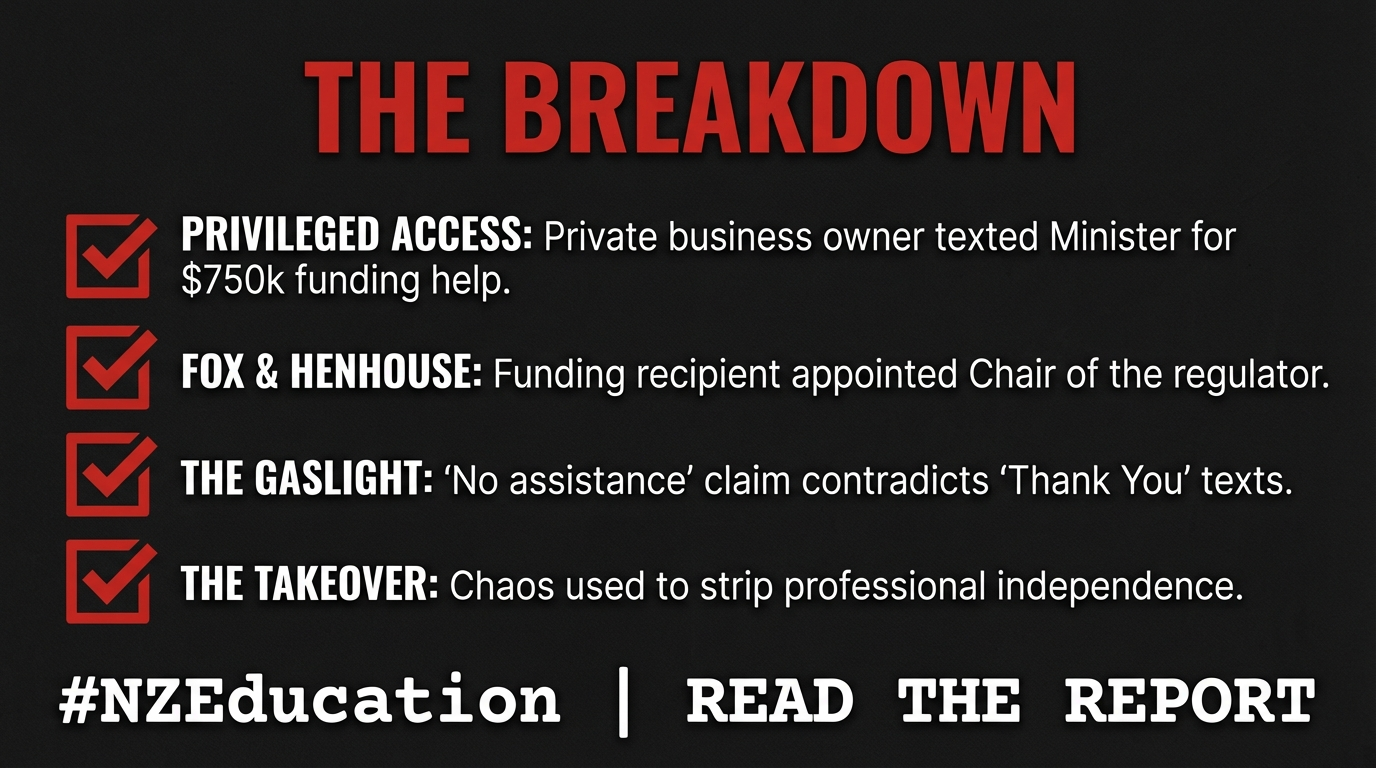
David Ferguson, Chair of the Teaching Council and CEO of the Teachers Institute, and Education Minister Erica Stanford, who appointed him. Messages obtained under the Official Information Act reveal a year-long pattern of Ferguson soliciting ministerial “advice or support” for government funding of his private teacher-training institute—before Stanford appointed him to chair the very council that approves such programmes.
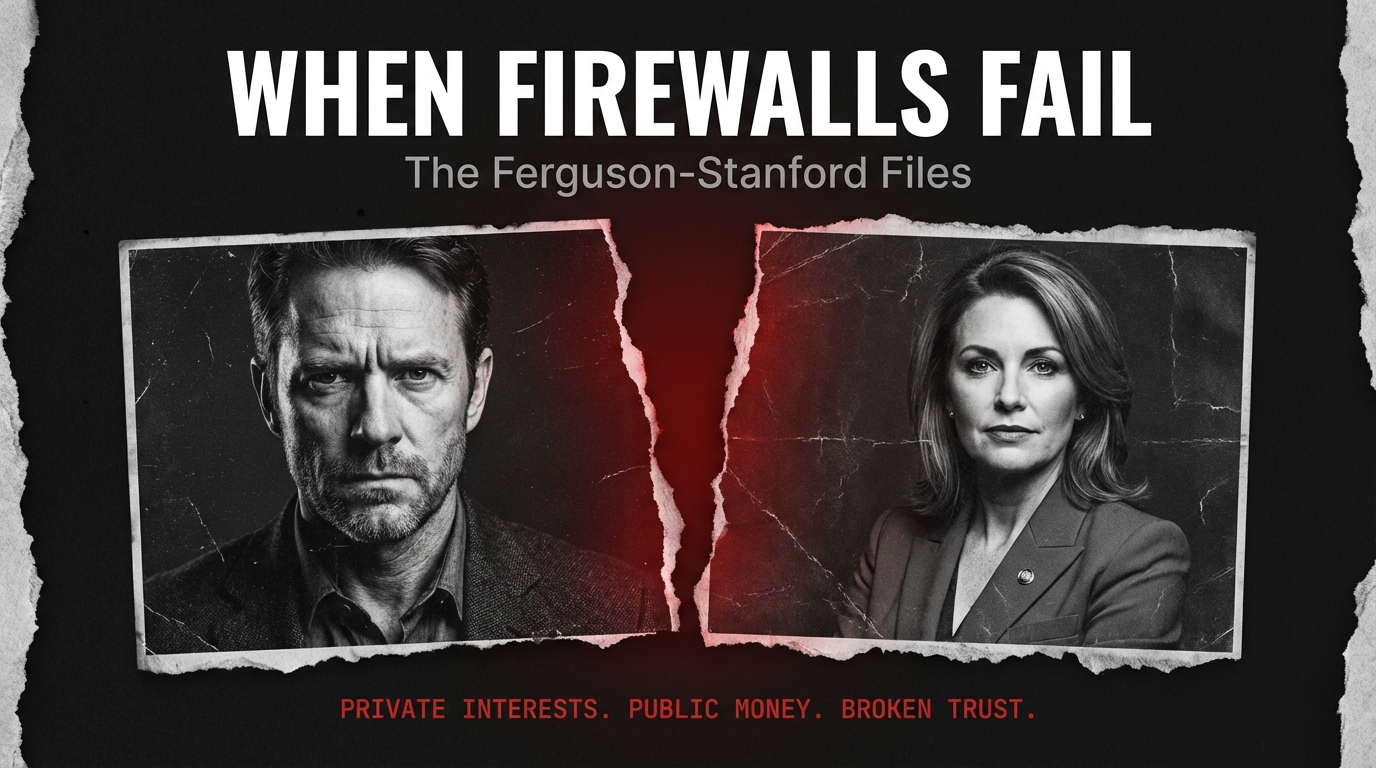
The scandal exposes fundamental failures in conflict-of-interest management and raises urgent questions about ministerial conduct, professional independence, and institutional integrity.
The Timeline: From Funding Requests to Ministerial Appointment
Between May 2024 and May 2025, Ferguson—then principal of Westlake Boys’ High School while establishing the Teachers Institute—engaged in repeated direct contact with Stanford regarding government funding. The messages, obtained by NZEI Te Riu Roa and first published by student researcher Brie Elliot, document a sustained pattern of engagement.
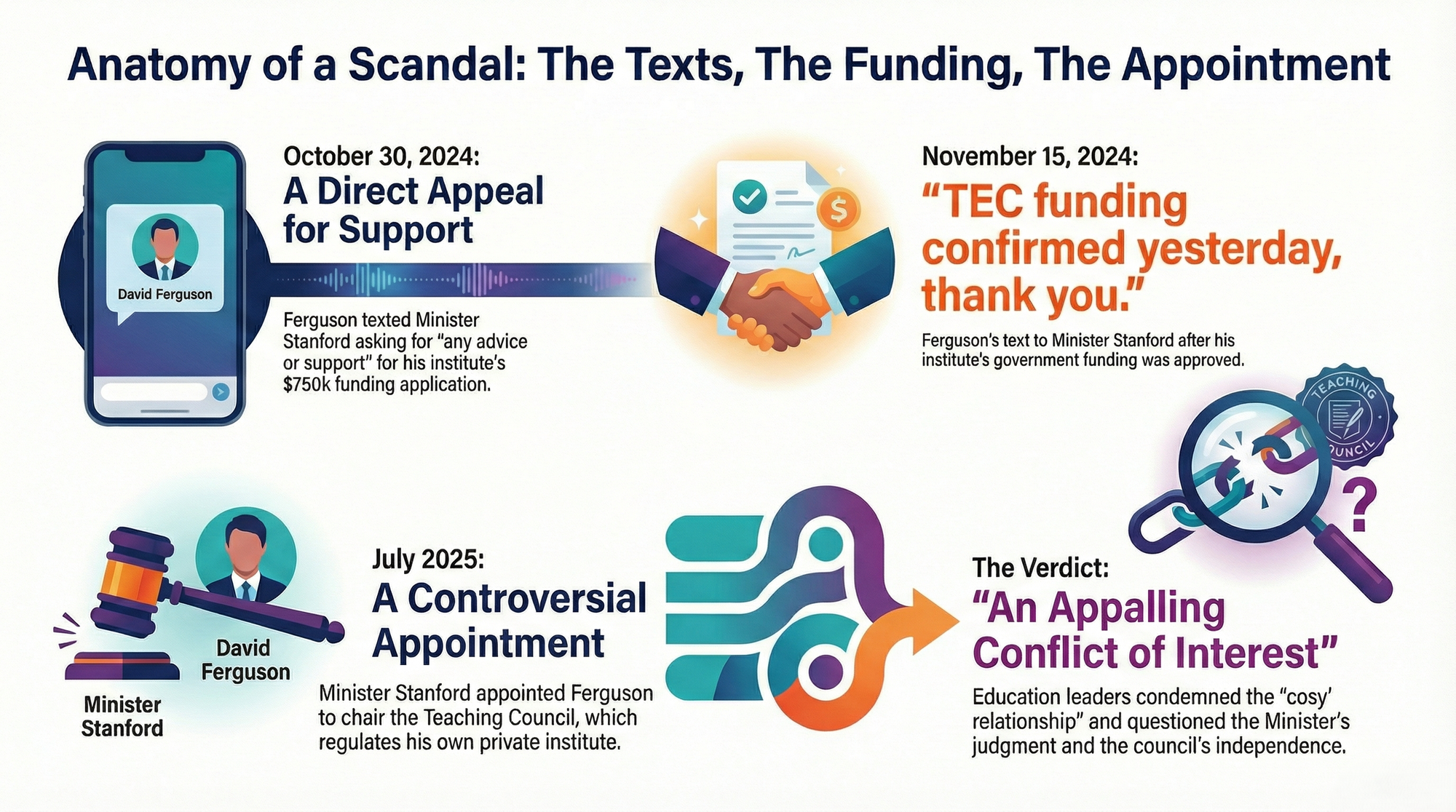
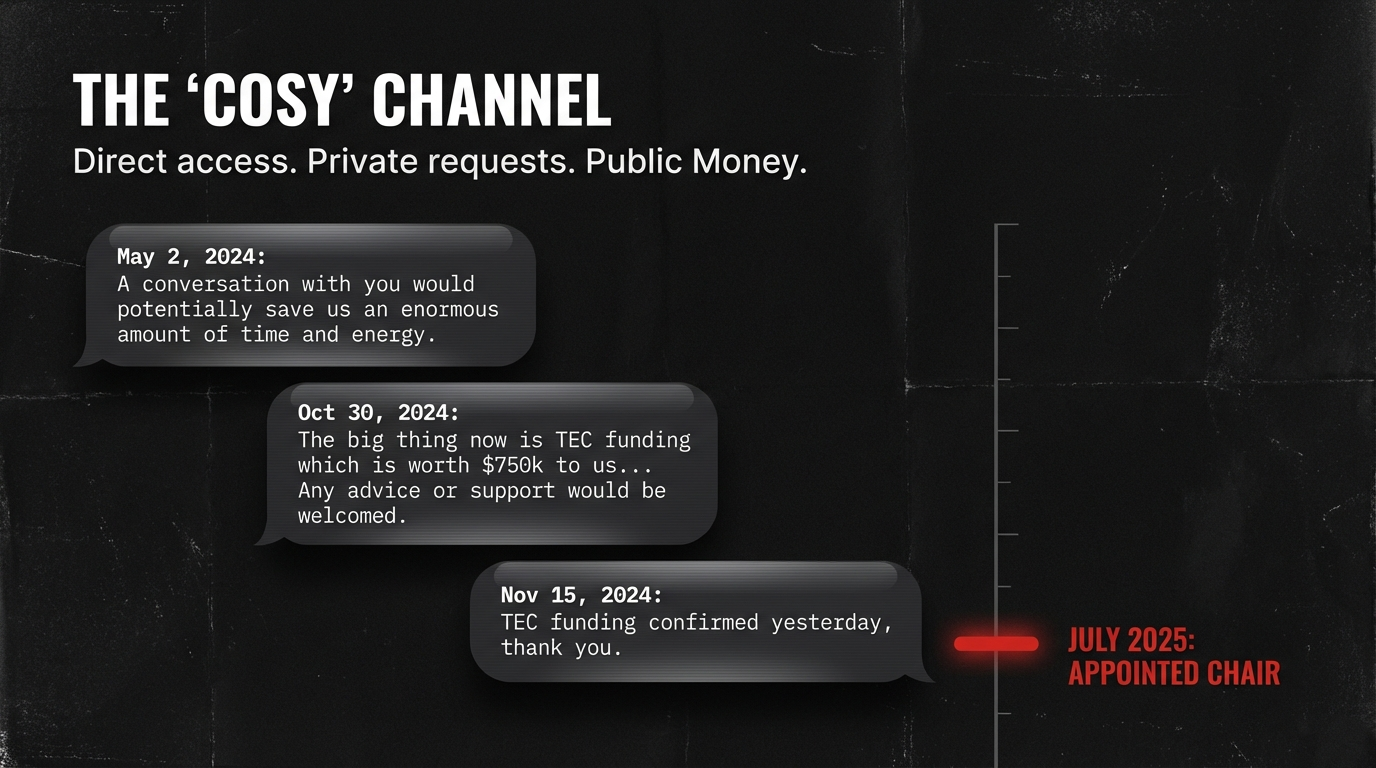
- 2 May 2024: Ferguson texts Stanford requesting a “five-minute phone conversation” about the institute’s new school-based teacher training programme, noting a conversation with her “would potentially save us an enormous amount of time and energy.”
- 3 May 2024: Stanford responds suggesting a call later that morning.
- 23-24 May 2024: Stanford asks Ferguson for detailed data on teacher training oversubscription. Ferguson provides figures: 100 places available, “conservatively at least 120” turned down.
- Late May 2024: Stanford offers to connect Ferguson with media, including RNZ, following her announcement of extra funding for school-based teacher education.
- 18 July 2024: Ferguson texts: “Would it be possible to speak to you or someone from your office... I had a meeting with the ministry yesterday regarding school onsite teacher training yesterday and wanted to check a couple of things with you.” Stanford responds: “How’s now?”
- 30 October 2024: Ferguson explicitly requests ministerial intervention: “The big thing now is TEC funding which is worth $750k to us. We won’t hear the outcome there until late November. I’ve been in touch with Tim Fowler. Any advice or support would be welcomed.”
- 1 November 2024: Stanford asks Ferguson to call her over the weekend.
- 8 November 2024: Ferguson inquires: “Morning Erica. I wondered if you’d managed to speak to Penny Simmonds about TEC funding for us.”
- 15 November 2024: Ferguson messages: “TEC funding confirmed yesterday, thank you.”
- July 2025: Approximately nine months after the first message and seven months after TEC funding was secured, Stanford appoints Ferguson to the Teaching Council—initially as deputy chair with the understanding he would become chair from late August 2025.
- November 2024: Ferguson is also appointed to the NZQA Board.
The Official Denials
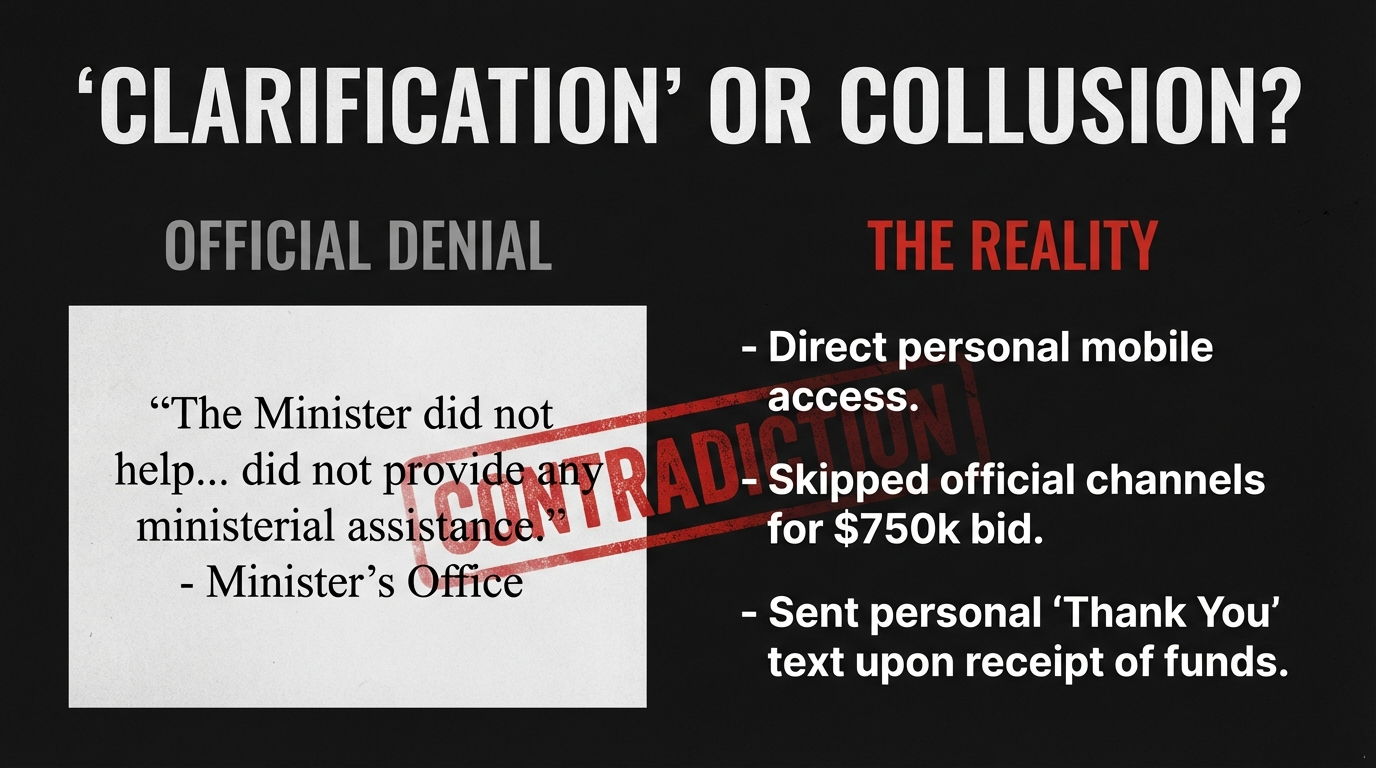
Stanford’s office provided a carefully worded statement asserting the Minister “did not help with securing any additional support or funding for the Teachers’ Institute, and did not provide any ministerial assistance.” The statement claims Stanford explained she was “not aware of how TEC funding worked” and had “a brief conversation with Hon Penny Simmonds about how, in general, TEC funding works, and overall timeframes”—but critically, “The Teachers’ Institute and David Ferguson were not discussed.”
Ferguson characterized his approach as seeking “clarity“ rather than ministerial assistance: “I had committed to leading a new ITE provider; staff had been employed and students enrolled for January 2025. The ITE provider is a charitable trust; certainty of funding was important.”
The Sector’s Verdict: “Appalling Conflict of Interest”
Multiple education bodies disputed the official accounts. NZEI Te Riu Roa National Secretary Stephanie Mills stated the documents showed Ferguson received “personal support” from Stanford for securing government funding, then Stanford appointed him as Chair of the Teaching Council, “which has responsibility for approving teacher training programmes.” Mills warned this “raises significant questions about the Minister’s management of potential conflicts of interest and risks eroding trust in her judgement.”
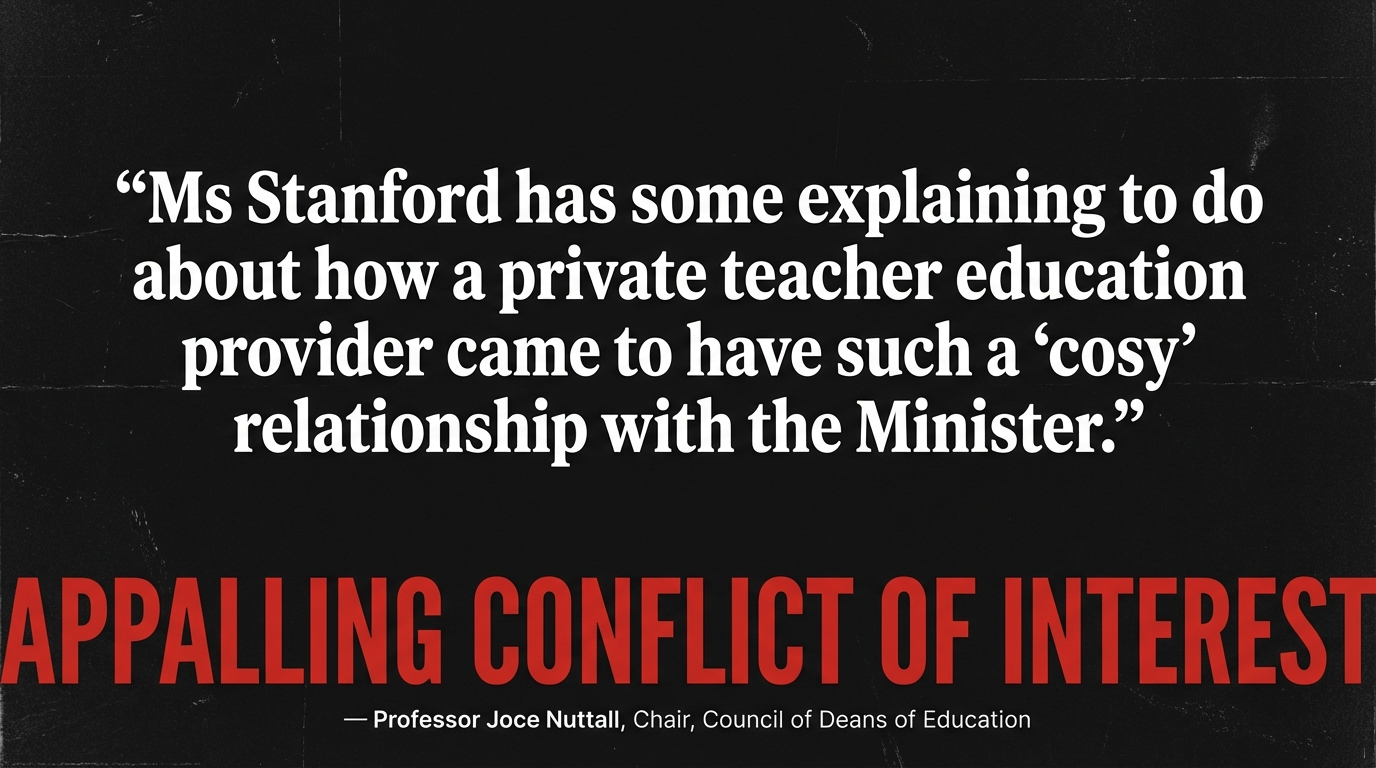
Professor Joce Nuttall, Chair of the Council of Deans of Education, which represents university teacher education programme leaders, was blunt: “Ms Stanford has some explaining to do about how a private teacher education provider came to have such a ‘cosy’ relationship with the Minister in setting up their business.” She described Ferguson’s concurrent role as Chair of the Teaching Council—”the very body that approves the Teaching Institute’s programmes”—as “appalling.”
An education sector analyst observed that while the Teaching Council Board has always had ITE representation, “a head of an ITE provider has never concurrently served as Board Chair, and at face value, the appointment raises concerns about conflicts of interest.”
What the Cabinet Manual Requires
Under the Cabinet Manual 2023, New Zealand’s primary guidance document for ministerial conduct, Minister Stanford was subject to strict conflict-of-interest protocols. Section 2.53 establishes the core principle: To protect executive integrity, “Ministers must conduct themselves in a manner appropriate to their office.” Critically, “appearances and propriety can be as important as actual conflicts of interest.”
Section 2.62 establishes an identification requirement: Ministers “are responsible for proactively identifying and reviewing possible conflicts of interest, and ensuring that any conflicts of interest are addressed promptly.”
Section 2.63 defines conflicts broadly: they may be pecuniary (financial), non-pecuniary (involving family, close associates), direct or indirect. Ministers must consider all types when assessing conflicts with their ministerial responsibilities.
Where conflicts exist, Cabinet Manual guidance prescribes mechanisms including declaration of interest, transferring responsibility to another minister, divestment of interests, or recusal from receiving papers or attending meetings on the subject.
Pattern Recognition: Why This Matters
The messages reveal not an isolated request for information, but a sustained pattern of Ferguson seeking ministerial engagement across a 12-month period. This pattern is inconsistent with Ferguson’s characterization of seeking “clarity” once; it suggests ongoing cultivation of ministerial support.
The “thank you” message of 15 November 2024 is particularly significant. The phrasing attributes the funding confirmation to Stanford—a conclusion the minister explicitly disputed. However, even if Stanford provided no direct intervention, the message suggests Ferguson believed she had been instrumental. This perception could itself constitute a conflict (actual or apparent) when Ferguson subsequently makes council decisions affecting education policy or funding that could benefit his institute.
The Council of Deans’ phrase—”cosy relationship”—captures the core concern: whether an ordinary teacher training provider would receive the same frequency of direct ministerial contact and apparent support. If the answer is no, then a privileged relationship exists, even if Stanford did not provide explicit ministerial assistance.
The Broader Institutional Crisis: Procurement Failures and Governance Collapse
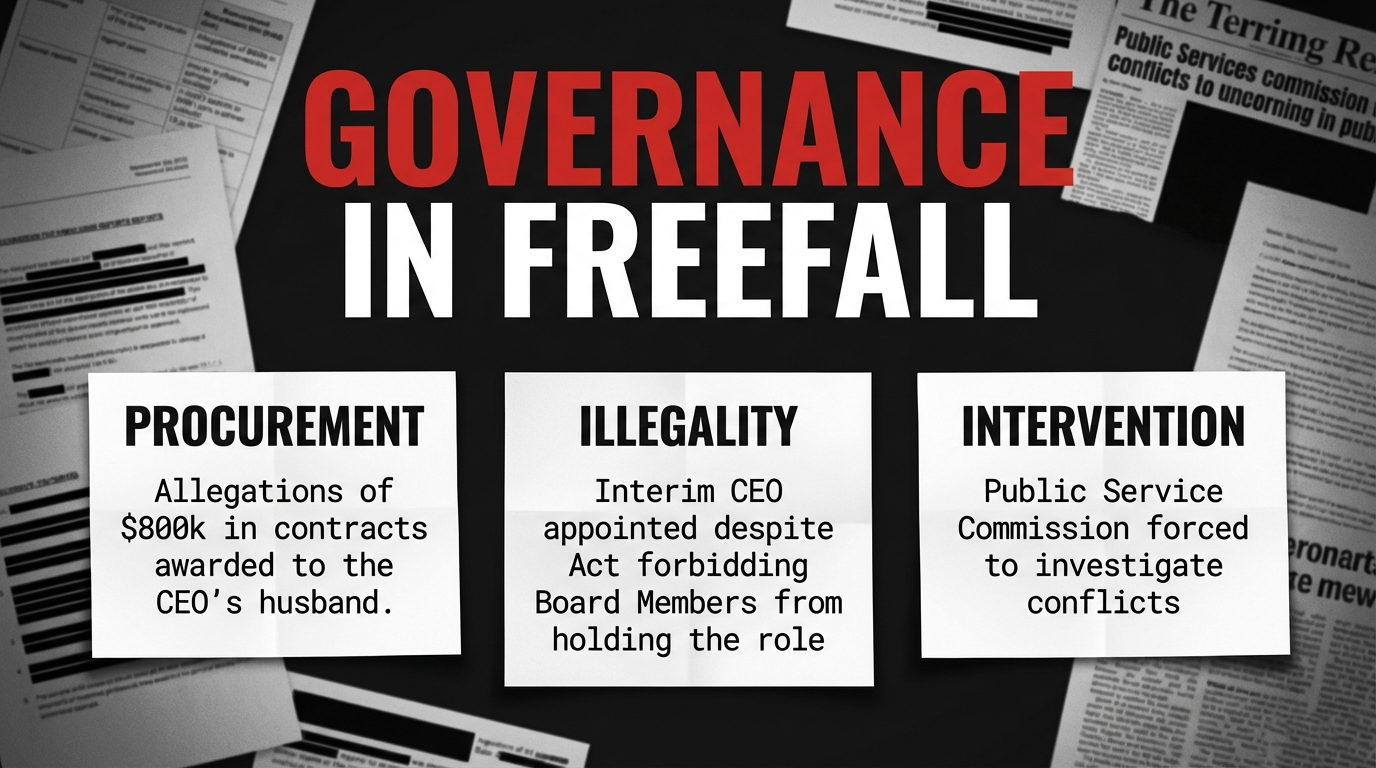
The Ferguson-Stanford controversy emerged within a broader institutional crisis at the Teaching Council itself. In June 2025, an anonymous whistleblower letter to Stanford alleged the Teaching Council had awarded contracts worth between $400,000 and $800,000 to Clemenger BBDO (specifically Clemenger Wellington), an advertising and consultancy firm managed by Brett Hoskin—the husband of Teaching Council CEO Lesley Hoskin.
Stanford referred the matter to the Public Service Commission (PSC), which launched an investigation into management of procurement and conflicts of interest. The PSC investigation was expected to conclude in early 2026. Separately, an independent conduct investigation into Hoskin’s conduct commenced. Hoskin took “agreed leave” beginning in October 2025, pending the investigation’s outcome.
The Tom Gott Legal Controversy
In November 2025, the council appointed Tom Gott as interim CEO while Hoskin remained on leave. However, Gott’s appointment created a legal controversy: the Education and Training Act explicitly states that the chief executive “may not be a member of the Teaching Council.” Neither the Education Ministry nor the council would definitively confirm whether this appointment was legal, describing it only as “pragmatic” for a “short-term arrangement.”
After RNZ scrutiny in December 2025, Gott resigned from the board but continued as interim CEO in an executive capacity. Council chair Ferguson told RNZ: “For the avoidance of doubt, Mr Gott has now resigned from the Board.”
The Policy Context: Centralization and the Loss of Professional Independence
In November 2025, simultaneously with the scandal’s intensification, Stanford announced sweeping reforms to the Teaching Council, incorporated into the Education and Training (System Reform) Amendment Bill before Parliament. These changes fundamentally restructure the council’s governance and functions.
Governance shift: The council, previously governed by a majority of elected members representing the teaching profession, would shift to a majority of ministerial appointees.
Functional reallocation: Professional standard-setting functions for Initial Teacher Education and the teaching workforce would be removed from the council and transferred to the Ministry of Education. The council would retain only teacher professional certification, conduct/competence registration, and teacher education provider quality assurance.
The timing and substance triggered unprecedented resistance. On 9 November 2025, ten major education organisations—including NZEI Te Riu Roa, PPTA Te Wehengarua, the New Zealand Principals’ Federation, Te Akatea, and others—issued an open letter warning the reforms represented “a fundamental shift in professional autonomy and independence.”
The sector’s core objection: when “the Ministry writes both the professional standards AND the teachers’ code of conduct,” teacher ability to “speak out professionally in the interests of ākonga [students] and quality teaching and learning becomes subject to direct political control. This is unprecedented.”
The Troubling Circularity
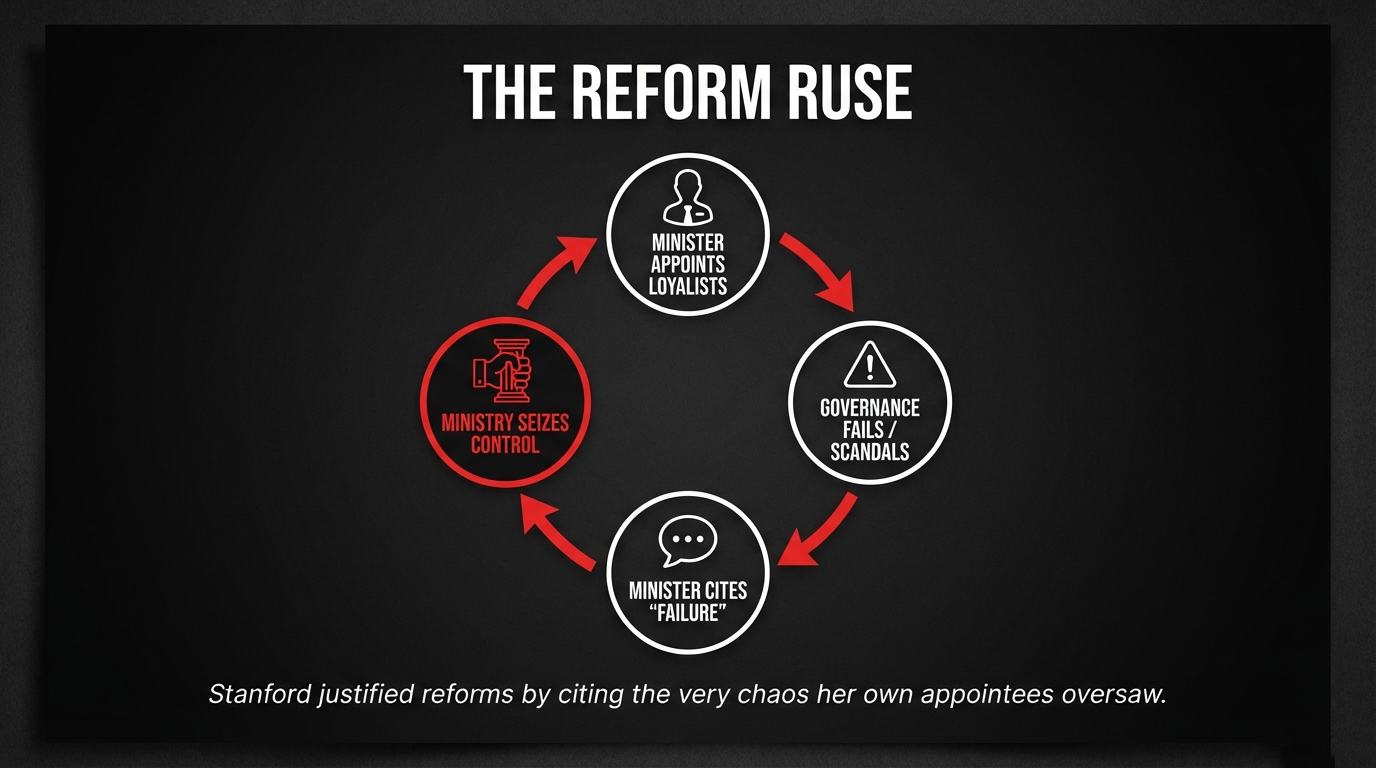
Critics observed that Stanford justified these reforms by citing the PSC’s investigation into Teaching Council conflicts of interest—suggesting the council’s governance failures warranted centralization of power in ministerial hands. Yet the Ferguson appointment—which raised the gravest conflict of interest concerns—was made by the Minister herself, not the council. This circularity prompted skepticism about whether the reforms were genuinely remedial or politically motivated.
What Happens Next
Student researcher Brie Elliot told RNZ she asked the Ombudsman to investigate. The PSC investigation into procurement and conflicts of interest is expected to complete in early 2026. A strategic review commissioned by the governing council and conducted by consultant Debbie Francis was due to complete in December 2025.
Meanwhile, the Teachers Institute continues to operate as a charitable trust providing school-based initial teacher education, with Ferguson as CEO and Chair of the council that approves such programmes. The institute aims to train 1,000 new teachers within five years and targets 150 trainees for its programmes.
The Broader Implications
This scandal exposes three systemic failures in New Zealand’s governance architecture:
First, conflict-of-interest management depends on ministerial self-identification and voluntary disclosure. The Cabinet Manual requires ministers to “proactively identify” conflicts, but enforcement is minimal. When ministers fail to recognize (or acknowledge) apparent conflicts, the system provides few remedies.
Second, regulatory capture occurs when regulators are appointed by—and maintain ongoing relationships with—the sectors they regulate. Ferguson’s dual role as institute CEO and Teaching Council Chair creates precisely the structure regulatory independence is meant to prevent.
Third, centralizing power in ministerial hands while citing governance failures at independent bodies creates a perverse incentive. If ministerial conduct itself creates conflicts, and those conflicts justify transferring power from independent bodies to ministries, the circle becomes self-reinforcing.
The Auditor-General’s 2025 report on ministerial conflicts of interest found that “overall, the system for managing Ministerial conflicts... was sound” and noted “clear expectations about the need for Ministers to register their interests and to document and manage conflicts well.” Yet the Ferguson-Stanford case suggests significant gaps remain between documentation and actual conflict prevention.
Integrity as Infrastructure
Public trust in education governance depends on visible separation between private interests and regulatory power. When that separation collapses—when the head of a private provider chairs the council that approves providers, when ministers appoint regulators they have ongoing relationships with, when governance failures at independent bodies justify ministerial centralization—the system loses legitimacy.
The messages between Ferguson and Stanford may not constitute a legal breach. But as the Cabinet Manual recognizes, “appearances and propriety can be as important as actual conflicts of interest.” The appearance here is unmistakable: a year-long pattern of engagement, expressions of gratitude for funding confirmations, followed by ministerial appointment to a regulatory role with direct oversight of the appointee’s private enterprise.
New Zealand’s education sector—and the 100,000+ teachers whose fees fund the Teaching Council—deserve better. They deserve regulators genuinely independent of the sectors they regulate. They deserve ministers who recognize conflicts before they create them. And they deserve a governance system where integrity is infrastructure, not aspiration.
Koha Consideration
Every koha signals that whānau are ready to fund the accountability that Crown and corporate structures will not provide. This essay exposes precisely what those structures fail to do: maintain the firewalls between private interests and public power that protect our tāmariki and rangatahi.
When ministers appoint regulators they have ongoing relationships with, when private provider CEOs chair the councils that approve providers, when procurement investigations reveal apparent self-dealing at the board level—those are not technical failures. They are institutional capture. And institutional capture thrives in darkness.
This essay exists because a student, Brie Elliot, chose to publish these messages publicly. Because the teachers’ union and deans of education chose to speak. Because whānau and educators refused to accept official denials when the pattern was clear.
But sustained accountability requires sustained funding. It requires people willing to keep watching. To keep asking questions. To keep demanding that integrity is infrastructure, not aspiration.
Kia kaha, whānau. Stay vigilant. Stay connected. And if you are able, consider a koha to ensure this voice continues—the voice that says: we see what happened here, and we will not let it be forgotten.
Three pathways exist:
For those who wish to support this mahi directly with a koha (voluntary contribution) to fund ongoing accountability journalism:
Koha—Support - https://app.koha.kiwi/events/the-maori-green-lantern-fighting-misinformation-and-disinformation-ivor-jones
For those who wish to receive essays directly and support through subscription, join the Substack community:
Subscribe to the Māori Green Lantern on Substack - https://themaorigreenlantern.substack.com/subscribe
For those who prefer direct bank transfer, account details are: HTDM, account number 03-1546-0415173-000.

Ivor Jones The Māori Green Lantern Fighting Misinformation And Disinformation From The Far Right