“When Mountains Weep and Bureaucrats Sleep: The Mauao Massacre as Sacred Betrayal” - 30 January 2026
Kia ora ano whānau,
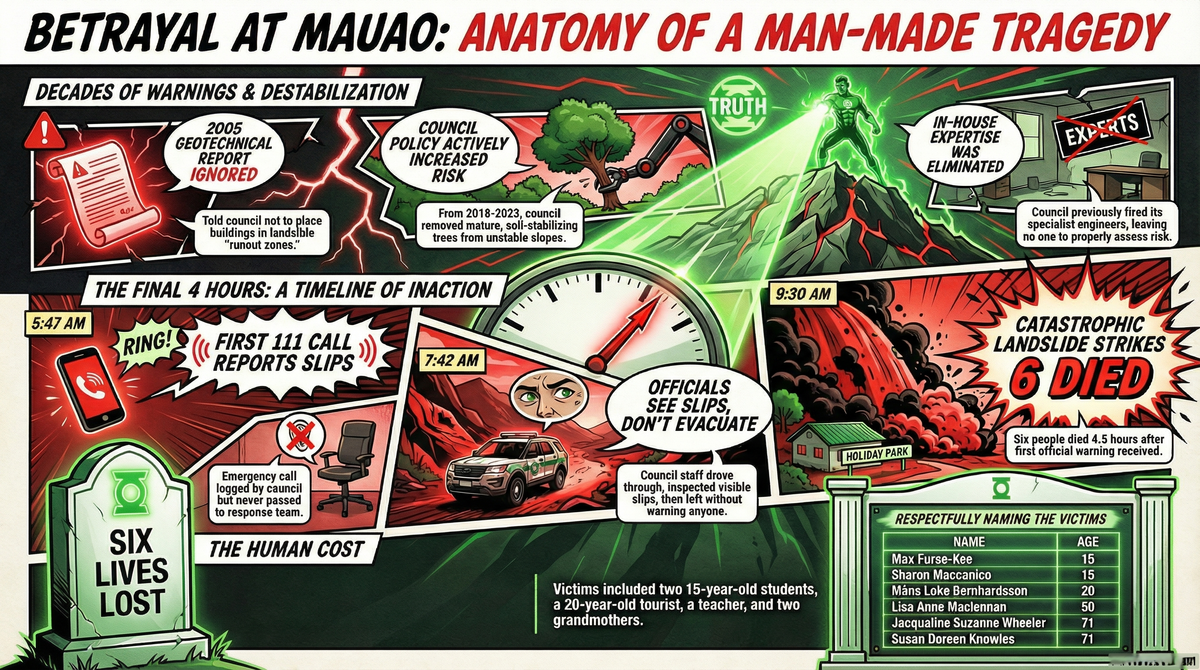
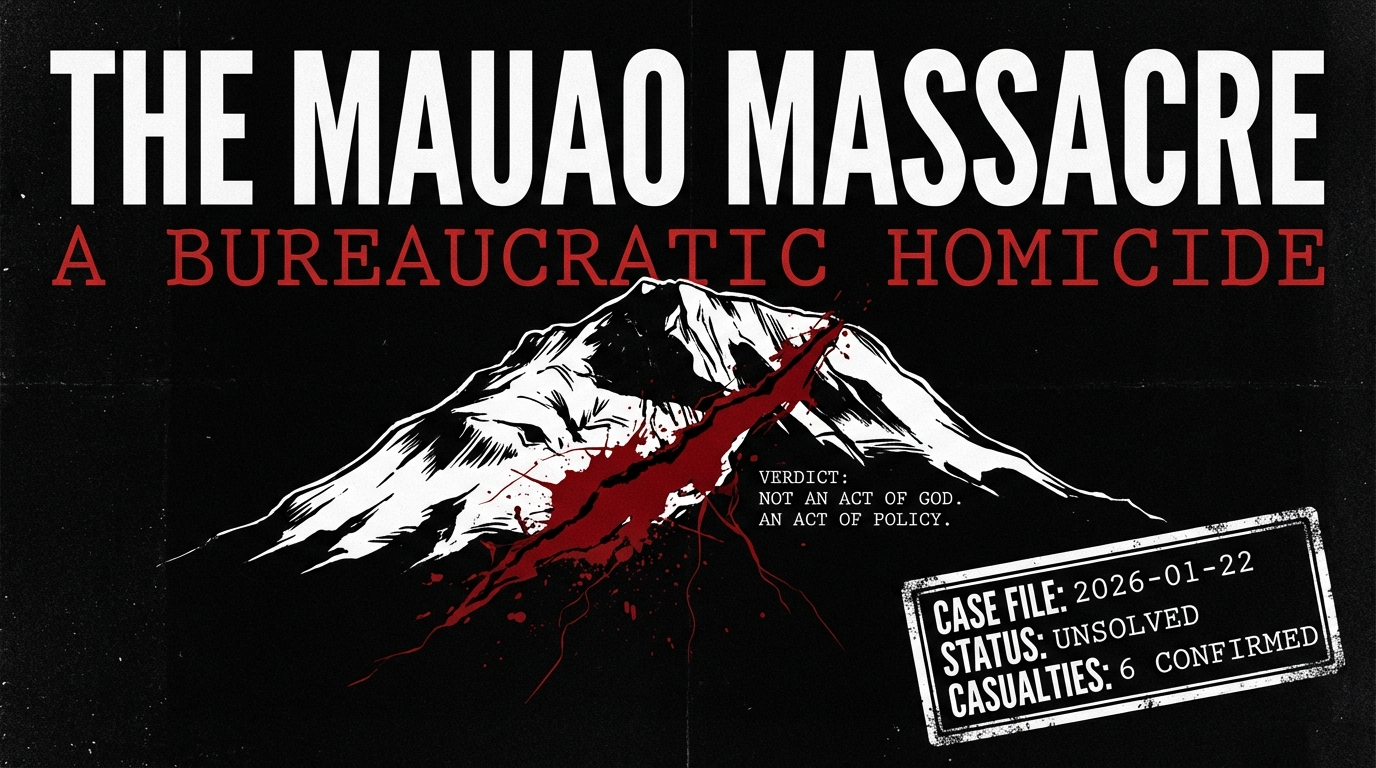
The mountain caught by dawn now holds six bodies in his wounded flank—not victims of nature’s caprice, but sacrifices to a cult of administrative negligence so grotesque it transforms manslaughter into policy.
As revealed by RNZ, the January 22, 2026 landslide at Mount Maunganui’s Beachside Holiday Park killed two fifteen-year-olds, a Swedish tourist barely twenty, a fifty-year-old teacher who died warning others, and two elderly women
—all while council bureaucrats drove past visible warning slips,
logged emergency calls they claim not to have received, and
opened a hot pool facility ninety minutes before the slope collapsed onto sleeping families.
This was not an “unprecedented disaster,” as officials now incant like a protective spell. This was bureaucratic homicide dressed in the respectable suit of institutional failure.
The Doctrine of Convenient Ignorance
Twenty years ago, geotechnical engineers handed Tauranga City Council a verdict as clear as a coroner’s report:
buildings must not be placed in landslide “runout zones” at the base of unstable slopes unless specially protected by engineered structures.
“Only in rare circumstances,” the 2005 study warned,
“would it be prudent to violate” these criteria.
Yet for two decades, the Beachside Holiday Park—owned and operated by the very council that received this warning—sat in precisely the forbidden zone, a campground of sacrificial tents pitched at the foot of a mountain documented to have suffered 80+ landslides during a single 2011 cyclone.
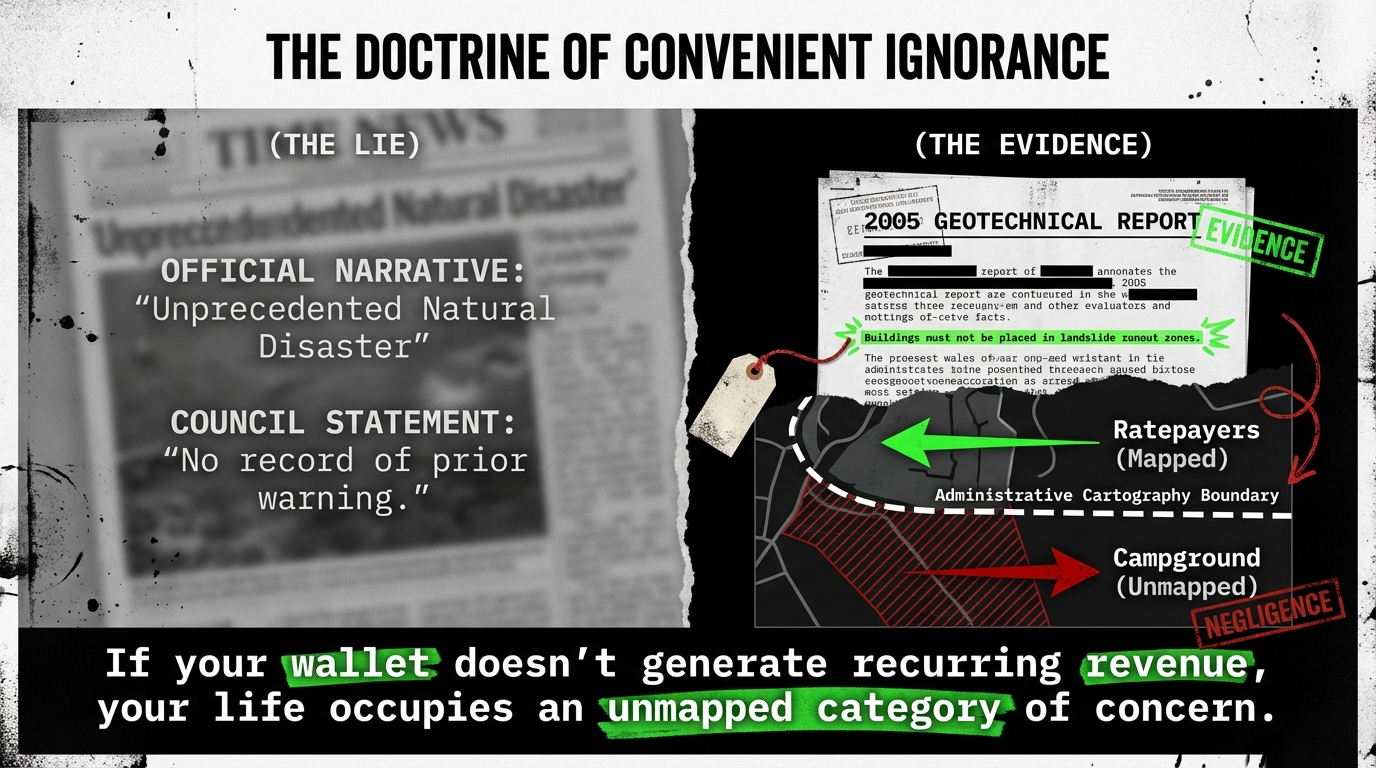
The quantified harm begins with administrative cartography. When Tauranga City Council commissioned WSP engineering consultants in July 2025 to conduct comprehensive landslide susceptibility mapping covering all Pacific-facing neighbourhoods of Tauranga, the resulting hazard maps stopped
—with bureaucratic precision
—at the boundary that excluded Mauao and its campground.
Tourists sleeping in council-owned caravans do not pay rates;
they therefore do not appear on risk assessments. If your wallet doesn’t generate recurring revenue, your life occupies a literally unmapped category of administrative concern.
This is not oversight. This is organized indifference calcified into policy.
Policy as Premeditated Destabilization
The mountain did not fail spontaneously. It failed because in 2018, Tauranga City Council approved the Mauao Historic Reserve Management Plan
—a document of bureaucratic elegance that prioritized
“cultural, archaeological and ecological objectives”
by mandating the systematic removal of exotic trees,
including the mature macrocarpa, pine, and oak that had, for decades, anchored the volcanic clay soils with their root systems.
Between 2018 and 2023, helicopter-assisted tree removal operations stripped Mauao’s slopes of the very vegetation that scientists confirm increases soil strength and provides critical drainage during intense rainfall.
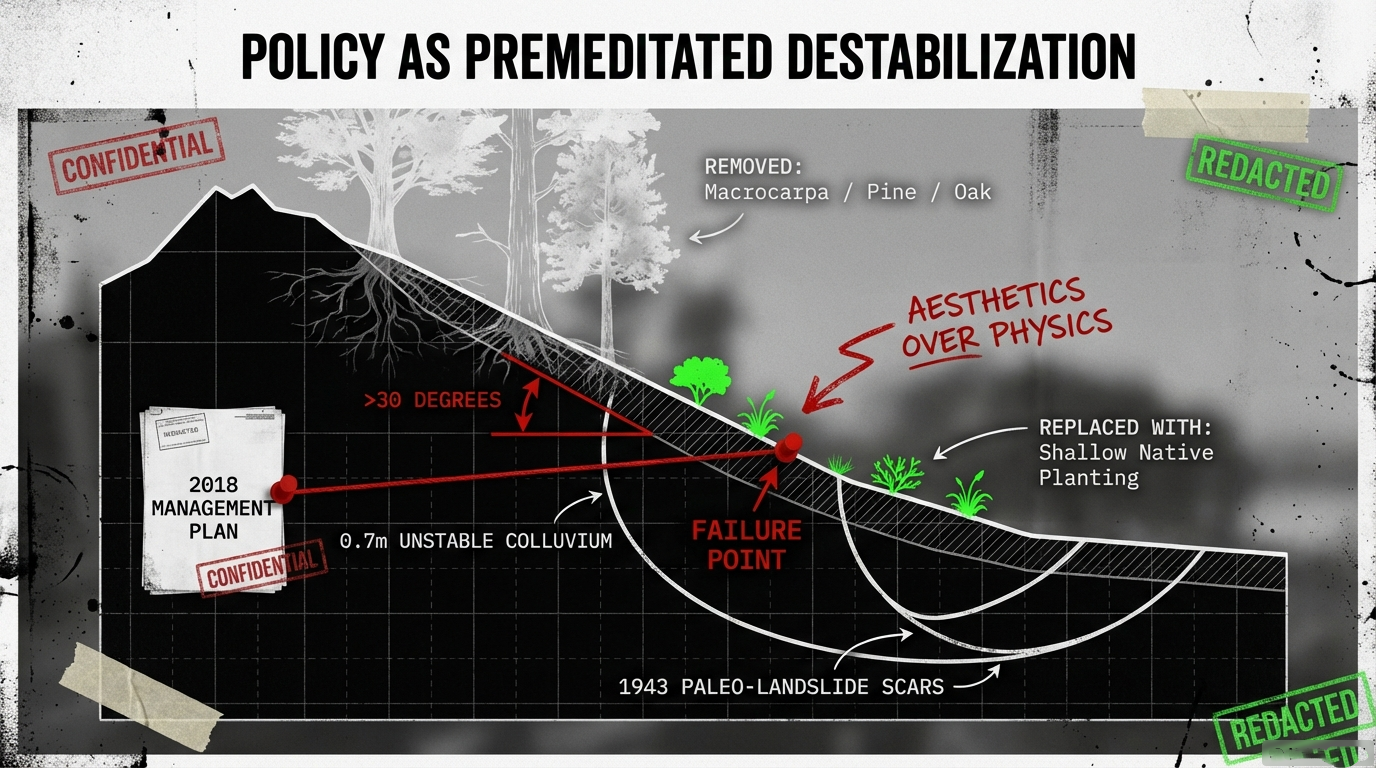
What the policy never integrated was the engineering function of those trees. The 2018 management plan reads like a liturgy to restoration—returning Mauao to a pre-colonial ecological state—without acknowledging that the mountain beneath these aspirations is geologically unstable volcanic material sitting at angles exceeding 30 degrees, covered in a documented 0.7-meter layer of colluvium (debris from previous landslides), and positioned above two massive paleo-landslide scars clearly visible in aerial photography dating to 1943. The January 22 landslide initiated in the narrow wedge between these ancient scars—the geological equivalent of building a campground at the base of a partially collapsed cliff and expressing surprise when the remaining section follows gravity’s invitation.
For Western minds accustomed to separating “natural” from “cultural” landscapes, understand: the council did not merely neglect to prevent this disaster. It engineered the conditions for failure, then placed revenue-generating temporary accommodation directly in the predicted impact zone.
The Timeline of Willful Negligence
The morning of January 22 unfolds like a procedural manual for institutional homicide:
- 5:00 AM: Lisa Anne Maclennan, a fifty-year-old teacher from Morrinsville, is jolted awake when a small slip pushes her campervan forward approximately one meter. She spends the next hour banging on neighbors’ windows, warning campers to move away from the base of Mauao. Many do. She returns—likely to the ablution block to warn others inside. She dies there.
- 5:47 AM: Local resident Alister McHardy calls 111, having spotted multiple slips near the campground. He tells Fire and Emergency New Zealand (FENZ) there are “likely to be more” and “it needs to be closed off.”
- 5:51 AM: FENZ notifies Tauranga City Council as the landowner. The call is logged at the council’s Contact Centre. Council CEO Marty Grenfell will later claim “no record” of this call, then backtrack hours later when confronted with telecommunication logs, admitting the Contact Centre received it but never forwarded it to the Emergency Operations Centre.
- 6:18 AM: Another camper calls police, speaking for eight minutes about slips that pushed vehicles and a distressed homeless man trapped in the toilet block who is “banging on the walls and smashing things.” Police say they’ll “try to get a unit there.” None arrives.
- 7:42 AM: The campground manager and a council worker drive through the site in a golf buggy. Multiple witnesses report pointing out the slips. The pair inspects them, then drives to check on the Surf Club. They never return.
- 7:45 AM: A Tauranga City Council utility vehicle drives slowly past three visible slips. A camper calls out warnings. It’s unclear if the driver hears. The vehicle continues through standing water streaming from the slopes and departs.
- 8:02 AM: The council posts on Facebook that Mauao is closed for the day, noting “fencing is getting put up.”
- 8:56 AM: Council emails media that the mountain has been “significantly destabilised, creating an ongoing risk of further slips and falling debris.”
- 9:00 AM: The Mount Hot Pools—also council-owned—opens for business. Tourists arrive for massages.
- 9:30 AM: Approximately 200 tonnes of volcanic clay, rock, and uprooted trees cascade through the campground, obliterating campervans, crushing the toilet block where Maclennan likely died warning others, and burying tents in a wave that travels 120 meters from its initiation point.
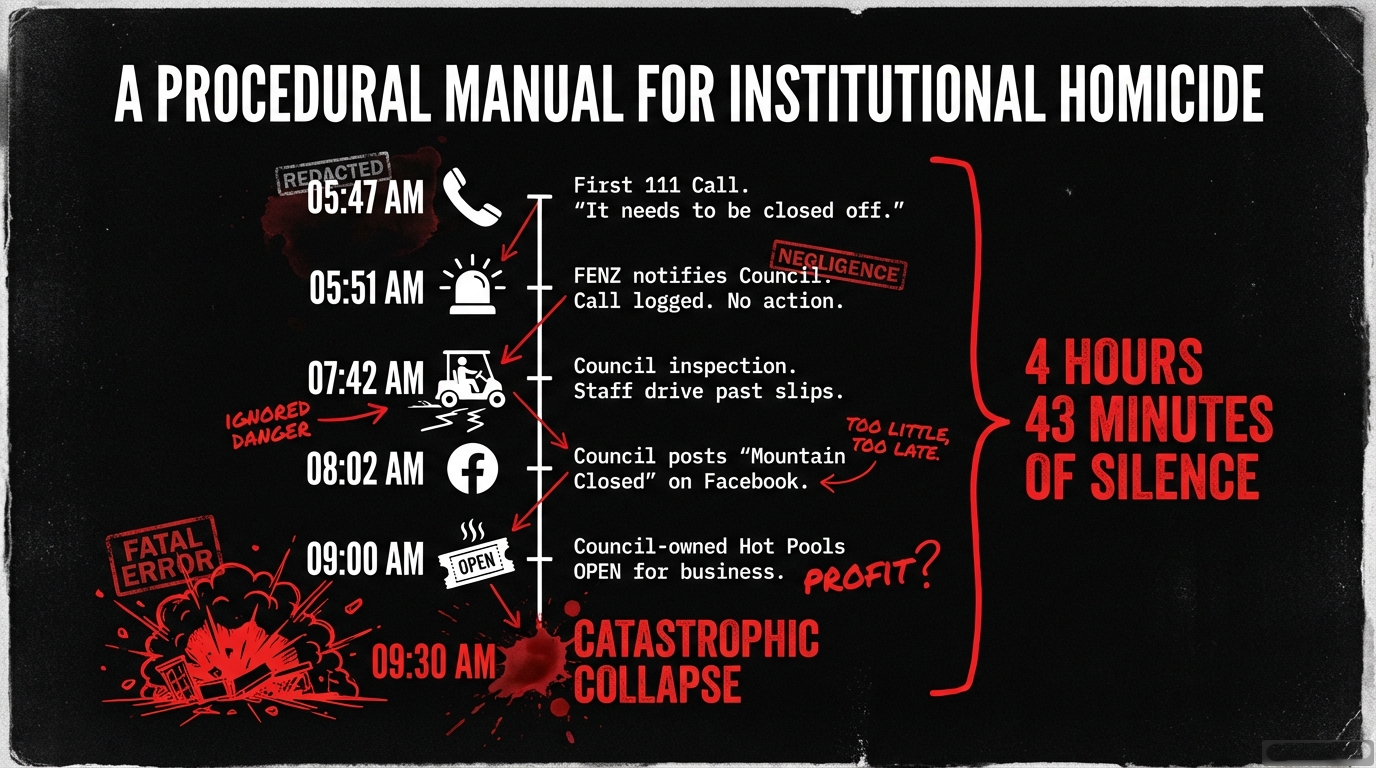
Four hours and forty-three minutes elapsed between the first 111 call and the catastrophic failure. Mayor Mahé Drysdale later confirms council staff were physically present at the site when the landslide struck. Not one camper received formal evacuation orders. The campground manager never returned after his 7:42 AM golf buggy inspection.
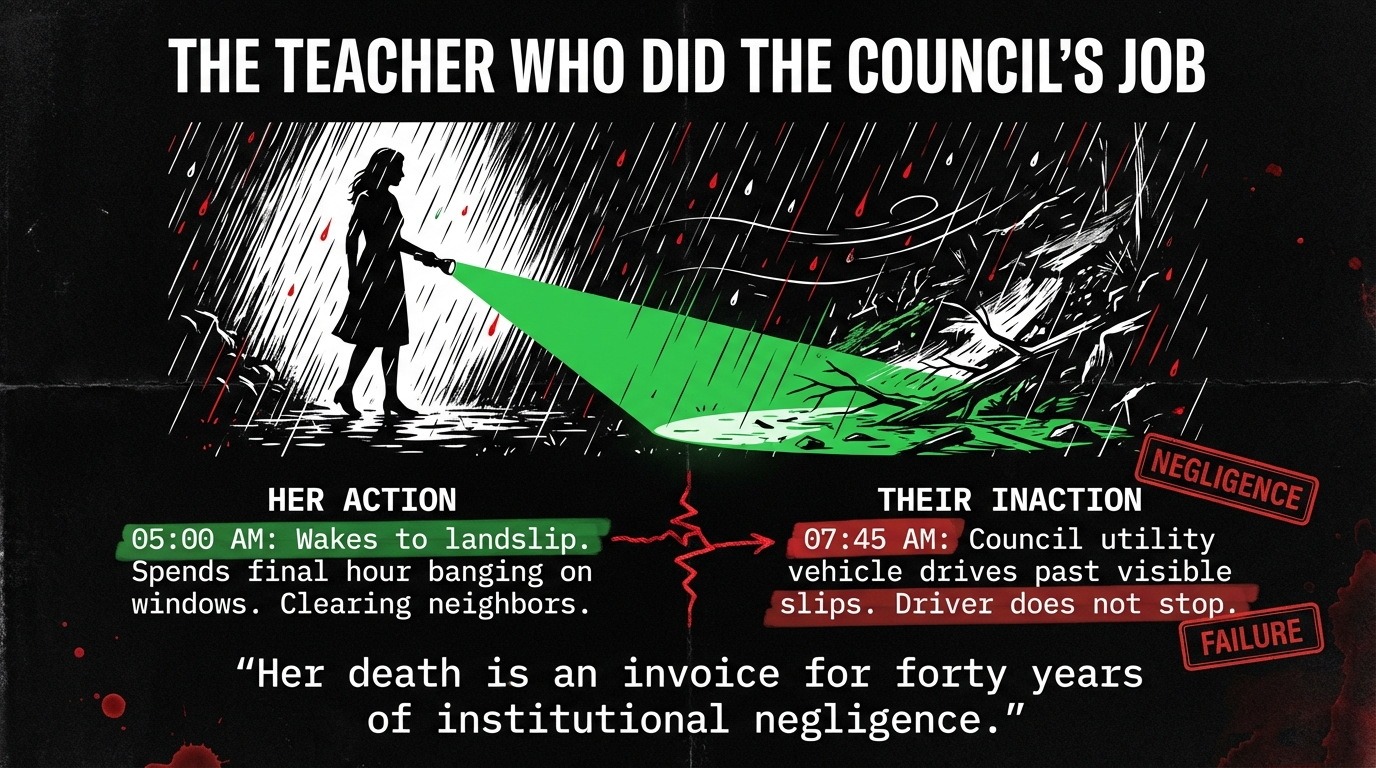
Six families will bury children and grandmothers because a council that knew, saw, was warned, and did nothing.
The Collapse of Institutional Capacity
This catastrophe cannot be understood merely as individual failure. It represents the terminal stage of a decades-long policy of institutional evisceration. Since the 1990s, as documented by geotechnical engineer David Buxton, New Zealand councils have systematically “shed expertise”—firing in-house geotechnical specialists and contracting external consultants for discrete projects. This creates what Buxton describes as councils “reliant on outside advice” but staffed by “in-house people without that depth of technical knowledge to make that decision-making.”
The result? Expensive reports that sit on digital shelves, written by consultants who depart once the invoice clears, understood by no one with institutional memory or the technical literacy to translate findings into operational reality. When the WSP landslide study arrived in July 2025, who in council chambers possessed the geological expertise to ask:
“Why have you excluded Mauao from this analysis when it’s the most landslide-prone feature in our entire district?”
Nobody. Because that position was eliminated in a cost-cutting exercise fifteen years ago.
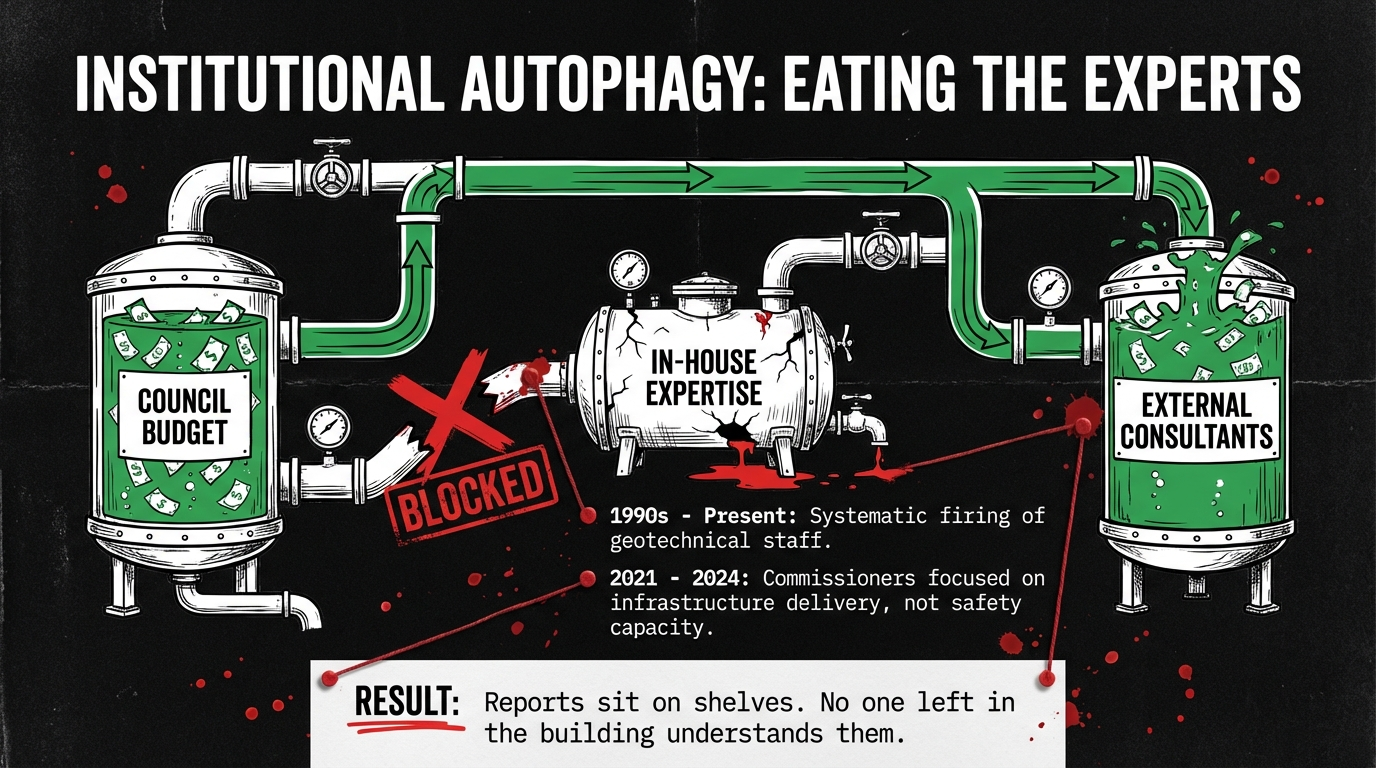
Tauranga exemplifies this institutional autophagy. The city’s elected council was so dysfunctional by 2020—characterized by infighting, bullying, and paralysis—that the government sacked the entire body and installed four Crown commissioners who governed from February 2021 until July 2024. The commission’s mandate focused on infrastructure delivery and spatial planning; it did not rebuild in-house expertise in natural hazards management. When democracy was restored in July 2024, the incoming elected council inherited an organization structurally incapable of protecting its citizens from known geological threats.
This is not a bug. This is the designed outcome of forty years of neoliberal local government “reform”—a word that in New Zealand governance means “convert public protection into a cost centre, then eliminate it.”
Tikanga Violated: The Sacred Made Profane
For Māori, and specifically for Ngāi Te Rangi, Ngāti Ranginui, Ngāti Pūkenga, and Waitaha—the iwi who hold Mauao as tūpuna maunga (ancestral mountain)—this disaster carries dimensions Western frameworks struggle to articulate. Mauao is not a “natural resource” to be “managed.” He is an ancestor, a tūpuna, bearing a name that means “caught by the light of day”—a reference to the creation narrative in which the heartbroken mountain asked patupaiarehe (fairy beings) to drag him to the ocean to drown his grief, only to be frozen in place when dawn arrived and the spirit beings fled from daylight.
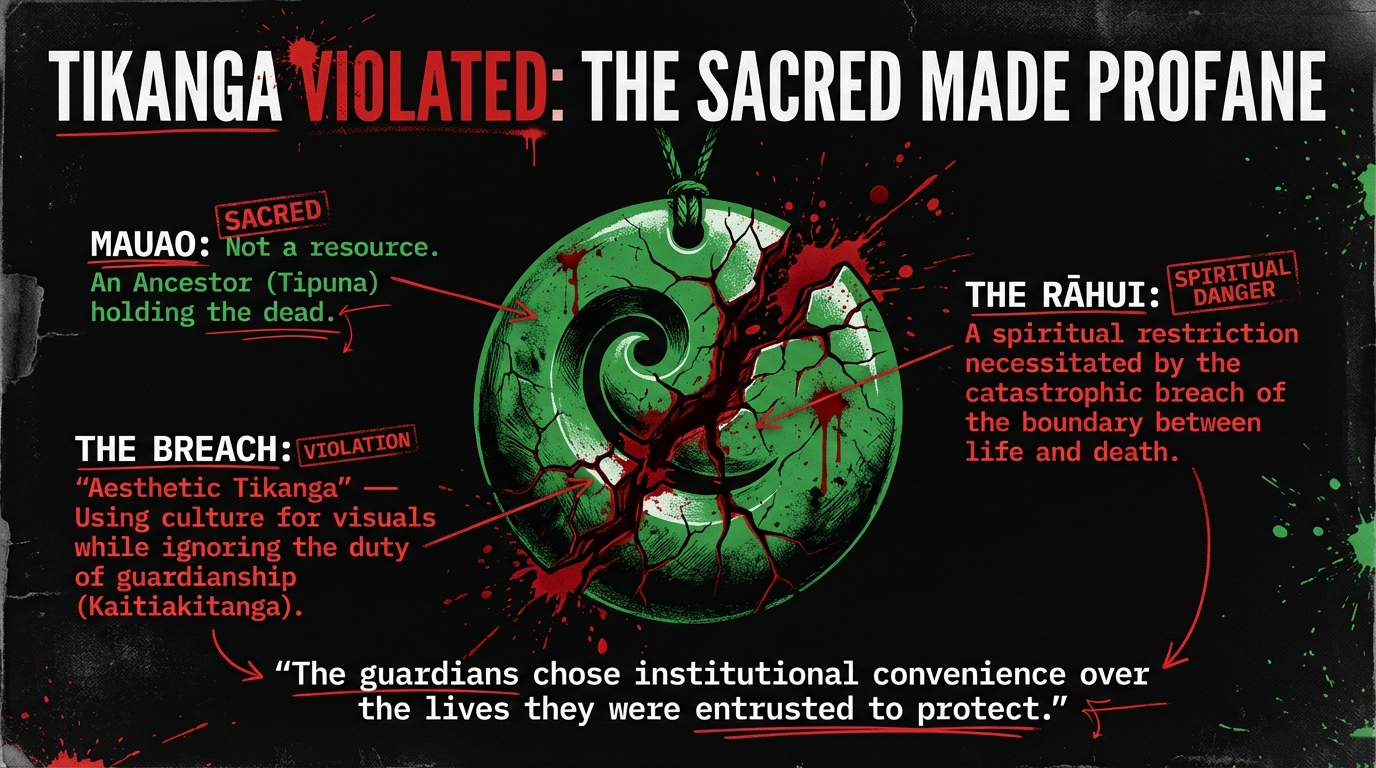
That this mountain—already bearing the spiritual weight of grief—should now hold six human dead buried in his slopes is not merely tragic.
It is tapu in the most profound sense:
sacred power rendered dangerous through violation. The rāhui placed over Mauao by the Mauao Trust following the disaster—a prohibition on climbing, swimming, or gathering resources near the mountain—is not superstitious theater for Western consumption. It is a recognition that death renders a space tapu (sacred/restricted) until it can be ritually returned to noa (common/safe) through karakia and the passage of time.
For Western minds:
imagine a cathedral where six people died in a structural collapse caused by documented neglect. Would you permit tourist access the next day? The rāhui functions similarly—it protects both the living (from additional physical danger and psychological trauma of encountering remains) and maintains the spiritual integrity of a space where the boundary between life and death has been catastrophically breached.
The council’s 2018 management plan, which prioritized tree removal for “cultural restoration,” engaged in what might be termed aesthetic tikanga—the performance of cultural values without their integration into the material management of risk. Removing exotic trees to restore ecological authenticity while ignoring their function in slope stability is like renovating a church’s stained glass while removing its load-bearing walls. The 2018 plan was developed in consultation with Ngā Poutiriao ō Mauao (the joint management board of iwi and council representatives), but consultation is not co-governance, and participation in planning does not transfer liability for engineering consequences that iwi representatives lack the technical training to evaluate.
What has been violated here is kaitiakitanga—the principle of guardianship. The council, as legal owner and manager of both the mountain reserve and the campground at its base, held the ultimate kaitiaki responsibility.
It received specific warnings in 2005, observed 80 landslides in 2011, commissioned tree removal operations in 2018-2023, received a 111 call at 5:51 AM, and saw visible slips at 7:42 AM.
At every decision point, the guardians chose institutional convenience over the lives they were entrusted to protect.
As Te Ariki Morehu of Ngāi Te Rangi stated in calling for a full investigation:
“There has been a lot of work done on Mauao. So, we look forward to a thorough investigation into why this occurred.”
The restraint of that statement barely conceals a fury that should burn through every level of government.
Solutions: What Accountability Demands
1. Immediate Criminal Investigation
WorkSafe New Zealand has confirmed it is investigating organisations with a duty of care for potential breaches of health and safety legislation. This must proceed to prosecution. Section 36 of the Health and Safety at Work Act 2015 creates duties for PCBUs (persons conducting business or undertaking) to ensure, so far as reasonably practicable, the health and safety of workers and others affected by the work. A council that received four separate warnings between 5:47 AM and 7:45 AM, physically inspected the hazard, then failed to evacuate the site or even close the adjacent hot pools, has manifestly breached this duty.
Criminal charges of manslaughter under section 150A of the Crimes Act 1961 should be explored against individuals who held operational control. The legal test is whether there was a major departure from the standard of care expected of a reasonable person in that position. Driving past visible landslips, logging emergency calls that are never acted upon, and opening a tourist facility below an unstable slope documented to be “significantly destabilised” appears to meet this threshold.
2. Mandatory Independent Government Inquiry
Prime Minister Christopher Luxon has signaled there is a “strong case” for a government inquiry separate from the council’s own review. This is insufficient—it must be mandatory, not contingent on negotiation with the council. The scope must include:
- Institutional capacity audit: Document the decline in in-house geotechnical expertise across all New Zealand councils since 1990 and quantify the relationship between expertise reduction and disaster vulnerability.
- Mapping exclusion analysis: Investigate why Mauao was excluded from the 2025 WSP study and whether this represents systemic undervaluing of temporary accommodation areas (campgrounds, holiday parks) in hazard assessments.
- Decision timeline reconstruction: Produce minute-by-minute documentation of who knew what, when, and what actions they took or failed to take between 5:47 AM and 9:30 AM on January 22, 2026.
- Tikanga integration assessment: Evaluate whether the 2018 management plan’s tree removal policy received adequate geological risk assessment and whether iwi representatives on the joint management board were provided with sufficient technical information to evaluate slope stability consequences.
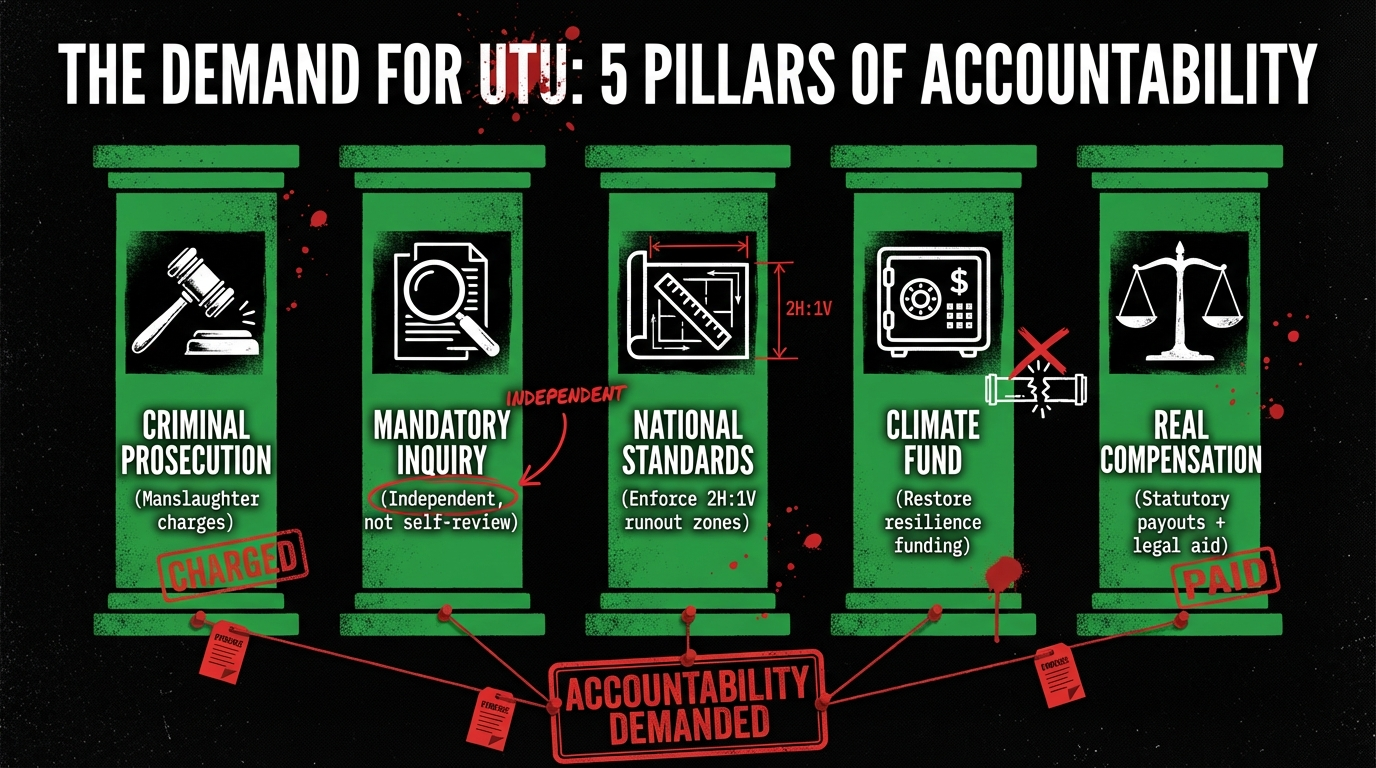
3. National Natural Hazard Management Standards
The Ministry for the Environment proposed a National Policy Statement for Natural Hazard Decision-Making in 2022, but it remains unimplemented. This must be fast-tracked with mandatory provisions including:
- Runout zone calculations: All territorial authorities must map and enforce landslide runout zones using the engineering formula 2H:1V (twice the vertical height of the slope, extending horizontally from its base) as the minimum restricted area for habitable structures.
- Real-time monitoring requirements: Any location with documented landslide history and active human occupation must have automated ground movement sensors with direct emergency service notification systems.
- Mandatory evacuation protocols: Establish national standards requiring immediate evacuation when ground movement is detected or when weather conditions exceed geotechnical thresholds for slope failure.
4. Dedicated Climate Adaptation Funding with Governance Reform
The current government has dismantled the $6 billion National Resilience Fund created after Cyclone Gabrielle, arguing resilience spending should be assessed through standard budget processes. This is ideological malpractice. Establish:
- National Climate Adaptation Authority: Independent statutory body with power to override local planning decisions where climate-amplified hazards threaten life, funded through a dedicated levy on insurance premiums and the Emissions Trading Scheme.
- Managed retreat funding: Create a national fund of $500 million annually for voluntary property acquisition in high-risk zones, with compensation at 2019 market values (pre-climate disclosure impacts) to avoid punishing homeowners for council planning failures.
- Council capacity grants: $100 million annually for councils to rebuild in-house expertise in geotechnical engineering, climate science, and emergency management, with funding contingent on hiring permanent staff rather than consultants.
5. Victim Compensation Beyond Symbolic Gestures
Fundraising pages have raised approximately $50,000 for victims’ families—a sum that represents the failure of institutional accountability. Establish:
- Statutory compensation scheme: Victims of deaths caused by natural hazard management failures must receive automatic compensation at ACC fatality rates (approximately $110,000 per death) plus economic loss calculations, paid from council insurance and central government where council insurance is inadequate.
- Funding for independent legal representation: Families must have access to Crown-funded legal teams to participate fully in coronial inquests and any criminal proceedings.
The Metaphor Made Material
Mauao, caught by the dawn, now holds six bodies in the geological grief of his slopes. The mountain did not fail. The institutions charged with protecting those who sleep at his feet failed—systematically, predictably, and with such thoroughness that it transforms negligence into policy and disaster into the administrative expression of contempt.
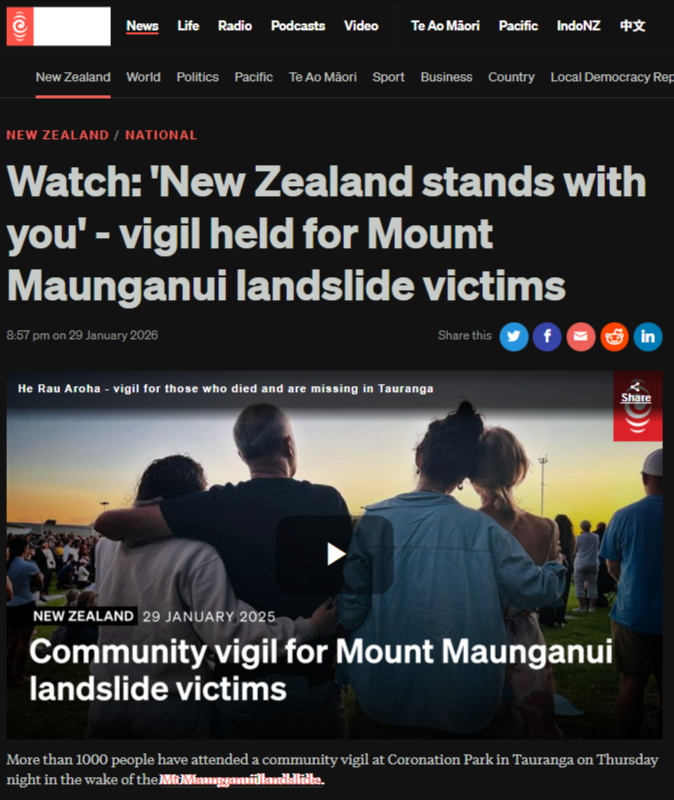
When the Prime Minister stood at the vigil and declared “New Zealand stands with you,” he spoke as if the nation were a separate entity from the machinery of governance that killed these six people. But New Zealand is its councils, its emergency services, its hazard mapping protocols, its budget allocations that eliminate in-house expertise and contract out safety to the lowest bidder.
We do not stand with the victims. We buried them. With administrative efficiency, institutional amnesia, and the willing delusion that calling catastrophe “unprecedented” absolves us of the engineering reports written twenty years ago that predicted exactly this outcome.
The vigil attendees held black balloons painted with victims’ names in gold. How perfectly this captures our national response to foreseeable disaster: transform the quantifiable failure of specific systems into an aesthetic of collective mourning, where grief becomes a substitute for accountability and candles replace criminal charges.
Lisa Anne Maclennan spent her final hour waking strangers, warning them away from the danger she recognized. She returned—possibly to warn others still inside the toilet block—and died there when 200 tonnes of the mountain the council destabilized crushed the structure around her. A fifty-year-old teacher without geological training performed the risk assessment and emergency evacuation that three levels of government failed to execute.
Her death is not tragedy. It is an invoice for forty years of institutional negligence, and we have paid it with her body and the bodies of five others who should have lived.
The mountain weeps. The bureaucrats sleep. And we call this governance.
Endnote on Solutions Implementation
These recommendations will be dismissed as “too expensive” by the same councils that found $355 million in the 2024 budget for roading upgrades but eliminated climate adaptation staff positions. They will be called “unrealistic” by central government ministers who dismantled resilience funding while climate disasters now cost New Zealand $1.5 billion annually in recovery spending. They will be labeled “regulatory overreach” by property developers who build in mapped flood zones because councils lack the capacity to enforce their own hazard rules.
Let this stand as benchmark: if these solutions are too expensive, we have admitted that six lives—including two fifteen-year-olds who will never graduate high school—are worth less than the administrative inconvenience of competent governance. That is the equation written in the volcanic clay now entombing their bodies.
We can afford solutions. We cannot afford the pretense that we can’t.
Koha: Funding the Accountability Crown Institutions Will Not Provide
This essay traces connections that official inquiries will sanitize—naming the twenty-year timeline from engineering warnings to fatal inaction, documenting the councils that “shed expertise” then claimed ignorance, mapping the bodies buried beneath bureaucratic euphemisms like “unprecedented” and “lessons learned.”
When Lisa Maclennan spent her final hour warning strangers while council staff drove past visible slips and opened tourist facilities beneath an unstable mountain, she performed the kaitiakitanga that three levels of government abdicated. Her heroism exposes their abandonment. This analysis honors her vigilance by refusing to accept the official narrative of blameless tragedy.
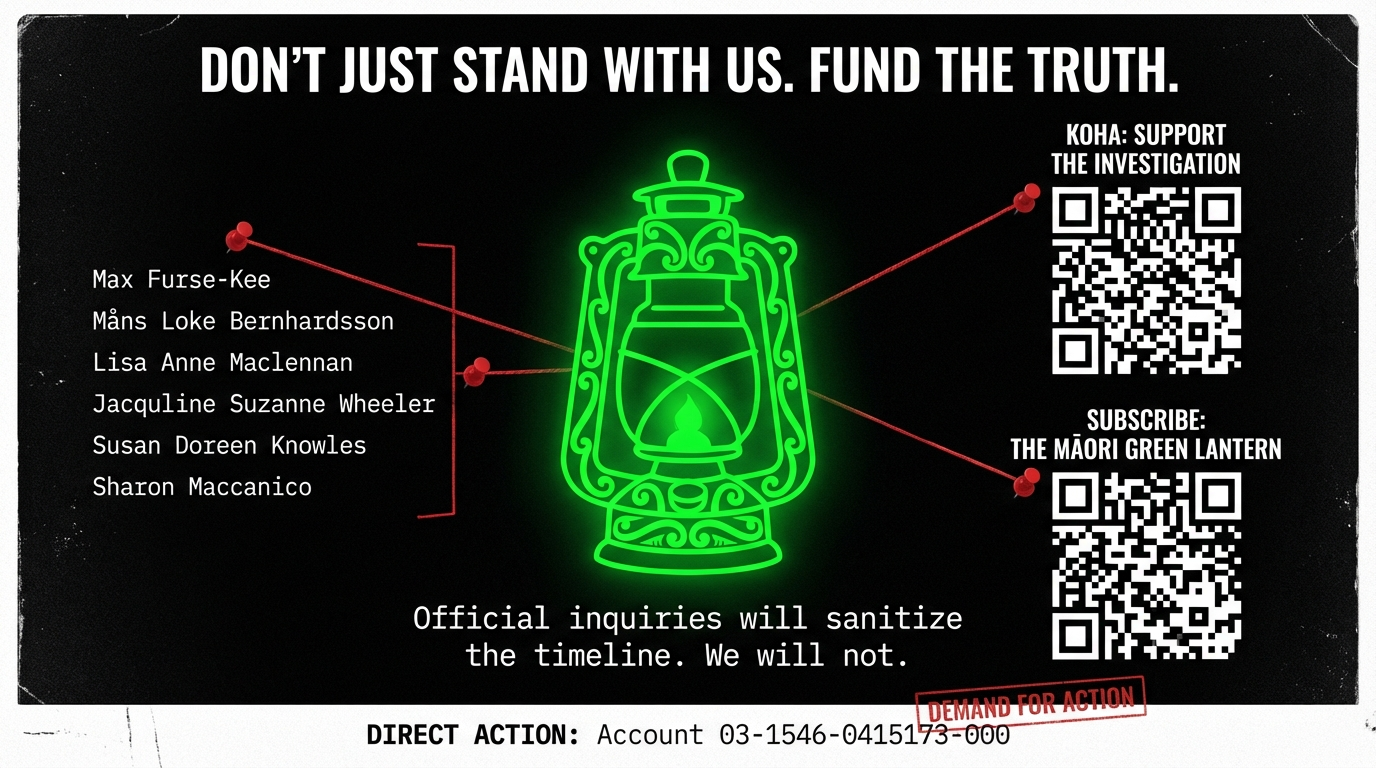
Every koha signals that whānau are ready to fund the investigation, documentation, and accountability that Crown and council structures actively avoid. It signals that rangatiratanga includes the power to fund our own truth-tellers when the state’s “independent reviews” are conducted by councils investigating themselves, when WorkSafe negotiations replace criminal prosecutions, and when coronial inquests deliver findings without consequences.
The six names painted in gold on black balloons at the vigil—Max Furse-Kee, Måns Loke Bernhardsson, Lisa Anne Maclennan, Jacqualine Suzanne Wheeler, Susan Doreen Knowles, Sharon Maccanico—deserve more than candles and collective grief. They deserve the institutional dismantling and criminal accountability this essay demands.
Kia kaha, whānau. Stay vigilant. Stay connected. And if you are able, consider a koha to ensure this voice continues naming names, tracing networks, and holding power accountable when official channels deliver only administrative exoneration.
Three pathways exist:
For those who wish to support this mahi directly with a koha (voluntary contribution):
Koha—Support The Māori Green Lantern
For those who wish to receive essays directly and support through subscription:
Subscribe to the Māori Green Lantern on Substack
For those who prefer direct bank transfer:
HTDM, account number 03-1546-0415173-000
He aha te mea nui o te ao? He tangata, he tangata, he tangata.
What is the most important thing in the world? It is people, it is people, it is people.

Ivor Jones The Māori Green Lantern Fighting Misinformation And Disinformation From The Far Right