“When Police Cook The Books” - 4 November 2025
The Neoliberal Rot Behind 30,000 Fake Breath Tests
Kia ora koutou katoa,
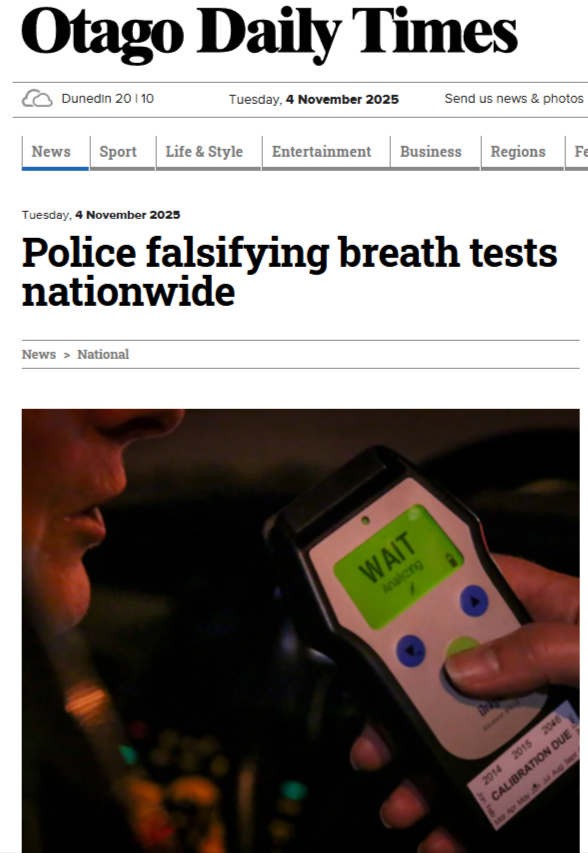
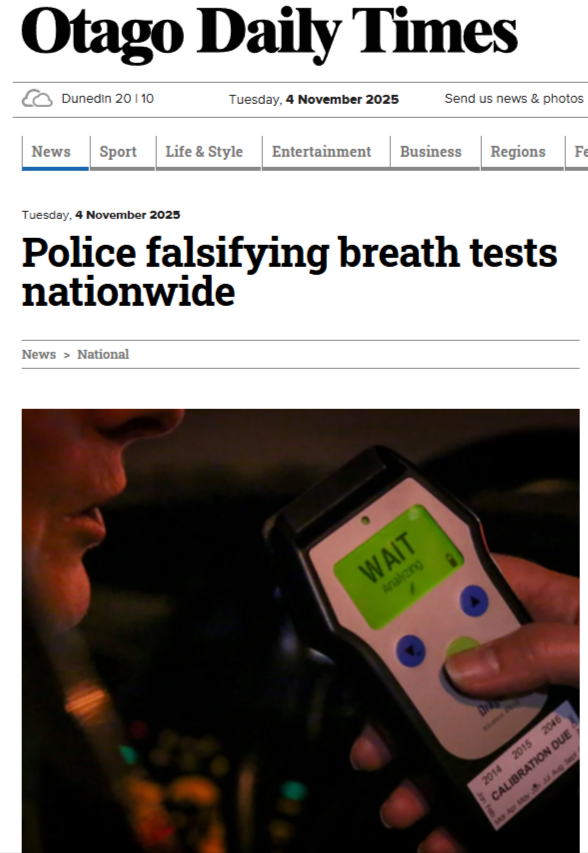
120 police officers nationwide fabricated over 30,000 breath tests while chasing performance targets tied to $24 million in annual funding. This isn’t a scandal about “a few bad apples”—it’s the predictable outcome when neoliberal accountability measures collide with public service, transforming police work into a stats-gaming exercise that betrays every principle of integrity and kaitiakitanga.
The Smoking Gun: $24 Million Reasons To Lie
The Road Policing Investment Programme 2024-27 contains a toxic mechanism called “delivery dependent funding”—$24 million annually ($72 million over three years) withheld from Police unless they hit specific targets. Every quarter, $6 million hangs in the balance, assessed against five key performance indicators including the headline target: 3.3 million breath tests annually, with 65% conducted during “high and extreme alcohol risk times.”
Between July 2024 and September 2025, police conducted 5.3 million breath tests. An internal algorithm—only developed in August 2025 because “the required technology was not available” earlier—revealed 30,961 tests were “simulated without the involvement of a driver”. The fraud occurred nationwide, implicating approximately 120 officers now facing disciplinary proceedings.
The timeline is damning: Police exceeded their Q1 2024/25 target by 20%, conducting 987,698 tests against a target of 825,000. They legitimately exceeded the national target by approximately 900,000 tests, according to Acting Deputy Police Commissioner Jill Rogers. Yet officers still felt compelled to fabricate data—suggesting either individual targets existed despite official denials, or a performance culture so toxic that exceeding targets by 27% still wasn’t enough.
Critically, Police deliberately chose to examine the period from July 2024 to September 2025 “because it related directly to the current Road Policing Investment Programme which contains delivery dependent funding requirements. It is particularly important to Police that we ensure our reported performance is legitimate, especially given the funding implications.” The funding implications created the pressure. Police’s own words expose that the system incentivized dishonesty.
RPIP Funding Structure
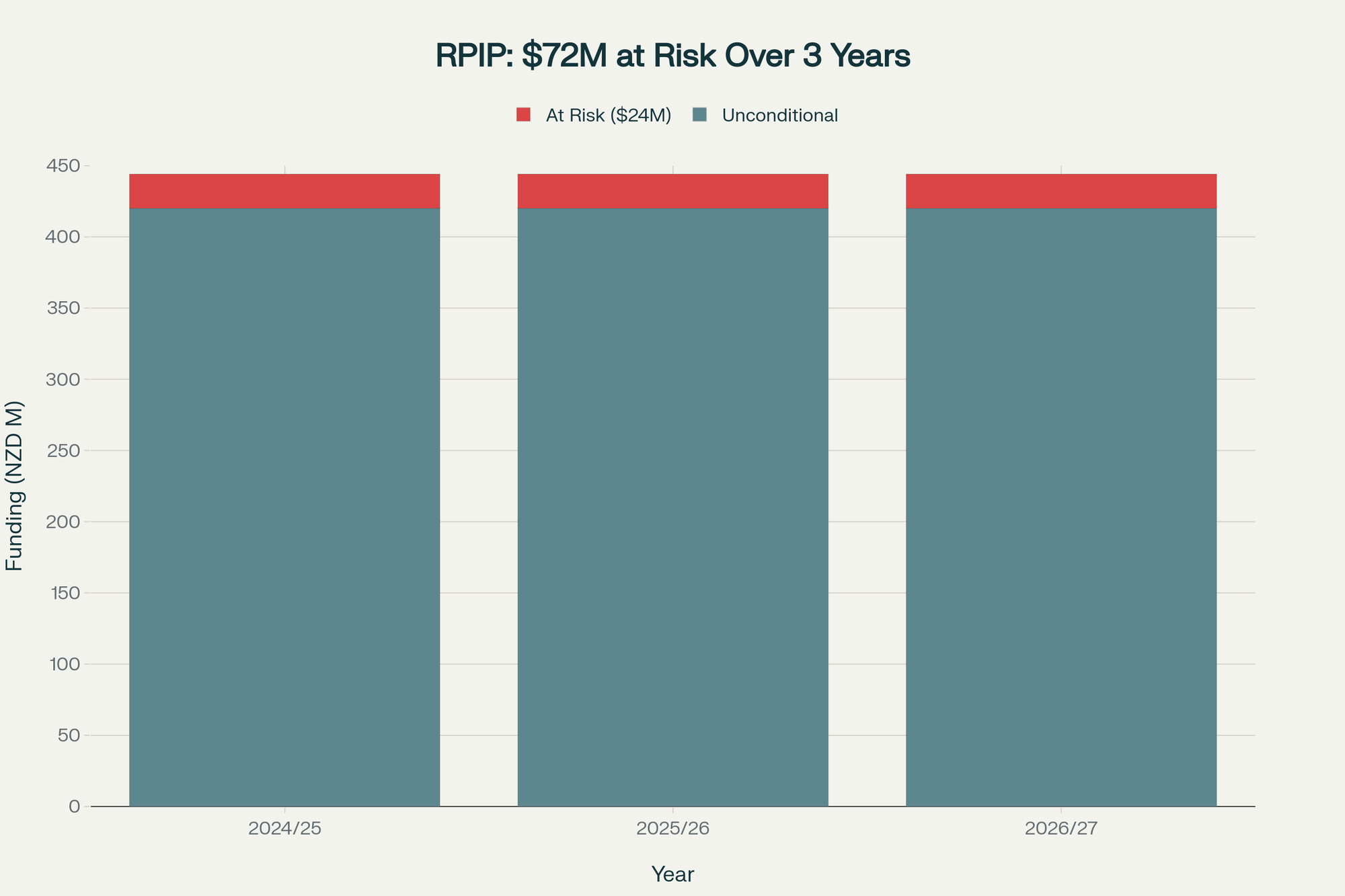
This chart immediately visualizes the financial mechanism at the heart of the scandal—showing readers that while $24 million seems small compared to the total $444 million annual budget, it’s withheld quarterly, creating constant pressure. The stacked bars make clear that 5.4% of Police funding is held hostage to performance metrics.
The Architects: Who Benefits From This System?
Mark Mitchell: The Police Minister With A Performance Obsession
Police Minister Mark Mitchell joined police in 1989 and worked in operational roles including the Armed Offenders Squad before entering Parliament in 2011. He’s spent his ministerial career demanding “back-to-basics” policing while simultaneously imposing the most advanced neoliberal performance management system Police has ever faced.
In December 2023, Mitchell sent a letter to Police Commissioner Andrew Coster setting out ministerial expectations, laying out the government’s direction and priorities. Mitchell stated: “I have been open about the fact I do not agree with the direction policing has taken under the previous government and I expect the police commissioner to focus on core policing with a back-to-basics approach.” The letter was explicit: hit targets or face consequences.
Mitchell called the RPIP targets “working well” even after the falsification scandal broke, refusing to review them. The irony is suffocating: a minister who built his political brand on “tough on crime” rhetoric now presides over systemic police dishonesty directly caused by his government’s funding model.
Simeon Brown: The Transport Minister Who Weaponized Targets
Until his January 2025 appointment as Health Minister, Simeon Brown served as Transport Minister and was chief architect of the RPIP’s performance regime. At just 33 years old, Brown became one of Prime Minister Christopher Luxon’s “most trusted allies” known for “ruthless execution” and an “unrelenting drive to push his agenda, regardless of obstacles”.
Brown’s approach to transport was explicitly ideological rather than evidence-based. He pushed through weaker vehicle emissions standards to meet the car industry’s preferred deadline despite his own officials wanting more time, and despite climate officials warning the move risked “blowing the country’s climate targets”. His transport policy reflected an ideological commitment to market fundamentalism over community safety or environmental outcomes.
The RPIP reflects Brown’s obsession with measurable outputs over genuine outcomes. When announcing the $1.335 billion RPIP in August 2024, Brown and Mitchell celebrated introducing “performance-based funding” to “ensure enforcement targets are met,” with Police required to prove they focused “65% of their breath testing on the highest risk times.” This wasn’t about road safety—it was about creating a surveillance and control mechanism over Police themselves, with funding contingent on meeting arbitrary numerical targets.
The Neoliberal Gospel: Targets Above Truth
This scandal exemplifies what scholars identify as New Public Management (NPM)—the neoliberal restructuring of public services that has dominated Aotearoa since the 1980s, imposing private sector management techniques including “performance measurement,” “delivery targets,” and “accountability mechanisms” on public agencies.
Research shows NPM in New Zealand has led to “misguided performance measurement” and “micromanagement” that undermines professional judgment and workplace democracy. The pattern is consistent across Coalition government policies. Prime Minister Luxon introduced nine Government Targets covering health, education, law and order, work, housing and the environment, describing them as “deliberately ambitious” and designed to make the public sector “think differently, dig deeply into root causes, learn from other places, and be innovative and disciplined in directing resources.”
NPM creates perverse incentives. When funding depends on hitting targets, staff game the system rather than serve the public. The RPIP demonstrates the predictable outcome: 120 officers across all districts simultaneously fabricate data to satisfy Wellington’s target obsession.
Tikanga Trampled: The Cultural Violations
This scandal violates multiple tikanga principles fundamental to Te Ao Māori:
Whakapapa and Mana: Police authority derives from community trust built over generations. When 120 officers systematically lie, they corrupt the whakapapa of that relationship, destroying mana earned by honest officers before them.
Pono (Truth) and Tika (Integrity): The devices couldn’t “differentiate between legitimate and illegitimate tests,” so Police promised to “act with integrity to the system.” That promise was worthless. Officers betrayed pono, the foundational principle that leadership requires truthfulness.
Kaitiakitanga (Guardianship): Road policing exists to protect community wellbeing. Performance targets transformed guardianship into a bureaucratic exercise where fabricated numbers satisfied Wellington while real road users went unprotected. Each fake test represents a moment an officer wasn’t actually keeping people safe.
Manaakitanga (Care for People): Rogers claimed “global evidence” shows breath testing “undoubtedly saved lives”. But 30,961 fake tests saved precisely zero lives. They demonstrate that institutional self-preservation trumped care for actual people.
Kotahitanga (Collective Responsibility): Police leadership insists this is “isolated to a small number of staff” that doesn’t reflect officers who “come to work every day to keep New Zealanders safe.” This deflection ignores that systemic problems require systemic solutions. The entire organization participated in a funding model that incentivized fraud.
The Rhetoric of Denial: How They Spin Systemic Corruption
Police and government responses follow a predictable pattern of minimization and blame-shifting:
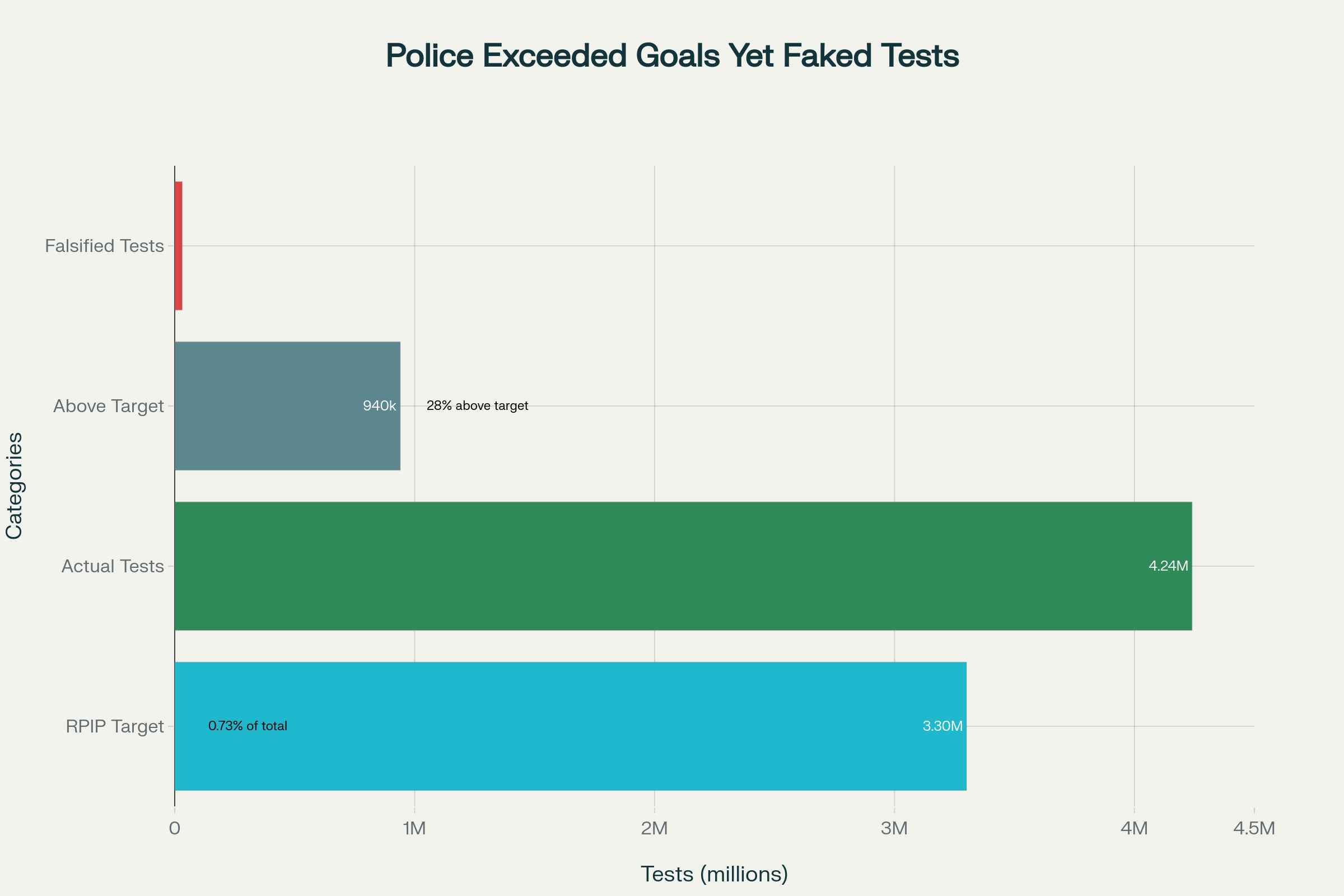
This chart devastates the “no pressure” defense by visualizing the paradox—if there was truly no pressure, why did 120 officers fake 31,000 tests when they’d already exceeded targets by 940,000? The visual immediately shows readers that the official explanation makes no logical sense.
The “No Pressure” Lie
Rogers claimed “there was no pressure to achieve the target” because Police “legitimately exceeded” it by 900,000 tests. This is sophistry. If there was no pressure, why did 120 officers fake 30,961 tests? The existence of delivery-dependent funding creates pressure by definition—$6 million quarterly is withheld until targets are proven met.
Moreover, Rogers admits the fraud period was chosen specifically because “it related directly to the current Road Policing Investment Programme which contains delivery dependent funding requirements. It is particularly important to Police that we ensure our reported performance is legitimate, especially given the funding implications.” The funding implications created the pressure. Her own words expose the lie.
The “Few Bad Apples” Fallacy
Leadership repeatedly frames this as isolated misconduct by individuals lacking values rather than systemic dysfunction. Rogers stated: “Our officers often work in high-pressure situations however that does not mean that we lose sight of our values.” This is the classic move to individualize institutional failure. When 120 officers across all districts simultaneously fabricate data using the same method, that’s not individual bad judgment—it’s organizational culture shaped by perverse incentives.
The Technology Excuse
Rogers blamed late detection on technology: “The required technology was not available” until August 2025 when ICT “enabled the National Road Policing Centre to build the algorithm.” This excuse reveals more than it hides. Police deployed “state-of-the-art technology” including GPS and officer identity tracking, but deliberately avoided building fraud-detection capabilities into devices that “cannot differentiate between legitimate and illegitimate tests.”
Why? Because leadership didn’t want to know. Ignorance protected the performance narrative—allowing ministers to trumpet achievement while reality remained hidden.
Hidden Connections: The Performance Management Industrial Complex
The Consultant Industrial Complex
Police and NZTA spent almost $250 million on contractors and consultants in 2022-23—a 50% increase, with Police spending reaching $135 million. Who are these consultants? What private firms profit from designing and implementing performance management systems that predictably generate fraud? The RPIP acknowledges “an independent evaluation of the Road Policing Investment Programme is underway“—but who’s conducting it, at what cost, and with what conflicts of interest?
This mirrors patterns across Coalition agencies where consultant spending balloons while frontline services get cut. The performance measurement apparatus itself becomes a profit center for private contractors who face no accountability when their systems generate perverse outcomes.
The Accountability Network

This network diagram visually captures the accountability gap—ministers at the top designed the corrupt system, frontline officers at the bottom face consequences, while the actual architects escape scrutiny. It reinforces your core argument about systemic versus individual responsibility.
The International Neoliberal Network
The RPIP claims to be “based on international best practice and evidence.” New Zealand’s NPM reforms were “driven by a particular mix of neoliberal theory including public choice theory, human capital theory, new institutional economics, and a form of managerialism identified as ‘New Public Management’ imported from overseas think tanks and international institutions.” The RPIP represents the latest iteration of this imported ideology—treating police as production units rather than community guardians.
The Political Payoff
Mitchell staked his political reputation on “tough on crime” messaging. Brown built his career on aggressive anti-government narratives. Both ministers benefited politically from inflated breath testing statistics. When those statistics proved partially fabricated, neither accepted responsibility or reformed the system that generated the fraud. Instead they doubled down, with Mitchell insisting targets are “working well” and Police refusing to review them.
Quantified Harm: The Real Costs
Public Trust Destroyed
Police operate through community consent. When 120 officers fake 30,961 tests over 15 months, trust evaporates. For Māori and Pacific communities already over-policed and under-protected, this confirms longstanding skepticism about Police integrity.
Road Safety Compromised
Every fake test represents real policing not done. Each fabricated entry meant an officer wasn’t actually checking drivers, potentially missing genuinely impaired people who later crashed. The 40% reduction in alcohol-related deaths celebrated by ministers is now suspect.
Historical Patterns: Corruption’s Long Shadow
Police falsifying data isn’t unprecedented in Aotearoa:
- Arthur Allan Thomas (1970-1979): Detectives planted a spent cartridge case in the Crewes’ garden, leading to Thomas’s wrongful murder conviction. A Royal Commission of Inquiry in 1980 found that Detective Inspector Bruce Hutton and Detective Sergeant Lenrick Johnston had fabricated evidence by planting the .22 cartridge case. Thomas served nine years before receiving a Royal Pardon and $950,000 in compensation. To the end of his life, Hutton denied planting evidence. At his 2013 funeral, Deputy Commissioner Mike Bush delivered Hutton’s eulogy and stated that “his integrity is beyond reproach,” a comment that generated public outcry.
- Alan Hall: Convicted based on fabricated evidence and denial of counsel rights, later exonerated.
- David Lyttle: Convicted of murder in 2011, he was later exonerated after the prosecution failed to disclose evidence.
- CIPEM interview technique (2018-2021): The Complex Investigation Phased Engagement Model, developed in 2018 and introduced without formal quality assurance or external expert review, came under intense scrutiny after a 2021 High Court judgment ruled evidence inadmissible in a murder case. The Independent Police Conduct Authority found CIPEM to be “sometimes manipulative and coercive” and inconsistent with best practice.
The breath test scandal fits this pattern: when institutional pressure conflicts with legal or ethical obligations, some officers choose institutional self-preservation. What’s new is the scale—120 officers, 30,961 fabricated records, nationwide participation—and the cause: performance targets explicitly designed by government to create pressure and incentivize dishonesty.
Implications: Where This Leads
Normalization of Gaming
If Police face no meaningful consequences—no funding model changes, no ministerial accountability, no systemic reform—other agencies will learn the lesson: fake whatever data satisfies Wellington. The Coalition’s target-obsessed management will encounter increasingly sophisticated gaming, with agencies investing more in appearing successful than being effective.
Māori Criminalization Intensified
Performance targets don’t just corrupt data—they corrupt policing decisions. Officers chasing numbers stop people who are easiest to stop, in places easiest to access. That means over-policing poor communities and Māori areas while under-policing wealthy Pākehā neighborhoods.
Performance regimes amplify this bias because institutional incentives override community need. Māori get stopped more to feed the target beast, experiencing harassment that damages police-community relations while resource-rich areas get ignored.
Constitutional Crisis Brewing
The Independent Police Conduct Authority now oversees disciplinary processes for 120 officers. But what about the ministers who designed the system? What about NZTA officials who implemented delivery-dependent funding despite knowing it would create perverse incentives? What about the Commissioner who agreed to the regime?
Without accountability at leadership levels, we’ve established that ministers can impose systems generating predictable corruption, then blame frontline staff when the predictable occurs. That’s not governance—it’s systemic moral hazard.
Call To Action: Dismantling The Performance State
This isn’t fixable with “clearer guidelines” or “better training.” The entire performance-based funding model must be dismantled:
- Abolish delivery-dependent funding: All RPIP funding should be unconditional. Police need resources to do their job, not incentives to fake metrics. The $72 million currently used as bait should be permanently allocated without strings.
- Independent inquiry: Not another consultant-run “evaluation” but a genuine commission of inquiry with power to compel evidence, examining who designed the RPIP funding model, what concerns were raised and ignored, and what systemic changes prevent similar disasters.
- Ministerial accountability: Mitchell and Brown must answer for their role in creating conditions for mass fraud. Did they ignore warnings about perverse incentives? Did officials raise concerns that were dismissed? Release all Cabinet papers, ministerial briefings, and internal advice relating to delivery-dependent funding design.
- Restore professional judgment: Police should determine road policing strategies based on evidence and community need, not hitting arbitrary numerical targets set by politicians pursuing ideological agendas. Abolish all performance metrics except genuine outcome measures like actual death and injury reductions.
- Truth and reconciliation: All 30,961 fabricated tests must be publicly identified—dates, times, locations, officers involved. Communities deserve to know when they were lied to. Officers who falsified data must face meaningful consequences, but so must the leadership who created the pressure to cheat.
- End NPM across government: The Coalition’s target obsession corrupts every service it touches. Abolish public service KPI regimes and quarterly reporting theater. Replace them with genuine community accountability mechanisms giving citizens power to shape service delivery.
- Resource adequacy: If Ministers want 3.3 million breath tests, fund Police adequately to deliver them without gaming. Alternatively, admit the target is arbitrary and let professionals determine appropriate enforcement levels.
The Neoliberal Emperor Has No Breath Test
Mark Mitchell and Simeon Brown built their political brands on “accountability,” “performance,” and “results.” They imposed a $1.335 billion funding regime designed to force Police to demonstrate measurable outputs regardless of actual community outcomes. They got exactly what they incentivized: 120 officers fabricating 30,961 tests to satisfy Wellington’s target obsession.

The Māori Green Lantern Fighting Misinformation And Disinformation From The Far Right
This isn’t a policing failure—it’s a political failure. The performance state that dominates Coalition governance creates predictable perverse outcomes. When you measure performance through targets, withhold funding until metrics are met, and treat police as production units, you get gaming, corruption, and fabricated data dressed up as “achievement.”
Police officers who faked tests betrayed their duty and must face consequences. But they did so in a system designed by ministers who betrayed tikanga principles of truth, guardianship, and community care while pursuing ideological obsessions with targets and measurements. Until those ministers face accountability—until the entire performance management apparatus they’ve built across government is dismantled—we haven’t addressed the real corruption eating our public services from the top down.
Kia mataara. E kore e ngaro te kakano i ruia mai i Rangiātea. The seed sown from Rangiātea will never be lost. Our people remember when leadership fails tikanga. We remember when systems prioritize institutional image over community care. And we remember that real accountability starts not with the frontline workers gaming broken systems, but with the architects who broke the systems in the first place.
Ko Ivor Jones tēnei, kaitiaki o Te Arawa/Ngāti Pikiao. If this analysis serves your whakapapa of resistance, and you have capacity, a humble koha is welcomed at HTDM: 03-1546-0415173-000. Kia kaha, kia māia, kia manawanui.