“When Power Prostrates Before Fascism: Judith Collins and the Nazi-Linked Sebastian Gorka” - 22 October 2025
The Attorney-General’s Embrace of Extremism
Tēnā koutou katoa. Ko Ivor Jones tōku ingoa, nō Te Arawa/Ngāti Pikiao ahau. Kia ora. Greetings to you all. My name is Ivor Jones, I am of Te Arawa/Ngāti Pikiao descent. Be well.
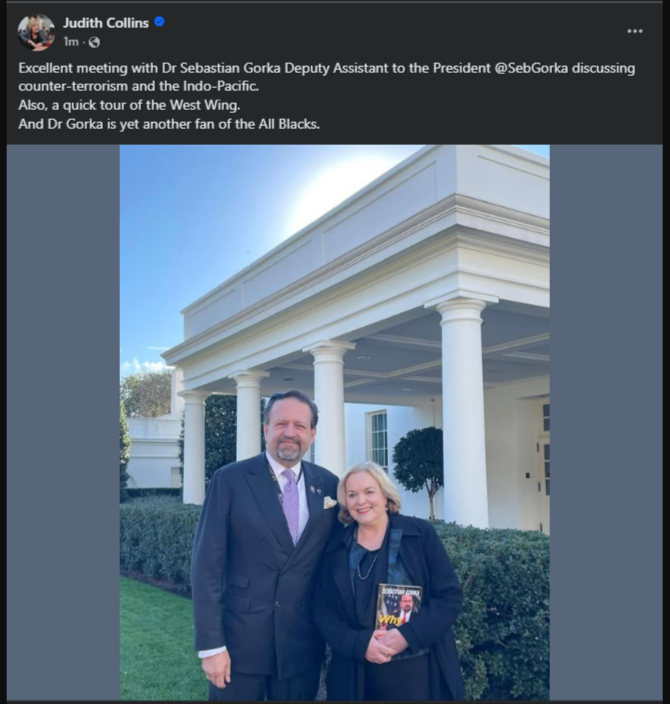
New Zealand’s Attorney-General Just Courted a Man with Sworn Allegiance to Nazi Collaborators—And She Did It in the White House
When Aotearoa Sees Its Leaders Smiling With Extremists
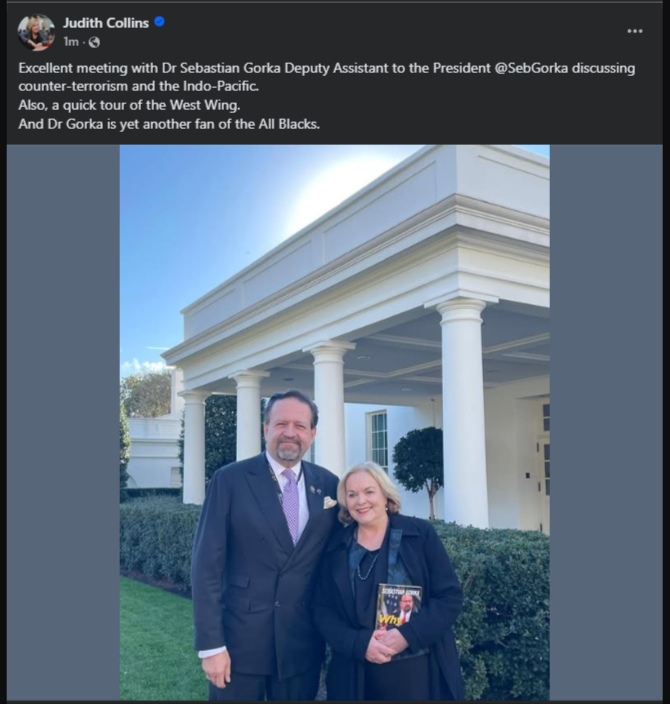
On October 22, 2025, Judith Collins, New Zealand’s Attorney-General and Minister of Defence, traveled to Washington DC for what she described as defence and security meetings. Among those meetings was an encounter she celebrated on social media: standing beside Dr Sebastian Gorka, Deputy Assistant to President Donald Trump, in the West Wing of the White House. Collins described their meeting as “excellent,” discussing counter-terrorism and the Indo-Pacific. She even appeared to be holding what looked like Gorka’s book.
Two men in suits talking under the White House West Wing entrance colonnade with classical white columns.
What Collins did not tell New Zealanders is that the man she was courting has documented ties to a Nazi-allied Hungarian organization, has been accused of membership in a group founded by a Holocaust collaborator, and has spent years spreading Islamophobic hatred through his work with the Trump administration. This is not diplomatic necessity. This is ideological alignment. And it exposes the fundamental white supremacy, Christian nationalism, and neoliberal rot at the heart of New Zealand’s current National-led coalition government.
Collins’ meeting with Gorka represents a dangerous normalization of fascist politics, a betrayal of the 51 Muslims murdered in Christchurch on March 15, 2019, and a continuation of Aotearoa’s colonial violence against Māori and all marginalized communities. This essay will expose who Sebastian Gorka really is, reveal the international networks of Christian nationalist extremism he represents, explain why Judith Collins’ embrace of this man should alarm every New Zealander who believes in te ao Māori values of manaakitanga, kaitiakitanga, and aroha, and demonstrate how this meeting fits into a global pattern of far-right organizing that directly threatens our communities.
The Historical Context: Understanding Fascism’s Continuities
Before examining Gorka’s specific connections, we must understand what we are dealing with. Fascism did not die in 1945. It adapted, networked, and rebuilt itself through international organizations that preserved Nazi ideology while distancing themselves from the stigma of swastikas. The Vitézi Rend, or Order of Vitéz, represents exactly this continuity of fascist organizing under the guise of cultural preservation.
Founded in 1920 by Hungarian regent Miklós Horthy, the Vitézi Rend was ostensibly a military honor society but functioned as an elite organization within Hungary’s fascist state structure. Horthy was no ordinary nationalist. As Hungary’s authoritarian leader, he aligned his country with Nazi Germany, implementing anti-Jewish laws that stripped Hungarian Jews of their rights, property, and ultimately their lives. Under Horthy’s regime, Hungary became complicit in the Holocaust, with hundreds of thousands of Hungarian Jews deported to Nazi death camps.
The United States State Department designated the Vitézi Rend as having operated “under the direction of the Nazi Government of Germany during World War II,” making it not merely a Hungarian nationalist organization but an active participant in the Nazi war machine. Members of this organization are classified as inadmissible to the United States under immigration law due to their association with Nazi collaboration. This is the organization that Sebastian Gorka has been credibly accused of joining, wearing its medal to Donald Trump’s 2017 inauguration, and defending when confronted about his ties.
Who Is Sebastian Gorka: A Career Built on Islamophobia and Extremist Networks
Sebastian Lukács Gorka was born on October 22, 1970, in the United Kingdom to Hungarian parents who had fled communist Hungary in 1956. His father, Paul Gorka, was reportedly a member of the Vitézi Rend, and Sebastian himself has been photographed wearing the organization’s medal—a Hungarian tunic adorned with the group’s symbol—at Trump’s 2017 inauguration. When questioned about this, Gorka claimed he wore it to honor his father, but members of the Vitézi Rend confirmed to NBC News in April 2017 that they were “proud” when Gorka appeared wearing their medal, with spokesman András Horváth stating it made them feel recognized.
The Forward, a Jewish American newspaper, reported in March 2017 that Gorka was a sworn member of the Vitézi Rend, having taken a lifelong oath of loyalty to the organization. Multiple leaders of the modern-day Historical Vitézi Rend and other Hungarian politicians have stated that Gorka is an official member. If true, this means Gorka may have lied on his U.S. immigration application, which requires disclosure of ties to organizations that were under Nazi direction during World War II.
Evidence of Gorka’s membership extends beyond the medal. Gorka has repeatedly identified himself as “Dr. Sebastian L. v. Gorka” in written testimony before Congress and other official documents, with the “v.” honorific used by members of the Vitézi Rend to indicate formal membership. According to Hungarian historians, Gorka’s use of this honorific goes back to at least 1998, predating his father’s death, contradicting his claim that he merely “inherited” the title. The Jewish Democratic Council of America condemned Trump’s appointment of Gorka, calling him “a right-wing extremist affiliated with an anti-Semitic Nazi Party.”
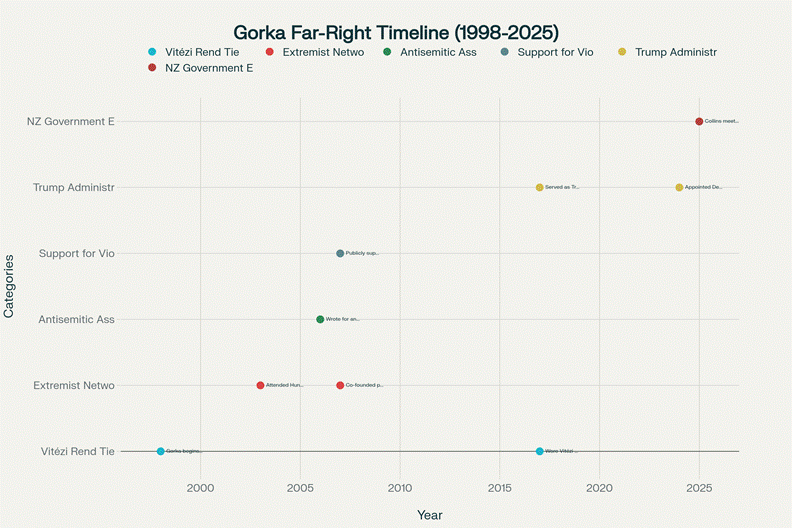
Timeline showing Sebastian Gorka’s documented connections to far-right networks, from his early use of Vitézi Rend honorifics through his meetings with New Zealand government officials.
Gorka’s Hungarian Connections: Orbán and the Far-Right Network
Before moving to the United States in 2008, Gorka spent 15 years in Hungary working within far-right political networks. During the mid-2000s, Gorka served as an advisor to Viktor Orbán, the current Prime Minister of Hungary who has transformed his country into what scholars call an illiberal democracy. Orbán has dismantled democratic institutions, captured media outlets, promoted Christian nationalism, and implemented policies based on ethnic nationalism and hostility toward migrants, particularly Muslims and Roma people.
Gorka also contributed to Magyar Demokrata, a Hungarian newspaper that the U.S. State Department’s 2004 country report on Hungary noted “continued to publish anti-Semitic articles, and featured articles by authors who have denied the Holocaust.” The newspaper’s long-time editor-in-chief, András Bencsik, is openly antisemitic. When asked whether he was aware of Bencsik’s views or those espoused in Magyar Demokrata, Gorka claimed to be “unfamiliar with Bencsik,” a statement that strains credulity given his multiple published articles in the publication.
In 2007, Gorka co-founded a short-lived Hungarian political party, the New Democratic Coalition (UDK), with two former senior-ranking members of Jobbik, a political party the Anti-Defamation League has described as “openly anti-Semitic” and the U.S. State Department has labeled “extreme ethnic nationalist.” Evidence shows that as early as 2003, Gorka attended a conference organized by Jobbik’s future Vice Chairman, advertised as discussing “Hungarian National Radicalism”—a euphemism for the Hungarian neo-Nazi movement.
Most damningly, when asked in a 2007 televised interview whether he supported Jobbik’s plan to create a paramilitary militia called the Hungarian Guard, Gorka responded affirmatively, with a banner running underneath him stating “UDK Supports the Hungarian Guard.” The Hungarian Guard went on to stage mass demonstrations notable for episodes of violence against Roma people, including murders in 2008 and 2009. Hungary’s highest court banned the Hungarian Guard in 2009 for its intimidating actions, and the European Court of Human Rights upheld the ban in 2013, finding that the group promoted “a certain vision of ‘law and order’ which is racist in essence.”
Gorka’s Islamophobic Ideology: Making Hatred Respectable
When Gorka moved to the United States in 2008, he established organizations focused on what he described as countering radical Islam. But Gorka’s approach was not about addressing terrorism—it was about promoting the idea that Islam itself is inherently violent and incompatible with Western civilization. As a Breitbart News contributor and editor, Gorka became a prominent voice in the “counter-jihad” movement, a transnational field of anti-Muslim political action.
Gorka has stated that “violence is an intrinsic part of the Islamic faith” and criticized Presidents Bush and Obama for declaring Islam a religion of peace. The Brennan Center for Justice published detailed analyses documenting the Islamophobic nature of the Trump administration, with Gorka as a central figure. Before joining the White House, Gorka was reportedly fired by the FBI for his “over-the-top Islamophobic rhetoric,” according to an ACLU report. Yet Trump appointed him anyway.
Gorka’s rhetoric has real-world consequences. After a mosque in Bloomington, Minnesota, was bombed in August 2017, Gorka suggested the attack might have been staged by a left-wing activist rather than condemning it as terrorism against Muslims. When pressed about white supremacist violence, Gorka dismissed concerns, saying historical attacks like the Oklahoma City bombing were decades ago, while insisting the “real problem” was jihadi violence. This downplaying of right-wing extremist violence ignores the persistent threat documented by law enforcement.
Multiple national security scholars and academics have characterized Gorka as fringe, with his own PhD advisor stating he would not call Gorka a terrorism expert. The journal Terrorism and Political Violence never used Gorka as a reviewer because, according to the associate editor, “he is not considered a terrorism expert by the academic or policy community.” Gorka holds his position not because of expertise but because of loyalty to Trump’s authoritarian movement.
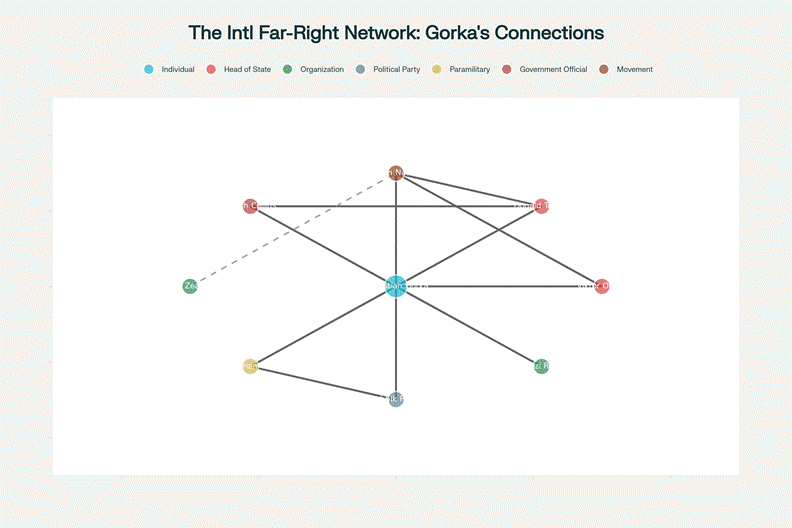
Network diagram illustrating how Sebastian Gorka connects international far-right movements, from Hungarian extremist organizations to the Trump administration and New Zealand government officials.
The Christian Nationalist Connection: A Global Movement
What unites Gorka, Orbán, and the broader far-right movement is Christian nationalism—the ideology that certain nations are fundamentally Christian in character and should privilege Christianity and its adherents. This is not traditional Christianity as practiced by mainstream churches; it is a political ideology that weaponizes Christian identity to justify white supremacy, authoritarianism, and violence against perceived outsiders.
Research published in 2024 on the rise of the Christian Right in Europe identifies three key ways this movement operates. First, it instrumentalizes religion to legitimize radical agendas under the guise of traditional values, normalizing extremist ideas by presenting them as religious convictions. Second, it creates novel geographies of power, with countries like Hungary playing outsized roles in coordinating transnational Christian Right activities. Third, it facilitates alliances between far-right groups, civil society, and political parties by identifying transversal issues—such as opposition to Muslim immigration, LGBTQ rights, and abortion—that unite diverse constituencies.
The World Council of Churches shared insights in June 2025 on the rise of Christian far-right extremism, noting how this ideology transcends denominational boundaries, uniting Catholics, Protestants, and Orthodox Christians who historically distrusted each other. What connects them is not theology but political strategy aimed at rolling back democratic gains and establishing authoritarian Christian states.
Gorka embodies this Christian nationalist ideology. His rhetoric consistently frames terrorism as Islamic terrorism, downplays white Christian violence, and presents Western civilization as engaged in an existential conflict with Islam. This framing is precisely what the Christchurch terrorist who murdered 51 Muslims in Aotearoa on March 15, 2019, believed. The shooter’s manifesto expressed the same fears of “white extinction” and “demographic replacement” by Muslims that animate Christian nationalist movements globally.
The New Zealand Context: Our Own Far-Right Networks
Aotearoa is not immune to these international fascist networks. Following the Christchurch attacks, the Dominion Movement, New Zealand’s first major Identitarian-inspired far-right extremist group, went underground. Within months, its members re-emerged as Action Zealandia, a white nationalist organization that restricts membership to “physically fit, tidy European males of sound mind and good character.”
A West Point Combating Terrorism Center study from January 2022 examined Action Zealandia as an instructive case of the gray area between so-called non-violent and violent extremism. While the group carefully states it rejects violence, multiple individuals linked to it have been involved in violent extremist threats, including aspiring to establish a terror cell in New Zealand and alleged threats against the Al Noor Mosque attacked in 2019.
In August 2025, a New Zealand Defence Force soldier with links to Action Zealandia and the Dominion Movement admitted attempting to pass classified information about New Zealand military bases to what he thought was a foreign agent. This followed concerns raised in 2022 about NZDF-trained extremists, with experts warning that military training combined with extremist ideology creates particularly dangerous threats.
Research by Professor Paul Spoonley estimates 60 to 70 far-right groups operate in Aotearoa, with 150 to 300 core activists. Proportionate to population, this matches Germany’s far-right density. A 2021 study found that New Zealand had 750 followers of far-right Facebook pages per 100,000 internet users—nearly double Australia’s rate and more than triple that of the United States and Canada.
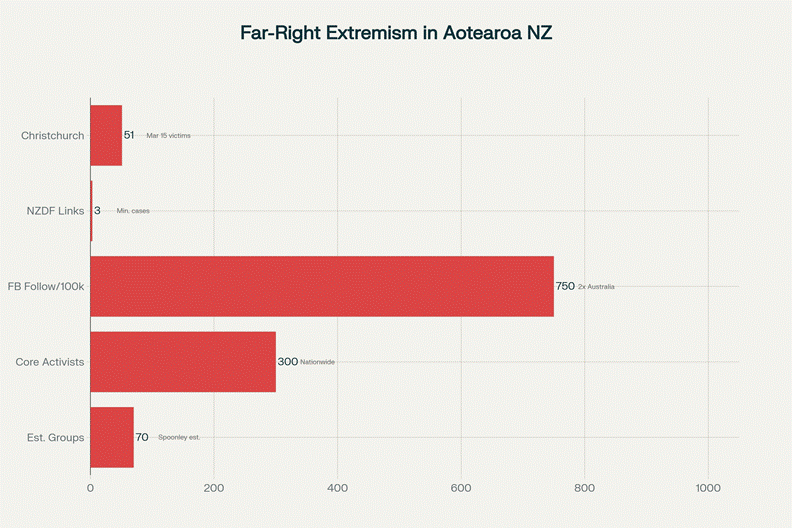
Key indicators showing the scale of far-right extremism in Aotearoa New Zealand, from organized groups to the deadly consequences of white supremacist violence.
Judith Collins: From Crusher to Collaborator
Judith Collins has built her political brand on law-and-order rhetoric, earning the nickname “Crusher Collins”. She served as National Party leader from July 2020 to November 2021, leading the party to its second-worst electoral defeat in 2020. After being removed as leader following a vote of no confidence, Collins remained in Parliament and returned to Cabinet in 2023 with seven ministerial portfolios, including Attorney-General, Minister of Defence, and Lead Coordination Minister for the Government’s Response to the Royal Commission’s Report into the Terrorist Attack on the Christchurch Mosques.
That last responsibility makes her meeting with Gorka particularly grotesque. Collins is supposed to be coordinating New Zealand’s response to the Christchurch terror attacks—attacks that killed 51 people and injured 89 others, motivated by the same white supremacist, Islamophobic, Christian nationalist ideology that Sebastian Gorka promotes. Yet she posed for a photo with Gorka, describing their meeting as “excellent” and making no mention of his extremist connections. This is not ignorance; it is complicity.
In April 2021, Collins stated that National would not pursue policies of “racist separatism,” using far-right rhetoric to attack policies designed to address inequities faced by Māori. This language of “separatism” to describe Treaty partnerships and Māori self-determination echoes the anti-co-governance campaigns that far-right groups have weaponized to mobilize white anxiety. Collins’ willingness to use this rhetoric demonstrates her comfort with far-right framing.
The Broader Government Strategy: Courting Trump at Any Cost
Collins’ meeting with Gorka must be understood within the broader context of New Zealand’s foreign policy approach under the National-NZ First-ACT coalition government. Foreign Minister Winston Peters has advocated a “softly-softly” approach to dealing with Trump’s administration, prioritizing maintaining close ties with Washington even as Trump dismantles democratic norms.
Trump was reelected in November 2024 and inaugurated in January 2025, bringing back many of the extremist figures from his first term. In November 2024, Trump appointed Gorka as Deputy Assistant to the President and Senior Director for Counterterrorism, praising him as a “tireless advocate for the America First Agenda and the MAGA Movement.” Trump made clear that loyalty to his authoritarian project, not expertise or ethics, determines who receives power.
New Zealand’s government has shown it will accommodate this authoritarianism to protect economic and security interests. When Trump imposed tariffs on New Zealand goods in October 2025, the government scrambled to maintain good relations. In March 2025, Peters sacked New Zealand’s High Commissioner to the United Kingdom, Phil Goff, for criticizing Trump’s negotiations with Russia. Goff had compared Trump’s approach to Neville Chamberlain’s appeasement of Hitler—a truth Peters could not tolerate because New Zealand’s government has decided that maintaining access to Trump’s administration matters more than defending democratic principles.
The Neoliberal Foundation: Why This Government Embraces Extremism
To understand why Collins and the National government are comfortable courting far-right extremists, we must examine the neoliberal ideology that has dominated New Zealand politics since the 1980s. Neoliberalism prioritizes market fundamentalism, individual responsibility rhetoric that ignores structural inequities, and deregulation that strips away protections for workers, the environment, and Indigenous rights. This economic ideology creates the conditions for fascism by immiserating working people, concentrating wealth and power among elites, and offering no collective solutions beyond intensified competition.
When people suffer under neoliberalism—when housing becomes unaffordable, wages stagnate, public services decay, and inequality skyrockets—they look for explanations and solutions. The left offers structural analysis identifying capitalism, colonialism, and white supremacy as root causes, proposing redistribution, Indigenous sovereignty, and collective organization as remedies. The far-right offers scapegoats: immigrants, Muslims, Māori “separatists,” LGBTQ people, feminists—anyone who can be blamed for disrupting an imagined past when things were better (for white people, especially white men).
Neoliberal governments prefer the far-right explanation because it does not threaten capitalist power. Blaming Muslims for terrorism is perfectly compatible with maintaining economic inequality and corporate dominance; addressing structural racism and redistributing wealth is not. When the Public Service Association organized industrial action in October 2025, Collins issued a statement calling it “unfair and unwarranted,” framing workers asserting their rights as the problem rather than addressing their legitimate grievances.
Exposing the Fallacies: How This Rhetoric Manipulates New Zealanders
Collins’ description of her meeting with Gorka as an “excellent” discussion of “counter-terrorism and the Indo-Pacific” relies on multiple rhetorical fallacies that New Zealanders must recognize.
First, there is the appeal to authority. By meeting with someone titled “Deputy Assistant to the President,” Collins suggests Gorka is a legitimate expert whose views merit respectful engagement. But titles do not equal expertise, and Gorka’s academic credentials have been thoroughly debunked, with his own PhD advisor saying he would not call Gorka a terrorism expert.
Second, there is the false equivalence between Islamist terrorism and right-wing extremism. Gorka dismisses white supremacist violence as isolated incidents while treating jihadist violence as an existential civilizational threat. This framing ignores that in Western countries, including New Zealand, far-right extremism poses the most significant domestic terrorism threat. The Christchurch attacks killed 51 people. The perpetrator was a white supremacist who shared Gorka’s worldview about Islam threatening Western civilization.
Third, there is the sanitization of extremism through diplomatic language. Collins does not mention Gorka’s ties to Nazi-allied organizations, his Islamophobic rhetoric, or the controversies that led to his removal from Trump’s first administration. By presenting the meeting as routine diplomatic engagement, she normalizes a man who represents fascist continuities from World War II to the present.
From a Māori perspective grounded in te ao Māori values, these fallacies are transparent. Manaakitanga requires us to care for all people, not to demonize Muslims while protecting white supremacists. Kaitiakitanga demands we protect our communities from violence, not embrace those who incite it. Whanaungatanga calls us to build inclusive relationships, not to divide people by religion and ethnicity. Tika, mana, and pono require truth, integrity, and justice—values completely absent from Gorka’s career of deception and bigotry.
The Treaty Betrayal: What This Means for Māori
For Māori, Collins’ meeting with Gorka represents a continuation of colonial violence under a new guise. The same white supremacist ideology that justified colonizing Aotearoa, stealing Māori land, suppressing te reo Māori, and attempting to destroy Māori culture now manifests as Christian nationalism targeting Muslims, immigrants, and Indigenous peoples globally.
The Treaty of Waitangi established a partnership based on principles of rangatiratanga (Māori sovereignty), kāwanatanga (governance), and ōritetanga (equality). But the New Zealand government has consistently violated these principles, and the current coalition government has escalated attacks on Treaty partnerships under the rhetoric of opposing “separatism” and ensuring “one law for all.”
When Collins, as Lead Coordination Minister for the Government’s Response to the Christchurch Royal Commission, meets with a figure like Gorka, she sends a clear message about whose safety matters. The 51 Muslims murdered in Christchurch were residents of Aotearoa, many of them immigrants and refugees who came here seeking safety. They were killed by someone who shared Gorka’s ideology. Yet Collins prioritizes diplomatic relations with Gorka over solidarity with the Muslim community her government is supposedly protecting.
An imam of one of the Christchurch mosques stated in September 2024 that he believes the current Government has “turned its back” on the victims, pointing to reductions in funding for victim support services and plans to soften firearms reforms. Collins’ meeting with Gorka confirms this assessment. For Māori living under a government that attacks Treaty rights while courting international fascists, the message is clear: we cannot rely on this government to protect us.
The International Fascist Network: Connecting the Dots
To fully grasp the danger Collins’ meeting represents, we must understand the connections between various far-right actors and movements globally. Viktor Orbán in Hungary has transformed his country into an authoritarian Christian nationalist state, serving as a model for far-right movements worldwide. Orbán’s former advisor Sebastian Gorka now holds a senior position in the Trump administration, bringing Hungarian far-right tactics to American policy-making.
Trump’s administration has assembled an unprecedented collection of extremist and far-right figures, including Gorka, Stephen Miller (known for anti-immigration extremism), and others who promote Christian nationalism, white grievance politics, and authoritarianism. European far-right parties coordinate transnationally, sharing strategies and supporting each other’s campaigns.
In New Zealand, groups like Action Zealandia explicitly network with international far-right movements, sharing ideologies and tactics. The Christchurch terrorist was connected to transnational white supremacist networks online and cited European far-right figures in his manifesto. Christian nationalist organizations operate across borders, coordinating opposition to LGBTQ rights, abortion access, Muslim immigration, and secular governance.
These connections matter because they reveal far-right extremism is not isolated incidents by lone actors but a coordinated international movement with shared ideology, resources, and political strategy. When Collins meets with Gorka, she is not just meeting one controversial individual; she is engaging with a node in this global fascist network.
Why This Matters Now: The Escalating Threat
Some might argue that diplomatic engagement requires meeting with officials from allied governments, even those we find objectionable. This argument fails for several reasons. First, Gorka is not a democratically legitimate authority requiring recognition. He holds his position because Trump appointed him, not through any process involving expertise, ethics review, or public accountability.
Second, the meeting was not necessary for New Zealand’s security. Collins could discuss counter-terrorism and Indo-Pacific security with numerous other U.S. officials who do not have ties to Nazi-allied organizations and histories of promoting bigotry. Choosing to meet with Gorka specifically indicates ideological alignment, not diplomatic necessity.
Third, the context of rising far-right violence globally and in New Zealand makes this meeting particularly dangerous. In the six years since the Christchurch attacks, far-right extremism has continued to grow. The 2021 siege of New Zealand’s Parliament included far-right activists and sovereign citizen ideologies imported from America. NZDF soldiers have been found involved with extremist groups. These are not isolated incidents but evidence of a movement that threatens democratic governance and public safety.
From a Māori perspective grounded in kaitiakitanga, we have a responsibility to sound the alarm about threats to our communities. Collins meeting with Gorka is such a threat. It signals that New Zealand’s government values proximity to American power more than protecting residents from fascist violence.
A Call to Action: What New Zealanders Must Do
We cannot wait for this government to protect us from the far-right threat it is actively cultivating relationships with. Every New Zealander who believes in democracy, human rights, and the dignity of all people must take action.
Educate yourself and others about far-right movements, Christian nationalism, and how extremism spreads. Understand that this is not “just politics” but an existential threat to democratic governance and community safety. Share information with friends, family, and colleagues. Counter the normalization of extremism wherever you encounter it.
Support organizations working against racism, Islamophobia, and far-right extremism. This includes Muslim community groups still healing from Christchurch, anti-racism education initiatives, and monitoring organizations tracking extremist activity. If you have capacity, donate to these groups or volunteer your time.
Demand accountability from media. When Collins posts a photo with Gorka describing an “excellent meeting,” journalists must investigate and explain who Gorka is, what he represents, and why this meeting should concern New Zealanders. Media outlets that treat this as routine diplomatic activity are failing their responsibility to inform the public about threats to democratic norms.
Pressure politicians across the political spectrum to condemn Collins’ meeting and the government’s accommodation of Trump’s extremist administration. This should not be a partisan issue. Labour, the Greens, Te Pāti Māori, and even moderate National MPs should be speaking out against normalizing figures like Gorka. Silence is complicity.
Build alternative power structures rooted in te ao Māori values and community solidarity. We cannot rely on colonial institutions to protect marginalized communities. We must create networks of mutual aid, political education, and collective action that can resist fascism regardless of what governments do.
For Māori specifically, this requires strengthening our movements for tino rangatiratanga and Treaty justice. The same government courting international fascists is attacking Māori rights domestically. These are not separate issues but manifestations of the same white supremacist logic. Our liberation is bound up with the liberation of all people targeted by this system—Muslims, immigrants, refugees, LGBTQ people, disabled people, workers.
For Pākehā New Zealanders, this requires confronting how white supremacy operates and choosing where you stand. You cannot be neutral about Judith Collins meeting Sebastian Gorka. You either oppose this normalization of extremism or you enable it through silence. Use your privilege and platform to speak out, to educate other Pākehā, and to support communities directly targeted by far-right violence.
The Implications: Where This Road Leads
History teaches us that fascism does not arrive suddenly but incrementally, through exactly the kind of normalization Collins’ meeting represents. First, extremists are treated as merely controversial. Then they are engaged as legitimate stakeholders in policy discussions. Then their ideas enter mainstream discourse. Then their policies are implemented, and by the time people recognize the danger, democratic safeguards have been dismantled.
We can see this trajectory already unfolding. Trump’s first administration (2017-2021) tested how much authoritarianism Americans would tolerate. His second administration, beginning in January 2025, has moved much more aggressively, with mass firings of federal employees, attacks on civil society, and embrace of authoritarian leaders like Orbán. Other countries following this model show how quickly democracy can decay.
New Zealand faces a choice. We can continue the current government’s approach of accommodating Trump’s extremism to protect economic and security interests, gradually normalizing authoritarian politics until our own democracy is hollowed out. Or we can recognize the danger, refuse to collaborate with fascism, and build international alliances based on democratic values rather than raw power.
For Māori, the implications are existential. A government that courts international fascists while attacking Treaty rights domestically will not protect Māori communities when far-right violence escalates. We have seen this before. The New Zealand state has repeatedly failed to protect Māori from colonial violence because the state itself is the instrument of that violence. Collins meeting Gorka is a reminder that decolonization is not complete and that the struggle for tino rangatiratanga continues.
Refusing Complicity, Building Resistance
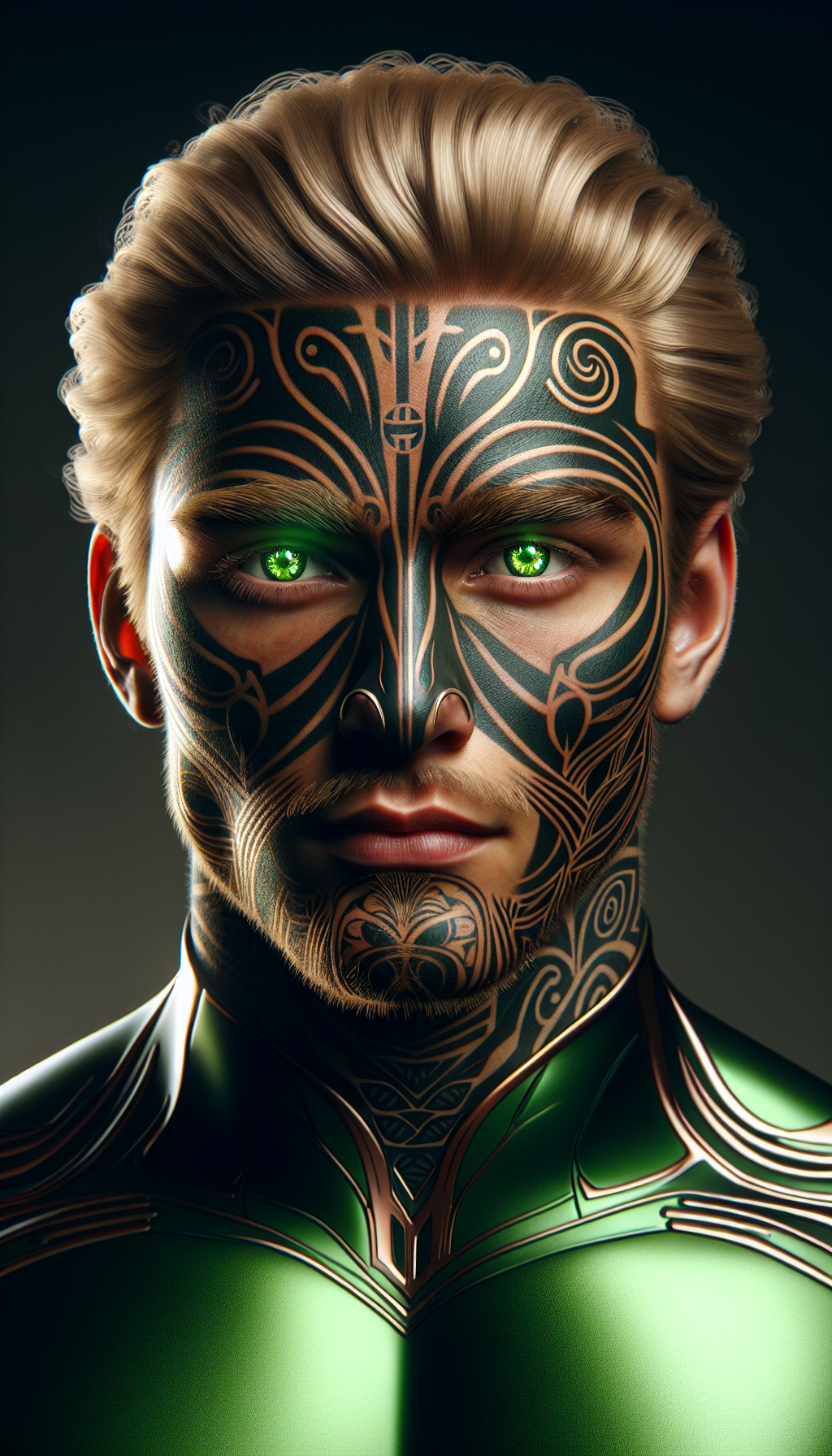
The Māori Green Lantern Fighting Misinformation And Disinformation From The Far Right
Judith Collins’ meeting with Sebastian Gorka is not an isolated diplomatic incident but a symptom of a government aligned with global far-right networks through shared commitment to white supremacy, Christian nationalism, and neoliberal capitalism. Gorka’s ties to Nazi-allied organizations, his career promoting Islamophobia, and his role in Trump’s authoritarian movement make him exactly the kind of figure that democratic governments should refuse to legitimize through engagement.
That Collins not only met with Gorka but celebrated the meeting publicly, apparently holding his book, without acknowledging his extremist background, reveals the ideological character of New Zealand’s current government. This is a government that will sacrifice democratic principles, betray communities targeted by far-right violence, and attack Indigenous rights to maintain proximity to American power, regardless of how authoritarian and fascistic that power becomes.
From a Māori perspective grounded in manaakitanga, kaitiakitanga, and aroha, we must reject this path. Our values demand we protect all communities from violence, care for those most vulnerable, and speak truth to power regardless of personal consequences. We cannot allow fascism to be normalized through incremental accommodation.
New Zealanders have a responsibility to learn the lessons of history. Fascism does not announce itself with swastikas and concentration camps. It arrives gradually, through respectable figures engaging extremists, through economic anxieties channeled into racist scapegoating, through democratic norms eroded one compromise at a time. We are watching this process unfold right now, and Judith Collins’ meeting with Sebastian Gorka is a clear marker on this dangerous path.
We must choose differently. We must refuse complicity with fascism, even when powerful governments embrace it. We must build movements rooted in solidarity, not in nationalist exclusion. We must demand that our government uphold democratic values and protect all residents, not just those who serve elite interests. And we must remember that the same colonial violence that stole Māori land and suppressed Māori culture continues in new forms, targeting Muslims, immigrants, and all who resist white supremacist capitalism.
The struggle against fascism is the struggle for decolonization. The struggle for Indigenous rights is the struggle against white supremacy. These are not separate battles but fronts in the same war for a just and democratic future. Judith Collins has shown which side she is on. Now every New Zealander must choose.
Kia kaha. Kia māia. Kia manawanui.
Be strong. Be brave. Be steadfast.
Nō reira, tēnā koutou, tēnā koutou, tēnā koutou katoa.
Therefore, greetings to you all.
Readers who find value in this analysis and wish to support the work of exposing misinformation, white supremacy, racism, and neoliberalism may consider a donation to support the cause: HTDM: 03-1546-0415173-000. I understand these are tough economic times for whānau, so please only contribute if you have capacity and wish to do so. The fight for truth and justice continues, with or without financial support, because our communities’ safety depends on it.
Nāku noa, nā
Ivor Jones
The Māori Green Lantern
1. https://www.semanticscholar.org/paper/4594d15d5182a898153512cfe7545414ae6eacbd
2. https://www.beehive.govt.nz/release/minister-us-defence-security-meetings
3. https://www.police.govt.nz/about-us/history-and-museum/museum/exhibitions/place-many-brave-deeds/2019-operation-deans-terrorist
4. https://www.politico.com/news/2024/11/22/sebastian-gorka-trump-administration-national-security-00191382
5. https://www.1news.co.nz/2025/10/21/trumps-war-secretary-positive-about-nz-collins-says-after-dc-meeting/
6. https://en.wikipedia.org/wiki/Christchurch_mosque_shootings
7. https://www.nytimes.com/2024/11/22/us/politics/sebastian-gorka-adviser.html
8. https://www.rnz.co.nz/news/national/576309/defence-ministerjudith-collins-visits-central-intelligence-agency-headquarters
9. https://nzhistory.govt.nz/51-killed-mosque-shootings
10. https://www.presidency.ucsb.edu/documents/statement-president-elect-donald-j-trump-announcing-the-appointments-alex-wong-assistant
11. https://www.aa.com.tr/en/americas/us-new-zealand-defense-chiefs-reaffirm-commitment-to-strengthen-partnership/3723016
12. https://www.tandfonline.com/doi/full/10.1080/03071847.2025.2458938
13. https://pmc.ncbi.nlm.nih.gov/articles/PMC11536286/
14. https://en.wikipedia.org/wiki/Sebastian_Gorka
15. https://www.1news.co.nz/2025/10/21/tvnz-escorted-out-of-pentagon-access-to-collins-hegseth-meeting-withdrawn/
16. https://christchurchattack.royalcommission.nz/publications/what-we-heard-from-the-whanau-of-the-51-shuhada-survivors-and-witnesses-of-the-christchurch-terrorist-attack/impact-of-the-terrorist-attack/
17. https://www.politico.com/live-updates/2024/11/14/congress/michael-anton-sebastian-gorka-trump-administration-00189629
18. https://www.dvidshub.net/image/9366026/new-zealand-minister-defense-judith-collins-visits-anc
19. https://www.tandfonline.com/doi/full/10.1080/19434472.2023.2294732
20. https://www.presidency.ucsb.edu/documents/app-attributes/appointments?page=1
21. https://www.dvidshub.net/image/9366006/new-zealand-minister-defense-judith-collins-visits-anc
22. https://www.nbcnews.com/news/world/new-zealand-mosque-shootings
23. https://www.tandfonline.com/doi/full/10.1080/03071847.2025.2476520
24. https://www.1news.co.nz/2023/10/24/tears-fall-as-inquest-into-mosque-terrorist-attack-opens/
25. https://www.1news.co.nz/2024/09/07/govt-turning-its-back-on-victims-of-march-15-attack-imam-says/
26. https://www.1news.co.nz/2025/10/19/mega-strike-incoming-govt-on-offensive-union-leader-fires-back/
27. https://www.rnz.co.nz/news/thedetail/544880/from-new-zealand-to-afghanistan-with-project-51
28. https://www.1news.co.nz/2025/10/16/journalists-exit-pentagon-rather-than-agree-on-new-reporting-rules/
29. https://www.rnz.co.nz/news/national/544752/six-years-on-those-who-helped-in-the-aftermath-of-the-mosque-attacks-share-stories
30. https://www.1news.co.nz/2025/10/18/us-seizes-survivors-of-strike-on-suspected-drug-carrying-boat-in-caribbean/
31. https://www.rnz.co.nz/tags/Temel Atacocugu
32. https://www.1news.co.nz/2025/10/11/white-house-begin-mass-firings-of-federal-workers-in-govt-shutdown/
33. https://www.rnz.co.nz/tags/mosque shootings
34. /content/files/2411-08890.pdf
35. https://www.rnz.co.nz/tags/Intelligence Agencies
36. https://www.rnz.co.nz/news/national/511354/five-years-on-from-mosque-attacks-widows-have-newfound-strength-and-courage
37. https://www.1news.co.nz/2025/10/05/everybody-in-washington-hates-a-shutdown-until-it-becomes-a-useful-tool/
38. https://www.rnz.co.nz/tags/Mosque
39. https://www.1news.co.nz/2025/10/22/trump-putin-summit-planned-for-budapest-on-hold-us-official-says/
40. https://teara.govt.nz/en/violent-crime/print
41. https://www.1news.co.nz/2025/10/18/inside-nzs-hectic-day-after-trumps-tariff-shock/
42. https://teara.govt.nz/en/terrorism-and-counter-terrorism/print
43. https://nzuscouncil.org/minister-collins-visiting-washington-d-c/
44. https://www.tandfonline.com/doi/pdf/10.1080/13501763.2024.2362762?needAccess=true
45. /content/files/record/895766/files/article.pdf
46. https://www.tandfonline.com/doi/pdf/10.1080/10357718.2024.2302589?needAccess=true
47. https://www.tandfonline.com/doi/full/10.1080/10357718.2024.2409358
48. /content/files/bitstream/20-500-12657/37367/1/2020_book_securityinaninterconnectedworl.pdf