“When Property Owners Write the News” - 17 November 2025
How the Herald’s CGT Poll Manufactures Consent for Wealth Hoarding
Cui Bono? Follow the Property Portfolio
Thomas Coughlan’s poll story lands November 17, 2025, with surgical timing. NZ Herald-Kantar Poll frames Auckland opposition (45% against, 32% for) as a democratic verdict. But this is spectacle masquerading as journalism—a textbook case of manufacturing consent for the propertied class.
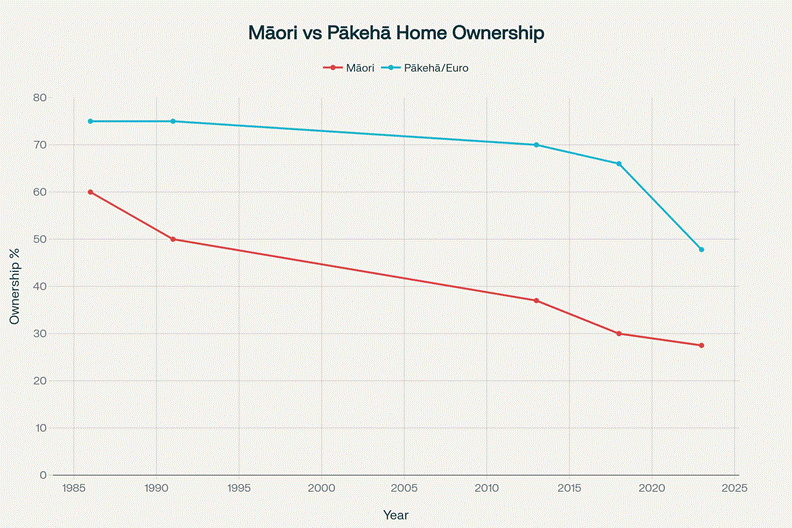
Māori home ownership has plummeted from 60% in 1986 to just 27.5% in 2023 - a 54% collapse following neoliberal reforms, compared to Pākehā decline from 75% to 47.8%.
Coughlan reports a “dead heat” nationally (39% support, 39% oppose). Yet the story’s architecture reveals whose interests matter. Auckland property owners—the demographic most enriched by four decades of house price speculation—receive sympathetic framing. Their opposition becomes the lede. The rest of Aotearoa, which supports the tax 42% to 36%, gets buried in paragraph four.
Who benefits? Not the 72.5% of Māori locked out of home ownership. Not the Pākehā whose median net worth ($222,000) dwarfs Māori ($52,000) by 4.3 times. The winners are the same people who own the paper.
The Neoliberal Machinery: NZME’s Political DNA
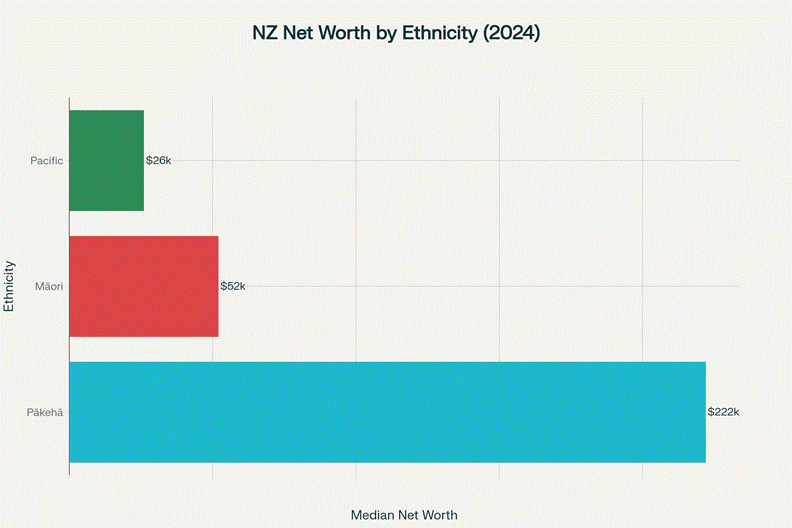
Pākehā median net worth is 4.3 times higher than Māori ($222k vs $52k) and 8.5 times higher than Pacific peoples ($26k) - stark evidence of structural wealth inequality in Aotearoa.
Steven Joyce, the new NZME chairman, didn’t stumble into the role. The former National Party Finance Minister (2016-2017) and chief architect of three election campaigns was installed May 2025 to “unify shareholders”—translation: protect property wealth from taxation.
Joyce’s record speaks. As Finance Minister under Prime Minister Bill English, he presided over policies that entrenched wealth inequality while New Zealand’s housing crisis metastasized. His RadioWorks fortune made him a millionaire before politics. Now he chairs the country’s largest media company during a capital gains tax election—a glaring conflict of interest disguised as “media expertise.”
According to Wikipedia, “Joyce subsequently established a consultancy firm called Joyce Advisory, which developed close ties with the National Party.” NZME’s board meeting in June 2025 appointed Joyce as chairman following a contested shareholders’ battle.
Alongside Joyce sits Jim Grenon, the Canadian-born billionaire who bought 9.97% of NZME in March 2025. According to RNZ’s reporting, Grenon founded The Centrist, a platform criticized for amplifying “concerns about the left-leaning New Zealand media” and promoting positions on “vaccination and mandate policies after Covid, climate change, gender issues and Treaty issues.”
Union director Michael Wood warned that Grenon sought editorial influence. E Tū, representing NZME journalists, stated: “We see a pattern that has been incredibly unhealthy in other countries of billionaires moving into media ownership roles to be able to promote their own particular view of the world.”
Bryce Edwards, director of the Integrity Institute, told RNZ: “If owners who have a very activist orientation are coming on board and if they want to push the media in a particular way as we’ve seen with Jeff Bezos, that is alarming for democracy.”
Manufacturing Consent: Poll as Propaganda
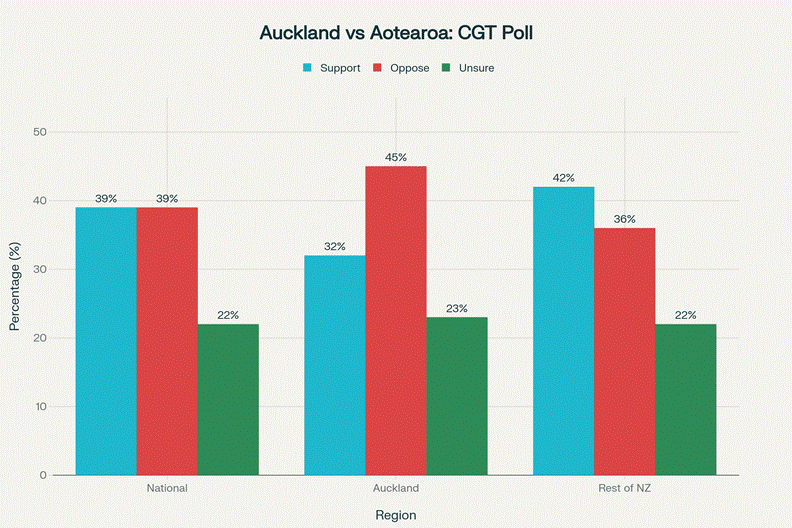
The NZ Herald-Kantar Poll shows Auckland property owners overwhelmingly oppose CGT (45% vs 32% support), while the rest of Aotearoa supports it (42% vs 36% oppose) - revealing whose interests the Herald serves.
The Herald-Kantar poll’s framing reveals engineered outcomes. Respondents heard Labour’s CGT would tax investment property at 28%, exempting family homes. Then: Would using revenue for “three free GP visits” change your view? This primes respondents to weigh healthcare against property wealth—a false binary that erases structural questions about who owns what.
The poll never asked: Should people who make untaxed capital gains on property pay tax like wage earners? Should Māori, with 27.5% home ownership versus 47.8% Pākehā, bear policy burdens while landlords profit tax-free? These questions threaten power, so they don’t get asked.
Regional framing amplifies property owner anxiety. Auckland’s opposition becomes the story’s moral center, framed as legitimate economic concern. But Auckland property owners aren’t neutral observers—they’re conflict-of-interest incarnate. Between 1986-2023, as neoliberal reforms gutted Māori home ownership from 60% to 27.5%, Auckland property values soared.
According to Te Ara: The Encyclopedia of New Zealand, “In 1926 nearly 70% of Māori households owned their own homes; by 1986 it had fallen to below 50%.” By 2023, RNZ reported, Māori home ownership had plummeted to 27.5% against 47.8% for Pākehā/European. This 42-point collapse in 37 years—during the neoliberal experiment—is colonial dispossession accelerated.
The Journalist as Ideological Conduit
Thomas Coughlan’s trajectory illuminates. Political editor since April 2025, he replaced Claire Trevett after NZME’s restructure. Coughlan’s framing consistently centers elite consensus: policy is “risk,” taxation is “radical,” property wealth is “aspiration.” This isn’t neutral reporting—it’s ideology naturalized as common sense.
Coughlan’s CGT coverage exemplifies. He describes Labour’s tax as “widely seen to be a political risk.” By whom? Not Māori economist Matthew Roskruge (Te Ātiawa, Ngāti Tama), Professor of Economics at Massey University, who called it “necessary” despite being “weak.” Not the 65% of New Zealanders who support CGT in principle.
Māori Housing: The Neoliberal Collapse
The poll story erases the most critical context: neoliberal reforms destroyed Māori housing security. According to Te Ara: “In 1926 nearly 70% of Māori households owned their own homes; by 1986 it had fallen to below 50%.” By 2023, RNZ confirmed Māori home ownership had fallen to 27.5%—a 42.5-point collapse in one generation.
What happened? Roger Douglas’s 1984 neoliberal revolution gutted the Department of Māori Affairs housing program, corporatized state housing, and dismantled welfare supports. House prices decoupled from wages. By the 2000s, investment property speculation became untaxed wealth accumulation.
RNZ reported in 2025 that “Pākehā had the highest median individual net worth at $222,000, compared to $52,000 for Māori and $26,000 for Pacific people.”
According to Stats NZ, “In the year ended June 2024, the wealthiest 20 percent of households held approximately two-thirds of New Zealand’s total household net worth.” Māori, locked out of asset accumulation by neoliberalism, hold proportionally nothing.
Matthew Roskruge on CGT & Māori Impact
According to RNZ’s interview with Māori economist Matthew Roskruge:
“Capital gains are a form of income, and every other form of income is taxed. People who make money from capital gains are disproportionately those who already have wealth.”
On Māori impact specifically:
- “With lower rates of home ownership and fewer investment properties, most whānau Māori would see little direct benefit... It’ll mostly hit high net-worth individuals, who are mostly non-Māori.”
- However, Roskruge warned: “Māori entities, such as iwi and hapū collectives, could face new costs depending on how the policy is applied to commercial investments. Our iwi invest heavily in farms and commercial property. Farms are exempt, but commercial portfolios like Ngāti Whātua Ōrākei or Tainui could feel the sting.”
- He concluded: “Māori had huge amounts of land and asset wealth taken through colonisation. For nearly 200 years that land’s been traded and accumulating capital gains for others. Now that the Māori economy is growing we’re investing in property and farms—suddenly there’s a tax on those gains. Better late than never, but it is late, and yes, you could argue it hurts Māori Inc just as we’re growing.”
The Missing Frame: Capital Gains Tax as Modest Redistribution
What the poll story conceals: Labour’s CGT is weak sauce. Roskruge called it “the bare minimum.” It taxes only residential and commercial property, not shares, business assets, or inheritances. Farms exempt. KiwiSaver exempt. Family home exempt.
According to Hāpai Te Hauora, a health advocacy organization: “For Māori land trusts and community housing projects, the details aren’t clear yet. It will depend on how land is owned and whether it’s ever sold – something Māori experts say will need careful attention.”
Treasury support exists. According to RNZ, New Zealand is “unusual among OECD countries for not having a general tax on income from capital gains.”
Steven Joyce’s Hollow Men History & NZME Control
Joyce’s chairmanship recalls media critic Nicky Hager’s The Hollow Men (2006), which exposed National’s 2005 campaign manipulation. According to Wikipedia, Joyce was “National Party campaign manager in both the 2005 and the 2008 general elections,” helping deliver National’s highest MMP vote shares (47.3% in 2011).
According to Wikipedia, “Joyce subsequently established a consultancy firm called Joyce Advisory, which developed close ties with the National Party... Joyce Advisory was rumoured to have played a role” in university policy decisions, and “In June 2025, Joyce was appointed as the chairman of media company New Zealand Media and Entertainment, which owns The New Zealand Herald newspaper and the radio station Newstalk ZB.”
This is systemic capture. Joyce’s political strategy firm now chairs a media company during a CGT election. The conflict of interest violates democratic norms.
The Māori Economy & CGT Timing
According to RNZ, “According to the Te Ōhanga Māori 2023 report, Māori entities grew from contributing $17 billion to New Zealand’s GDP in 2018 to $32 billion in 2023, turning a 6.5 percent contribution to GDP into 8.9 percent. The Māori economy asset base grew from $69 billion in 2018 to $126 billion in 2023 - an increase of 83 percent.”
This growth—built on restored mana and post-settlement investment—now faces taxation designed for Pākehā property speculators. It’s epistemically colonial: treating iwi entities like private landlords, ignoring whakapapa obligations, commodifying the sacred.
Auckland Exceptionalism: Whose Voice Counts?
The poll’s regional breakdown reveals ideology. Auckland: 45% oppose, 32% support. Wellington: 42% support, 38% oppose. Rest of NZ: 42% support, 36% oppose. Nationally: 39% support, 39% oppose.
Coughlan frames Auckland opposition as determinative. But why? Auckland holds 32% of New Zealand’s population. The poll shows 68% of Aotearoa outside Auckland either supports CGT or splits evenly. Yet Auckland property owners dominate the narrative.
This is class warfare disguised as regional analysis. Auckland property owners have the most to lose—not because they’re uniquely vulnerable, but because they’ve accumulated the most untaxed wealth.
Action: Reclaim Media, Demand Accountability
Immediate:
- Name conflicts: Joyce’s political history, Grenon’s activist ambitions, Coughlan’s ideological framing
- Demand editorial transparency via Bryce Edwards’ Integrity Institute framework
- Amplify Māori economist voices
Structural:
- Support independent Māori media
- Demand comprehensive CGT with Māori collectively-owned asset exemptions under Treaty principles
- Organize tenant unions, housing collectives, rangatahi movements
Long-term:
- Decolonize media ownership via public interest trusts with iwi representation
- Restore Māori housing programs grounded in kaitiakitanga
- Implement wealth redistribution: CGT, wealth taxes, inheritance taxes, land value taxes
The Herald‘s poll story isn’t journalism—it’s class warfare. The taiaha has traced the whakapapa. Now the mahi begins.

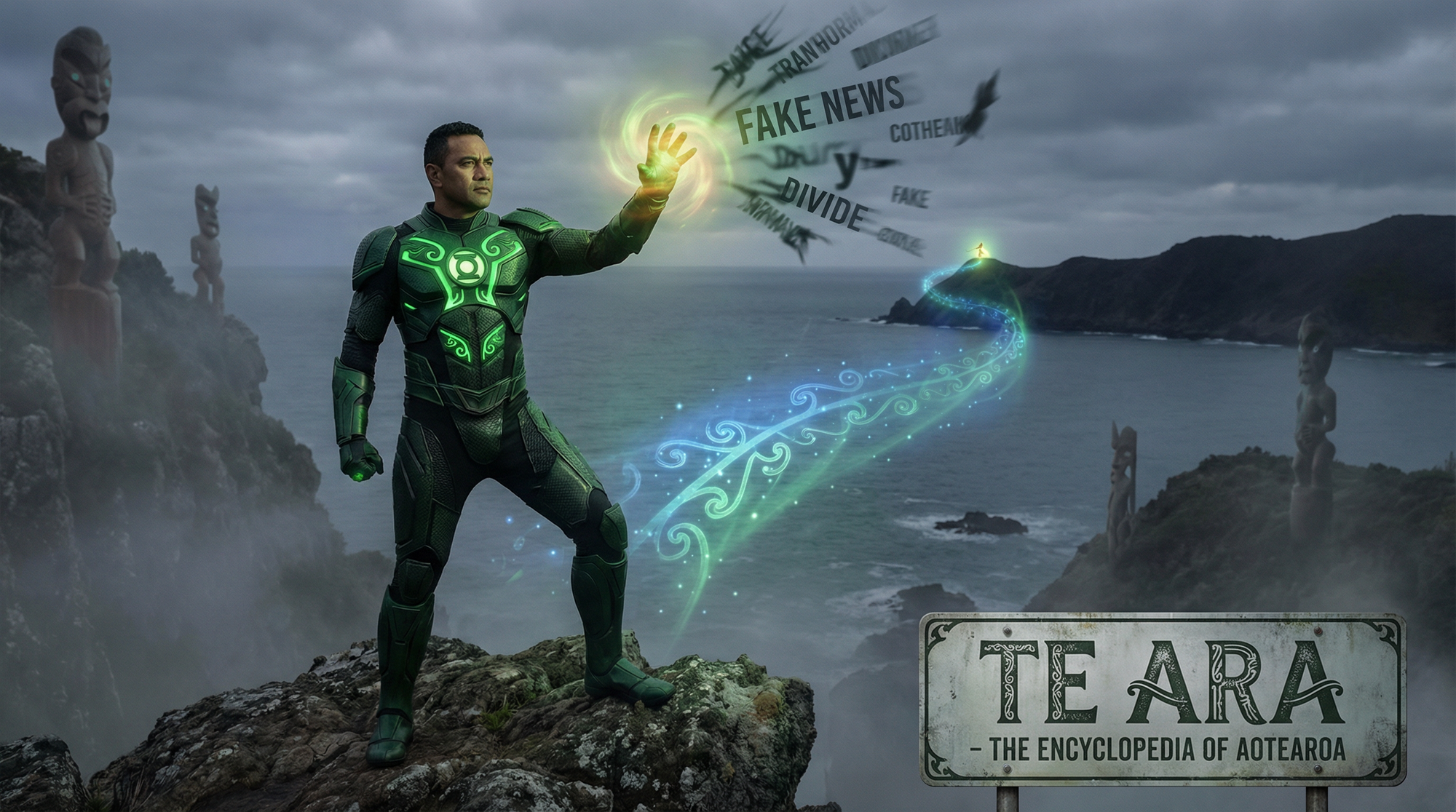
Ivor Jones The Māori Green Lantern Fighting Misinformation And Disinformation From The Far Right
Ka tū. Kia kaha.