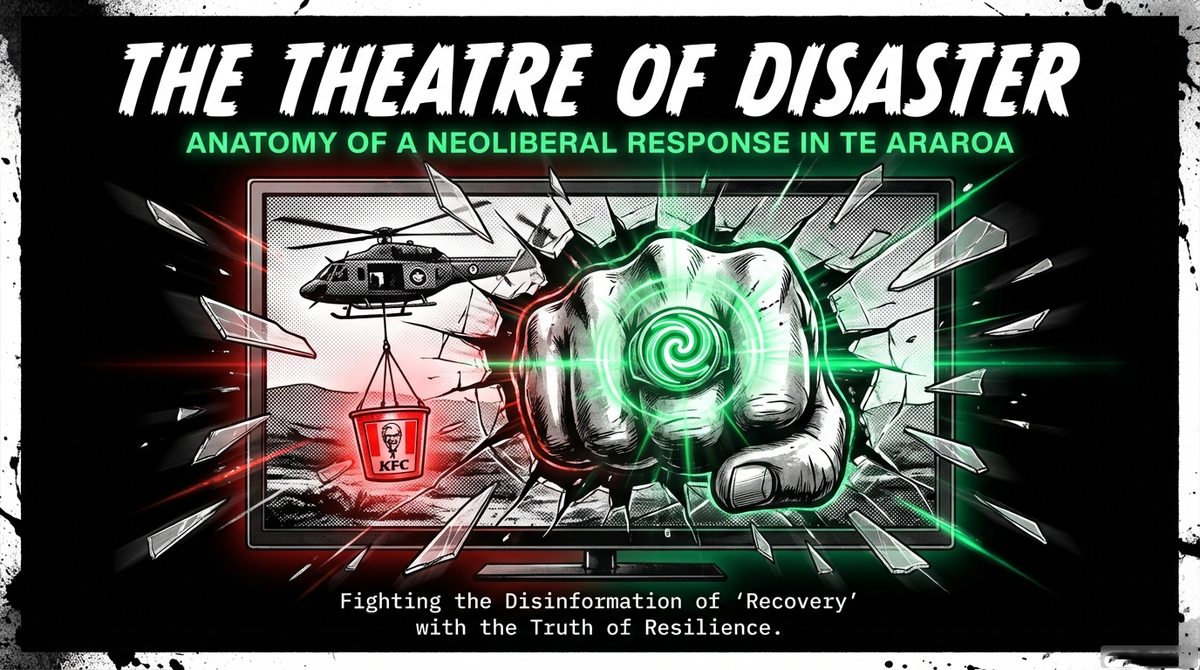
“When the Captain Brings Fried Chicken While the Ship Burns: Christopher Luxon’s Theatre of Disaster Management” - 30 January 2026
The anatomy of neoliberal disaster response in Te Araroa, January 2026
Mōrena ano Aotearoa,
Act One: The Storm and the Silence
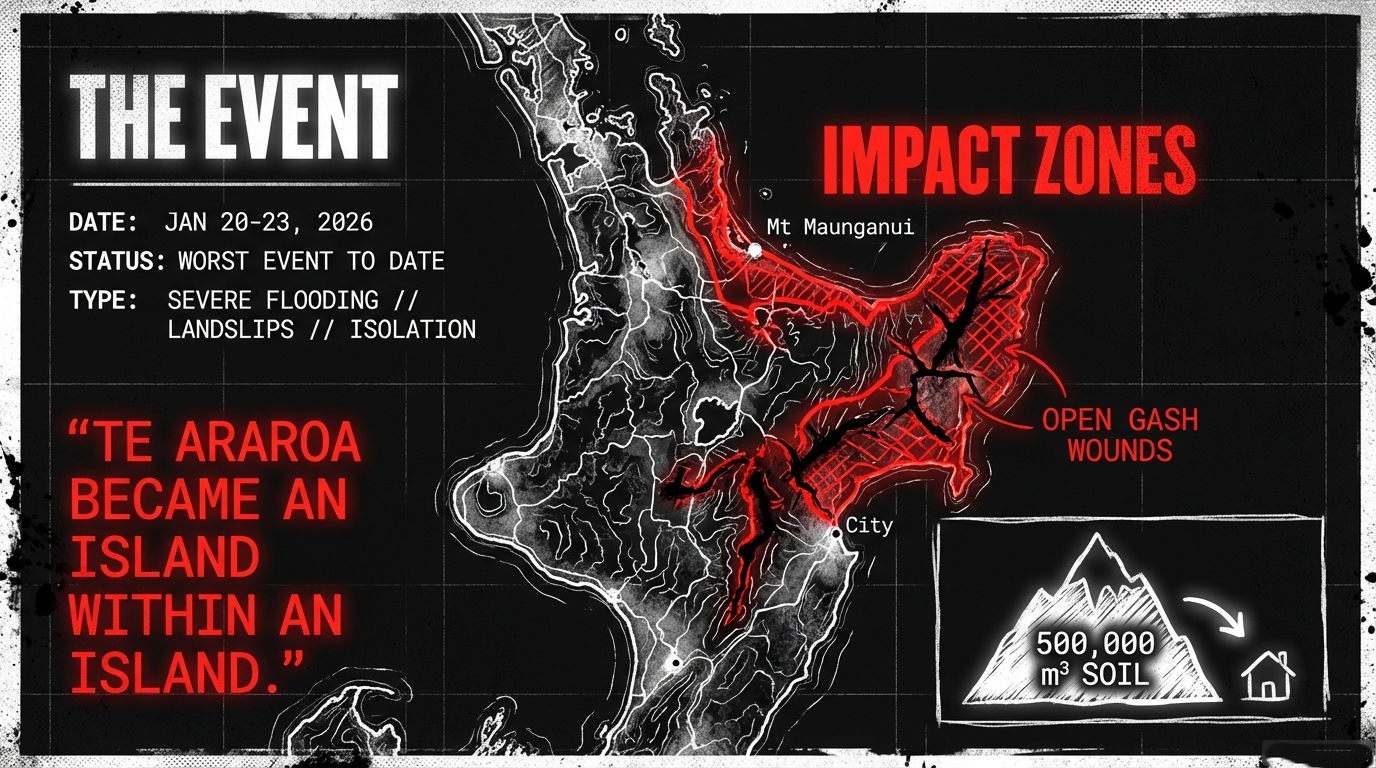
On January 20-23, 2026, the East Coast of New Zealand’s North Island was eviscerated. Severe flooding and landslips carved open hillsides like surgical incisions gone catastrophically wrong, dumping 500,000 cubic metres of soil onto roads and communities.
Te Araroa—one of Aotearoa’s most isolated settlements—became an island within an island, cut off by nature’s fury and governmental neglect in equal measure.
As communities faced their “worst event to date,” knowing that “our lives are never going to be the same,” a different tragedy unfolded 400 kilometers south.
At Mount Maunganui’s beachside holiday park, six people—including two fifteen-year-old friends—were buried alive beneath tonnes of saturated earth while authorities who had been warned four hours earlier failed to evacuate the campground.
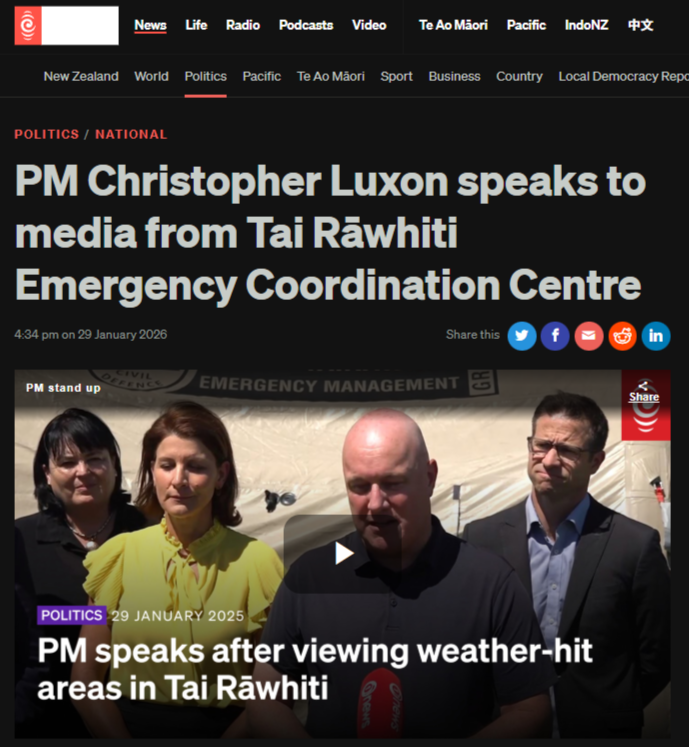
This is not a story about weather. This is a story about the theatrical performance of leadership in the age of neoliberal disaster capitalism—where optics trump outcomes, where a Prime Minister’s second helicopter visit delivers Kentucky Fried Chicken to workers while communities drown in bureaucratic indifference.
Koha Consideration: Funding the Truth About Disaster Response
Every koha to this mahi signals that whānau understand what this essay documents: that marae feed evacuees while governments deliver fried chicken by helicopter, that communities save themselves while leaders pose for photographs, that rangatiratanga—true authority and self-determination—includes the power to fund the voices that speak this reality when Crown structures will not.
This essay exists because someone chose to name what happened in Te Araroa, Hicks Bay, and Mount Maunganui for what it is: not incompetence, but a system functioning exactly as designed to extract value from crisis while providing minimal care. That naming threatens power. That’s why independent Māori voices—voices not beholden to government or corporate funders—are essential.
Your koha says: We will fund our own accountability. We will resource our own truth-telling. We will not wait for official inquiries that change nothing.
Kia kaha, whānau. The next storm is coming. It may come this year. And when it does, we will remember who showed up with quad bikes and who showed up with photo opportunities.
If you are able, consider a koha to ensure voices like this continue:
Three pathways exist:
- Direct Koha (Voluntary Contribution):
Support this mahi directly via the Koha platform: https://app.koha.kiwi/events/the-maori-green-lantern-fighting-misinformation-and-disinformation-ivor-jones - Substack Subscription:
Receive essays directly and support ongoing research and writing through: https://themaorigreenlantern.substack.com/subscribe - Direct Bank Transfer:
HTDM, account number 03-1546-0415173-000
Every koha—whether $5 or $50—signals that you understand: accountability is not something we wait for. It is something we fund. It is something we demand. It is something we create ourselves.
Act Two: The Captain Arrives (Briefly)
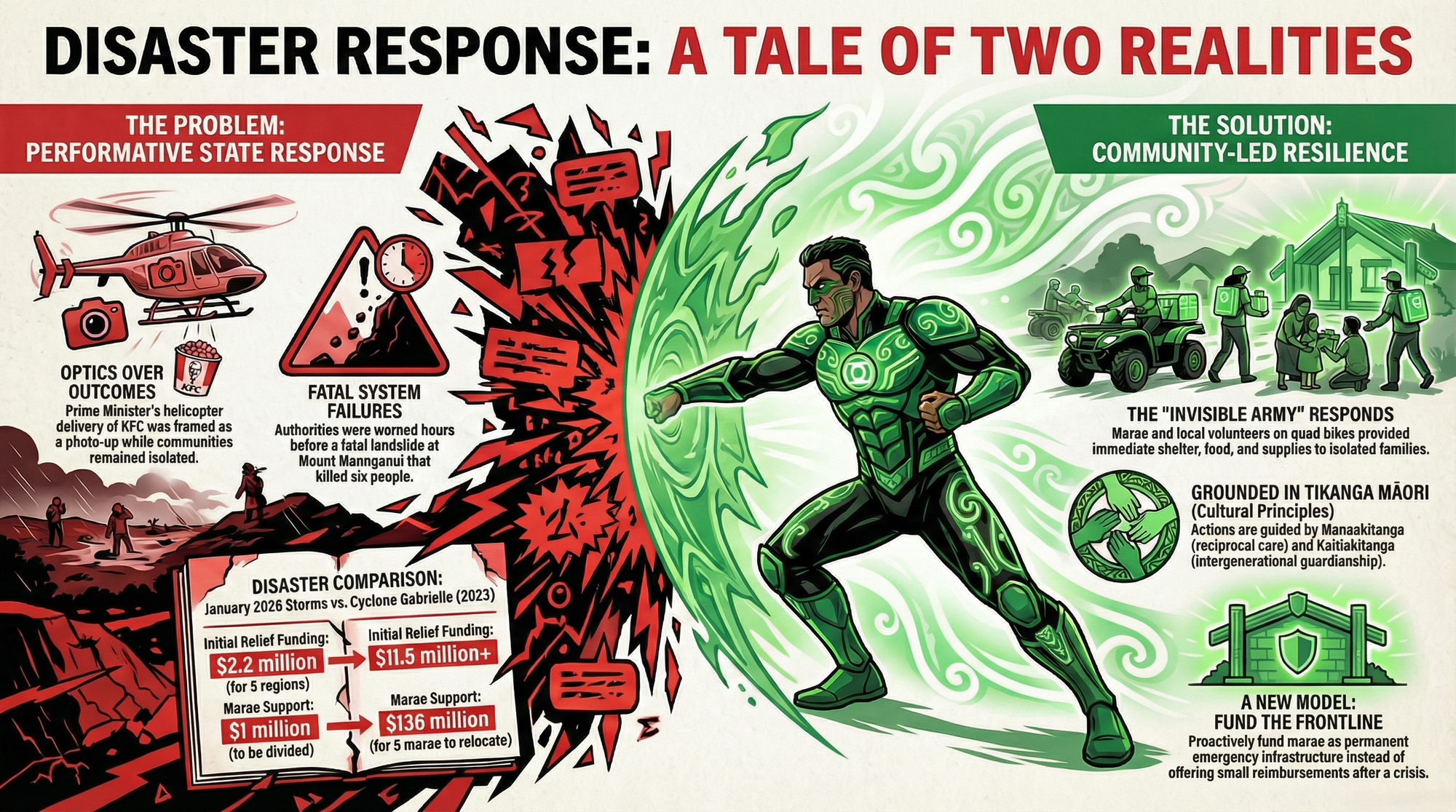
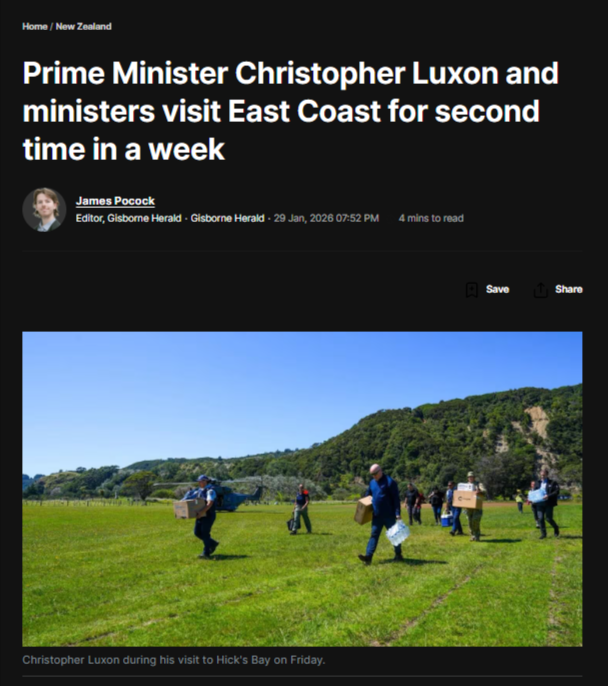
On January 28, Prime Minister Christopher Luxon made his first helicopter visit to Hicks Bay and Te Araroa, surveying “huge challenges” in the roading network.
He announced what communities already knew:
reconnecting them would require moving 500,000 cubic metres of soil—”five to six months of work.”
Then he left.
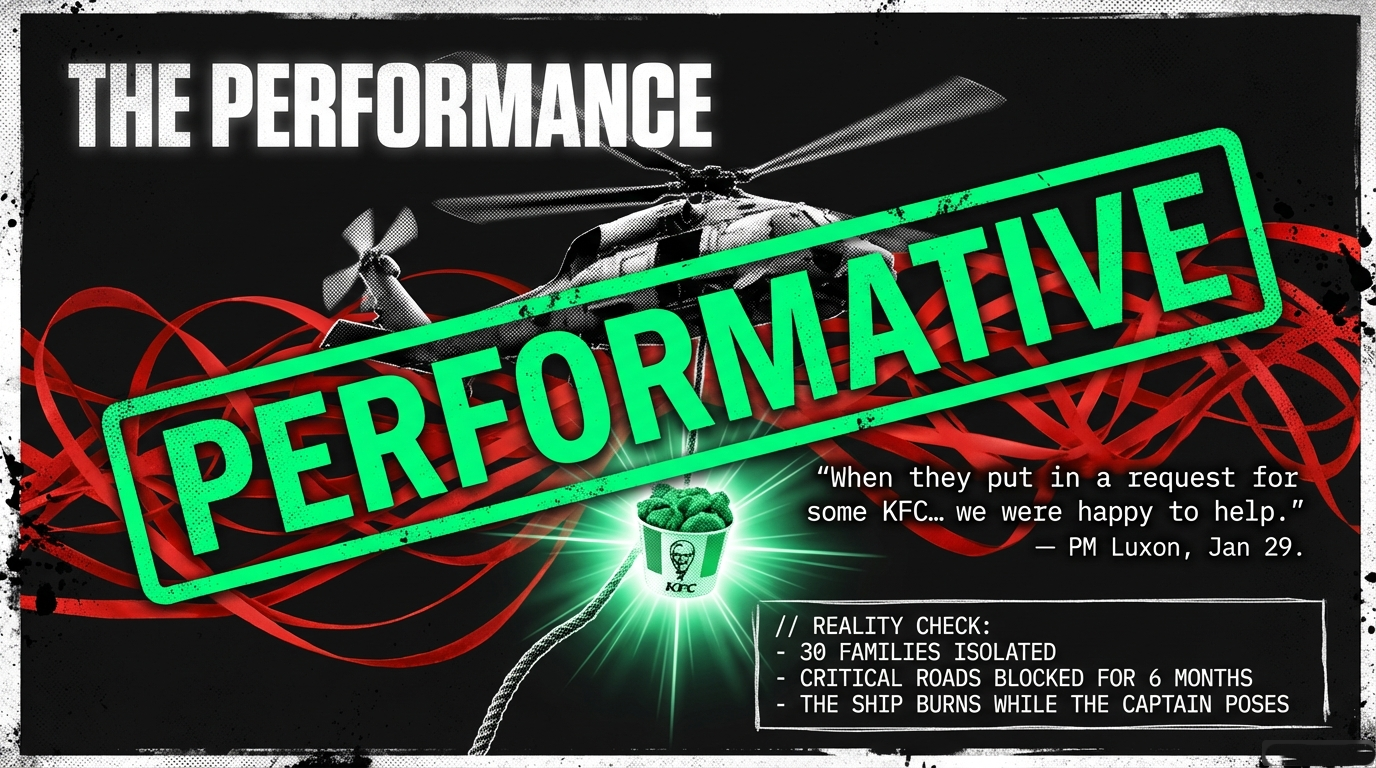
Then he returned. The next day, January 29, Luxon helicoptered back to Te Araroa with a payload critical to disaster recovery:
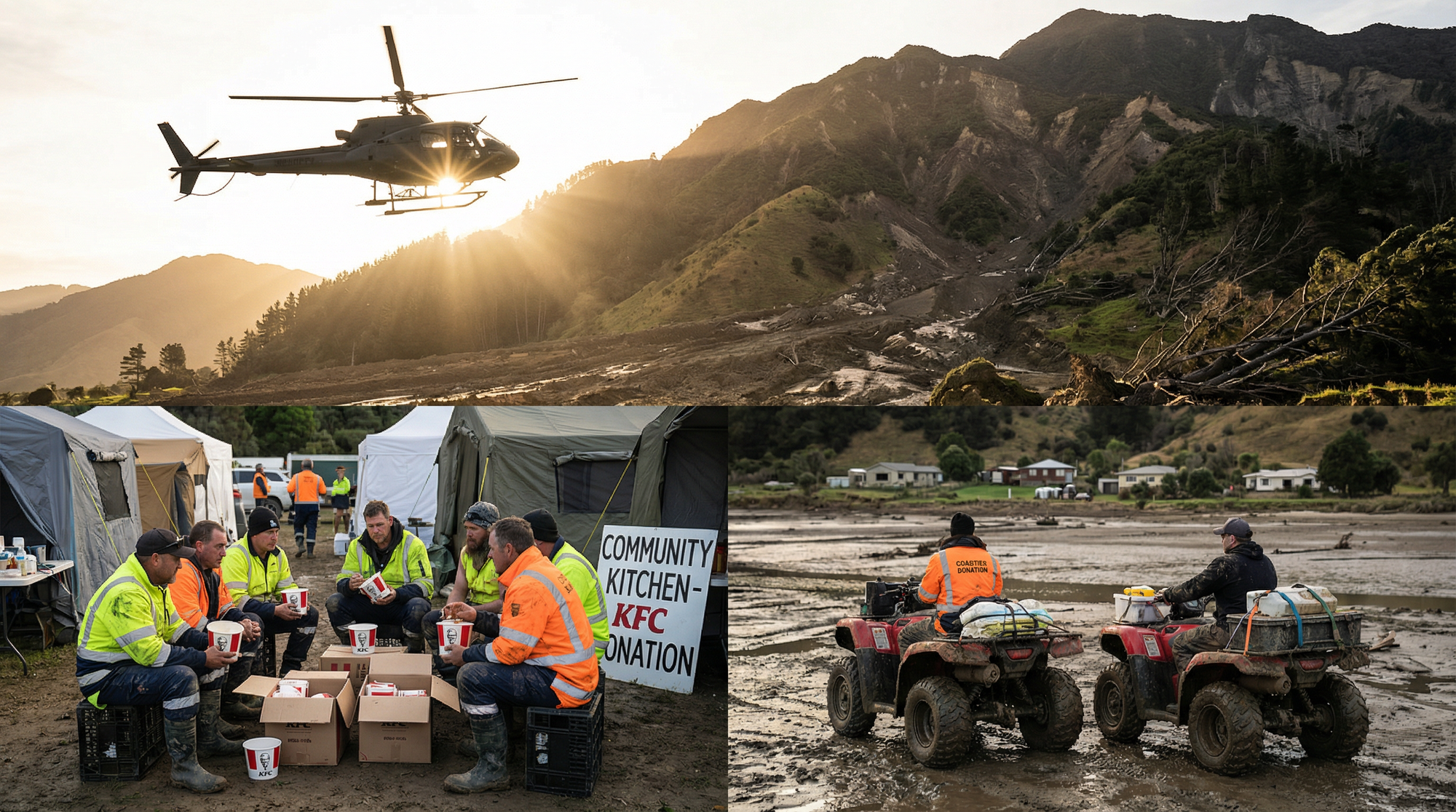
Kentucky Fried Chicken. His Facebook post captures the neoliberal disaster aesthetic perfectly:
“The community in Te Araroa has been putting in a massive effort to recover from the recent weather events—so when they put in a request for some KFC to share, we were more than happy to help get it to them.”
The photo opportunity complete, the helicopter lifted off again. The Prime Minister departed. The workers ate their chicken. The mountain ranges still bore “open gash wounds.” Thirty families remained isolated, supplied by volunteers on quad bikes navigating low tide. The marae kitchen crews were “going hard,” hosting 30-40 people at any time with dwindling resources.
But the Prime Minister had been seen. The gesture had been made. The performance documented.
This is what disaster capitalism looks like when it wears a smile and holds a bucket of fried chicken.
Act Three: Counting the Corpses, Calculating the Costs
Let us quantify what “less widespread than [Cyclone] Gabrielle” actually means when you are the one buried beneath it:
The Human Ledger:
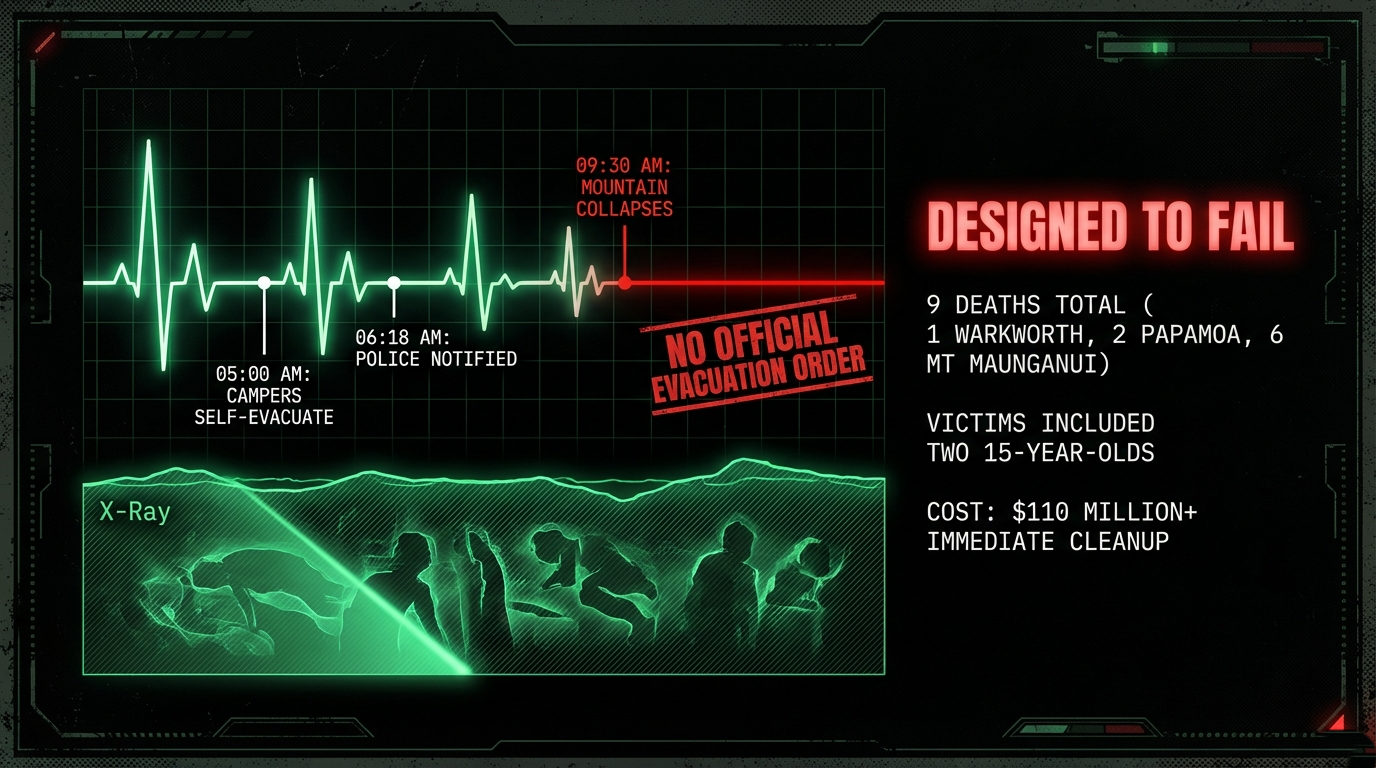
- Nine deaths total: one man swept away near Warkworth, two killed in a Papamoa landslide, six missing presumed dead at Mount Maunganui
- 500 people displaced across the North Island
- More than 30 houses evacuated in Onepoto alone, with no timeline for return
- Communities separated for weeks, fearing “generational disconnection“ as whānau cannot reach each other
The Infrastructure Collapse:
- State Highway 35: sections between Te Araroa and Pōtaka out of action “for some time”
- Waioweka Gorge: 1,000 truckloads of debris, approximately 40 slips, hoped to reopen one lane within a week
- State Highway 25: closed until February
- 500,000 cubic metres of soil to relocate—an Everest of earth with nowhere to put it
The Economic Hemorrhage:
Tai Rāwhiti loses 55 million tonnes of topsoil every year. Post-storm cleanup costs have already exceeded $110 million in debris removal alone. Without intervention, cumulative storm damages over 30 years could exceed $1 billion.
The Government’s Response:
A $2.2 million relief package. Split between five regions. $1.2 million for Mayoral Relief Funds. $1 million to “reimburse” marae that provided welfare support.
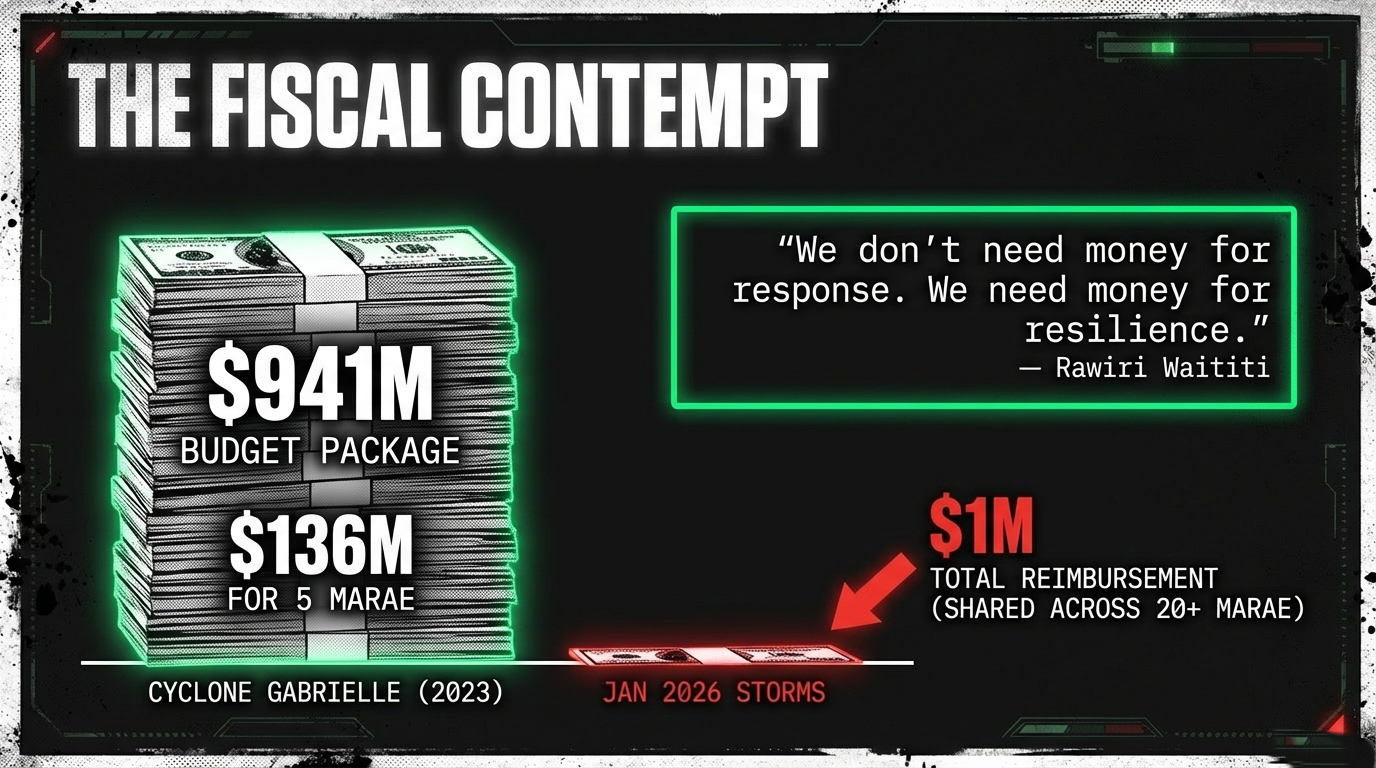
To contextualize this fiscal contempt:
When Cyclone Gabrielle struck in 2023, the government provided $11.5 million immediately, then $50 million for business support, $250 million for roads, and eventually $941 million in the budget, with a $556 million cost-sharing recovery package for Hawke’s Bay alone. Five Tairāwhiti marae received $136 million to relocate to safer ground.
This time, for at least 20 marae across five regions that opened their doors, fed evacuees, provided power, shelter, and spiritual sustenance: $1 million. Total. To be divided among them all.
As Te Pāti Māori co-leader Rawiri Waititi observed with surgical precision:
“We don’t need money for response. We need money for resilience. This is not a one in 100 year event anymore. This is happening every year.”
Paora Glassie from Ōtetao Reti Marae in Punaruku, his community prepared with solar power and emergency supplies after learning from Gabrielle, responded with Māori restraint to the government’s generosity: “I think it’s not enough, but at the end of the day we should be grateful we have been offered some money.”
Grateful for crumbs while the Prime Minister delivers fried chicken by helicopter.
Act Four: When the System Fails by Design
The Mount Maunganui catastrophe exposes the rotten timber beneath the government’s performative compassion. At 5:00 AM on January 22, campers were already self-evacuating, warned by Lisa Anne Maclennan, who photographed the slip threatening her campervan. She called police at 6:18 AM. Fire and Emergency New Zealand had received a 111 call about a slip near the campground hours earlier, notifying Tauranga City Council three minutes later.
No evacuation order came.
At 9:30 AM, the mountain let go. Six people—including teenagers Max Furse-Kee and Sharon Maccanico, fifteen years old, on holiday together—were buried. Eight days later, recovery workers are still “digging millimetres at a time.”
Luxon announced a “strong case“ for an independent government inquiry, noting “a potentially inherent conflict” between the council’s ownership of the campground and its ability to investigate itself. Questions, he intoned, “deserve answers.”
Questions deserve answers. But answers require accountability, and accountability threatens the neoliberal order that privileges market efficiency over human safety, that transforms public services into profit centers, that defunds emergency management while demanding “resilience” from individuals and communities.
This is disaster capitalism’s modus operandi: privatize gains, socialize losses, and when the system predictably fails, convene an inquiry that will find “lessons learned” without fundamentally challenging the structures that produced the catastrophe.
Act Five: The Invisible Army
While Luxon posed with buckets of chicken, an invisible army was already in motion.
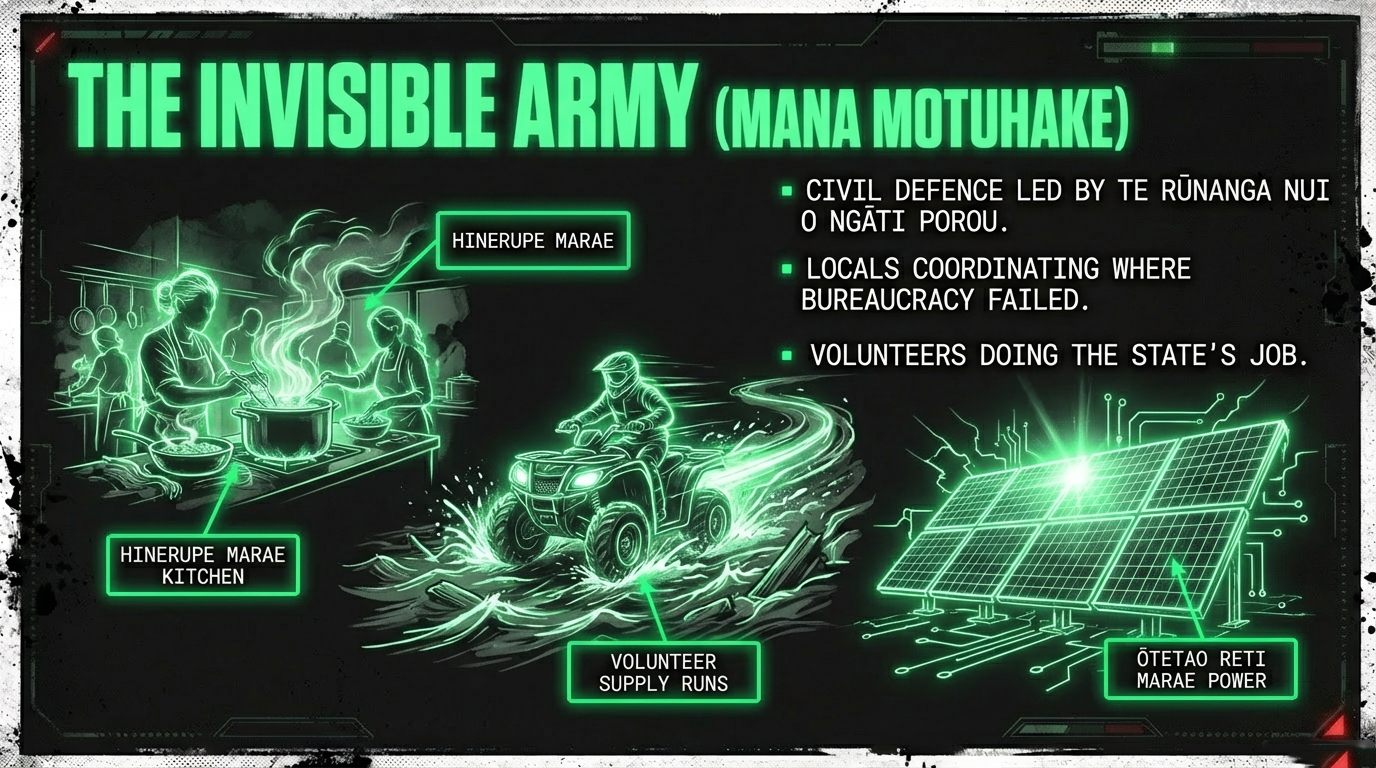
At Hinerupe Marae in Te Araroa, Civil Defence workers and kitchen crews were hosting 30-40 people continuously, their own power and supplies dwindling. Local stores coordinated with Civil Defence to supply 20-30 isolated families. Volunteers on quad bikes navigated slip-torn roads at low tide, delivering groceries and gas bottles.
Ōtetao Reti Marae in Punaruku had prepared after Cyclone Gabrielle, installing solar power, improving water supplies, stocking emergency containers. When the storm hit, they became a lifeline for their community, providing shelter, kai, and power while the state helicoptered in photo opportunities.
Te Rūnanga Nui o Ngāti Porou and the Manaaki Matakaoa fund provided resources critical to ground-level response. Local Civil Defence coordinators Trudi Ngāwhare and Tash Wanoa worked through the night as the storm hit, their “emotional devastation” real but their commitment absolute.
This pattern—community self-organization superseding governmental response—is well-documented in disaster research. When COVID-19 overwhelmed Wuhan in early 2020, self-organized citizen networks delivered supplies, coordinated care, and filled gaps left by official channels. After Canterbury’s earthquakes, Te Rūnanga o Ngāi Tahu mobilized health practitioners, established 24-hour support services, and leveraged tribal networks to coordinate community-wide response.
The effectiveness of this community-led model threatens the neoliberal narrative. If people can coordinate their own disaster response more effectively than marketized, bureaucratized government agencies, what justification remains for the current system? Better to send a Prime Minister with fried chicken than to acknowledge that marae have become the de facto emergency management system—unpaid, under-resourced, and irreplaceable.
Interlude: Explaining Tikanga to a Western Mind
For readers whose worldview was forged in the fires of Enlightenment individualism and market rationality, understanding why the government’s response represents not merely inadequacy but profound cultural violence requires a conceptual translation.
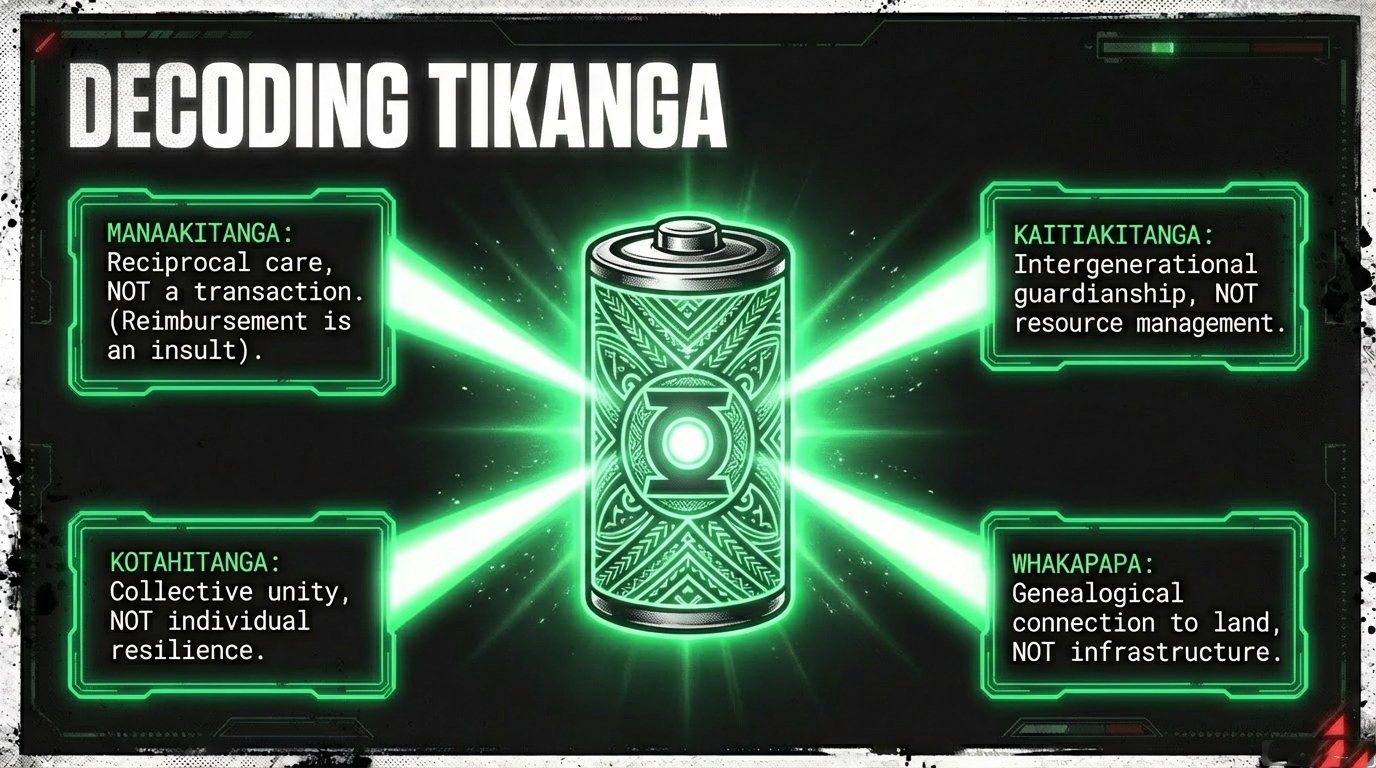
- Manaakitanga means reciprocal care, hospitality that creates and maintains relationships. When marae provide shelter, food, and support during disasters, they are not merely offering “services”—they are enacting a sacred obligation to care for all people within their rohe (territory), regardless of ethnicity or affiliation. To “reimburse” manaakitanga with a one-time payment of $1 million spread across 20+ marae treats a spiritual and communal obligation as a transactional service delivery. It is the equivalent of sending your mother an invoice for the meals she cooked.
- Kaitiakitanga translates roughly as guardianship, but encompasses intergenerational responsibility for the health of land, water, ecosystems, and communities across time. The government’s response—reactive, short-term, focused on “getting back to normal”—fundamentally misunderstands that kaitiakitanga demands transformation, not restoration. Tai Rāwhiti’s land use must change; 55 million tonnes of annual topsoil loss cannot be “managed.” Yet when the Transition Advisory Group requested $359 million to transition 100,000 hectares from pine forestry to permanent native cover—noting that “for every $1 spent, we save $4 on recovery”—the government’s response was that such expectations were “unrealistic”.
- Kotahitanga—unity, collective action—recognizes that survival depends on the strength of communal bonds, not individual resilience. Western neoliberal ideology, by contrast, responsibilizes individuals for structural failures. When disaster strikes, governments frame citizens as “crisis-ready responsible selves” who should have prepared better, insured more, chosen safer locations. The victim becomes the author of their own suffering. Kotahitanga rejects this atomization, demanding that the collective respond to collective threats. Luxon’s helicopter arrival—a leader descending briefly to survey damage before departing—embodies the opposite: authority without presence, visibility without solidarity.
- Whakapapa refers to genealogical connections, but extends far beyond bloodlines to encompass relationships between people, land, ancestors, and future generations. Every landslide that buries a marae, every flood that scours a riverbed, every family separated by impassable roads—these sever whakapapa connections that Western frameworks categorize merely as “infrastructure damage” or “displacement.” When Tash Wanoa says “our lives are never going to be the same,” she is not being dramatic. She is describing the rupture of relationships that constitute identity itself.
- Utu—balance, reciprocity—demands that giving be met with receiving, that harm be addressed, that debts be repaid not in monetary terms but in maintaining equilibrium within social and ecological systems. Marae give and give and give—labor, resources, emotional support, spiritual sustenance—while the government offers a fractional reimbursement months later and praises their “exceptionalism.” This is not utu. This is exploitation wrapped in compliments.
The government’s failure is not merely logistical or financial. It is ontological. It emerges from a worldview that cannot conceive of obligations that transcend market transactions, of knowledge systems that exceed Western science, of resilience that arises from strengthening communities rather than fortifying individuals.
Act Six: The Structural Rot
Luxon’s KFC delivery is theater, but theater serves power. Performative leadership during disasters—the photo opportunity, the high-visibility visit, the empathetic sound bite—allows governments to appear responsive while avoiding substantive policy change.
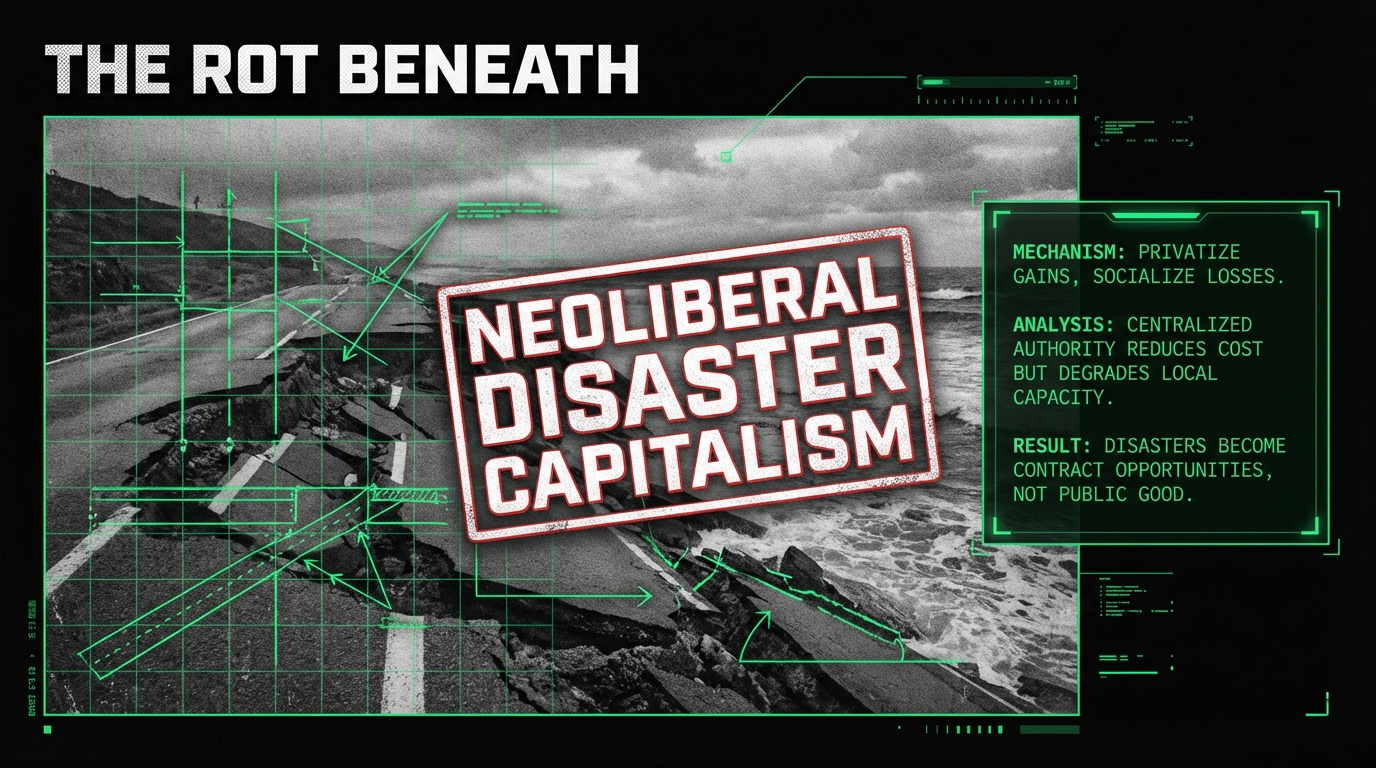
The pattern is global. After Hurricane Katrina, President George W. Bush’s aerial survey from Air Force One—gazing down at flooded New Orleans without landing—became “among the most damaging photographs” of his presidency. But the real disaster was not the optics; it was the systematic defunding of levees, the failure to evacuate the poor, and the post-hurricane privatization of New Orleans’ public school system—what Naomi Klein famously termed “disaster capitalism”.
After Cyclone Gabrielle, investigations found that the Hawke’s Bay region’s transition to a “centralised and regionalised emergency management model” had created systemic vulnerabilities: “de-emphasis of local-level response capacity in favour of regional integration” meant that when disaster struck, coordination collapsed.
This is not incompetence. This is neoliberalism functioning exactly as designed. Centralize authority to reduce costs. Marketize public services to generate efficiencies. Responsibilize citizens to prepare for disasters that the state will not prevent. And when the inevitable catastrophe arrives, when the hollowed-out emergency management system buckles, when people die waiting for help that never comes—send a Prime Minister with fried chicken and promise an inquiry that will find “lessons learned” without threatening the fundamentals.
Joseph Stiglitz, Nobel laureate in economics, diagnosed this dynamic precisely: “Forty years of the denigration of government has left the government much less prepared to deal with a crisis such as this pandemic... there’s been a concerted effort on the right to disempower the government. We’ve seen the consequences of that.”
The consequences in Te Araroa: volunteers on quad bikes doing the state’s job. Marae bankrupting themselves to feed evacuees. Families separated for weeks while the Prime Minister—who is, let us remember, personally “wealthy” and “sorted”—helicopters in with comfort food.
Act Seven: What Is to Be Done
The solutions exist. They are documented, proven, and ignored.
1. Fund Marae as Permanent Emergency Infrastructure
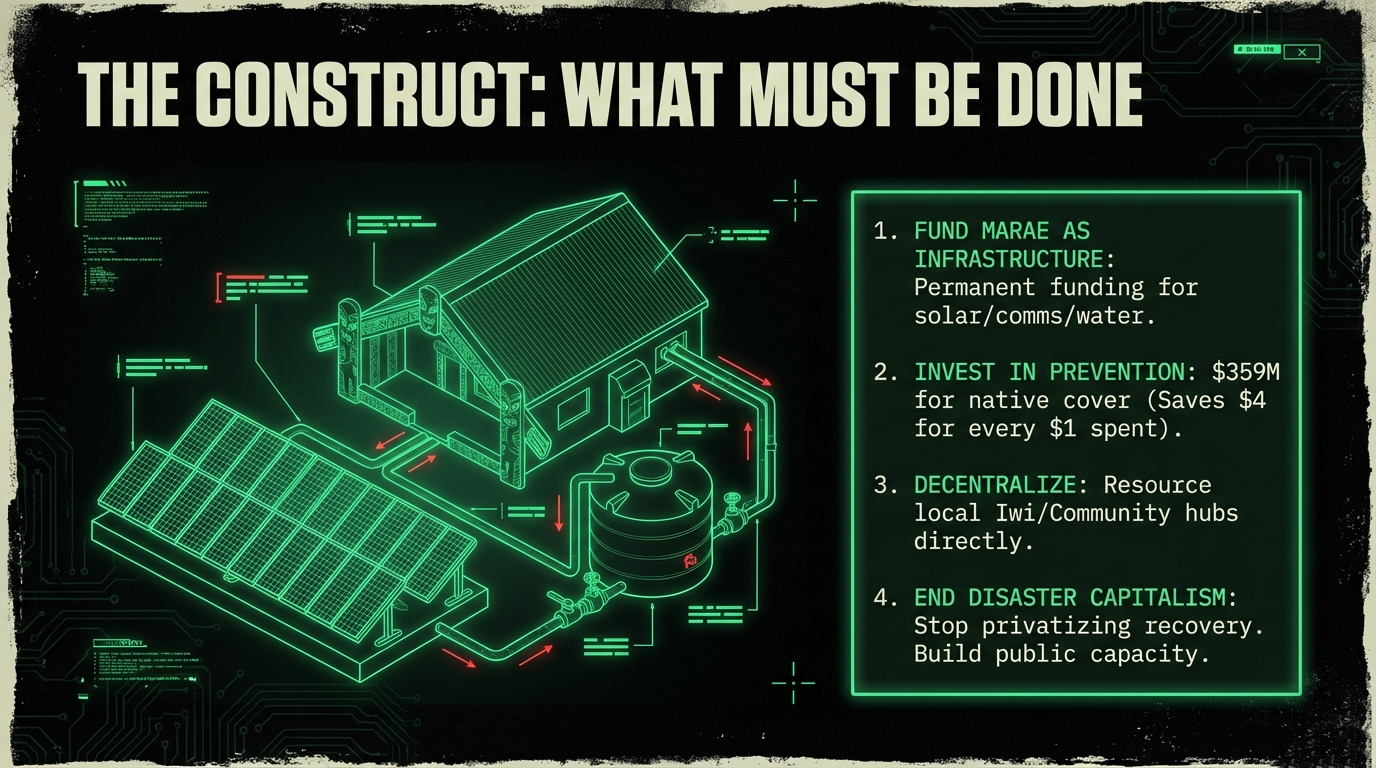
Research across disaster contexts—Canterbury earthquakes, Cyclone Gabrielle, COVID-19—demonstrates that marae-led response is faster, more effective, and more culturally appropriate than centralized government models. Stop “reimbursing” marae after disasters. Fund them proactively: solar power, water systems, emergency supplies, communication technology. The government’s own Emergency Management Bill proposes “formally codifying” marae as having “a seat at the table”—a seat they have earned through decades of unpaid labor. Give them a funded, permanent role with genuine decision-making authority.
2. Invest in Prevention, Not Just Response
The Tai Rāwhiti Transition Advisory Group’s $359 million proposal to convert 100,000 hectares of erosion-prone land to permanent native cover would save $4 for every $1 spent over 30 years, preventing more than $1 billion in future damages. This is not charity. This is fiscal sanity. Yet the government called it “unrealistic” while preparing to spend billions responding to predictable disasters. Preventative infrastructure investment is cheaper than perpetual crisis management—unless your goal is to maintain a state of permanent emergency that justifies austerity.
3. Decentralize Emergency Management
The post-Gabrielle review found that centralizing emergency management degraded local capacity and coordination. Community-centered disaster recovery, while “widely recognised as ‘the gold standard,’” is “rarely applied well enough in practice” because command-and-control agencies resist ceding authority. The solution: resource local communities—especially iwi and marae—with funding, decision-making power, and direct lines to central coordination, rather than forcing all requests through bureaucratic hierarchies.
4. Recognize and Fund Indigenous Knowledge Systems
Indigenous climate adaptation strategies—from Aboriginal Australians’ cultural burning to Maya milpa agriculture to Māori kaitiakitanga—are proven effective at building resilience. The National Geographic-funded Preserving Legacies programme selected Tūranganui-a-Kiwa (Gisborne) and Tāhuna-Glenorchy as two global sites for climate adaptation precisely because Rongowhakaata’s leadership “affirms the vital role of indigenous leadership in shaping multigenerational solutions.” Yet the New Zealand government, as Rongowhakaata noted, is providing this recognition “at a time when government support for climate leadership and Treaty obligations is declining”.
5. End Disaster Capitalism
neoliberal disaster response creates new markets (carbon offsets, private security, reconstruction contracts) while failing the affected. Stop treating disasters as opportunities for privatization. Fund public infrastructure. Employ public workers. Build public capacity. When the next storm comes—and it will, because this is no longer a once-in-a-century event but an annual occurrence—the response should not depend on volunteers with quad bikes and marae bankrupting themselves.
Coda: The Bucket, Empty
On January 29, 2026, Prime Minister Christopher Luxon stood in Te Araroa, the helicopter idling, the cameras rolling, the buckets of Kentucky Fried Chicken distributed to grateful workers. The performance complete, he departed.
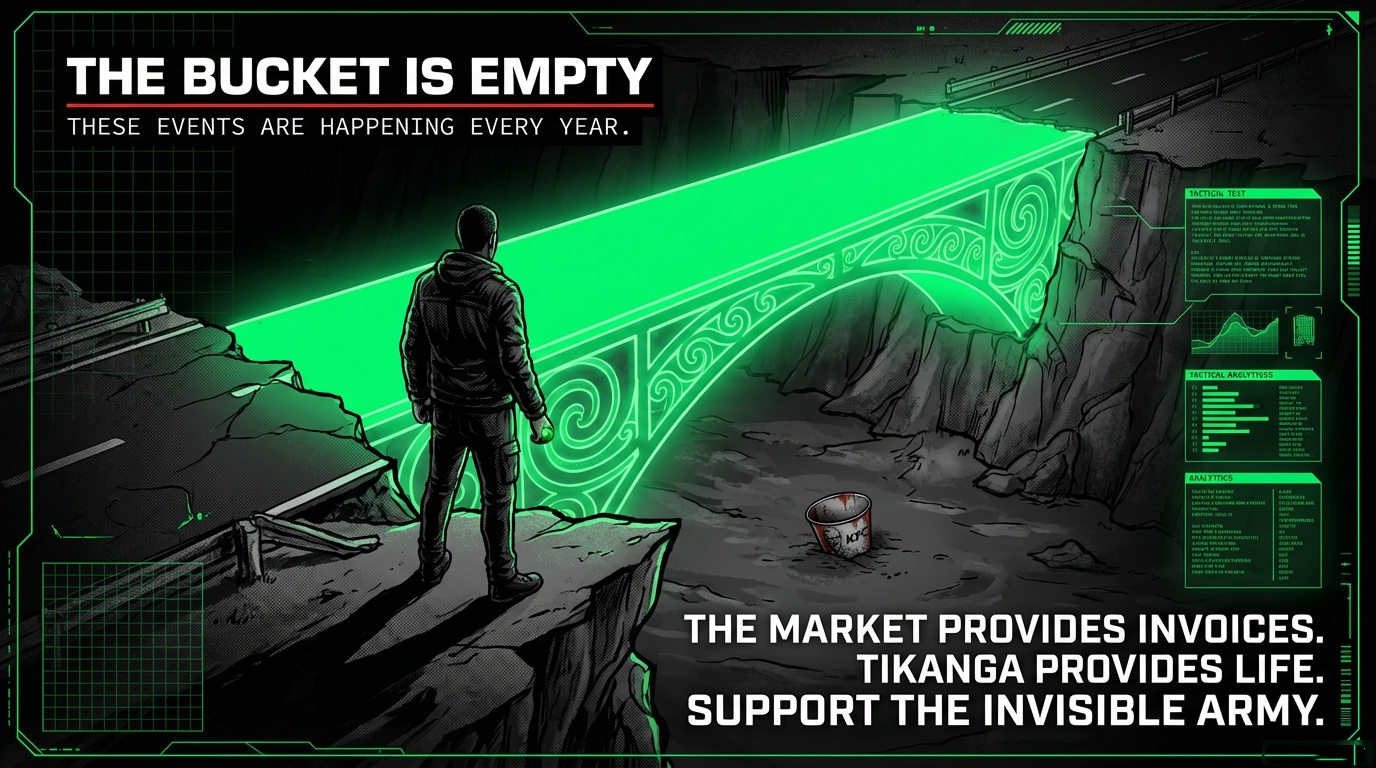
Behind him:
open gash wounds on the mountains. Thirty families still isolated. Marae kitchen crews working to exhaustion. Five hundred thousand cubic metres of soil with five to six months of work ahead. A $2.2 million relief package divided among five devastated regions. Six bodies still being excavated millimeter by millimeter from beneath a mountain that authorities were warned about hours before it killed them.
This is not a failure of leadership. This is the leadership—leadership as theater, as optics, as performance divorced from substance. Leadership that arrives, is photographed, and departs, leaving communities to save themselves with resources they don’t have and support the government won’t provide.
Forty years of neoliberalism has taught us that the market will provide, that individuals must be resilient, that government is the problem, not the solution. And when the storms come—and they come every year now, because climate chaos respects no ideology—we discover the market provides nothing but invoices, resilience means dying quietly, and the problem was not too much government but governments deliberately weakened to serve capital rather than citizens.
Rawiri Waititi’s words should be carved into every government building in Aotearoa:
“We’re the first to respond, but we’re the last to be given any type of resources. This is not an unprecedented issue anymore. These events are happening every year.”
Every year, the storms come.
Every year, communities save themselves.
Every year, the Prime Minister arrives with his helicopter and his fried chicken and his empty promises.
And every year, we pretend this is leadership.
The bucket is empty. It was always empty. It held nothing but grease and performance, substance and solidarity long since consumed.
The ship burns. The captain poses. And six months from now, when the roads are finally reconnected and the lives that will never be the same have reorganized around their permanent rupture, we will do this again.
Unless we choose otherwise.

Ivor Jones The Māori Green Lantern Fighting Misinformation And Disinformation From The Far Right