"When the Crown Shoots Its Own: The Betrayal of Tā Wira Gardiner" - 4 November 2025
Veterans Affairs rejected Tā Wira Gardiner seven times over four years while he died from Agent Orange. The High Court twice found the agency "prioritized cost over care."
Kia ora whānau. E ngā mana, e ngā reo, e ngā karangatanga maha o te motu, tēnā koutou katoa.
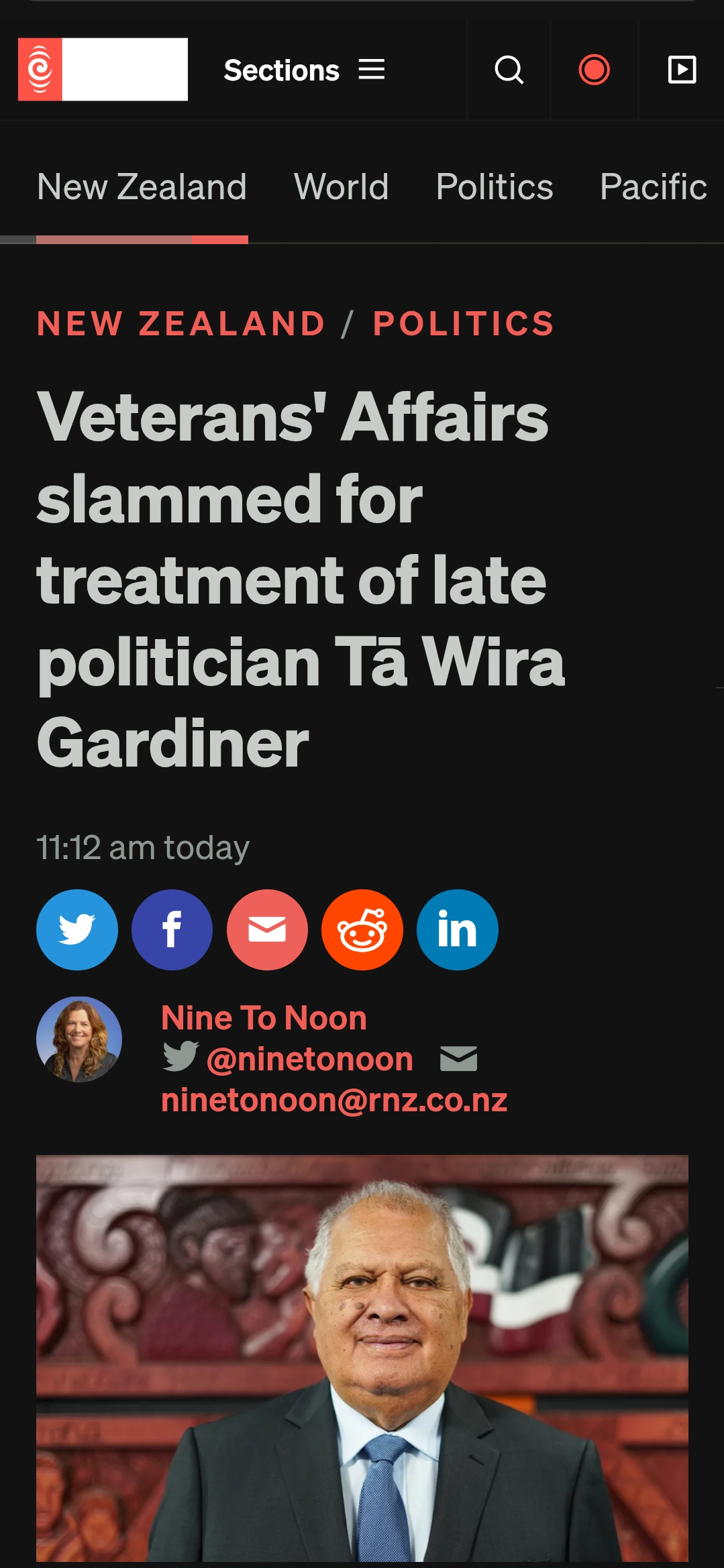
https://www.rnz.co.nz/news/national/577741/veterans-affairs-slammed-for-treatment-of-late-politician-ta-wira-gardiner
The smoking gun sits in plain sight: New Zealand’s coalition government spent $12 billion arming the Defence Force while allocating just $4 million over four years to Veterans Affairs - a 3,000 to 1 ratio that exposes “support our troops” rhetoric as nakedly hollow. But the real scandal runs deeper than budget lines. High Court judgments in August 2025 found Veterans Affairs “appears to be prioritizing cost over care” after the agency rejected Lieutenant Colonel Tā Wira Gardiner’s Agent Orange claim seven times over four years while he died from glioblastoma - institutional bullying disguised as bureaucratic process. This wasn’t about getting the law right. This was about avoiding a $3.2 billion liability.[1][2][3][4]
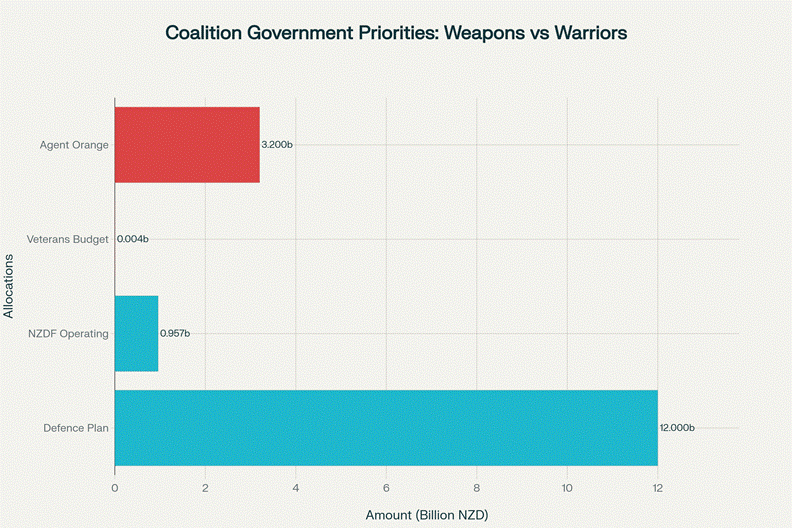
The coalition government allocated $12 billion for Defence capability while Veterans Affairs received just $4 million over four years - a 3,000:1 ratio that exposes the “support our troops” rhetoric as hollow.
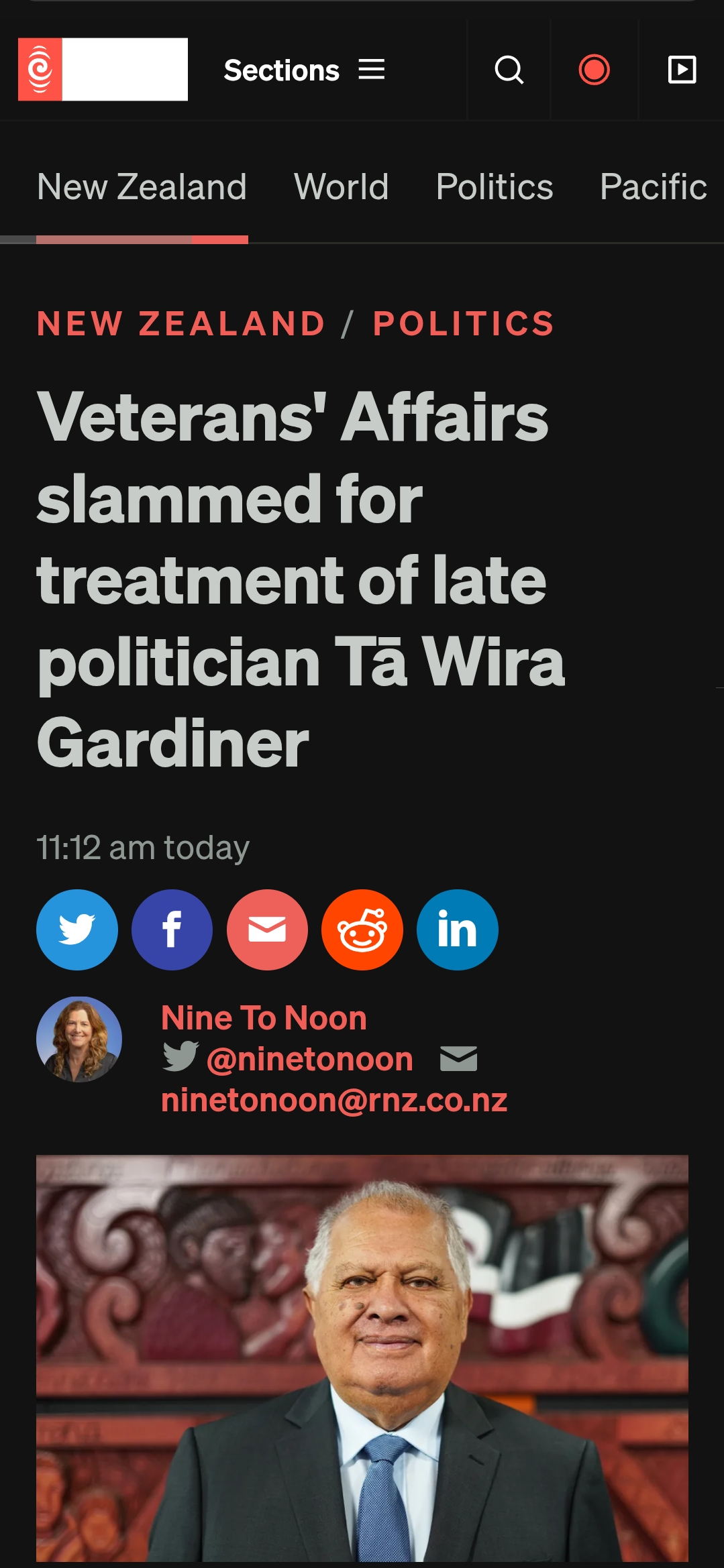
Tā Wira Gardiner - of Ngāti Awa, Ngāti Pikiao, Te Whānau-ā-Apanui and Te Whakatōhea descent - wasn’t just any veteran. He served as a Platoon Commander in Vietnam in 1970, exposed to Agent Orange, then became the first director of the Waitangi Tribunal, founding chief executive of Te Puni Kōkiri, and one of Aotearoa’s most senior public servants. His widow, former National Cabinet Minister Hekia Parata, called Veterans Affairs’ conduct “bullying rather than trying to clarify” their decision. When even a former National education minister condemns her own party’s agency for tormenting a dying rangatira, you know something is rotten.[5][3][6][7]
Background: The Whakapapa of Betrayal
The Veterans’ Support Act 2014 requires a “benevolent approach” to claims. In September 2021, Tā Wira filed his claim. Veterans Affairs rejected it. He appealed. They rejected again. He went to the Veterans’ Entitlements Appeal Board. VA appealed the Board’s decision. The High Court in July 2023 ordered reconsideration. VA kept appealing. In October 2024, the Board finally accepted Tā Wira’s glioblastoma as service-related. VA appealed again. Tā Wira died in March 2022 - still fighting while the agency legally harassed his whānau.[5][8][9][10][11]
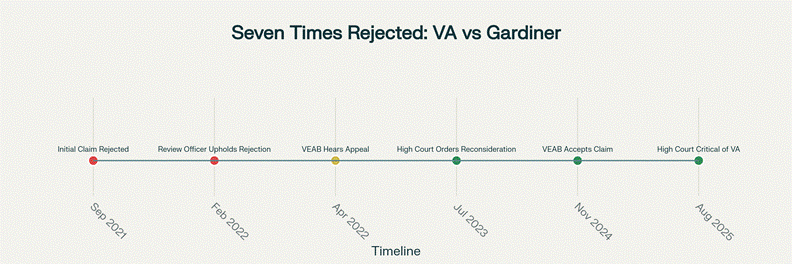
Veterans Affairs rejected Tā Wira Gardiner’s Agent Orange claim seven times over four years, with courts twice finding VA prioritized cost over care - institutional bullying of a dying war hero.
The precedent existed. William “Pancho” Kenyon’s glioblastoma was accepted as Agent Orange-related years earlier under the War Pensions Act 1954. Tā Wira’s case manager was notified of the Kenyon decision in September 2021 but never brought it to appropriate attention. Why? Because accepting the claim meant opening the gates for thousands more veterans to access support. US research shows glioblastoma has at least a 50/50 probability of Agent Orange causation. Recent Brown University studies demonstrate Agent Orange damages brain tissue in ways similar to Alzheimer’s disease. The science was there. The precedent was there. The law required benevolence.[12][13][14][15][16]
But the Auditor-General identified this as the largest single instance of unappropriated expenditure ever recorded - $3.2 billion. That’s the real reason Veterans Affairs fought so hard.[2][17]
Neoliberal Cost-Cutting Dressed as Due Process
Let’s name what this is: liability management dressed as legal process. Acting head Alex Brunt claimed “benevolence is fundamental” to how VA operates. Yet the High Court found the opposite - that VA’s interpretation appeared “the very opposite of benevolence and instead appears to be about resources”.[18][3][19]
This follows a pattern. Veterans Minister Chris Penk - who served in the Royal New Zealand Navy but doesn’t qualify as a veteran under our restrictive law - oversees an agency that in Budget 2024 received just $4 million over four years. Budget 2025 added a mere $1 million in short-term, non-annual funding. Meanwhile, the Defence Capability Plan received $12 billion over four years, including $2 billion for maritime helicopters alone.[20][21][22][23][4]
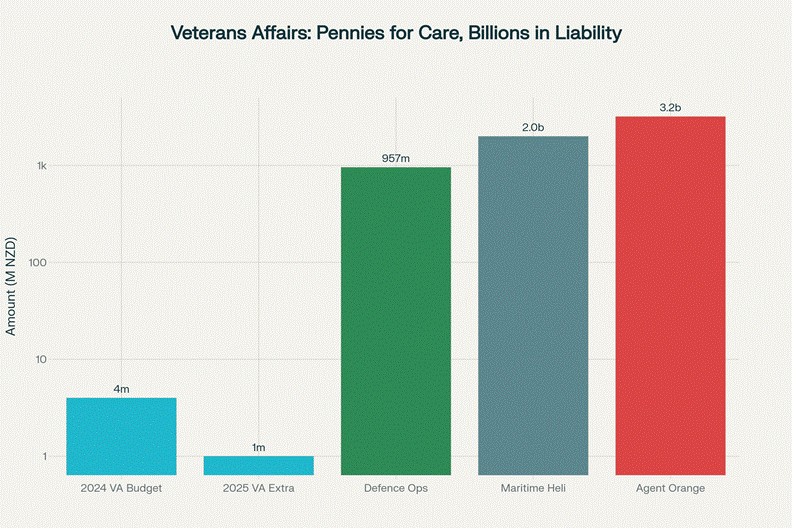
Veterans Affairs received just $4 million over four years in Budget 2024 while facing a $3.2 billion liability from the Agent Orange case - revealing the government’s funding priorities.
Rhetorical techniques deployed:
False Compassion Framing: “We are always conscious of our responsibilities to veterans” while fighting them in court seven times.[3]
Legal Necessity Defense: Penk claimed it was “appropriate to seek a judicial view” - except you don’t need seven appeals to get clarity.[3]
Future Benefits Argument: “Achieving a clear and consistent understanding of the law is in the long-term interests of all veterans” - while the veteran died waiting.[3]
Process Legitimation: Hiding behind “proper legal processes” when the High Court twice found VA’s interpretation wrong.
This is neoliberal austerity in action - the same ideology Ruth Richardson’s “Mother of All Budgets” weaponized in 1991, slashing welfare while demanding “personal responsibility.” Richardson later joined ACT, the party now in coalition with National, whose Regulatory Standards Bill - designed by the Business Roundtable - prioritizes private property over collective good.[24][25][26][27][28]
Follow the Money, Name the Names
Who Benefits:
Prime Minister Christopher Luxon, former Air New Zealand CEO with a reputation for “foot-on-the-throat attention to the bottom line”, leads a coalition with ACT Party leader David Seymour - whose Regulatory Standards Bill emerged from Business Roundtable ideology. Defence Minister Judith Collins, who led National to its worst defeat in 2020, now controls the longest ministerial portfolio list and secured $12 billion for Defence.[4][29][30][31][32][28][33]
Who’s Harmed:
Veterans Affairs has a backlog of 2,305 claims down from 2,807 - with average wait times of about a year. No Duff Charitable Trust, founded by veteran Aaron Wood after finding a suicidal veteran living rough in an Auckland park, reports four veteran suicides in February-March 2025 alone. Less than 10 percent of contemporary veterans engage with VA support services - “the lowest rate in the Western world.”[34][19][35][36][37]
Thousands of veterans denied support under restrictive definitions while waiting lists grow. The Veterans Independence Programme was suspended due to backlogs before partial reopening for those over 80 or terminally ill. Veterans who deployed to Afghanistan and other modern conflicts find themselves fighting ACC instead of VA for PTSD support because the law excludes them.[38][39][35][40]
Network Revelations:
1. Bernadine Mackenzie led Veterans Affairs from 2016-2024 through the worst of the Gardiner fight before Alexander Brunt took over as acting head. Brunt previously worked at the Social Investment Agency - an agency known for cost-benefit analysis of social spending.[41][42][43]
2. The coalition government cut over 7,500 public sector jobs while Defence receives record funding, continuing National’s 1991 pattern of austerity for social services, largesse for security.[44][26][4]
3. ACT’s Regulatory Standards Bill - first drafted by Business Roundtable in 2001 - creates a board appointed by Seymour to judge legislation against “principles” prioritizing private property and economic efficiency. This is the same neoliberal project Roger Douglas launched in 1984.[45][28]
4. No Duff wrote to all MPs in October 2025 seeking assurances they’d vote against legislative amendments restricting veterans’ rights after Penk said the government was “carefully considering its response” to the court ruling.[3][19]
5. The $3.2 billion liability appeared in fiscal forecasts but no appropriation was made - signaling the government hoped to legislate its way out rather than pay up.[17]
Tikanga Violations:
Whanaungatanga (relationships): Parata described VA’s conduct as abandoning veterans who “have been put in harm’s way by their government.” The relationship between Crown and warrior is sacred. VA severed it.[3]
Manaakitanga (care): The High Court found VA prioritized cost over care. This isn’t manaakitanga - it’s calculated neglect.[3]
Kaitiakitanga (guardianship): VA should guard veterans’ wellbeing. Instead, they guarded Treasury coffers.[3]
Rangatiratanga (self-determination): Tā Wira fought for four years while dying. He couldn’t determine his own fate because the state held him hostage to appeals.[5]
Aroha (compassion): There was none. Seven rejections over four years to a dying rangatira is institutional cruelty.[1]
Hidden Connections: The Neoliberal Pipeline
This isn’t incompetence - it’s ideology. The coalition agreement between National and ACT commits to passing the Regulatory Standards Act, establishing a Ministry for Regulation, and implementing cuts to “back-office” spending. Finance Minister Nicola Willis demanded 6.5-7.5 percent savings targets from departments that grew more than 50 percent since 2017.[46][47][48][44]
Veterans Affairs is simply collateral damage in a broader war against the public sector. The government announced 240 savings initiatives in Budget 2024 to fund tax cuts weighted toward property investors. Meanwhile, Defence gets $4.2 billion this year alone as New Zealand aims for 2 percent of GDP defense spending by 2032/33 - last achieved in the early 1990s under Bolger’s National government.[4][49][50][25][51]
The historical parallel is exact: Richardson’s 1991 budget slashed welfare, doubled child poverty, and left unemployment at 11 percent. Now we’re seeing “Ruthanasia 2.0” with neoliberalism deeply entrenched across both major parties.[24][52][53][26]
Implications: Quantified Harm and Threatened Rights
Quantified Impact:
- $3.2 billion in unfunded liability the government tried to avoid
- 2,305 veterans waiting for claims processing
- Average one-year wait for claim decisions
- 4 veteran suicides in two months
- Less than 10% veteran engagement with VA services
- $4 million total VA funding over four years vs $12 billion Defence spending
International Context:
In the United States, Agent Orange compensation was settled for $180 million in 1985, though veterans receive as little as $12,000 over 10 years. New Zealand established a 2006 Memorandum of Understanding for $40,000 ex-gratia payments for conditions on the “Prescribed Conditions List” linked to Agent Orange. But glioblastoma wasn’t on that list - which is why Tā Wira had to fight through the Veterans’ Support Act instead.[54][55]
Australia has long struggled with veteran support, with massive claims backlogs only recently addressed. New Zealand risks following that pattern - deliberately underfunding services while expanding military operations.[56][4][57]
Call to Action:
No Duff has floated a boycott of ANZAC Day services unless meaningful change occurs, with Wood stating: “Don’t stand in silence and pretend everything’s fine”. They’re exploring legal action against the government for failing its statutory duty of care.[58]
Specific targets:
- Veterans Minister Chris Penk: Demand immediate withdrawal of any legislative amendments restricting veterans’ rights. Fund VA properly or resign.
- Acting VA head Alex Brunt: Implement the High Court’s benevolent interpretation immediately. Apologize publicly to all veterans denied claims under cost-driven interpretations.
- Prime Minister Christopher Luxon: Allocate $3.2 billion to veterans’ support or admit “support our troops” is a lie.
- All MPs: Vote against any amendments to the Veterans’ Support Act that restrict access. No Duff has your contact information.
Hekia Parata said it clearly: “Veterans are entitled to expect that they will be looked after because they have been put in harm’s way by their government.” That’s the social contract. New Zealand has broken it.[3]
Tā Wira Gardiner’s case was “a final act of selfless service” according to the Veterans’ Entitlements Appeal Board - he fought to “vindicate the rights” of all Vietnam veterans. He won. Twice in the High Court. Three times at the Veterans’ Entitlements Appeal Board. Yet the government is “carefully considering” whether to override those victories with legislation.[59][3]
This isn’t about money. It’s about mana. It’s about whether we honor those who serve or sacrifice them twice - once in war, again in bureaucracy. As Aaron Wood said: “If you want to stand there on ANZAC Day with a few hundred thousand other New Zealanders and talk about remembering veterans... Then you’ve got to stand by what happens to those veterans when they come back.”[12]
The Crown shot its own. Now it must answer for it.
Mā te Atua tātou e manaaki. E te whānau, if this mahi has been of value and you have the capacity, please consider supporting this work through koha: HTDM 03-1546-0415173-000. Only give if you are able.
Kia kaha, kia māia, kia manawanui.
Beehive.govt.nz. (2024, December 2). Wait times for veterans improve.
Beehive.govt.nz. (2021, May 20). More Vietnam Veterans to receive compensation for Agent Orange Exposure.
Budget.govt.nz. (2025). Factsheet: Budget 2025 Defence Funding.
Controller and Auditor-General. (2025, May 12). Controller update: July to December 2024.
E-Tangata. (2025, February 7). Proposed bill ‘an ideological project that must be stopped’.
Greenpeace Aotearoa. (2025, June 23). Placing the current New Zealand Government into context.
Ministry for Culture & Heritage. (2022, March 17). Farewell Tā Wira Gardiner.
New Zealand Herald. (2025, October 23). Govt faces $3.2 billion bill as court slams Veterans’ Affairs for rejecting Agent Orange link to brain tumour.
New Zealand Herald. (2024, March 19). Service cuts to veterans but new Cabinet minister Chris Penk says it will help fix unacceptable wait times.
1News. (2024, June 6). Extra funding for veterans welcomed, but more needs to be done - RSA.
1News. (2025, May 4). Budget 2025: Over $2b for naval helicopters, extra $957m for Defence.
1News. (2023, November 23). National, ACT, NZ First coalition deal reached, awaiting sign-off.
Radio New Zealand. (2025, November 3). Former cabinet minister condemns veterans’ agency.
Radio New Zealand. (2025, November 3). Veterans’ Affairs slammed for treatment of late politician Tā Wira Gardiner.
Radio New Zealand. (2025, October 18). Government mulls law change after court rulings favour returned service people.
Radio New Zealand. (2025, April 16). Charity launches AI chatbot therapy service for veterans.
Radio New Zealand. (2025, April 6). Claim Agent Orange caused brain tumour adds $3.2b in unallocated govt spending.
Radio New Zealand. (2025, April 6). Government unveils $12 billion Defence Capability Plan.
Radio New Zealand. (2024, November 19). Vietnam war vets’ financial support claims boosted by new ruling.
Radio New Zealand. (2022, March 17). Sir Wira Gardiner remembered as ‘a tireless advocate for his people’.
Radio New Zealand. (2016, September 15). Questions raised over Defence Force suicides.
ScienceDaily. (2024, February 14). Exposure to Agent Orange damages brain tissue in ways similar to Alzheimer’s disease.
The Conversation. (2023, October 17). NZ election 2023: Labour out, National in - either way, neoliberalism wins again.
The Spinoff. (2025, April 23). Anzac Day boycott: why official services will be missing some veterans.
Veterans’ Affairs New Zealand. (2024, November 17). VEAB decision in the case of Tā Harawira Gardiner.
Veterans’ Affairs New Zealand. (2024, June 6). Budget 2024: Additional capacity and Discretionary VIP Services.
Veterans’ Affairs New Zealand. (2024). Appeal 2022-1 Final.
Veterans’ Affairs New Zealand. (2024). Appeal 2022-4.
Wikipedia. (2024, September 5). Mother of all Budgets.
Wikipedia. (2023, November 27). Sixth National Government of New Zealand.
Wikipedia. (2023, November 12). Ruth Richardson.
Wikipedia. (2008, April 14). Hekia Parata.
Wikipedia. (2001, November 15). Agent Orange.
1.