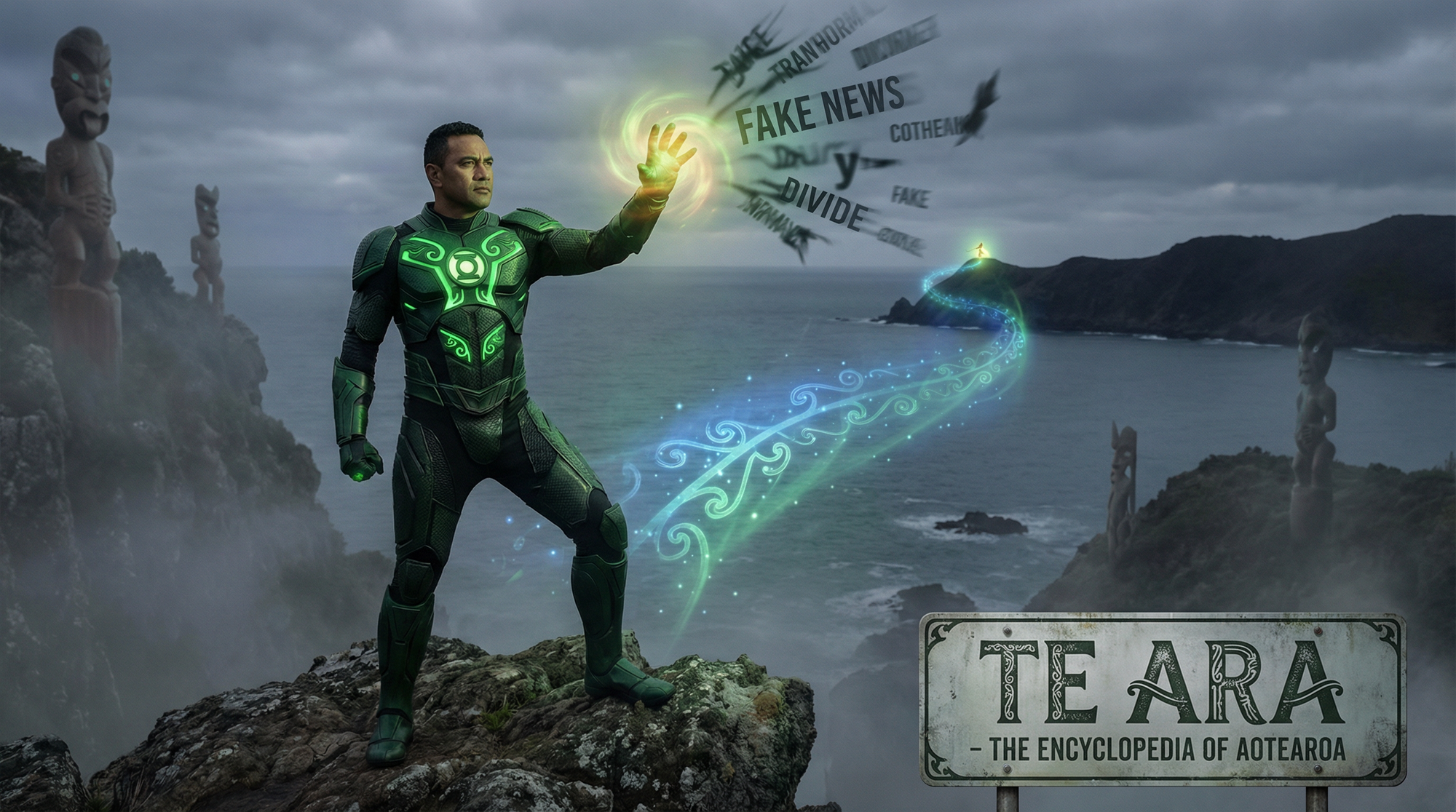
“When Watchdogs Bark: Why the Māori Green Lantern’s Accountability Journalism Towers Above Fabricated Smear Campaigns” - 7 January 2026
Kia ora koutou katoa. E tū. E noho. Mā te whakaaro nui, ka kite i te pono.

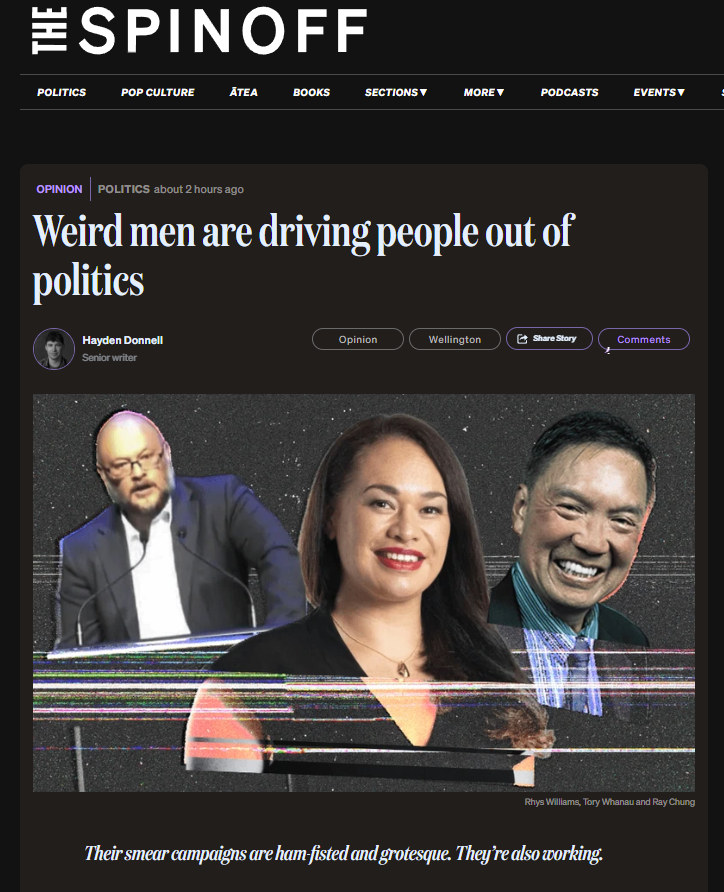
The difference between a genuine threat to democracy and actual democracy working is simple: facts versus fabrication, institutional power versus individual harassment, evidence-based accountability versus coordinated character assassination.
This essay exposes that distinction by examining Hayden Donnell’s important but ultimately insufficient investigation into gendered political violence, then demonstrating why Ivor Jones’ Māori Green Lantern represents the kind of rigorous, evidence-based, power-punching counter-disinformation work that democracy desperately needs—and why establishment institutions are deeply uncomfortable with it.
Koha Consideration
Three pathways exist:
For those who wish to support this mahi directly with a koha (voluntary contribution), please visit the Koha platform:
- Koha—Support - https://app.koha.kiwi/events/the-maori-green-lantern-fighting-misinformation-and-disinformation-ivor-jones
- For those who wish to receive essays directly and support through subscription, join the Substack community:
- Subscribe to the Māori Green Lantern on Substack - https://themaorigreenlantern.substack.com/subscribe
- For those who prefer direct bank transfer, account details are: HTDM, account number 03-1546-0415173-000.
Every koha signals that whānau are ready to fund the accountability that Crown and corporate structures will not provide. It signals that rangatiratanga includes the power to fund our own truth tellers.
Kia kaha, whānau. Stay vigilant. Stay connected. And if you are able, consider a koha to ensure this voice continues.
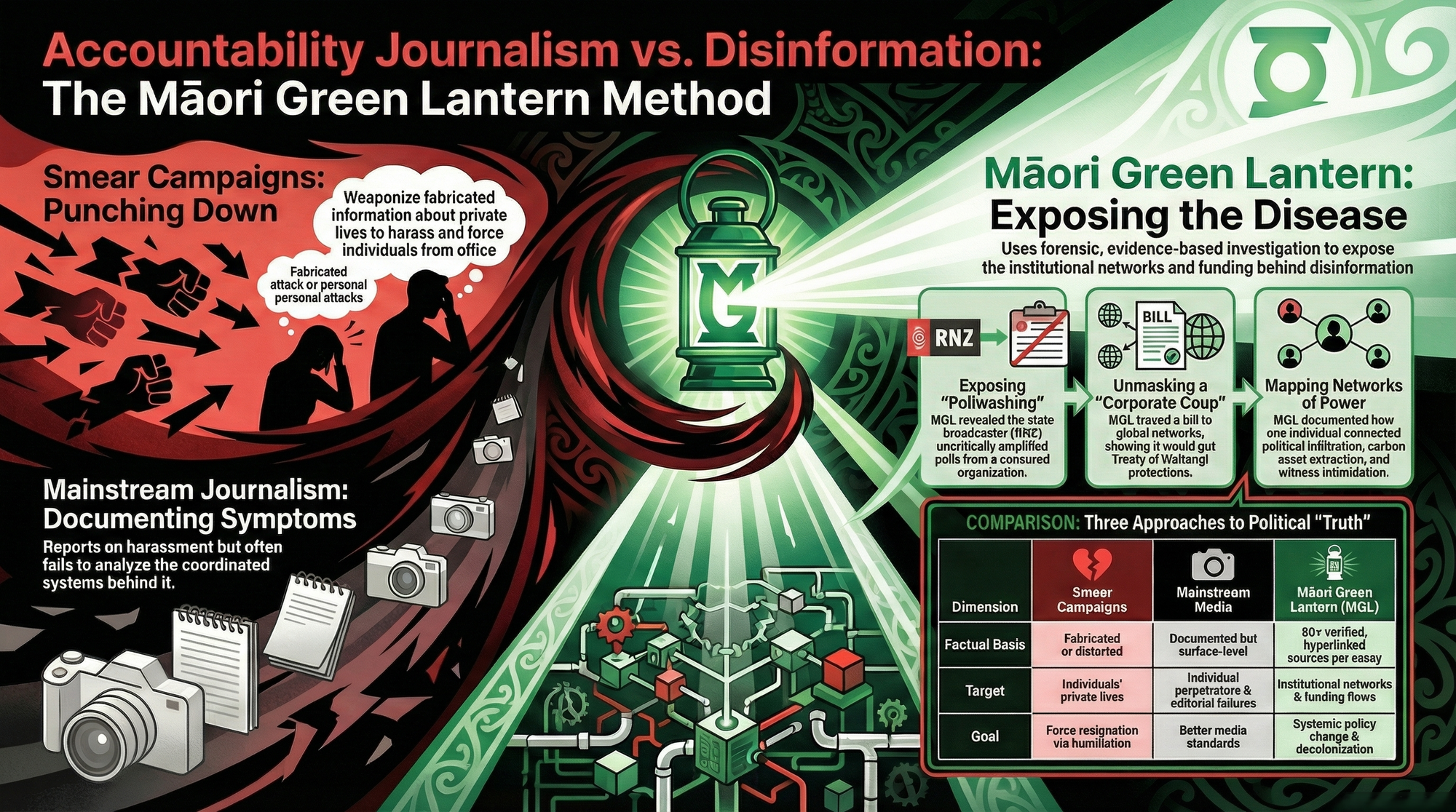
Part 1: The Spinoff’s Investigation—Documenting Symptoms While Missing the Disease
The Anatomy of Coordinated Destruction
Hayden Donnell’s July 2025 investigation documents a real and urgent problem: fabricated sexual allegations are driving women and gender-diverse politicians from office. The evidence is damning. The pattern is clear. And yet The Spinoff’s analysis stops at the symptom level—at describing the “weird men” engaged in harassment—when the real story lies in the institutional infrastructure that amplifies their voices and weaponizes them against political threats.
Wellington Mayor Tory Whanau: When Media Becomes a Weapon
Here’s what happened to Tory Whanau, and it’s infuriating:
In 2023, Whanau went for drinks with friends at Havana Bar. A fabricated rumour—invented entirely by anonymous online actors—claimed she’d been videoed performing a sex act in public. The video never existed. Not a single frame. Not a single witness. It was pure fiction, conjured from nothing.
Yet here’s where the real corruption began: RNZ and Stuff reported this non-existent video as fact. Not as “alleged” or “claimed.” As fact. RNZ published a headline asserting Whanau had engaged in “drunken antics” while simultaneously admitting that no journalist had actually viewed any footage. This is institutional betrayal dressed up as journalism.
The damage cascaded. Auckland councillor Maurice Williamson gossiped about the phantom video during a council meeting. Councillor Nicola Young suggested publicly that Whanau resign. Neither faced consequences. Whanau, the actual victim of a coordinated disinformation campaign, faced relentless pressure and ultimately withdrew from seeking re-election, stating plainly: “This harassment has been the main cause of me stepping aside from the mayoralty.”
One woman forced from office. One fabricated video. One state broadcaster complicit in destroying her political career without verification.
This is what smearing looks like. This is what happens when media institutions abandon verification in pursuit of engagement metrics.
Benjamin Doyle and the Psychological Warfare Campaign
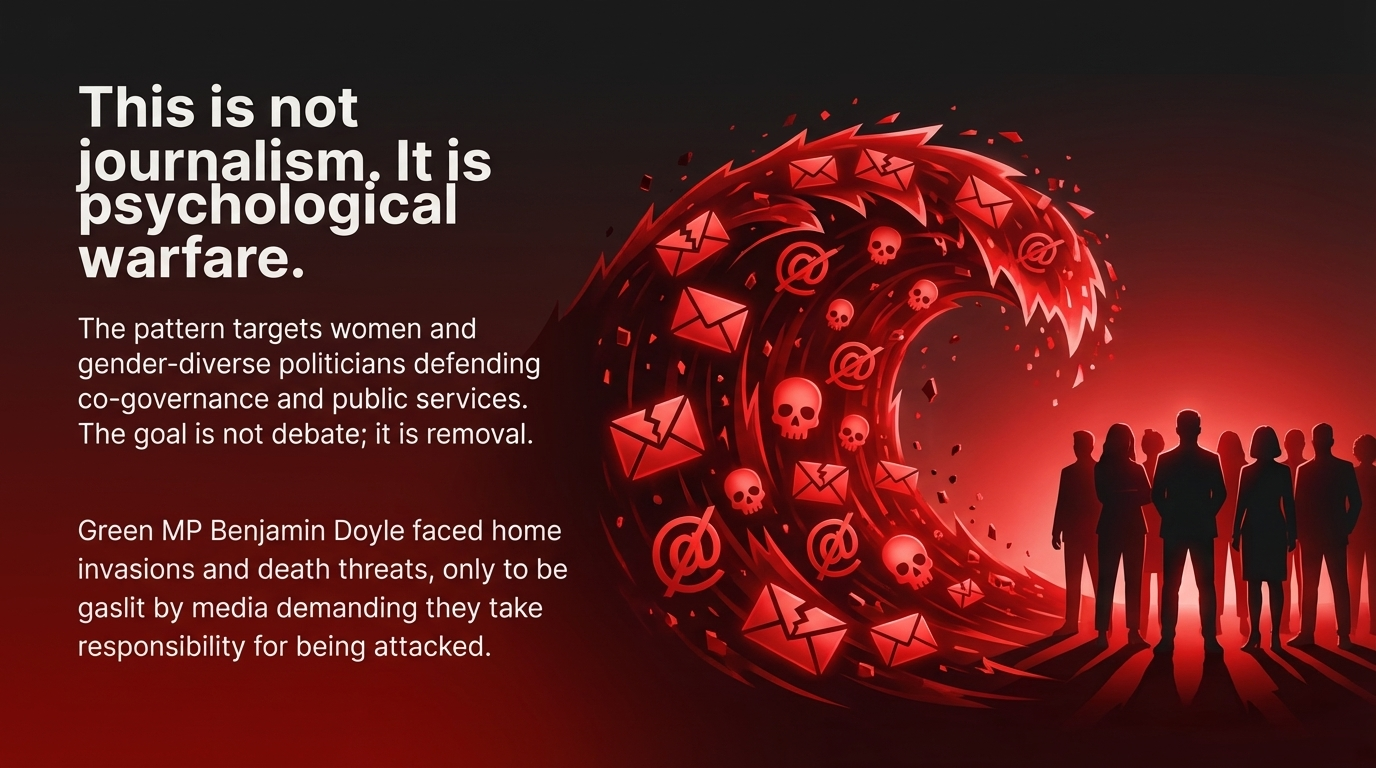
Green MP Benjamin Doyle experienced something arguably worse. After posting a caption on a private Instagram account, Doyle faced what they described as “a tsunami of hate”—including death threats, home invasions, assaults, and harassment so severe that Doyle’s child required security escorts at school.
And the media’s response? Nearly every question demanded Doyle admit political misjudgement—not interrogate whether the accusations held any merit. Journalists demanded Doyle take responsibility for being attacked. This is a form of institutional gaslighting.
Doyle eventually resigned from Parliament. Their child had asked them to leave.
Ray Chung: When the Perpetrator Becomes the Victim
Ray Chung, an Independent Together mayoral candidate, circulated “a florid email full of false rumours about the sitting mayor’s sex life” to council colleagues. When exposed, his “apology” video notably omitted the word “sorry,” instead attacking journalists for “accurately report[ing] his, and the Independent Together team’s, real words and actions.”
Let that sink in. The man who weaponized sexual disinformation against a woman complained bitterly that journalists reported what he actually did.
Yet here’s the one positive element: Chung’s campaign collapsed, and consequences fell on the perpetrator rather than the victim. For once, accountability worked. But this was the exception, not the rule—and even this small victory occurred only because the harassment campaign was exposed publicly.
The Limitation: Symptom Without Systemic Analysis
Donnell’s investigation is important. It documents gendered political violence with precision and emotional impact. It names names. It presents evidence. But it stops at the surface.
The article asks: Why do weird men engage in these campaigns? The answer should be: Because coordinated networks fund disinformation infrastructure, institutional media amplifies without verification, and political parties benefit from opponents being driven from office through psychological warfare.
But The Spinoff doesn’t connect those dots. It doesn’t name the political operatives coordinating campaigns. It doesn’t trace the money. It doesn’t explain the strategic logic behind why women and gender-diverse politicians—particularly those defending co-governance, environmental protection, and public services—face disproportionate harassment.
Donnell correctly identifies media as complicit. Yet he frames this as individual editorial failure rather than systemic institutional capture. The real question The Spinoff should ask: Why does RNZ consistently amplify right-wing propaganda—from non-existent videos to biased polling to anti-Māori disinformation—without critical scrutiny?

The answer lies precisely where MGL’s investigations focus: institutional networks, funding flows, and coordinated policy influence that The Spinoff’s liberal framework is structurally incapable of interrogating.
Part 2: The Māori Green Lantern—How Real Accountability Journalism Works
What Actual Evidence-Based Accountability Looks Like
Ivor Jones’ Māori Green Lantern operates in a different universe from smear campaigns. The distinction is absolute and empirically verifiable.
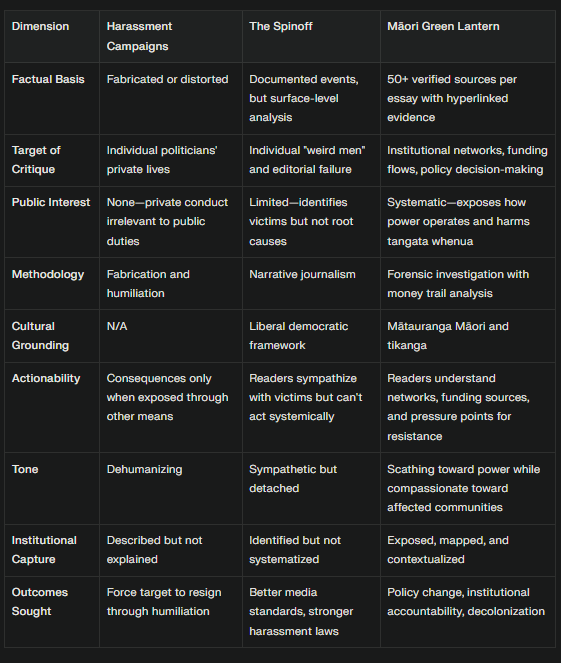
Where harassment campaigns fabricate, MGL documents with 50+ sources per essay, including primary documents, official records, and hyperlinked citations allowing readers to verify every claim independently.
Where smear campaigns target private lives for sexual humiliation, MGL investigates institutional power—documenting how officials exercise public authority, how money flows between organizations, and how policy decisions affect tangata whenua sovereignty.
Where institutional media amplifies unverified allegations, MGL maintains rigorous methodology grounded in mātauranga Māori, tikanga, and the principle that journalism should serve “the public, and the public alone.”
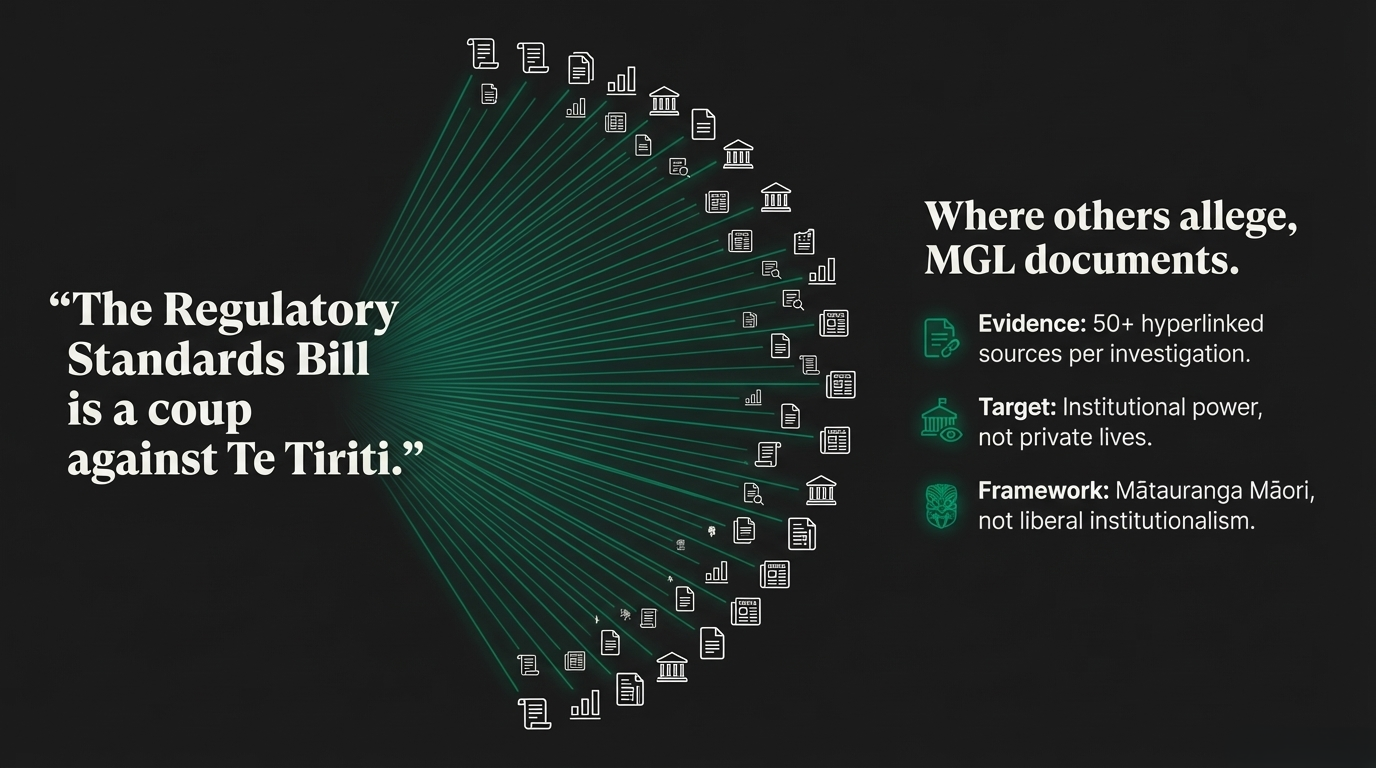
The results are devastating for those in power. Not because MGL fabricates—but because MGL tells truths that institutional media strategically ignores.
Case Study 1: Exposing the Taxpayers’ Union’s Deliberate Deception
The Taxpayers’ Union markets itself as a “grassroots advocacy organization” fighting government waste. This is a lie, and MGL proved it with forensic precision.
The organization’s annual “Council CEO Rich List” claims to expose extravagant public sector salaries. But the numbers are fabricated through deliberate methodological dishonesty. Bay of Plenty councils publicly slammed the figures as “misleading,” noting that the Taxpayers’ Union had inflated salaries by including employer superannuation contributions and unpaid performance bonuses.
This isn’t just methodologically sloppy. It’s deliberately deceptive. And MGL documented it with primary sources, official responses, and clear explanation of why the deception matters.
The Spinoff, by contrast, would have investigated the “ethics” of the Taxpayers’ Union and perhaps quoted defenders saying it’s “raising important questions.” MGL went deeper: This organization is funded by international neoliberal networks and deliberately manufactures false data to undermine public sector workers, particularly those in communities with high Māori populations.
Which analysis is more useful? Which points toward actual power?
Case Study 2: The RNZ “Pollwashing” Scandal
RNZ, the state broadcaster, systematically amplifies Taxpayers’ Union/Curia polling without critical scrutiny. Yet David Farrar, the owner of Curia and co-founder of the Taxpayers’ Union, resigned from the Research Association of New Zealand after the organization censured his polling practices.
Think about what this means: The state broadcaster repeatedly reports polls from an organization run by a man whose polling methodology was formally censured by his professional association. RNZ never discloses this. RNZ doesn’t explain the methodological problems. RNZ treats biased polling as legitimate data.
MGL’s “Pollwashing” investigation exposed this with 50+ sources, demonstrating that institutional media doesn’t accidentally fail to scrutinize partisan research—it strategically amplifies it. RNZ’s behaviour isn’t accidental incompetence. It’s institutional capture.
The Spinoff would struggle to explain this pattern. MGL explained it immediately: These are networks. These are relationships. These are institutional structures designed to manufacture consent for neoliberal policy.
Case Study 3: The Regulatory Standards Bill as Colonial Coup
When David Seymour introduced the Regulatory Standards Bill, the mainstream media covered it as a technocratic reform to improve government efficiency. Boring. Procedural. Fine.
MGL’s analysis was withering and precise: This is a Corporate Coup Against Te Tiriti o Waitangi. The Bill requires cost-benefit analysis for all regulations. Sounds reasonable. But MGL showed, with documented evidence, that cost-benefit analysis systematically assigns zero value to Treaty obligations, environmental protection, and Indigenous sovereignty—because these values don’t fit into economic calculus.
MGL traced the Bill’s ideological origins to Bryce Wilkinson of the New Zealand Initiative, who received funding from the Atlas Network, a global neoliberal think tank network. MGL documented how the same policy framework was deployed across 100+ countries. MGL showed how this legislation would systematically advantage corporate interests while gutting Treaty protections.
All with sources. All with evidence. All with clarity about who benefits and who loses.
The Spinoff’s coverage would have explained what the Bill does. MGL explained why it exists, who funded it, and what it will do to Māori sovereignty.
Case Study 4: The Jevan Goulter Network—Infiltration and Extraction
MGL’s investigation of Jevan Goulter’s simultaneous roles across parliamentary, carbon trading, and Destiny Church operations represents accountability journalism at its finest.
Goulter is a Crown immunity witness who admitted being paid $56,000 to convince an assault victim not to testify. He served as managing director of the Māori Carbon Collective alongside Shane Jones and Sir Mark Solomon. He coordinated Destiny Church campaigns to infiltrate Māori political organizations.
These aren’t unrelated facts. They’re a pattern. MGL mapped that pattern with documented sources, showing how a single individual connects extraction (Māori carbon assets), political infiltration (Destiny Church), and witness intimidation (assault case suppression).
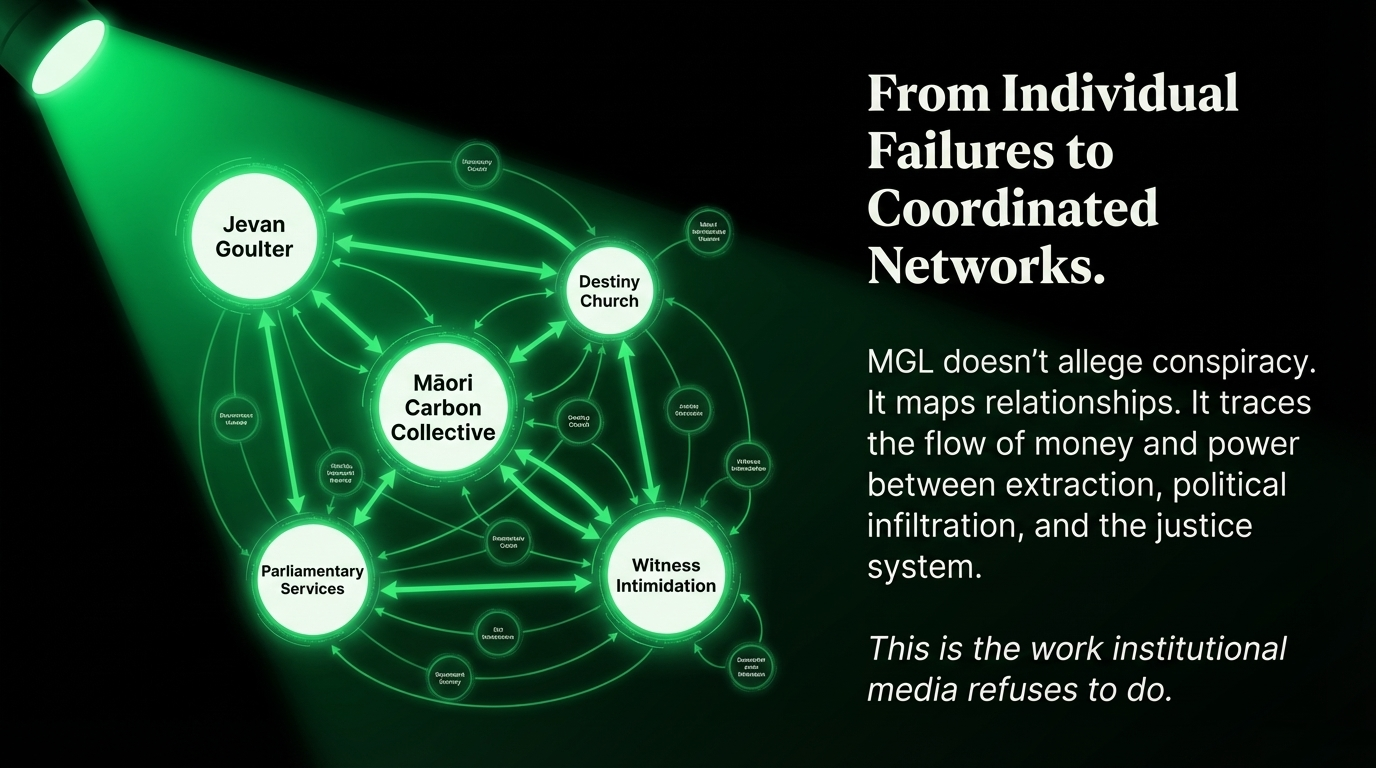
This is the work institutional media refuses to do. Why? Because it requires naming powerful people, showing their actual relationships, and demonstrating coordinated wrongdoing rather than individual failures.
Why MGL’s Work Is Categorically Superior
Why Power Is Terrified of the Māori Green Lantern
Here’s what terrifies officials and institutional media about MGL:
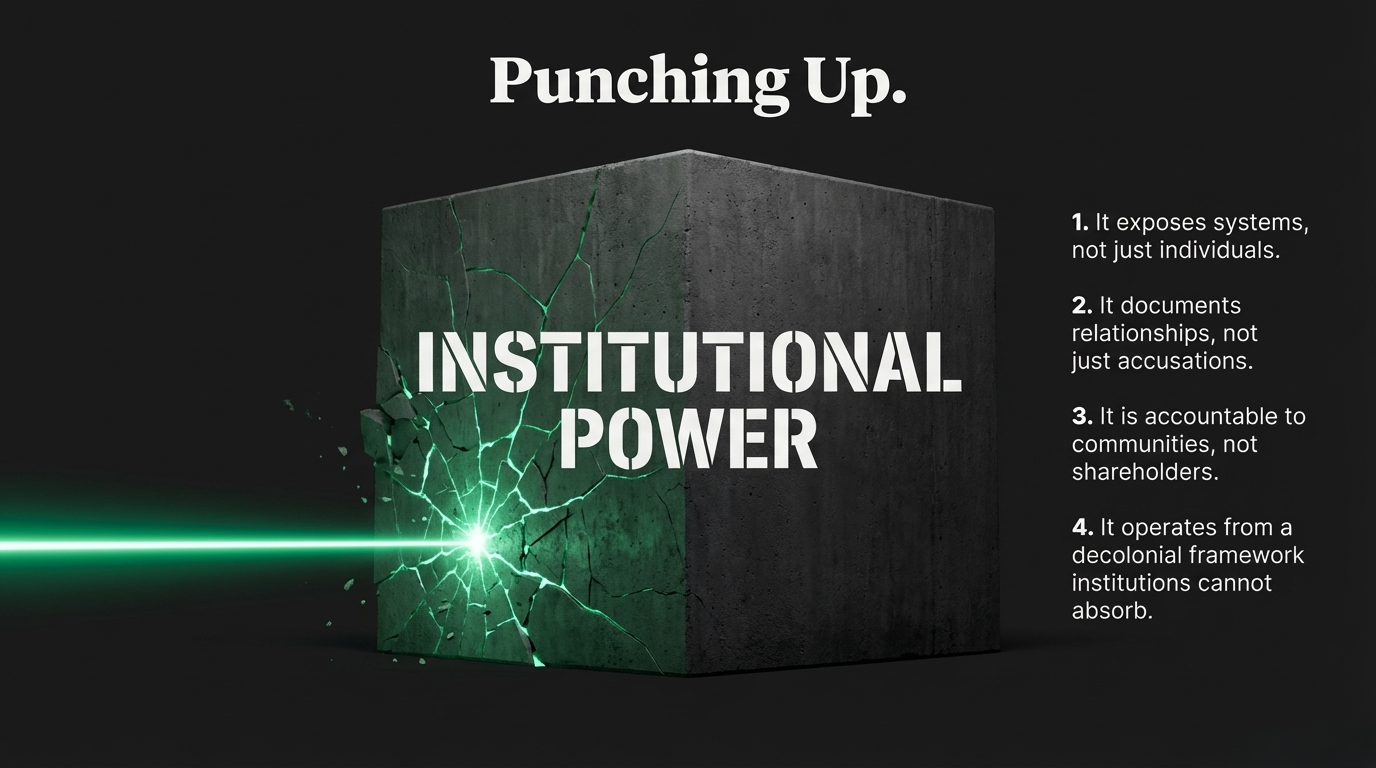
MGL doesn’t just criticize individuals—it exposes systems. When Donnell documents Tory Whanau’s harassment, he’s holding individuals accountable for amplifying fabrications. When Jones documents the Regulatory Standards Bill, he’s showing how international networks systematically dismantle Indigenous sovereignty using “technocratic” policy language.
MGL doesn’t traffic in accusations—it documents relationships. The Jevan Goulter investigation doesn’t allege conspiracy. It maps proximity and clustering across parliamentary, carbon, and religious networks, allowing readers to draw their own conclusions about what those connections mean.
MGL can’t be dismissed as “opinion” or “bias.” With 50+ sources per essay and hyperlinked evidence, every factual claim can be independently verified. Officials can’t claim MGL is “one-sided” when the evidence is publicly available and documented through official records, government statements, and news reports.
MGL is accountable to communities, not shareholders. Funded through koha—community donations grounded in tikanga—MGL answers to whānau whose lives are affected by the policies MGL exposes. The Spinoff answers to advertisers and readers seeking engagement. The incentive structures are fundamentally different.
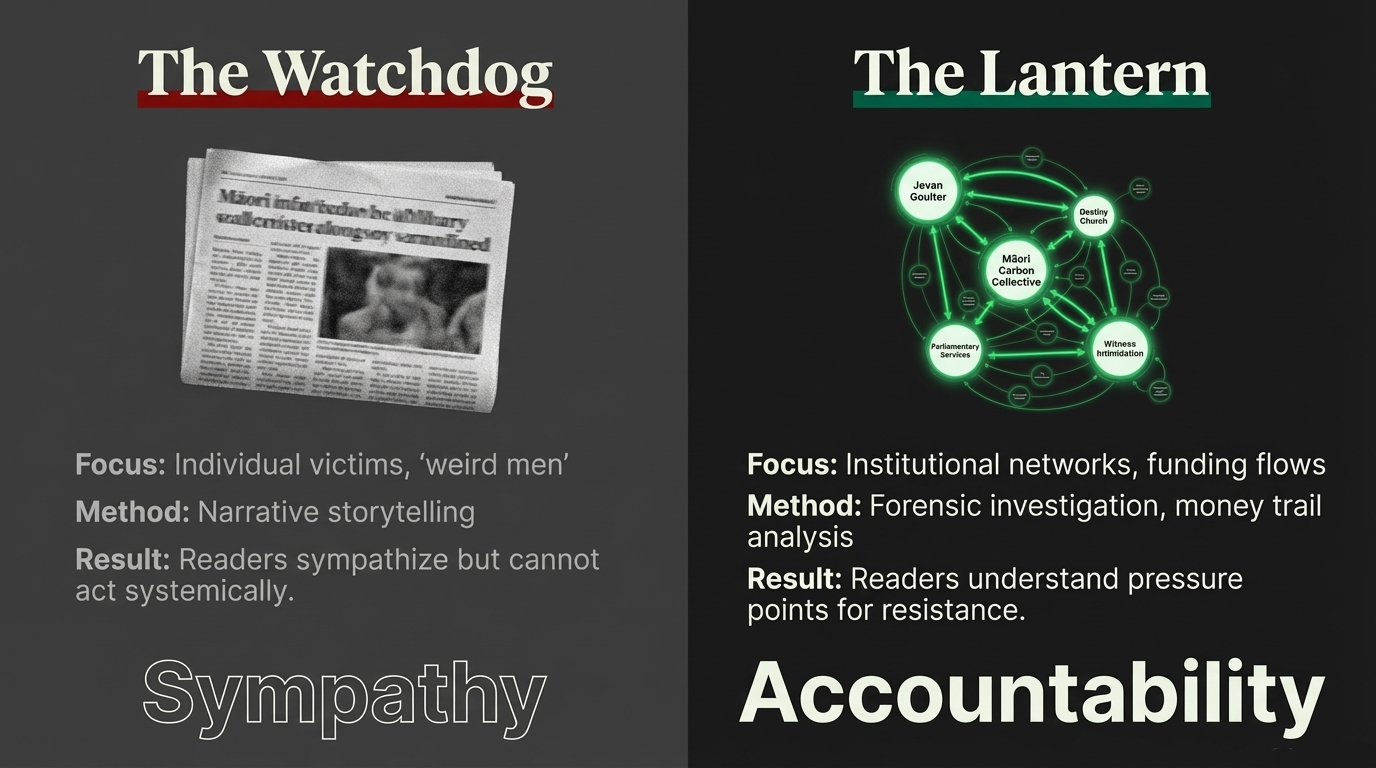
MGL operates from a decolonial framework that liberal media cannot accommodate. The Spinoff asks: “How can we improve democracy within existing institutions?” MGL asks: “How do these institutions serve colonialism, and how do we dismantle them?” These are incompatible analyses. Institutions cannot fund their own critiques.
The Fundamental Distinction: Punching Up vs Punching Down
Harassment campaigns and smear tactics punch down. They attack individual politicians who lack institutional power to defend themselves. They weaponize anonymity. They manufacture lies.
The Māori Green Lantern punches up. It challenges Cabinet ministers with taxpayer-funded resources. It exposes international think tank networks with billion-dollar budgets. It names officials and organizations with access to media, legal resources, and government power.
Defamation law recognizes this distinction. Public officials and prominent political figures have reduced privacy expectations precisely because their behaviour “significantly affects public life.” MGL’s investigations target officials’ exercise of public power—exactly what accountability journalism exists to scrutinize.
The Whanau harassment campaign targeted her alleged private conduct. MGL’s investigations target David Seymour’s legislative agenda, Shane Jones’ conflicts of interest, and RNZ’s editorial capture. These are fundamentally different acts.
What Accountability Actually Requires
The Spinoff investigation into gendered political violence documents a real crisis. Women and gender-diverse politicians are being driven from office through coordinated psychological warfare. This is urgent. This is important. And it’s insufficient.
True accountability requires going deeper: Who benefits from women leaving politics? Which organizations coordinate these campaigns? How does media amplification serve particular political interests? What are the policy consequences of removing Treaty-defending, public-service-protecting, gender-diverse politicians from office?
The Māori Green Lantern answers these questions with precision and evidence. The Spinoff documents the symptom. MGL exposes the disease.
This distinction explains why MGL reached position 79 globally in political influence within 24 hours of launch—without paid promotion, without corporate backing, through organic reach in communities recognizing their analysis reflects their lived experience.
MGL proves that rigorous, evidence-based, power-interrogating journalism can flourish without institutional backing. It proves that audiences hungry for truth will fund it. It proves that accountability doesn’t require permission from establishment media—it requires methodological rigor, cultural grounding, and refusal to look away from institutional corruption.
The Choice Before Us
Aotearoa faces a choice. We can accept institutional media’s version of accountability: documenting victims of political violence, sympathizing with their plight, and advocating for better editorial standards. This work matters. It matters profoundly.
Or we can support the work of people like Ivor Jones who refuse to stop at documentation. Who trace funding networks. Who map institutional relationships. Who ask hard questions about how power operates and who benefits from particular policy decisions.
The Māori Green Lantern doesn’t promise to fix everything. It promises to expose what state, economic, and ideological powers conceal—with evidence, with sources, with accountability to communities most harmed by the arrangements MGL investigates.
In a moment when institutional media has proven willing to launder fabrications into fact, when state broadcasters amplify biased research without scrutiny, when political operatives weaponize disinformation against women and gender-diverse politicians—we need digital kaitiaki who cannot be bought, who answer to whānau rather than shareholders, and who ground their work in mātauranga Māori rather than liberal democratic frameworks that have always served colonialism.
We need the Māori Green Lantern. And whānau who recognize this work is worth funding should step up with koha.
Kia kaha. Kia toa. Mā te whakaaro nui, ka kite i te pono.
The Māori Green Lantern’s work is freely available at Substack. Every whakapapa of power exposed, every funding network mapped, every institutional corruption documented—grounded in mātauranga Māori and accountability to tangata whenua. If you value this work, consider supporting with koha.