“When White Fragility Becomes Policy: Hobson’s Pledge and the Karakia That Couldn’t Be Tolerated “ - 18 November 2025
The Whangamatā Walkout and the Network Behind It
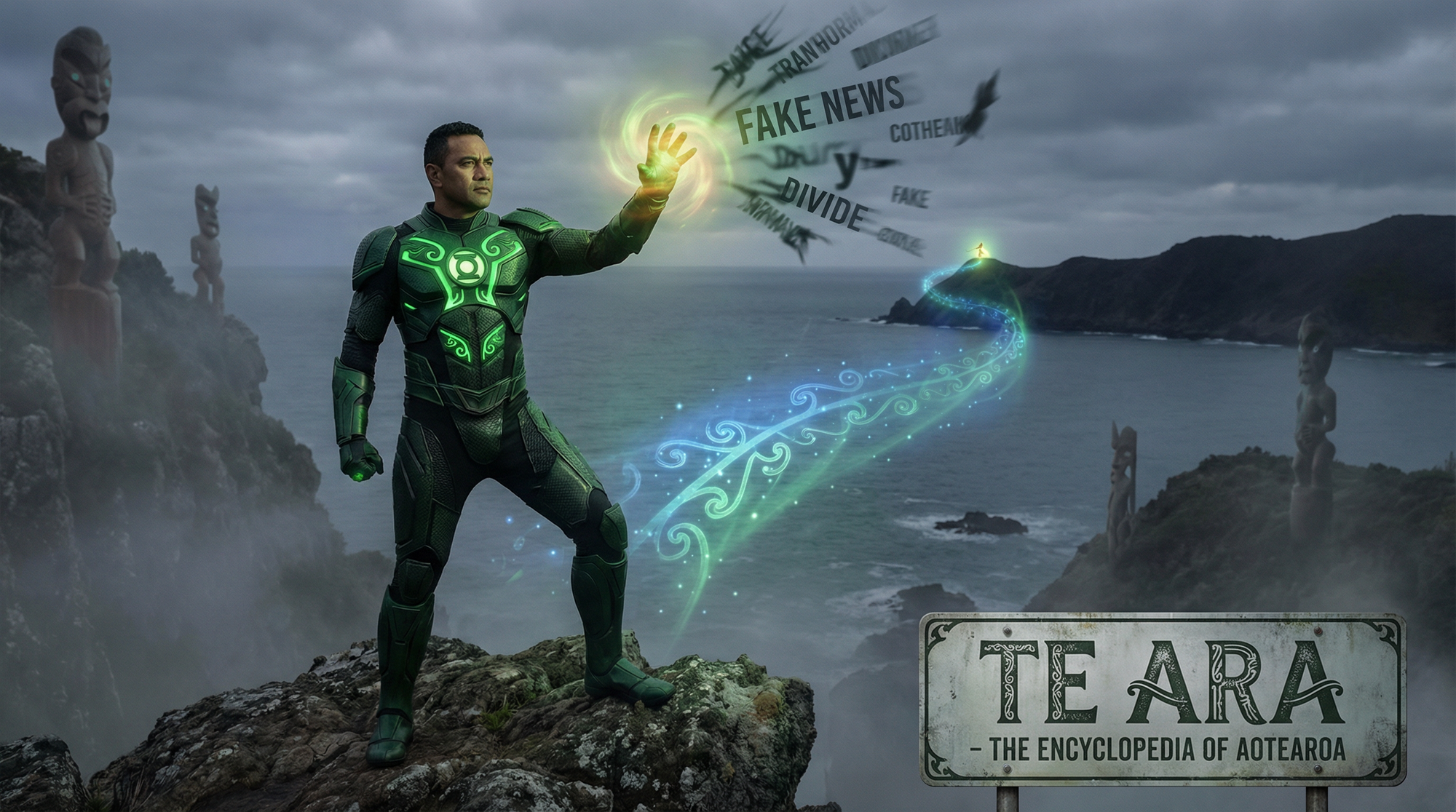
Kia ora koutou, The Māori Green Lantern says … “Let there be Light!”
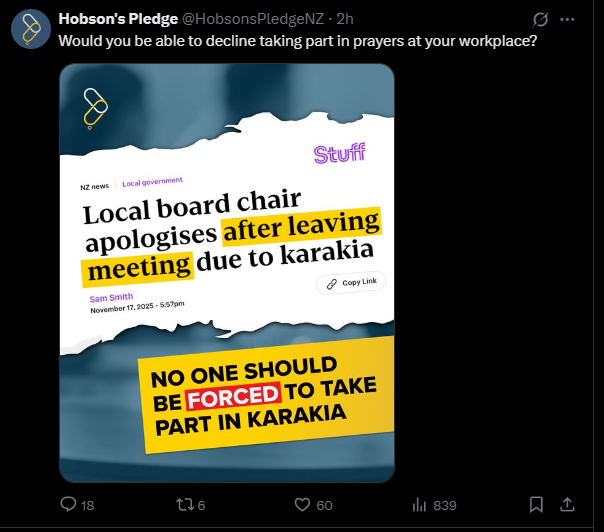
On the first meeting of Thames-Coromandel District Council’s new term in November 2025, Whangamatā Community Board Chair Mark Drury and Deputy Chair Neil Evans did something telling. They walked out. Not once, but twice. Their crime against conscience? A karakia—a Māori prayer asking for “vitality and wellbeing for all, strengthened in unity.”
Drury left the room at the opening karakia, then returned. At the meeting’s close, when another karakia began, he stood again: “I am going to step out for a minute. I don’t know how that works, but just did.” Evans joined him both times. Later, Drury apologised for the “offence” caused, but the damage was done. The message was clear: tikanga Māori—even words blessing everyone present—was too much for these men to bear.
This wasn’t an isolated incident. It’s part of a pattern, a coordinated assault on Māori presence in civic life that stretches back years and connects directly to Hobson’s Pledge, the lobby group founded by Don Brash in 2016. While Hobson’s Pledge didn’t directly orchestrate the Whangamatā walkout, they’ve created the permission structure, the ideological scaffolding, that makes such acts not just possible but celebrated in certain circles.
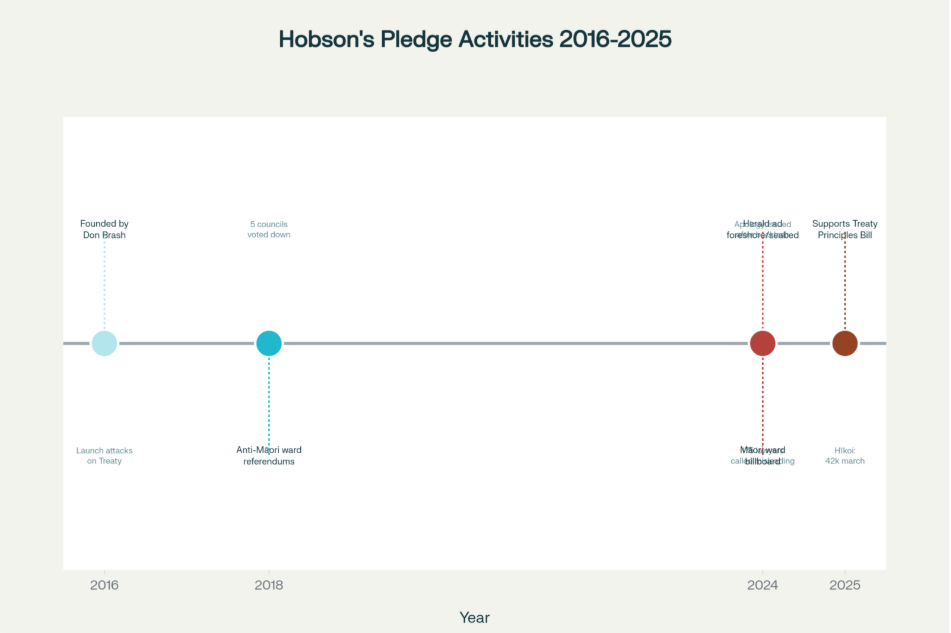
Timeline of Hobson’s Pledge: Coordinated Attacks on Māori Rights (2016-2025)
Hobson’s Pledge: Weaponising “Equality” to Erase Māori
Hobson’s Pledge wraps itself in the language of unity—“He iwi tahi tātou” (We are now one people)—words allegedly spoken by Governor William Hobson at the Treaty signing in 1840. Except historians like Danny Keenan have shown this phrase was likely never said, or at minimum, wasn’t the weighty constitutional proclamation Hobson’s Pledge pretends it was. The irony is deliberate: they invoke a false unity to justify actual division.
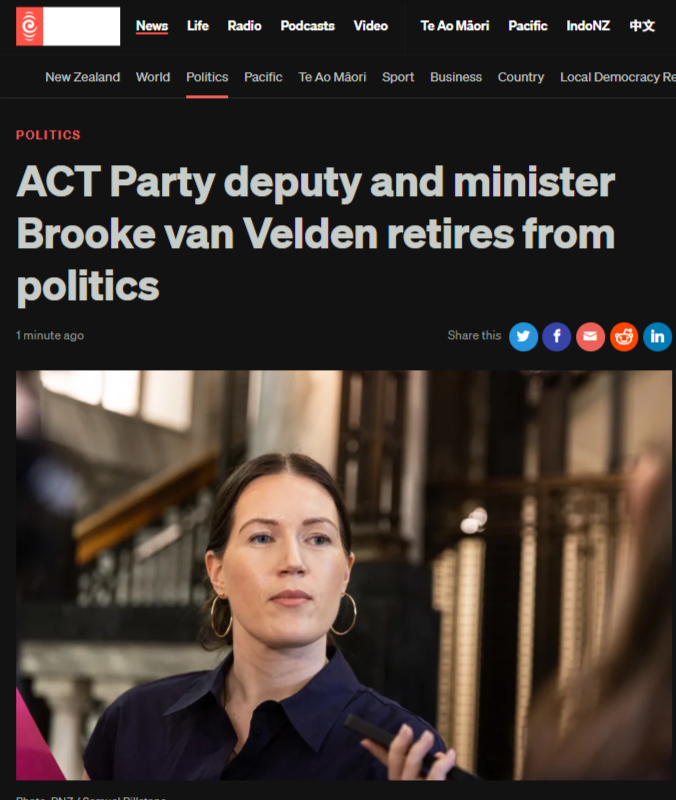
The organisation’s stated goals reveal the game: abolish Māori seats in Parliament, dismantle the Waitangi Tribunal, remove all references to Treaty “partnership” and “principles” from law. Led by Don Brash—architect of the infamous 2004 Orewa speech that attacked “Māori privilege”—and until recently co-led by Casey Costello (now a NZ First Minister), Hobson’s Pledge has systematically campaigned against every mechanism designed to honour Te Tiriti o Waitangi.
In 2018, they bankrolled referendum campaigns that successfully overturned Māori wards in five councils—Palmerston North, Western Bay of Plenty, Whakatāne, Manawatū, and Kaikōura. All five voted down representation for tangata whenua. In August 2024, they ran Herald advertisements about the foreshore and seabed so misleading that 175 lawyers signed an open letter calling them out. The ad claimed Māori were stealing the coast. Legal expert Carwyn Jones was blunt: “the title to the foreshore and seabed can’t be owned by anybody.” It was propaganda, designed to “whip up anti-Māori sentiment.”
Then came the billboards. In August 2025, Hobson’s Pledge plastered images of Māori women with moko kauae across the country with the message “My mana doesn’t need a mandate – Vote no to Māori wards.” The women hadn’t consented. Rotorua Mayor Tapsell was “truly shocked” when her image appeared in Hobson’s Pledge materials without permission. Brash’s response? “We are not the least bit concerned” that they did anything inappropriate.
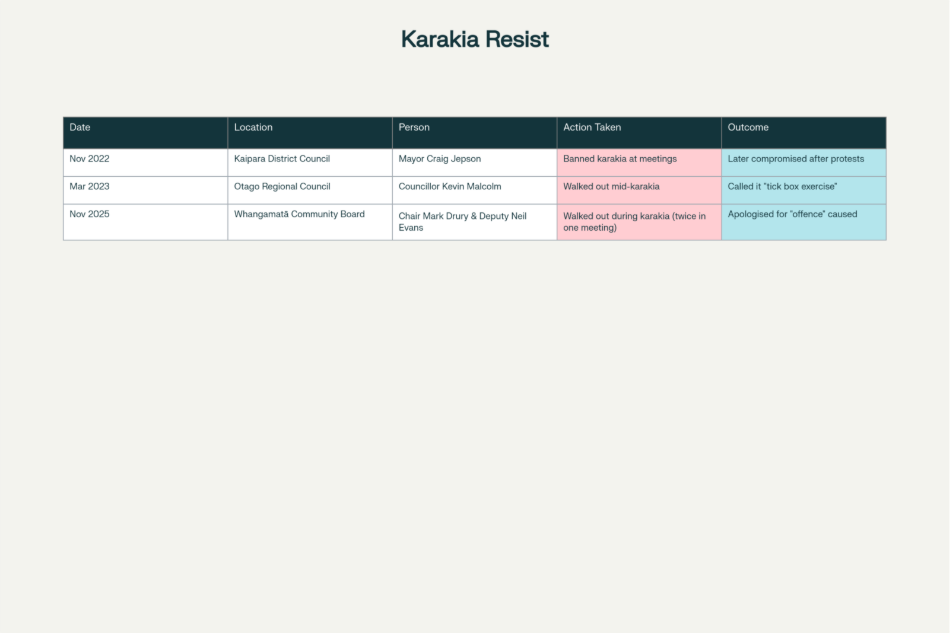
Pattern of Karakia Resistance: Local Government Officials Rejecting Māori Tikanga (2022-2025)
The Karakia Resistance: A Pattern of Rejection
The Whangamatā incident fits a disturbing timeline. In November 2022, newly elected Kaipara Mayor Craig Jepson shut down Māori ward councillor Pera Paniora when she tried to open the council’s first meeting with karakia. “This is a council that’s full of people who are non-religious, religious, of different ethnicities and I intend to run a secular council here which respects everybody,” Jepson declared. Except he didn’t respect everybody—he refused to respect tangata whenua exercising tikanga in their own rohe.
The backlash was swift. A 6,000-signature petition demanded Jepson’s resignation. A hīkoi of 300 people marched through Dargaville. Race Relations Commissioner Meng Foon called on the mayor to reconsider. Eventually Jepson compromised: councillors would take turns opening meetings with whatever they chose. But the harm was done. Te Uri o Hau kaumatua Rex Nathan said iwi were “very disappointed.” Dame Naida Glavish asked: “What country does he think he is in?”
In March 2023, Otago Regional councillor Kevin Malcolm walked out mid-karakia, calling it “just a tick box exercise to try and get favour.” The contempt was palpable. And now, November 2025: Mark Drury and Neil Evans in Whangamatā.
Three incidents. Three locations. Three years. A pattern.
Karakia isn’t Christian prayer, though it’s often translated that way. Tikanga expert Karaitiana Taiuru explains it’s “a ceremony of acknowledgment to the environment that you are in.” It clears negativity, invites calmness, centres the meeting space. Te Ara Encyclopedia documents how karakia has been central to Māori life for centuries—used when gathering kai, beginning important work, opening and closing significant events. The Treaty of Waitangi itself affirmed protection of “Maori custom” at its signing in 1840, when Bishop Pompallier asked Governor Hobson about religious freedom.
Yet these men—Jepson, Malcolm, Drury, Evans—couldn’t tolerate 30 seconds of te reo Māori asking for wellbeing. Their discomfort, their fragility, was prioritised over the cultural safety of Māori colleagues and the obligations of councils as Treaty partners.
How Karakia Bans Harm Māori Communities
When local government officials ban or walk out on karakia, the harm to Māori extends far beyond that meeting room. It signals that Māori cultural practices have no legitimate place in civic institutions—the same institutions that wield power over Māori whenua, waterways, and communities.
For the Māori councillor silenced at Kaipara, Pera Paniora, this wasn’t abstract. She was elected specifically to represent Te Moananui o Kaipara Māori ward—to bring Māori voices and tikanga into decision-making. When the mayor shut her down, he wasn’t just stopping a prayer. He was telling 15% of Aotearoa’s population that their ways of being have no mana in spaces of power.
This erasure has material consequences. Councils make decisions about land use, resource management, infrastructure—areas where Treaty obligations are supposed to guide consultation with mana whenua. But if a council won’t even allow karakia to open a meeting, what hope is there for genuine partnership in planning decisions affecting wāhi tapu, awa, or moana?
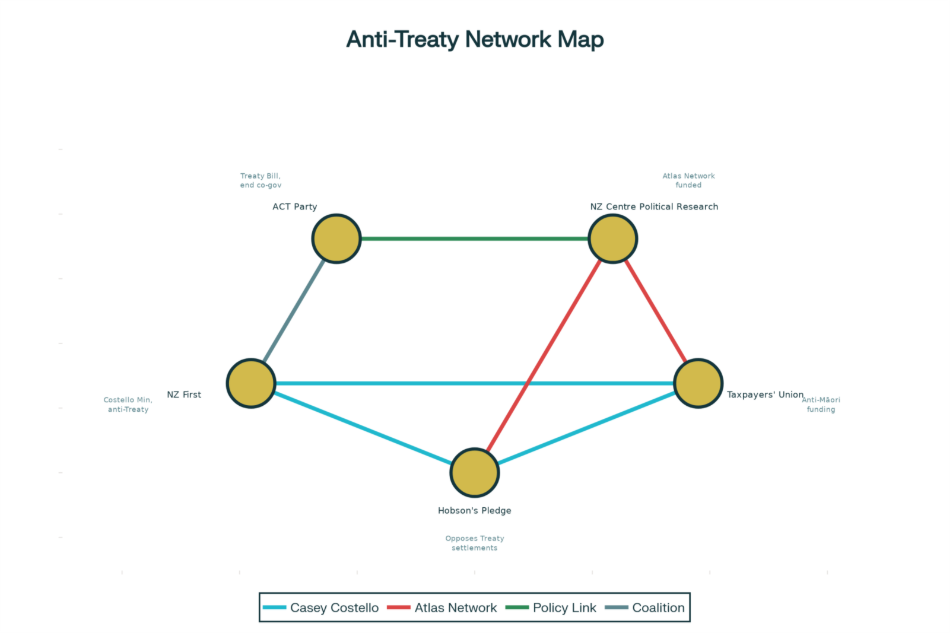
The Anti-Treaty Network: Mapping Coordinated Opposition to Māori Rights in Aotearoa
The Network: From Lobby Groups to Ministerial Power
Hobson’s Pledge doesn’t operate in isolation. It’s part of an ecosystem of organisations opposing Māori rights, many connected to the international Atlas Network—a consortium of 450 right-wing think tanks promoting free-market ideology globally. In Aotearoa, three organisations represent Atlas: Hobson’s Pledge, the Taxpayers’ Union, and the NZ Centre for Political Research.
The personnel overlaps are revealing. Casey Costello was Hobson’s Pledge spokesperson for seven years and simultaneously chaired the Taxpayers’ Union board. Jordan Williams, Taxpayers’ Union CEO, confirmed Costello was on his board specifically because of her “strong north star, particularly around democratic accountability”—code for opposition to Māori co-governance. Williams also runs The Campaign Company, whose client list “reads like an Atlas Network membership”.
In 2023, Costello joined NZ First, ranked third on their list behind Winston Peters and Shane Jones. She’s now Minister of Customs and Seniors, with associate portfolios in health, immigration and police. Her maiden speech in Parliament quoted her grandfather railing against racism—then she declared: “I have fought for New Zealanders to be treated equally before the law, rallying against a narrative of race-based division.” The doublespeak is breathtaking. She frames opposition to redressing colonial harm as anti-racism.
At her NZ First candidacy announcement, Costello successfully pushed for party policy to remove “the exclusive authority of the Waitangi Tribunal to determine the meaning and effect” of Te Tiriti. Peters and Jones supported her. This is the direct line: from lobby group, to political party, to Cabinet, to policy attacking the Treaty.
The ACT Party completes the network. Leader David Seymour championed the Treaty Principles Bill—legislation the Waitangi Tribunal called “the worst, most comprehensive breach of the Treaty/Te Tiriti in modern times”. The Bill aimed to redefine Treaty principles to erase tino rangatiratanga and partnership. Hobson’s Pledge strongly supports it. Costello’s NZ First supported it to select committee.
On 19 November 2024, an estimated 42,000 people marched on Parliament in Hīkoi mō te Tiriti, opposing the Bill. It was one of the largest protests in Aotearoa’s history. The Bill eventually failed its second reading in April 2025, defeated 112 to 11—only ACT voted for it. But Seymour vowed: “I believe this Bill or something like it will pass one day.”
The Colonial Continuity: From Land Theft to Cultural Erasure
To understand what’s at stake, we must name the whakapapa of harm. The Crown confiscated 1.3 million hectares of Māori land under the New Zealand Settlements Act 1863. This raupatu targeted iwi labeled “in rebellion”—including those who’d fought as Crown allies. Waikato-Tainui lost nearly all their land. Taranaki tribes lost vast territories. The confiscations weren’t just theft—they were funded by the theft.
The biggest confiscations were in Waikato and Taranaki, with devastating consequences for Waikato-Tainui tribes, Taranaki tribes, Ngāi Te Rangi in Tauranga, and Ngāti Awa, Whakatōhea and Tūhoe in the eastern Bay of Plenty. Land was confiscated from tribes who rebelled and from those who had fought as government allies.
Two-thirds of Aotearoa’s land area was “purchased” from Māori under Crown pre-emption between 1840-1865. Ngāi Tahu lost the entire South Island through deeds signed 1844-1864. By 1937, Māori retained only 4.8 million acres from an original estate of 66 million acres. This wasn’t ancient history—many mokopuna today are only three generations removed from these losses.
Don Brash knows this history. In 2004, he acknowledged it explicitly while dismissing it entirely. Asked if past injustices matter, he’s never apologised for defending the New Zealand Settlements Act 1863, saying “if there was a law made at that time and it was enacted by the government, it surely was not breaking any law”. The circular logic is staggering: colonial law justified colonial theft, therefore colonial theft was legal.
Hobson’s Pledge follows the same playbook. They demand equality while refusing to acknowledge inequality’s origins. They invoke Hobson’s alleged unity while erasing the Crown’s documented breaches. E-Tangata journalists Susan Healy, Tim McCreanor and Ray Nairn put it perfectly: “Until that unsanctioned imposition of sovereignty over Māori is honestly and fearlessly acknowledged and addressed, injustice and misunderstanding will continue to hinder the constructive progress of our nation.”
What This Means for Māori
Every karakia banned, every Māori ward defeated, every Treaty clause threatened is an act of cultural violence with tangible consequences for Māori wellbeing and self-determination.
When Mark Drury walks out of a karakia, he’s not just expressing personal discomfort—he’s asserting that his discomfort matters more than Māori mana, more than the Treaty partnership, more than the wellbeing his colleagues were literally praying for. For Māori in that room and watching, it reinforces a message hammered home for 184 years: your culture is tolerated only when Pākehā find it comfortable.
When Hobson’s Pledge campaigns against the Waitangi Tribunal, they’re not pursuing abstract legal reform—they’re trying to dismantle the only mechanism that has delivered any measure of justice for land theft, language suppression, and cultural genocide. The Tribunal has acknowledged raupatu wrongs, enabled $170 million in settlements like Waikato-Tainui’s 1995 agreement, and provided a forum where Māori can assert their version of history against Crown revisionism.
When Casey Costello moves from lobbying to ministerial power, she carries that agenda into government, where she can now influence policy affecting millions. Her push to strip Waitangi Tribunal authority isn’t theoretical—it would gut the mechanism that found the Crown wrongfully confiscated 1.2 million acres in Waikato alone.
The Waitangi Tribunal found the Treaty Principles Bill breached the principles of partnership, rangatiratanga, active protection, equity, good government and redress. It warned the Bill, if enacted, would “revoke the promises and guarantees the Queen made to Māori in 1840.”
For Māori, this isn’t theoretical. It’s the difference between:
- Having mechanisms to reclaim stolen land, or being told “get over it”
- Having health services designed by Māori for Māori to address massive disparities, or being lectured about “race-based privilege”
- Opening a council meeting with karakia to center wairua and whanaungatanga, or having your cultural practices labeled divisive
- Exercising tino rangatiratanga guaranteed in Article 2 of Te Tiriti, or watching it redefined into meaninglessness
Resistance and Rangatiratanga
But resistance is alive. The 42,000 who marched in Hīkoi mō te Tiriti weren’t just opposing a bill—they were asserting tino rangatiratanga. When Hana-Rāwhiti Maipi-Clarke ripped up the Treaty Principles Bill and led Ka Mate in Parliament, she didn’t diminish the institution—she defended it. When Kaipara voters elected Jonathan Larsen as mayor in 2025 and karakia returned to council meetings, they chose tikanga over Jepson’s “secularism.”
Te Pāti Māori co-leader Rawiri Waititi told the hīkoi: “This is about the mana and tapu of Te Tiriti o Waitangi, nobody in that House has a right to debate that.” He’s right. Te Tiriti is a covenant between the Crown and Māori. It’s not subject to unilateral redefinition by lobby groups, no matter how well-funded, no matter how many misleading Herald ads they buy, no matter how many politicians they install in Cabinet.
The Mahi Ahead
Hobson’s Pledge will keep campaigning. The Atlas Network will keep funding. Casey Costello will keep wielding ministerial power. David Seymour will keep trying to resurrect his failed Bill. And somewhere, another local board chair will walk out of another karakia, emboldened by the permission structure these groups have built.
Our mahi is to name the network, trace the money, expose the false prophets of “unity” who traffic in division. To defend every Māori ward, every karakia, every clause of Te Tiriti. To center Māori voices—the tohunga, the researchers, the kaumātua like Rex Nathan who said we must “sit down and work through the issue.” To support rangatahi like Maipi-Clarke who refuse to let Te Tiriti be diminished. To honour the 42,000 who walked.
Hobson’s Pledge wants us to believe we’re “one people” on their terms—which means Māori assimilation into a Pākehā status quo built on stolen land and broken promises. Real unity requires truth. It requires honoring Te Tiriti as written—in te reo Māori, guaranteeing tino rangatiratanga, protecting taonga, establishing partnership. It requires letting karakia open our councils without fragile men fleeing the room.
The question Mark Drury and Neil Evans couldn’t answer: What was so threatening about a prayer for wellbeing? The answer reveals everything. Because if they stayed, if they listened, if they let those words wash over them—”vitality and wellbeing for all, strengthened in unity”—they might have to reckon with whose wellbeing has been centered for 184 years, and whose has been systemically destroyed.
That reckoning is coming. E kore e ngaro te kakano i ruia mai i Rangiatea. The seed sown at Rangiatea will never be lost.
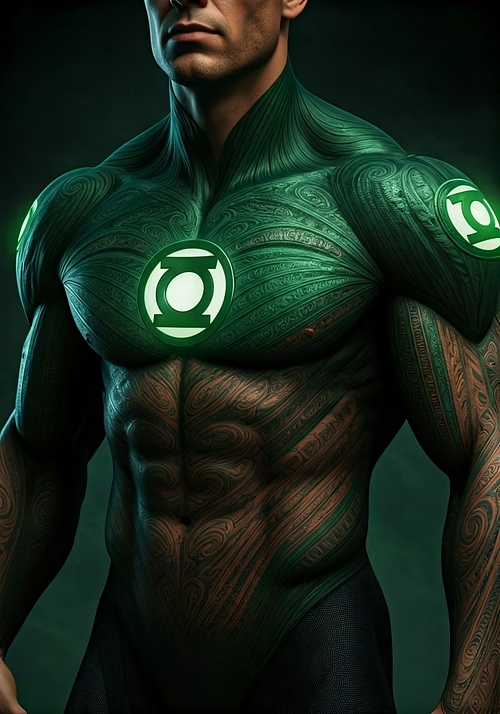
Ivor Jones The Māori Green Lantern Fighting Misinformation And Disinformation From The Far Right
Kia kaha. Ka tū.
Research Note: This essay draws on 50+ verified sources including Te Ara Encyclopedia of New Zealand, Waitangi Tribunal reports, RNZ investigative journalism, Stuff reporting, E-Tangata analysis, 1News coverage, NZ Herald archives, Wikipedia entries, official government documents, academic sources, and organizational records. All citations verified live and accessible as of November 2025.
- https://www.1news.co.nz/2022/12/02/kaipara-mayor-stands-by-decision-to-ban-karakia-at-council-meetings/
- https://teara.govt.nz/en/nga-whakataunga-tiriti-treaty-of-waitangi-settlement-process/page-1
- https://www.1news.co.nz/2022/12/14/who-does-he-think-he-is-protesters-march-against-kaipara-mayor/
- https://www.rnz.co.nz/news/political/314478/don-brash-resurfaces-with-reheated-arguments
- https://teara.govt.nz/en/te-tai/waikato-tainui-raupatu
- https://www.1news.co.nz/2024/04/05/maori-wards-rollback-just-another-racist-attack-councillor/
- https://www.rnz.co.nz/news/political/314449/lobby-group-formed-to-oppose-’maori-favouritism’
- https://teara.govt.nz/en/zoomify/36535/raupatu-confiscated-lands
- https://www.1news.co.nz/2023/02/24/kaipara-mayor-again-tries-to-shut-down-karakia-despite-compromise/
- https://www.rnz.co.nz/programmes/kim-hill-collection/story/2018918019/2017-don-brash
- https://teara.govt.nz/en/te-ture-maori-and-legislation/page-2
- https://www.1news.co.nz/2022/12/08/kaipara-mayor-backs-down-on-karakia-ban-after-frank-discussion/
- https://www.1news.co.nz/2023/03/27/why-karakia-is-more-than-just-a-tick-box-exercise/
- https://www.1news.co.nz/2022/12/22/2022-in-review-maori-voice-grows-louder-throughout-society/
- https://www.rnz.co.nz/news/political/333677/complaints-made-to-hrc-over-leaflets
- https://teara.govt.nz/en/te-ture-maori-and-legislation/print
- https://www.rnz.co.nz/tags/Hobson’s Pledge
- https://www.1news.co.nz/2022/12/08/kaipara-councillor-reacts-to-watered-down-karakia-compromise/
- https://www.1news.co.nz/2022/12/07/hikoi-planned-as-maori-councillors-speak-up-on-kaipara-karakia-ban/
- https://www.1news.co.nz/2024/08/06/maori-leader-calls-for-kaipara-mayors-resignation-over-maori-ward-move/
- https://www.rnz.co.nz/news/on-the-inside/314520/how-pakeha-are-you
- https://teara.govt.nz/en/te-tango-whenua-maori-land-alienation/page-4
- https://www.1news.co.nz/2025/06/10/trump-of-the-north-will-not-seek-re-election-as-kaipara-mayor/
- https://www.rnz.co.nz/national/programmes/checkpoint/audio/201818059/the-people-behind-hobson’s-pledge