“When White Settlers Destroyed the Middle Ground” - 21 October 2025
The Deliberate Demolition of Māori-Pākehā Partnership
Kia ora tatou,
The point needs to be made clear from the start so everyday New Zealanders understand exactly what happened: The so-called middle ground between Māori and Pākehā was not lost through misunderstanding or unfortunate circumstances. It was systematically demolished by white supremacist settler colonialism backed by Christian nationalist ideology and executed through demographic warfare, military violence, and legislative theft. Historian Vincent O’Malley’s analysis of this destruction exposes how what began as mutual accommodation between two peoples was deliberately crushed once Pākehā gained numerical superiority and no longer needed Māori cooperation to survive. This was not an accident. This was a plan.
Background: Understanding the Middle Ground
O’Malley describes a middle ground that emerged around 1814 when Church Missionary Society missionaries established their first permanent presence at Rangihoua, five years after the Boyd massacre at Whangaroa had temporarily halted European shipping. During this period from roughly 1814 to 1840, Māori held overwhelming demographic and military superiority. The relationship operated on genuine reciprocity because neither side could force the other into submission.
But here is what O’Malley fails to adequately emphasize in his extracted analysis: that middle ground was always built on a foundation of Christian missionary infiltration that served as the ideological vanguard for colonial conquest. Samuel Marsden and the Church Missionary Society did not come to Aotearoa out of benevolent concern for Māori spiritual wellbeing. They came to prepare the ground for systematic colonisation, believing that introducing European civilisation and Christianity was the necessary first step before land could be seized. Marsden himself stated his conviction that commerce and the arts had a natural tendency to inculcate industrious and moral habits, making Māori dependent on Europeans and thus opening the way to both salvation and subordination.
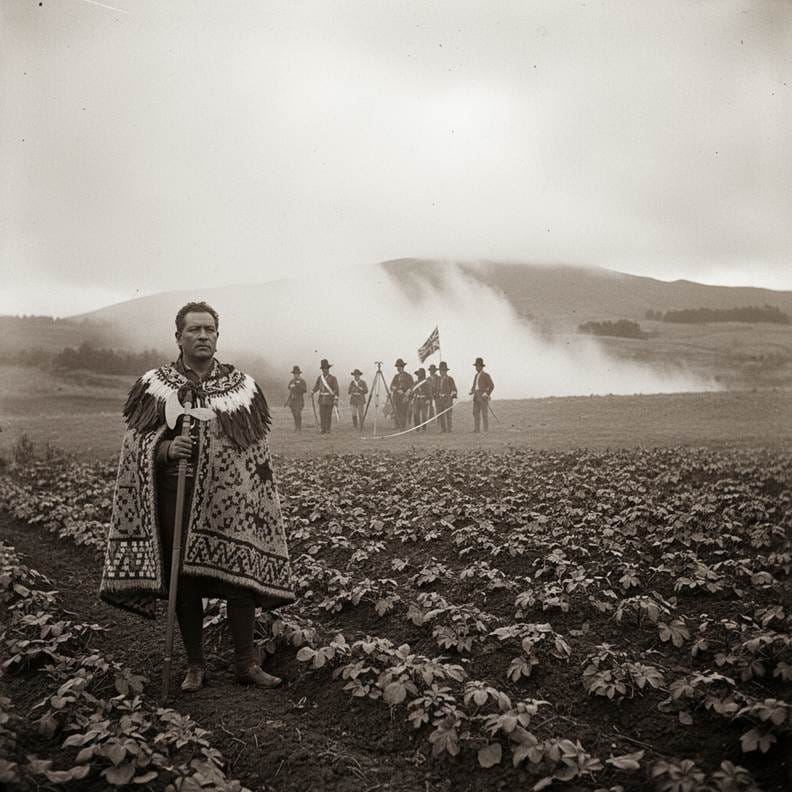
Māori prosperity on ancestral lands before the colonial invasion of the 1860s wars
The Issue: How Demographics Became a Weapon of Genocide
The critical turning point that O’Malley identifies is 1858, when the Pākehā population exceeded the Māori population for the first time. This was not coincidental timing. The demographic shift was the result of deliberate policy. In 1840, when Te Tiriti o Waitangi was signed, the ratio of Pākehā to Māori was approximately one to forty. By 1860, the groups had reached parity. By 1874, Māori were less than one-tenth of the national population. This was demographic warfare.
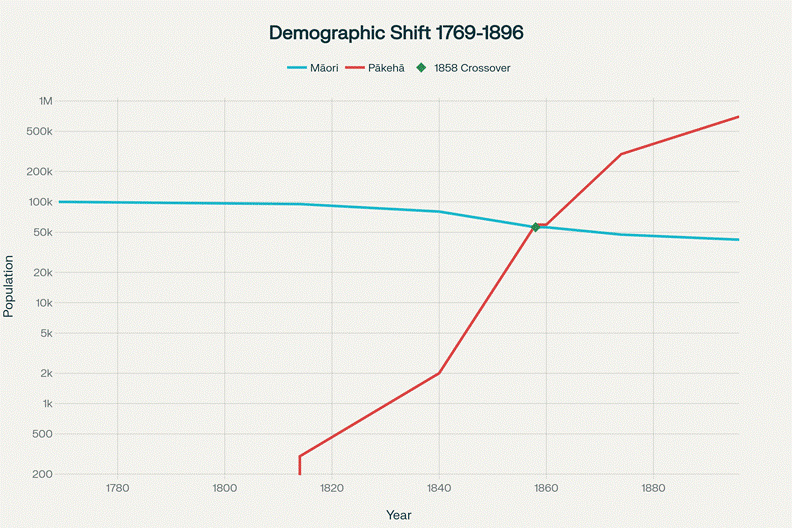
The stark demographic shift showing how systematic colonisation and introduced disease decimated the Māori population while Pākehā numbers exploded, particularly after the 1840 Treaty.
The arrival of the British government in 1840 brought what Edward Gibbon Wakefield called systematic colonisation. The New Zealand Company, founded on Wakefield’s theories, implemented a calculated program to flood Aotearoa with British settlers while simultaneously making land prohibitively expensive for labourers, ensuring a ready workforce for capitalist landowners. This was not benign immigration. This was invasion by another name, using economic theory to justify racial replacement.
At the same time, introduced European diseases ravaged Māori communities. The Māori population, which James Cook had estimated at 100,000 in 1769, had declined to approximately 56,000 by the 1858 census. By 1896, it had crashed to a low of approximately (https://teara.govt.nz/en/taupori-maori-maori-population-change/page-2). Meanwhile, the Pākehā population exploded from virtually zero to over 700,000 in the same period.[1]
The White Supremacist Ideology Behind the Violence
Once Pākehā achieved numerical superiority, the mask came off. O’Malley notes how Donald McLean observed in 1861 that offensive terms like bloody Maori, black nigger, and treacherous savage were frequently applied to Māori. But this was not merely casual racism. This was the ideological justification for genocide.
In 1856, physician and politician Dr Isaac Featherston declared it was the duty of Europeans to smooth down the dying pillow of the Māori race. A.K. Newman, a prominent scientist, stated in 1881 that the disappearance of the race is scarcely subject for much regret. They are dying out in a quick, easy way, and are being supplanted by a superior race. These were not fringe opinions. These were mainstream views expressed by political and scientific leaders, published in respected journals, and used to justify policy.
This genocidal rhetoric was grounded in Victorian racial hierarchies that positioned Māori as inevitably doomed savages who must either assimilate completely or perish. The choice offered was cultural death or physical death. Māori culture would have to die in order for its people to survive, as O’Malley notes. This is the definition of genocide under international law.
Kīngitanga and Māori Resistance to Extermination
Māori were not passive victims of this assault. The Kīngitanga movement, founded in 1856, represented a sophisticated political response to land alienation and the erosion of Māori autonomy. At the Hīnana ki Uta, Hīnana ki Tai hui at Pūkawa, rangatira from multiple iwi agreed to establish a Māori monarch who could deal with the British Crown on equal footing and protect Māori land from further theft.
The colonial government viewed Kīngitanga as a direct threat to the supremacy of the British monarchy and moved swiftly to crush it. This was not about rebellion. This was about Māori daring to assert sovereignty over their own lands and futures. The government’s response was total war.
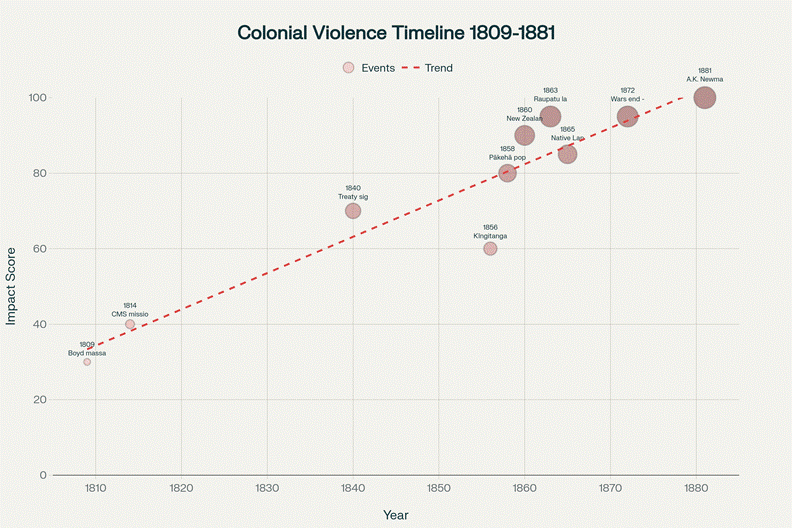
The systematic escalation of colonial violence from the Boyd massacre through missionary infiltration, Treaty deception, demographic inversion, war, and mass land theft, culminating in genocidal declarations.
The New Zealand Wars and Raupatu: Military Conquest as Policy
The New Zealand Wars between 1860 and 1872 were not defensive actions by the Crown. They were wars of aggression designed to seize Māori land and break Māori political power. The New Zealand Settlements Act 1863 provided legal cover for the government to confiscate land from Māori tribes deemed to be in rebellion, but in practice it made little distinction between loyal and rebel tribes.
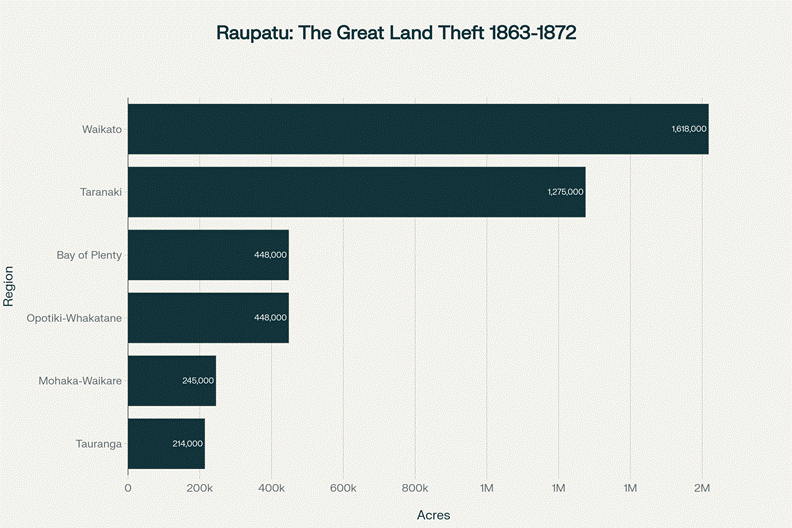
Over 3.3 million acres of Māori land were confiscated under the New Zealand Settlements Act, with Taranaki and Waikato bearing the greatest losses to fund and reward the colonial war machine.
Over 3.3 million acres of Māori land were confiscated under Raupatu, including the vast majority of Waikato and Taranaki. The confiscated lands were then sold to military settlers or speculators, with the proceeds used to fund the very wars that had dispossessed Māori in the first place. This was theft compounded by obscenity. As Dr Ranginui Walker observed, Māori were forced to pay for the settlement and development of their own lands through their expropriation in a war for the extension of Crown sovereignty into their territory.
The confiscations devastated Waikato and Taranaki iwi in particular. Waikato Māori went from being prosperous agricultural producers to living in exile, alienated from their lands and the industries that had supported thriving communities. The 1995 Waikato Raupatu settlement provided compensation over 130 years after the wars, but the amount covered only a fraction of the true value of the stolen lands.
The Native Land Court: Legal Theft Following Military Conquest
For lands not confiscated outright, the Crown deployed the Native Land Court, established in 1865, as a mechanism for dispossession through legal manipulation. The Court imposed individual title on collectively held Māori land, recognising only ten owners or fewer from entire land-holding groups and registering them as the owners. This dispossessed the majority of each tribe of any legal rights to their ancestral lands.
Land sharks then picked off individual owners willing to sell their shares, breaking up tribal landholdings piece by piece. By 1900, Māori were left with approximately 7 million acres of the original 66.4 million acres. Most of the remaining 7 million acres were leased to Pākehā farmers or the Crown, leaving Māori effectively landless in their own country.
The Christian Civilising Mission as Colonial Violence
Throughout this entire period of dispossession, the Christian church provided ideological justification and practical support for colonisation. The CMS missionaries who arrived in 1814 saw themselves as bringing light to darkness, civilisation to savagery, Christianity to heathenism. But their civilising mission was always tied to the colonial project.
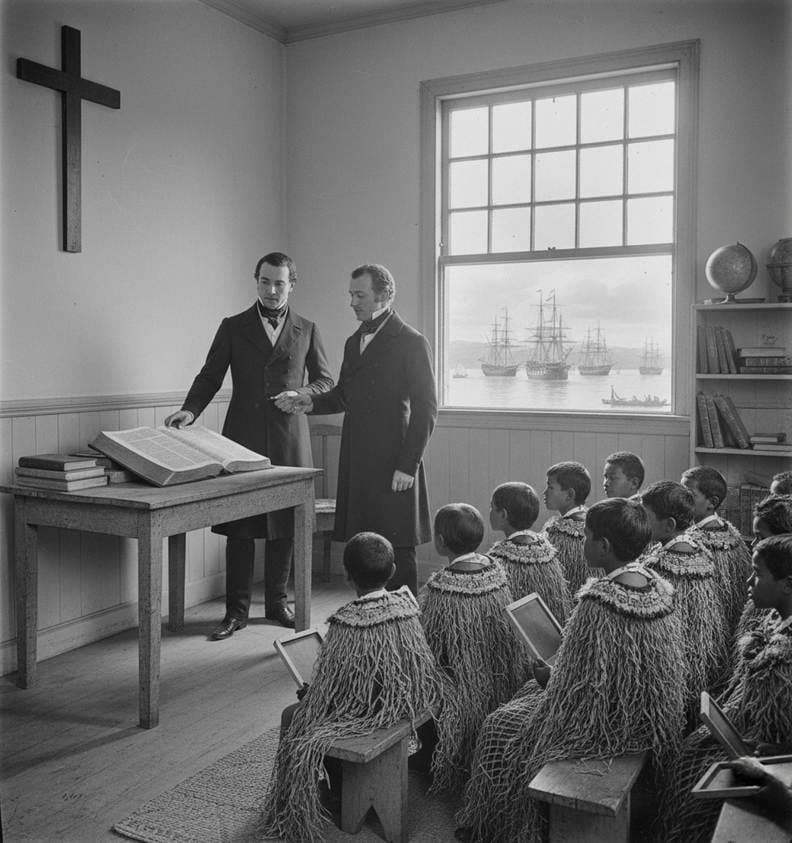
CMS missionaries establishing their civilising mission as the vanguard of colonial conquest
Missionary influence grew substantially from the 1830s onward as the Musket Wars and introduced diseases undermined Māori confidence in their own spiritual systems. By 1842, most Māori aged between 10 and 30 could read and write in Māori, a higher literacy rate than in the Pākehā population. But this literacy was in service of Christian indoctrination and cultural assimilation.
The missionaries wielded enormous influence in persuading Māori rangatira to sign Te Tiriti o Waitangi in 1840. The high regard for missionaries among Māori was a key factor in many chiefs signing what they believed was a partnership agreement. But the Treaty was a trap. The English text, which the Crown relied upon, ceded sovereignty to Britain while the Māori text guaranteed tino rangatiratanga. This was not a translation error. This was deliberate deception.
Hidden Connections: The Nexus of Christian Nationalism and White Supremacy
The links between Christian missionary activity, white supremacist ideology, and capitalist land theft reveal a coordinated system of oppression. Samuel Marsden was simultaneously a prison chaplain in New South Wales, a Church Missionary Society agent, and a wealthy landowner who profited from colonial expansion. He personally funded the Active, the ship that brought the first missionaries to Aotearoa.
The CMS was supported by the Clapham Sect, an influential group of evangelical Anglican social reformers that included William Wilberforce, famous for his opposition to slavery. Yet these same men saw no contradiction in supporting the colonisation of Indigenous lands and the subordination of Indigenous peoples. Their Christianity was white Christianity, their civilisation was white civilisation, and their god was a white god who sanctioned racial hierarchy.
Edward Gibbon Wakefield, the architect of systematic colonisation, developed his theories while imprisoned for abducting a teenage heiress. His vision for New Zealand was to create little Englands throughout the world, each replicating the social and economic structure of Britain while being free from its evils. But his system required cheap Indigenous land and exploitable Indigenous labour. Systematic colonisation was white supremacy with an economic plan.
The New Zealand Company, which implemented Wakefield’s theories, vigorously opposed Te Tiriti o Waitangi because the Treaty was an obstacle to obtaining the greatest possible amount of land at the cheapest price. The Company’s board members included aristocrats and Members of Parliament who used their political connections to lobby the British government. They launched fraudulent advertising campaigns depicting Aotearoa as a fertile Eden while suppressing negative reports. They bought vast tracts of land from Māori using questionable contracts, then resold that land with its title in doubt.
This nexus of Christian missionary societies, capitalist land companies, and white supremacist ideology formed a coordinated system for Indigenous dispossession. The missionaries softened up Māori communities for colonisation. The land companies brought the settlers. The British military crushed resistance. The legislative system legalised the theft. The scientists provided racist justifications. And the churches blessed it all in the name of bringing civilisation and Christianity to the savages.
Implications: The Settler Colonial State Built on Anti-Māori Racism
The destruction of the middle ground had catastrophic implications that continue to reverberate today. The Pākehā-dominated state that emerged from the wars and confiscations was built on a foundation of anti-Māori racism embedded in every institution. Legal rhetoric as the official discourse of power sanctioned specific conceptions of race and racism, leaving white cultural imperialism largely unexamined while Indigenous sovereignty was systematically denied.
The privileging of whiteness in Aotearoa goes beyond general racism and beyond institutional racism to an intentional, structural, and sustained ideological and legislative attack on Māori. As scholar Donna Awatere argued, white culture and its articulation through governance and policy is the starting point for understanding Māori dispossession and the strategies of racialised surveillance, control, and containment that followed.
By the early 20th century, Pākehā had begun appropriating Māori motifs for nationalist purposes, but they did so from a position of complete dominance. Māori were expected to straddle two cultures on their own, with no support and no power. The middle ground was long gone. In its place stood a settler colonial state premised on Māori subordination and Pākehā supremacy.
The myth-making identified by scholar Margaret Mutu was central to British colonists justifying the dispossession of Māori. These myths, embedded in the political and ideological superstructure, continue to sustain anti-Māori racism and white supremacy in contemporary Aotearoa. The theatre of legality performed by the state sanctions anti-Māori racism by imbuing narratives rooted in it into wider public discourse while leaving dominant white ideologies unexamined.
From the systematic policies embedded in the New Zealand Constitution Act and Native Lands Acts to contemporary legislative attacks on Māori sovereignty, there has been a continuous thread of deliberate colonial violence. The state that emerged from the ruins of the middle ground has spent over 180 years ensuring Māori sovereignty cannot be obtained.
Exposing the Truth of Deliberate Destruction
Vincent O’Malley ends his analysis with cautious optimism about the possibility of a new middle ground emerging in the 21st century based on demographic and economic shifts. He points to Treaty settlements and Māori economic resurgence as potential foundations for renewed mutual accommodation.

The Māori Green Lantern Fighting Misinformation And Disinformation From The Far Right
But we must be clear-eyed about what was lost and how it was lost. The middle ground did not fade away through natural processes or inevitable historical forces. It was deliberately destroyed by white supremacist settler colonialism executing a coordinated program of demographic replacement, military conquest, legal theft, and cultural genocide. Christian missionaries, capitalist land speculators, British soldiers, colonial legislators, and scientific racists all played their parts in a system designed to dispossess Māori and establish permanent Pākehā dominance.
The genocidal declarations of Featherston and Newman were not aberrations. They were the logical expression of a colonial project that viewed Indigenous peoples as obstacles to be removed or assimilated. The New Zealand Wars were not defensive actions but wars of aggression designed to break Māori political power and seize Māori land. The Raupatu confiscations were not punishment for rebellion but theft on a massive scale. The Native Land Court was not a neutral legal institution but a mechanism for dispossession.
Every institution of the settler colonial state that emerged from this violence continues to carry the DNA of anti-Māori racism. Understanding how the middle ground was destroyed is essential to understanding how we arrived at the present moment, where Māori continue to fight for sovereignty, self-determination, and the honouring of Te Tiriti o Waitangi.
The past is not behind us. It is ahead of us, as the whakataukī ka mua, ka muri reminds us. We walk backwards into the future with our eyes on the past. Only by confronting the truth of what was deliberately done to Māori can we hope to build something better. That truth is brutal: white supremacist settler colonialism destroyed the middle ground through a coordinated program of demographic warfare, military violence, legislative theft, and genocidal ideology, all blessed by Christian nationalist rhetoric about bringing civilisation to savages.
The middle ground did not end. It was murdered. And we live in the society built on its corpse.
Readers who find value in the work of The Māori Green Lantern exposing white supremacy, racism, and neoliberalism are invited to consider a koha/donation to support this kaupapa: HTDM: 03-1546-0415173-000. These are tough economic times for whānau, so please only contribute if you have the capacity and wish to do so.
Kia kaha, kia maia, kia manawanui
The Māori Green Lantern
1. https://www.tandfonline.com/doi/full/10.1080/03036758.2019.1668439
2. https://linkinghub.elsevier.com/retrieve/pii/S2352340921007277
3. https://www.facebook.com/WorldGeoDemo/posts/-maori-population-in-new-zeeland-️/1176926657769595/
4. https://ourarchive.otago.ac.nz/view/pdfCoverPage?instCode=64OTAGO_INST&filePid=13397002630001891&download=true
5. https://en.wikipedia.org/wiki/1858_New_Zealand_census
6. https://paperspast.natlib.govt.nz/books/ALMA1929-9915985213502836-Young-New-Zealand---a-history-of
7. https://teara.govt.nz/en/1966/featherston-dr-isaac-earl
8. https://teara.govt.nz/en/te-tai/te-mana-o-te-reo-maori-timeline
9. https://teara.govt.nz/en/chatham-islands/print
10. https://www.nzherald.co.nz/whanganui-chronicle/news/rob-rattenbury-four-great-new-zealanders-who-saved-maori-from-extinction/YCR5D2N3IOFNTPUVWCVGYOAG7Y/
11. https://teara.govt.nz/en/new-zealand-wars/print
12. https://teara.govt.nz/en/maori-education-matauranga/print
13. /content/files/index-php/hts/article/download/9032/26452.pdf
14. https://www.nzherald.co.nz/nz/simon-chapple-how-many-maori-lived-in-aotearoa-when-captain-cook-arrived/46GFYJISSN42KBK5ZBS6GE2CZA/
15. /content/files/wp-content/uploads/2022/07/the-passage-of-maori-land-into-pakeha-ownership-2-20june-ag.pdf
16. /content/files/kotare/article/download/602/414.pdf
17. https://www.tandfonline.com/doi/pdf/10.1080/00358533.2023.2268932?needAccess=true
18. /content/files/iupjournals/index-php/jwp/article/download/620/76.pdf
19. https://www.tandfonline.com/doi/full/10.1080/2201473X.2023.2195062
20. https://ojs.aut.ac.nz/rangahau-aranga/article/download/199/177
21. /content/files/journal/AJHC/article-full-text/fd8548470308.pdf
22. /content/files/ethnographic-edge/article/download/249/232.pdf
23. /content/files/kotare/article/download/618/430.pdf
24. https://digitalcommons.uri.edu/cgi/viewcontent.cgi?article=2768&context=theses
25. https://pmc.ncbi.nlm.nih.gov/articles/PMC11854029/
26. /content/files/kotare/article/download/668/479.pdf
27. /content/files/journals/index-php/phrj/article/download/254/238.pdf
28. /content/files/ajie/article/download/322/570.pdf
29. https://fiveable.me/history-new-zealand/unit-4/kingitanga-movement/study-guide/zEcSDzNaUxCF3OYY
30. https://teara.govt.nz/en/te-tango-whenua-maori-land-alienation/page-4
31. https://mro.massey.ac.nz/bitstream/handle/10179/6506/02_whole.pdf
32. https://en.wikipedia.org/wiki/Māori_King_movement
33. https://nzhistory.govt.nz/politics/the-maori-king-movement-1860-94/raupatu-confiscations
34. https://teara.govt.nz/en/biographies/3n4/newman-alfred-kingcome
35. https://zenodo.org/record/2505790/files/article.pdf
36. https://www.raukawasettlementjourney.org.nz/raukawa-and-the-crown/
37. https://en.wikipedia.org/wiki/New_Zealand_land_confiscations
38. /content/files/nzsr/article/download/7834/6975.pdf
39. https://e-tangata.co.nz/history/vincent-omalley-the-origins-of-the-kingitanga/
40. /content/files/wp-content/uploads/2022/08/waikato-war-education-resource-2014.pdf
41. https://paperspast.natlib.govt.nz/periodicals/TPRSNZ1924-55.2.10.1.24
42. https://digitalcommons.uri.edu/cgi/viewcontent.cgi?article=2740&context=theses
43. /content/files/index-php/journal/article/download/503/402.pdf
44. https://www.mdpi.com/2077-1444/14/2/139/pdf?version=1674200561
45. /content/files/journal/AJHC/article-full-text/5d944d155369.pdf
46. /content/files/pub/article/download/185/pdf.pdf
47. /content/files/index-php/tv/article/download/170/428.pdf
48. The-end-of-the-middle-ground-E-Tangata-10-21-2025_08_02_AM.jpg
49. /content/files/index-php/ve/article/download/2077/4166.pdf
50. /content/files/index-php/ve/article/download/1887/3655.pdf
51. /content/files/index-php/hts/article/download/2648/5178.pdf
52. /content/files/pub/article/download/405/pdf.pdf
53. /content/files/index-php/hts/article/download/6767/21453.pdf
54. https://brill.com/downloadpdf/journals/exch/51/3/article-p266_5.pdf
55. https://nzhistory.govt.nz/samuel-marsden-conducts-nzs-first-christian-service
56. https://nzhistory.govt.nz/culture/maori-european-contact-before-1840/the-boyd-incident
57. https://teara.govt.nz/en/population-change/page-6
58. https://nzhistory.govt.nz/culture/missionaries/marsden-and-cms
59. https://e-tangata.co.nz/history/the-end-of-the-middle-ground/
60. https://en.wikipedia.org/wiki/Boyd_massacre
61. https://teara.govt.nz/en/taupori-maori-maori-population-change/print
62. https://teara.govt.nz/en/missions-and-missionaries/print
63. https://teara.govt.nz/en/1966/boyd-massacre-of
64. https://nzhistory.govt.nz/media/photo/maori-and-european-population-numbers-1838–1901
65. https://en.wikipedia.org/wiki/Samuel_Marsden
66. https://collections.tepapa.govt.nz/object/36720
67. https://en.wikipedia.org/wiki/Demographics_of_New_Zealand
68. https://www.salvationarmy.org.nz/ruataras-mission/
69. https://nzhistory.govt.nz/keyword/boyd
70. The-end-of-the-middle-ground-_-E-Tangata.pdf
71. https://www.migrationpolicy.org/article/new-zealand-migration-profile-history
72. https://en.wikipedia.org/wiki/New_Zealand_Church_Missionary_Society
73. https://natlib.govt.nz/records/22358072
74. https://www.christianstudylibrary.org/article/samuel-marsden-road-rangihoua
75. https://www.nzonscreen.com/title/shipwreck-the-tragedy-of-the-boyd-2000
76. https://teara.govt.nz/en/missions-and-missionaries/page-2
77. https://www.rnz.co.nz/news/te-manu-korihi/83830/book-on-boyd-massacre-wins-literary-prize
78. https://teara.govt.nz/en/graph/36364/maori-and-european-population-numbers-1840-1881
79. https://teara.govt.nz/en/biographies/1m16/marsden-samuel
80. https://teara.govt.nz/en/photograph/7706/whangaroa-harbour
81. http://www.emerald.com/her/article/38/1/16-28/79037
82. https://teara.govt.nz/en/history-of-immigration/page-3
83. https://teara.govt.nz/en/1966/missions/page-2
84. https://teara.govt.nz/en/european-ideas-about-maori/print
85. https://teara.govt.nz/en/biographies/1k9/kendall-thomas/print
86. https://teara.govt.nz/en/biographies/1r19/ruatara/print
87. https://teara.govt.nz/en/taupori-maori-maori-population-change/page-1
88. https://teara.govt.nz/en/biographies/6t3/tuai/print
89. https://teara.govt.nz/en/1966/marsden-samuel
90. https://teara.govt.nz/en/population-change/print
91. https://teara.govt.nz/en/artwork/27985/marsden-and-ruatara
92. https://www.semanticscholar.org/paper/c46620e9fbc9a51b3efcc4dc895aa64e80210c9c
93. https://teara.govt.nz/en/1966/te-pahi
94. https://www.publish.csiro.au/HC/HC23171
95. https://ojs.victoria.ac.nz/aha/article/view/8709
96. https://journals.sagepub.com/doi/10.1177/14687968231192037
97. https://bmcpublichealth.biomedcentral.com/articles/10.1186/s12889-024-17984-2
98. https://link.springer.com/10.1007/s12134-023-01044-6
99. http://www.sciedupress.com/journal/index.php/wje/article/view/18553
100. https://journals.sagepub.com/doi/10.1177/0091217417745295
101. https://www.tandfonline.com/doi/full/10.1080/1177083X.2022.2082988
102. https://harmreductionjournal.biomedcentral.com/articles/10.1186/s12954-022-00613-9
103. https://www.semanticscholar.org/paper/d1aa65ad93d8f5bf837645d4d1439894542c8b95
104. https://www.tandfonline.com/doi/full/10.1080/20440243.2021.1978136
105. https://storage.googleapis.com/jnl-au-j-jiss-files/journals/1/articles/217/64c242fab2448.pdf
106. https://www.tandfonline.com/doi/pdf/10.1080/17449057.2022.2096767?needAccess=true
107. https://www.mdpi.com/2313-5778/4/2/46/pdf
108. https://www.mdpi.com/2071-1050/14/18/11127/pdf?version=1663238130
109. https://www.pnas.org/content/pnas/117/16/8813.full.pdf
110. https://www.tandfonline.com/doi/pdf/10.1080/15358593.2024.2313238?needAccess=true
111. https://pmc.ncbi.nlm.nih.gov/articles/PMC2409139/
112./content/files/2402-02666.pdf
113. https://pmc.ncbi.nlm.nih.gov/articles/PMC4497933/
114.https://www.semanticscholar.org/paper/b56732cd2cc80243f342b31aff86a38ce4c506f4
115. https://pmc.ncbi.nlm.nih.gov/articles/PMC6065006/
116.https://www.mdpi.com/2313-5778/6/1/10/pdf
117. https://dx.plos.org/10.1371/journal.pone.0064580
118. /content/files/core/services/aop-cambridge-core/content/view/E70299763E5A5C412744E7B510153C38/S0950268816001989a/div-class-title-rapid-mortality-transition-of-pacific-islands-in-the-19th-century-div.pdf
119.https://pmc.ncbi.nlm.nih.gov/articles/PMC11841167/
120. /content/files/core/services/aop-cambridge-core/content/view/5497BB49DEFC5BAC3A7323FE7F0884F9/S1740022823000128a/div-class-title-the-company-microstate-the-auckland-islands-and-corporate-colonialism-in-global-history-1849-52-div.pdf
121.https://pmc.ncbi.nlm.nih.gov/articles/PMC7183181/
122. https://teara.govt.nz/en/taupori-maori-maori-population-change/page-2
123. /content/files/index-php/tekaharoa/article/download/112/103.pdf
124. https://content.time.com/time/subscriber/article/0,33009,812829,00.html
125. https://www.tandfonline.com/doi/full/10.1080/14780038.2018.1441792
126. https://teara.govt.nz/en/document/29808/racist-letter
127. https://nzhistory.govt.nz/war/new-zealand-wars/roaring-forties
128. https://maoriresistance.weebly.com/a-dying-race.html
129. https://paperspast.natlib.govt.nz/books/ALMA1986-9917504403502836b-Policing-the-colonial-frontier--?page=4&phrase=0&query=Collins
130. https://www.facebook.com/groups/aotearoanzhistory/posts/1144417250713969/
131. https://nzhistory.govt.nz/keyword/donald-mclean
132. https://e-tangata.co.nz/history/ned-fletcher-theres-no-clash-between-te-tiriti-and-the-treaty/
133. /content/files/media/5013/download.pdf
134. https://www.facebook.com/groups/aotearoanzhistory/posts/1328306178991741/
135. https://www.wgtn.ac.nz/news/2019/01/ongoing-endeavour-to-establish-nzs-1769-population