"Who Benefits When Our Pacific Whānau Drown in Drugs We Created?" - 31 October 2025
The Smoking Gun Behind the “Narco-States” Panic
Kia ora e te whānau,
The revelation: New Zealand and Australia’s insatiable demand for methamphetamine—where a single gram costs 15-20 times more than in North America—has transformed Pacific Islands into drug highways, yet the same governments now cutting Pacific aid by millions are deploying military force and blaming island nations for a crisis they created. Meanwhile, David Seymour’s Regulatory Standards Bill mirrors Elon Musk’s DOGE playbook: unelected power, corporate interests, and zero accountability—the same neoliberal model that allows Trump to bomb alleged drug boats, killing 57 people in eight weeks without evidence or trial.
Background: The Neoliberal Drug Empire
Let’s trace the whakapapa of this crisis. Since the 1980s, the so-called “war on drugs” has functioned as neoliberal enforcement—criminalizing the poor while protecting the market conditions that make drug trafficking spectacularly profitable. The Pacific didn’t have a methamphetamine crisis until New Zealand and Australia created it.
Here’s how the exploitation works: Between 2013 and 2018, New Zealand deported 1,040 people to Pacific nations—including 400 with criminal records—with no job prospects, no cultural connections, and no support. Australia’s 501 deportation policy sent 3,058 people to New Zealand since 2015, with 60 percent being Māori or Pacific peoples despite making up only 24.6 percent of the population—a 2.4-times overrepresentation rooted in deliberate structural racism. These deportees, stripped of citizenship after decades in Australia, are then sent to Pacific Islands where they reach back to criminal networks, seeding organized crime.
The economic mathematics are brutal. A point of methamphetamine costs $5 USD in the United States but costs $80-$100 in New Zealand—a 15-20 times markup that makes the Pacific region a “golden nugget” for transnational crime groups. When a kilogram of meth costs $1,000 USD wholesale in Myanmar but can generate hundreds of thousands in New Zealand, cartels flood the region with product. From January to July 2025 alone, New Zealand seized methamphetamine with a street value of $370 million—and gangs are making an estimated $11-13 million per week in cash.
Yet here’s the smoking gun: New Zealand’s 2024 Budget cut Pacific aid funding by $26 million while simultaneously increasing Customs enforcement spending by $35 million over four years. This is neoliberalism in its purest form—slash community support, militarize enforcement, and blame the vulnerable for systemic violence. Associate Police Minister Casey Costello established the Ministerial Advisory Group on Organised Crime in February 2025, producing reports that frame Pacific Islands as “at risk of becoming narco-states”. But the real question Costello and her advisors won’t answer: at risk from whom?
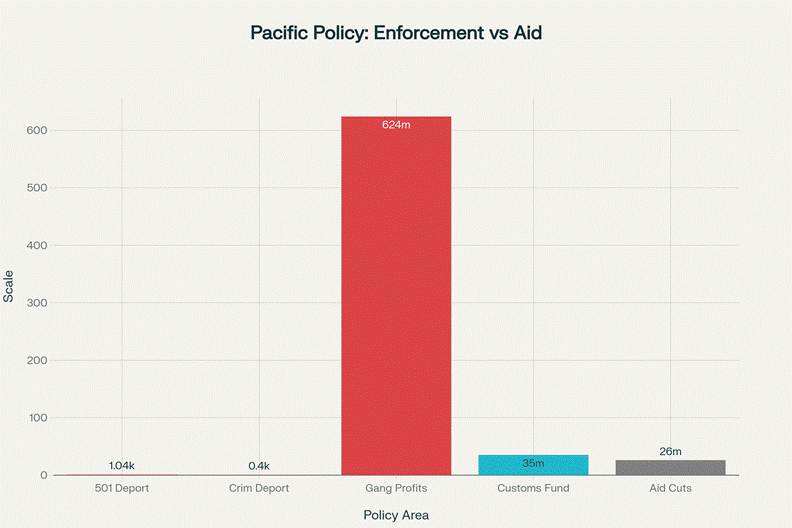
Chart showing how New Zealand’s neoliberal policies create harm in the Pacific through deportations and aid cuts while increasing enforcement spending.
Scapegoating Islands for Demand We Created
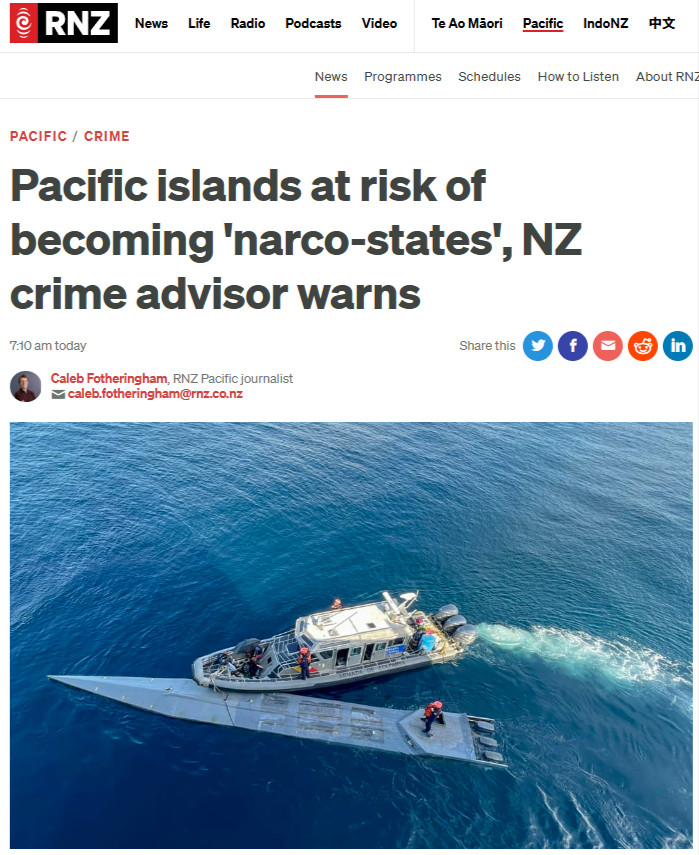
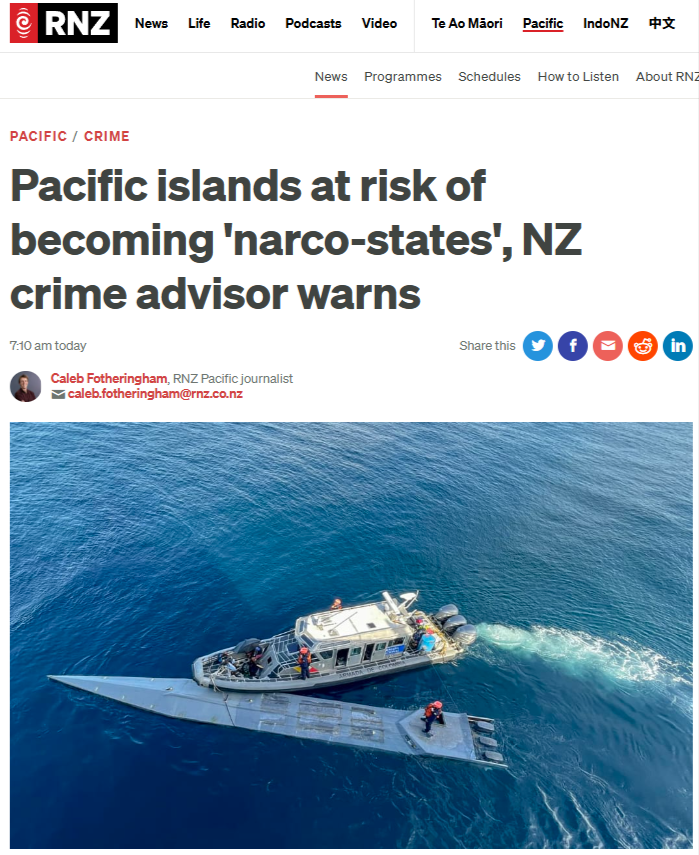
The October 31, 2025 RNZ article by Caleb Fotheringham deploys classic neoliberal misdirection. Steve Symon, chair of the Ministerial Advisory Group and senior partner at Meredith Connell law firm, warns that Fiji, Tonga, Samoa, and Rarotonga are “vulnerable because of their size and because of economic difficulties” and “at risk of becoming narco-states”. José Sousa-Santos from the University of Canterbury’s Pacific Regional Security Hub—funded by the UK Government—adds that “The Pacific would not have this drug problem or an issue with traditional organised crime, if it wasn’t for New Zealand’s and Australia’s drug markets and its hunger for illicit drugs”.
But notice what’s absent: any acknowledgment that New Zealand and Australia created this crisis through deportation policies, market demand, and economic exploitation. The article mentions the “moral obligation” to support the Pacific but frames it as border security—”our borders really reach there”. This isn’t manaakitanga; this is extractive paternalism wrapped in security theatre.
The logical fallacies are textbook:
Scapegoating: Pacific Islands are framed as the problem rather than victims of Australian and New Zealand policy failures.
Omitted context: No mention that 60 percent of 501 deportees are Māori/Pacific, revealing the racist architecture of these policies.
Savior complex: New Zealand positions itself as the solution while simultaneously cutting Pacific aid and exporting criminals.
The Network of Neoliberal Violence
Who Profits? The Money Trail
Casey Costello is the linchpin. A New Zealand First MP and former Taxpayers’ Union chairperson, Costello carries water for tobacco and now drug war industries. Documents reveal Philip Morris specifically targeted New Zealand First in 2017 to embrace heated tobacco products, and Costello—who was on the Taxpayers’ Union board—later cut excise taxes on these products at a potential cost of $216 million. She’s been twice rebuked by the Ombudsman for unlawfully withholding OIA information. This is corruption masquerading as policy.
The Ministerial Advisory Group she chairs is funded through the Proceeds of Crime Fund—a delicious irony, using seized criminal assets to fund reports that expand police and customs power rather than addressing root causes. The group delivered monthly reports from February to September 2025, culminating in a final report titled “Lead Boldly, Act Decisively: Tackling and Dismantling Organised Crime”. This document, obtained from Customs, warns organised crime is “one of the most significant threats” and recommends a dedicated TSOC Minister with centralised power—exactly the kind of authoritarian consolidation neoliberals adore.
Meanwhile, Pacific aid was slashed. The Ministry for Pacific Peoples received $6.4 million less annually in 2024, with funding stopped for the Pacific Business Procurement Support Service ($1.25 million yearly) and skills/training for Pacific peoples dropped from $18.3 million to $12.5 million. The message is clear: enforcement matters, people don’t.
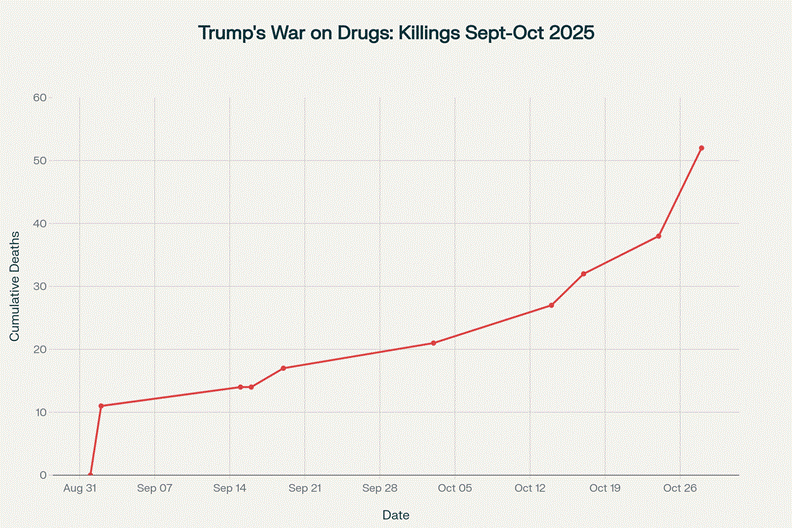
Cumulative death toll from Trump administration’s military strikes on alleged drug boats showing rapid escalation of extrajudicial killings.
The Seymour-Musk-Trump Axis: Deregulation as Domination
David Seymour’s Regulatory Standards Bill, passed first reading May 23, 2025, is New Zealand’s DOGE. Like Elon Musk’s Department of Government Efficiency—which Trump created by executive order to “slash excess regulations” and “cut wasteful expenditures”—Seymour’s bill establishes ideological “principles” that all future legislation must follow.
The parallels are chilling:
Unelected power: Seymour’s Regulatory Standards Board, appointed entirely by him as Regulation Minister, would review legislation against libertarian principles prioritizing private property and “personal liberties” over environmental protection, public safety, and Te Tiriti o Waitangi. Musk, a “special government employee” running DOGE, has gained access to federal payment systems and terminated contracts across agencies—enriching himself while claiming “transparency”.
Corporate capture: Seymour’s bill would require governments to pay corporations if new rules impact their property, even rules preventing pollution or protecting workers. Musk’s DOGE has already saved Tesla and his other companies billions by dismantling regulatory oversight.
Securitization: Both frame deregulation as protecting “individual freedom” while expanding state violence. Seymour’s bill erases Te Tiriti from law-making while his coalition partners militarize enforcement. Trump’s DOGE facilitates “mass layoffs” and agency dismantling while his administration bombs alleged drug boats—57 people killed in eight weeks without trials, evidence, or due process.
The Trump boat strikes deserve special attention because they reveal where this logic leads. Since September 2, 2025, the Trump administration has conducted at least 15 strikes on vessels in the Caribbean and Pacific, killing 57 people. Trump claims these boats carried drugs and were operated by “narcoterrorists” from groups like Venezuela’s Tren de Aragua, but he’s provided zero evidence. U.S. officials admitted anonymously that at least one boat appeared to be turning around when struck—undermining even the administration’s self-defense justification.
Trump deployed 10 warships, a nuclear submarine, F-35 jets, and the USS Gerald R. Ford aircraft carrier group to the region. Defense Secretary Pete Hegseth ordered strikes killing six on October 24 in a “night operation” and 14 more on October 28 across four boats in the Pacific. Pentagon lawyers raised concerns, but the White House claims Trump is waging “armed conflict” with drug cartels under the same authority used after 9/11—bypassing Congress entirely.
This is what happens when neoliberal deregulation meets militarized enforcement: extrajudicial execution, corporate immunity, and authoritarian power grabs justified through manufactured crises. Seymour’s bill is the legislative infrastructure for New Zealand’s version.
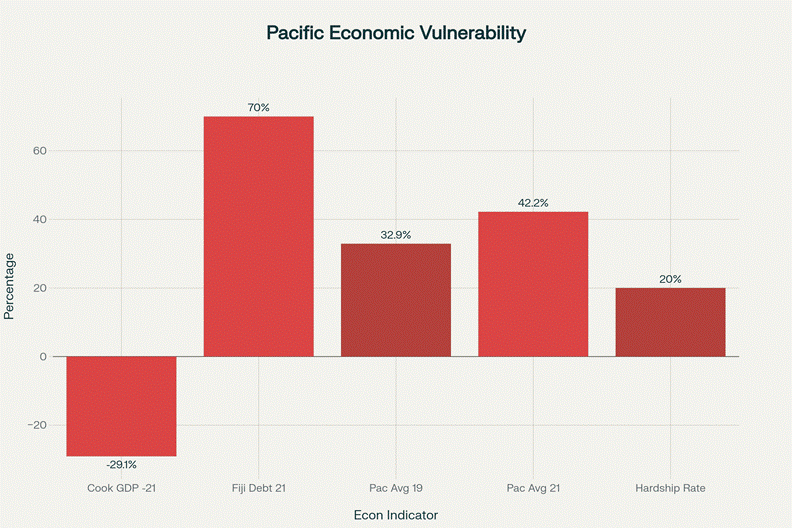
Chart showing Pacific Islands’ severe economic vulnerability through GDP contraction, debt crisis, and hardship rates that create conditions for organized crime infiltration.
Tikanga Violations: The Assault on Whanaungatanga and Manaakitanga
Every principle of tikanga Māori is violated by these policies:
Whanaungatanga (relationships/connection): Deportations sever whānau ties, dumping people into communities where they have no connection, creating isolation that drives crime.
Manaakitanga (care/hospitality): Cutting Pacific aid by $26 million while increasing enforcement by $35 million is the opposite of care—it’s abandonment dressed as security.
Kaitiakitanga (guardianship): We’re not protecting the Pacific; we’re poisoning it with our drug demand and then blaming islands for corruption we enabled through economic desperation.
Rangatiratanga (self-determination): The “Pacific-led, partner-supported” rhetoric is hollow when New Zealand controls funding, sets enforcement priorities, and deploys personnel without meaningful consultation.
Kotahitanga (unity): These policies divide Pacific communities by seeding criminal networks through deportations while demanding cooperation on enforcement.
Historical Pattern: Neoliberalism as Colonial Extraction
This isn’t new. The “war on drugs” has always been racialized control. In New Zealand, Māori face structural racism in policing and prosecution for drug offences. Pacific peoples face the same structural racism. The 501 deportation overrepresentation—60 percent Māori/Pacific—is deliberate ethnic cleansing by Australia.
Globally, drug prohibition creates profitable illicit markets that enrich organized crime and justify expanded state violence. The U.S. used the “war on drugs” to justify Plan Colombia, which privatized banks, increased homicides, and profited U.S. arms dealers. Plan Mexico followed the same playbook—militarization masked as drug enforcement that facilitated resource extraction for U.S. multinationals.
The Pacific faces the same extraction. Islands with debt-to-GDP ratios jumping from 32.9 percent (2019) to 42.2 percent (2021)—with Fiji at 70 percent-plus—are economically desperate. Over 20 percent of Pacific people live in hardship, unable to meet basic food and non-food needs. When a Tongan customs official earns low wages, supports extended family through cultural obligation, and faces intimidation from traffickers, corruption becomes survival.
New Zealand and Australia created these conditions. Neoliberal “reforms” in the 1980s-90s gutted Pacific economies through structural adjustment, free trade agreements that killed local industries, and debt traps. Then we deported criminals, flooded the region with drug demand, cut aid, and now militarize enforcement while framing islands as “at risk” of becoming narco-states.
Hidden Connections: Five Revelations
Hidden Connections: Five Revelations
- Casey Costello’s Tobacco-to-Drug War Pipeline: Costello was targeted by Philip Morris in 2017 while on the Taxpayers’ Union board, later cut tobacco taxes costing $216 million, was twice rebuked by the Ombudsman for withholding information, and now chairs the drug war advisory group recommending centralized enforcement power. This is regulatory capture converting tobacco profits into drug war budgets.
- José Sousa-Santos’ UK Funding: The Pacific Regional Security Hub at University of Canterbury, led by Sousa-Santos, receives UK Government funding and was established in November 2024. This is Western intelligence interests embedded in Pacific “security” research, shaping narratives that justify intervention.
- Steve Symon’s Corporate Connections: As senior partner at Meredith Connell, Symon represents government agencies and corporations in regulatory compliance—meaning he profits from the enforcement-industrial complex he’s now empowered to expand.
- The Seymour-Costello-Peters Triangle: Seymour’s Regulatory Standards Bill was a coalition agreement priority, Costello oversees drug enforcement expansion, and Winston Peters (who launched the “Pacific Reset” in 2018) now enables both while New Zealand First accepts tobacco lobbyist influence.
- The 501-Meth-Deportation Cycle: Methamphetamine prices dropped 36 percent from 2017-2024 as supply saturated the market, directly correlating with the 2015-2023 period when Australia deported 3,058 people to New Zealand under 501 provisions—many of whom connect to Pacific trafficking networks.
Implications: Quantified Harm and Threatened Rights
The human cost is staggering:
- 87,000 fentanyl deaths in the U.S. from October 2023-September 2024, with Pacific wastewater already showing traces
- 57 people killed by Trump’s boat strikes in eight weeks without trial
- 3,058 people deported by Australia since 2015, 60 percent Māori/Pacific
- 1,040 people deported by New Zealand to Pacific Islands (2013-2018), including 400 criminals
- $11-13 million in weekly gang profits from methamphetamine in New Zealand
- 70+ percent debt-to-GDP ratio in Fiji, up from 32.9 percent in 2019
- $26 million Pacific aid cut while $35 million added to enforcement
If this trajectory continues, we’re looking at Pacific Islands with corrupted institutions, militarized enforcement funded by Western powers, expanding drug markets driven by Australian/New Zealand demand, and zero investment in demand reduction, economic development, or community resilience.
Te Tiriti o Waitangi is under direct assault. Seymour’s Regulatory Standards Bill explicitly excludes Te Tiriti from its principles framework. This follows his Treaty Principles Bill—which failed but signaled intent. The coalition government’s anti-co-governance agenda, cuts to Māori wards, and 501 deportation impacts on Māori all reveal a coordinated attack on Indigenous sovereignty using neoliberal deregulation as the weapon.
Call to Action: Name the Criminals
We know who benefits from this crisis:
Casey Costello (Associate Police Minister, Customs Minister): Expand tobacco profits while militarizing drug enforcement. Demand her resignation and full OIA disclosure of tobacco industry connections.
David Seymour (ACT leader, Regulation Minister): Corporate deregulation enabling organized crime while erasing Te Tiriti. Oppose the Regulatory Standards Bill through select committee submissions.
Steve Symon (MAG chair, Meredith Connell partner): Profiting from enforcement expansion while recommending centralized TSOC power. Demand conflicts of interest disclosure and independent review of MAG recommendations.
Christopher Luxon (Prime Minister): Enabling Seymour and Costello while cutting Pacific aid.
Winston Peters (Deputy PM, Foreign Minister): Launched “Pacific Reset” in 2018 with increased aid, now presides over aid cuts and enforcement expansion.
Specific demands:
- Restore Pacific aid to 2023 levels with additional funding for community-led addiction support.
- End 501 deportations and establish pathways to citizenship for long-term residents in Australia.
- Implement demand reduction through evidence-based harm reduction approaches nationally.
- Reject the Regulatory Standards Bill entirely—no amendments can fix its neoliberal architecture.
- Establish Pacific-controlled enforcement frameworks where island nations set priorities and control budgets, not Wellington or Canberra.
- Investigate Casey Costello for regulatory capture, tobacco industry influence, and OIA violations.
- Condemn Trump’s boat strikes and demand New Zealand oppose U.S. militarization of the Pacific.
Solidarity is Survival

The Māori Green Lantern Fighting Misinformation And Disinformation From The Far Right
The “narco-states” panic is a lie designed to justify the policies that created the crisis. New Zealand and Australia’s demand for methamphetamine—where we pay 15-20 times global prices—floods Pacific Islands with drugs and organized crime. Our deportation policies seed criminal networks. Our aid cuts create economic desperation that enables corruption. And now we militarize enforcement, cut social support, and blame our Pacific whānau for problems we caused.
David Seymour’s Regulatory Standards Bill and Elon Musk’s DOGE are the same neoliberal playbook: deregulate for corporations, criminalize the poor, consolidate unelected power, and use manufactured crises to justify authoritarian control. Trump’s 57 extrajudicial killings in eight weeks show where this logic ends—state violence without evidence, trials, or accountability.
Our ancestors didn’t navigate Te Moana-nui-a-Kiwa to watch their descendants abandon Pacific whānau in manufactured crises. Whanaungatanga demands we recognize our shared humanity. Manaakitanga demands we care for the vulnerable, not militarize against them. Kaitiakitanga demands we protect our ocean, our islands, our people from this neoliberal violence.
The path forward is clear: Restore aid. End deportations. Invest in demand reduction. Reject Seymour’s deregulation. Support Pacific-led solutions. Name the real criminals—Costello, Seymour, Luxon, the corporate interests they serve—and organize to remove them from power before they export Trump’s bombing campaigns to our moana.
Kia mau ki te whakapono. Kia kaha te aroha.
If this mahi has helped you see through the lies, and you have the capacity and capability, please consider supporting this work through koha: HTDM: 03-1546-0415173-000. Only give if you can—solidarity doesn’t require money, it requires courage to name power and organize resistance.
Kia kaha, kia māia, kia manawanui.