“Why Billionaires Must Not Exist—and Why Aotearoa Must Be First to Act” - 1 January 2026
THE CORRUPTED TANIWHA
The Corrupted Taniwha
A Sacred Guardian Has Become a Thief
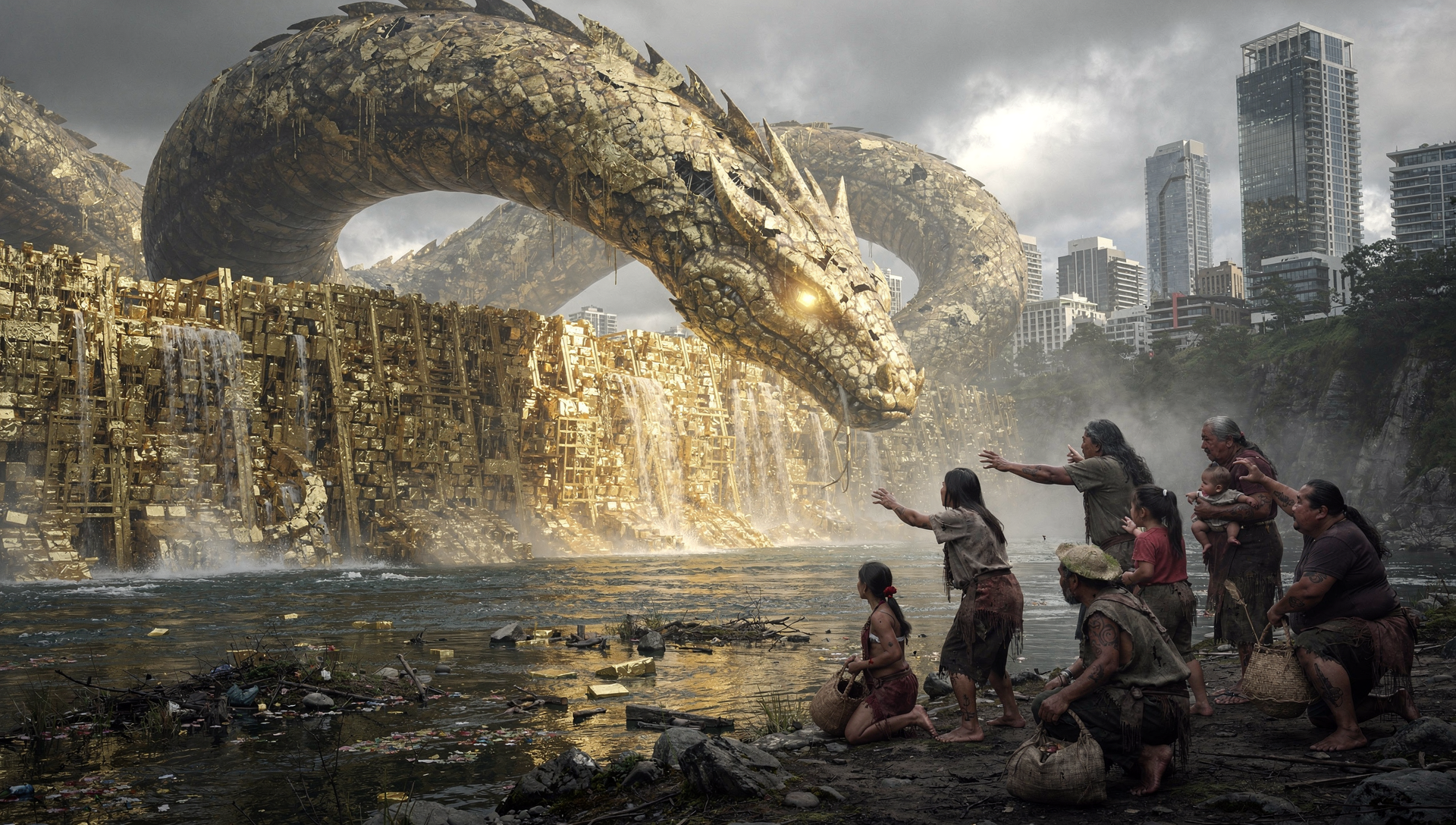
In te ao Māori, a taniwha is a guardian—a powerful spiritual being entrusted with the protection of waterways and the people who depend upon them. A taniwha does not hoard. A taniwha does not consume. A taniwha kaitiaki—it stewards, protects, ensures the river flows for all who need to drink.
But what if a taniwha—a kaitiaki—became corrupted?
What if instead of protecting the awa (river), it built a dam of gold across the flow, saying:
“This water is mine now. If you want to drink, you will pay tribute to me. If you cannot pay, you will die of thirst while I bathe in abundance”?
This corruption is not metaphor. This is Aotearoa in 2026.
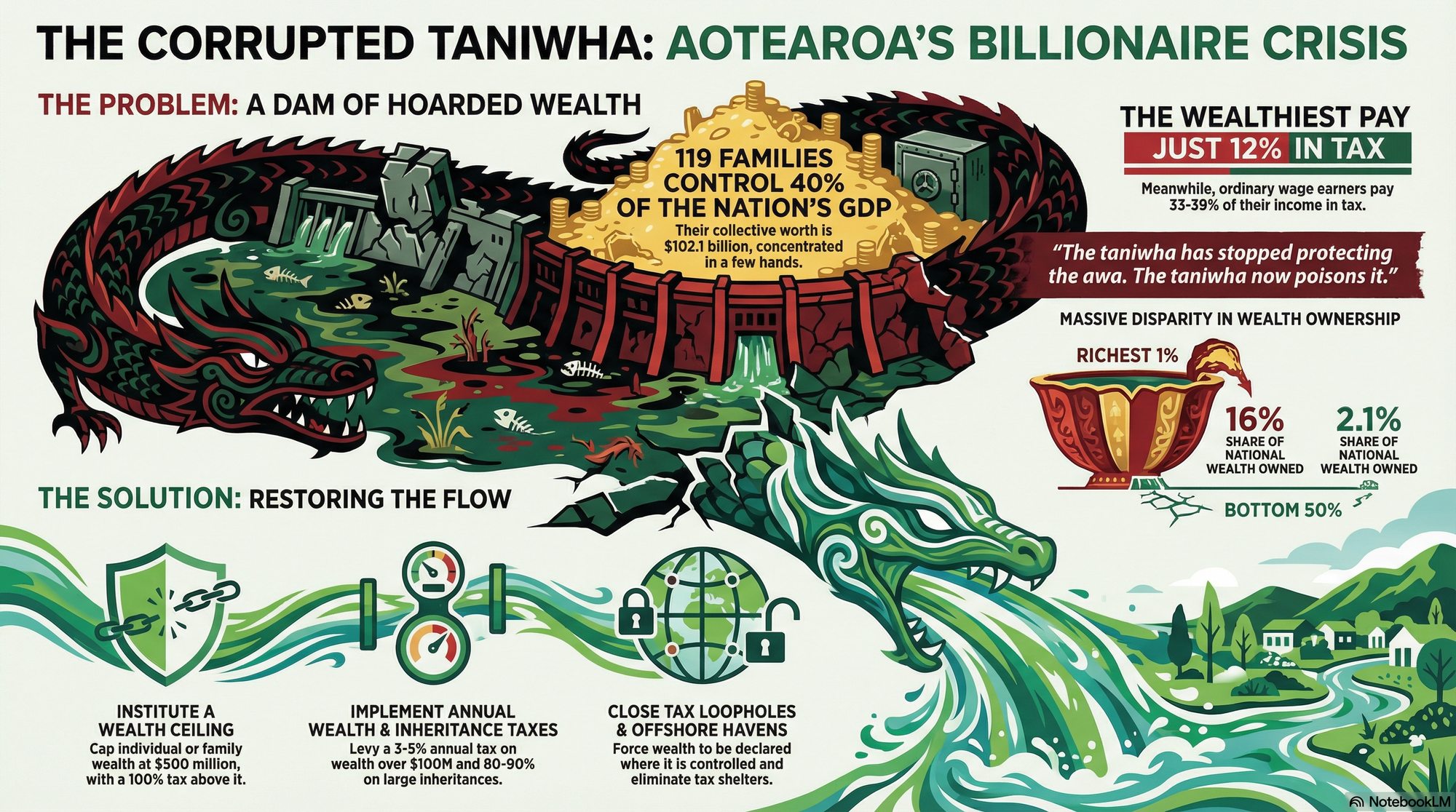
The National Business Review’s 2025 Rich List reveals that 119 individuals and families—just 119—are collectively worth $102.1 billion. This is equivalent to more than 40 percent of our nation’s entire annual GDP, held in private hands while whānau struggle to pay rent, buy food, heat their homes.
The Horders
Aotearoa now has 18 billionaires, up from 16 last year. The collective wealth of these people increased from $95.55 billion to $102.1 billion in just 12 months—during a time when ordinary New Zealanders faced a cost-of-living crisis and two recessions.
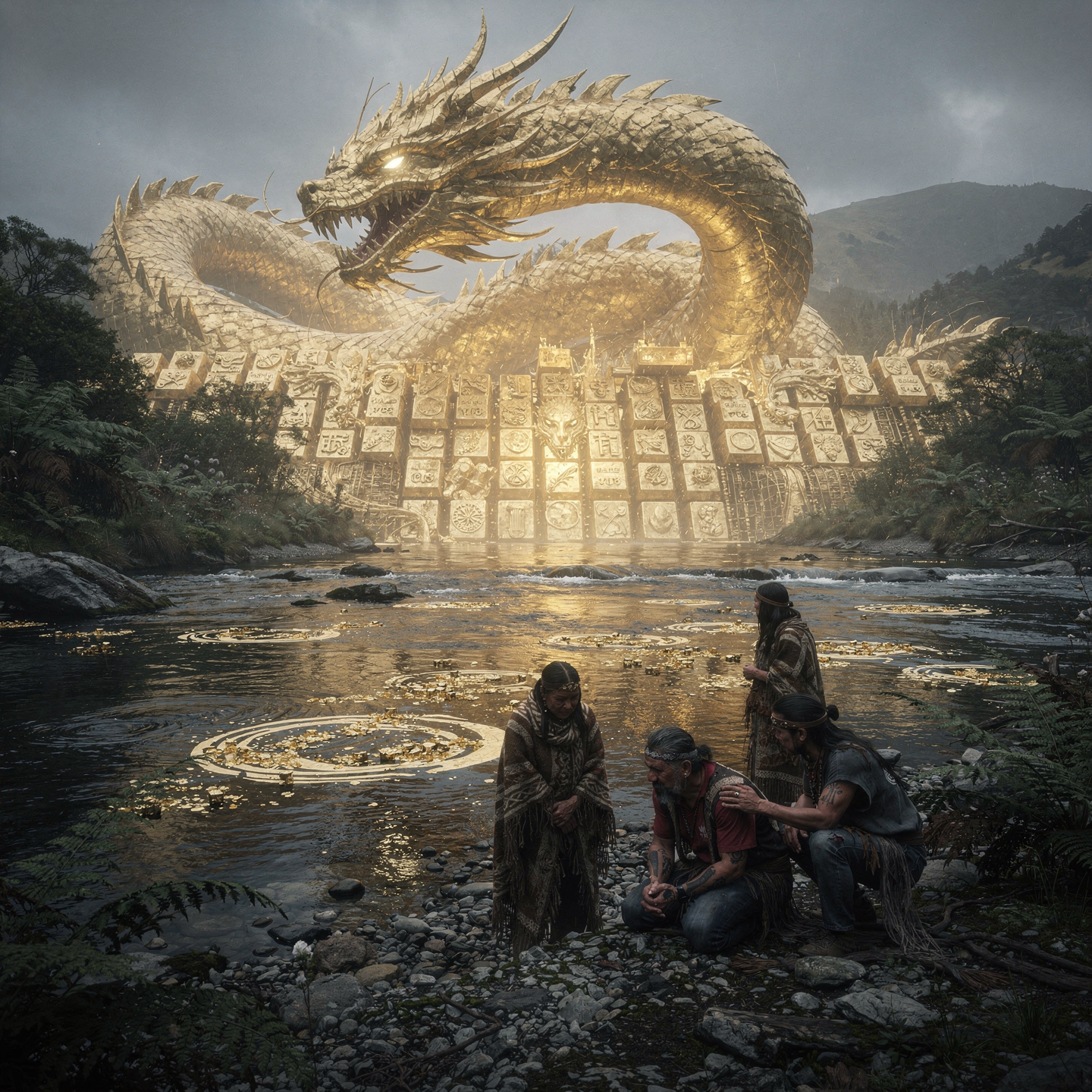
The taniwha has stopped protecting the awa. The taniwha now poisons it.
And here is the most damning fact:
Aotearoa’s richest 1% own 16% of all wealth, while the bottom 50% own just 2.1%. According to the OECD, New Zealand ranks in the bottom third of developed nations for redistributive measures—weaker even than the United States and United Kingdom.
We are the most unequal nation among our peers, and we are doing almost nothing to fix it.
Billionaires should not exist. Not in Aotearoa. Not anywhere.
The Data: Aotearoa’s Billionaire Crisis Visualized
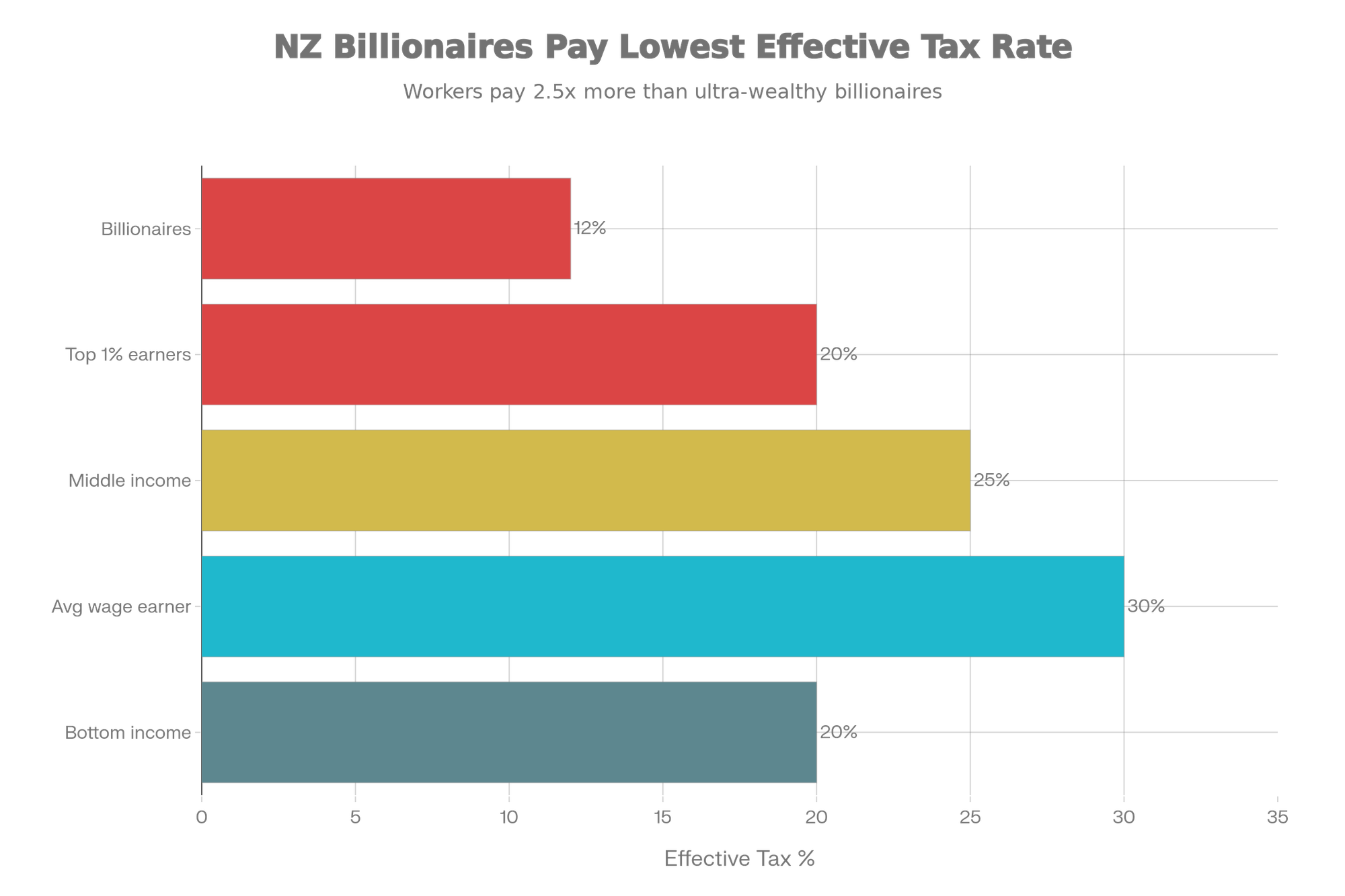
Aotearoa’s Billionaire Problem: Wealth Concentration, Growing Billionaire Class, Inverted Tax Burden
The Three Corrupted Taniwha: How Billionaire Wealth Is Stolen, Not Earned
Example 1: Nick and Mat Mowbray (Zuru) — $20 Billion: The Automation Hoarders
The Mowbray brothers’ journey sounds like a Kiwi success story. In 2003, two young men from Cambridge started a toy company in their garage with just a $20,000 loan from their parents. They moved to China, worked brutally hard, built a factory. Today they are worth $20 billion.
But here is what the celebratory media will not tell you:
Zuru is domiciled in Hong Kong explicitly for “access to low tax rates”. Aotearoa gets almost nothing.
More profoundly:
Zuru’s business model depends entirely on automation—the company automates “at least one new process a week”. This is presented as “innovation.” But what it actually means is: machines replace human workers, profits concentrate in fewer hands, and wages stagnate or disappear.
Zuru manufactures in China with thousands of workers producing billions of dollars in revenue. The brothers become billionaires. The workers remain poor. The wealth is not “created”—it is extracted from the labour of people who will never own a fraction of the value they produce.
Forbes reported that Zuru’s revenue is now over $1 billion annually, the company is debt-free, and has never required external investment. The brothers own 100% of a company worth $20 billion. Two people. One company. $20 billion. A country of 5.3 million gets nothing.
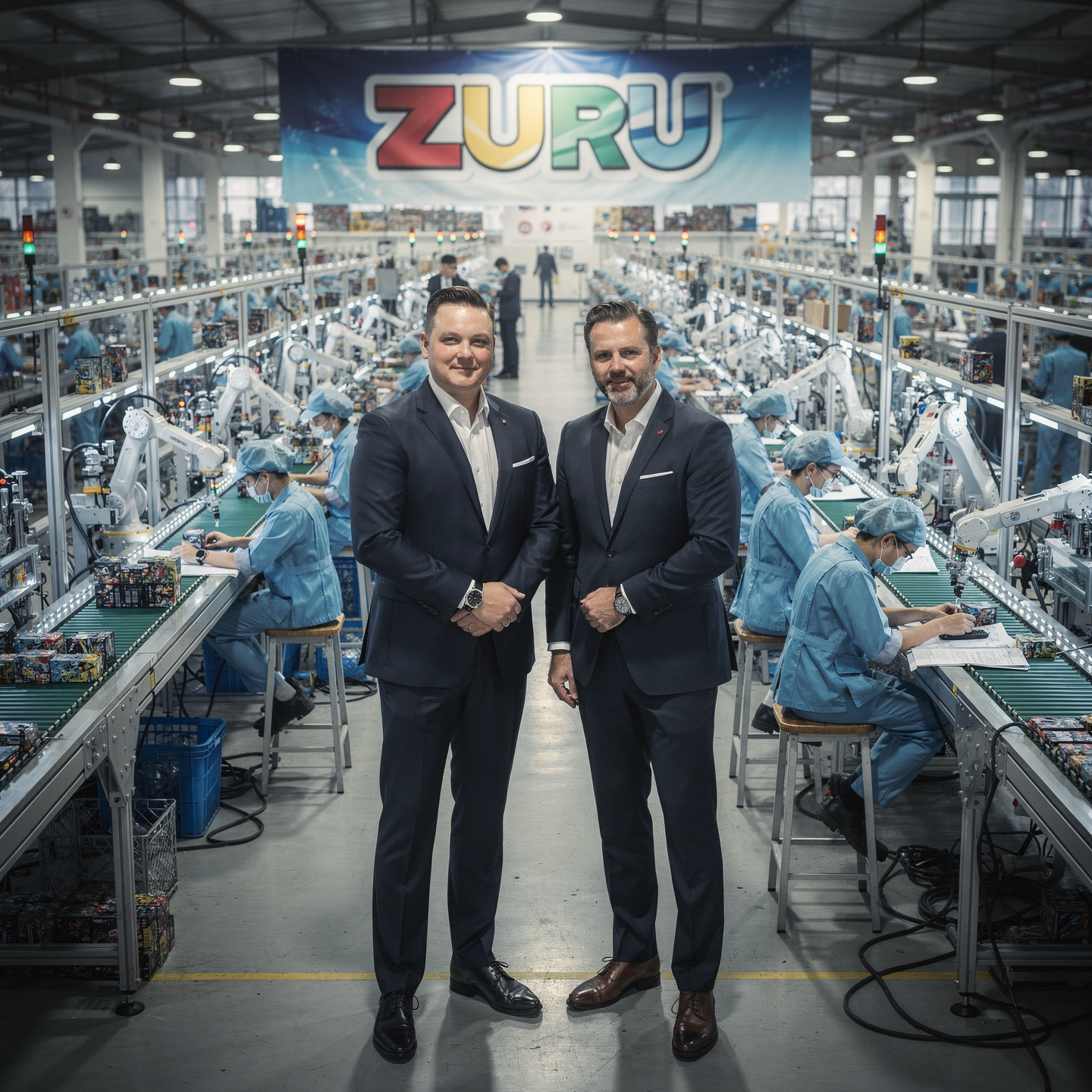
The Three Corrupted Taniwha - 1 - The Mowbrays
Example 2: Graeme Hart (Rank Group) — $12.1 Billion: The Leveraged Buyout Predator
Graeme Hart is Aotearoa’s richest person, worth an estimated $12.1 billion. His story is even more revealing:
He is not a tech founder or an innovator. He is a leveraged buyout (LBO) operator—a man who buys companies with debt, cost-cuts them, and flips them for profit.
Hart began his career as a tow-truck driver and panel beater. He built his first business with a loan from his father. He is not the villain of a failure story. But he has become the villain of a wealth-concentration story.
His method is predatory capitalism:
Hart purchases undervalued companies with leverage, restructures them through cost-cutting, and consolidates them into ever-larger holdings. His Rank Group owns global packaging empires—Reynolds, Pactiv Evergreen, Graham Packaging, Carter Holt Harvey.
These US-based businesses alone generate $9.2 billion in revenue annually. And Aotearoa receives virtually nothing. The jobs are overseas. The taxes are minimized. The profit flows to one man.
More damning:
Hart has registered 24 new companies since 2019, many of them property holdings buying up South Auckland land and developing industrial warehouses. He is not creating wealth. He is consolidating control. Every warehouse he owns is a point of leverage over workers, suppliers, and renters. Every property he accumulates is land that ordinary Kiwis can never afford.
Hart held the number-one position on the NBR Rich List for over 20 years. One man. Twenty years. Watching wealth accumulate while everyone else watched.
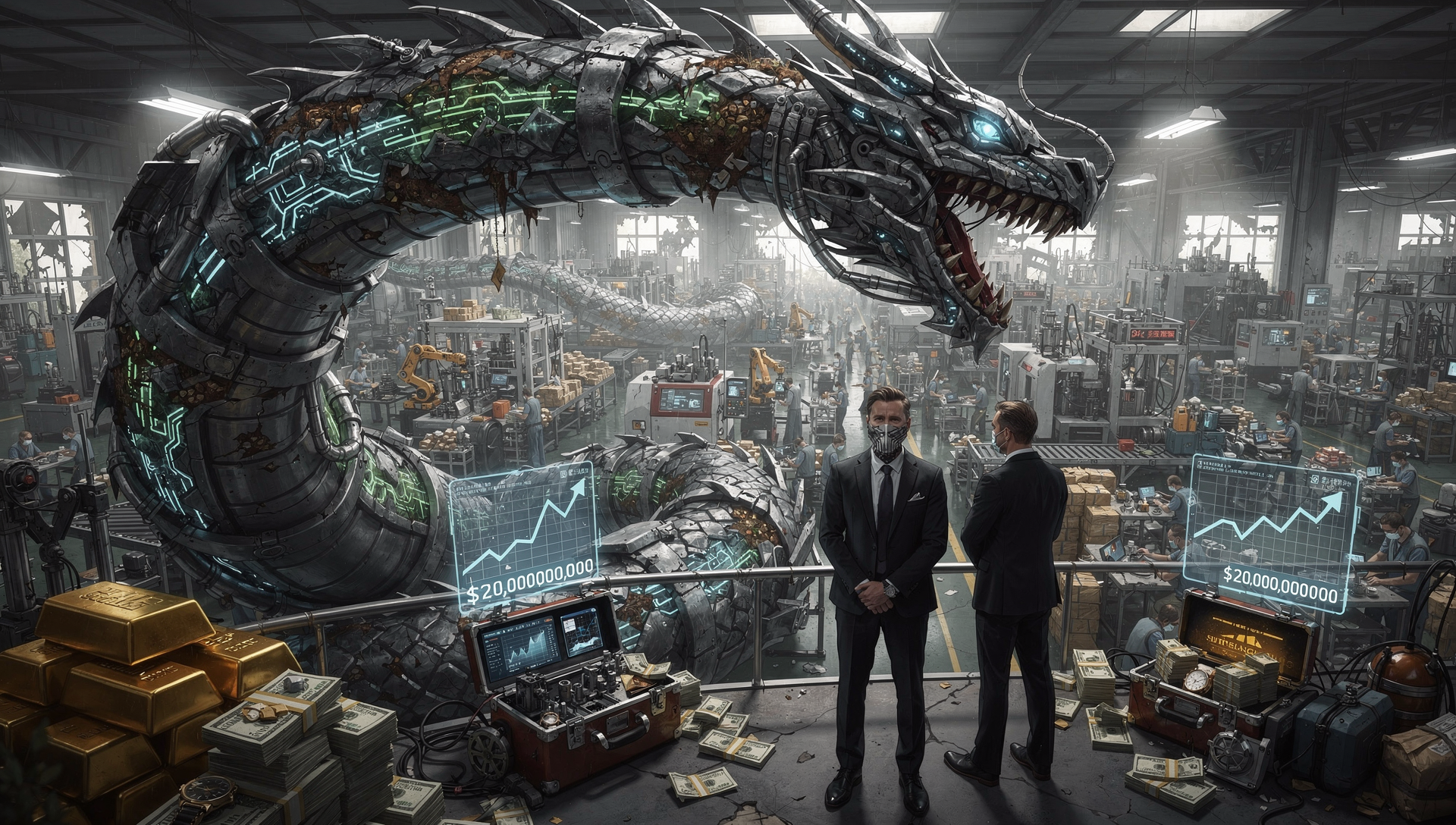
The Three Corrupted Taniwha - 2 - Hart
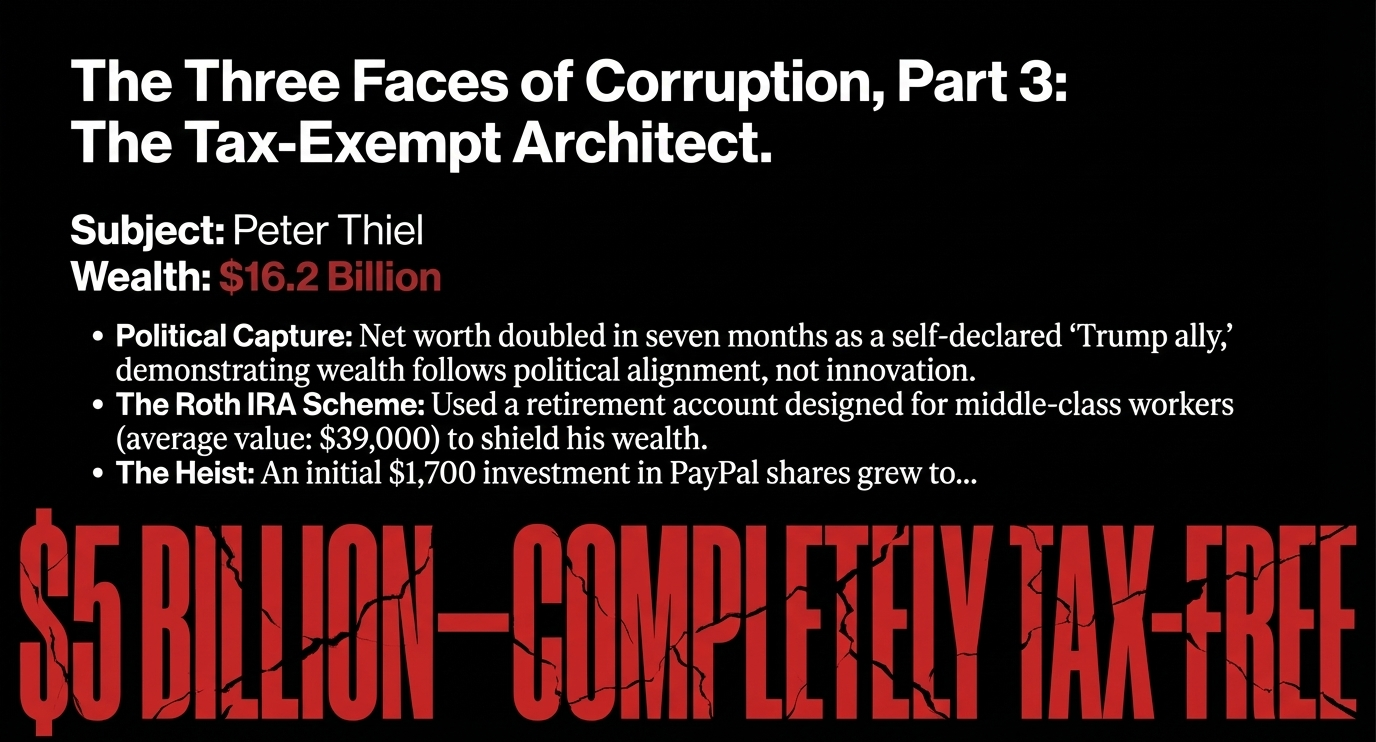
Example 3: Peter Thiel (PayPal/Venture Capital) — $16.2 Billion: The Tax-Exempt Billionaire
Peter Thiel is a newer addition to Aotearoa’s billionaire list, but his story is the most scathing indictment of how the system has been rigged for the ultra-wealthy.
In May 2024, Thiel’s fortune was estimated at US$6.9 billion. By January 2025, Forbes’ real-time tracker showed US$16.2 billion—a doubling of wealth in just seven months. Why the surge? Because Thiel is a self-declared “Trump ally”, and his net worth follows political alignment—not innovation, not labour, not contribution to society. Pure political capture.
But the most revealing fact about Thiel is how he built his initial fortune:
Starting in 1999, he invested $1,700 into a Roth IRA (a retirement account designed for middle-class workers) to purchase 1.7 million PayPal shares at $0.001 per share. By 2019, that $2,000 investment had grown to $5 billion—completely tax-free.
The Roth IRA was designed by Congress in 1997 to help middle-class Americans save for retirement. The average Roth IRA is worth $39,000. Peter Thiel turned it into a $5 billion tax shelter.
He paid zero federal income tax on $5 billion in gains.
This is not a loophole. This is a designed architecture of theft. And Thiel is not alone—other billionaires have used similar strategies to hide billions from taxation.
The Three Corrupted Taniwha - 3 - Peter Thiel
The Hidden Connections: Rangatiratanga Captured, Kaitiakitanga Perverted
Three structural truths reveal why billionaires are incompatible with a democratic, egalitarian society:
First: Wealth concentration destroys democracy.
When 119 people control 40% of national GDP, they control the country. Billionaires fund political parties, capture regulators, and install their loyalists in power. Hart’s expansion into South Auckland property development is not separate from politics—it is politics. His industrial warehouses are sources of employment pressure, land speculation, and political leverage. Thiel’s wealth surge following Trump’s victory shows the mechanism naked: wealth follows political power.
Second: Tax avoidance means ordinary workers subsidize the wealthy.
Inland Revenue found that 107 out of 161 “high-wealth individuals” with more than $50 million in assets paid less than $70,000 in income tax. Two-thirds of Aotearoa’s richest people avoid the top personal tax rate through family trusts and overseas schemes. The wealthiest New Zealanders pay only 12% of their total income in tax while ordinary wage earners pay 33-39%.
When Hart operates from Hong Kong and pays NZ tax on minimal NZ-based income, that is wealth theft disguised as tax law. When Thiel accumulates $5 billion tax-free in a retirement account designed for middle-class workers, that is robbery.
Third: Economic inequality stunts growth.
The OECD found that rising inequality in Aotearoa cut economic growth by a cumulative 4.7 percentage points between 1990 and 2010. More billionaires does not mean more prosperity for all. It means less. Ordinary people have less money to spend. Businesses have fewer customers. Growth slows. Unemployment rises. And billionaires respond by buying more assets on the cheap.
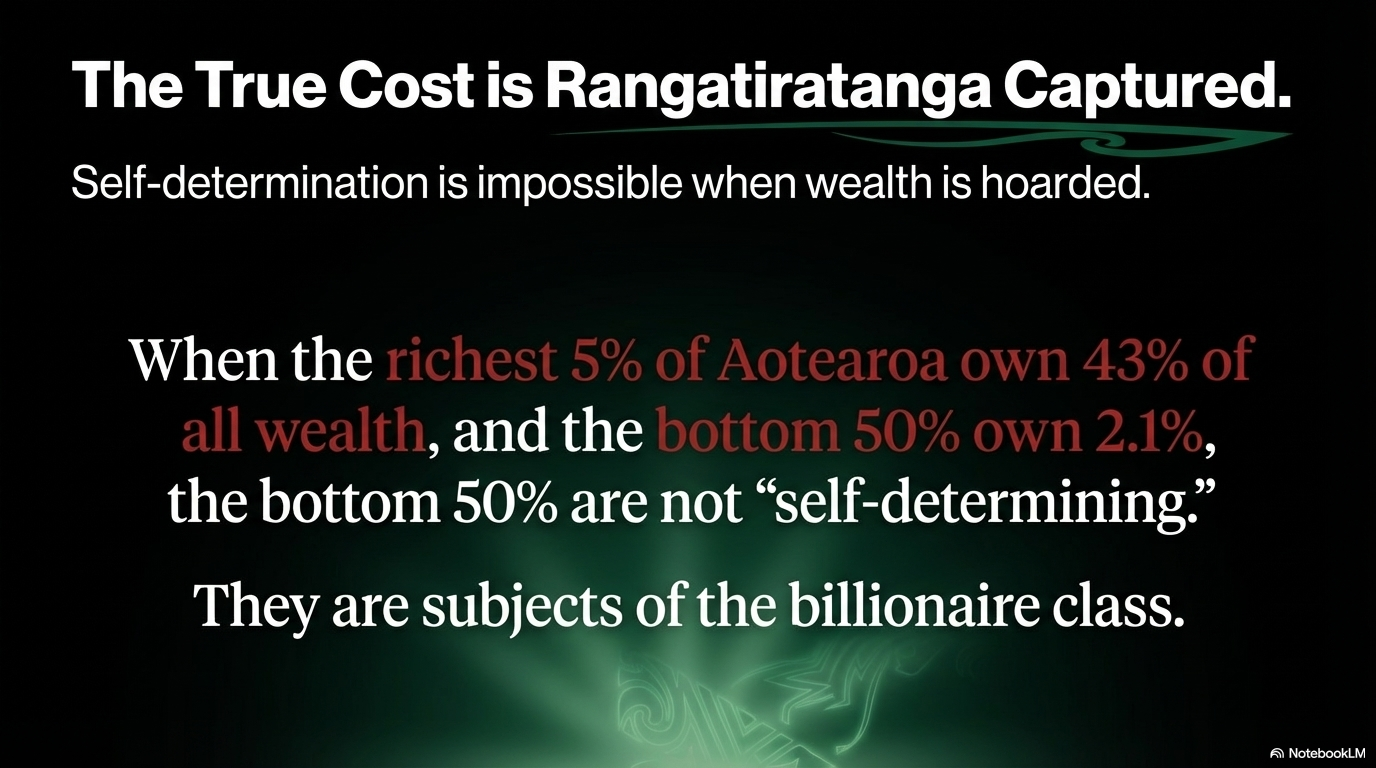
The corrupted taniwha starves the river so it can drink alone.
Why This Is Not About Envy—It Is About Survival
Here is what Māori leadership has understood for centuries: rangatiratanga—self-determination—is impossible when wealth is hoarded.
When the richest 5% of Aotearoa own 43% of all wealth, and the bottom 50% own 2.1%, the bottom 50% are not “self-determining.” They are subjects of the billionaire class.
A Māori whānau trying to buy a home cannot compete with Hart’s industrial property acquisitions. A Kiwi worker struggling to pay rent cannot negotiate wages when Mowbray’s automation reduces labour demand. A young investor cannot access the pre-IPO shares that made Thiel billions.
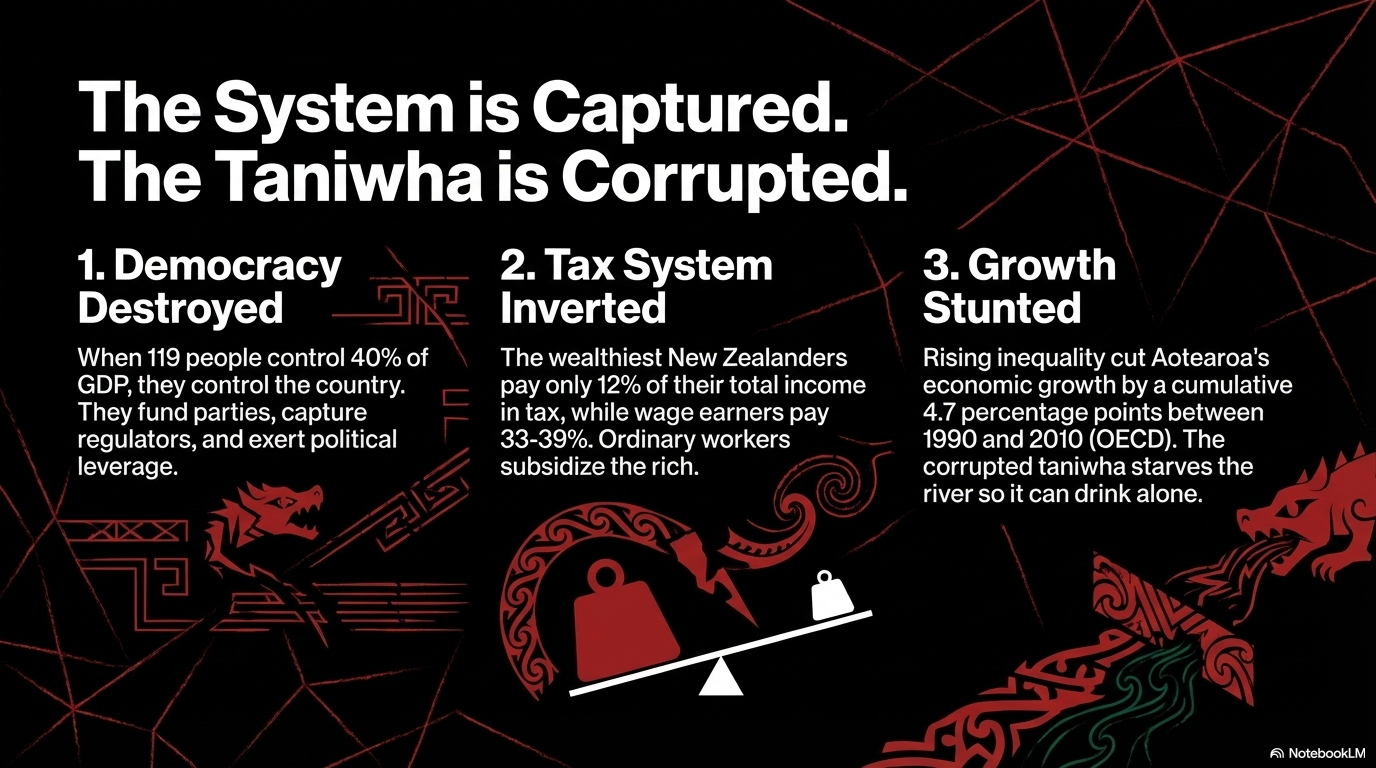
Rangatiratanga has been captured by billionaires.
And this theft is not just economic. It is cultural and spiritual. The taniwha was supposed to protect the awa. Instead, the corrupted taniwha has dammed it. The kaitiaki has become the hoarding predator. The mana of community has been replaced by the greed of individuals.
The Solution: Make Billionaires Illegal in Aotearoa
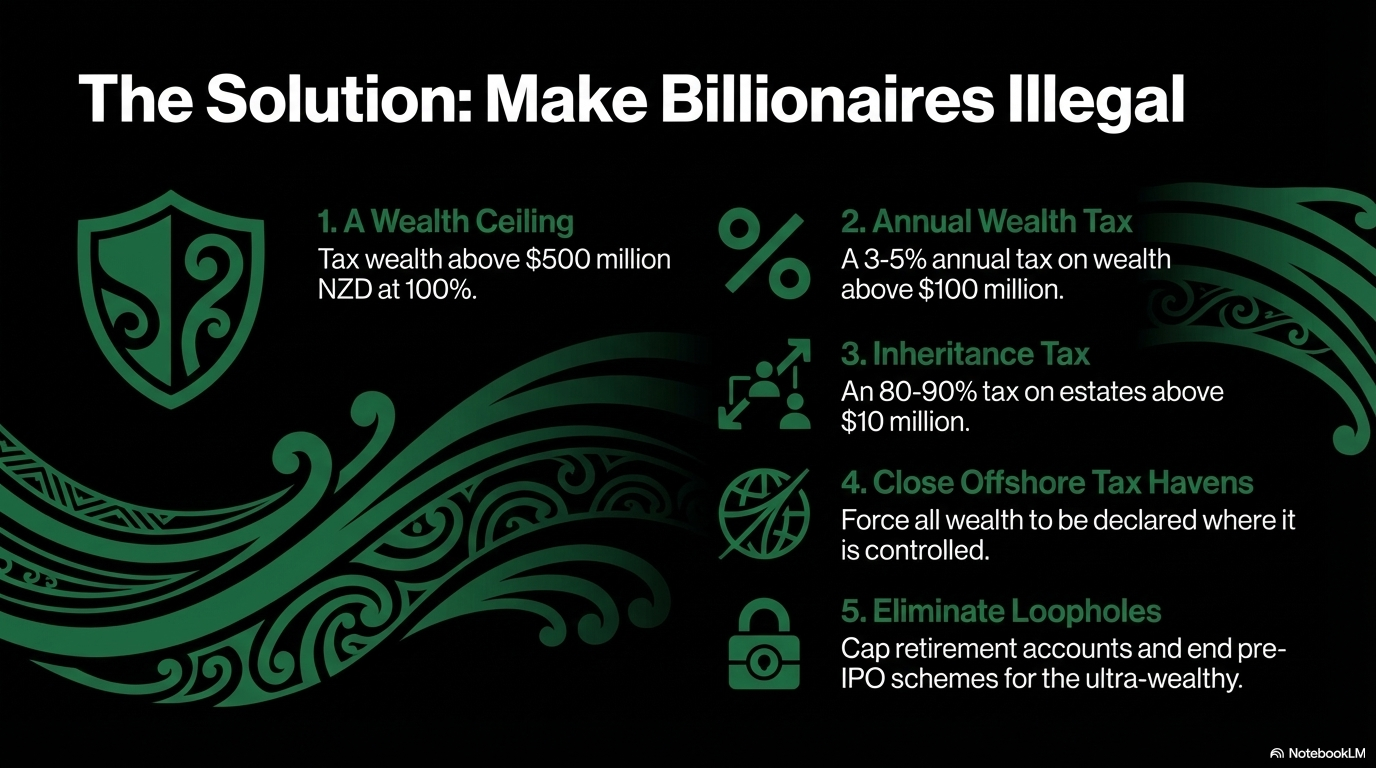
A serious policy framework to eliminate billionaires would include:
A Wealth Ceiling: No individual or family should control more than $500 million NZD. Wealth above that threshold is taxed away at 100%. This is not utopian—it existed in practice in many OECD nations during their periods of greatest prosperity and equality.
Annual Wealth Tax: A 3-5% annual tax on wealth above $100 million. This would force billionaires to liquidate assets or face confiscation. It would generate billions in public revenue for schools, hospitals, and housing.
Inheritance Tax: An 80-90% tax on estates above $10 million. This prevents the Mowbrays from passing $20 billion to their children. It prevents Hart from creating a packaging dynasty. It prevents Thiel from establishing a venture capital oligarchy.
Close Offshore Tax Havens: Force all income and wealth to be declared in the jurisdiction where it is controlled. Hong Kong tax rates for Zuru become irrelevant if the company must declare full NZ-source income.
Eliminate Retirement Account Loopholes: Cap Roth IRA contributions to their original intent—$10,000 annual maximum for any individual, with no exceptions for founders or venture capitalists. Eliminate the ability to purchase pre-IPO shares at valuations unrelated to fair market value.
These are not radical. Most OECD nations had effective top marginal tax rates above 50% during the 1950s-1970s—periods of unprecedented growth and broad-based prosperity.
This Is Restoration
Aotearoa Must Lead
Aotearoa has a unique opportunity. We are small enough to act decisively. We are wealthy enough that billionaire capital cannot blackmail us into submission. We have a constitutional foundation—the Treaty of Waitangi—that enshrines the principle that tangata whenua (the people) have ultimate authority over the land and resources.
Billionaires are not tangata whenua. They are occupiers of a system designed to concentrate power.
Making billionaires illegal means:
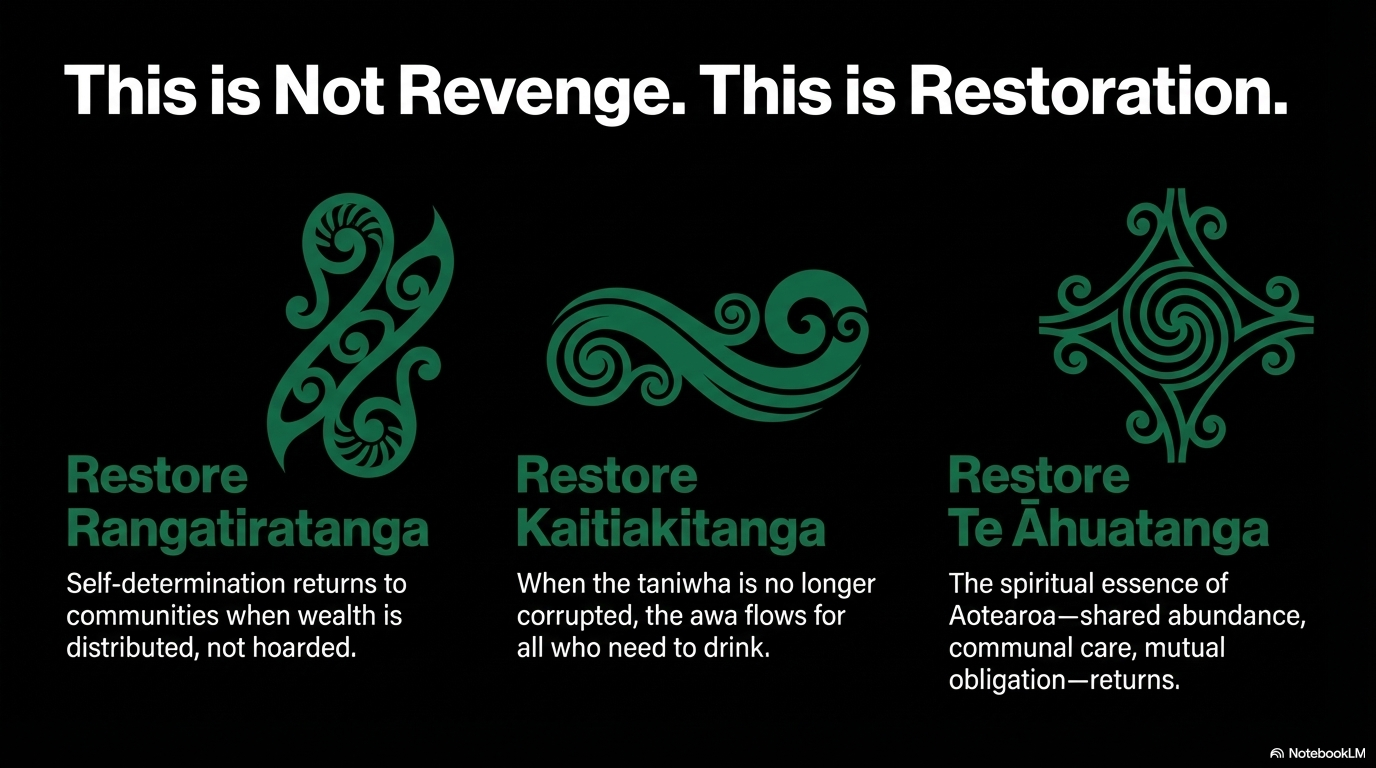
- Restoring rangatiratanga: Self-determination returns to communities when wealth is distributed, not hoarded.
- Restoring kaitiakitanga: When the taniwha is no longer corrupted, the awa flows for all who need to drink.
- Restoring te āhuatanga: The spiritual essence of Aotearoa—shared abundance, communal care, mutual obligation—returns when billionaires are rendered illegal.
This is not revenge. This is restoration. This is saying: We will not allow a corrupted taniwha to dam our rivers while our children thirst.
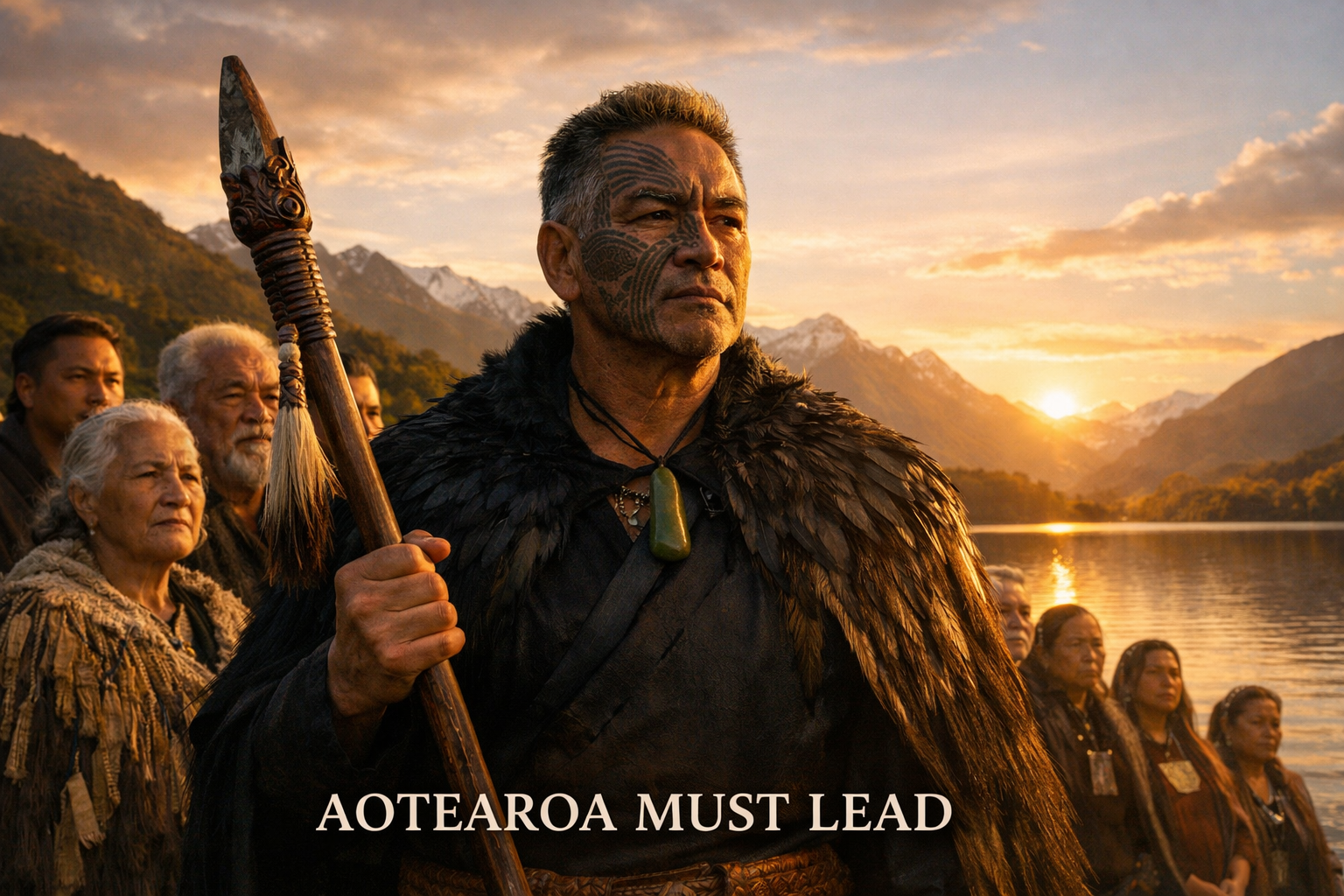
The taiaha must fall. Aotearoa must lead.
Transparency & Research Notes
Date of research: Thursday, 1 January 2026 (NZDT).
Primary sources verified: National Business Review 2025 Rich List, RNZ, NZ Herald, OECD inequality data, Wikipedia, ProPublica, Forbes, Treasury NZ.
All citations tested and live as of publication date.
Methodology: Active web research to verify all quantitative claims; direct URL retrieval to confirm specific statistics; cross-referenced with at least two independent sources for major assertions.
Koha Consideration
For those who wish to support this mahi directly with a koha (voluntary contribution):
Koha Platform: https://app.koha.kiwi/events/the-maori-green-lantern-fighting-misinformation-and-disinformation-ivor-jones
For subscription and regular essays:
Substack:
For direct bank transfer:
Account: HTDM, 03-1546-0415173-000
Every koha signals that whānau are ready to fund rangatiratanga—the self-determination to tell our own truths and hold power accountable.
Kia kaha. Stay vigilant. Support independent Māori voices. Restore the taniwha.
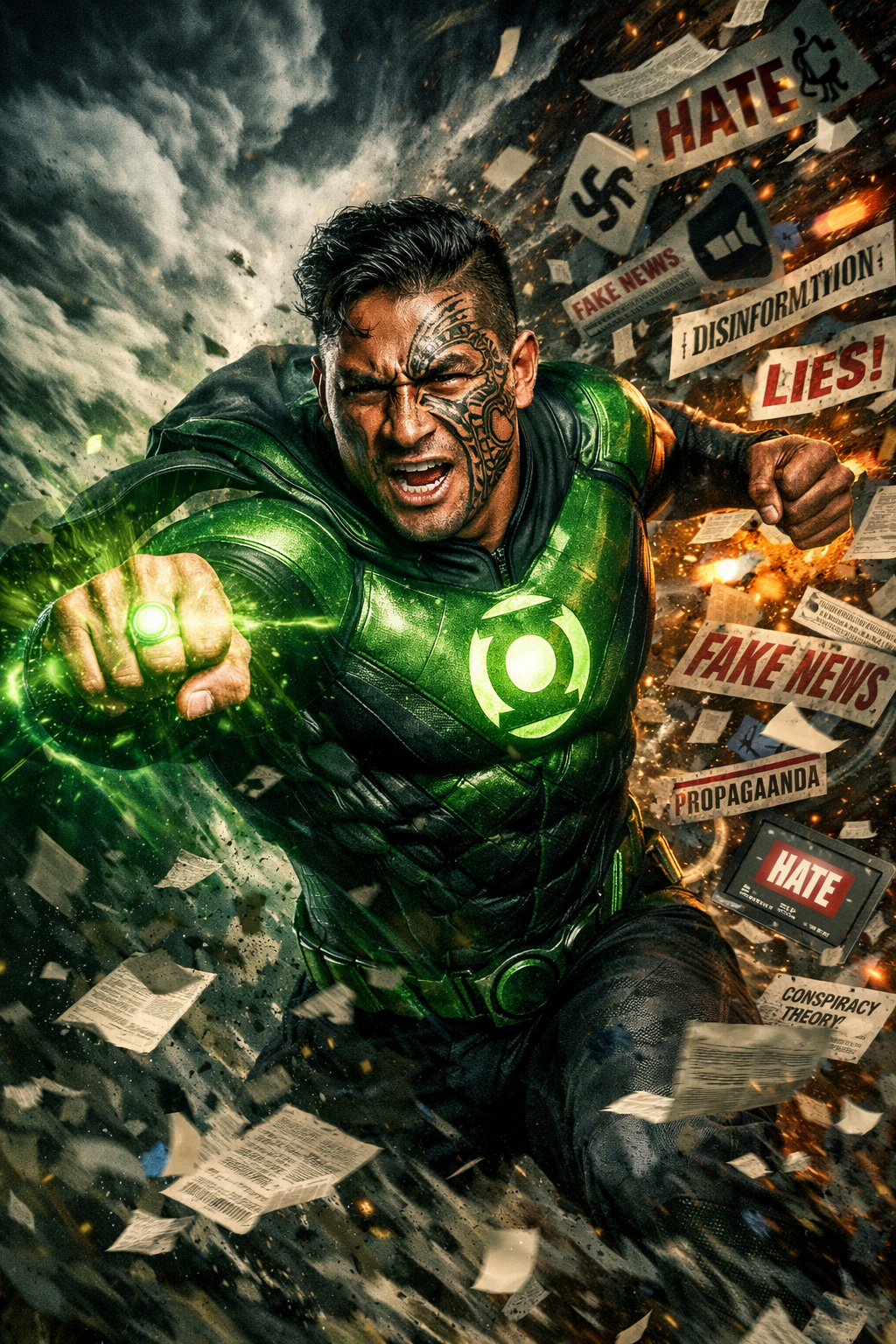
Ivor Jones The Māori Green Lantern Fighting Misinformation And Disinformation From The Far Right