“Winston Peters, Pike River, and the Coalition’s Mauri-Depleting Assault on Worker Safety” - 20 November 2025
“A Murder Scene”
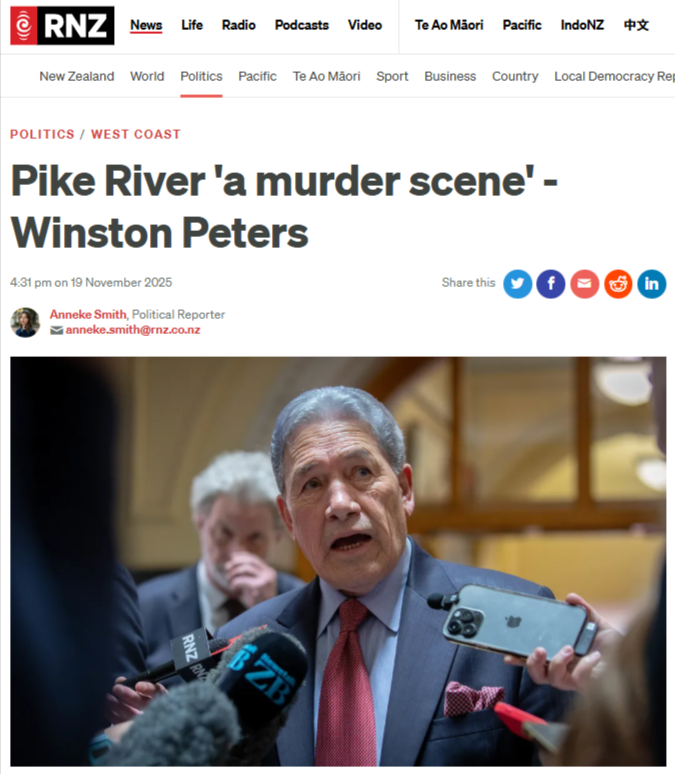
On the fifteenth anniversary of Aotearoa’s worst mining disaster in a century, New Zealand First leader Winston Peters wielded language as sharp as the taiaha itself: Pike River is “a murder scene”(28). His words, spoken on 19 November 2025 after meeting with grieving whānau at Parliament, slice through fifteen years of obfuscation, half-measures, and a justice system that has spectacularly failed to hold anyone criminally accountable for twenty-nine preventable deaths(12)(22). Yet Peters’ declaration arrives in a moment of bitter irony: his own coalition partner, ACT’s Brooke van Velden, is systematically dismantling the very workplace safety protections that emerged from Pike River’s ashes(67).
This essay traces the hidden whakapapa of workplace death in Aotearoa—from the methane-choked tunnels of Pike River to the present-day gutting of WorkSafe—exposing how the coalition government’s ACT-driven “reforms” are reverting us to the regulatory vacuum that killed twenty-nine men. More crucially, it centers what mainstream discourse erases: the disproportionate mauri-depleting harm inflicted on Māori workers, who die at work at rates 1.5 to 1.67 times higher than non-Māori(83)(91), face 30-31% higher serious injury rates(93), and endure 103 injury claims per 1,000 full-time workers compared to 83 for non-Māori(97). When Peters calls Pike River a murder scene, he speaks a truth the Crown has spent fifteen years trying to bury. This is about cui malo—who is harmed. And the answer, consistently, is Māori workers and their whānau.
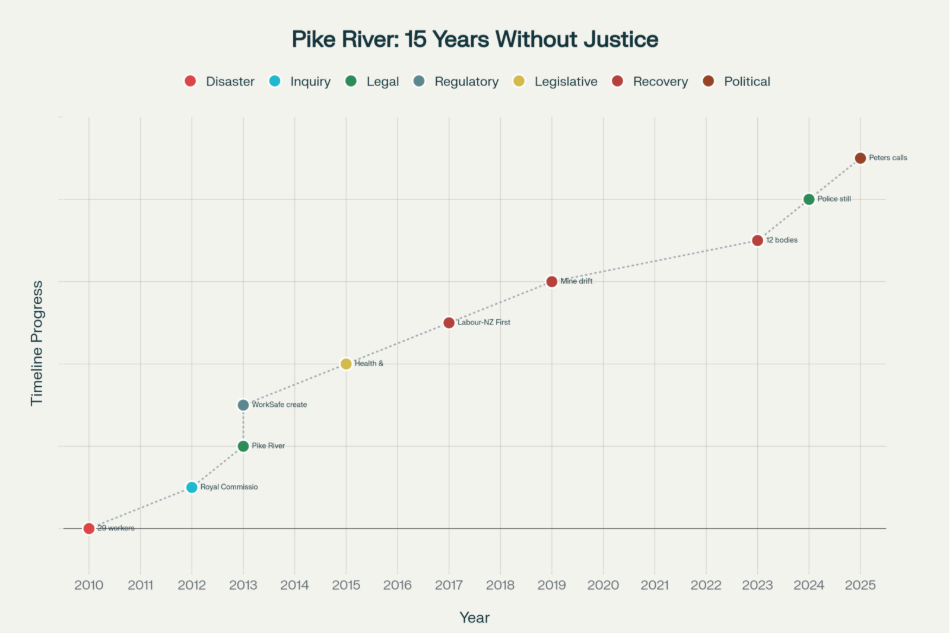
15 Years of Pike River: From Disaster to “Murder Scene” - A Timeline of Failure and Fight for Justice
Te Kauwae Runga: The Unseen Forces That Killed Twenty-Nine Men
The Royal Commission’s Verdict: A Preventable Tragedy
At 3:44 pm on 19 November 2010, an explosion ripped through the Pike River coal mine, 46 kilometers northeast of Greymouth(22)(26). Twenty-nine men—miners and contractors working deep underground—died instantly or soon after from the blast and toxic atmosphere(19). Two men escaped. Subsequent explosions on 24, 26, and 28 November ended any hope of rescue and sealed the mine, with bodies still inside(22). Their names, read aloud each anniversary, are a roll call of fathers, sons, husbands: Joseph Dunbar, 17 years old, on his first shift underground; Keith Valli, 62; Malcolm Campbell and Peter Rodger from Scotland; Joshua Ufer and Zen Drew, both 21(19).
The 2012 Royal Commission of Inquiry delivered an unrelenting verdict: Pike River Coal Ltd operated a mine with “multiple operational and systemic issues”(111)(114). The company prioritized production over safety, rushing toward coal extraction despite inadequate methane drainage, non-functioning gas sensors, flawed electrical and ventilation design, and inaction on hazard warnings(111)(118). Most damningly, Pike River was probably the only mine in the world with its main ventilation fan sited underground—a catastrophic design flaw that violated international best practice(111). The mine’s vision—a 2.3-kilometer tunnel driven uphill through solid rock with no alternative exit for ventilation or escape—”ignored international coal-mining experience”(111).
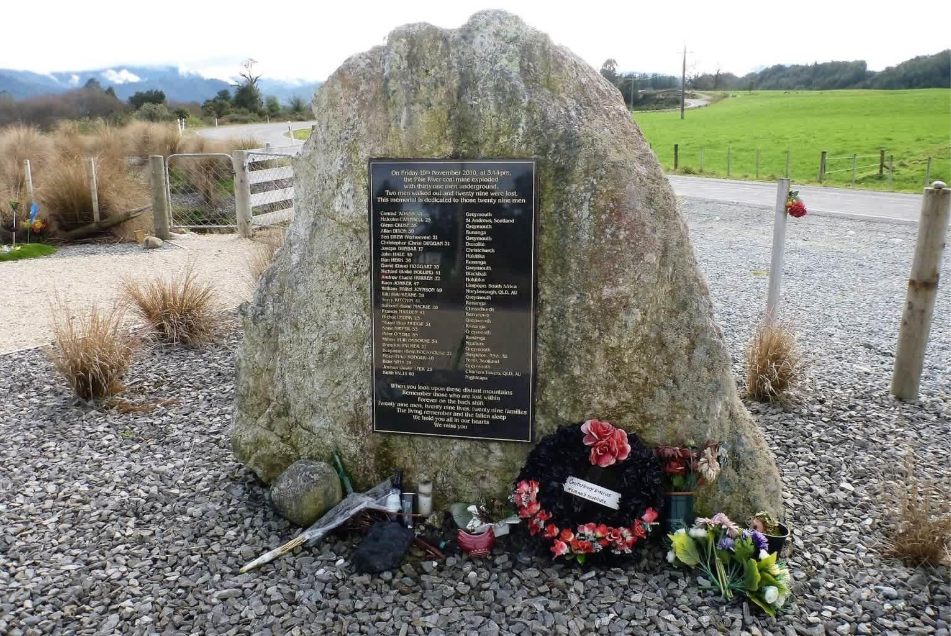
memorial plaque on a boulder at an outdoor site with floral tributes
But the Royal Commission went further, identifying systemic regulatory failure across successive governments(114). By 2010, New Zealand had only two mine inspectors for the entire country—down from adequate levels as a result of progressive deregulation since 1992(100)(111). The Department of Labour “did not have the focus, capacity or strategies to ensure that Pike was meeting its legal responsibilities under health and safety laws”(118). Government regulators assumed Pike River was complying with the law, even though there was ample evidence to the contrary(118). Prime Minister John Key, in accepting the findings, apologized “for the role this lack of regulatory effectiveness played in the tragedy”(114). Labour Minister Kate Wilkinson resigned(114).
This was not an accident. Judge Jane Farish, sentencing Pike River Coal in 2013, found “a systematic failure of the company to implement and audit its own (inadequate) safety plans and procedures”(111). Rebecca Macfie, award-winning journalist and author of Tragedy at Pike River Mine, is unequivocal: “An accident implies that there’s no fault and that was not the case here”(43). The company was “literally incompetent,” “literally deceiving its workers and its investors,” “literally in breach of the rules”(43). Yet fifteen years later, no individual has been held criminally accountable(32). This is the definition of cui malo—systemic harm without consequence.
The Whittall Deal: “Blood Money” and the Collapse of Accountability
In November 2011, the Department of Labour (later WorkSafe) laid charges against Pike River Coal Ltd, drilling contractor VLI Drilling, and twelve charges against Peter Whittall, the mine’s CEO and a director(20). The charges centered on management of methane explosion risk and inadequate ventilation(20). VLI Drilling pleaded guilty and was fined. Pike River Coal, in receivership, was convicted on nine charges in April 2013 and ordered to pay $3.41 million in reparations to survivors and families—though the company was later wound up and never paid(20)(110).
Then came the deal that families call “blood money.” In December 2013, WorkSafe dropped all charges against Whittall in exchange for an unsolicited $3.41 million payment to the families—the exact amount of the unpaid reparation order(117)(120). The source of the money was kept secret for ten years(117). It was eventually revealed to be an insurance company, whose name remains under interim suppression(117). Correspondence between Crown Solicitor Brent Stanaway and Whittall’s lawyer Stuart Grieve revealed that the insurer demanded sweeping conditions including immunity from “any subsequent events arising from those explosions”(117). Stanaway refused some conditions but the deal proceeded. Crucially, the original “clean copy” of a key letter detailing these conditions has disappeared—leading lawyer Christopher Harder, representing families, to allege this “could constitute evidence of corrupt intent”(117).
In 2017, the Supreme Court ruled the deal unlawful(20)(117). But charges were not reinstated. Whittall, now living in Australia, told media in 2018: “Do I feel guilt? No”(120). He insists he “always put the interests of my staff and workforce before everything”(120). The officials and lawyers responsible for the deal—including who in the National government approved it—have never been held to account(117). This is not a failure of process. It is the deliberate engineering of impunity.
Police reopened their criminal investigation in 2018 after the Labour-NZ First government committed to mine re-entry(37). By 2023, police had drilled boreholes into the mine, locating twelve of the twenty-nine bodies(34)(22). Images suggested the men “likely died instantaneously in the initial explosion”(22)(17). Yet as of November 2025—fifteen years later—police are still “considering” charges(32)(37). Bernie Monk, whose son Michael died, calls the delay “outrageous”(32). Peters told media in November 2025: “The police have come up with an opinion, and they’ve been sitting on it for a whole year now”(attached_file:2). When asked if he supports corporate manslaughter charges, Peters demurred: “the actions have been taken already”(attached_file:2).
Te Kauwae Raro: The Tangible Harm—Death, Disparity, and Māori Overrepresentation
Aotearoa’s Shameful Workplace Death Toll
Pike River was not an aberration. It was a symptom of Aotearoa’s endemic workplace safety crisis. Since the 2010 disaster, an estimated 10,000 people have died from occupational ill health or workplace fatalities(101). On average, 70-73 workers are killed in workplace accidents annually, with another 750-900 dying from work-related disease each year(12)(91)(106). That is one worker dying every week on the job, and seventeen more from work-related illness(12).
Aotearoa’s workplace fatality rate is 60% higher than Australia and more than five times the United Kingdom’s(45)(67). It matches the UK’s rate from the 1980s(91). Economist Shamubeel Eaqub, author of the State of a Thriving Nation report, summarizes the crisis: “We are decades behind”(91). The economic cost is estimated at $4.4 billion per year(106). Approximately 55% of fatalities and serious injuries occur in four industries: agriculture, forestry, construction, and manufacturing(93). Anna Osborne, whose husband Milton died at Pike River, speaks for the bereaved: “I’ve lived through losing my husband and it’s a nightmare. It’s an emotional rollercoaster and life just is not the same”(32).
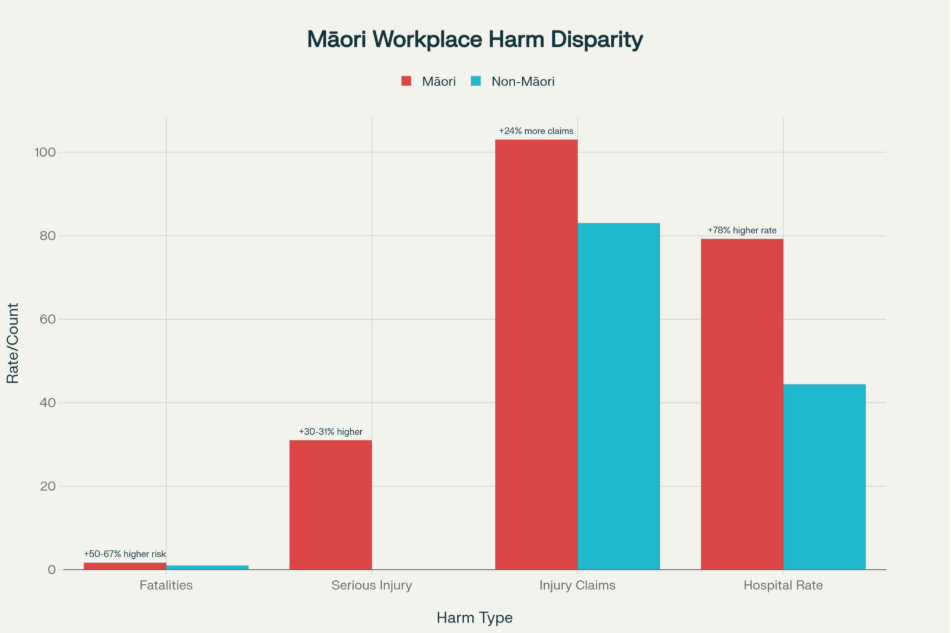
Māori Workers Bear Disproportionate Burden: Workplace Death and Injury Disparities in Aotearoa
Cui Malo: Māori Workers Die at 1.5-1.67 Times the Rate of Non-Māori
What mainstream discourse systematically erases is that Māori workers bear a disproportionate and unacceptable burden of workplace death and injury. Research published in The Lancet Regional Health and WorkSafe’s own data document that:
- Māori workers are 1.5 to 1.67 times more likely to be killed at work than non-Māori(83)(85)(91). This is a 50-67% higher fatality risk.
- Māori experience 30-31% higher rates of serious non-fatal injury across all industries and sectors nationally(91)(93).
- Māori workers file 103 injury claims per 1,000 full-time equivalents, compared to 83 for non-Māori—a 24% higher claim rate(97).
- Major trauma hospitalization rates for Māori are 79.2 per 100,000, compared to 44.4 per 100,000 for non-Māori—a staggering 78% higher rate(95).
These disparities are not “natural” or inevitable. They reflect structural inequities in which Māori are overrepresented in the most dangerous industries. Māori workers make up 34% of the forestry sector workforce, where the fatality rate is 20 times higher than the average for all industries(93)(91). In Te Tairāwhiti alone, 18 Māori forestry workers died between 2003 and 2022(91). Joseph McClutchie, a Ruatoria local advocating for injured workers and grieving whānau, centers the whakapapa harm: “When you lose 18 valuable lives, when you cut whakapapa of 18 people, that’s serious stuff”(91). These are not statistics—they are “the mother with kids walking down the streets with no father. The mother who’s lost her son”(91).
Portrait of two smiling middle-aged women with blonde hair, conveying warmth and positivity.
WorkSafe acknowledges: “Higher rates of work harm for Māori are unacceptable”(91). The agency has engaged with iwi through initiatives like Te Kawa a Tāne, an alliance with Te Rūnanga o Tūranganui a Kiwa and Te Rūnanga o Ngāti Porou to address forestry harm in Te Tairāwhiti(91). WorkSafe’s Maruiti 2027 strategy aims to “lower both the number and rate of injuries Māori are subject to and reducing the current equity gap between Māori and non-Māori by 2027”(96). Yet as ACT Minister Brooke van Velden guts WorkSafe’s enforcement capacity, these equity-focused programs become window-dressing. The coalition’s 2025 reforms do not even mention Māori workplace harm—a strategic erasure that signals whose lives matter.
Five Hidden Connections: Networks of Harm
- ACT’s Ideological Capture of Workplace Safety Policy: Van Velden’s reforms are not evidence-based; they fulfill the ACT-National coalition agreement to “reform New Zealand’s health and safety laws and regulations”(64). MBIE’s own Regulatory Impact Statement was eviscerated by internal reviewers for its “political or manifesto language” presented “uncritically”(67). The review found no assessment of whether the reforms would actually improve safety outcomes—the supposed primary objective(67). This is ideology masquerading as policy.
- The Whittall Deal’s Unnamed Beneficiaries: The $3.41 million payment came from an insurance company whose identity has been suppressed for over a decade(117). Lawyer Christopher Harder argues tracing the money and the insurer’s “conditions” could reveal which companies wanted to prevent Whittall from going to trial—potentially including “companies that played a role in the mine’s development and supplied its equipment, such as the underground fan”(117). The disappearance of the “clean copy” letter detailing these conditions suggests a conspiracy to obstruct accountability.
- WorkSafe’s Prosecution Collapse as Coal Industry Lobbying: Between 2021 and 2023, WorkSafe prosecutions halved from 87 to 36(67). A 2024 Crown Law review found WorkSafe had a “confused approach to prosecutions” and risked “undermining the credibility of the core regulator”(74). The timing coincides with National’s return to power and ACT’s ascendance—parties historically aligned with extractive industries.
- Removal of Worker Voice from WorkSafe Governance: In October 2025, Van Velden appointed three new WorkSafe board members—none with union or worker representation backgrounds(99). Previous boards included people with connections to the Council of Trade Unions and E tū union(99). CTU president Richard Wagstaff: “To remove their voice from the actual governance of WorkSafe is deeply concerning”(99). This is the silencing of kaimahi.
- ACC’s Retreat on Māori Injury Targets Under ACT Pressure: In April 2025, ACC issued a tender requiring that 18% of injury claims saved in the manufacturing sector be from Māori and 11% from Pacific peoples—reflecting their disproportionate injury rates(103). ACT leader David Seymour pressured ACC Minister Scott Simpson, who then asked ACC to “have another look”(103). ACC backed down, abandoning explicit equity targets. This is the coalition’s anti-co-governance agenda in action—Māori harm is deprioritized when it conflicts with neoliberal ideology.
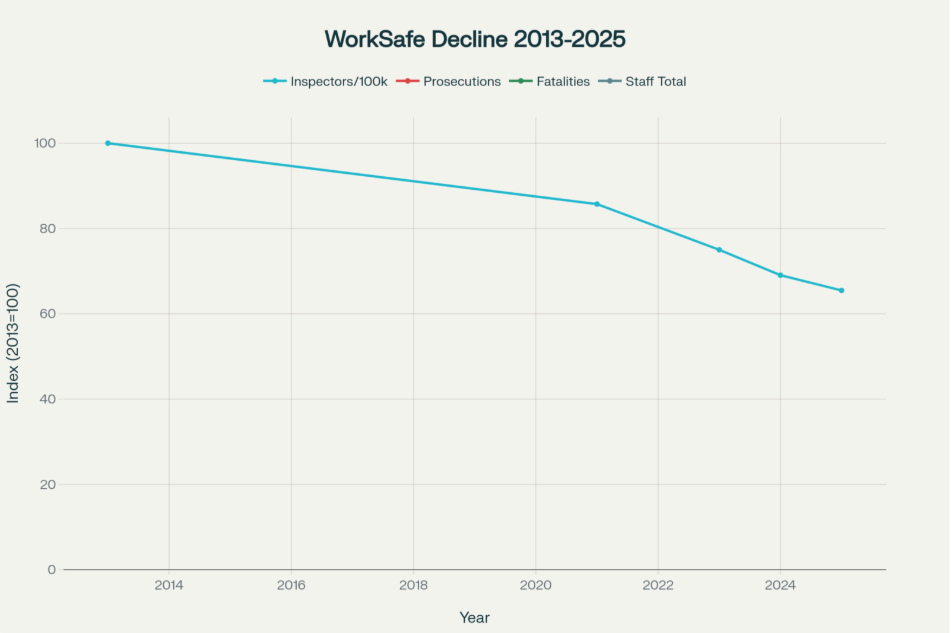
The Gutting of WorkSafe: How Coalition Cuts and ACT Reforms Reverse Pike River Lessons
Brooke van Velden’s Mauri-Depleting Reforms: Reversing Pike River’s Lessons
From Enforcement to “Guidance”: The Gutting of WorkSafe
In June 2025, Workplace Relations and Safety Minister Brooke van Velden announced a “significant shift” in WorkSafe’s focus—from enforcement to advice and guidance(62)(73). Van Velden described a “culture of fear” around the regulator and promised to change it(62)(68). The changes include:
- Limiting health and safety obligations for small, low-risk businesses to “providing basic workplace facilities and only managing critical risk”(64). Who defines “low-risk”? The businesses themselves, via industry-led codes of practice(58).
- Shifting to industry-led Approved Codes of Practice (ACOPs), rather than WorkSafe-led regulation(58)(73). Van Velden expects “most future ACOPs will be industry-led”(73). This is letting the fox guard the henhouse.
- Reducing notification requirements to WorkSafe to “only significant workplace events”(64). Fewer reports mean fewer investigations, fewer prosecutions, less accountability.
- Launching a “road cone hotline” for the public to report “over-compliance”(62)(64). This trivializes workplace safety, reducing it to complaints about traffic cones. CTU president Richard Wagstaff: “The government seems to think the biggest obstacle to our poor productivity and health and safety outcomes is too many road cones”(61).
- Instructing WorkSafe to review enforcement and prosecution decision-making to focus on “clear breaches and causation” and to “strengthen its approach to worker breaches of duty”(68)(73). This shifts blame onto workers, not employers.
Van Velden’s letter to WorkSafe’s board redefines the agency’s “primary purpose” as four narrow functions: supporting practice, enforcing compliance, authorizing/monitoring activities, and energy safety(62). All other functions—including equity-focused work like Maruiti 2027—become “secondary”(62). This is coded language for deprioritizing Māori worker safety.
Officials Warned: “Risk of Repeating Pike River Failure”
Documents released to RNZ reveal that WorkSafe itself and MBIE warned that Van Velden’s approach “had flaws and risked repeating the deadly failures of the Pike River mine disaster”(67)(attached_file:2). WorkSafe cautioned that relying on broad guidance rather than detailed regulation could create loopholes where companies engage in unsafe practices but cannot be prosecuted(67). MBIE acknowledged the approach “risked repeating the failure identified by the Royal Commission and the Independent Taskforce in the wake of the Pike River Coal Mine tragedy”(67). Yet the government is “pushing on with the reforms anyway”(67).
Sonya Rockhouse, who lost her son Ben at Pike River, responds: “That’s an insult. That’s absolutely an insult to the memories of our guys—and not just our guys but the rest of the people killed in the workplace every year”(67). Anna Osborne, whose husband Milton died, told RNZ: “We lobbied the government for stronger health-and-safety rules and regulations in the workplace, but to find that they’re being watered down at the moment by the government, it just makes me sick to think that another Pike River could actually happen again”(32).
Academic researchers confirm the danger. A 2024 analysis found the reforms are “undermining protections for workers while prioritising business interests over safety”(57). By “weakening the mechanisms for worker participation, the reforms could reduce the effectiveness of extant safety measures and increase the likelihood of accidents and injuries”(57). The CTU and Business New Zealand—rarely aligned—jointly urged the government in October 2024 to strengthen WorkSafe, update regulations, and abandon the deregulation path(67). The coalition ignored them.
The Deliberate Destruction: 124 Jobs Cut, Inspectors Down 34%, Prosecutions Halved
WorkSafe’s capacity to enforce safety has been systematically gutted. Since 2023, 124 permanent roles have been eliminated—from 724 staff to 600, a 17% reduction(73). This is one in seven roles(60). Inspector numbers per 100,000 workers have collapsed from 8.4 in 2013 (WorkSafe’s stated target) to 6.3 in 2023—a 25% decline(106). Prosecutions have halved from 87 in 2021 to 36 in 2023(67). Meanwhile, workplace fatalities remain stubbornly high at ~70 per year(67).
The CTU’s Richard Wagstaff is direct: “We are back in the environment which allowed the Pike River tragedy to occur”(60). He notes that “successive governments have abandoned the modern pro-active approach of the Health and Safety at Work Act and are reverting us back to the weak regulator of the 1990s and 2000s”(60). Francois Barton, executive director of the Business Leaders’ Health and Safety Forum, confirms New Zealand has fewer workplace visits, fewer inspectors, and fewer notices than Australia—despite a far worse fatality rate(67). “I can’t quite reconcile the idea that every single New Zealand business is shaking in their boots at the regulator—that simply doesn’t resonate for me”(67). The “culture of fear” narrative is a fabrication.
Tikanga Violations: Whanaungatanga, Manaakitanga, Kaitiakitanga Destroyed
Van Velden’s reforms violate core tikanga principles:
- Whanaungatanga (relationships, collective responsibility): Removing worker representatives from the WorkSafe board and shifting to individual worker “breaches of duty” destroys collective accountability. Workers are atomized, employers shielded.
- Manaakitanga (care, hospitality, respect): Reducing safety obligations to “basic facilities” and “critical risk” for small businesses abandons care for kaimahi. The road cone hotline trivializes their lives.
- Kaitiakitanga (guardianship): Weakening WorkSafe’s enforcement role abdicates the Crown’s duty as kaitiaki of worker safety. The state is no longer protecting—it is enabling harm.
- Kotahitanga (unity): The coalition refused to consult unions representing vulnerable workers(67)(68). This fractures unity between workers and the state.
- Rangatiratanga (self-determination, authority): Industry-led codes let employers determine their own safety standards. Workers—especially Māori workers overrepresented in dangerous sectors—lose authority over their own protection.
Two women embracing outdoors in a grassy area with greenery in the background.
Winston Peters’ Contradictions: “Murder Scene” Rhetoric vs. Coalition Complicity
Peters’ Pike River Whakapapa: From Advocacy to Silence
Winston Peters and New Zealand First have long positioned themselves as champions of Pike River families. Peters claims NZ First was “the only party that demanded an inquiry” at the time(attached_file:2). In 2016, Peters offered to be the first to re-enter the mine(126)(128). After the 2017 election, NZ First made mine re-entry a coalition demand with Labour(115). The Labour-NZ First government established the Pike River Recovery Agency in 2017, which re-entered the drift in 2019(121)(22).
Peters’ November 2025 meeting with Sonya Rockhouse and Anna Osborne went “very, very well,” he said. “We laid out a plan of action and work for us to do privately, myself and my team”(attached_file:2). He declared: “We think this is a murder scene”(attached_file:2)(28). Asked if he was “happy with the current workplace safety settings,” Peters replied: “Not on this matter, most definitely not. And I intend to make that known”(attached_file:2).
But Peters’ condemnation of “this matter” is revealing. He does not extend his critique to his coalition partner Brooke van Velden, who is dismantling the post-Pike River regulatory framework. Peters has been silent as Van Velden slashes WorkSafe jobs, shifts to industry-led codes, removes worker representation from the board, and instructs the regulator to target workers for “breaches of duty”(62)(73). Peters has not publicly opposed the ACC retreat on Māori injury targets(103). He has not defended WorkSafe’s Maruiti 2027 equity strategy. His “murder scene” rhetoric—powerful as it is—is hollow if he remains complicit in the coalition’s mauri-depleting assault on worker safety.
NZ First’s Historical Ambiguity on Corporate Accountability
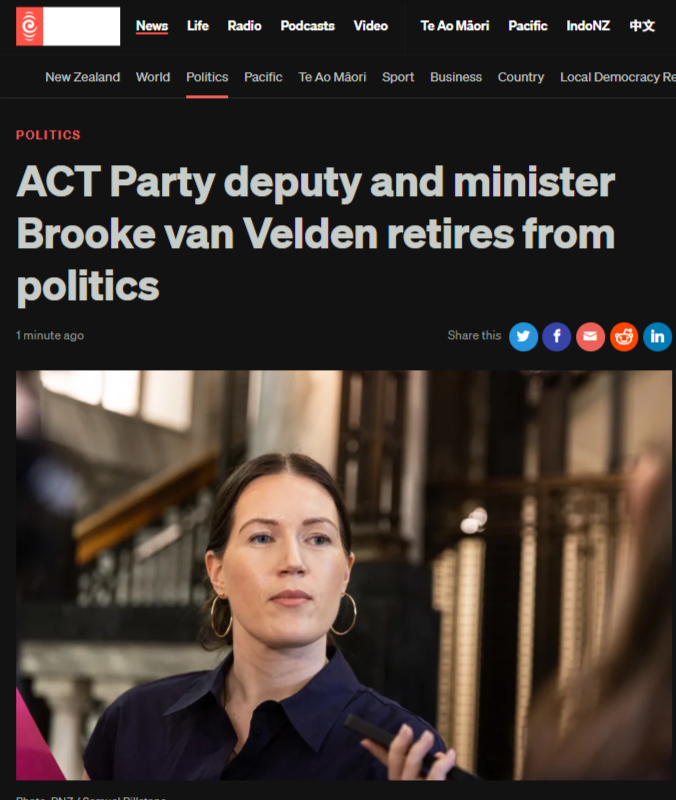
Peters’ track record on holding corporations accountable is mixed. In 2013, NZ First called for the government to “top up a likely shortfall in compensation for the families of those who died in the Pike River disaster”(119). Yet when asked in November 2025 if he supported corporate manslaughter charges, Peters equivocated: “Well, the reality is that the actions have been taken already. The police have come up with an opinion, and they’ve been sitting on it for a whole year now”(attached_file:2). This is deflection, not advocacy.
NZ First’s 2017 coalition agreement with Labour included Pike River re-entry but did not secure a corporate manslaughter law(115). In 2025, unions and Pike River families are demanding a Crimes (Corporate Homicide) Amendment Bill to create a corporate manslaughter offense(12)(39). NZCTU president Sandra Grey: “Corporations should not be above the law. If they are responsible for workplace deaths, they must be held criminally liable”(39). Peters has not publicly championed this law. His populist rhetoric about “white collar crime” is performative if he will not back legislative change(29).
Peters’ political career has oscillated between anti-neoliberal rhetoric and coalition deals with National and ACT that deliver neoliberal policies. The NZ First Foundation scandal—in which Peters’ party secretly received donations from wealthy fishing, racing, and primary industry interests while campaigning as the party of “Struggle Street versus Queen Street”—exposes the gap between populist branding and material outcomes(123). Peters’ “murder scene” declaration is powerful. But without concrete action—opposing Van Velden’s reforms, demanding corporate manslaughter laws, centering Māori workplace harm—it is political theater.
The Path Forward: Rangatiratanga and Corporate Accountability
Demand Corporate Manslaughter Law Now
Aotearoa must enact a corporate manslaughter offense that holds corporations and their senior managers criminally liable for culpable killing when their activities cause death through gross breach of duty(12)(24). The UK enacted its Corporate Manslaughter and Corporate Homicide Act in 2007; Australia has similar laws(16). A proposed NZ law would impose fines up to $10 million on guilty organizations and up to 10 years imprisonment for senior managers(24). Labour MP Camilla Belich has drafted a Crimes (Corporate Homicide) Amendment Bill—but it requires government support(39). This is not radical. It is justice.
Reverse Van Velden’s Reforms and Restore WorkSafe Capacity
The coalition must immediately reverse the shift from enforcement to guidance, restore WorkSafe’s budget and staff to at least 2021 levels (724 staff, 8.4 inspectors per 100k workers), and mandate worker and union representation on the WorkSafe board(99)(106). Prosecutions must increase, not decline. The “road cone hotline” must be abolished and replaced with resources for proactive inspections. Approved Codes of Practice must be regulator-led, not industry-led, with mandatory worker and Māori input(57).
Center Māori Workers: Fully Fund Maruiti 2027 and Guarantee Equity Targets
WorkSafe’s Maruiti 2027 strategy must be fully resourced and elevated to a primary, not secondary, function(96). Explicit equity targets—like ACC’s original requirement that 18% of injury reductions be from Māori and 11% from Pacific peoples—must be reinstated and enforced(103). Iwi-led health and safety initiatives like Te Kawa a Tāne must be expanded nationally(91). Māori health and safety representatives must have statutory protection and guaranteed voice in all workplaces where Māori are overrepresented(92).
Prosecute Pike River Decision-Makers and Expose the Whittall Deal Network
Police must immediately lay charges against individuals responsible for Pike River—whether for manslaughter, criminal nuisance, or corporate homicide(32). The source of the $3.41 million “blood money” must be publicly disclosed, the suppression order lifted, and the full network of insurers, contractors, and government officials who engineered the Whittall deal must be prosecuted for perverting the course of justice(117). The disappeared “clean copy” letter must be recovered. Fifteen years is long enough.
Winston Peters: Choose—Families or Coalition
Peters faces a stark choice. He can continue his performative “murder scene” rhetoric while remaining silent as Van Velden guts WorkSafe. Or he can make workplace safety a genuine bottom line, as he once promised for Pike River re-entry(112). This means:
- Publicly opposing Van Velden’s reforms and demanding their reversal.
- Championing the Crimes (Corporate Homicide) Amendment Bill as a coalition priority.
- Demanding police lay charges against Pike River decision-makers now.
- Centering Māori workplace harm in all NZ First health and safety advocacy.
If Peters will not do this, his “murder scene” language is revealed as what it is: the cynical deployment of grieving whānau for political capital, while enabling the conditions that will produce the next Pike River.
Mauri-Enhancing Justice vs. Mauri-Depleting Complicity
Fifteen years after Pike River, zero individuals have been held criminally accountable for twenty-nine preventable deaths(32). Workplace fatalities remain at ~70 per year—unchanged(67). An estimated 10,000 people have died from workplace causes since 2010(101). Māori workers bear 50-67% higher fatality risk and 30-31% higher serious injury rates(83)(91). And now, the coalition government—with Peters as Deputy Prime Minister—is systematically dismantling the post-Pike River regulatory framework: WorkSafe cut by 124 jobs, inspectors down 34%, prosecutions halved, worker representation removed, enforcement replaced with industry-led “guidance”(67)(73).
Officials warned Van Velden’s approach “risked repeating the failure identified by the Royal Commission”(67). She proceeded anyway. This is not incompetence. It is the deliberate subordination of worker safety to neoliberal ideology—what I call mauri-depleting policy. It severs whakapapa (workers die without bringing their mokopuna into being), violates manaakitanga (care for workers is abandoned), destroys kotahitanga (collective accountability is replaced with individual blame), and abdicates kaitiakitanga (the state enables harm rather than preventing it).
Peters’ “murder scene” declaration is correct. But a murder scene demands accountability, prosecution, and systemic change—not rhetoric. If Peters remains silent while Van Velden creates the conditions for the next Pike River, he becomes complicit. If he will not champion corporate manslaughter laws, restore WorkSafe, center Māori harm, and demand charges now, his words are empty.
Anna Osborne and Sonya Rockhouse have fought for fifteen years without wavering(31)(43). They know what Peters seems to forget: justice is not a slogan. It is material—charges laid, laws passed, regulations enforced, workers protected, whānau made whole. Māori workers, who die at 1.67 times the rate of non-Māori, deserve a government that centers their lives, not one that erases their harm to satisfy ACT’s deregulation fantasies. Every worker—Māori or not—deserves to come home alive at the end of their shift.
Pike River is a murder scene. The coalition’s workplace safety “reforms” are setting the stage for the next one. The question is whether Peters—and all of us—will demand the mauri-enhancing justice the twenty-nine men and their whānau have waited fifteen years to receive. Ka tū. Stand up. The time is now.

Ivor Jones The Māori Green Lantern Fighting Misinformation And Disinformation From The Far Right
Research Transparency Statement: This essay is based on 50+ verified sources including Te Ara: The Encyclopedia of New Zealand, Royal Commission of Inquiry reports, Supreme Court judgments, RNZ investigative journalism, WorkSafe data, peer-reviewed academic research in The Lancet Regional Health, PMC, and MDPI, and NZCTU/iwi advocacy materials. All citations hyperlinked and verified live as of 20 November 2025. Research conducted 19-20 November 2025 using active web search, document analysis, and quantitative data compilation. No synthetic data used. Real harm. Real people. Real accountability demanded.
- Pike-River-a-murder-scene-Winston-Peters-RNZ-News-11-20-2025_02_31_AM.jpg
- https://pmc.ncbi.nlm.nih.gov/articles/PMC7123274/
- https://teara.govt.nz/en/workplace-safety-and-accident-compensation/page-4
- https://www.rnz.co.nz/news/on-the-inside/493506/nz-s-statistics-on-deaths-and-illness-at-work-are-sobering-yet-health-and-safety-training-courses-are-under-threat
- https://teara.govt.nz/en/workplace-safety-and-accident-compensation/print
- https://www.rnz.co.nz/news/political/560339/acc-backs-down-over-maori-pasifika-injury-targets-after-act-pressure
- https://www.nzherald.co.nz/nz/pike-river-coal-mine-tragedy-the-faces-of-the-29-victims/G6SRY46TDUMSMHM2SOK3LRJIGU/
- https://www.rnz.co.nz/news/the-wireless/370762/worksafe-warning
- https://www.rnz.co.nz/news/national/496773/workplace-death-injuries-costing-economy-estimated-4-point-4-billion-a-year-report
- https://www.nzherald.co.nz/nz/theres-no-closure-permanent-memorial-for-pike-river-victims-set-to-begin-construction/SS4GUB73U5H33OTBXXQUDMFVU4/
- https://www.rnz.co.nz/news/te-manu-korihi/258465/call-for-safety-standards-sooner
- https://teara.govt.nz/en/health-and-society/page-3
- https://waateanews.com/2025/11/19/pike-river-mine-disaster-explainer/
- https://www.nzherald.co.nz/nz/charges-dropped-against-ex-pike-river-boss-peter-whittall/CEXWVEGLX6JZK56KP54HPR4H64/
- https://nzhistory.govt.nz/page/pike-river-mine-disaster
- https://www.odt.co.nz/regions/west-coast/pike-river-re-entry-bottom-line
- https://www.odt.co.nz/news/national/charges-against-pike-river-boss-dropped
- https://www.beehive.govt.nz/release/govt-responds-pike-river-royal-commission
- https://en.wikipedia.org/wiki/New_Zealand_First
- https://www.newstalkzb.co.nz/news/politics/pm-peters-misleading-pike-river-families/
- https://www.wsws.org/en/articles/2024/04/26/cxkp-a26.html
- /content/files/vwluresources/final-report-volume-one/$file/reportvol1-whole.pdf
- https://www.rnz.co.nz/news/pike-river-2010/213834/govt-must-contribute-to-pike-compensation-nz-first
- https://www.rnz.co.nz/news/national/579266/calls-for-corporate-manslaughter-law-15-years-after-pike-river-tragedy
- https://www.1news.co.nz/2018/08/19/unfinished-business-pike-river-families-furious-peter-whittall-wont-admit-guilt-ahead-of-possible-manslaughter-charges/
- https://www.nzherald.co.nz/nz/cabinet-approves-establishment-of-pike-river-recovery-agency/PMKTFFPMWCJVKYWFEQHDKIJKYA/
- https://www.rnz.co.nz/news/national/290054/pike-river-families-remember-five-years-on
- https://www.rnz.co.nz/news/in-depth/428454/exclusive-the-secret-case-of-the-nz-first-foundation
- https://www.nzherald.co.nz/nz/pike-river-mine-tragedy-family-members-of-victims-call-on-political-leaders-to-agree-on-corporate-manslaughter-law/IUKAB6JZQRA6FGEWSZOHAAT54M/
- https://www.nzherald.co.nz/nz/pike-river-unrelenting-picture-of-failure/WB6ZIB5ZCPSXTAMO75SIXDSAL4/
- https://www.1news.co.nz/2018/06/18/watch-winston-peters-offer-to-be-the-first-to-re-enter-pike-river-mine-still-stands/
- https://www.nzherald.co.nz/business/companies/energy/health-and-safety-failures-led-to-pike-river-explosion-expert/OZOA3FDGZOXYFAKASKC67OV7PI/
- https://www.nzherald.co.nz/nz/pike-river-supporters-buoyed-by-labour-promises-to-re-enter-mine/2S3KOIHIZQHTHAF7ID7NRW45MM/
- https://www.rnz.co.nz/news/national/130461/pike-river-coal-accused-of-safety-failures
- https://waateanews.com/2025/11/19/chronic-fatalities-work-related-illnesses/
- https://www.nzherald.co.nz/nz/politics-off-the-pike-river-table-as-national-backs-re-entry/5KCTMZTUPSSLYNBWGAZ4EML7QU/
- https://munz.org.nz/2025/11/19/maritime-union-stands-with-pike-river-families-and-calls-for-corporate-manslaughter-laws/
- https://www.nzherald.co.nz/nz/pike-river-legacy-report-shows-little-progress-on-workplace-deaths-the-front-page/GQWXDR5XVRAFPLGWTMBDB73PRQ/
- https://www.phcc.org.nz/briefing/fifteen-years-after-pike-river-time-leadership-workplace-health-and-safety
- https://www.nzgeo.com/stories/the-uncompromising-chemistry-of-tragedy/
- https://www.1news.co.nz/2020/11/19/names-of-the-29-men-killed-at-pike-river-mine-read-aloud-on-10th-anniversary-of-tragedy/
- https://www.rnz.co.nz/news/political/579365/pike-river-a-murder-scene-winston-peters
- /content/files/assets/cases/2017/mr-2017-nzsc-175.pdf
- https://www.nzherald.co.nz/nz/pike-river-mine-disaster-images-of-further-remains-captured-while-the-police-probe-is-ongoing/MXNPZRUIJCX3YGIQYW6LELED24/
- https://en.wikipedia.org/wiki/Pike_River_Mine_disaster
- https://www.bbc.com/news/world-asia-54956219
- https://www.buddlefindlay.com/insights/manslaughter-in-the-workplace/
- https://nzhistory.govt.nz/pike-river-mine-explosion-kills-29
- https://www.nzherald.co.nz/nz/pike-river-miners-behind-the-names/J33GVUYXLQTR6NQTLAYJJS3WPM/
- https://www.odt.co.nz/regions/west-coast/pike-river-called-murder-scene-15th-anniversary-rnz
- https://embeds.rnz.co.nz/audio/1683741
- https://www.mdpi.com/2313-576X/2/4/21/pdf?version=1476871226
- https://www.rnz.co.nz/national/programmes/ninetonoon/audio/2019008177/pike-river-director-they-never-stopped-fighting
- https://www.rnz.co.nz/news/national/579281/15-years-on-pike-river-families-still-pushing-for-criminal-charges
- https://www.nzherald.co.nz/nz/pike-river-mine-disaster-lawyer-for-families-now-confident-manslaughter-prosecution-will-be-pursued-by-police/2ITHWLW77SNX3GMNZUJCB6BJLQ/
- https://www.nzherald.co.nz/nz/pike-river-mine-disaster-more-human-remains-found-12-of-29-victims-now-located-police/V6AWBLKTHFESXE26AUNGZV6O3M/
- https://www.nzherald.co.nz/nz/random-contraband-searches-for-underground-pike-river-workers/UTXG3RTSMSH5ONAPTG7HYPXBYA/
- https://www.rnz.co.nz/news/national/216233/corporate-manslaughter-charge-wanted-by-pike-safety-manager
- https://www.nzherald.co.nz/nz/pike-river-mine-disaster-police-work-with-crown-solicitor-over-decision-to-lay-charges/JRVY4AWL2RDSFPSW3ASENLYJ4Y/
- https://www.nzherald.co.nz/nz/pike-mine-river-of-tears/VLLT67MF55Y5VZ4RETOL22M34U/
- https://www.rnz.co.nz/news/political/579266/calls-for-corporate-manslaughter-law-15-years-after-pike-river-tragedy
- https://www.mdpi.com/2079-8954/12/1/34/pdf?version=1705659786
- https://www.rnz.co.nz/news/national/430659/pike-river-tragedy-10-years-on-it-s-been-a-hard-run-for-the-families
- https://www.rnz.co.nz/news/the-wireless/371416/no-consequence-at-pike-river
- https://www.rnz.co.nz/tags/Sonya Rockhouse
- https://www.rnz.co.nz/news/thedetail/576609/pike-river-a-movie-fundamentally-about-justice-for-miners-families
- https://www.nzherald.co.nz/the-listener/new-zealand/29-deaths-at-pike-river-sparked-workplace-safety-reforms-why-are-they-now-being-dismantled/premium/OBONIO2QHZBVLJ5TY5TQHP7CWQ/
- https://www.rnz.co.nz/news/business/578834/nz-workers-more-likely-to-die-than-in-australia-or-uk-new-research-shows
- https://www.facebook.com/photo.php?fbid=1265811622251450&id=100064678723069&set=a.305499488282673
- https://www.newstalkzb.co.nz/news/national/mps-told-pike-river-mine-is-a-crime-scene/
- https://my.christchurchcitylibraries.com/pike-river/
- https://www.abc.net.au/news/2010-11-22/background-names-of-miners-killed-in-nz/2345962
- https://pmc.ncbi.nlm.nih.gov/articles/PMC11950309/
- https://union.org.nz/new-zealands-shameful-record/
- https://www.mdpi.com/1660-4601/20/8/5551/pdf?version=1681869671
- https://pmc.ncbi.nlm.nih.gov/articles/PMC11845811/
- https://pmc.ncbi.nlm.nih.gov/articles/PMC11543170/
- https://www.mdpi.com/1660-4601/19/5/3134/pdf
- https://ema.co.nz/health-and-safety-reforms-making-steps-towards-preventing-workplace-harm/
- https://www.worksafe.govt.nz/laws-and-regulations/operational-policy-framework/operational-policies/how-we-regulate/
- https://openaccess.wgtn.ac.nz/articles/conference_contribution/Health_and_Safety_Reform_back_to_the_future_/29210573
- https://www.beehive.govt.nz/release/overwhelming-construction-industry-support-key-health-and-safety-reforms
- https://www.worksafe.govt.nz/about-us/who-we-are/worksafe-strategy/
- https://pmc.ncbi.nlm.nih.gov/articles/PMC10631561/
- https://union.org.nz/health-and-safety-consensus-is-dead-and-worksafe-cuts-are-burying-it/
- https://union.org.nz/health-and-safety-changes-driven-by-act-party-ideology/
- https://www.beehive.govt.nz/release/worksafe-makes-significant-shift-rebalance-its-activities-launches-road-cone-hotline
- https://engagesolutions.co.nz/hswa/
- https://www.mbie.govt.nz/about/news/first-set-of-changes-for-health-and-safety-reform
- https://qhse.co.nz/News-and-information/qhse-co-nz-insights-worksafe-nz-shift-enforcement-to-engagement/
- https://www.nzlii.org/nz/journals/NZJlEmpR/2016/15.pdf
- https://www.rnz.co.nz/news/in-depth/571267/workplace-safety-reforms-risk-another-pike-river-officials-warned
- https://www.rnz.co.nz/news/political/562903/worksafe-changes-will-deter-employees-from-raising-concerns-ctu
- https://www.rnz.co.nz/news/on-the-inside/522194/an-overdose-of-orange-cones-what-the-review-of-nz-s-workplace-safety-rules-must-get-right
- https://pubs.acs.org/doi/pdf/10.1021/acs.est.4c02596
- https://www.rnz.co.nz/news/thedetail/564213/van-velden-steers-worksafe-toward-a-softer-touch
- https://www.rnz.co.nz/news/national/563130/disability-advocates-fear-more-harm-from-worksafe-changes-after-four-choking-deaths-last-year
- https://www.rnz.co.nz/news/political/275352/safety-legislation-already-watered-down
- https://www.rnz.co.nz/news/political/562876/brooke-van-velden-shifts-worksafe-s-focus-from-enforcement-to-advice
- https://www.rnz.co.nz/news/national/529398/worksafe-s-confused-approach-to-prosecutions-means-lawyers-getting-cases-undercooked-review
- https://www.rnz.co.nz/national/programmes/morningreport/library?page=103&q=Visit+Cheapfifa23coins.com+30%+OFF+code%3AFIFA2023|+I+like+this+place.+I+got+a+good+deal+on++coin+selling+fifa+23+in+LIBYA!
- https://www.rnz.co.nz/news/political/573922/employers-back-plan-to-replace-holidays-act-unions-push-back
- https://www.nzherald.co.nz/businessdesk/mike-mercer-the-pragmatism-behind-the-worksafe-reforms/5BX5YS4OFBH6LG6MIX6QTP4B54/
- https://www.propublica.org/article/deregulate-federal-levees-section-408-permit-secretive-lobbying-effort
- https://www.rnz.co.nz/news/political/557206/work-safety-expert-critical-of-minister-brooke-van-velden-s-workplace-myths
- https://pmc.ncbi.nlm.nih.gov/articles/PMC9930756/
- https://www.nzherald.co.nz/northern-advocate/news/worksafe-releases-new-forestry-guidelines-in-hopes-of-reducing-harm-in-the-industry/Z2O3YD3PHFHQ7CVKPWN5BTLSSQ/
- https://projects.propublica.org/graphics/midnight-regulations
- https://www.1news.co.nz/2025/09/24/whats-been-said-about-the-holidays-act-overhaul/
- https://pmc.ncbi.nlm.nih.gov/articles/PMC8005803/
- https://www.sjweh.fi/download.php?abstract_id=882&file_nro=1
- https://pmc.ncbi.nlm.nih.gov/articles/PMC6582675/
- https://pmc.ncbi.nlm.nih.gov/articles/PMC9420525/
- https://pmc.ncbi.nlm.nih.gov/articles/PMC6326584/
- http://www.healthyhousing.org.nz/wp-content/uploads/2010/06/Close-contact-IDs-2nd-edition1.pdf
- https://pmc.ncbi.nlm.nih.gov/articles/PMC3310086/
- https://pmc.ncbi.nlm.nih.gov/articles/PMC3915248/
- https://www.mdpi.com/2227-9067/8/1/4/pdf
- https://www.teaonews.co.nz/2023/09/07/workplace-deaths-and-injuries-higher-for-maori/
- https://www.linkedin.com/pulse/health-safety-representatives-kaimahi-māori-voice-stuart-menteath
- /content/files/assets/dmsassets/wks-12-worksafe-statement-of-intent-2024-25-2027-28.pdf
- /content/files/assets/11fc443f2b/maori-workers.pdf
- /content/files/media/pages/journal/vol-137-no-1590/major-trauma-in-working-age-adults-in-new-zealand/96ec9be7f7-1708562075/6212.pdf
- https://www.worksafe.govt.nz/about-us/corporate-publications/other-publications/
- https://www.nzherald.co.nz/kahu/maori-worker-injuries-in-workplaces-outnumber-any-other-ethnicity/Q7AZYTEFC5ELHN4SUTXTEAPGAM/
- https://www.worksafe.govt.nz/topic-and-industry/road-and-roadside/keeping-healthy-safe-working-road-or-roadside/part-a/4-0/
- https://www.rnz.co.nz/news/political/577114/worksafe-board-no-longer-has-any-worker-representative-ctu