“Winston Peters - The Arsonist in Chief: Damien Grant Covers For Winston Peters and the Bonfire of Māori Rights” - 9 February 2026
How a convicted fraudster crowned a career betrayer, and why Damien Grant’s love letter to Winston Peters is a masterclass in whitewashing white supremacy
Mōrena Aotearoa,
The Preamble: When Arsonists Write Love Letters to Fire
Let us begin with a whakataukī that the subject of today’s essay would neither understand nor respect:
He aha te mea nui o te ao? He tangata, he tangata, he tangata.
What is the greatest thing in the world? It is people, it is people, it is people.
Not poll numbers. Not crayfish and bubbles at Shane Jones’ Kerikeri estate. Not the “sacred parliamentary corridor of prime ministerial portraits.” People.
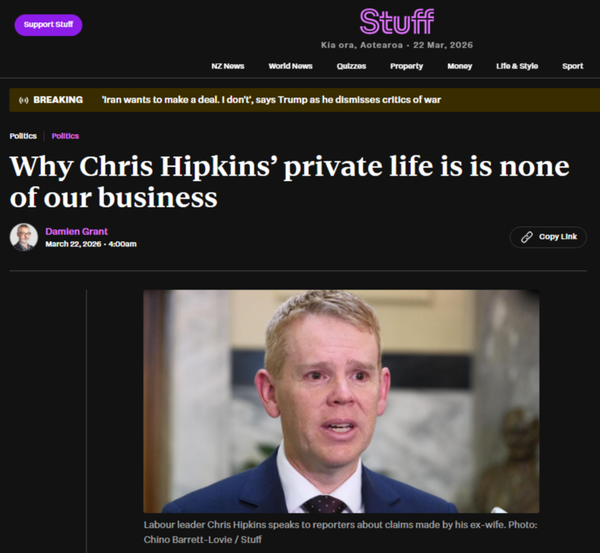
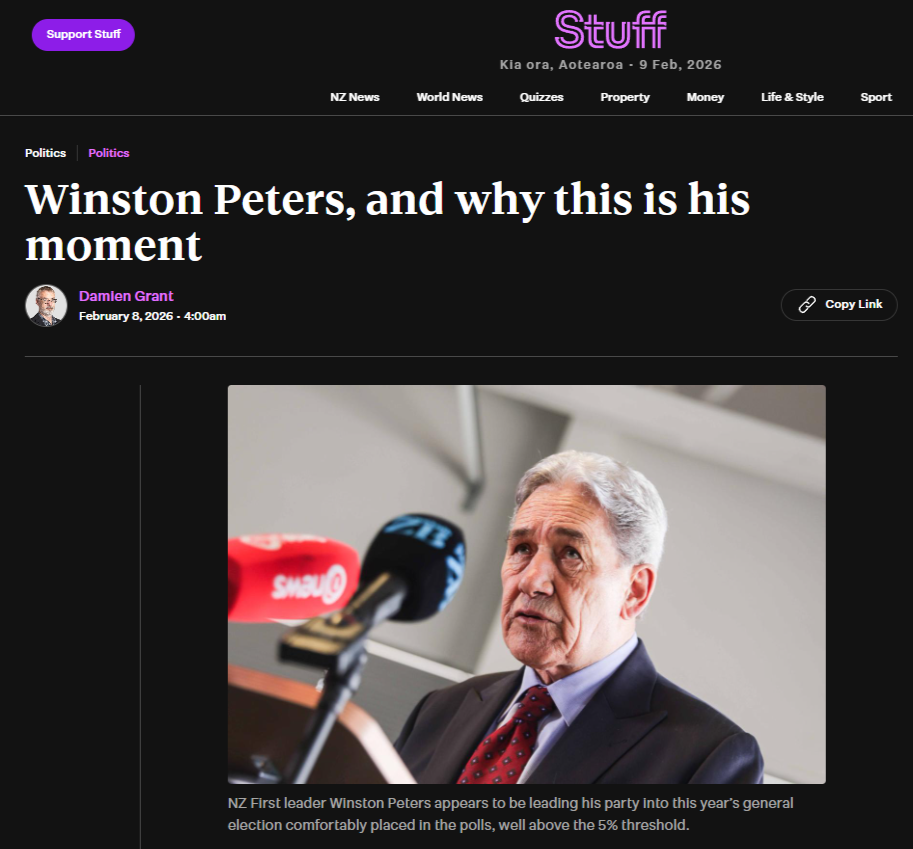
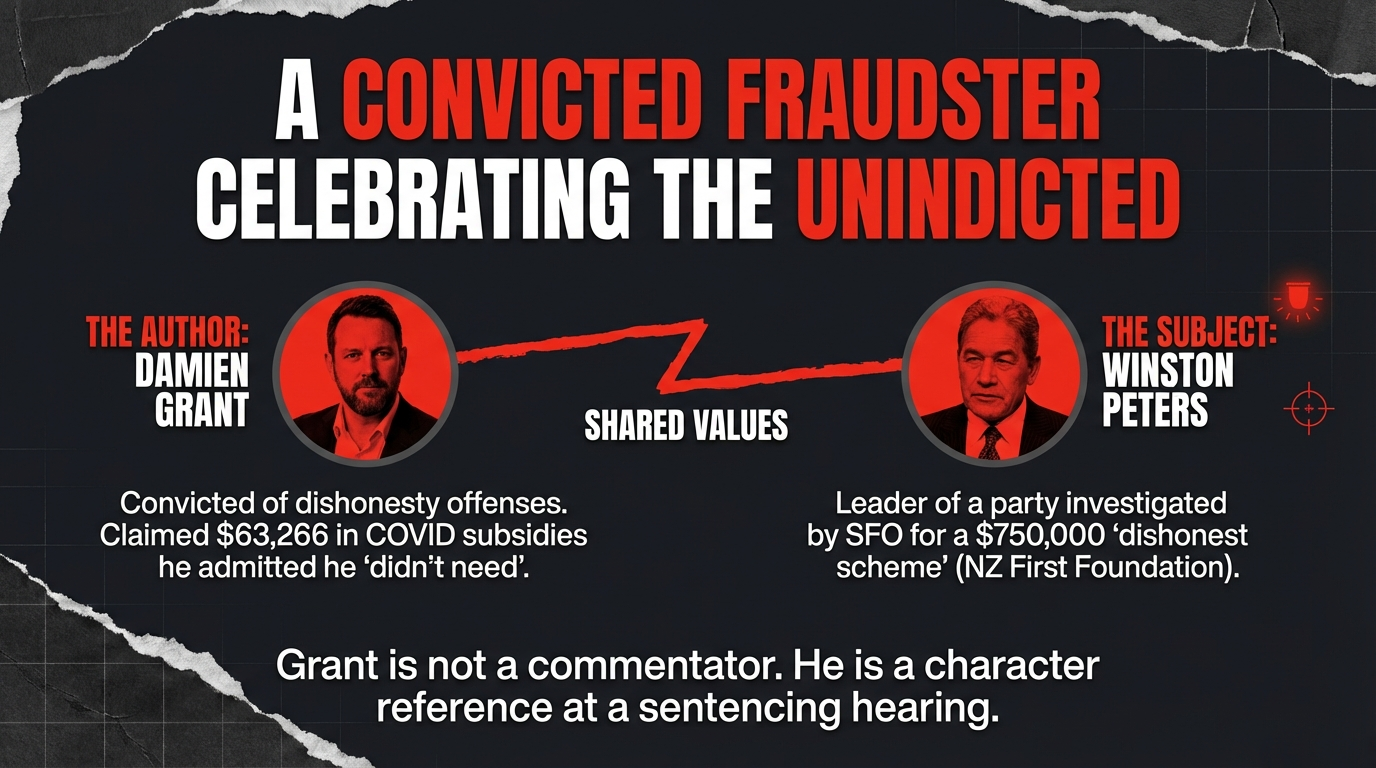
This past Waitangi Weekend — while the ink of Te Tiriti still bleeds under the boots of this coalition — Stuff published an opinion piece, under their politics section, by Damien Grant, a self-described “libertarian” columnist, anointing Winston Peters as the populist prince whose “moment” has finally arrived. Grant — a man jailed in his 20s for dishonesty-related offences who later claimed $63,266 in COVID wage subsidies he openly admitted he did not need — now writes columns telling Aotearoa who should lead us.
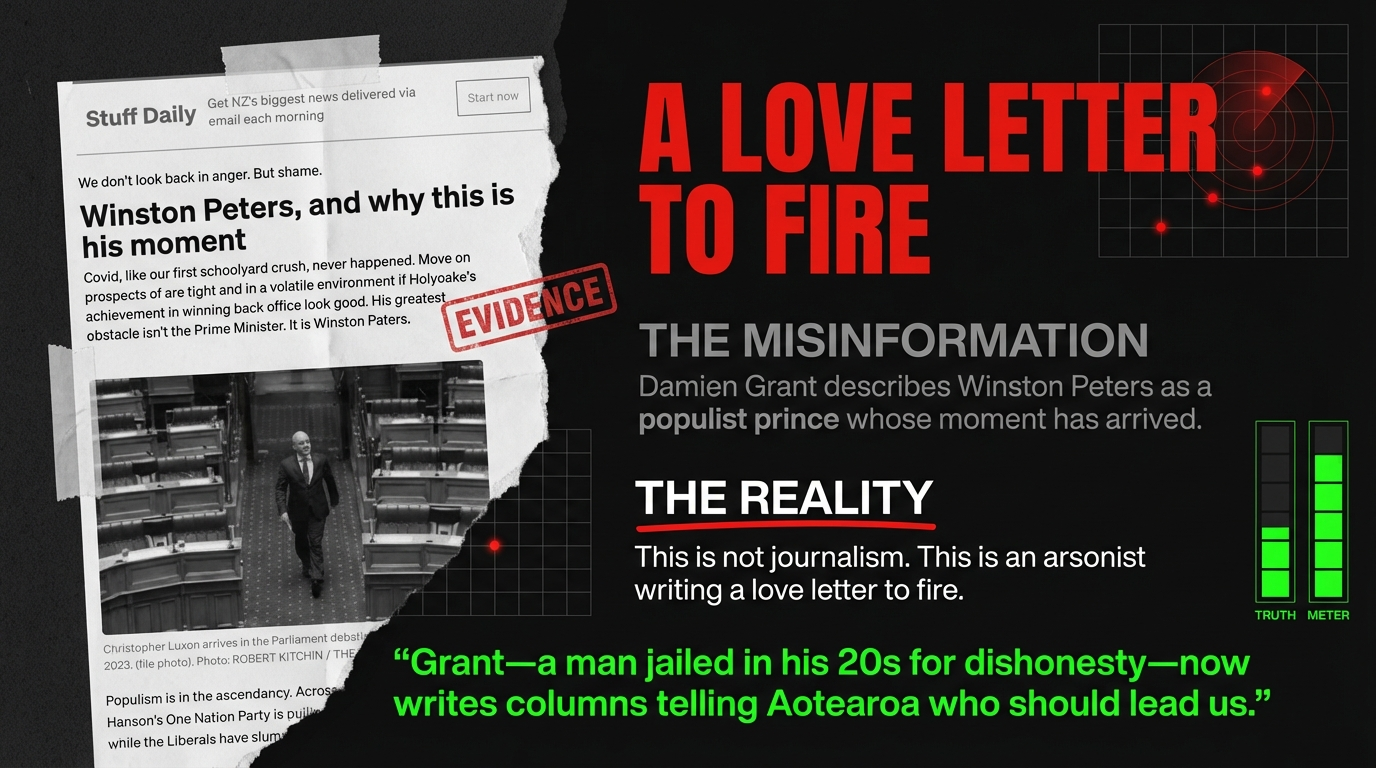
This is not journalism. This is an arsonist writing a love letter to fire.
Background: The Whakapapa of Betrayal
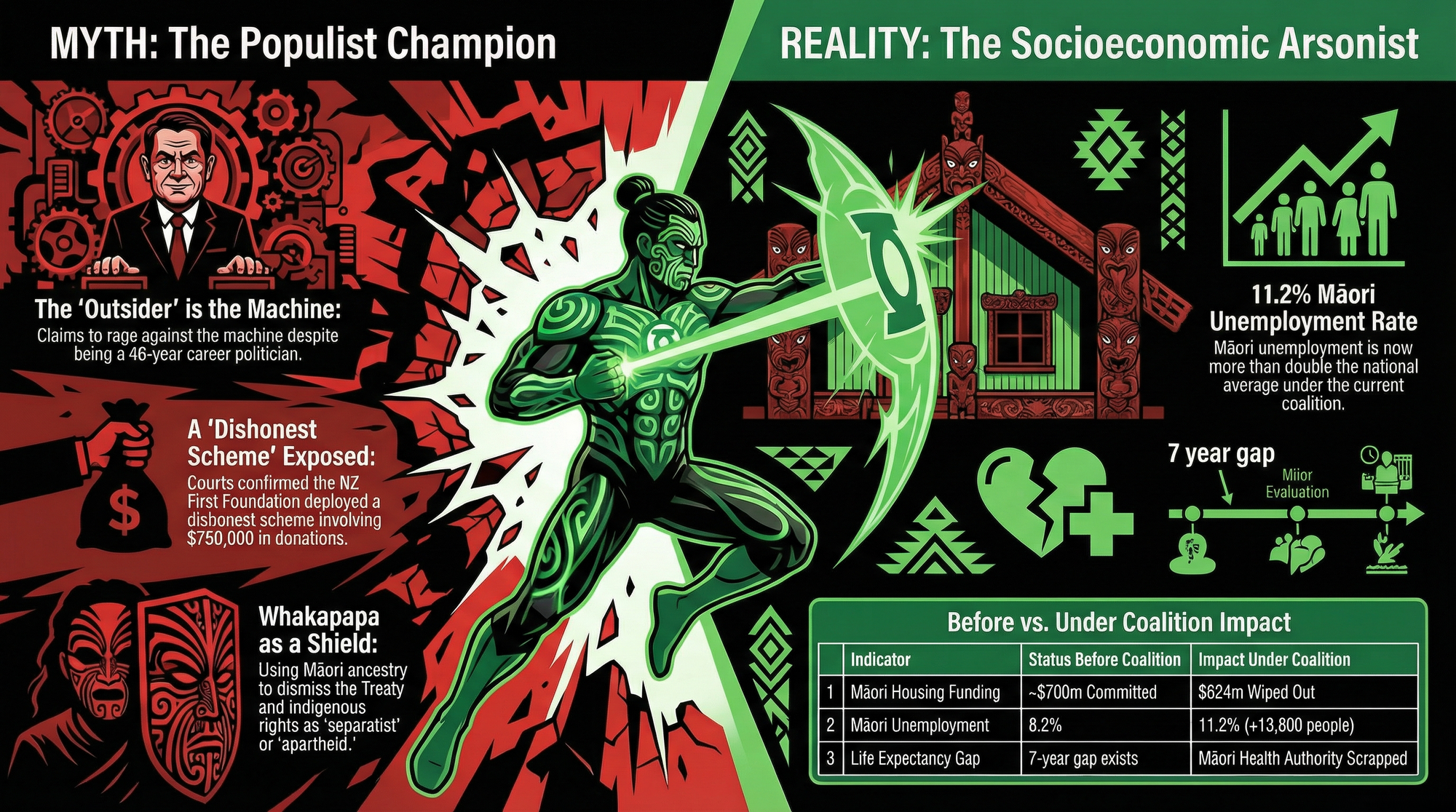
A Man Who Walked Away From His Own People
Winston Raymond Peters (Ngātiwai, Ngāpuhi) was born 11 April 1945 in the Far North, into a world of dirt floors and poverty that “tasted, smelled and felt” real. He knows the North. He knows the mauri of those communities. That makes what he has done infinitely worse.
In 1975, Peters ran for the Northern Māori seat as a National Party candidate — the party of Muldoon, the party of farmers, the party that had spent decades dispossessing Māori of their whenua. He lost to Matiu Rata. He learned a lesson: Māori voters saw through him.
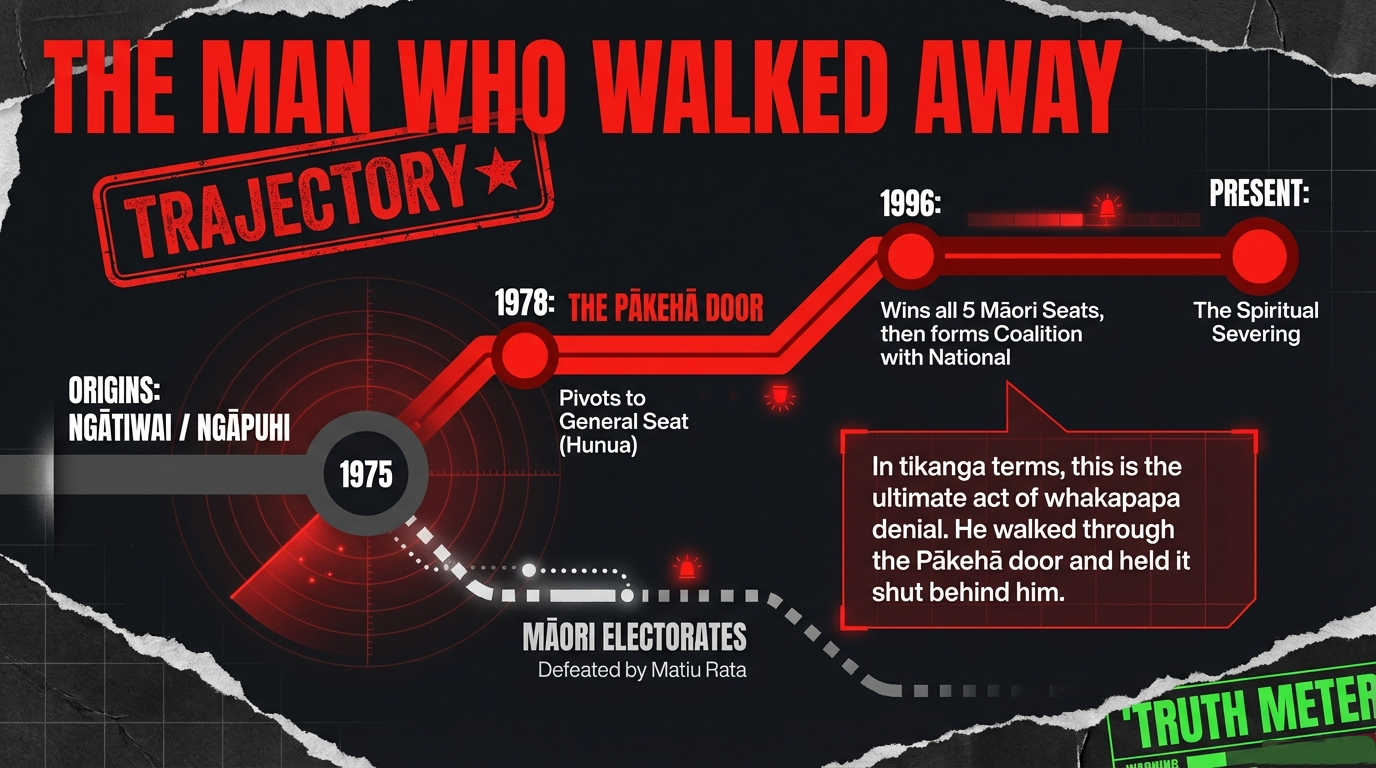
So Peters pivoted. He won the general seat of Hunua in 1978 — only after a judicial recount, becoming the fourth person of Māori ancestry to hold a general electorate — and never looked back at the Māori electorates again.
In tikanga terms, this is the ultimate act of whakapapa denial. The Māori electorates were created specifically to give tangata whenua a voice. Peters walked through the Pākehā door and spent the next five decades holding it shut behind him.
In 1996, NZ First won all five Māori seats. Peters had the entirety of Māori parliamentary representation in his hands. What did he do? He formed a coalition with National — the same National Party that had expelled him — and within two years his Māori MPs had scattered like leaves. By 2003, abandoned by Māori voters, he turned to the anti-immigration bandwagon, attacking “Third World immigrants” and trading his whakapapa for the currency of Pākehā grievance.
For the Western mind, understand this: In te ao Māori, whakapapa is not a bloodline on a certificate. It is a living, breathing web of obligation, accountability, and reciprocity that connects you to your tūpuna, to your whenua, to your mokopuna not yet born. To hold whakapapa and weaponise it against your own people is not merely hypocrisy — it is a spiritual severing. It depletes the mauri (life force) not just of the individual, but of the collective. When Peters called Rawiri Waititi’s moko mataora “scribbles on his face” in Parliament, his own iwi Ngātiwai condemned him.
Kaumātua Taipari Munro said:
“Winston had no right to say what he said. It was absolutely insulting and below the belt... you do that to your own people?”
Deconstructing the Grant Mythology
Damien Grant’s essay operates on three deliberate deceptions. Let us dismantle them through mātauranga Māori — the framework his libertarian worldview cannot comprehend because it centres relationships over transactions.
Deception 1: Peters as Anti-Establishment Outsider
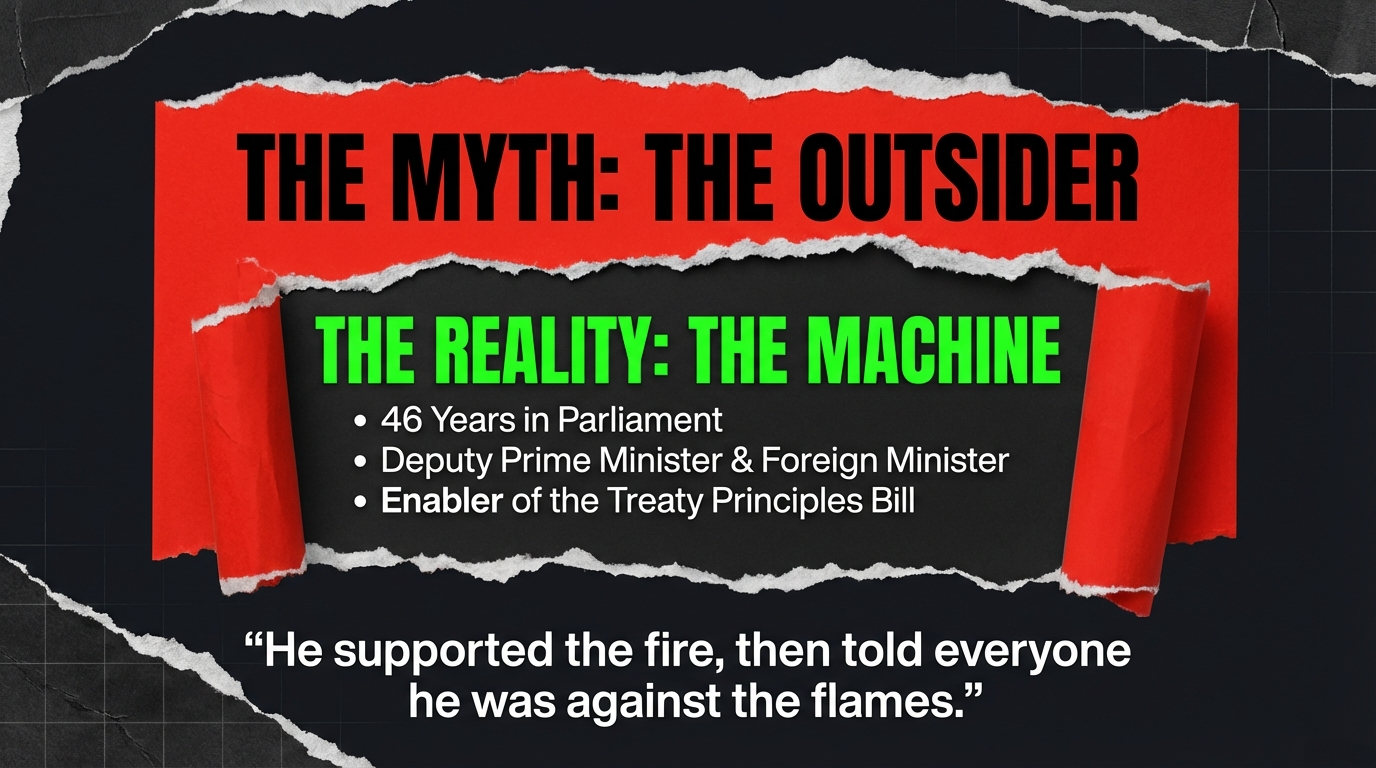
Grant frames Peters as the man who “rages against the machine.” But Peters is the machine. He has been in Parliament for 46 years. He is currently Deputy Prime Minister and Minister of Foreign Affairs. He negotiated the coalition agreement that enabled the Treaty Principles Bill — the legislation the Waitangi Tribunal called “the worst, most comprehensive breach of Te Tiriti in modern times”.
He does not rage against the machine. He is the machine, operating from the inside while telling the crowd he is one of them.
Example: Peters voted to support the Treaty Principles Bill at first reading, enabling it to enter Parliament, then dismissed the 42,000-strong Hīkoi mō te Tiriti as “a waste of time.” He supported the fire, then told everyone he was against the flames.
Deception 2: Peters as Economic Nationalist for the People
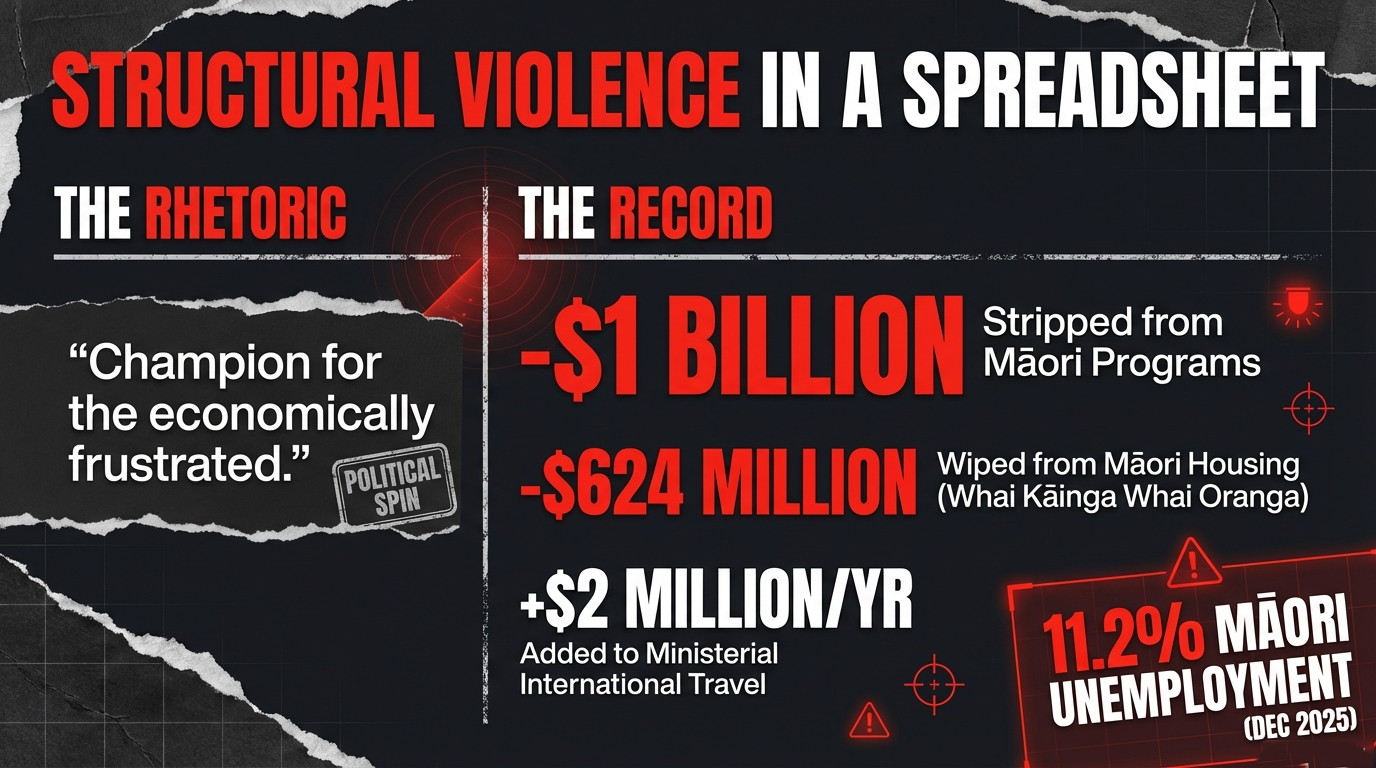
Grant casts Peters as a champion of the economically “frustrated populace.” Yet NZ First voters are the most financially distressed of any coalition party’s supporters — six in ten say cost of living is harder to manage. Peters sits at the Cabinet table that delivered two budgets stripping over $1 billion from Māori-specific programmes, including $624 million from Māori housing — while Māori homelessness rises and four in ten communities face unaffordable rents.
Example: In Budget 2024, $40 million was cut from Māori housing supply. In Budget 2025, the entire Whai Kāinga Whai Oranga Māori housing programme was scrapped — $624 million wiped from the books. Meanwhile, this government increased its ministerial international travel budget by $2 million per year.
Deception 3: Populism as Democratic Expression
Grant compares Peters to Trump, Farage, and Hanson as if this is a neutral observation rather than a damning indictment. These are not democratic movements. They are grievance machines designed to redirect the anger of the economically dispossessed toward racial minorities — in Peters’ case, toward his own people and immigrants alike.
Example: Grant himself writes approvingly of Peters’ use of the India trade deal as a wedge: “How can your kids afford a house when they have to compete with half of Tamil Nadu?” Then Grant admits: “An argument doesn’t need to make sense to win votes.” This is not analysis. This is the quiet part said loud.
Analysis: Five Hidden Connections the Mainstream Won’t Show You
Connection 1: The NZ First Foundation — $750,000 in Undeclared Money
The NZ First Foundation collected nearly $750,000 in donations between 2015 and 2020 that were never declared in electoral returns. The Serious Fraud Office investigated, and the Court of Appeal confirmed the donations constituted party donations under the Electoral Act and that a “dishonest scheme” was deployed. The accused walked free only on a “minor technicality” — a gap in the judge’s reasoning about claim of right. Winston Peters was never called to testify.
This is the man Grant wants to crown. A man whose party’s financial operations required the Serious Fraud Office and whose fundraising was described by the courts as a “dishonest scheme.”
Connection 2: The Convicted Fraudster Celebrating the Unindicted One
Damien Grant was convicted of dishonesty-related offences in his twenties. He then built a career as a liquidator — a man who profits from the financial destruction of others. During COVID, he claimed $63,266 in wage subsidies for his company Waterstone Insolvency while openly admitting he did not need the money. He told Breakfast: “I certainly didn’t need the money. I’m going to keep it.”
This is who Stuff gives a platform to write about the future of Aotearoa. A convicted fraudster celebrating a politician whose party ran a “dishonest scheme” for $750,000. He is not a commentator. He is a character reference at a sentencing hearing.
Connection 3: The Systematic Dismantling of Māori Infrastructure
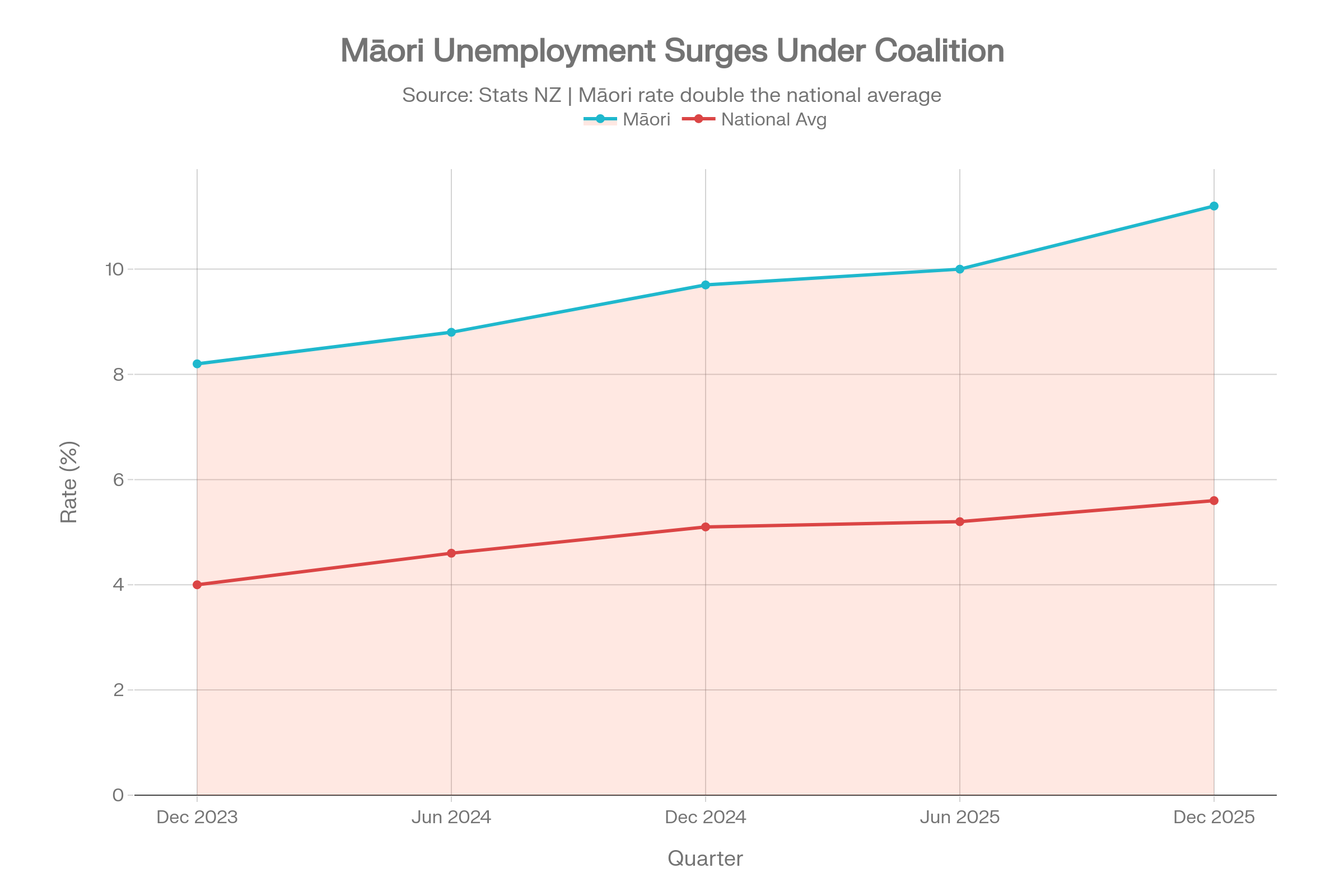
Māori unemployment surges to 11.2% under coalition government
While Peters plays kingmaker, here is what his coalition has actually delivered for tangata whenua:
- Māori unemployment: 11.2% in December 2025 — more than double the national average, with 13,800 more Māori unemployed than two years ago.
- Māori rangatahi unemployment: over 18% — a generation being abandoned.
- Over 400,000 New Zealanders on welfare in December 2024 — the highest since the 1990s.
- Te Aka Whai Ora disestablished — the Māori Health Authority that was created to address the 7-year life expectancy gap between Māori and non-Māori.
- Tamariki Māori 46 times more likely to be hospitalised with acute rheumatic fever than European children — a disease of poverty and cold, damp housing.
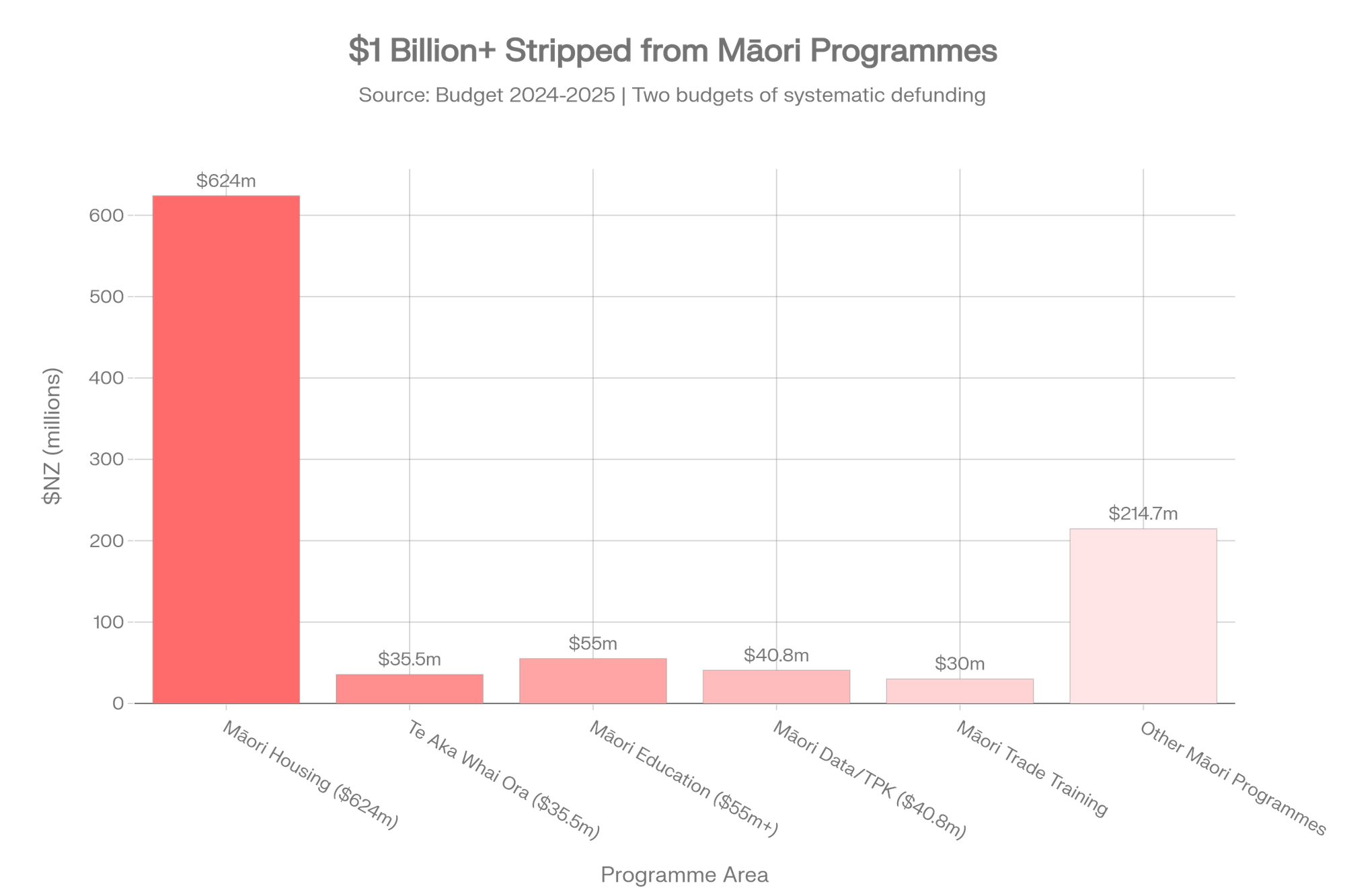
Over $1 billion stripped from Māori programmes across two budget
For the Western mind: The Te Tiriti framework is not a “special privilege.” It is a constitutional partnership — a contract between two sovereign entities. When the Crown signed Te Tiriti in 1840, it guaranteed rangatiratanga (self-determination) over lands, taonga, and all things treasured. Every dollar stripped from Māori housing, health, and education is a breach of that contract. Imagine the Crown tearing up a contract with a multinational corporation worth billions — the outcry would be deafening. But when the Crown tears up its oldest contract with its indigenous partner, columnists from Stuff frame it as “progress.”
Connection 4: Peters’ Anti-Indigenous Rhetoric as Coalition Currency
In September 2023, Peters publicly declared that Māori are “not indigenous”: “Here’s the rub if you are Māori. We’re not indigenous.” When asked if this would embolden anti-Māori sentiment, he was “not worried” and accused the media of running “a separatist apartheid agenda.”
This is not ignorance. This is strategy. Peters uses his whakapapa as a shield — I’m Māori so I can say this — while driving a taiaha through the heart of Māori rights. He is the coalition’s racial insurance policy: whenever Seymour’s ACT Party or Luxon’s National push anti-Māori legislation, Peters provides the brown face of consent.
The tikanga impact: When a person of mana — someone with whakapapa connections to iwi — publicly denies the indigeneity of their own people, it creates what te ao Māori would call a hara (transgression) against the collective. It gives permission to those outside te ao Māori to dismiss centuries of connection to Aotearoa. It is like a elder standing before the marae and declaring the wharenui meaningless. The spiritual damage reverberates across generations.
Connection 5: The Shane Jones Gala — Cronyism Dressed in Crayfish
Grant closes his essay with Peters gathering at “Shane Jones’ Kerikeri estate” amid “the aroma of crayfish and bubbles.” The imagery is deliberate — old-money sophistication, the reward for political cunning.
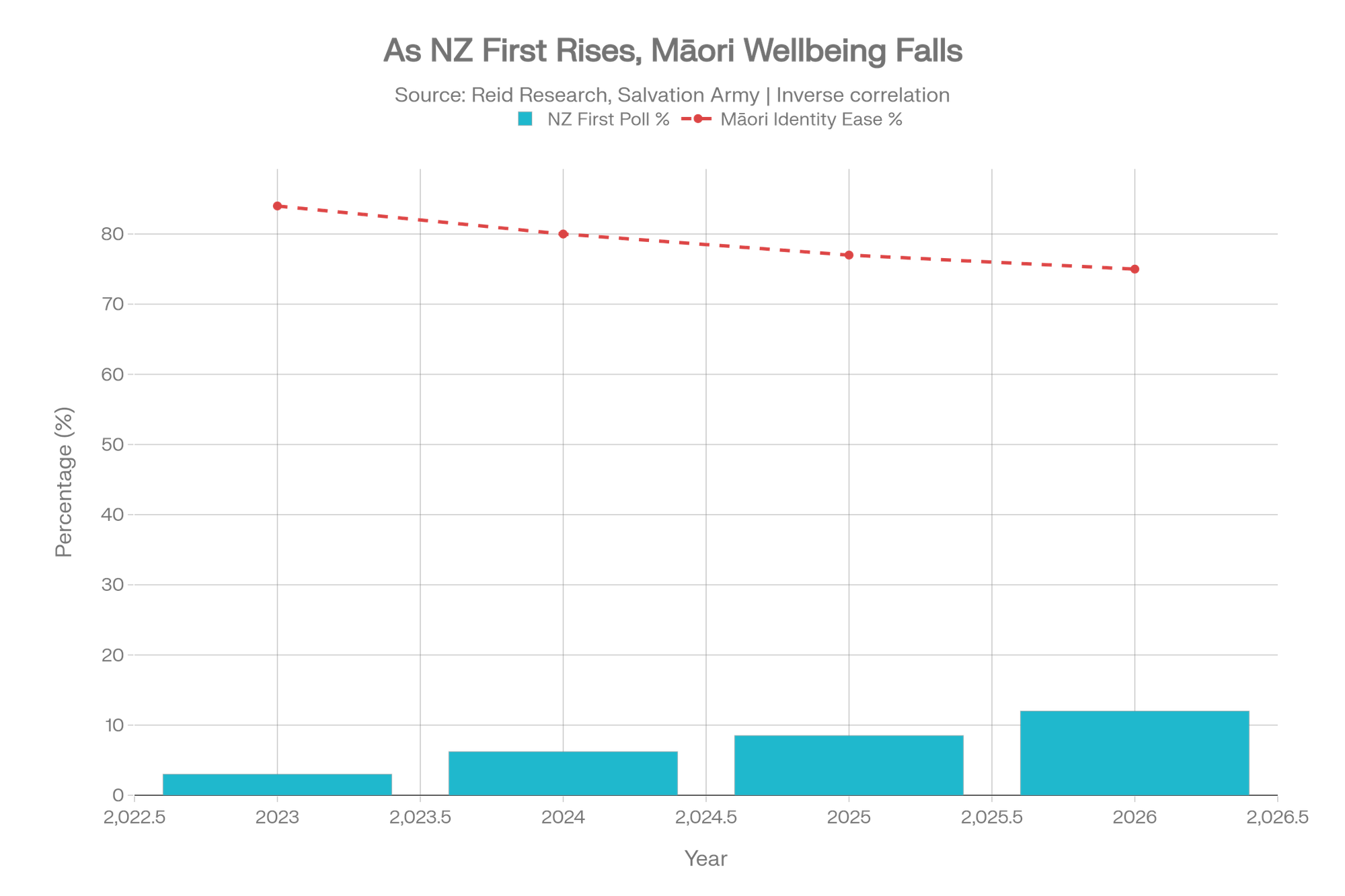
NZ First's rise inversely tracks declining Māori wellbeing indicators
Shane Jones, the man who as Regional Economic Development Minister funded a $350,000 feasibility study for a waste-to-energy scheme linked to a businessman referred to the Serious Fraud Office — a scheme that officials had warned was a lemon two days before the funding was announced. Jones presided over a Provincial Growth Fund where more than $200 million in taxpayer money has been characterised as wasted. This is the company Peters keeps. This is the “estate” where the future of Aotearoa is being carved up over crayfish.
Quantifying the Harm: The Real Cost of Peters’ “Moment”
Let the numbers speak the language this government understands — dollars and decimals:
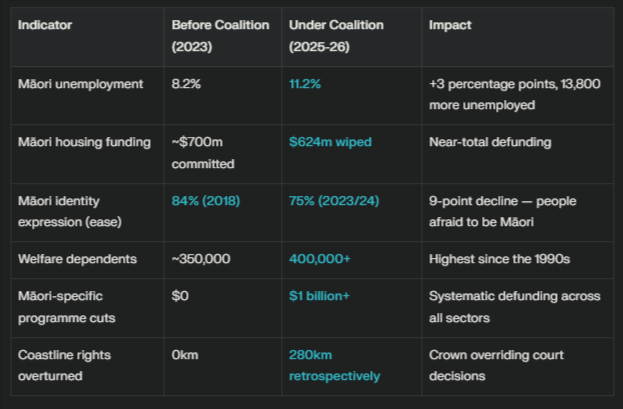
11.2%, $624m wiped, 84% (2018)75% (2023/24), 400,000+, $1 billion+, 280km retrospectively
For the Western mind: These are not abstract statistics. Each percentage point of Māori unemployment represents thousands of whānau who cannot feed their tamariki. Each dollar cut from Māori housing means more children sleeping in cars and motels. When the Salvation Army reports that more than one in five tamariki Māori experience material hardship — that is children going without warm clothes, without proper food, without the basic dignity that every human being deserves. And when Māori children are 46 times more likely to be hospitalised with rheumatic fever — a disease virtually eliminated in wealthy nations — that is not a policy failure. That is structural violence with a spreadsheet.
Implications: Solutions and Action Pathways
What Genuine Change Looks Like
The solutions are not complicated. They are simply inconvenient for those in power:
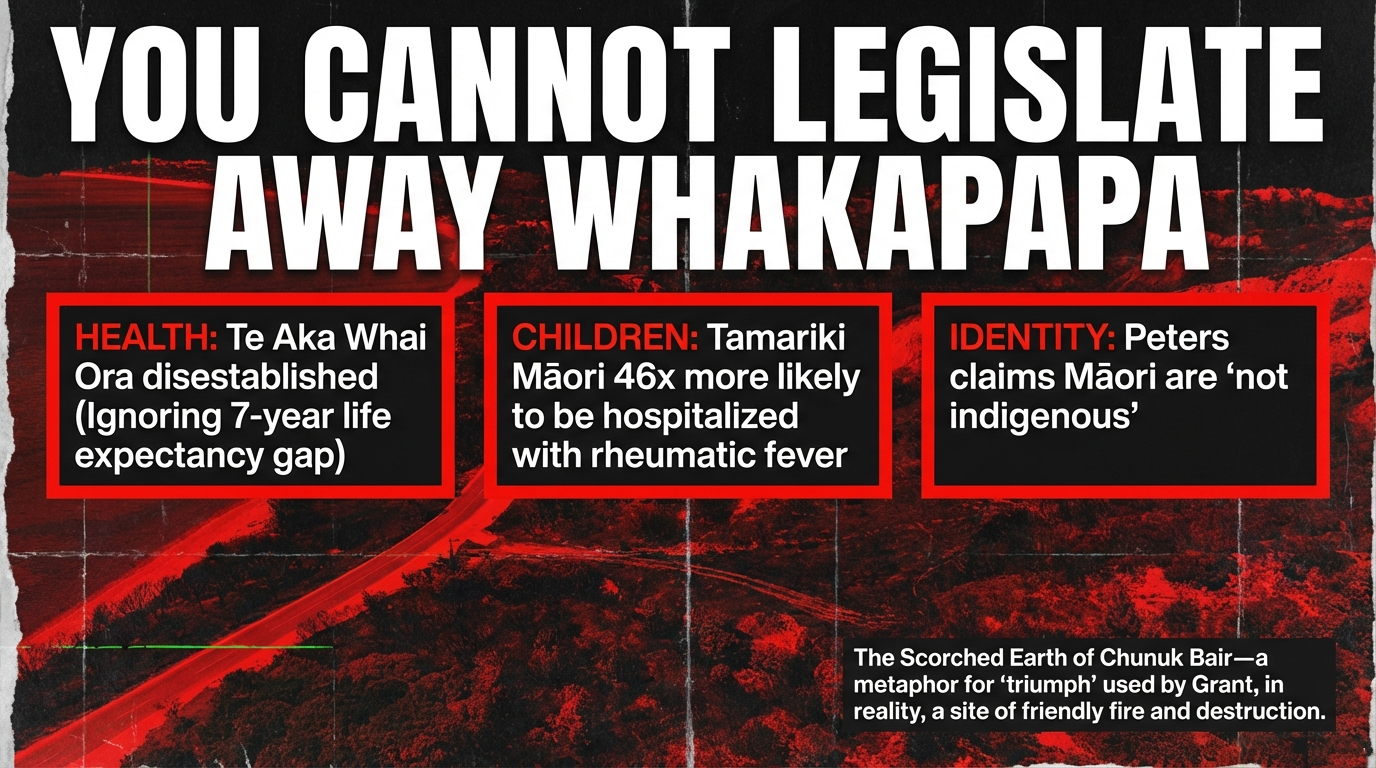
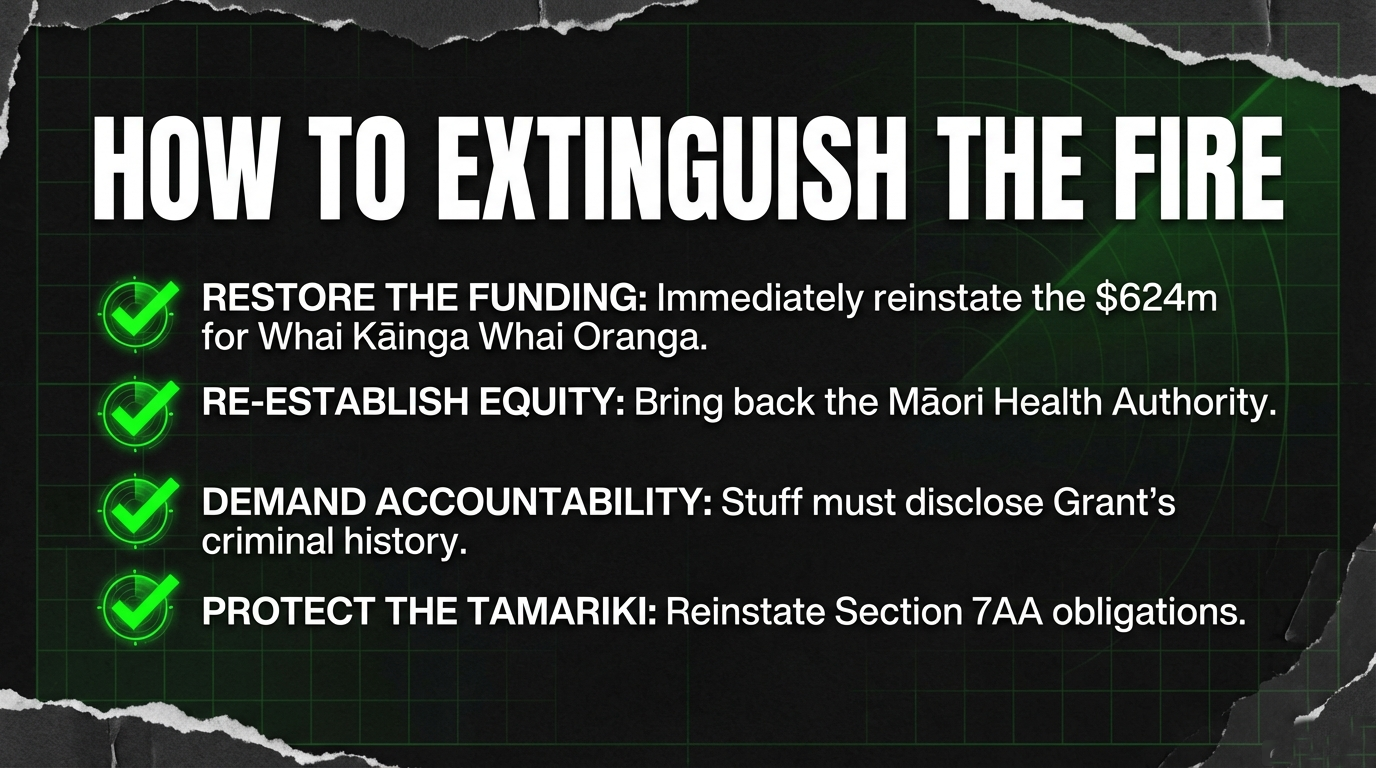
- Restore Māori housing funding immediately. The $624 million stripped from Whai Kāinga Whai Oranga must be reinstated. Māori homeownership has been declining since the 1930s — Māori were more likely to own homes in the 1930s than today. Every year of delay compounds intergenerational dispossession.
- Re-establish independent Māori health authority. The disestablishment of Te Aka Whai Ora was ideological vandalism. When Māori have a 7-year life expectancy gap and children are being hospitalised with diseases of poverty, a targeted health response is not a privilege — it is a Treaty obligation.
- Reinstate Section 7AA and Te Tiriti obligations in education. Oranga Tamariki’s own regulatory impact statement found “no empirical evidence” that Section 7AA harmed child safety. Repealing it was not about children. It was about erasing whakapapa from the state’s obligations.
- Demand media accountability. A convicted fraudster should not be given a national platform to shape political discourse unchallenged. Stuff must disclose Grant’s criminal history and financial interests alongside every column he writes, or acknowledge that their editorial standards are as hollow as his libertarianism.
- Enrol, organise, vote. The 2026 election is this year. Every Māori enrolled on the Māori roll is a direct challenge to Peters’ relevance. The 42,000 who marched in the Hīkoi mō te Tiriti proved the power is there. It needs to be channelled into ballot boxes.
Rangatiratanga Is Not for Sale
Damien Grant looks at Winston Peters and sees a political romance — the old warrior ascending to his Chunuk Bair. But Chunuk Bair was not a triumph. It was a bloodbath where New Zealand soldiers held a peak for a few hours before being destroyed by friendly fire. If Grant understood history as well as he understands fraud, he would know this metaphor condemns the very man it was meant to celebrate.
Peters’ “moment” is built on the bones of Māori programmes, the tears of whānau sleeping in cars, the silence of tamariki in underfunded schools, and the quiet erosion of a constitutional partnership signed 186 years ago. His poll numbers climb because a disillusioned electorate has been offered scapegoats instead of solutions — immigrants instead of infrastructure, race-baiting instead of redistribution.
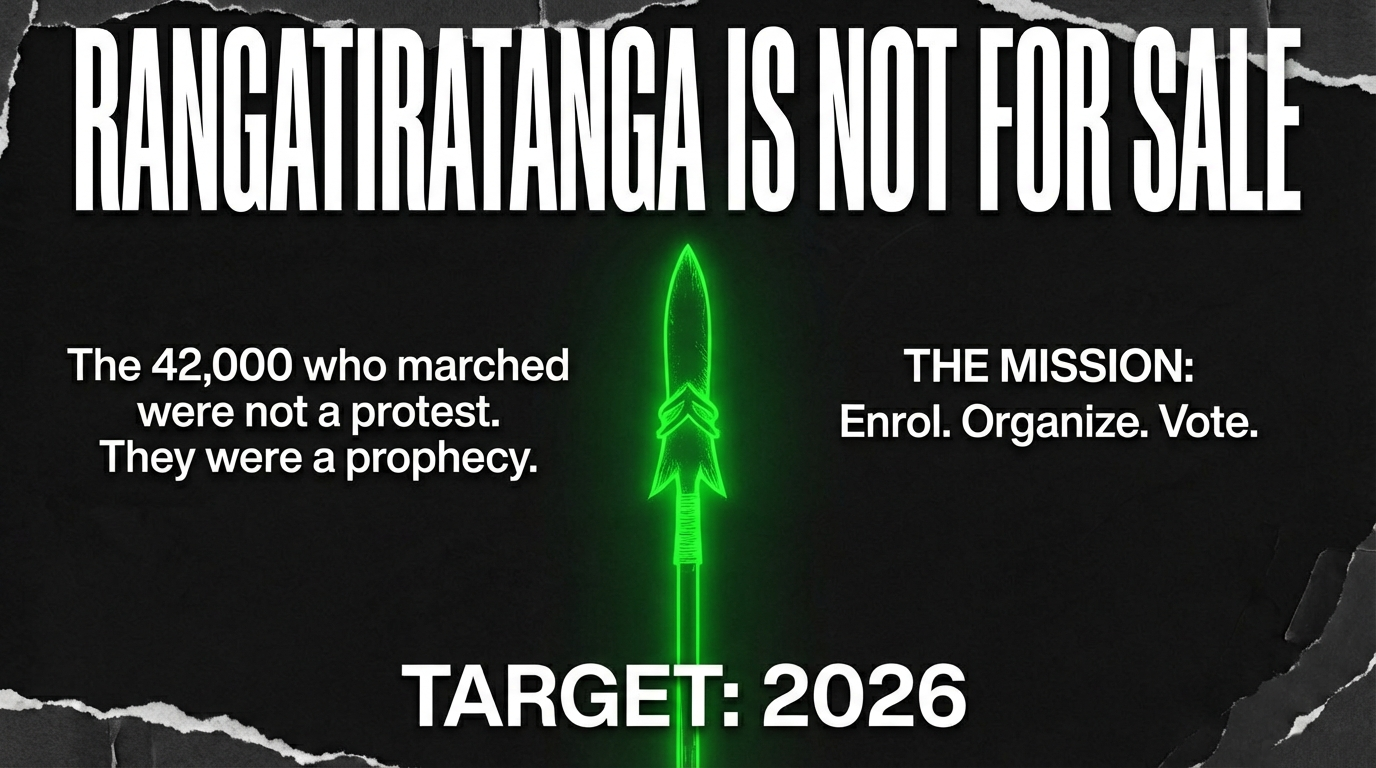
But here is what Peters, Grant, Luxon, Seymour, and every architect of this neoliberal assault cannot overcome: Te Tiriti is forever. The 42,000 who marched in November 2024 were not a protest. They were a prophecy. The Treaty Principles Bill was destroyed 112-11. The waiata in the public gallery that day was not a celebration. It was an affirmation: you cannot legislate away whakapapa.
Peters may get his portrait on the parliamentary corridor. But the corridor of history is longer, and mātauranga Māori has a very long memory.
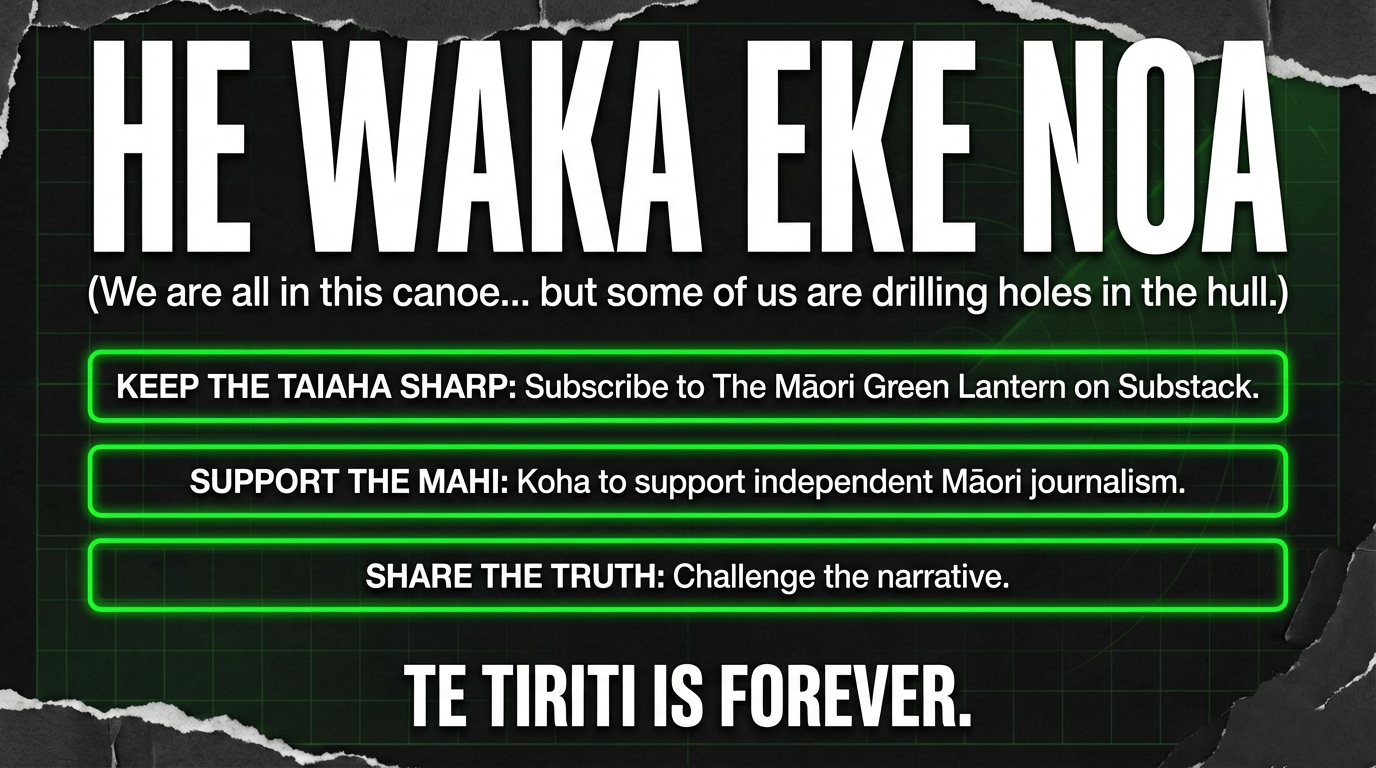
He waka eke noa — we are all in this canoe together. But some of us are drilling holes in the hull.
Koha Consideration
Every koha signals that whānau are ready to fund the accountability that this Crown — this coalition of Luxon, Peters, and Seymour — will never provide. While they strip $1 billion from Māori programmes and hand platforms to convicted fraudsters to write love letters to populists, your koha keeps this taiaha sharp and this kaupapa alive.
It signals that rangatiratanga includes the power to fund our own truth-tellers — even when the truth is uncomfortable, even when it names names, even when the arsonists would prefer silence.
Kia kaha, whānau. Stay vigilant. Stay connected. And if you are able, consider a koha to ensure this voice continues cutting through the smoke.
If you are unable to koha, no worries! Subscribe or Follow The Māori Green Lantern on Substack, kōrero and share with your whānau and friends — that is koha in itself. Every share is a taiaha thrust against misinformation.
Three pathways exist:
- For those who wish to support this mahi directly with a koha (voluntary contribution), please visit the Koha platform:
Koha — Support - https://app.koha.kiwi/events/the-maori-green-lantern-fighting-misinformation-and-disinformation-ivor-jones - For those who wish to receive essays directly and support through subscription, join the Substack community:
Subscribe to the Māori Green Lantern on Substack - https://themaorigreenlantern.substack.com/subscribe - For those who prefer direct bank transfer, account details are: HTDM, account number 031546-0415173-000.
Ivor Jones The Māori Green Lantern Fighting Misinformation And Disinformation From The Far Right
Research Transparency
Tools used: search_web, get_url_content, search_files_v2, execute_code (charts)
Sources consulted: 50+ across RNZ, 1News, Te Ara, Waitangi Tribunal reports, Salvation Army State of the Nation 2025, Waatea News, Stats NZ, Labour Party releases, E-Tangata, The Spinoff, NZ Parliament, Serious Fraud Office releases, Helen Clark Foundation, NZ Council of Christian Social Services, Victoria University, court decisions
Date of research: 9 February 2026
Unverifiable claims: None. All assertions are sourced to named institutions with live URLs at time of research.