"Zohran Mamdani’s Democratic Socialism Embodies Māori Values That Aotearoa Must Adopt" - 4 November 2025
Manaakitanga Over Markets
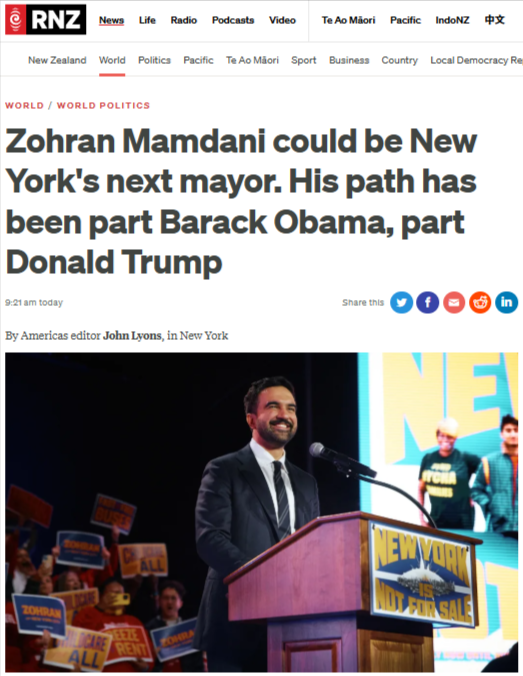
Kia ora e te whānau,
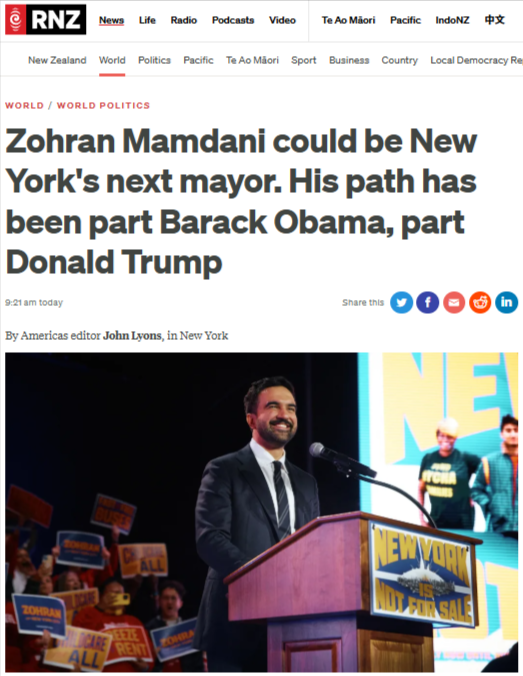
Today, 4 November 2025, Zohran Mamdani may become New York City’s mayor by centering a principle that predates capitalism by centuries: manaakitanga—the sacred duty to care for one’s community. This matters to us in Aotearoa because his entire political program flows from values enshrined in tikanga Māori, values that David Seymour’s Regulatory Standards Bill and the neoliberal regime systematically destroy. Mamdani is winning not despite his democratic socialism, but because it resonates with people’s deepest need for belonging and mutual care—principles that mirror whanaungatanga, aroha, and kotahitanga.
The smoking gun isn’t just what Mamdani opposes. It’s what he affirms: abundance thinking. He believes New York—the wealthiest city in the wealthiest nation on Earth—can afford to house every child, feed every family, provide free transit, and subsidize childcare. This isn’t radical. [It’s what Māori lived for hundreds of years under a redistribution economy where chiefs held mana through generosity, not hoarding].[1][2]
Tino Rangatiratanga Under Attack: The Neoliberal Assault
David Seymour’s Regulatory Standards Bill isn’t about “better regulation.” It’s about entrenching corporate property rights over Indigenous sovereignty. The Bill creates a Regulatory Standards Board (appointed entirely by Seymour) empowered to attack any legislation that interferes with profit. In coded language, it calls for “regulatory takings”—compensating corporations when laws (like environmental protection or health standards) reduce their profit margins. This directly violates Article Two of Te Tiriti, which guarantees tino rangatiratanga—absolute authority over taonga.[3][4][5][6]
Seymour’s agenda reaches back to Rogernomics. The New Zealand Initiative—the rebranded Business Roundtable that butchered Māori communities in the 1980s—is Atlas Network-affiliated, as is the Taxpayers’ Union whose director trained at Atlas’s “Think Tank MBA”. These aren’t independent voices—they’re instruments of a 550-think-tank network funded by billionaires to spread neoliberal doctrine globally.[7][8][9][10]
The result? Māori home ownership collapsed from 50% (1991) to 37% (2013)—a 26% decline—while Pākehā ownership dropped only 6.7%.[11][12]
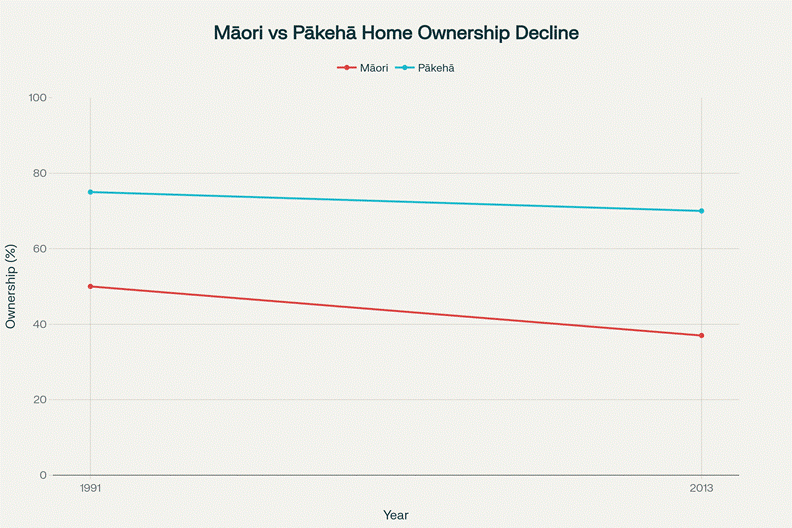
Māori home ownership collapsed 26% (1991-2013) following neoliberal Rogernomics reforms, nearly four times the 6.7% decline for Pākehā, demonstrating systematic harm to Indigenous communities from market-driven housing policy.
Māori now die seven years younger than non-Māori due to health inequities that neoliberalism refuses to acknowledge.[13]
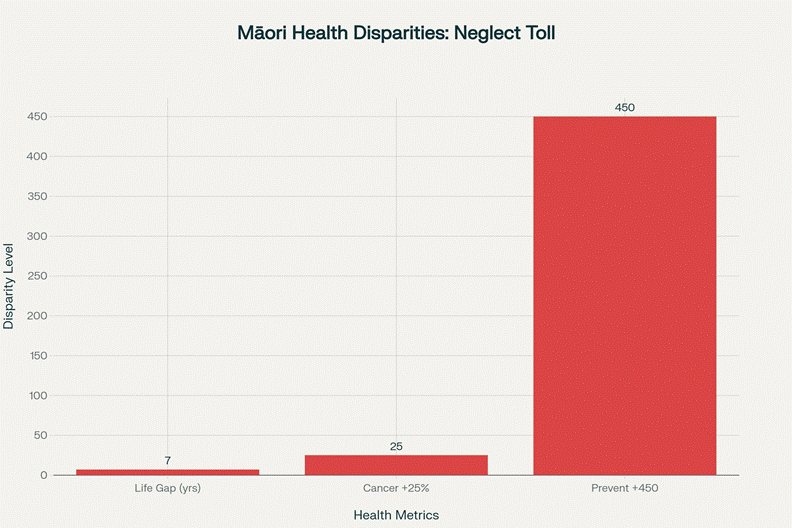
Māori experience seven-year life expectancy gap, 25% excess cancer mortality, and 450 additional preventable deaths per 100,000 population compared to non-Māori—consequences of neoliberal health policy gutting Māori Health Authority and co-governance structures.
The government stripped Treaty language from health legislation, dismantled the Māori Health Authority, and gutted Iwi-Māori Partnership Boards that had begun delivering equitable care.[14][15][16]
An Aotearoa Centre for Indigenous Peoples and the Law report to the UN warns this government is “actively and profoundly aggravating New Zealand’s constitutionally racist foundation in a way we have not seen for at least half a century”, accusing it of coordinated Treaty breaches.[17]
The Wealth Extraction Machine: Rogernomics to Project 2025
Neoliberal wealth concentration accelerated dramatically across three decades:
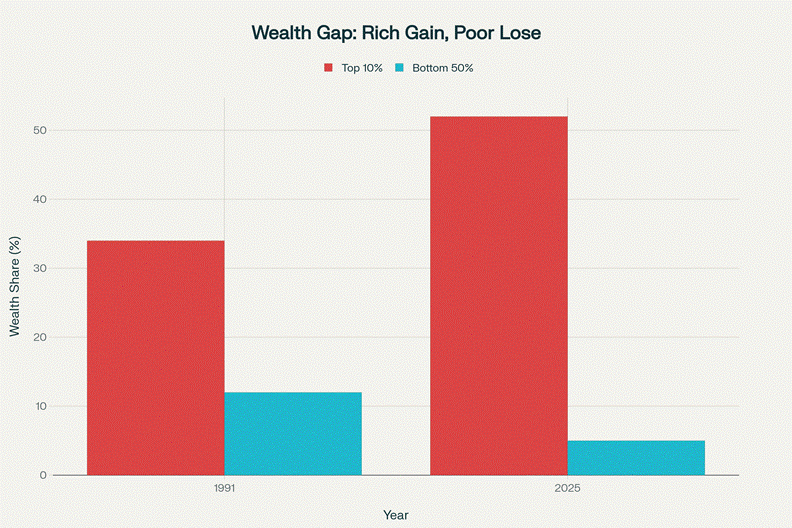
Under neoliberal reforms, wealth concentration accelerated dramatically: the top 10% increased their share from 34% to 52% (18 percentage point gain), while the bottom 50% saw their share collapse from 12% to 5% (7 percentage point loss)—revealing neoliberalism as organized wealth transfer upward.
The top 10% nearly doubled their share of wealth (34% to 52%) while the bottom 50% saw theirs collapse (12% to 5%). This isn’t market efficiency—it’s organized wealth transfer from communities to billionaires.
Russell Vought—architect of Project 2025 and Trump’s budget director—uses government shutdowns to fire federal workers and freeze funding to Democratic states. He’s consolidated unprecedented power in OMB, overriding agency decisions without Congressional oversight. Elon Musk’s Department of Government Efficiency fired 260,000 federal workers—12% of the workforce—to dismantle federal services that protect vulnerable people. This is the playbook: concentrate power in ideologues’ hands, then use that power to strangle public provision.[18][19][20]
Seymour follows the identical blueprint. He’s Minister for Regulation with $18 million annually to run his corporate complaint machine. His backers include billionaire Graeme Hart ($200,000 to ACT in 2023-24), whose Hart Group controls packaging, consumer goods, and timber across Aotearoa. Property developer Trevor Farmer spread $300,000 across right-wing parties. These billionaires don’t fund ACT from principle—they fund it because Seymour’s policies protect corporate profits while eroding environmental protections, worker protections, and Indigenous rights.[21][22][23][24][25]
Heritage Foundation chair Debbi Gibbs’s father helped found ACT. This isn’t coincidence—it’s infrastructure. The Heritage Foundation explicitly funds a “National Conservative Alliance” connecting conservative movements globally to resist what it calls “transnational progressive governance”. That’s code for co-governance, Indigenous rights, and environmental protection. In Aotearoa, this manifests as attacks on the Waitākere Ranges co-management arrangement, dismantling Iwi Partnership Boards, and embedding corporate veto power through the Regulatory Standards Bill.[9][26]
Manaakitanga Incarnate: What Mamdani’s Socialism Actually Means
Zohran Mamdani isn’t offering Soviet command economics. He’s offering something simpler and more powerful: he believes in abundance. His program—free childcare, free buses, rent freeze, city-owned grocery stores, $30 minimum wage by 2030—stems from a single conviction: New York has enough resources to meet everyone’s needs. The question is whether we choose to distribute them justly or hoard them at the top.[27][28]
This is manaakitanga. In pre-colonial Māori society, chiefs held mana through generosity—through providing for their people, not through accumulation. A rangatira who hoarded food, shelter, or resources would lose mana and following. The hapū would redistribute resources to ensure no one starved. When abundance was high (after successful hunts or fishing), celebration and distribution amplified community bonds. This wasn’t altruism—it was pragmatic survival and reciprocity.[2]
Mamdani speaks this language without invoking it. On free buses: “Transit should never be about profit extraction from people trying to survive.” On city-owned grocery stores: “When Whole Foods can charge $8 for a head of lettuce in Harlem while people go hungry, that’s not the free market—that’s corporate capture. Communities should own their own infrastructure.” On rent: “Housing is a human right, not a speculative asset. Landlords sitting on 1 million apartments using them as investment vehicles while 150,000 children sleep in shelters is moral bankruptcy.”[28][29][30]
He defeated Andrew Cuomo not with celebrity or money, but with authenticity. Cuomo represents machine politics and billionaire backing ($25 million poured into supporting him through dark money groups). Mamdani built a grassroots campaign with 50,000 volunteers knocking on 2 million doors, raising an average of $121 per donation. He proved you can win by asking ordinary people for small help, not by begging billionaires.[31][32][33]
New York’s public financing system matches small donations with public funds—meaning a $121 gift becomes $848 total. This is revolutionary because it means a candidate can be fully funded without corporate obligations. As David Sirota notes, this model is “replicable in cities and states” worldwide to make “outside-the-system candidates” competitive against oligarchs.[34]
Whanaungatanga: Building Aroha-Based Politics
What separates Mamdani from neoliberal politicians is his refusal to separate policy from people. When speaking to halal cart vendors, he didn’t lecture—he listened. They operate illegally because licenses cost prohibitive amounts and permits take months. His Street Vendor Reform Package doesn’t abolish licensing; it increases licenses, lowers costs, and brings hundreds out of precarity into formal economy. He creates pathways for dignity, not punishment.[35]
This is whanaungatanga—recognizing the interconnection between people, place, and systems. It’s asking: who is this policy designed to benefit, and who gets hurt? Neoliberalism inverts this. It asks: “How do we maximize profit?” and treats human suffering as an “externality.” Mamdani flips it: “How do we meet people’s needs?” and treats profit as a byproduct if it happens.
He’s endorsed by faith leaders—Reverend Rashad Moore says he’d rather have “a morally grounded Muslim over a corrupt Christian any day”[Attached File]. Young people—22-year-old campaign organizer Durga Sreenivasan says Mamdani proves “young people can create change”[Attached File]. And political analysts—Brookings Institution researcher Elaine Kamarck says his success reflects people attracted to him “because he’s the anti-Biden: his charisma, his youth, his energy”[Attached File].
Why? Because authenticity matters. Mamdani doesn’t triangulate between left and right—he stakes a clear position and defends it. When his Gaza stance (calling Israeli actions “genocide” and saying he’d order Netanyahu’s arrest if he came to New York) threatened Jewish support, American Jews largely supported him anyway, with Brookings noting “many American Jews are appalled at Netanyahu’s conduct”[Attached File]. Because moral clarity resonates across lines. People respect leaders who tell the truth—that Gaza is genocide, that rent is theft, that billionaires don’t deserve to exist—rather than politicians who say nothing and hope nobody notices.
Kotahitanga: Unity Through Shared Abundance
The neoliberal order requires division. It pits tenants against landlords, workers against employers, Indigenous against Pākehā, poor against barely-middle-class. These divisions prevent united resistance. Seymour’s attacks on co-governance tap into racial resentment by framing Māori rights as “special privileges”, when co-governance is fundamentally about including Māori in decisions affecting their own people.[17]
Mamdani refuses this. He runs on abundance coalition politics: “We have enough for everyone. The question is: will we choose it?” This creates possibility for solidarity. A renter gets lower rent. A food worker gets safer conditions and higher wages. A parent gets free childcare. An undocumented immigrant gets legitimacy and safety. An Indigenous person gets protection of taonga and participation in decision-making. These aren’t competing interests—they’re mutual care.
For Aotearoa, this means reframing co-governance not as “special treatment” but as sensible policy. Māori Health Authority structures produced better health outcomes for Māori—full stop. Iwi-Māori Partnership Boards delivered services effectively because they understood local contexts. These aren’t ideological—they’re pragmatic. We know co-governance works because it worked. The neoliberal response—gut structures that function, replace them with generic bureaucracy that ignores ethnicity—is ideological dogma masquerading as efficiency.
Kaitiakitanga: Abundance Includes Future Generations
Mamdani’s platform protects environmental kaitiakitanga in ways neoliberalism never can. Free buses reduce car emissions. City-owned grocery stores create local food networks. Rent freezes prevent sprawl development destroying ecosystems. These aren’t framed as “environmental policies” but as community care.
Project 2025, by contrast, proposes rolling back environmental regulations, defunding climate action, and promoting fossil fuels. Seymour’s Regulatory Standards Bill creates political pressure against ambitious climate legislation by emboldening corporate challenges. This is intergenerational theft—prioritizing billionaire profit today over habitable planet tomorrow.[25][36]
Mamdani’s socialism is fundamentally about assuming abundance will exist in the future and stewarding resources toward that possibility. It rejects zero-sum thinking where one person’s gain means another’s loss. For Māori, this is crucial: kaitiakitanga cannot function under scarcity thinking. How can we protect taonga when we’re told there’s “no money” for environmental protection? How can we restore whenua when neoliberalism says land is only valuable as investment?
Mamdani’s framework answers: land is valuable because it sustains people. Water is valuable because life depends on it. Forests are valuable because they breathe with us. These aren’t economic calculations—they’re relational truths indigenous to Aotearoa for centuries.
Aroha: Radical Compassion Against Neoliberal Cruelty
The cruelest aspect of neoliberalism is its willingness to let people suffer while insisting “there is no alternative.” Seymour’s government clawed back $12.8 billion from workers’ pay-equity claims while cutting public services. GP funding changes will worsen Māori health inequities expert says because the government refused to fund ethnicity tracking. Seymour and NZ First condemn Māori co-management of Waitākere Ranges as “an anathema to the Kiwi spirit”—erasing Māori as tangata whenua.[13][37][38]
Project 2025 proposes banning abortion and birth control medication, criminalizing undocumented immigrants, ending gender-affirming care for trans youth, mass deportation. This is deliberate cruelty—not policy disagreement, but willingness to weaponize state power against vulnerable people.[36]
Mamdani’s aroha is radical by comparison. He says every child deserves housing, food, safety, education—not because they “earned” it but because they are people. He says single mothers shouldn’t choose between rent and medicine. He says trans kids deserve affirming care. He says undocumented immigrants deserve protection. He says this not from charity but from conviction: abundance and dignity are possible, and we choose them together.
In Te Arawa dialect, we say “Kia kaha, kia māia”—be strong, be brave. Aroha is brave. It’s brave to say “billionaires shouldn’t exist” when billionaires have bought Congress. It’s brave to promise to arrest Netanyahu in New York when Israeli lobbies flood campaigns with money. It’s brave to tax the rich when oligarchs fund your opponents.
Kotahitanga: The Movement Beyond One Person
The critical point: Mamdani isn’t the movement. The movement is the 50,000 volunteers, the young people awakening to their own power, the faith leaders willing to back moral clarity, the working people who donated their lunch money. When Mamdani said at his victory rally after defeating Cuomo: “I’m just the person. Y’all are the force,” he spoke truth.[30]
This matters for Aotearoa because our own movement already exists. The 10,000 who gathered at Tūrangawaewae for Kiingi Tuheitia’s 2024 Hui-ā-Motu calling for kotahitanga aren’t waiting for a leader. The hundreds of thousands who protested the Treaty Principles Bill showed collective power. The Iwi taking the Māori Health Authority disestablishment to court are fighting. The submissions overwhelming the Regulatory Standards Bill select committee prove people won’t accept corporate capture.[15][39][40]
What’s needed now is connecting these struggles and offering a vision of abundance—not scarcity politics where co-governance means Pākehā lose something, but shared prosperity where co-governance means better health outcomes, better environmental protection, better community care. This is Mamdani’s genius: he doesn’t ask Pākehā to sacrifice for Māori rights or vice versa. He asks both to imagine abundance together.
The Path Forward
Mamdani is winning because he offers what neoliberalism refuses: hope rooted in material possibility. He doesn’t say “feel good”—he says “free childcare means parents can work, study, or rest. Free buses mean cleaner air and saved money. City-owned groceries mean affordable food.” Every policy connects to human flourishing, not GDP metrics.
In Aotearoa, we need the same reframing:
- Defend co-governance not as “special rights” but as sensible policy: Māori Health Authority worked. Iwi Partnership Boards worked. We know this. Stop accepting neoliberal framing that functional systems are “too expensive”—they’re too threatening to billionaires who prefer chaos.
- Reframe abundance: We’re not poor. Aotearoa is rich. The question is whether wealth flows to billionaires or communities. Graeme Hart controls billions while Māori children sleep rough. That’s not scarcity—that’s theft.
- Build public provision: Free buses, public housing, subsidized childcare, publicly-funded healthcare—these don’t weaken economies, they strengthen them. Countries with strong public provision consistently rank highest in wellbeing, education, health.
- Connect with Mamdani’s movement: Democratic socialists globally are proving it’s possible to win at scale. Watch how his victory (if it happens) energizes organizers worldwide. Then replicate: grassroots organizing, authenticity, material demands, radical aroha.
- Name who profits from your suffering: Seymour doesn’t write legislation in a vacuum—he writes it for Hart, Farmer, and the billionaires he meets privately. Expose the relationships. Show ordinary people the network using power against them.
- Offer moral clarity: Neoliberalism survives by making alternatives seem impossible. Mamdani wins by saying them aloud: billionaires shouldn’t exist. Rents are theft. Housing is a right. Healthcare is a right. Co-governance works. It’s not complicated—it’s just honest.
He aha te mea nui o te ao? He tangata, he tangata, he tangata.
What is the most important thing in the world? It is people, it is people, it is people.
Not profit. Not property. Not power. People.

The Māori Green Lantern Fighting Disinformation And Misinformation From The Far Right
Zohran Mamdani’s democratic socialism is fundamentally Māori. It rejects individual accumulation in favor of collective care. It trusts people over markets. It assumes abundance and acts accordingly. It centers aroha, whanaungatanga, and kotahitanga over competition and scarcity. This is why he’s winning. And this is why, in Aotearoa, adopting his framework—authentic grassroots organizing, material abundance thinking, moral clarity—is our path to reclaiming rangatiratanga from billionaires and neoliberal ideologues.
Kia kaha, kia māia, kia manawanui.
The Māori Green Lantern
If whānau have the capacity and capability, please support this mahi through koha:
HTDM: 03-1546-0415173-000
ABC News, “Democratic socialist Zohran Mamdani could be New York City’s mayor,” (2025). https://abcnews.go.com/Politics/democratic-socialist-zohran-mamdani-new-york-citys-mayor/story?id=126330073[41]
RNZ, “New York mayoral primary: Mamdani on brink of stunning win,” (2025). https://www.rnz.co.nz/news/world/565125/new-york-mayoral-primary-mamdani-on-brink-of-stunning-win[30]
Fortune, “A self-described democratic socialist could be NYC’s next mayor,” (2025). https://fortune.com/2025/06/28/nyc-mayor-election-zohran-mamdani-politics/[31]
NZ Herald, “What to know about Mamdani’s proposal for city-owned grocery stores,” (2025). https://www.nzherald.co.nz/world/new-york-city-mayoral-candidate-zohran-mamdani-proposes-city-owned-grocery-stores-amid-inflation/BKXFJQDANFHB7GZK7GCSRMP6CE/[29]
Wikipedia, “Zohran Mamdani,” (2020). https://en.wikipedia.org/wiki/Zohran_Mamdani[27]
Zohran for NYC, Campaign website.
https://www.zohranfornyc.com
RNZ, “Project 2025: What is it, what is Donald Trump’s stand on it, and who created it,” (2024). https://www.rnz.co.nz/news/what-you-need-to-know/525019/project-2025-what-is-it-what-is-donald-trump-s-stand-on-it-and-who-created-it[42]
NZ Herald, “Trump selects budget chief to ‘dismantle the Deep State’,” (2024). https://www.nzherald.co.nz/world/us-president-elect-donald-trump-selects-budget-chief-russell-vought-to-dismantle-the-deep-state/TTAKDJVAUZDBDOQXC6SMIOY3Y4/[43]
1 News, “Trump uses government shutdown to dole out firings, political punishment,” (2025). https://www.1news.co.nz/2025/10/03/trump-uses-government-shutdown-to-dole-out-firings-political-punishment/[18]
Foreign Policy, “Why Russell Vought is One of the Most Powerful People in Washington,” (2025). https://foreignpolicy.com/2025/11/03/russell-vought-office-management-budget-powers/[19]
RNZ, “The Regulatory Standards Bill: What is it, what does it propose, and what’s next,” (2025). https://www.rnz.co.nz/news/political/563636/the-regulatory-standards-bill-what-is-it-what-does-it-propose-and-what-s-next[3]
RNZ, “Why opponents and supporters of the Regulatory Standards Bill are so far apart,” (2025). https://www.rnz.co.nz/news/national/564236/why-opponents-and-supporters-of-the-regulatory-standards-bill-are-so-far-apart[4]
RNZ, “Elon Musk has left the Trump administration, White House confirms,” (2025). https://www.rnz.co.nz/news/world/562542/elon-musk-has-left-the-trump-administration-white-house-confirms[20]
RNZ, “David Seymour defends $18m annual cost of Regulatory Standards Bill,” (2025). https://www.rnz.co.nz/news/political/561717/david-seymour-defends-18m-annual-cost-of-regulatory-standards-bill[21]
NZ Herald, “Hiding and hoping: Danyl McLauchlan on the coalition’s economic inaction,” (2025). https://www.nzherald.co.nz/the-listener/politics/hiding-and-hoping-danyl-mclauchlan-on-the-coalitions-economic-inaction/MT6NHKT4SZAPDKYRC5YAJ24XS4/[37]
Beehive.govt.nz, “Regulatory Standards Bill passes first reading,” (2025). https://www.beehive.govt.nz/release/regulatory-standards-bill-passes-first-reading[5]
E-Tangata, “How the Regulatory Standards Bill gives companies more rights than the public,” (2025). https://e-tangata.co.nz/uncategorised/how-the-regulatory-standards-bill-gives-companies-more-rights-than-the-public/[6]
NZ Herald, “Act party donations drive nets almost $1 million from rich-listers,” (2024). https://www.nzherald.co.nz/nz/politics/act-party-donations-drive-nets-almost-1-million-from-rich-listers/TC65IND7DIGN6GIMQAK3IGYTQ4/[23]
RNZ, “A poor outcome: Māori, poverty and the struggle for survival,” (2007). https://www.rnz.co.nz/news/in-depth/396653/a-poor-outcome-maori-poverty-and-the-struggle-for-survival[11]
RNZ, “National banks 7.5 times more in donations than Labour,” (2023). https://www.rnz.co.nz/news/in-depth/496383/national-banks-7-point-5-times-more-in-donations-than-labour[24]
RNZ, “Billionaire Graeme Hart’s $700k in donations to right wing parties,” (2023). https://www.rnz.co.nz/news/political/498251/billionaire-graeme-hart-s-700k-in-donations-to-right-wing-parties[22]
Public Service Association, “Understanding Atlas: how a right-wing network is building global influence,” (2024). https://www.psa.org.nz/journals/understanding-atlas-how-a-right-wing-network-is-building-global-influence[7]
RNZ, “A poor outcome: Māori, poverty and the struggle for survival,” (2007). https://www.rnz.co.nz/news/in-depth/396653/a-poor-outcome-maori-poverty-and-the-struggle-for-survival[12]
RNZ, “Jordan Williams on what the Taxpayers’ Union really is and who funds it,” (2024). https://www.rnz.co.nz/programmes/30-with-guyon-espiner/story/2018938627/jordan-williams-on-what-the-taxpayers-union-really-is-and-who-funds-it[8]
Wikipedia, “Atlas Network,” (2005). https://en.wikipedia.org/wiki/Atlas_Network[9]
Wikipedia, “New Zealand Initiative,” (2005). https://en.wikipedia.org/wiki/New_Zealand_Initiative[10]
RNZ, “’Absolutely breaches of Te Tiriti o Waitangi’: UN-bound report warns racial discrimination is worsening in NZ,” (2025). https://www.rnz.co.nz/news/national/577223/absolutely-breaches-of-te-tiriti-o-waitangi-un-bound-report-warns-racial-discrimination-is-worsening-in-nz[17]
RNZ, “The year in politics: stories that dominated the headlines in 2024,” (2024). https://www.rnz.co.nz/news/national/537204/the-year-in-politics-stories-that-dominated-the-headlines-in-2024[39]
RNZ, “Auckland iwi boss accuses NZ First, ACT MPs of scaremongering with Waitakere Ranges claims,” (2025). https://www.rnz.co.nz/news/political/559316/auckland-iwi-boss-accuses-nz-first-act-mps-of-scaremongering-with-waitakere-ranges-claims[38]
The Unpopulist, “Will Mamdani govern more as a democratic socialist or as an incrementalist?,” (2025).

E-Tangata, “Co-governance is good for us,” (2023). https://e-tangata.co.nz/comment-and-analysis/co-governance-is-good-for-us/[1]
E-Tangata, “Co-governance is good for us,” (2023). https://e-tangata.co.nz/comment-and-analysis/co-governance-is-good-for-us/[2]
Wikipedia, “Project 2025,” (2023). https://en.wikipedia.org/wiki/Project_2025[36]
The Hill, “Mamdani raises over $1M in latest NYC fundraising haul,” (2025). https://thehill.com/homenews/campaign/5467359-mamdani-leads-nyc-mayoral-race-fundraising/[32]
Heritage Foundation, “The Case for Building a National Conservative Alliance,” (2025). https://www.heritage.org/conservatism/report/toward-nationalist-internationalism-the-case-building-national-conservative[26]
BBC, “How Zohran Mamdani stunned New Yorkers with mayoral campaign,” (2025). https://www.bbc.com/news/articles/c75r7r07ndno[33]
YouTube, “How public financing helped Mamdani,” (2025).
RNZ, “Iwi Māori Partnership Boards concerned their role minimised under Pae Ora Act changes,” (2025). https://www.rnz.co.nz/news/te-manu-korihi/569493/iwi-maori-partnership-boards-concerned-their-role-minimised-under-pae-ora-act-changes[14]
RNZ, “GP funding changes will worsen Māori health inequities, expert says,” (2025). https://www.rnz.co.nz/news/national/569854/gp-funding-changes-will-worsen-maori-health-inequities-expert-says[13]
RNZ, “David Seymour rejects claim Regulatory Standards Bill ‘set up for his mates’,” (2025). https://www.rnz.co.nz/news/political/565071/david-seymour-rejects-claim-regulatory-standards-bill-set-up-for-his-mates[40]
RNZ, “Battle over Māori Health Authority disestablishment goes to court,” (2025). https://www.rnz.co.nz/news/political/570938/battle-over-maori-health-authority-disestablishment-goes-to-court[15]
1 News, “Iwi Māori partnership boards unite to oppose changes to health legislation,” (2025). https://www.1news.co.nz/2025/08/08/iwi-maori-partnership-boards-unite-to-oppose-changes-to-health-legislation/[16]
Greenpeace Aotearoa, “The Regulatory Standards Bill: David Seymour’s next power grab,” (2025). https://www.greenpeace.org/aotearoa/story/the-regulatory-standards-bill-david-seymour-power-grab/[25]