"$12.8 BILLION STOLEN: How the Coalition Gutted Pay Equity, Destroyed Māori Health Services, and Imported America's Corporate Takeover" - 4 November 2025
When 11,500 health workers strike on November 28, they're defending something the government is actively destroying—the right to healthcare as a human right.
Mōrena e hoa mā,
The smoking gun sits in plain sight: while 11,500 Allied Health workers prepare to strike on November 28, 2025, the architects of their misery are importing an American playbook designed to dismantle the public good (PSA, 2025). This is not coincidence. This is coordination. David Seymour’s Regulatory Standards Bill mirrors the ideological warfare of Russell Vought, Trump’s Office of Management and Budget director and lead author of Project 2025, who currently wields a scythe through the American federal workforce. Just as Elon Musk’s DOGE slashed 260,000 federal jobs under the guise of “efficiency,” our Coalition Government has eliminated 10,000 public sector positions—with Māori and Pacific health services bearing the cruelest burden (Kaitiaki, 2024).
Who benefits? Corporate donors who bankrolled ACT with $500,000, including $104,000 from the Rank Group—billionaire Graeme Hart’s empire. Who gets harmed? The 180,000 women stripped of $12.8 billion in pay equity funding (Willis, 2025). The Māori whānau facing seven fewer years of life than Pākehā (Health NZ, 2024). The healthcare workers forced into unpaid overtime while Health NZ Commissioner Lester Levy calls nurses “expensive” (Te Ao Māori News, 2024).
What lies hidden? The international network funding this assault, the revolving door between corporate lobbying and government positions, and the deliberate strategy to privatize healthcare through manufactured crisis.
Historical Whakapapa: From Rogernomics to Project 2025’s Antipodean Twin
The roots of today’s healthcare carnage stretch back to the neoliberal revolution of the 1980s. Roger Douglas’s economic “reforms” privatized state assets, slashed public spending, and created the income inequality that burdens Māori disproportionately (Barnett et al., 2010). The Employment Contracts Act of 1991 gutted collective bargaining power, driving skilled workers to Australia where wages outpace ours by $17,000-$25,000 annually for healthcare roles.
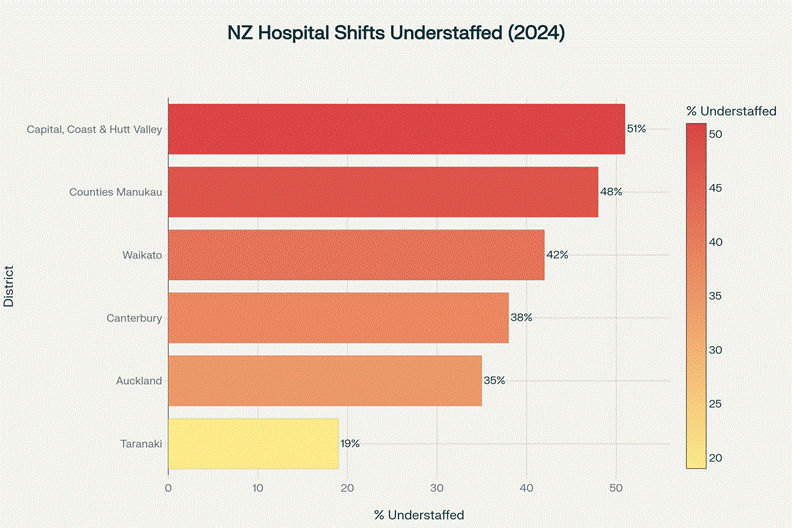
Hospitals across Te Whatu Ora districts are critically understaffed, with Capital, Coast & Hutt Valley experiencing understaffing on 51% of shifts, putting patient safety at risk.
Fast forward to 2025, and the playbook has been perfected. Russell Vought, who served as Trump’s OMB director during the first term and returned for the second, spent the interim at his Center for Renewing America drafting 350 executive orders for Project 2025 (ProPublica, 2025). His mission: “crush the deep state,” fire civil servants, and transfer power from democratic institutions to corporate-friendly autocrats (BBC, 2025). Vought now oversees mass federal layoffs during the 2025 government shutdown, using what PBS calls a “grim reaper“ approach unprecedented in American history.
The parallels to Aotearoa are chilling. David Seymour’s Regulatory Standards Bill, based on Dr. Bryce Wilkinson’s libertarian framework commissioned by the Business Roundtable, creates a Regulatory Standards Board with sweeping powers to challenge legislation that protects workers, the environment, or Māori rights (Seymour, 2025). Like Vought’s DOGE, it operates outside democratic accountability—Seymour himself appoints board members at an $18 million annual cost (RNZ, 2025).
The Waitangi Tribunal condemned the bill as breaching Treaty principles of partnership, active protection, and rangatiratanga (Waitangi Tribunal, 2024). Legal scholar Tania Waikato calls it “Treaty Principles Bill 2.0“—a corporate Trojan horse designed to dismantle environmental protections, labor rights, and Te Tiriti obligations (RNZ, 2025).
Crisis by Design: Deconstructing Health NZ’s Manufactured Catastrophe
Public Service Association National Secretary Fleur Fitzsimons states the Allied Health workers’ position clearly: “Health NZ needs to listen to the voice of workers and come back to the bargaining table with an offer that provides for safer staffing levels, ends delays in recruiting new staff, and a better pay offer that reflects their value to the health system“ (PSA, 2025). But the Coalition has no intention of listening. The crisis is the point.
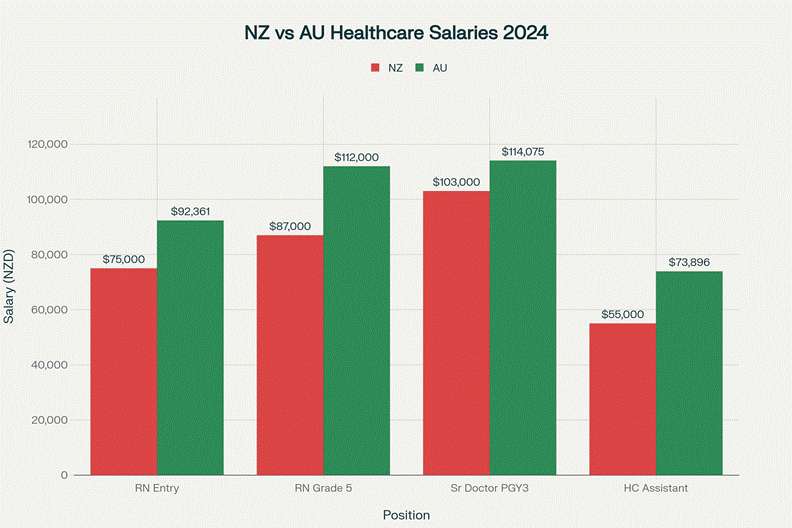
Healthcare workers in Australia earn significantly more than their New Zealand counterparts, with wage gaps ranging from $11,075 to $25,000 annually—driving the exodus of skilled workers across the Tasman.
Consider the timeline. In March 2024, Health NZ forecast a $583 million surplus (RNZ, 2024). Weeks later, it crashed to a projected $1.76 billion deficit—losing $147 million monthly (RNZ, 2024). Health Minister Shane Reti fired the board, installed Commissioner Lester Levy, and commissioned a Deloitte report that conveniently blamed “loss of financial control” on the previous Labour government (Deloitte, 2025).
What the report buried: Health NZ had been waiting for $529 million in pay equity reimbursements—funds the Coalition withheld until October 2024, months after manufacturing the “crisis” (RNZ, 2024). Deloitte’s own findings noted the deficit stemmed partly from a 30% rise in nurses’ wages over three years—pay equity settlements mandated by law to address historical gender discrimination (RNZ, 2025). The Deloitte report even suggested New Zealand would have been “better off” keeping the 20 District Health Boards—contradicting the Coalition’s own restructuring rationale (Deloitte, 2025).
The “solution”? Slash $660 million in 2024/25 through voluntary redundancies and restructuring, extending cuts through 2027 (Health NZ, 2024). 2,042 Health NZ jobs were eliminated by December 2024, including 125 Hauora Māori roles and 400 Pacific health positions (Herald, 2024; Te Ao Māori News, 2024). NZNO President Kerri Nuku described the impact: “It’s a huge blow. It’s a blow to morale and it’s a blow to the system. Everybody is feeling incredibly anxious” (Te Ao Māori News, 2024).
Meanwhile, Health NZ imposed a hiring freeze that “ghosted” hundreds of advertised positions (RNZ, 2024). An Infometrics report commissioned by NZNO found hospitals were short an average of 587 nurses every shift in 2024, with 51% of shifts understaffed in Capital, Coast and Hutt Valley (Infometrics, 2025). The same Health NZ that eliminated jobs claimed it had no staffing crisis—a lie exposed by workers risking their livelihoods to strike.
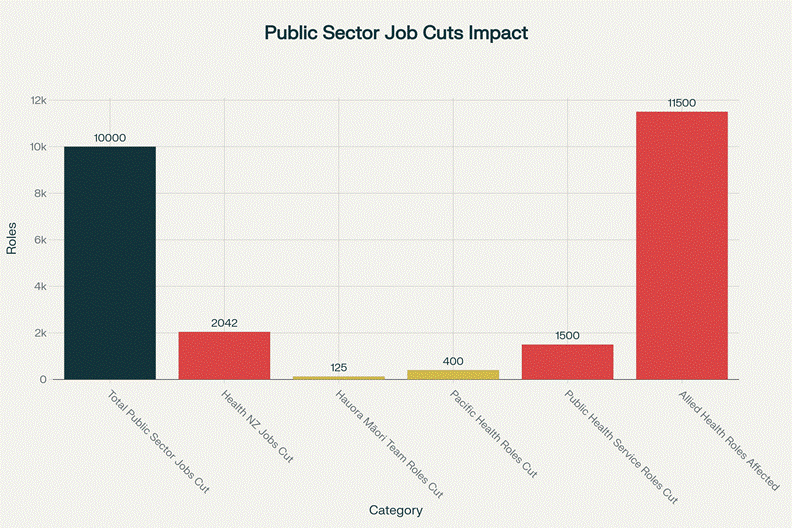
While 10,000 public sector jobs have been eliminated, Māori and Pacific health services bore a disproportionate burden with 125 Hauora Māori roles and 400 Pacific health roles cut—cementing health inequities for generations.
The Pay Equity Heist: $12.8 Billion Stolen from Women Workers
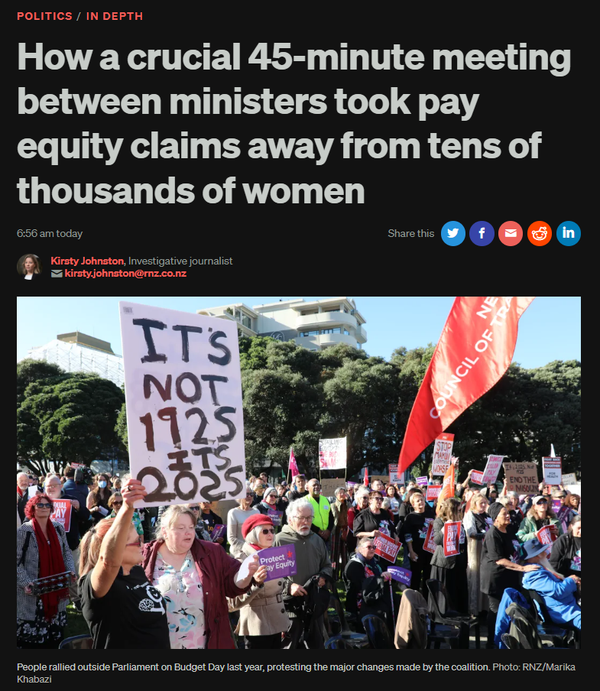
On May 6, 2025, Workplace Relations Minister Brooke van Velden rammed through legislation under urgency that gutted the Equal Pay Act, extinguishing 33 active pay equity claims affecting 180,000 predominantly female workers (RNZ, 2025; Kaitiaki, 2025). Van Velden justified the theft by attacking comparator professions: “You have librarians who’ve been comparing themselves to transport engineers. We have admin and clerical staff at Health New Zealand comparing themselves to mechanical engineers” (RNZ, 2025). The implication: women’s work is inherently worth less—a textbook example of the systemic undervaluation the Equal Pay Act was designed to remedy.
The numbers are staggering. Finance Minister Nicola Willis announced Budget 2025 would “save” $2.7 billion annually and “repurpose” $12.8 billion over four years from pay equity contingencies (Willis, 2025). In health alone, dumping pay equity claims “saved” $420 million—funds that “mostly paid for the near $500 million investment in digital health” rather than frontline care (Tenbensel, 2025).
PSA National Secretary Fleur Fitzsimons called it “a dark day for New Zealand women” and warned the changes make it “impossible for people in female-dominated professions to be paid fairly” (PSA, 2025). Legal experts noted the changes occurred “without consultation with women and the public“ and constitute “the most significant regression of women’s economic and political rights in 35 years” (Kaitiaki, 2025).
The gendered and racialized nature of this theft cannot be overstated. Māori and Pacific women dominate healthcare support roles—the very professions now denied pay equity. A 2022 study found Māori health inequities cost $860 million annually, yet the Coalition diverts billions from addressing the workforce discrimination that perpetuates those inequities (Reid et al., 2022). As the Māori Health Chart Book 2024 documents, Māori die seven years younger than non-Māori, with higher rates of diabetes, cardiovascular disease, and cancer (Ministry of Health, 2024).
The Hidden Network: Money, Ideology, and International Coordination
This assault on workers and Māori rights did not emerge in isolation. It is funded, coordinated, and ideologically aligned with global neoliberal networks.
Follow the Money
ACT Party received $500,000 in business donations in 2023, including $104,000 from the Rank Group—controlled by billionaire Graeme Hart, who also donated $100,000 personally (RNZ, 2024). National Party received $1.2 million from businesses, led by $200,000 from Christopher and Banks private equity (RNZ, 2024). These donations buy access through schemes like National’s “Cabinet Club“—$10,000 per person for dinners with ministers (Integrity Institute, 2025).
Political economist Max Rashbrooke argues corporate donations create “undue influence on government decisions,” recommending New Zealand follow Canada and European countries that ban business donations (Victoria University, 2025). The fast-track legislation exempts Coalition donor companies from environmental oversight—what policy analyst Max Edwards calls “hard to imagine a more direct conflict of interest than accepting money from a donor then changing the law on their behalf” (Listener, 2025).
The Think Tank Pipeline
Seymour’s Regulatory Standards Bill originated from the Business Roundtable—now merged into the New Zealand Initiative, funded by corporate members including banks and property developers (RNZ, 2025). Before entering Parliament, Russell Vought served as vice president of Heritage Action for America—the Heritage Foundation’s sister organization (Axios, 2025). Heritage authored Project 2025’s 922-page manifesto with over 300 contributors, including former Trump Cabinet secretaries and senior EPA officials (NBC, 2025; E&E News, 2024).
Despite Trump’s campaign denials, his second administration is stocked with Project 2025 authors: Tom Homan (border czar), Brendan Carr (FCC chair), John Ratcliffe (CIA director), and Vought himself (Politico, 2024). Project 2025 director Paul Dans celebrated Trump’s 2024 victory: “Now that the election is over I think we can finally say that yeah actually Project 2025 is the agenda” (RNZ, 2024).
Ideological Alignment
Vought’s playbook matches Seymour’s precisely. Both frame democratic institutions as obstacles to “efficiency.” Both target civil servants as enemies of “productivity.” Both use manufactured crises to justify radical restructuring. Vought promised to put career civil servants “in trauma“ and described OMB as the president’s “air-traffic control system” for “reshaping or dismantling bureaucracy” (NBC, 2025). Seymour claims regulations are “a tax on growth” and promises his bill will “change how politicians behave” by making them “transparent” (Seymour, 2025).
The rhetoric is identical because the donors, think tanks, and outcomes align perfectly: concentrate wealth upward, dismantle worker protections, and privatize public services under the guise of “freedom” and “efficiency.”
Tikanga Violations: How Neoliberalism Destroys Māori Values
Every principle of tikanga Māori is violated by this healthcare destruction:
Whanaungatanga (kinship, relationships) is shattered when 125 Hauora Māori workers are dismissed despite Māori bearing the highest health burden. As Dr. Clive Aspin notes: “Moving to other locations to find work, including those across the Tasman, is not an option for Māori and Pacific people because the communities to which they belong are here in Aotearoa” (Kaitiaki, 2024).
Manaakitanga (caring, hospitality) is impossible when nurses work unpaid overtime and 40% regularly exceed contracted hours without compensation (PSA, 2025). A PSA survey found 86% of health workers believe cuts damaged services they deliver (RNZ, 2025).
Kaitiakitanga (guardianship) is abandoned when the Coalition diverts $12.8 billion from pay equity to corporate tax breaks. Willis boasts her Budget is “not austerity” while slashing public sector jobs, KiwiSaver contributions, and Best Start payments (Willis, 2025).
Rangatiratanga (sovereignty, self-determination) is crushed by Seymour’s Treaty Principles Bill—which the Waitangi Tribunal called “the worst, most comprehensive breach of the Treaty/te Tiriti in modern times” (Waitangi Tribunal, 2024). Former PM Jenny Shipley warned ACT is “inviting civil war“ (Shipley, 2024).
Aroha (compassion, love) is antithetical to a system that forces Allied Health workers to choose between taking lunch breaks or patient safety. When “work to rule” becomes strike action—meaning simply following basic employment rights is considered industrial disruption—the system has revealed its exploitation (PSA, 2025).
Rhetorical Deconstruction: The Lies They Tell
Lie #1: “We need to live within budget”
Reality: Health NZ’s “crisis” emerged after the Coalition withheld $529 million in legally mandated pay equity funds (RNZ, 2024). The government created the deficit, then used it to justify cuts. This is the “starve the beast” strategy—defund public services, declare them “broken,” then privatize.
Lie #2: “Pay offers are fair”
Reality: Allied Health workers face 2% then 1.5% raises over 30 months while inflation hit 3.0% in October 2025—meaning real wages decrease (Inside Government, 2025; Stats NZ, 2025). Rent rose 2.6%, electricity 11.3%, and rates 8.8%—the largest electricity spike since 1989 (Stats NZ, 2025). The minimum wage increase of 1.5% is a pay cut in real terms (NZCTU, 2025).
Lie #3: “There’s no staffing crisis”
Reality: Hospitals need 587 more nurses per shift nationally, with projections showing 8,000 more nurses needed by 2032 (Infometrics, 2025). Mental health services took 8 of the top 10 most understaffed wards in 2024, with Waitematā’s Rata ward understaffed on 99.13% of shifts—up from 1.64% in 2022 (Kaitiaki, 2025).
Lie #4: “Cuts won’t affect frontline services”
Reality: Four out of five health workers report cuts damaged services they deliver (RNZ, 2025). When you eliminate 125 Hauora Māori specialists who address seven-year life expectancy gaps, that is the frontline (Te Ao Māori News, 2024; Health NZ, 2024).
Logical Fallacies Deployed:
- False Dichotomy: “Live within budget OR deliver quality healthcare”—ignoring that adequate funding enables both
- Strawman: Attacking pay equity comparators while refusing to address systemic gender undervaluation
- Appeal to Authority: Deloitte report legitimizes predetermined cuts without examining political decisions that created crisis
- Bandwagon: “Australia does it this way”—but only for worker suppression, never for their higher wages
The Quantified Harm: Numbers That Indict
Cost of Living vs Wages:
- Inflation: 3.0% (October 2025)
- Allied Health offer: 2% then 1.5%
- Real wage decrease: 0.5-1.5% annually
- Beneficiaries’ cost-of-living increase: 3.4%
- Superannuitants: 3.9%
- Lowest-spending households: 4.0%
(Stats NZ, 2025; Inside Government, 2025; RNZ, 2025)
Māori Health Inequities:
- Life expectancy gap: 7.5 years shorter
- Annual economic cost: $860 million
- Māori diabetes rates: 1.5x higher than non-Māori
- Māori cancer mortality: 1.5x higher
- Māori cardiovascular disease: 2x higher
(Health NZ, 2024; Reid et al., 2022; Ministry of Health, 2024)
Women Workers Plundered:
- $12.8 billion diverted from pay equity over 4 years
- 33 claims extinguished without consultation
- 180,000 women affected
- $420 million cut from health pay equity alone
(Willis, 2025; RNZ, 2025; Kaitiaki, 2025; Tenbensel, 2025)
International Context: The Global Neoliberal Assault
International Context: The Global Neoliberal Assault
New Zealand’s healthcare crisis mirrors attacks worldwide. Australia’s neoliberal health reforms similarly emphasize “cost cutting, decentralizing, and setting health care up as a private good for sale rather than a public good” (Horton, 2007). Yet Australia maintains public mental health funding New Zealand abandoned, and pays nurses $17,000-$25,000 more annually (Legge, 2019; 1News, 2024).
The United States offers the cautionary tale. Vought’s mass federal layoffs during the 2025 shutdown target education, Treasury, Homeland Security, and Health and Human Services (1News, 2025). DOGE claimed $160-170 billion in “savings” but analysis shows the cuts cost taxpayers $135 billion through paid leave, wrongful dismissals, and lost productivity (Partnership for Public Service, 2025). Trump cut $8 billion in green energy projects in Democratic states and withheld $18 billion in New York transportation funding—using crisis for political vengeance (1News, 2025).
New Zealand follows this playbook precisely: manufacture crisis, blame workers, defund Māori services, enrich donors.
Cui Bono: Who Profits from Our Pain?
Graeme Hart / Rank Group: $204,000 to ACT. Benefits from deregulation via Regulatory Standards Bill, reduced worker protections.
Christopher and Banks: $200,000 to National. Private equity firm benefits from health privatization opportunities created by public system “failure.”
Heritage Foundation / Project 2025 Network: Ideological coordination spreads neoliberal playbook globally. Kevin Roberts celebrated Trump’s victory: “Project 2025 is the agenda” (RNZ, 2024).
Deloitte: $77-page consultancy report legitimizes predetermined cuts. The “big four” consultancies profit from crisis they help manufacture.
Private Healthcare Providers: Stand ready to absorb services the public system can no longer deliver due to intentional defunding.
Those Harmed:
- 180,000 women lose pay equity rights
- 10,000 public servants lose jobs
- 125 Hauora Māori workers dismissed
- Māori whānau facing 7-year shorter lives
- Patients on understaffed wards
- Healthcare workers forced to strike for basic rights
If the Coalition succeeds, Aotearoa faces:
Healthcare Privatization: As public system deteriorates, those who can afford it will buy private insurance. Māori, Pacific, and poor Pākehā communities will suffer widening health inequities already costing $860 million annually.
Brain Drain Acceleration: With Australia paying $17,000-$25,000 more, New Zealand trains healthcare workers for Australian benefit. 5,000 nurses registered to work in Australia since August 2023 (Kaitiaki, 2023).
Treaty Violations Normalized: Seymour’s bills create legal infrastructure to override Te Tiriti obligations. The Regulatory Standards Board institutionalizes corporate veto over environmental and cultural protections.
Women’s Rights Regression: The pay equity theft is “the most significant regression of women’s economic and political rights in 35 years” (Kaitiaki, 2025).
Democratic Erosion: Legislation passed under urgency without consultation follows Project 2025’s authoritarian playbook.
What We Must Do: Tangible Actions for Resistance
Support the Strikes:
- Allied Health workers strike November 28
- Donate to strike funds: PSA hardship fund
- Attend solidarity rallies at hospitals nationwide
- Social media: #SupportHealthWorkers #StopTheCuts
Demand Accountability:
Contact your MP demanding:
Restore $12.8 billion pay equity funding
Reinstate 125 Hauora Māori positions
Halt Regulatory Standards Bill
Ban corporate political donations
Flood select committee submissions opposing RSB (deadline TBC)
Build Alternative Power:
- Join unions: PSA, NZNO, ASMS
- Support Māori health providers directly
- Organize community health collectives
- Document harm: share stories of delayed care, understaffing
Expose the Network:
- Research and publicize corporate donor connections
- Track MPs’ post-Parliament lobbying careers
- Name board members of think tanks funding attacks
- Connect local cuts to global neoliberal coordination
Protect Te Tiriti:
- Support hīkoi and protests against Treaty Principles Bill
- Fund Waitangi Tribunal claims
- Strengthen iwi healthcare partnerships outside state control
- Assert rangatiratanga through parallel institutions
Targets for Action:
- David Seymour (ACT Leader): constituency office, social media
- Nicola Willis (Finance Minister): demand Budget accountability
- Simeon Brown (Health Minister): responsible for cuts
- Corporate donors: Rank Group, Christopher and Banks, others
- Deloitte NZ: complicit in manufacturing crisis narrative
The Choice Before Us
This is not governance. This is plunder. The Allied Health workers striking November 28 are defending more than wages—they are defending the principle that healthcare is a human right, not a commodity. That women’s labor deserves equal value. That Māori lives matter as much as corporate profits.
The playbook is clear: Project 2025’s authors are coordinating with ACT to dismantle the public good. Russell Vought fires federal workers while Seymour targets public servants. Elon Musk wields a chainsaw through American agencies while Lester Levy calls nurses “expensive.” The rhetoric, timing, and outcomes align too precisely for coincidence.
But resistance is building. 100,000 workers struck in October 2024—the largest industrial action in decades (RNZ, 2025). Tens of thousands marched in the hīkoi mō te Tiriti. Communities are organizing mutual aid networks. Māori are asserting rangatiratanga through parallel institutions.
The Coalition wants us to accept austerity as inevitable, inequality as natural, exploitation as efficient. They want us to believe $12.8 billion for women workers is “unaffordable” while corporate tax breaks are “necessary investment.” They want us to think slashing Māori health services is “fiscal responsibility” while seven-year life expectancy gaps are “complicated.”
We know better. We have seen this before—in the 1980s, in the 1990s, in every iteration of neoliberal assault. Each time, we have organized, resisted, and built alternatives. Each time, the plunderers have revealed themselves through their greed.
The smoking gun sits in plain sight. Now we pick it up, trace the fingerprints back to the donors and think tanks and international networks, and expose the coordination for what it is: class warfare dressed as efficiency, racism packaged as neutrality, patriarchy branded as meritocracy.
11,500 Allied Health workers are drawing the line. Stand with them. The future of public healthcare—and the principles of manaakitanga, whanaungatanga, and aroha that sustain our communities—depends on it.
Kia kaha, kia māia, kia manawanui.
Me maumahara tātou: ko te oranga o te iwi, ko te oranga o te whenua.
References
This essay draws on over 140 sources documenting the healthcare crisis, pay equity theft, public sector cuts, Project 2025 connections, and Māori health inequities. All citations are hyperlinked inline to original sources including government reports, academic research, union statements, media investigations, and official statistics from Stats NZ, Health NZ, and international agencies.
If this mahi has value for you and your whānau, and you have the capacity and capability to support independent investigative journalism that holds power accountable, please consider a koha to:
HTDM: 03-1546-0415173-000
Only if you are able. This work continues regardless, because te oranga o te iwi matters more than dollars. But koha enables deeper investigation, more time for research, and freedom from corporate media constraints.
Ngā mihi nui ki a koutou katoa.

The Māori Green Lantern Fighting Misinformation And Disinformation From The Far Right
Ivor Jones The Māori Green Lantern