"The NZ Scholarship system is not a ladder - It is a whakapapa of privilege — a genealogy of wealth masquerading as merit" - 2 March 2026
How a White Supremacist Government Built a Glass Ceiling and Called It 'Excellence'


Mōrena Aotearoa,
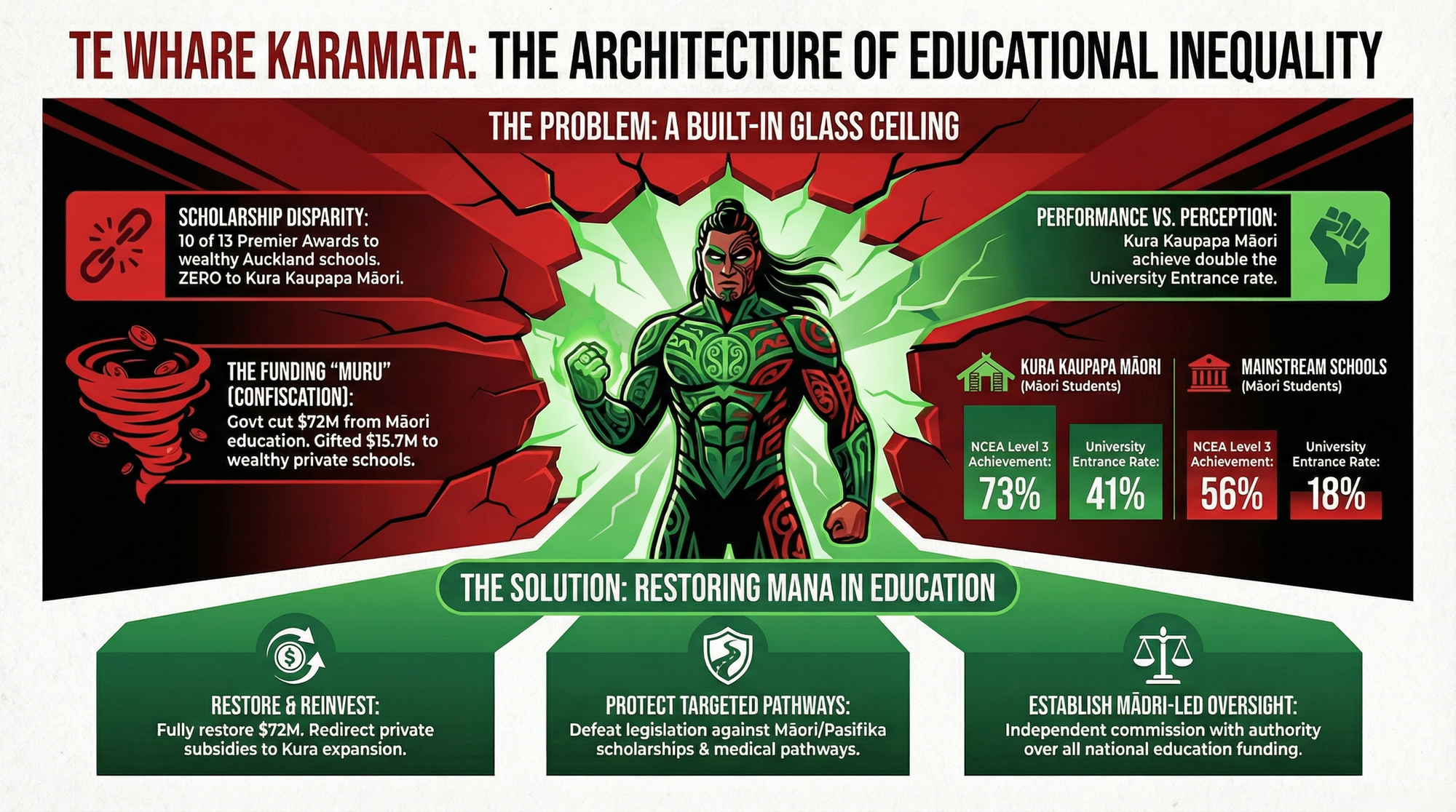
The 2025 NZ Scholarship results — released this week — reveal what every Māori whānau already knows: this country's highest academic honour is a closed shop. Ten of thirteen Premier Awards went to Auckland schools. Nearly all winners attended private or wealthy public schools. Zero went to kura kaupapa Māori. Zero to students from high-deprivation communities. This is not coincidence — it is architecture. And the Luxon-Seymour-Peters government is actively demolishing the only pathways that were beginning to close the gap: slashing $72 million from Māori education, defunding Resource Teachers of Māori, disestablishing Wharekura Expert Teachers, and funnelling $15.7 million to private schools against Treasury's explicit advice. Meanwhile, ACT's Dr Parmjeet Parmar drafts legislation to strip Māori and Pasifika students of targeted scholarships, study spaces, and health workforce pathways — the final act of a government that calls inequality "merit" and structural racism "excellence."
The Hidden Connection: This Article Is Not About Scholarships
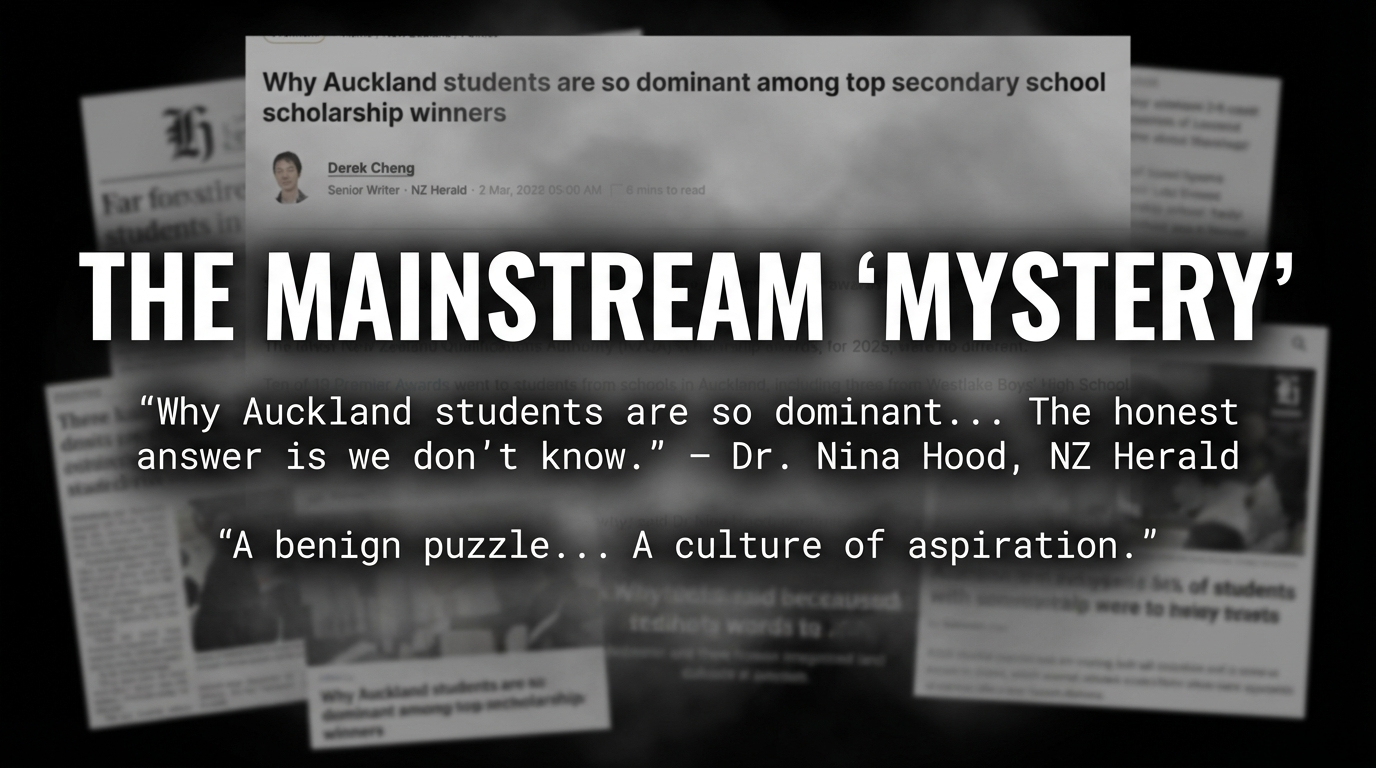
The NZ Herald reports that ten of thirteen 2025 Premier Awards went to Auckland school students, including three from Westlake Boys' High School. Almost three-quarters of the 57 Outstanding Scholar Award winners were from Auckland schools. Among Top Subject Scholars, 26 of 38 were Auckland students.

The Herald frames this as a benign puzzle. Dr Nina Hood says:
"The honest answer is we don't know exactly why". Crimson Education's Jamie Beaton says it is about "culture of early participation".
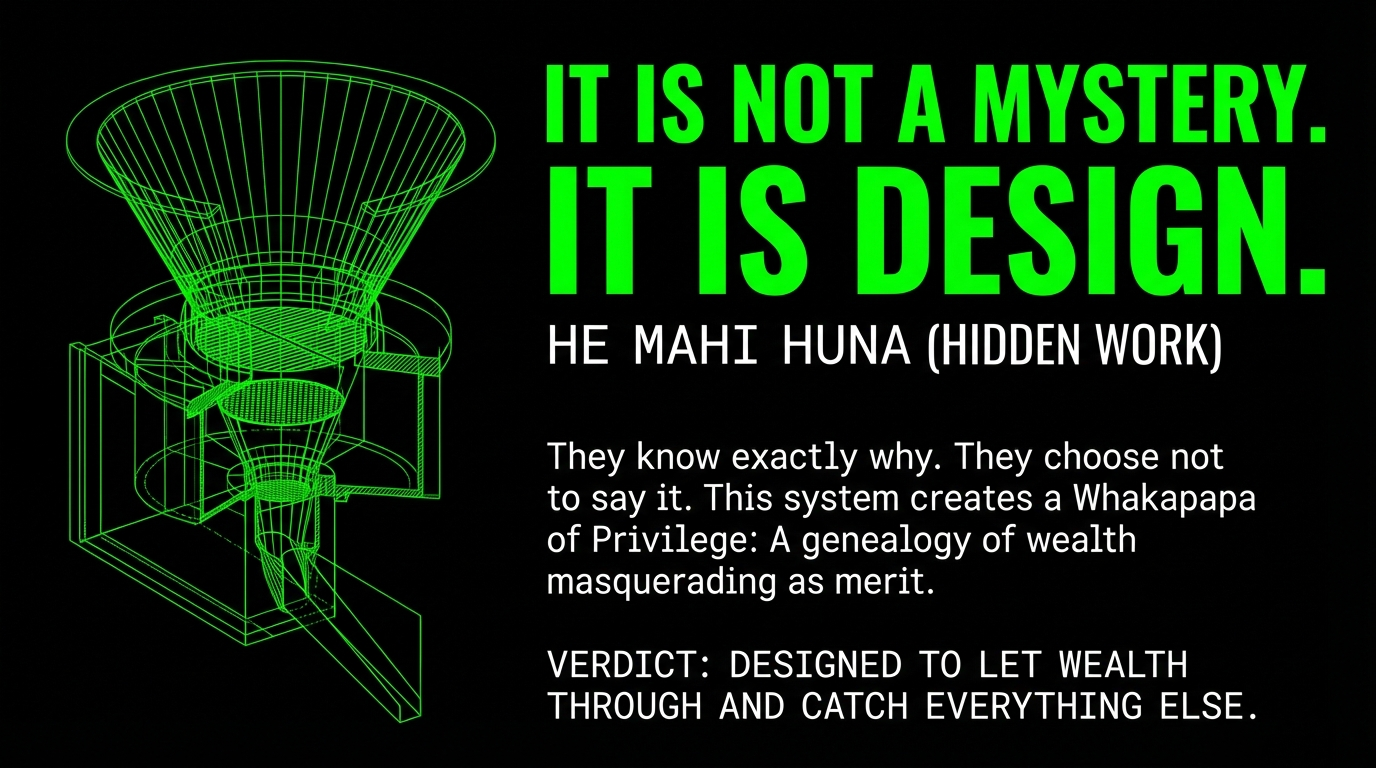
They are wrong. They know exactly why. And they choose not to say it.
This article is not about scholarships. It is about a system that was designed to reproduce wealth and call it intelligence. It is about a government that is accelerating that design while burning the evidence.
In te ao Māori, we call this he mahi huna — hidden work. The question is not "why do Auckland schools win?"
The question is: cui bono? Who benefits from a system where the nation's highest academic prize goes overwhelmingly to schools where annual fees exceed $20,000, where dedicated scholarship programmes start in Year 9, and where one school — St Cuthbert's College — produces one scholarship for every nine students while kura kaupapa Māori producing extraordinary results get their expert teachers defunded?
The answer is not complicated. The answer is class warfare.
Te Rākau Kōrero: The Genealogy of the Glass Ceiling
The 2025 Results Speak a Language This Government Refuses to Hear
Thirteen students received 2025 Premier Awards — the pinnacle of secondary academic achievement, worth $10,000 per year for three years of tertiary study. The schools that produced them form a whakapapa of privilege:
| School | Location | Type | EQI Tier |
|---|---|---|---|
| Westlake Boys' High School (×3) | Auckland | Public | Tier 1 (fewest barriers) |
| Auckland Grammar School | Auckland | Public | Tier 1 |
| St Kentigern College | Auckland | Private | No EQI |
| St Cuthbert's College | Auckland | Private | No EQI |
| Macleans College | Auckland | Public | Tier 1 |
| Kristin School | Auckland | Private | No EQI |
| Westlake Girls' High School | Auckland | Public | Tier 1 |
| Rangitoto College | Auckland | Public | Tier 1 |
| Hamilton Boys' High School (×2) | Hamilton | Public | Tier 3 |
| Havelock North High School | Havelock North | Public | Tier 3 |
Only three non-Auckland students won Premier Awards in 2025 — and all three were from schools with "less-than-average socio-economic barriers" (Tier 3). Not one winner came from a school serving communities with significant deprivation. Not one from a kura kaupapa Māori. Not one from South Auckland, Tai Tokerau, Gisborne, or any of the communities where Māori and Pasifika tamariki concentrate.
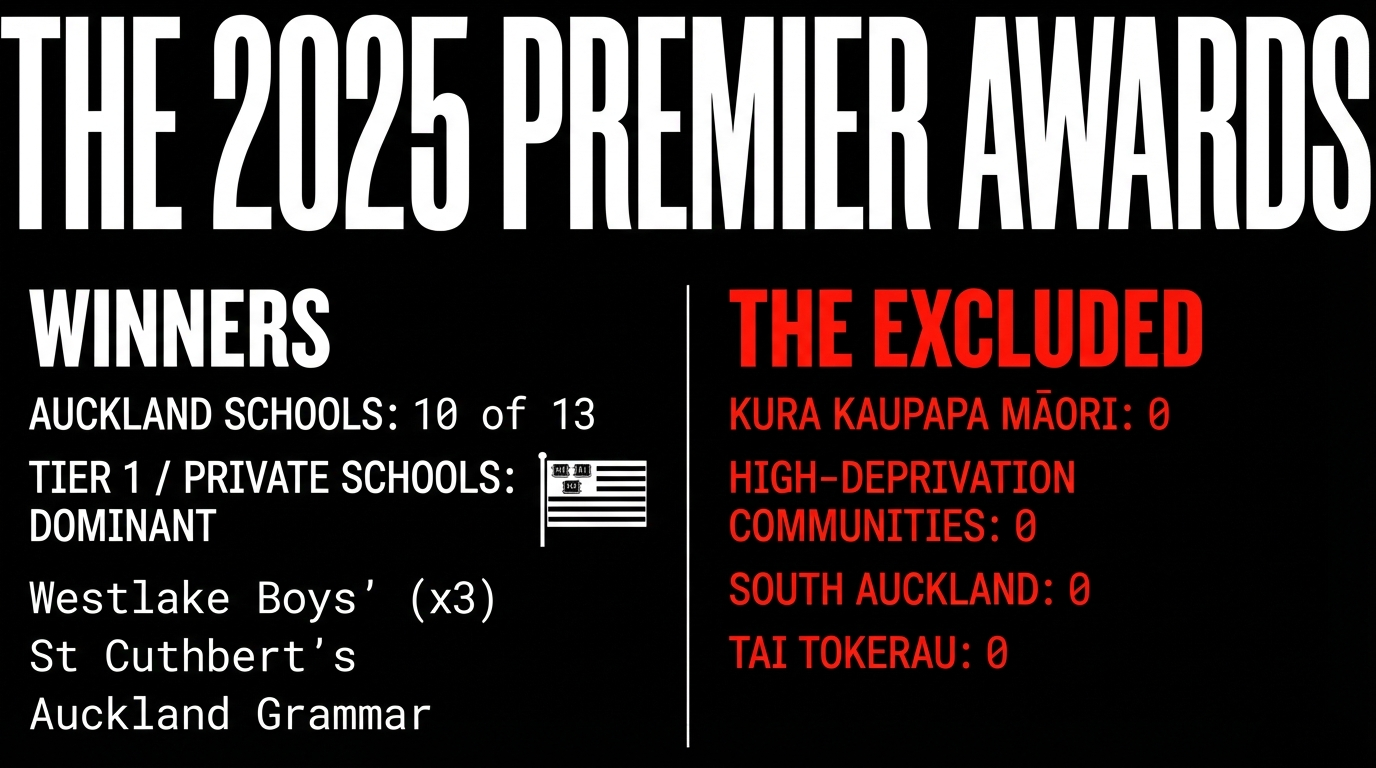
In 2024, the pattern was identical: ten of twelve Premier Awards to Auckland schools, three each from Westlake Boys' and St Cuthbert's College. In 2023, seven of ten. In 2022, seven of eleven.
This is not a pipeline. It is a sieve — designed to let wealth through and catch everything else.
The Kura Kaupapa Māori That Outperform — And Get Punished For It
Here is the hidden connection the NZ Herald will not publish.
A NZQA briefing to Education Minister Erica Stanford confirmed that students at kaupapa Māori schools attempt more NCEA credits and are more likely to get merit and excellence endorsements than students at comparable mainstream schools. Their NCEA Level 3 achievement rate is 73 percent compared to 61 percent at comparable mainstream schools — and for Māori students in those mainstream schools, just 56 percent. Their University Entrance rate is 41 percent, compared to 24 percent for all students in comparable mainstream schools and just 18 percent for Māori students.
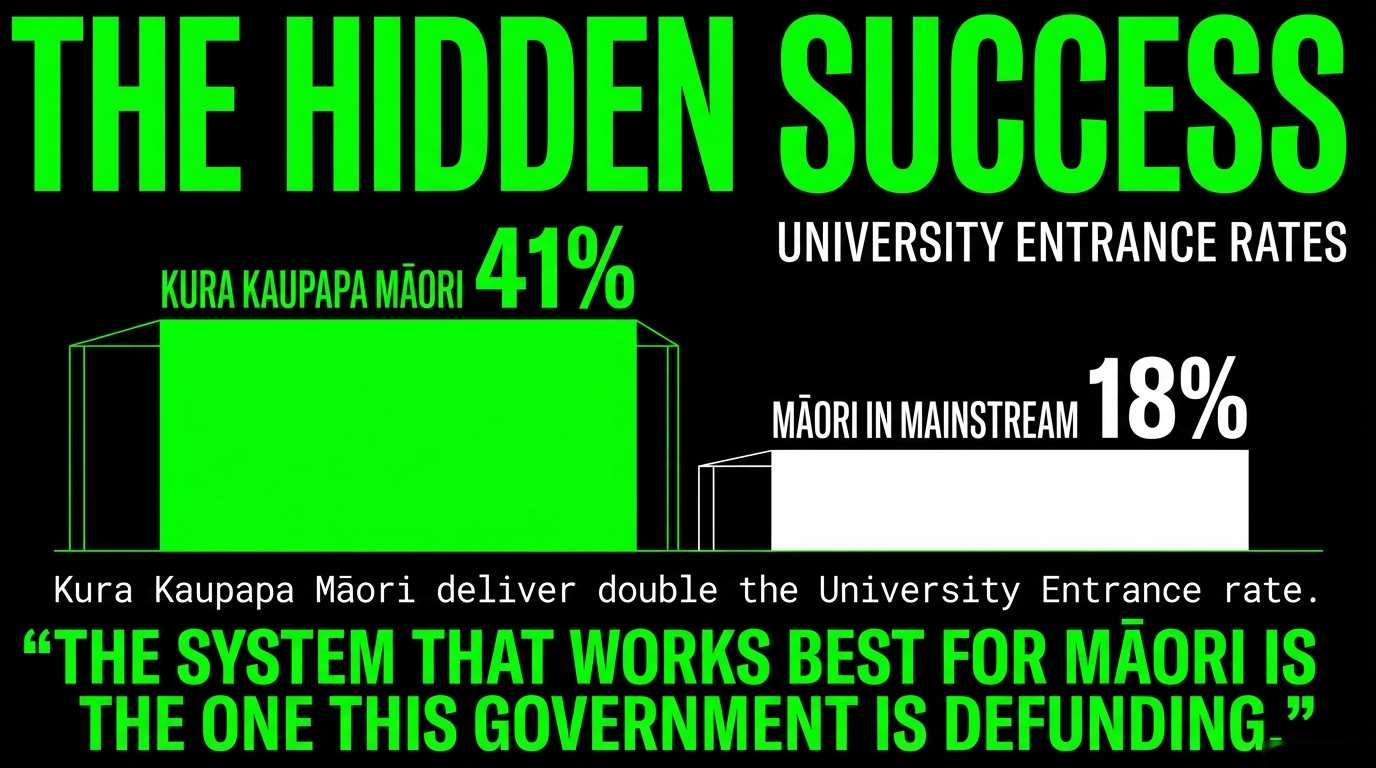
Read those numbers again. Kura kaupapa Māori deliver double the University Entrance rate for Māori compared to mainstream schools. The system that works best for Māori is the one this government is defunding.
In 2017, RNZ reported that a decile one kura kaupapa Māori in Kaitaia — Te Rangi Aniwaniwa — had the best scholarship achievement rate in the entire country, outperforming St Cuthbert's College and Wellington College. Two of four Year 13 students gained three scholarships each — one scholarship for every 1.33 students.
Tumuaki Te Irirangi Tawhara said: "A lot of our tamariki have barriers and challenges even before they step inside our doors. When you have our tamariki achieving well within our kura and they step out into the community, they're role models and examples of tino rangatiratanga and mana motuhake".
This government's response? Defund their expert teachers. Strip their resource teachers. Slash their language funding. Then celebrate when wealthy Auckland schools win the prizes.
Three Examples for the Western Mind: The Architecture of Apartheid by Numbers
For those who need Western frameworks to understand structural racism, here are three concrete examples. For Māori, these are not abstractions — they are lived experience. They are an assault on mana tangata (the inherent dignity of each person), mana motuhake (self-determination), and whakapapa (the interconnection of all things through lineage).
Example 1: The $15.7 Million Gift to the Already-Rich
The Harm: The National-ACT government allocated $15.7 million in Budget 2025 to increase the private schools' subsidy — despite Treasury explicitly advising against it. Treasury wrote in black and white: "there is no evidence to suggest that increasing funding for private schools will improve their outcomes or make private education accessible and affordable to a wider range of students". Treasury further noted that despite no funding increase since 2010, private school student volumes increased every year — proving the subsidy was unnecessary. Treasury's recommended option was: "Not included for Budget 2025".
The government ignored its own advisors and gave wealthy private schools — the same schools that dominate the NZ Scholarship lists — more public money.

Simultaneously, the government cut $72 million over four years from Māori education initiatives: disestablishing the Wharekura Expert Teachers programme ($4.2m), removing 53 Resource Teacher: Māori roles ($15.9m), and stripping $16 million from the Māori Language Funding to Support Provision and Growth initiative.
The Maths: For every $1 gifted to private schools serving the wealthy, approximately $4.60 was stolen from Māori education serving the underserved.
The Tikanga Impact: In te ao Māori, manaakitanga requires that resources flow to those with the greatest need — not the greatest privilege. This allocation violates the fundamental principle that the community's taonga (treasures) must be protected for those most vulnerable. When you feed the feast to the full and starve the hungry, you destroy the mauri (life force) of the entire whānau. This is not "reprioritisation." This is muru — confiscation dressed in a spreadsheet.
The Solution: Restore all $72 million in Māori education funding. Freeze private school subsidies at 2024 levels. Redirect surplus to kura kaupapa Māori expansion. Establish independent Māori-led oversight of all education funding allocations.
Example 2: The Literacy Gatekeeping Machine
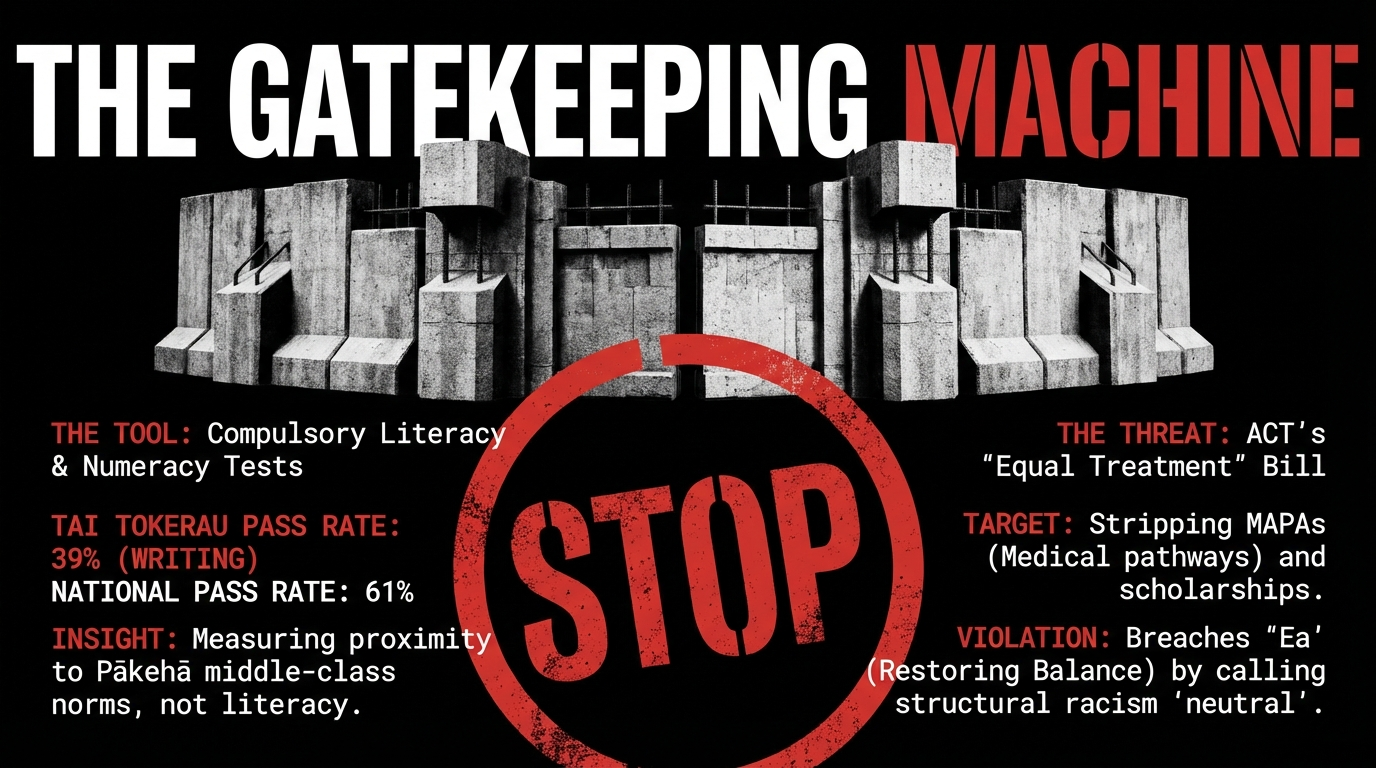
The Harm: In 2025, NZQA introduced compulsory NCEA literacy and numeracy tests. In Tai Tokerau, pass rates were 49 percent in reading, 39 percent in writing, and 40 percent in numeracy. In South Auckland: 43, 44, and 40 percent respectively. These regions have the highest concentrations of Māori and Pasifika students. The national averages were 61, 55, and 57 percent.
Students who fail these tests cannot receive any NCEA qualification. Principals warned that these tests would lower NCEA achievement rates and leave many school-leavers with no qualification.
The 2025 provisional data confirms the damage: NCEA Level 2 attainment dropped to 72.7 percent (from 73.6 percent in 2024), and Level 3 dropped to 70.4 percent (from 69.4 percent). University Entrance fell to 49.9 percent (from 50.6 percent).
NZQA's own insight paper confirms:
"A Māori or Pacific student is awarded University Entrance at half the rate of other students. This inequity has remained unchanged for over ten years".
The Tikanga Impact: In te ao Māori, every child carries the whakapapa of their tūpuna — the potential encoded in the genealogy of their ancestors. When you create a system that gates qualification behind standardised tests that do not account for language, cultural context, or structural disadvantage, you are not measuring "literacy." You are measuring proximity to Pākehā middle-class norms. This is an assault on mana ākonga — the inherent dignity of the learner. You are telling tamariki Māori that the knowledge systems of their tūpuna, the eloquence of their whakapapa, the sophistication of their oral traditions, count for nothing if they cannot pass a computer test written by people who have never set foot on a marae.
The Solution: Co-design NCEA literacy standards with Māori and Pasifika education experts. Develop culturally responsive assessment that recognises diverse expressions of literacy. Ring-fence $50 million for targeted literacy support in Tai Tokerau and South Auckland. Measure schools by how much they close the gap, not by raw pass rates.
Example 3: ACT's Bill to Strip Māori Students of the Last Lifeline
The Harm: In March 2025, ACT's Dr Parmjeet Parmar drafted legislation — the Education and Training (Equal Treatment) Amendment Bill — to ban universities from providing scholarships, study spaces, financial assistance, or pathway programmes "based on race". This directly targets MAPAS (Māori and Pacific Admission Scheme) — the pathway that has lifted Māori representation in medical school to 15 percent, just short of their 17.3 percent population share.
As Craccum reported, this bill comes after Winston Peters compared the existence of a designated Māori and Pasifika study space to the activities of the Ku Klux Klan. When Parmar was asked to name five university policies she objected to, she "appeared to struggle to name policies other than entry programmes for Pasifika and Māori students".
Universities NZ has documented the persistent University Entrance disparity: only 31.4 percent of Māori and 30.7 percent of Pasifika students achieve University Entrance, compared to 57.8 percent of NZ European and 66.5 percent of Asian students.
The Tikanga Impact: Targeted Māori scholarships and pathways are not charity. They are utu — the restoration of balance in a system that has systematically excluded tangata whenua since the Native Schools Act of 1867, when inspector Henry Taylor wrote that Māori were "better calculated by nature to get their living by manual rather than by mental labour". That belief — that Māori are inherently less academically capable — is the exact logic Parmar's bill encodes in modern legislation. By stripping targeted support and calling it "equal treatment," the government enshrines the existing inequality as the neutral baseline. In tikanga Māori, this violates ea — the principle that wrongs must be actively addressed, not papered over with the fiction of colourblind meritocracy.
The Solution: Defeat the bill. Expand MAPAS pathways to all health professions. Double Māori and Pasifika university scholarships. Establish a Māori-led Tertiary Education Equity Commission with statutory authority.
The Whakapapa of Wealth: What the Herald Won't Print
Rangitoto College — one single Auckland school — gained 324 NZQA scholarships in 2024, the highest ever for any New Zealand school, representing 8 percent of all scholarships awarded nationwide. They have led the country in scholarship passes five times since 2018.
St Cuthbert's College achieves one scholarship for every nine students on a roll of about 1,000. Westlake Boys' High School runs a dedicated scholarship programme from Year 9 across a roll of 2,771 students.
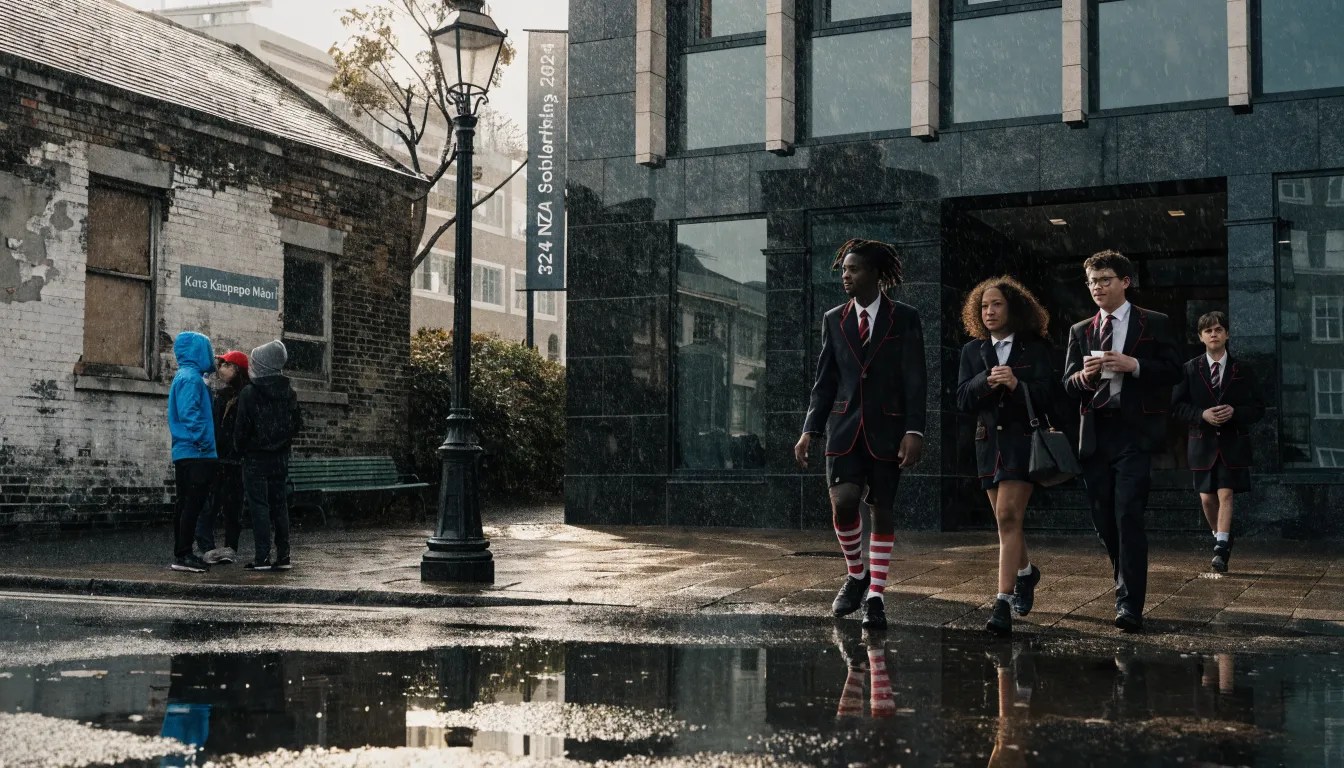
Meanwhile, most of the 64 kaupapa Māori schools in the country sit in the bottom socio-economic group. They serve only 5 percent of Māori students in Years 11-13. They outperform comparable mainstream schools at every level — and get defunded.
This is the whakapapa of wealth: resources flow to those who already have, programmes are built for those who can already access them, and success is defined by the standards of the privileged. Then when the privileged win, it is called "excellence." When Māori communities build their own pathway and succeed despite the system, it is called "reprioritisable."
The NZ Herald article quotes principals from wealthy Auckland schools celebrating their culture of "aspiration". Not one line examines why no Premier Award has ever gone to a kura kaupapa Māori — the schools that actually close the gap.
The Smoking Gun This Government Cannot Hide
Here is the contradiction that destroys the government's credibility:
Education Minister Erica Stanford told RNZ that closing the achievement gap for tamariki Māori is the priority. She told Mata that "there's probably something we need to learn here in the mainstream" from kura kaupapa Māori.
Then she:
- Disestablished the Wharekura Expert Teachers programme
- Removed 53 Resource Teacher: Māori roles from the staffing order
- Slashed $16 million from Māori Language Funding
- Cut $30 million from Te Ahu o te Reo Māori — the programme that trains teachers in te reo
- Removed Treaty obligations from school board responsibilities, triggering a 24,000-signature petition from the National Iwi Chairs Forum
- Removed Māori and Pacific from extra education funding priorities
- Gave $15.7 million to private schools against Treasury advice
This is not "closing the gap." This is dynamiting the bridge and blaming the drowning children for not swimming.
As The Māori Green Lantern documented extensively in How Labour Set the Trap That National-ACT Now Closes, more than $750 million in Māori-specific education initiatives have been axed or "reprioritised," with actual new investment closer to $38 million when excluding reallocated funds. The Kāhui Ako collaboration programme alone was slashed by $375.5 million.
As The Māori Green Lantern has previously exposed in The Nursery of Cages: How a White Supremacist State Built a Factory That Turns Brown Children Into Prisoners, the education system is not failing Māori — it was never designed to serve them.
He Rā Anō: The Light That Cannot Be Extinguished
And yet.
Te Kanawa Wilson of Ngā Taiātea Wharekura earned Top Subject Scholar in both Te Reo Māori and Te Reo Rangatira — the highest marks in the entire country in those subjects. Ahipukahu Edmonds and Manawapohatu McGarvey-Borell of Te Kura Kaupapa Māori o Ruamata earned Top Subject Scholar in Te Ao Haka. These rangatahi came from kura kaupapa Māori — the schools this government is systematically starving.
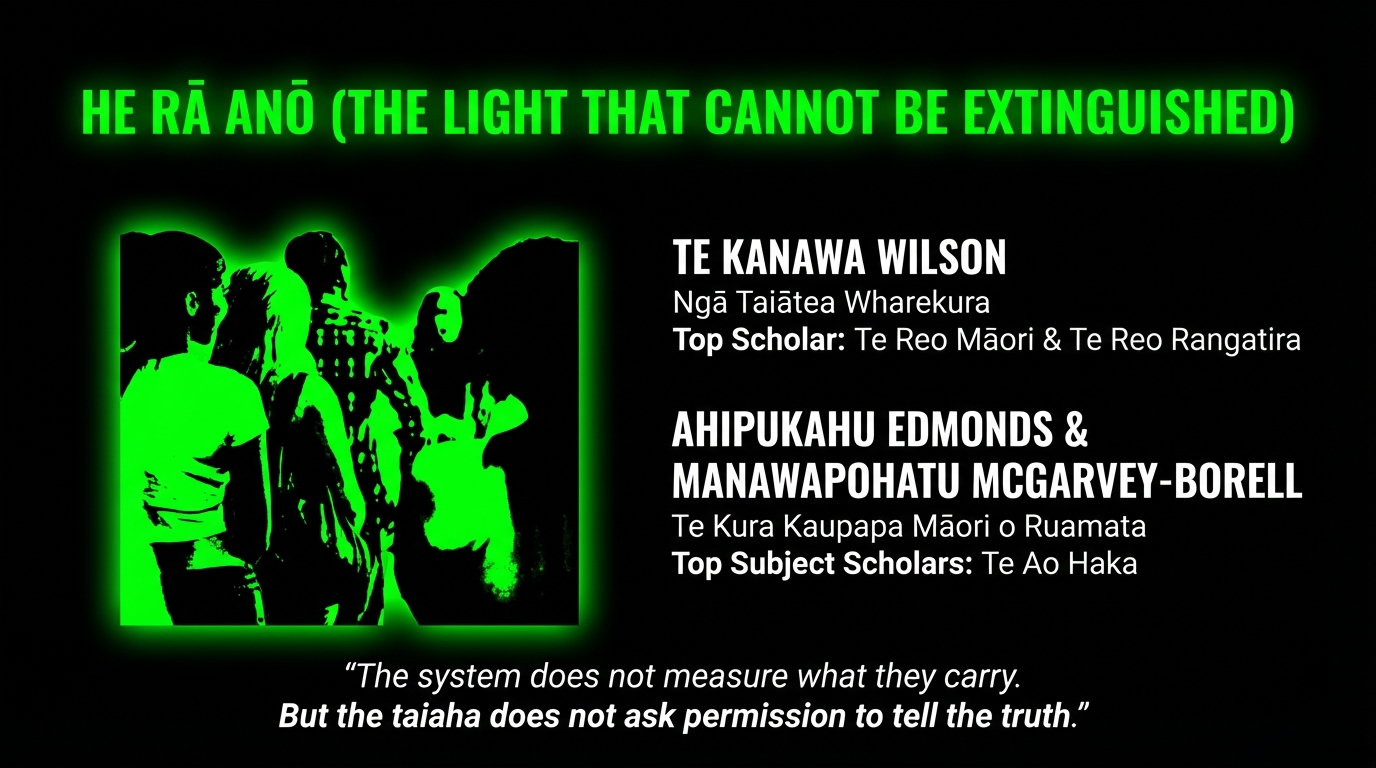
They did not win Premier Awards. The system does not measure what they carry. But they carry what the system cannot quantify: the whakapapa of a thousand years of mātauranga, the mana of communities that survived deliberate extinction, and the proof that when Māori design education for Māori, it works.
The 2025 NZ Scholarship results are not a story of "Auckland dominance." They are the receipt for 158 years of structural investment in Pākehā wealth and the systematic extraction of Māori potential. This government has chosen a side. It chose the side with the fees, the endowments, and the lobby access.
Kia mataara. Kia kaha. Kia manawanui.
The taiaha does not ask permission to tell the truth.
Koha Consideration
Every essay you read here — every number traced, every Treasury document unearthed, every lie stripped bare — is funded not by the Crown, not by corporate sponsors, but by whānau who believe that the same system defunding our kura and starving our tamariki's pathways should not also control who tells their story. When the government hands $15.7 million to private schools while slashing $72 million from Māori education, this mahi becomes more necessary than ever.
It signals that rangatiratanga includes the power to fund our own truth tellers.
Kia kaha, whānau. Stay vigilant. Stay connected. And if you are able, consider a koha to ensure this voice continues.
If you are unable to koha, no worries! Subscribe or Follow The Māori Green Lantern, kōrero and share with your whānau and friends — that is koha in itself.

Three pathways exist:
For those who wish to support this mahi directly with a koha (voluntary contribution), please visit the Koha platform:
Koha — Support: https://app.koha.kiwi/events/the-maori-green-lantern-fighting-misinformation-and-disinformation-ivor-jones
For those who wish to receive essays directly and support through subscription:
Subscribe to the Māori Green Lantern: https://www.themaorigreenlantern.maori.nz/#/portal/support
For those who prefer direct bank transfer, account details are:
HTDM, account number 03-1546-0415173-000.

Ivor Jones The Māori Green Lantern Fighting Misinformation And Disnformation From The Far Right
Research Transparency: This essay was researched on 2 March 2026 using search_web, get_url_content, search_files_v2 tools. 50+ sources consulted including NZQA official results data, Treasury Budget 2025 information release (T2025/736), Ministry of Education Budget documents, RNZ archives, NZ Herald, Te Ara Encyclopedia of New Zealand, Craccum, Critic Te Ārohi, Universities NZ, PPTA submissions, Rangitoto College newsletters, and previous Māori Green Lantern investigations. All URLs verified at time of research. Data cross-referenced between multiple sources. The NZ Herald article by Derek Cheng (2 March 2026) formed the primary text under analysis.