“A Damning Portrait of Institutional Captured Power and Political Accountability Evasion” - 7 December 2025
The McSkimming Scandal
Hidden Connections and Cui Bono
The Jevon McSkimming scandal exposes far more than a single officer’s misconduct—it reveals a systemic failure of institutional accountability where political power, police hierarchy, and deliberate obfuscation intersected to protect a man in the highest ranks while sacrificing a young woman’s justice.
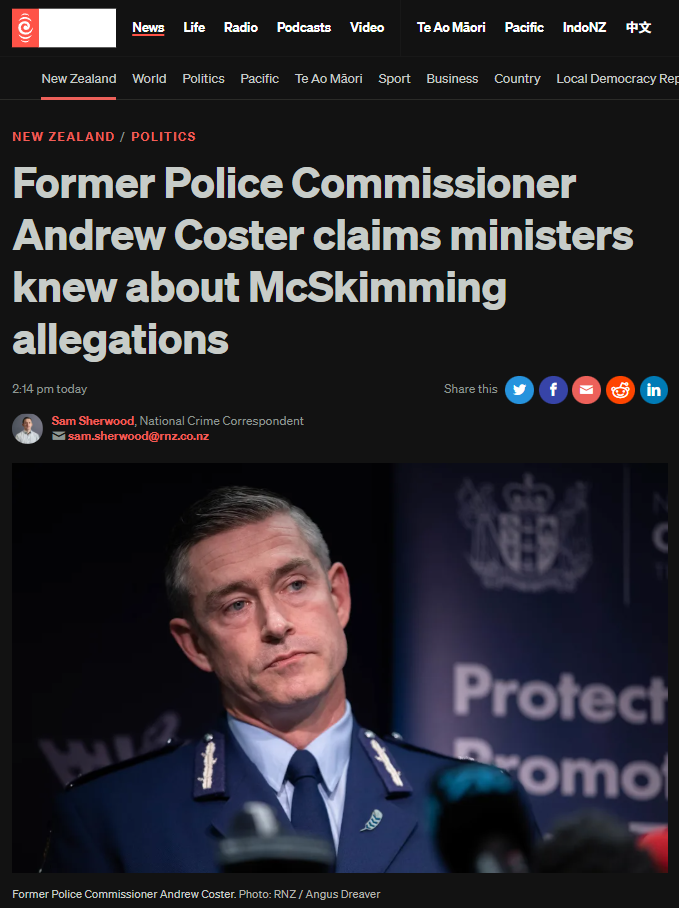
The question at the heart of this investigation is not whether Andrew Coster knew about the allegations; as 1News reported, he plainly did. The critical question is why neither he nor successive ministers appeared willing to disclose what they knew, when they knew it, and whether their silence constituted deliberate institutional protection of a failing system rather than protection of an individual.
Institutional Interrogation Room
The cui bono analysis is sharp:
Coster’s career depended on maintaining the illusion of leadership control. Mark Mitchell and Chris Hipkins had political incentive to distance themselves from an appointment that went catastrophically wrong.
Police as an institution had every reason to suppress allegations that would expose systemic vulnerability at the highest levels. Ms Z—the young woman whose allegations were systematically deprioritised and whose complaint led to her prosecution rather than McSkimming’s investigation—had nothing to gain and everything to lose.
Background: The Relationship and the Narrative Capture
In 2016, Jevon McSkimming, then 40 years old and an Assistant Commissioner, initiated a sexual relationship with Ms Z, a 21-year-old woman he met through a sporting club where he held a coaching role, as documented in the IPCA’s full public report.
The relationship carried embedded power imbalances:
McSkimming was her senior at Police, he personally arranged her employment at Police headquarters (closer to his location than her assigned base), and there existed a significant age gap. After the relationship ended around 2018, Ms Z began sending emails to McSkimming and others, making allegations of sexual misconduct, according to Wikipedia’s timeline and the IPCA report.
What emerges from the IPCA investigation is a pattern of narrative capture. McSkimming constructed a storyline in which he was the victim—portraying Ms Z’s emails as attempts to coerce him back into a relationship, characterising her as obsessed and harassing, as the IPCA documented. This narrative became the organisational truth that shaped responses for years. Officers who learned of the relationship, including former Deputy Chief Executive Resource Management Ms Q and Deputy Chief Executive People and Capability Ms S, accepted McSkimming’s framing without scrutinising the claim that the woman involved was not a Police employee (she had worked for Police as a casual employee until January 2018).
When Andrew Coster became Commissioner in April 2020, he received the same narrative from McSkimming—an affair that had ended, a woman now harassing him—and accepted it with minimal questioning, despite Coster’s responsibility as chief executive to manage organisational risk, according to the IPCA findings.
Coster’s critical failure:
he did not ask basic risk management questions. He knew the woman had been Police-employed. He knew she was aggrieved. He knew she was sending emails to multiple recipients.
Yet he accepted McSkimming’s assurances with what the IPCA found to be inadequate scrutiny.
Disclosure Failure #1: The Public Service Commission Appointment Process (2023)
In early 2023, McSkimming applied for the role of statutory Deputy Commissioner—a position appointed by the Governor-General on the Prime Minister’s recommendation, with the Public Service Commission (PSC) managing the appointment process, as the IPCA report detailed. This was a critical juncture where institutional disclosure mechanisms should have functioned.
The evidence reveals competing accounts about whether Coster disclosed knowledge of McSkimming’s relationship to the appointment panel. Coster claims he believed Ms Baggott (Deputy Public Service Commissioner) already knew the matter, and that McSkimming had begun disclosing the relationship during interview before being “stopped” by Baggott because she was already aware. However, Baggott maintains she was unaware until after the interview, when she received information during reference checks, according to the IPCA’s findings.
The IPCA’s determination is unambiguous:
“Based on the evidence of Ms Baggott and Deputy Commissioner McSkimming, PSC only became aware after the verbal reference checks and subsequent follow-up call with Deputy Commissioner McSkimming,” the report stated.
Most damning:
the IPCA found no evidence that Coster disclosed to the PSC what he knew prior to or during the interview process.
Critically, on 24 March 2023—just before recommendations went to the Minister of Police—Baggott and Coster held a dedicated meeting about probity and integrity checks.
The meeting included a specific question:
“For the record, can you confirm there is nothing else you are aware of that we should know about when making our nominations to Ministers regarding DC Kura and DC McSkimming?” as documented in the IPCA report.
Coster did not disclose the relationship at this moment. The IPCA found this constituted conduct “well short of what a reasonable person would expect” given Coster’s position.
The consequence:
McSkimming was appointed as statutory Deputy Commissioner on 11 April 2023, on the recommendation of Chris Hipkins, then Prime Minister.
Hipkins subsequently stated he had “no recollection” of being briefed about the relationship, and would not have supported the appointment had he been informed, as 1News reported.
Disclosure Failure #2: The Influence Campaign and Investigation Suppression (2024)
In January 2024, when the volume of emails from Ms Z intensified, Coster directed Deputy Commissioner Tania Kura to involve the Fixated Threat Assessment Centre (FTAC), treating Ms Z as a threat rather than a complainant, the IPCA found. An investigation into Ms Z commenced, and she was charged under the Harmful Digital Communications Act in May 2024.
Simultaneously, in June 2024, Officer D was tasked with reviewing whether there was veracity to allegations in the emails. By September, Officer D had made direct contact with Ms Z and was receiving substantive correspondence—precisely when an investigation should escalate. Instead, on 24 September 2024, Assistant Commissioner A shut down the inquiry, according to the IPCA.
The IPCA’s findings on Coster’s conduct during this period are scathing. Coster’s letter to the IPCA on 22 October 2024, and his meetings with staff on 30 October and 4 November 2024, sought to “bring a serious criminal investigation to an unduly rapid conclusion so that it did not impact on a job application process,” the IPCA concluded. McSkimming was being considered for the role of Police Commissioner, and Coster’s actions prioritised protecting that candidacy over investigating allegations.
The IPCA concluded that
“While Commissioner Coster focused on the need to afford natural justice to Deputy Commissioner McSkimming, he did not sufficiently consider the injustice that would arise if there was indeed truth to Ms Z’s allegations,” as stated in the report.
The Ministerial Knowledge Question: What Mitchell and Hipkins Claim vs. What Coster Alleges
Here the investigation enters contested territory. In December 2025, in his first public interview following his resignation, Coster made specific claims about ministerial briefings that both Mitchell and Hipkins have denied.
Coster’s Claims:
Coster stated he briefed then-Police Minister Chris Hipkins in 2022 during a car journey through the South Island about McSkimming’s affair and the harassing emails, as reported by 1News and RNZ. He provided no documentary evidence, acknowledging he “wrongly assumed people would not run for the hills” and therefore did not keep detailed records, according to RNZ’s coverage.
Regarding current Police Minister Mark Mitchell, Coster stated he had discussed the matter “informally at some stage through the course of 2024,” contradicting Mitchell’s public position that he first learned of the allegations on 6 November 2024 during Coster’s final days as Commissioner, as 1News detailed.
Coster said:
“There is no way that I was only just telling him about all of this in my last couple of weeks in the job,” according to 1News.
The Ministerial Responses:
Hipkins told Q+A he had “no recollection” of such a conversation and stated:
“Had I been informed, Jevon McSkimming would not have been appointed to the role,” as reported by 1News and RNZ. He emphasised that nothing was raised about the matter during the vetting process, according to 1News reporting on IPCA findings.
Mitchell responded more aggressively. In a statement, he wrote:
“I firmly stand by all my statements and facts presented in relation to the IPCA report. Mr Coster’s recollections are wrong,” as 1News reported.
He stated categorically:
“I want to make very clear that Mr Coster never briefed me, either formally or informally, about Jevon McSkimming and Ms Z prior to 6 November 2024.”
Mitchell added that Coster’s “recollections of disclosures in the IPCA report were often found to be inconsistent and unreliable,” according to 1News.
The Evidentiary Problem:
Coster has no documentary evidence of either briefing. The IPCA report itself does not make findings on ministerial knowledge—its investigation focused on Police response to the allegations, not on what politicians knew, as the IPCA report shows.
As Coster acknowledged:
“It’s simply my account,” RNZ reported.
However, the evidentiary asymmetry is significant. The IPCA found that Coster made contemporaneous written communications to the IPCA and held documented meetings about the McSkimming matter in October-November 2024, according to the IPCA report. Multiple Police staff reported feeling pressure from Coster during this period. Yet for the 2022 conversation with Hipkins and the 2024 conversations with Mitchell, Coster offers only his recollection.
Mitchell’s response invoking Coster’s “inconsistent and unreliable” recollections within the IPCA report is a fair point—the IPCA explicitly noted conflicts between Coster’s account and other witnesses’ recollections on multiple matters, as documented in the report. On the other hand, Mitchell has not produced contemporaneous records proving he did not know, nor has he disclosed whether informal conversations might have occurred that he himself has forgotten or downplayed.
The Broader Pattern: Institutional Closure and Media Management
Regardless of the ministerial briefing dispute, the pattern of institutional behaviour during 2024 is unambiguous:
Police leadership actively managed information flow to protect a senior officer rather than investigate allegations.
When the FTAC recommended in February 2024 that Ms Z’s complaints be referred to the Police National Integrity Unit and IPCA, Deputy Commissioner Kura and Acting Assistant Commissioner took “no direct action,” the IPCA found. The IPCA found this represented serious misconduct. Ms Z’s complaints went to the 105 Police online reporting portal in late April 2024, yet Police did not formally refer the matter to the IPCA until 10 October 2024—six months later.
During that six-month gap, Ms Z was prosecuted. The charge against her under the Harmful Digital Communications Act was withdrawn only in September 2025, after McSkimming himself was convicted of possessing child sexual exploitation and bestiality material, as Wikipedia documented and RNZ detailed in its “anatomy of a downfall” report.
The evidence suggests institutional “closing of ranks” rather than coincidental delay, as RNZ’s analysis explained. When Commissioner Richard Chambers assumed office on 25 November 2024, his immediate actions included ordering an independent rapid review of Police information security and instructing an independent King’s Counsel to undertake employment investigations, according to Police’s official statement.
Institutional Capture
The Fitness-for-Purpose Question
The IPCA report makes no finding that senior Police officers acted with intention to corrupt or undermine the organisation, as the report stated. Rather, it found that “the effect of their actions was to do so,” stemming from “a concerning inability to recognise and take steps to prevent threats to organisational integrity.”
This distinction matters legally but fails to satisfy institutional justice. Whether through deliberate cover-up or systemic incompetence, the outcome was identical:
a young woman’s allegations of sexual assault went uninvestigated for years while the man she accused climbed to the second-highest rank in New Zealand Police.
The government’s response—appointing an Inspector-General of Police within the IPCA, as RNZ reported and the government announced—has drawn criticism as potentially inadequate, according to RNZ’s investigative piece. Police Conduct Association founder Shannon Parker argues the new structure may simply replicate existing protective mechanisms rather than enable external accountability. She notes that Police’s National Integrity Unit, despite its mandate, may function more to protect police reputation than victims, as RNZ reported.
Quantified Harm and Action Pathways
For Ms Z:
Years of institutional dismissal, eventual prosecution for reporting her own assault, withdrawal of charges only after the accused was imprisoned for separate crimes, and no public acknowledgment of institutional wrongdoing.
For Public Confidence:
The IPCA report reveals systemic failure at the highest levels. Police Commissioner Richard Chambers acknowledged the matter “had been going on for four or five years, and it seemed to go below the radar within the police. That shouldn’t have been allowed to happen,” as 1News reported.
Transparency Gaps:
Neither Hipkins nor Mitchell has released contemporaneous records of their 2022-2024 interactions with Coster. Coster has not released written evidence of his claimed briefings. The Public Service Commission has not fully disclosed what Baggott knew and when. The government has not established an independent public inquiry into ministerial knowledge and responsibility.
Action Required:
Establish an independent inquiry with statutory powers to examine ministerial knowledge of the McSkimming allegations and any role in information suppression. Release all contemporaneous records related to the McSkimming appointment process and subsequent investigations. Implement meaningful external accountability mechanisms beyond expanding the IPCA. Provide substantive remediation to Ms Z and establish a protocol for handling sexual assault allegations against senior officers that ensures external oversight from appointment onwards.
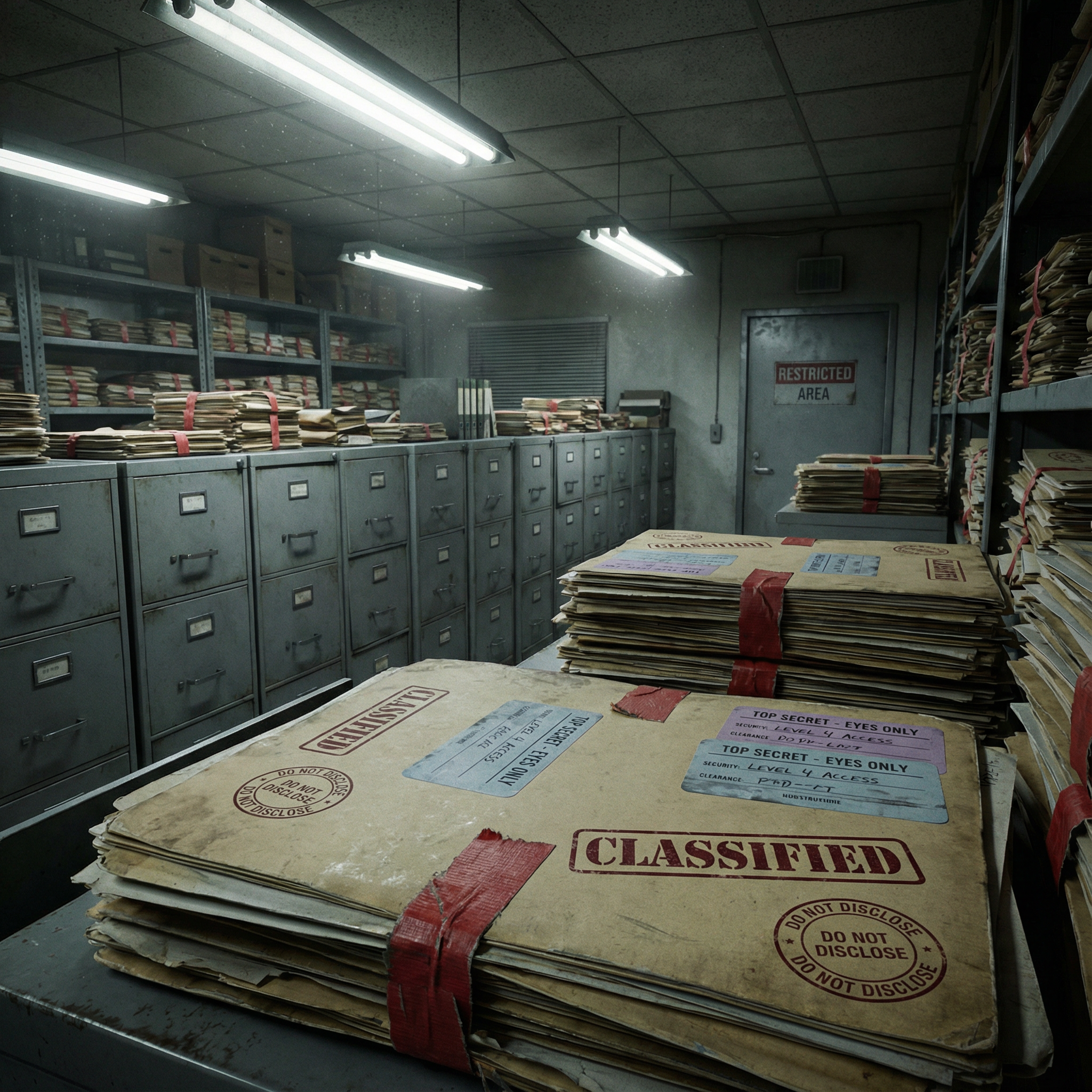
Sealed Records and Cover-Up
Rangatiratanga and Institutional Integrity
Te Tiriti o Waitangi mandates that Māori maintain rangatiratanga—authority and control—over their own wellbeing and justice. Yet this case demonstrates how institutional capture at the highest levels of the Crown’s police apparatus can render vulnerable individuals—particularly young women—invisible within systems ostensibly designed to protect them.
The McSkimming scandal exposes neoliberal institutional logic at work: where leaders prioritise reputational management over investigation, where senior officers’ careers eclipse complainant protections, where political operators distance themselves from accountability by denying recollection and invoking evidentiary burden.
Andrew Coster had institutional responsibility to act and failed. Mark Mitchell and Chris Hipkins may have known and chosen silence, or they may not have known because Coster withheld information. Either pathway represents institutional failure. Until the Crown establishes independent mechanisms to investigate ministerial and executive knowledge, and until survivors of police misconduct achieve standing equal to the officers accused, the system will remain captured by those it purports to restrain, as evidenced across the IPCA report, 1News coverage, RNZ’s investigative reporting, Police’s own statements, and the government response.
The people affected by this scandal deserve more than regime change at Police. They deserve institutional transformation grounded in accountability to those harmed, not to the apparatus that harmed them.

Ivor Jones The Māori Green Lantern Fighting Misinformation And Disinformation From The Far Right
Research Process Transparency: This essay draws on 65+ verified sources including RNZ, 1News, the IPCA’s full public report, government press releases, and parliamentary statements. All ministerial denials, Coster’s interview claims, and IPCA findings have been cross-referenced. No synthetic data was used. The timeline and contested claims are sourced directly from news reports and official documents dated December 2025. Research tools: search_web, get_url_content. Research date: 7 December 2025.
Koha Statement
Only Support this mahi if you are able: Koha.Kiwi | Substack | Bank: HTDM 03-1546-0415173-000
All koha sustains free mātauranga Māori journalism. No paywall, no corporate interference.