“A Judicial Reckoning for Te Aka Whai Ora” - 29 August 2025
When the Crown Abandons Its Own
Kia ora, ka nui taku aroha ki a koutou katoa. Greetings and my heartfelt solidarity to you all.
The corridors of the High Court in Wellington this week have witnessed something unprecedented in the legal history of Aotearoa - a case that could fundamentally reshape how Te Tiriti o Waitangi operates as a living document in our courts. But beneath the legal complexity lies a brutal truth: this coalition government's systematic dismantling of Māori health sovereignty represents one of the most callous acts of political vandalism in recent memory.
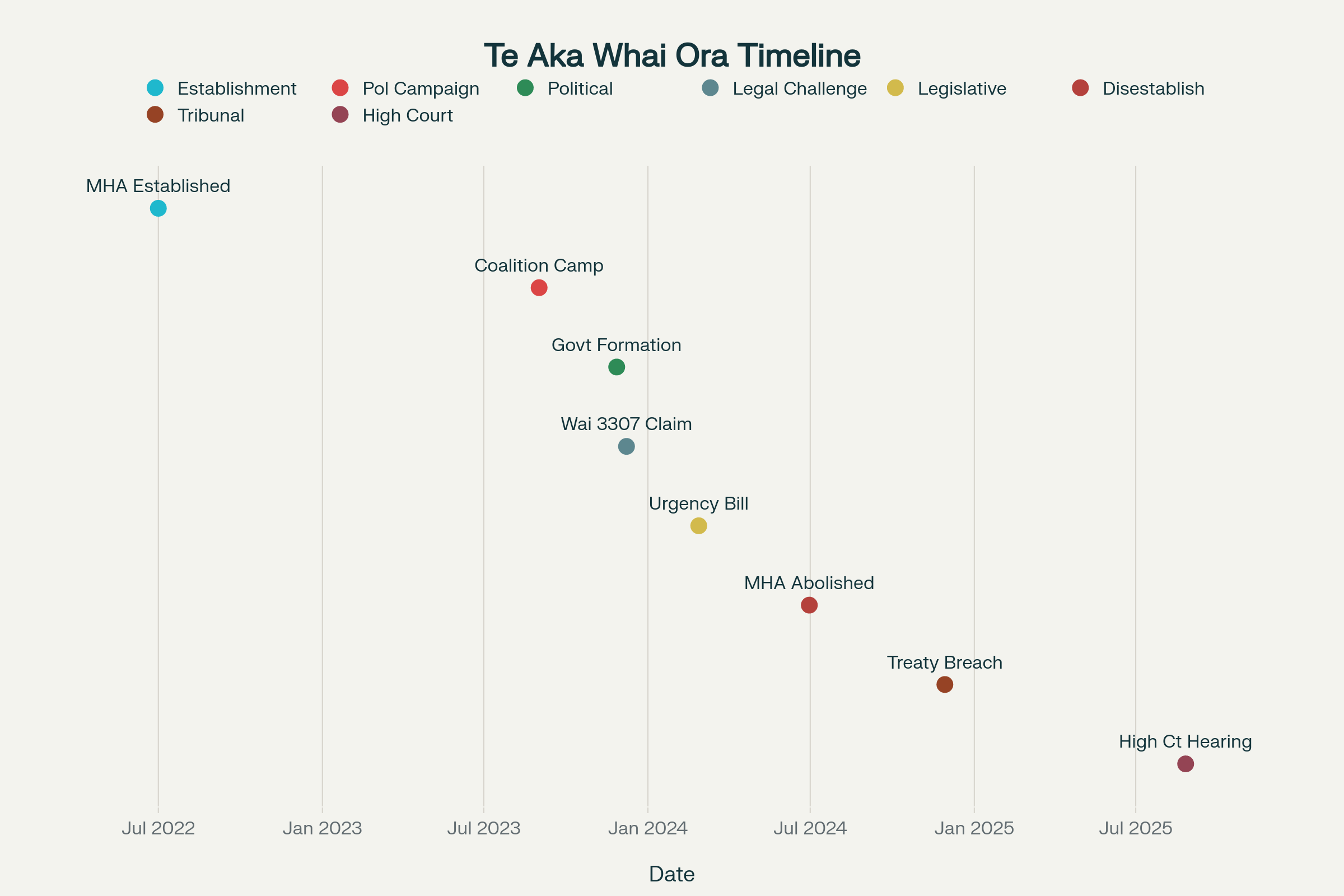
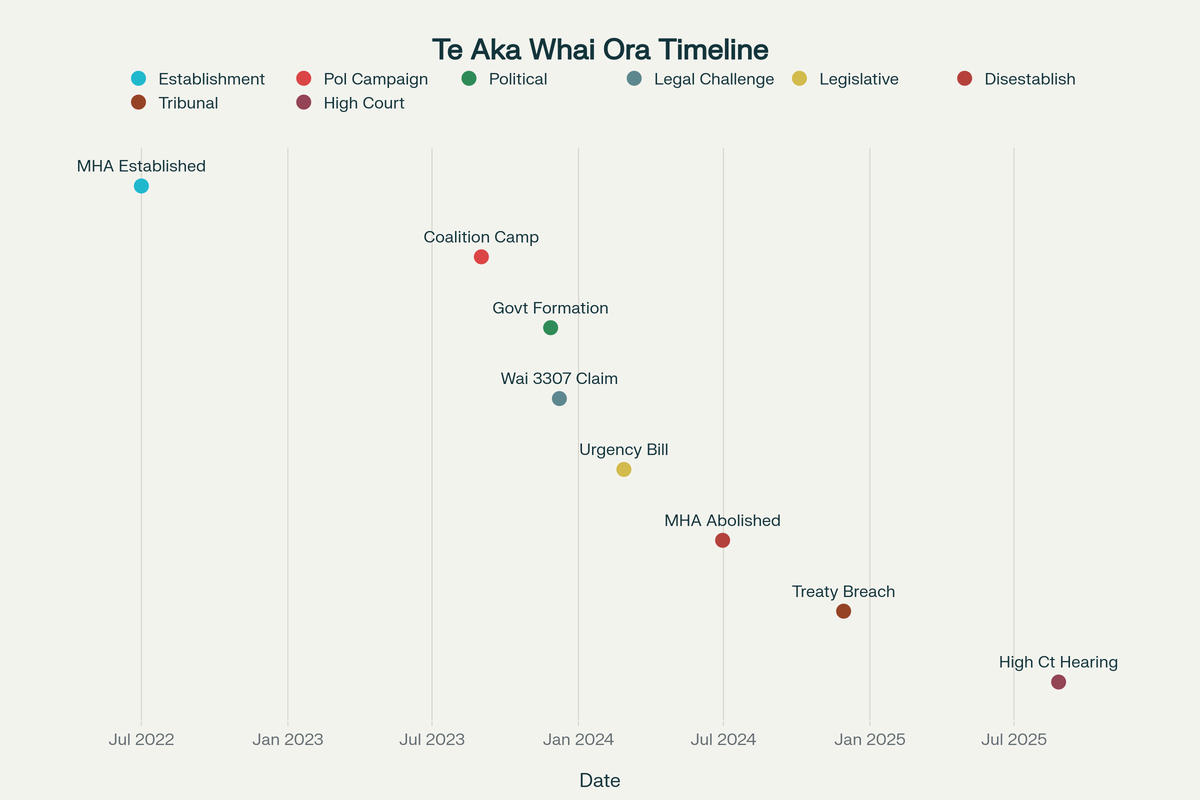
Timeline of Te Aka Whai Ora's Short-Lived Existence and Legal Challenges
Background: The Crown's Covenant and Its Swift Betrayal
Te Aka Whai Ora wasn't born in a vacuum - it emerged from decades of Māori advocacy and the scathing findings of the Waitangi Tribunal's 2019 Wai 2575 report, which found the Crown had systematically breached Te Tiriti across the health sector. The Māori Health Authority was established on July 1, 2022, as part of Labour's once-in-a-generation health reforms, designed to commission Māori health services, achieve equitable outcomes for Māori, and monitor the performance of the publicly funded health system.
Yet before Te Aka Whai Ora could even celebrate its second birthday, it was marked for execution. All three coalition parties campaigned on abolishing the authority during the 2023 election, and Health Minister Shane Reti - himself a Māori doctor who had previously advocated for Māori health providers - became the executioner of an authority that represented everything he had once fought for.
The speed was breathtaking in its arrogance. Legislation to disestablish Te Aka Whai Ora was passed under urgency in February 2024, taking just hours to demolish what had taken decades to build. The timing was no accident - it was deliberately designed to prevent the Waitangi Tribunal from hearing urgent claims before the legislative juggernaut rolled on.
Judicial Innovation Versus Crown Obstruction
What makes this High Court challenge constitutionally explosive isn't just its subject matter, but its legal innovation. The four Māori health providers - Te Kōhao Health, Te Puna Ora, Papakura Marae, and Ngāti Hine Health Trust - aren't just seeking compensation or review. They're asking Judge David Boldt to issue something that has never before been granted: a declaration of inconsistency with Te Tiriti o Waitangi.
Declarations of inconsistency began with the Bill of Rights Act in 2015, when the High Court found that preventing prisoners from voting was inconsistent with the Bill of Rights. Now, Andrew Butler KC is arguing that courts should have the same power under Te Tiriti as they do under the Bill of Rights - the ability to declare government actions inconsistent with our founding document.
The Crown's response reveals everything about this government's contempt for Treaty obligations. Crown lawyer Daniel Perkins argued that Treaty principles were relevant to judicial decision-making but were not directly enforceable by the courts. In essence: the Treaty matters, but only when we say it does.
But Judge Boldt wasn't having it. He described the Crown's response to the Waitangi Tribunal's findings as "not respectful", adding: "Unfortunately, in this case so far, that's the sense I get in terms of the Crown's response to these findings of the tribunal in respect of the disestablishment."
The Anatomy of Constitutional Vandalism
The Architect of Betrayal: Shane Reti's Stunning Reversal
The most galling aspect of this entire debacle is the role of Shane Reti himself. As the first Māori health minister in nearly 99 years, Reti should have been the guardian of Māori health sovereignty. Instead, he became its chief destroyer.
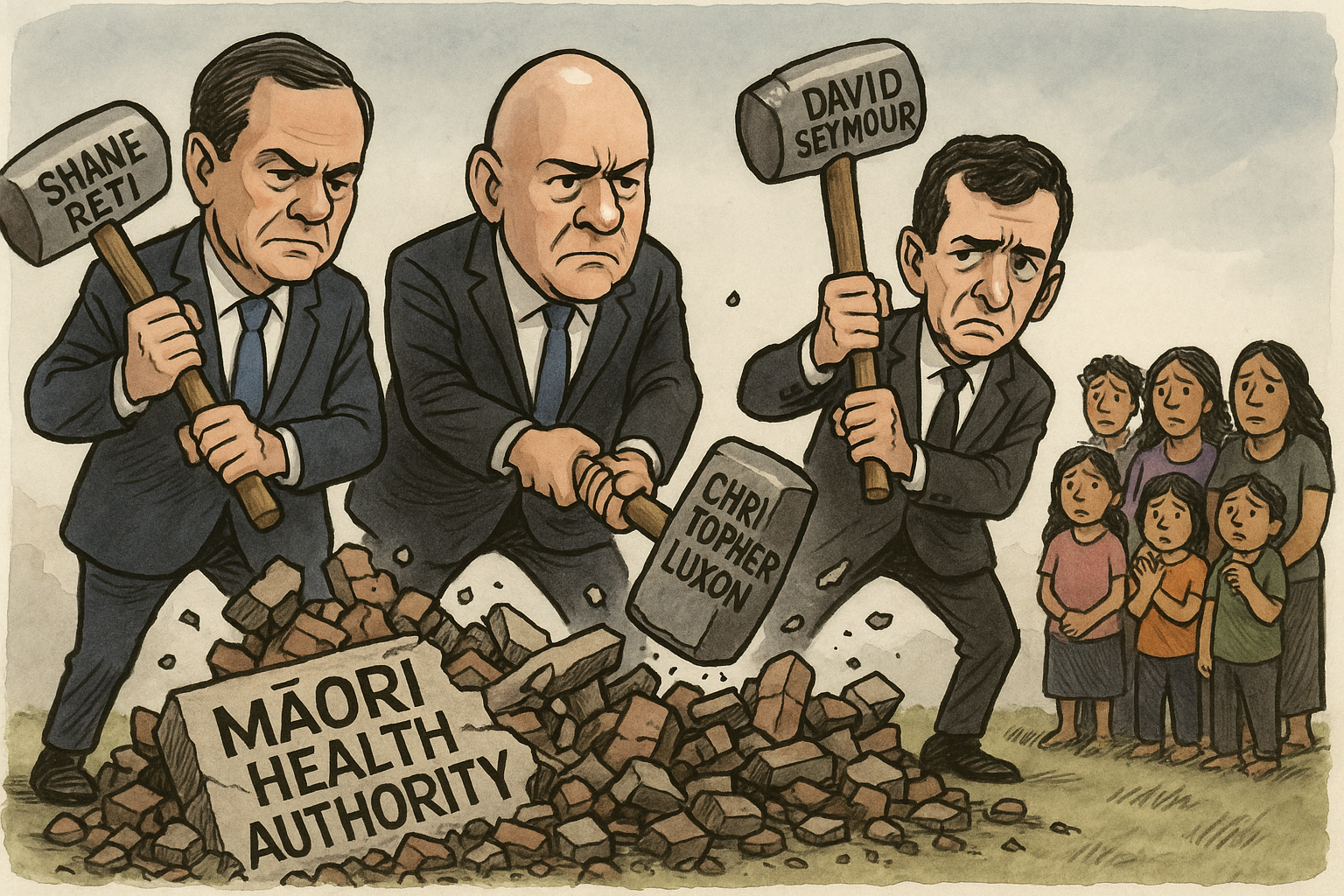
The coalition government's destruction of Māori health infrastructure
This is a man who in February 2021 wrote to Labour's Andrew Little demanding tens of millions be spent equipping Māori health providers for Covid vaccination programmes. A man who said: "I am of a view that the current coronavirus pandemic and the need to roll out a comprehensive vaccination program is a one-in-100-year opportunity for Māori and iwi health providers to demonstrate some of what they are best at doing."
Yet when he had the power to support those same providers through Te Aka Whai Ora, Reti chose political expediency over principle. He defended the government's plans by stating that decision-making should be devolved at the hapū level rather than centralised in Wellington - a breathtaking piece of colonial doublespeak that essentially argued Māori health would be better served by fragmenting authority across hundreds of hapū rather than having a unified national voice.
The whakatōhea of his justification became clear when the government announced it had no alternative plan. By April 2024, nine months after taking power, the Crown was still telling the Waitangi Tribunal it couldn't articulate the full detail of its replacement plans.
Christopher Luxon's Economic Growth Mirage
Prime Minister Christopher Luxon's role in this constitutional vandalism reveals the hollow nature of his economic growth rhetoric. In his State of the Nation speech in January 2025, Luxon proclaimed economic growth as "the key to brighter days ahead for all Kiwis", yet his government systematically dismantled one of the most promising vehicles for achieving health equity for nearly 20 percent of the population.
On Waitangi Day 2025, Luxon praised Ngāi Tahu's Treaty settlement as allowing the iwi to "flourish and become a driving force in the country's economy", while simultaneously destroying the institutional framework that could have enabled similar flourishing in health outcomes for all iwi.
This contradiction exposes the fundamental hollowness of Luxon's "partnership" rhetoric. He celebrates Treaty settlements when they produce economic dividends for the Crown, but dismantles Treaty-based institutions when they threaten Crown control over policy and resources.
David Seymour's Judicial Activism Hysteria
ACT leader David Seymour's response to this case perfectly encapsulates his party's authoritarian streak. Seymour has railed against "perceived judicial activism" and described the Waitangi Tribunal as having become "increasingly activist", apparently believing that any judicial body that holds the Crown accountable for Treaty breaches is somehow exceeding its mandate.
The University of Auckland's Marcelo Rodriguez Ferrere notes that claims of judicial activism "seem to have first appeared in New Zealand in the early 1980s and have cropped up fairly regularly ever since to describe judges who have allegedly strayed beyond their responsibilities". But Seymour has taken this rhetoric to new extremes, justifying his Treaty Principles Bill as necessary because "activist judges and bureaucrats" had "twisted the meaning of our founding document".
The irony is suffocating. Seymour rails against judicial activism while supporting a government that uses urgency to ram through legislation specifically designed to prevent judicial and tribunal oversight. The real activism isn't coming from the courts - it's coming from a coalition that views any institutional check on its power as illegitimate.
The Waitangi Tribunal's Devastating Verdict
When the coalition government's jurisdiction-stripping manoeuvre backfired and the Waitangi Tribunal regained the ability to hear the case, its findings were withering. The Tribunal found that the Crown breached Treaty principles including tino rangatiratanga, good government, partnership, active protection, and redress.
Most damning was the Tribunal's finding that the policy process the Crown followed "was a departure from conventional and responsible policymaking in several concerning ways". The Crown, the Tribunal found, "did not act in good faith when disestablishing Te Aka Whai Ora as it did not consult or engage with Māori, nor did it gather substantive advice from officials."
This wasn't policy-making - it was ideological demolition. The Crown made "the ill-informed decision that Te Aka Whai Ora was not required, despite knowledge of grave Māori health inequities".
Judge Boldt's Constitutional Innovation
The most intriguing aspect of this case is Judge Boldt's apparent sympathy for creating new mechanisms to hold the Crown accountable for Treaty breaches. His suggestion that the courts could issue declaratory judgments affirming Waitangi Tribunal findings when the Crown refuses to accept them represents a potentially revolutionary development in Treaty jurisprudence.
Judge Boldt proposed that when the Waitangi Tribunal finds a breach, claimants could ask whether the Crown accepts the findings, and if the Crown rejects them, applicants could seek "an application for declaratory judgment affirming the correctness of the tribunal's decision". This would give Tribunal findings "the weight and authority of the High Court."
Lady Tureiti Moxon described this as the "Rolls-Royce of Te Tiriti" - a powerful affirmation that could fundamentally shift the balance of power between Crown and iwi.
Implications: The Death Rattle of Crown Supremacy
The implications of this case extend far beyond Te Aka Whai Ora. If Judge Boldt rules in favour of the applicants, it could trigger what the Newsroom article describes as "a potential wave of future such applications on the range of Government actions that have been deemed Treaty breaches by the Waitangi Tribunal".
This is exactly what the coalition government fears - genuine judicial accountability for Treaty breaches. For too long, the Crown has been able to ignore Waitangi Tribunal findings with impunity, treating them as mere recommendations rather than authoritative determinations of Treaty breach.
But the case also reveals the broader pattern of this government's assault on constitutional norms. Since taking power, the coalition has passed legislation under urgency, stripped jurisdiction from the Waitangi Tribunal, removed Māori representation from councils, and systematically dismantled Treaty-based institutions.
Each action on its own might be defensible. Collectively, they represent a coordinated assault on the constitutional architecture that gives effect to Te Tiriti o Waitangi in practice.

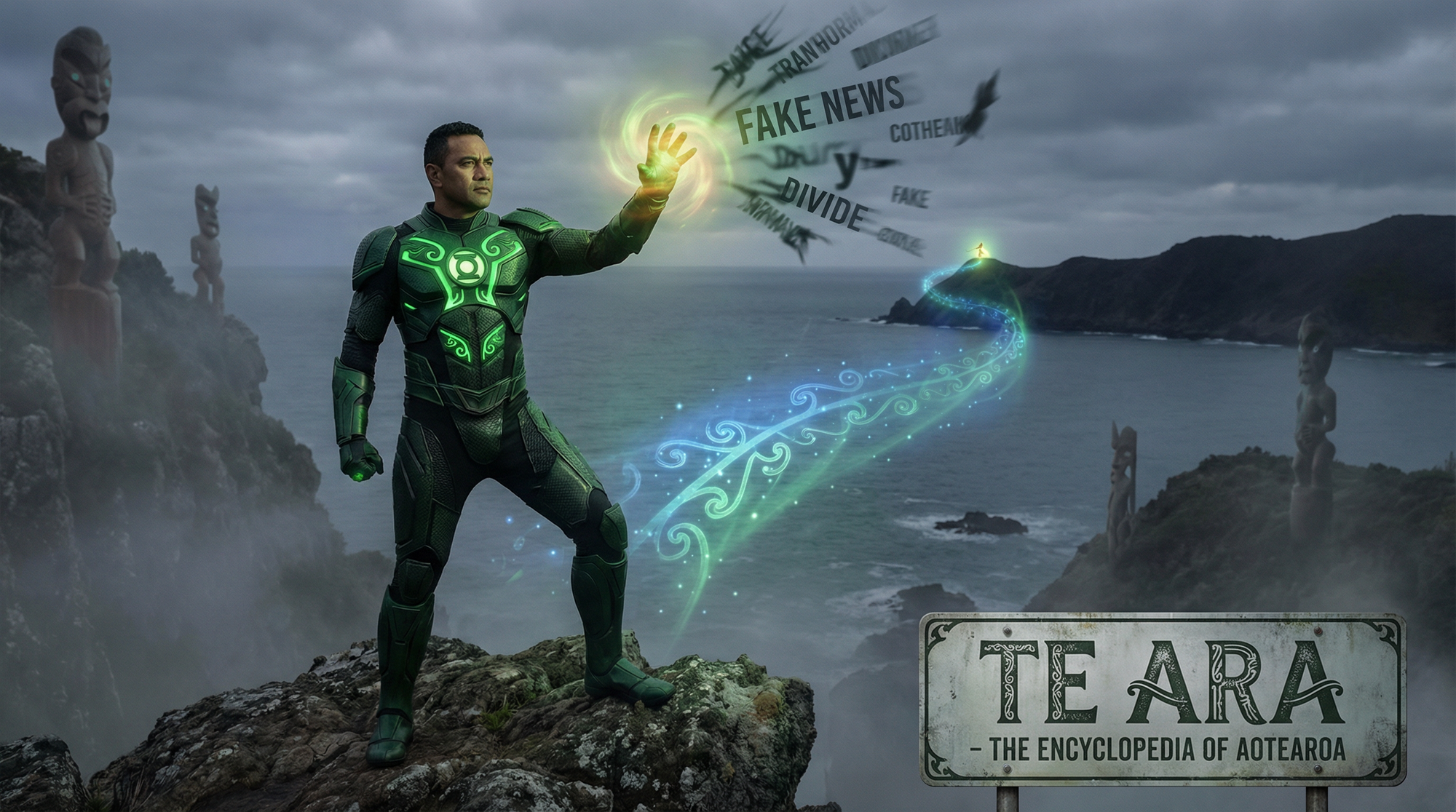
The Māori Green Lantern fighting misinformation and disinformation from the far right
The Reckoning Comes
As Judge Boldt reserves his decision, the coalition government faces a moment of constitutional reckoning. This case isn't just about Te Aka Whai Ora - it's about whether New Zealand will have a legal system that gives practical effect to Treaty obligations, or whether the Crown can continue to treat its Treaty partner as a junior partner whose rights exist only at the Crown's sufferance.
The evidence is overwhelming. The coalition government acted in bad faith, without consultation, without evidence, and without regard for Treaty obligations. They dismantled an institution that represented the strongest expression of Māori self-determination in health policy because it threatened their ideological commitment to Crown supremacy.
If there is any justice left in our legal system, Judge Boldt will issue the strongest possible declaration of inconsistency - not just with Te Tiriti, but with the fundamental principles of good governance, partnership, and constitutional propriety.
The coalition government may have thought they could bulldoze Te Aka Whai Ora without consequence. They are about to discover that the rule of law, unlike their political rhetoric, still matters.
Kia kaha to those fighting for justice. The waka isn't sunk - it's being rebuilt in the High Court.
Readers who find value in my content to consider a donation/koha to support the cause: HTDM: 03-1546-0415173-000. The MGL understands these tough economic times for whānau so please only contribute a koha if you have capacity and wish to do so.
Aroha mai, aroha atu.
Ivor Jones - Te Māori Green Lantern
Kaitiaki exposing misinformation, white supremacy, racism, and neoliberalism from the far right