"A Māori Reckoning with the US-Israel War on Iran" - 11 March 2026
Ko te Ahi Kā o Te Ao Kua Tahu: The World's Home Fire Is Burning
Mōrena ano Aotearoa,
Now, we investigate this global issue affecting us all an show you how Trump will fail.
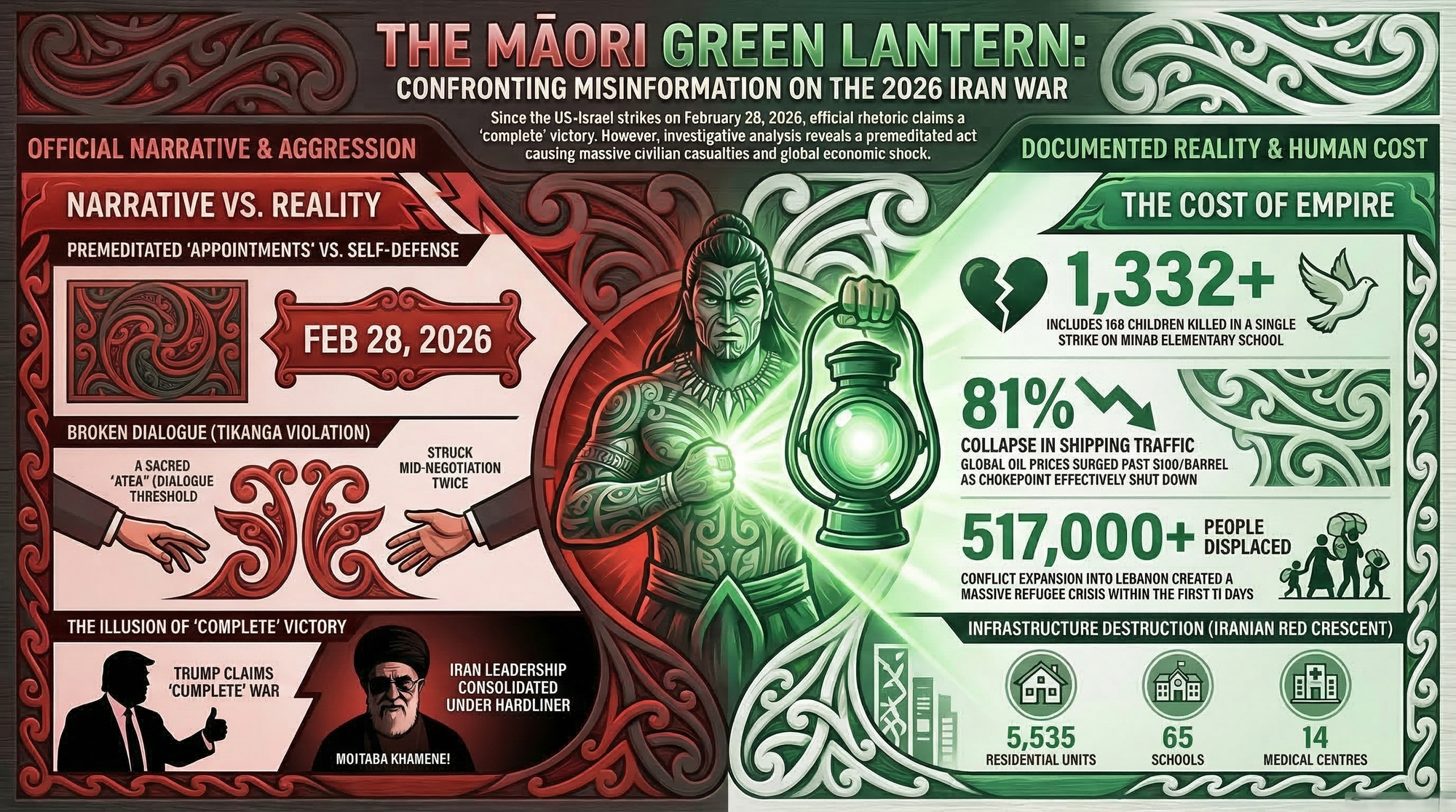
"He aha te mea nui o te ao? He tangata, he tangata, he tangata."
What is the greatest thing in the world? It is people, it is people, it is people.
The world has been at war for eleven days. Not metaphorically. Not in the slow-motion sense of sanctions and proxy skirmishes. In the full, irreversible sense — missiles, warships, burning schools, shattered hospitals, children in body bags. And almost no one in power is calling it by its correct name: the destruction of a sovereign nation by two militaries who planned the attack months in advance, moved it forward when diplomatic conditions aligned, and launched it while their own negotiators were still at the table.
This is not a response. This is not self-defence. This is a scheduled act of imperial violence — and the whakapapa of this moment traces back not just to 1979, but to 1953, when the CIA removed Iran's democratically elected Prime Minister Mohammad Mosaddegh for daring to nationalise British oil. The west has been collecting its colonial debt from the Persian people ever since. The bombs of 28 February 2026 are only the latest instalment.
Ko wai ka hua? Ko wai ka mate? Who profits? Who dies? These are the questions of a tohunga wairua — a spiritual investigator — when the smoke rises. Let us answer them together.
Koha Consideration

168 girls went to school on a Tuesday morning and did not come home. No Crown structure will fund the naming of that. No corporate media will trace the whakapapa of a war that was scheduled on a calendar months before the first bomb fell. That mahi — the tracing, the naming, the refusing to look away — lives here, and it lives because whānau choose to fund it.
Every koha signals that rangatiratanga includes the power to fund our own truth-tellers. That the ahi kā of accountability does not go cold on our watch.
Kia kaha, whānau. Stay vigilant. Stay connected. And if you are able, consider a koha to keep this taiaha swinging.
If koha is not possible right now — no worries at all. Subscribe, follow, kōrero about this essay with your whānau and friends, share it widely. That is koha in itself. Every share is a fern frond rising.
Three pathways:
Koha direct — Support the Māori Green Lantern on Koha
Subscribe for essays direct to your inbox — The Māori Green Lantern Substack
Direct bank transfer — HTDM, account number 03-1546-0415173-000
🎙️ Deepdive Podcast

Want to go further down the rabbit hole? Listen to the full deep-dive audio analysis of this essay — the whakapapa of the war, the five hidden connections, and the predicted outcome.
He Whakapapa o Te Pakanga — The Genealogy of This War
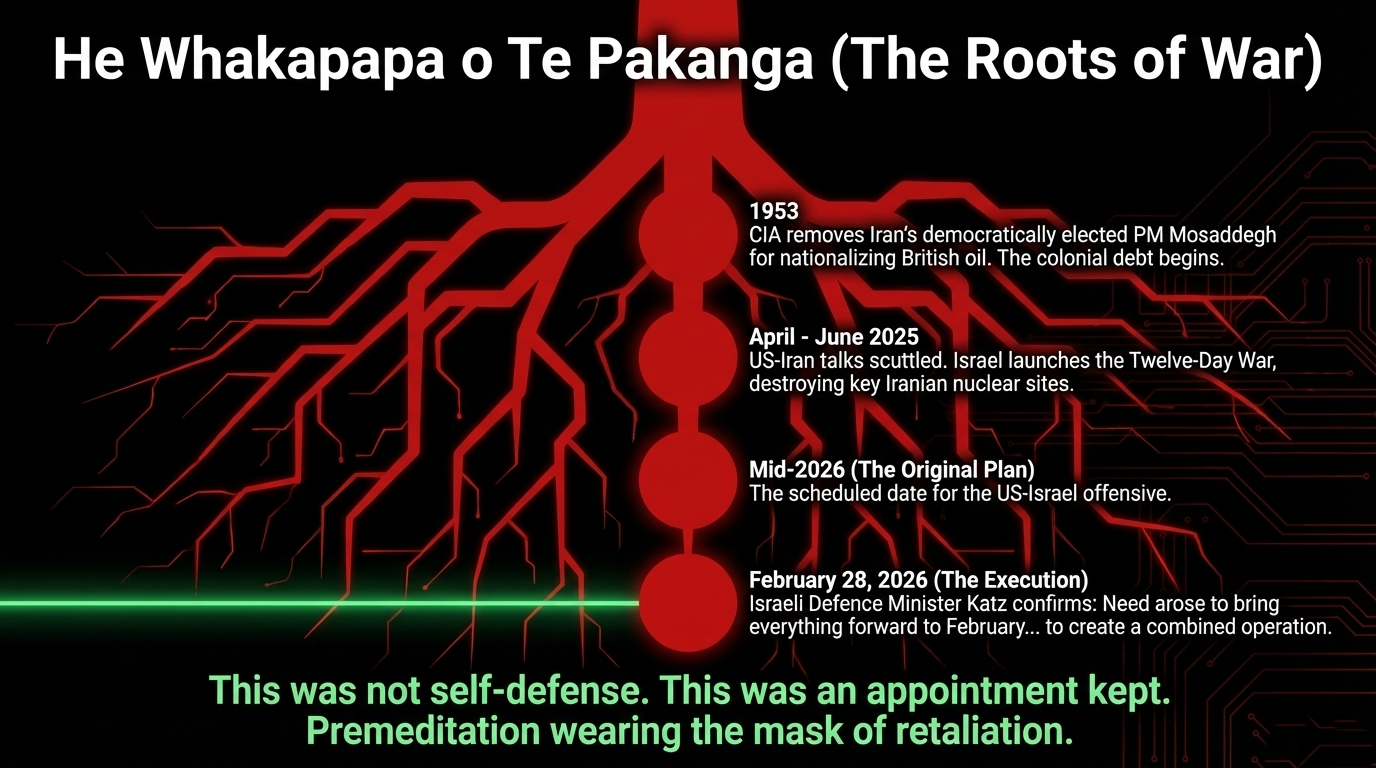
No war begins in a vacuum. This one carries the whakapapa — the genealogy — of empire stretching across decades of transgression.
The 2026 war did not begin on 28 February. It began in April 2025, when US-Iran nuclear talks were scuttled after Israel launched what became the June 2025 "Twelve-Day War" — a brief but devastating conflict that left Iran's key nuclear sites "in tatters," ended with a US-Qatar-brokered ceasefire documented by Wikipedia, and gave Trump and Netanyahu their July 2025 "victory lap" as reported by 1News. That ceasefire was proclaimed triumphant. Iran was supposedly contained. Eight months later, here we are again — with a new war, wider, bloodier, and without any visible exit.
Israeli Defence Minister Israel Katz confirmed, as 1News reported on 5 March, that this offensive was originally scheduled for mid-2026 but the "need arose to bring everything forward to February" due to internal Iranian protests, Trump's political positioning, and "the whole possibility of creating a combined operation." Read that again slowly. This war was on a calendar. It was moved up, like a business meeting rescheduled to suit the board. The Iranian people who died in their beds on the night of 28 February were not threats. They were appointments kept.
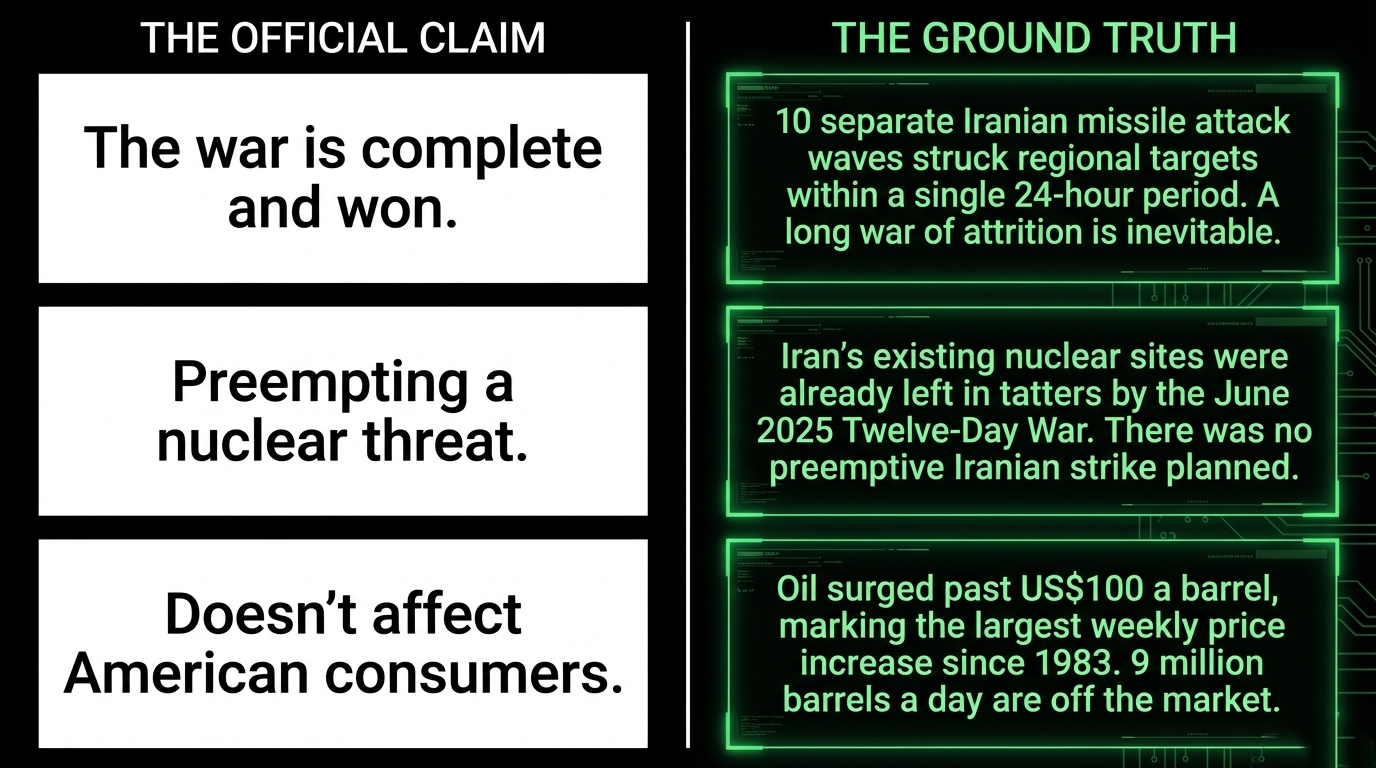
Crucially, 1News confirmed on 2 March that US intelligence did not suggest Iran was planning a preemptive strike before Washington and Tel Aviv launched their attacks. Trump later told reporters, as 1News documented on 10 March, that the war started because Iran "was starting work on a new site for developing material for nuclear weapons" — a claim directly contradicted by the fact that Iran's existing nuclear sites were already destroyed in the June 2025 Twelve-Day War. As RNZ reported on 2 March, drawing on Reuters analysis, Trump's stated objectives have shifted constantly: nuclear capability, missile stockpiles, proxy networks, regime change, and finally — most revealingly — that he had "someone in mind" to lead Iran but wouldn't say who. This is not a war with strategy. This is a war with ambitions searching for justification.
The Stimson Center's expert panel put it precisely: "The rejection of diplomacy in favour of a major bombing campaign against Iran frames US negotiations as PR stunts meant to buy time, gain information, and conclude with regime change." Iran's Foreign Minister Abbas Araghchi confirmed the betrayal before the UN Security Council — as reported by the Times of Israel:
"We negotiated with them twice and every time they attacked us in the middle of negotiations."
In tikanga Māori, breaking one's word during formal kōrero is among the gravest violations of mana. You do not strike a people mid-kōrero and expect them to return to the table. The burned marae does not invite the arsonist to hui.
Ko Tū Rangatira Mā — The War Gods and Their Servants
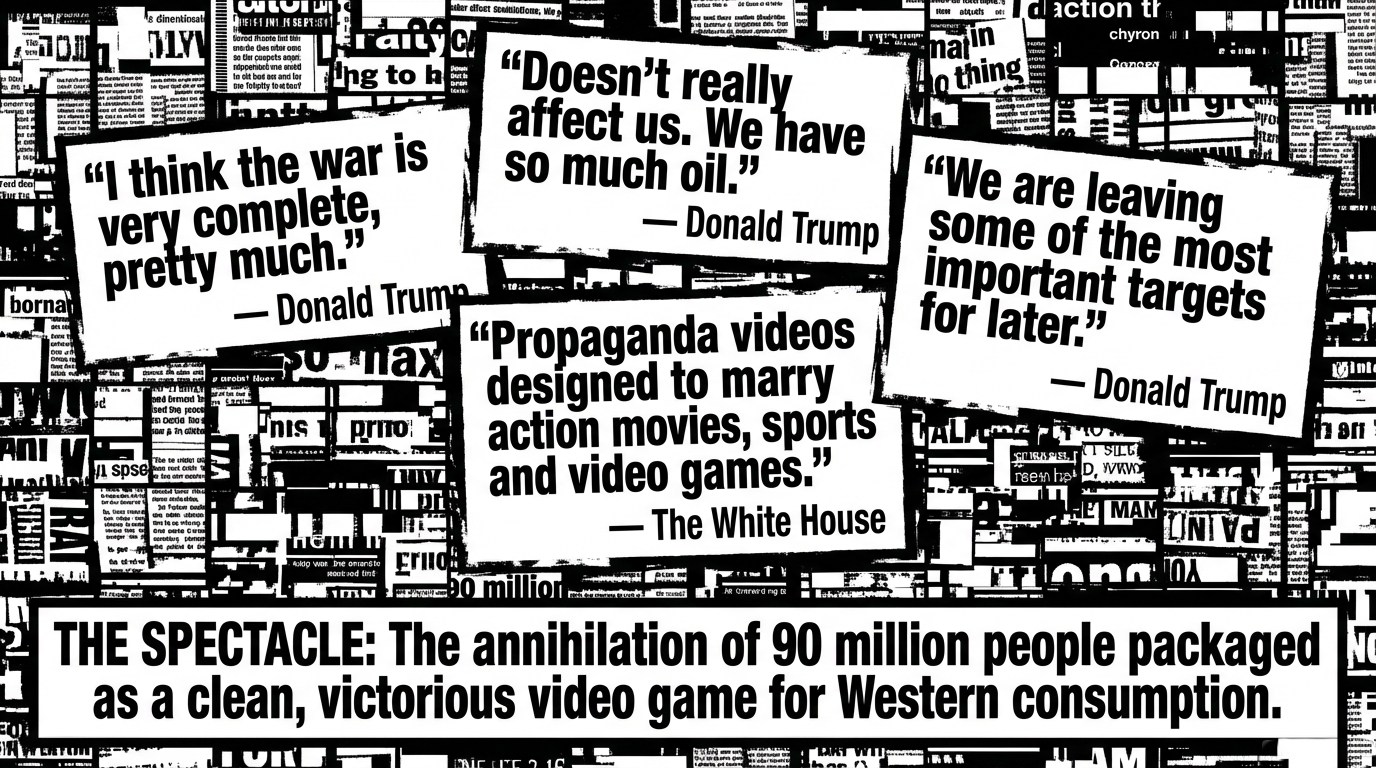
In te ao Māori, Tū is the atua of war — fierce, purposeful, bound by tikanga even in destruction. What we witness from Washington is something different: Tū without tikanga. War without whakaaro.
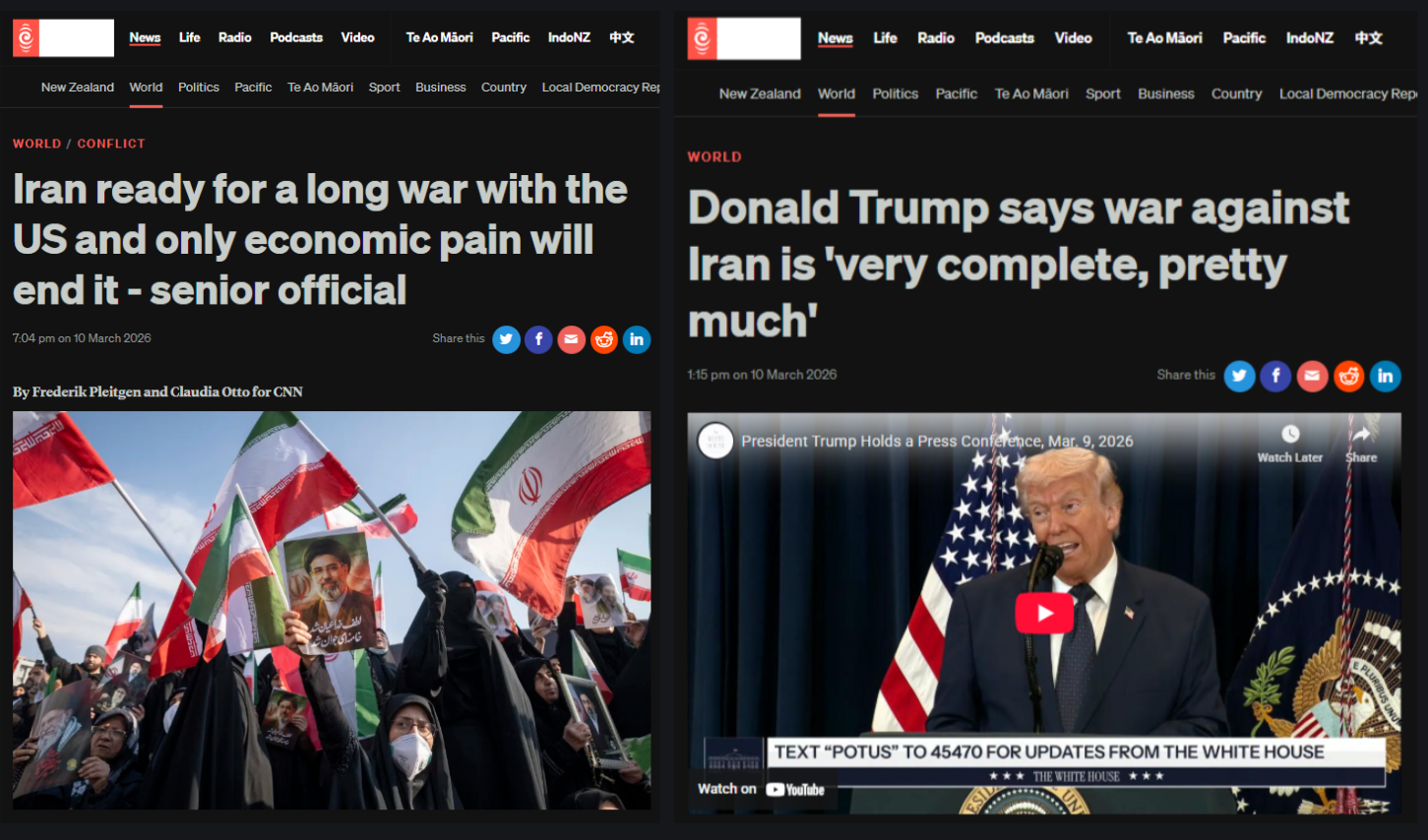
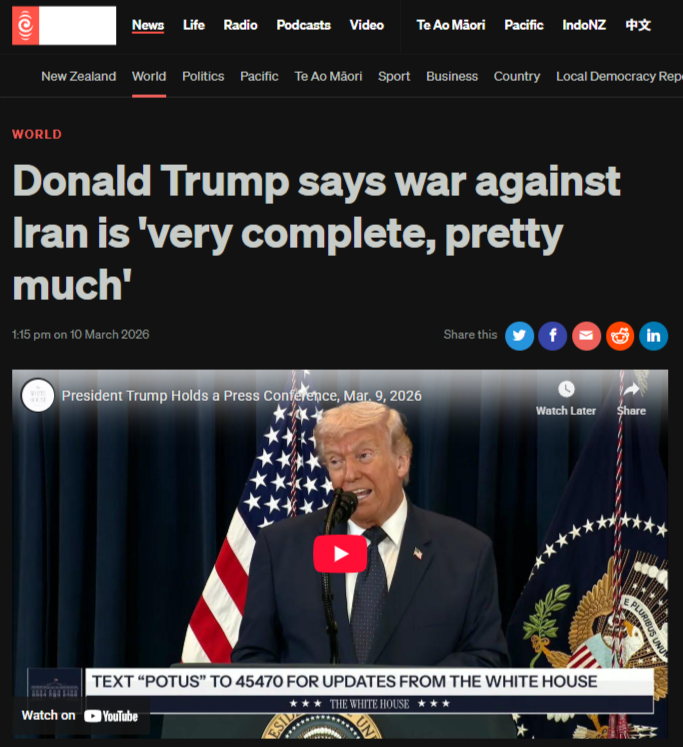
Trump stood before cameras and declared — as RNZ reported directly — that the war was "very complete, pretty much," that Iran has "no navy, no communications, no Air Force," as though the annihilation of a nation of 90 million people were a real estate deal signed and sealed. Meanwhile, as 1News reported on 8 March, Iranian missiles continued striking Israel, Hezbollah launched from Lebanon, and the Institute for the Study of War's evening special report of 7 March documented ten separate Iranian missile attack waves striking Israeli and regional targets within a 24-hour period. Trump's proclamation of victory was not a military assessment. It was a performance — spectacle dressed as strategy.
The White House has been producing war propaganda videos that, as 1News reported on 9 March, "marry action movies, sports and video games" — packaging the bombing of a civilisation into entertainment content. Families watching their homes destroyed in real time in Tehran were simultaneously being repackaged as cinematic content for American audiences. This is whakaaro kino — the colonisation of public consciousness through spectacle, turning tangata into pixels, grief into content, death into clout.
And when asked if Americans would feel economic pain at the pump, Trump replied — as 1News reported — "Doesn't really affect us. We have so much oil." The correct te reo Māori term for this is pōhēhē — the delusion born of privilege, the arrogance of a rangatira who cannot see beyond his own pā walls to the suffering of the world outside.
Ngā Mate — The Dead and the Counting of Them
The human cost of eleven days must be named plainly, because the powerful prefer abstractions.
Al Jazeera reported on 9 March, citing Iran's Deputy Health Minister Ali Jafarian directly, that at least 1,255 people have been officially killed — the government's floor figure, which human rights monitors regard as significantly underreported. The same Al Jazeera report confirmed 12,000+ injured, 200 women killed, 200 children killed, and 168 children killed at Minab Elementary School alone in the opening strikes — ages 8 to 13. The Reuters Security Council report of 6 March revealed that Iran's UN Ambassador Iravani told the Security Council that at least 1,332 Iranian civilians — not soldiers, civilians — had been killed by that date.
The human rights organisation Hengaw, publishing independently verified field data, estimated over 4,145 total killed including approximately 2,100 Iranian military personnel by 4 March. The Wikipedia 2026 Iran war live casualty tracker puts the total regional death toll at between 2,232 and 5,048+ killed and 15,782+ injured across all parties. The same tracker confirms that Iranian Red Crescent data shows 6,668 civilian units struck, including 5,535 residential units, 65 schools, and 14 medical centres destroyed or severely damaged.
In Lebanon, 1News reported on 9 March at least 486 killed, 1,313 injured, and 517,000 people displaced, with 83 children and 82 women confirmed among the dead. The United States, as NPR confirmed on Day 10, has lost 7 soldiers killed and 20 injured — six dying in a single Iranian airstrike on a US base in Kuwait. The Iranian frigate Dena, torpedoed by a US submarine in the Indian Ocean as 1News documented on 5 March, had 87 bodies recovered by Sri Lankan authorities, 32 survivors, and approximately 180 crew aboard.
And then there is the school.
1News published new footage on 9 March raising the likelihood that the strike on Minab Elementary School — 168 children killed — was caused by a US Tomahawk missile. CENTCOM maintains "US forces do not target civilians — period." The footage and crater signature say otherwise. This claim is unresolved and demands independent investigation by the International Criminal Court. The girls had names. Their mothers have faces. Their whakapapa stretches back through Persia to the oldest human civilisations on earth. They were tangata — the greatest thing in the world — and they are gone.
Ngā Hono Huna — Five Hidden Connections the Mainstream Does Not Name
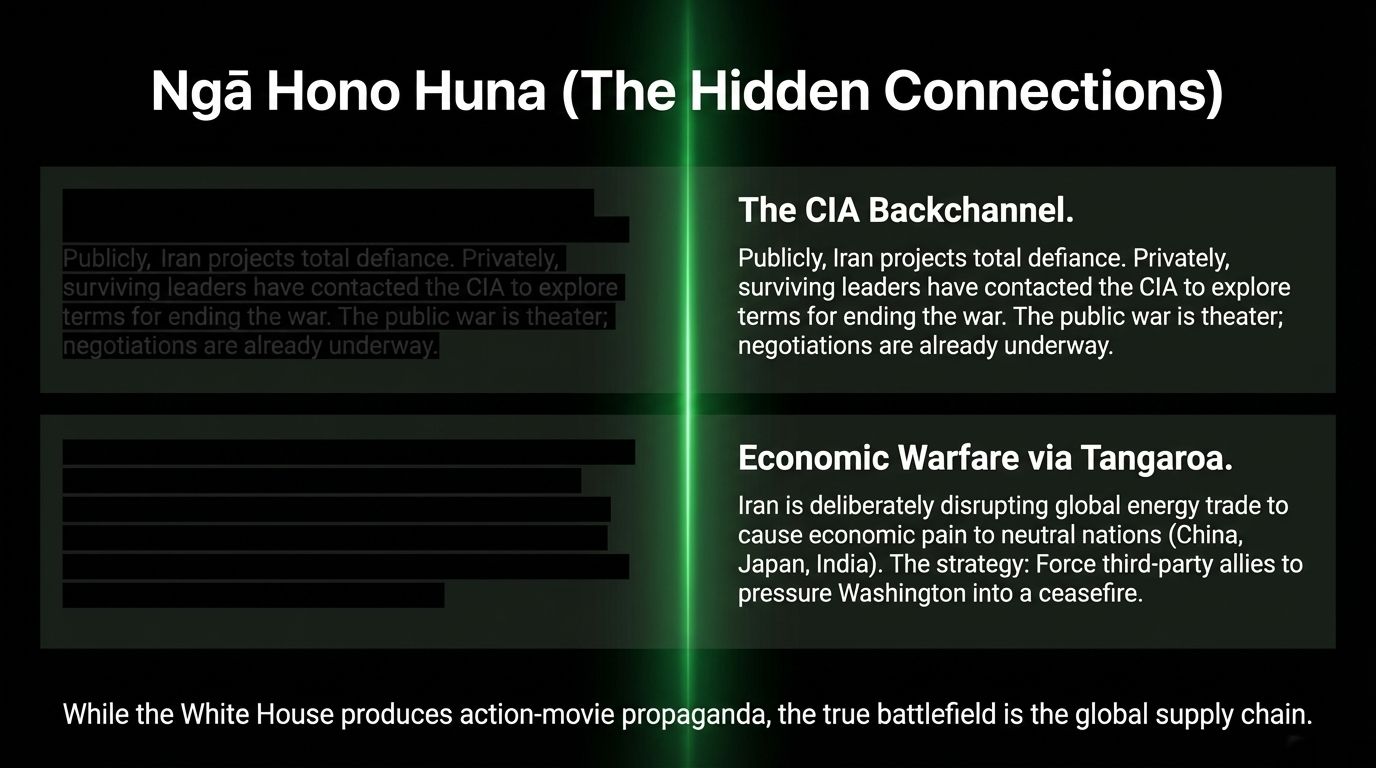
The taiaha of the Māori Green Lantern traces the networks that power prefers invisible.
1. The War Was Pre-Planned — Premeditation Wearing the Mask of Self-Defence
1News reported on 5 March that Israel's Defence Minister Katz confirmed the offensive was originally scheduled for mid-2026, moved forward to February when political conditions aligned. 1News further reported on 3 March that the US bombing shows "little evidence of endgame strategy," confirming that this was a campaign planned for its initiation, not its conclusion. In law, this is called premeditated aggression. At the Nuremberg Tribunals, it was called a crime against peace.
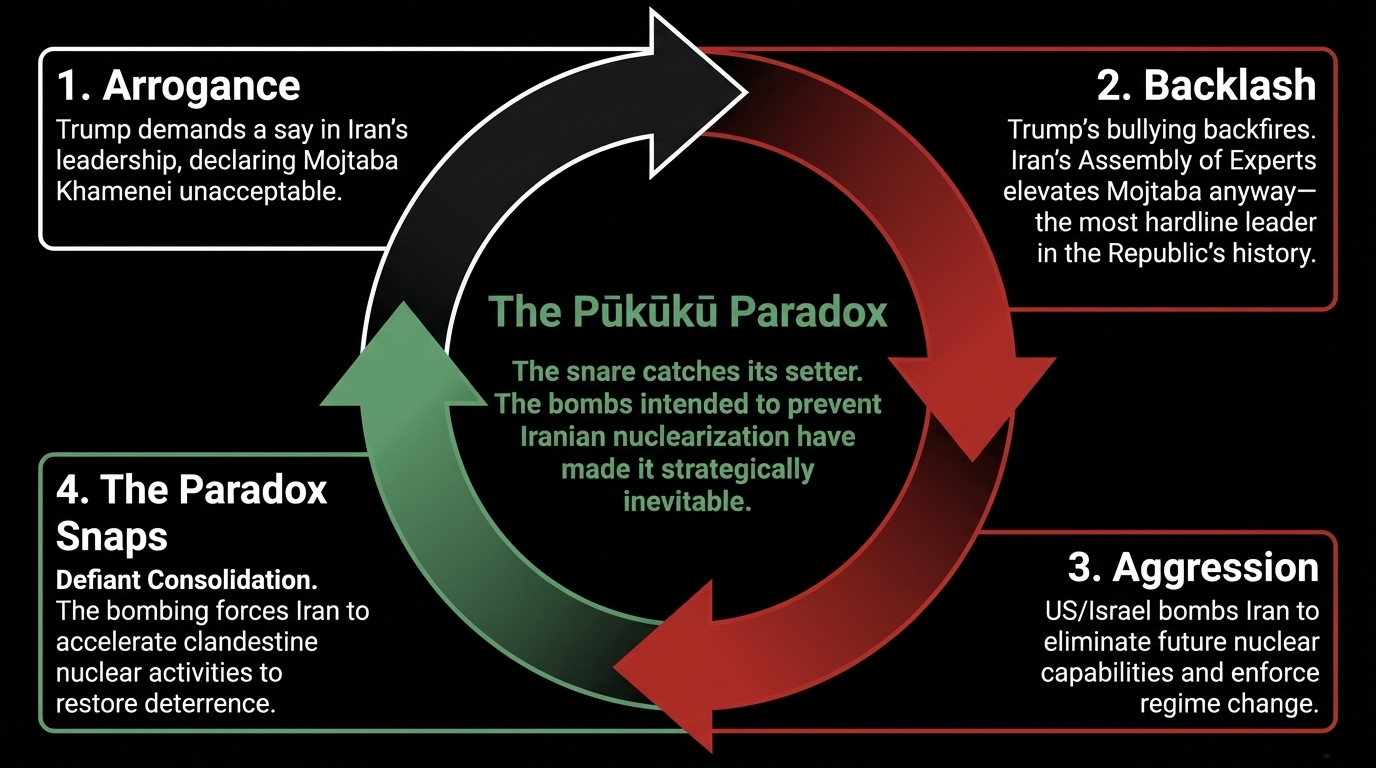
2. The Nuclear Rationale — The Pūkūkū Paradox
The Washington Institute for Near East Policy warned on 4 March that new Supreme Leader Mojtaba Khamenei "may pursue extreme options to restore deterrence," including "accelerating clandestine nuclear activities" and "exploring unconventional procurement channels for missile and nuclear capabilities." The bombs intended to prevent Iranian nuclearisation have made it strategically rational — even inevitable — under the new leadership. This is the Pūkūkū Paradox: the snare that catches its setter.
3. Iran's Strategy is Deliberate Economic Warfare Through Tangaroa
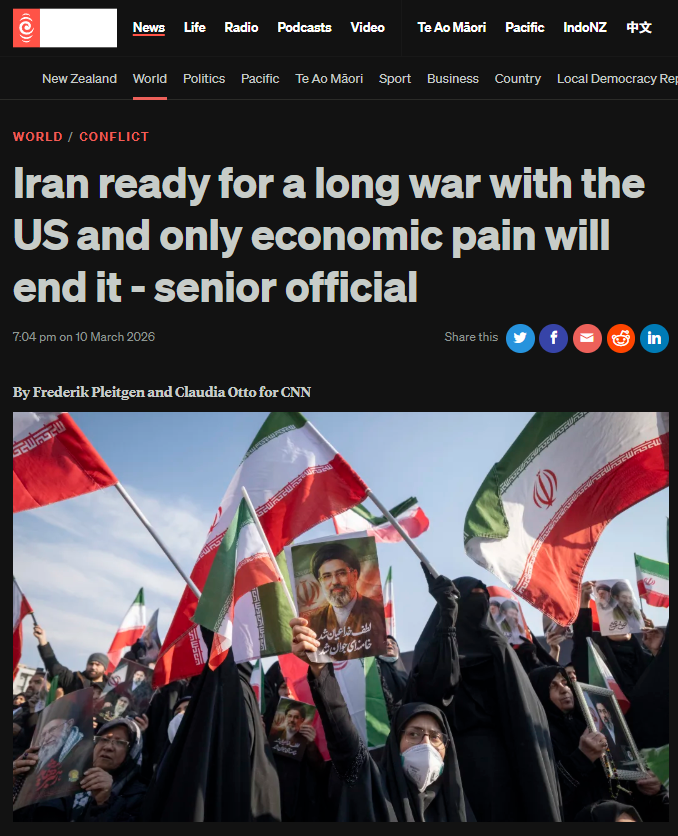
RNZ reported directly from CNN that Iran's senior foreign policy adviser Kamal Kharazi stated Iran is deliberately causing economic pain to neutral third-party nations to force them to pressure Washington into ending the conflict. The Stimson Center confirmed that sustained Hormuz disruption links "Gulf military escalation to Asian utility costs, industrial margins, and import bills" worldwide, making China, Japan, India and South Korea — nations that depend on Hormuz for half their crude — Iran's unwilling diplomatic allies in this strategy.
4. Trump's Intervention Strengthened the Hardliner It Was Designed to Block
1News reported on 6 March that Trump publicly declared Mojtaba Khamenei "unacceptable" and demanded the US be involved in selecting Iran's next leader. Iran's Assembly of Experts promptly elected Mojtaba Khamenei as Supreme Leader anyway, as 1News confirmed on 9 March. Foreign Policy reported on 8 March that "when Washington publicly rejects an Iranian figure, that rejection can enhance the figure's domestic standing by framing opposition as alignment with foreign interests." Trump's bullying produced the exact opposite of its intended result. He demanded a moderate. He got the most hardline succession in the Islamic Republic's history.
5. Iran Reached Out Through the CIA — The Back-Channel Washington Hides
The Jerusalem Post reported on 3 March that Iran's surviving leaders — despite publicly projecting total defiance — had contacted the CIA to explore terms for ending the war. US officials reportedly insist any agreement must include Iran abandoning its ballistic missile and nuclear programmes and ending support for proxy groups. Trump has indicated the regime can survive if it disarms — a formula that "prioritises compliance on strategic programmes over sweeping internal political reform." The public war of words is theatre. The real negotiation is already underway.
Ngā Hau e Whā — The Economic Shockwaves Reaching Every Corner of Te Ao Mārama
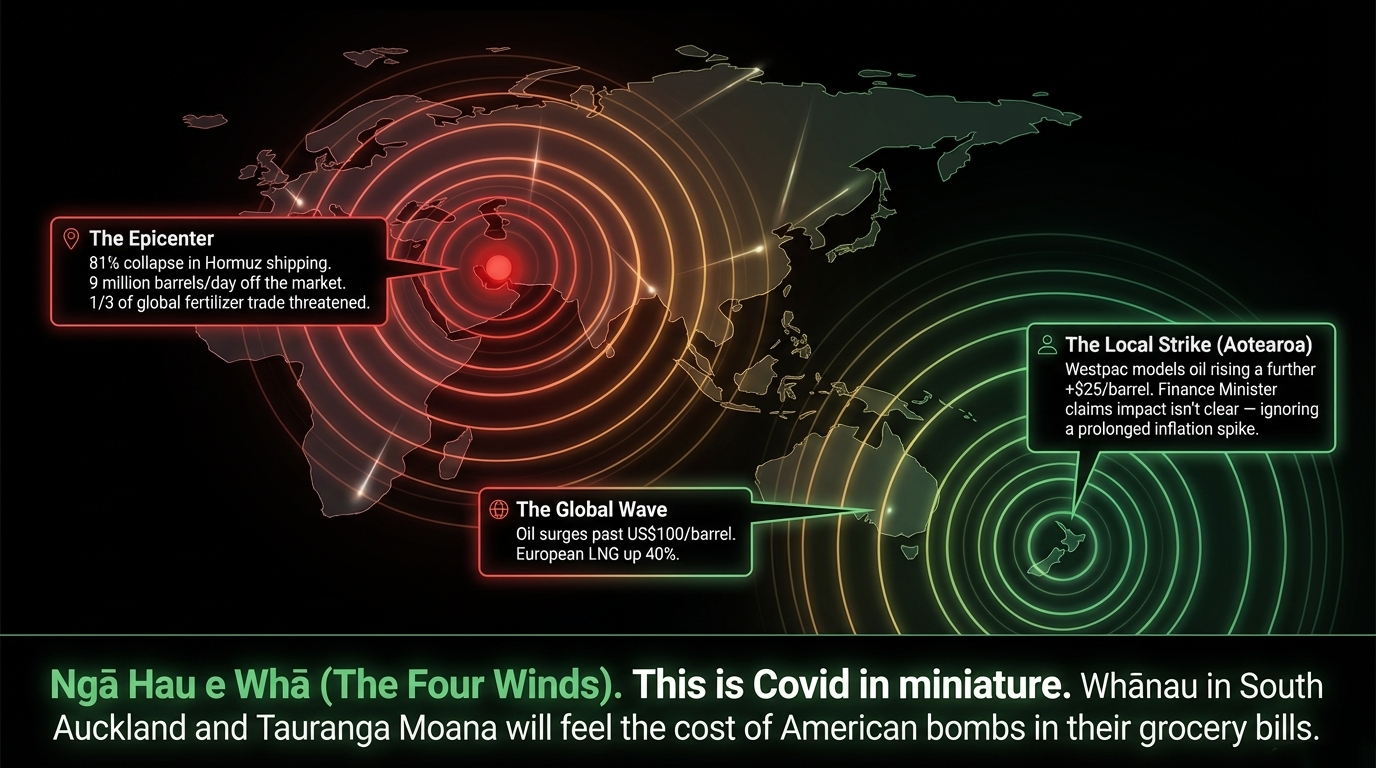
Ngā hau e whā — the four winds — carry the consequences of this war to every corner of the world of light.
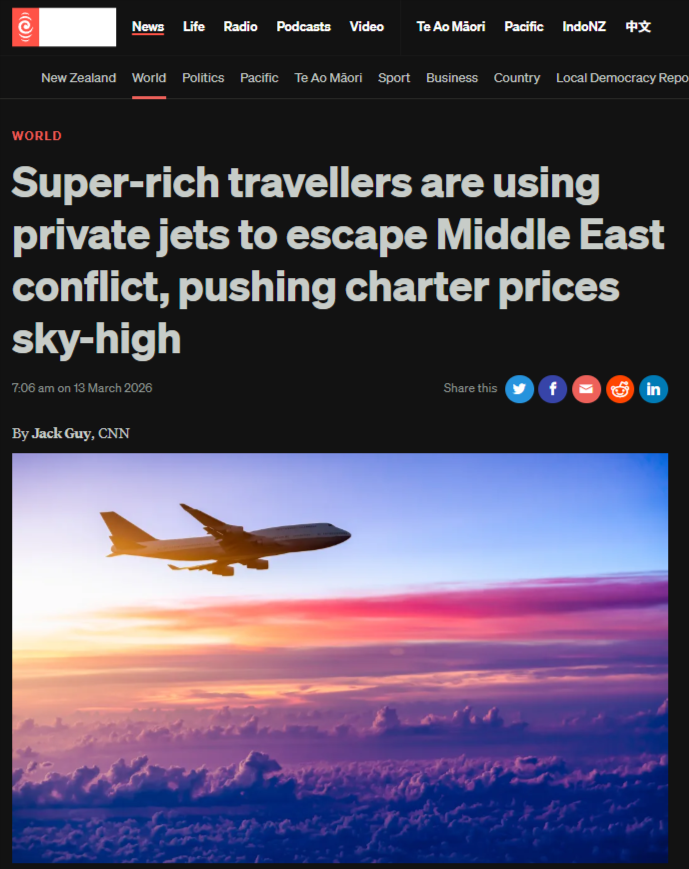
Al Jazeera reported on 8 March that the week's rise in oil prices was the largest weekly increase since 1983, with oil surging past US$100 a barrel before settling back toward $90 as Trump hinted at resolution. 1News confirmed on 3 March that European natural gas prices surged 40% after QatarEnergy halted LNG production. ABC Australia reported on 3 March that traffic through the Strait of Hormuz collapsed 81% compared to the prior week. The LA Times reported on 7 March that nine million barrels of oil per day are off the market through damage or precautionary shutdown. 1News reported on 3 March that one third of the world's fertiliser trade passes through the Strait — meaning this war threatens not just energy but kai, food itself, for the world's most vulnerable. The Economist warned on 1 March that this "could cause the biggest oil shock in years," while CNBC modelled on 28 February that a sustained closure "would inevitably lead to a global recession."
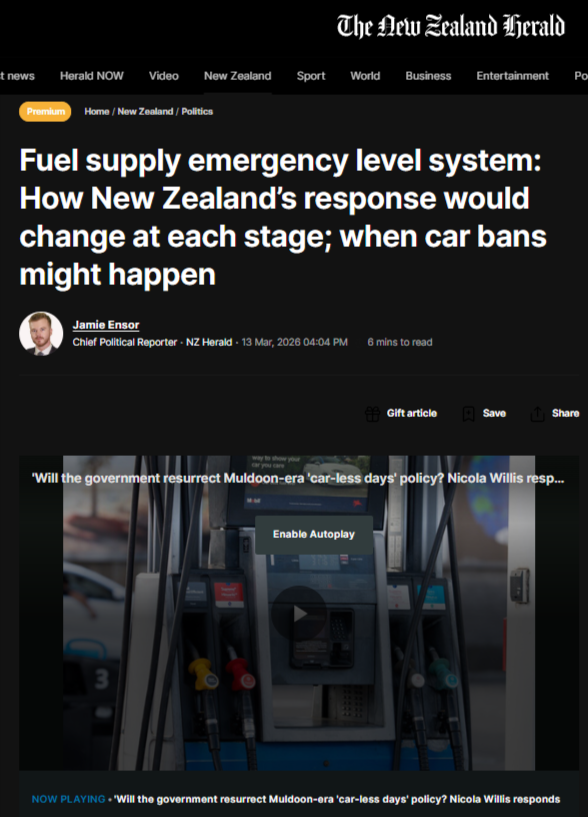
For Aotearoa New Zealand, RNZ reported on 4 March that Finance Minister Nicola Willis told parliament the economic impact "isn't clear." This is pōhēhē wearing a Budget 2026 suit. The same RNZ report confirmed that Westpac had already modelled oil rising a further US$25 per barrel. 1News reported on 8 March that New Zealand faces disruption "like Covid in miniature." Our whānau in South Auckland, in Tauranga Moana, in Gisborne and Whanganui — already stretched taut by three years of this government's cost-of-living indifference — will feel this war in their grocery bills before they feel it anywhere else. They always do.
Te Matapae — Predicting the Outcome with High Certainty
The Māori Green Lantern does not deal in comfort. He deals in analysis. Here is what the evidence tells us will happen.
The war will not be "won" by the United States or Israel.
The Stimson Center's expert consensus is unambiguous: "No matter how precise or devastating, air strikes alone cannot topple a government, and Iran in 2026 is likely to emerge battered but not broken." The Brookings Institution stated on 4 March that Iran "appears to be pursuing the same strategy, expanding the war as much as and as quickly as possible in order to create the greatest diplomatic pressure on Trump to end the war." 1News confirmed on 2 March that "Iran's regime was built for survival — a long war is now likely." It survived eight years of brutal war with Iraq in the 1980s. It survived decades of maximum-pressure sanctions. A fortnight of airstrikes — however devastating — will not dissolve 47 years of revolutionary institutional infrastructure.
There will be a negotiated ceasefire — brokered by Qatar — within 2–6 weeks.
The whakapapa of the June 2025 Twelve-Day War is directly instructive: it began explosively, escalated rapidly, and ended when Iran reached out through Qatar and Saudi Arabia, offering "flexibility in nuclear negotiations in return" for a ceasefire, as the Wikipedia Twelve-Day War ceasefire article confirms. The exact same pressure architecture is already assembling. The Jerusalem Post reported on 3 March that Iran has contacted the CIA. 1News reported on 10 March that Trump is signalling the war is nearly over. The National News reported on 8 March that Iran's Foreign Minister — while publicly rejecting an unconditional ceasefire — is in fact defining the conditions for one. Iran International confirmed on 9 March that Iran's position is "no talks while bombs fall" — not "no talks ever." The economic pain — oil above $100, global recession modelling, US domestic inflation — is generating the political urgency that drives Trump to the exit.
The terms of the ceasefire will be: Iran's surviving leadership retains power in exchange for verified curtailment of its long-range ballistic missile programme, formal renunciation of nuclear weapons development, and reduced proxy support. Trump will declare total victory. Iran will frame it as resistance vindicated. Neither claim will be fully true.
The Pūkūkū Paradox will activate — Mojtaba Khamenei will accelerate covert nuclear procurement.
The Washington Institute for Near East Policy's assessment is stark: under IRGC influence, Mojtaba Khamenei will likely pursue "defiant consolidation," embracing "extreme options to restore deterrence," including "accelerating clandestine nuclear activities" and exploring "unconventional procurement channels" in the longer term. NPR's profile of the new Supreme Leader on 9 March confirmed he is the most ideologically hardline figure to hold the role in the Republic's history. The lesson Iran's new Supreme Leader draws from this war is the lesson any rational actor would draw: the only reliable deterrent against US-Israeli regime change is a nuclear weapon. North Korea has never been invaded. Pakistan has never been invaded. The bombs intended to prevent Iranian nuclearisation have made it strategically inevitable.
The Strait of Hormuz will reopen — but the global energy architecture is permanently destabilised.
As the Stimson Center documented, oil consumers will accelerate decarbonisation and supply diversification not out of environmental principle but out of geopolitical terror. The Gulf's role as the world's petrol station is now structurally unreliable in ways that 2022 did not fully establish but 2026 confirms. This is paradoxically positive for long-term climate outcomes and catastrophic for the transition period, during which working-class communities globally absorb the cost.
The United States will not achieve regime change.
1News reported on 6 March that Trump wanted "someone in mind" to lead Iran. He got Mojtaba Khamenei. As Foreign Policy reported on 8 March, "Iran has signalled defiance" through the very selection that Washington tried to prevent. The Islamic Republic — battered, grieving, carrying the weight of its dead — will emerge from this war having demonstrated that it cannot be bombed into compliance. As the US learned in Vietnam. As it learned in Afghanistan. History does not repeat, but it rhymes, and this rhyme is a dirge.
New Zealand and the Pacific will face a prolonged inflation spike through late 2026.
The disruption to Hormuz trade routes, the fertiliser shortfall, and the energy price surge will compound existing cost-of-living pressures throughout Te Moana-nui-a-Kiwa. Nicola Willis's "isn't clear" — as RNZ reported on 4 March — will be clarified painfully by Q3 2026 consumer price data. Māori, Pasifika, and low-income whānau will bear this burden disproportionately, as they have borne every economic shock of the last decade.
Te Whakamāoritanga — Reading the War Through Mātauranga
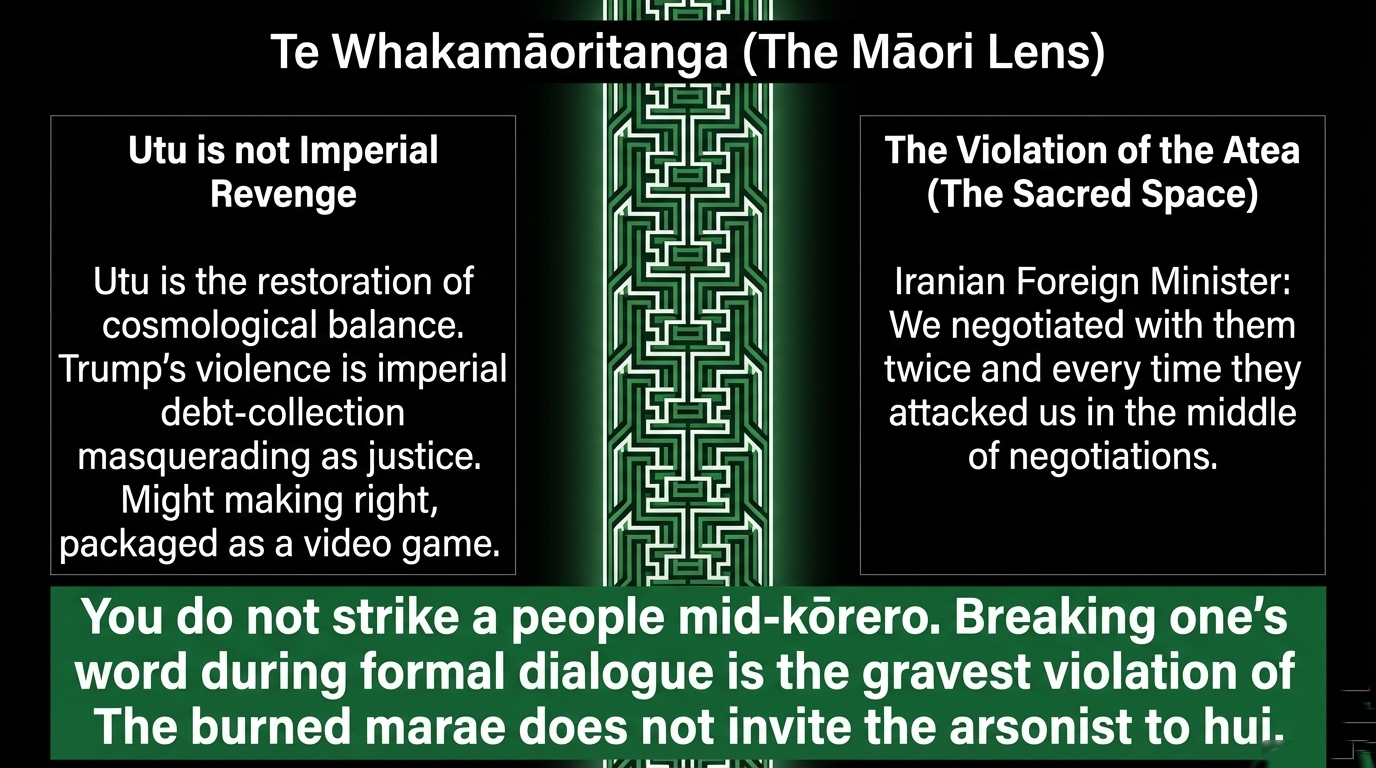
In te ao Māori, utu is not simple revenge. It is the restoration of cosmological balance — the re-alignment of relationships that have been violated. Both Iran and the United States believe they are enacting utu. The difference is scale. The difference is who started it.
Iran's Foreign Minister Araghchi, as The National News reported on 8 March, said before the Security Council:
"They are killing our people, they are killing girl students, they are attacking hospitals, freshwater desalination refineries. This is not our war. This is imposed on us."
This is a specific, verifiable claim. Iran was at the negotiating table. The strikes came mid-kōrero, twice, as confirmed by the Times of Israel. In tikanga Māori, this is the destruction of the atea — the sacred threshold of dialogue — and it cannot be undone by the party who destroyed it.
Trump's utu is imperial: the settling of debts from 1979, from the hostage crisis, from proxy wars across the region, conducted not through whakaaro but through firepower. RNZ confirmed on 2 March that his objectives shift with each press conference. Every bomb dropped on Papatūānuku — the Earth Mother — plants seeds of resistance that grow for generations. Every child killed in a school becomes the whakapapa of the next generation's resolve. The Americans of all nations should understand this. They learned it in Vietnam. They learned it in Afghanistan. They are learning it again.
The Māori Green Lantern does not pretend to love the Iranian theocracy. The Islamic Republic carries its own account with its own people. But the question of who has the right to obliterate a nation — to kill its Supreme Leader, destroy its navy, bomb its schools, choke its civilians — is not answered by pointing to the regime's sins. Colonisers have always named the chiefs they killed as tyrants. It made the killing no less wrong.
What we witness is the logic of empire at its rawest: might makes right, dressed in the language of liberation, packaged as a video game — as 1News confirmed the White House is literally doing.
He Kupu Whakamutunga — Words for the Living and the Dead
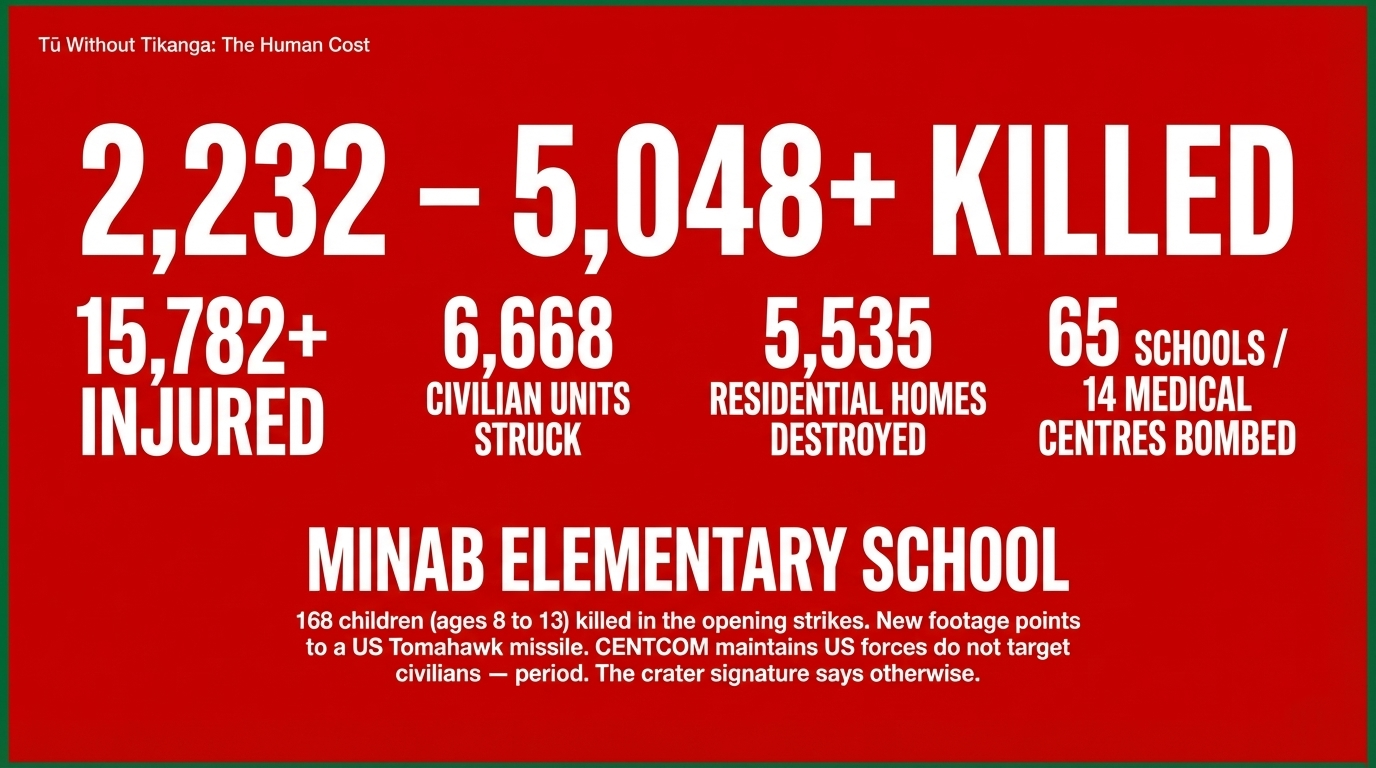
Ko tēnei te ahi kā o te ao. This is the world's home fire burning.
The 168 girls who died at Minab Elementary School had names. They were going to school on a Tuesday morning. Their backpacks were packed. They had homework. They had kōrero with their friends they had not yet finished. Somewhere between the bell and the blast, the world's most powerful military decided that whatever was near their school was worth the cost of their lives — and then, as 1News reported on 10 March, new footage raised the likelihood that the US Tomahawk missile caused it, while CENTCOM maintained its innocence.
We are asked to accept this as necessary. We are asked to receive Trump's "very complete, pretty much" — as RNZ reported directly — as a reasonable summary of what has been done to a nation of 90 million people. We are asked to believe that 1,332 confirmed Iranian civilian deaths, 15,782+ regional injuries, an 81% collapse in Strait of Hormuz shipping, and the biggest oil shock in forty years constitute a proportionate response to a nuclear programme that was, as 1News confirmed, already "in tatters" before the first bomb of this new war fell.
The Māori Green Lantern does not accept this.
The Waitangi Tribunal has taught us — and the lessons of colonisation have confirmed in blood — that when power names its violence as necessity, it is our job to name it back. When empire calls its invasions liberation, our mahi is to trace the whakapapa to the resource, the contract, the back-room deal, the scheduled date on the calendar that someone moved up to February.
The Iranian people will survive this. They have survived empires before — Greek, Arab, Mongol, Ottoman, British, American-backed Shah. Their civilisation is among the oldest continuous cultures on earth. They will bury their dead. They will rebuild their hospitals. The new Supreme Leader — hardened, IRGC-aligned, his father's blood on American hands — will make decisions that haunt the next three decades of geopolitics, as the Washington Institute has already warned.
And Trump will post about winning.
Ka hinga atu he tētē kura, ka ara mai he tētē kura.
When one fern frond falls, another rises in its place.
The ferns of Iran are falling. The ferns will rise again. The question for the rest of us — for the people of Aotearoa, for the peoples of the Pacific, for everyone downstream of Hormuz and downstream of empire — is whether we have the courage to stand now and say clearly: this was wrong, it was planned, it was unnecessary, and the ones who did it must be held to account.
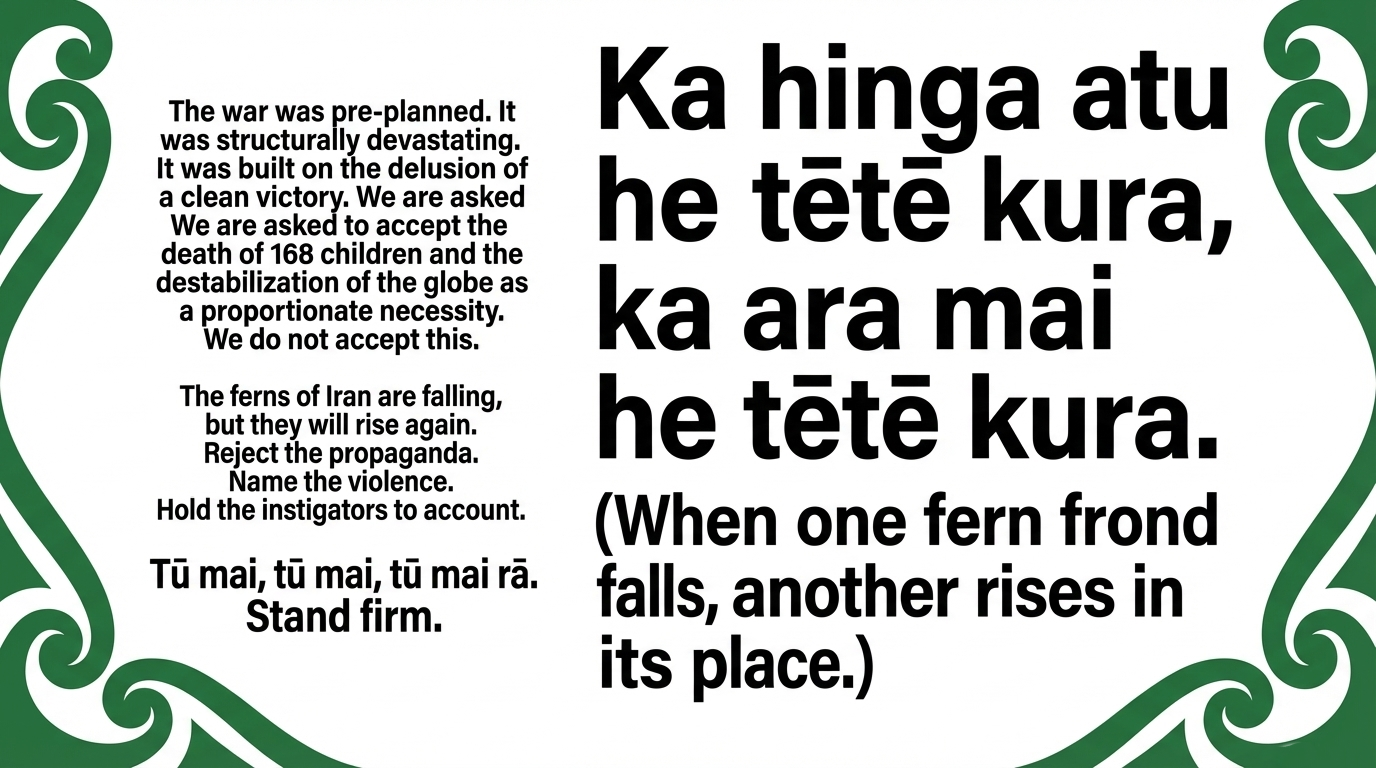
Tū mai, tū mai, tū mai rā.
Stand firm, stand firm, stand firm.

Ivor Jones The Māori Green Lantern Fighting Misinformation And Disinformation From The Far Right
Research conducted 10 March 2026. Sources include RNZ, 1News, Reuters, Al Jazeera, Iran International, Foreign Policy, NPR, Brookings Institution, Washington Institute for Near East Policy, Stimson Center, CNBC, The Economist, ABC Australia, LA Times, The National News, Modern Diplomacy, Hengaw, Wikipedia live tracker, Institute for the Study of War, Times of Israel, Jerusalem Post, and Britannica. All URLs verified at time of publication. Death toll figures are confirmed minimums — the actual toll is almost certainly higher.