“Auckland's Housing Smoke and Mirrors” - 25 July 2025
Unmasking the Colonial Neoliberal Fantasy Behind Auckland's "Improved" Affordability
Kia ora koutou for the second time today, :).
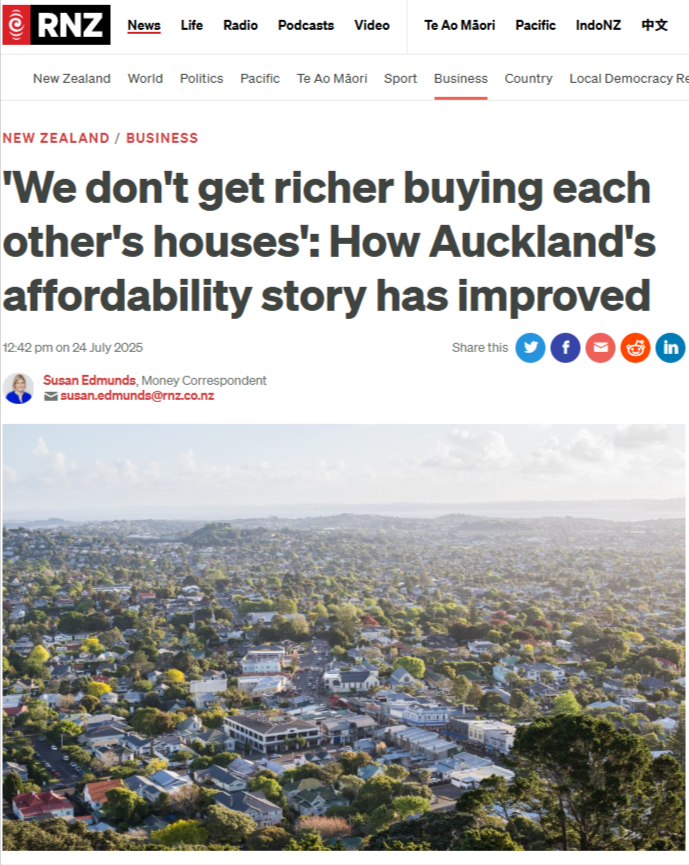
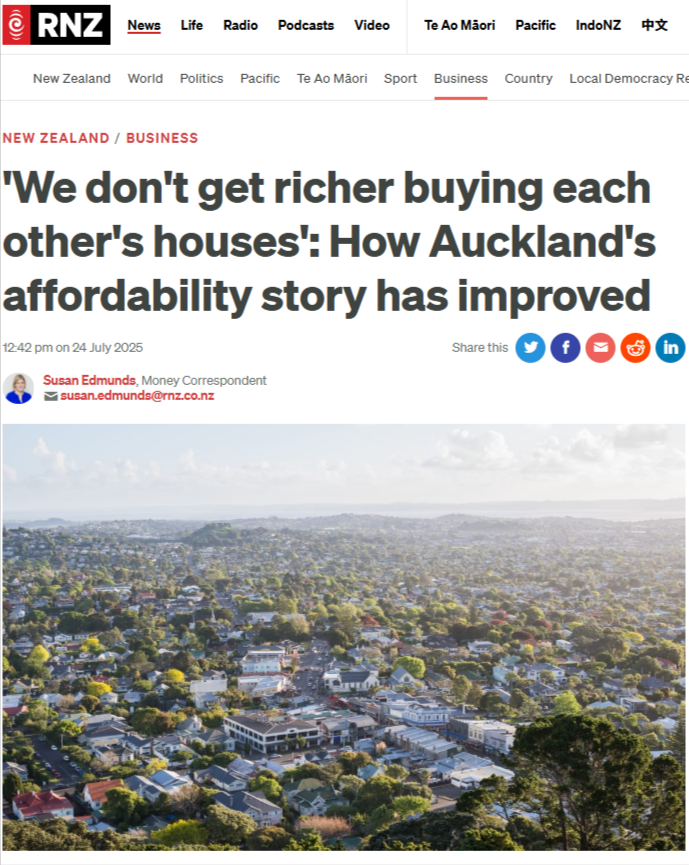
The Auckland housing "success story" being peddled by Susan Edmunds and her expert chorus represents a masterclass in colonial neoliberal propaganda. While bureaucrats and economists celebrate Auckland dropping from the world's most unaffordable cities to merely being severely unaffordable, they conveniently ignore the devastating reality facing tangata whenua and working-class whānau across Tāmaki Makaurau. This sanitised narrative serves the interests of property speculators, developers, and the settler colonial state while obscuring the ongoing dispossession of Māori from their ancestral whenua.
Background and Context
The housing crisis in Aotearoa represents a continuation of colonial dispossession by other means. Housing has been weaponised as a tool of colonisation since European settlement, with the construction of European-style dwellings serving to "express European cultural values and submerge Māori ones"1. This process deliberately removed Māori pā and kāinga to make way for a settler colonial housingd individual property ownership over collective wellbeing.
Today's housing market operates as a "politically condoned, finance-fuelled casino with investors broadly betting on tax-free capital gains"2, where banks actively aid housing speculation while making massive profits3. This speculative economy has created what researchers describe as systematic wealth transfer from Māori and working-class communities to property-owning elites.
The Auckland Unitary Plan, lauded in the RNZ article as a solution, actually represents another layer of colonial violence. Māori rights including tino rangatiratanga and Treaty principles were deliberately removed from the plan4, while protections for 3,600 sites of cultural significance to Māori were stripped away4.
The Manufactured "Success" Story
The RNZ narrative constructs a false triumph around Auckland's improvement from 9th to 16th most unaffordable city globally5. This statistical sleight of hand obscures several crucial realities that expose the colonial and neoliberal agenda at work.
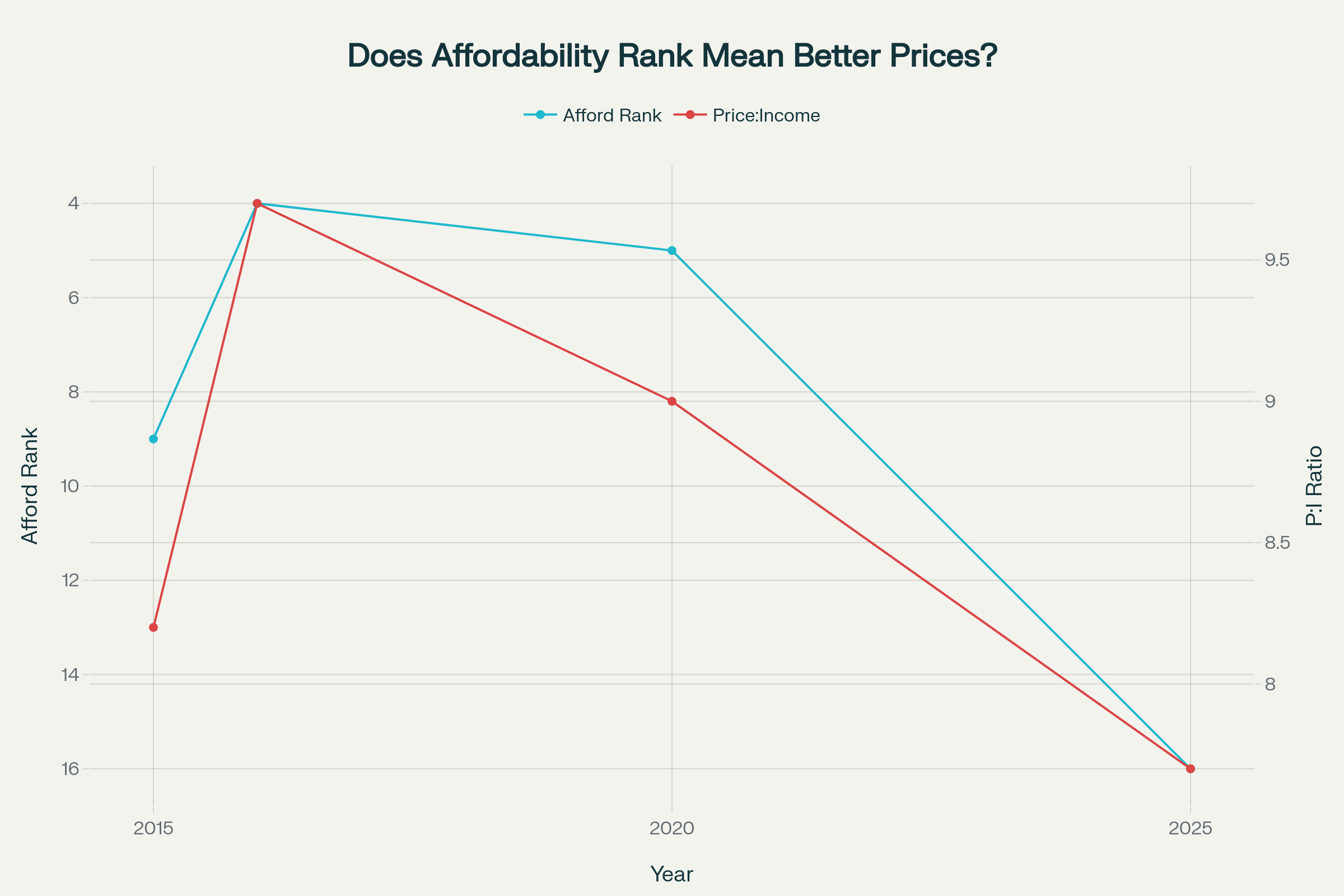
Auckland's housing affordability ranking improvement masks continued severe unaffordability with ratios far above sustainable levels
The Demographia methodology itself represents neoliberal ideology masquerading as objective measurement. The survey contains "significant biases and errors" and fails to account for crucial affordability factors like interest rates and transportation costs6. More fundamentally, Demographia's authors advocate for urban sprawl and oppose planning regulations that might protect indigenous lands or working-class communities7.
Ryan Greenaway-McGrevy's claim that Auckland has built "a hell of a lot of houses" through the Unitary Plan5 ignores who these houses are actually for. The 127,000 new dwelling permits he celebrates5 represent primarily market-rate housing that further displaces existing communities rather than addressing the needs of those most severely housing deprived.
The celebration of townhouses and apartments as "cheaper housing options"5 reveals the colonial mindset that equates cramming people into smaller spaces with solving affordability. This densification strategy has systematically targeted low-income communities while high-income neighbourhoods remain "protected under heritage rules"8.
The Hidden Reality: Māori Displacement and Dispossession
While economists celebrate statistical improvements, the lived reality for Māori reveals the true nature of Auckland's housing system. Māori make up 43 percent of Auckland's homeless population despite being only 11 percent of the region's total population9. Nationally, four out of five homeless women are Māori10, while only 27.5 percent of Māori own their own homes compared to 42.1 percent of non-Māori11.
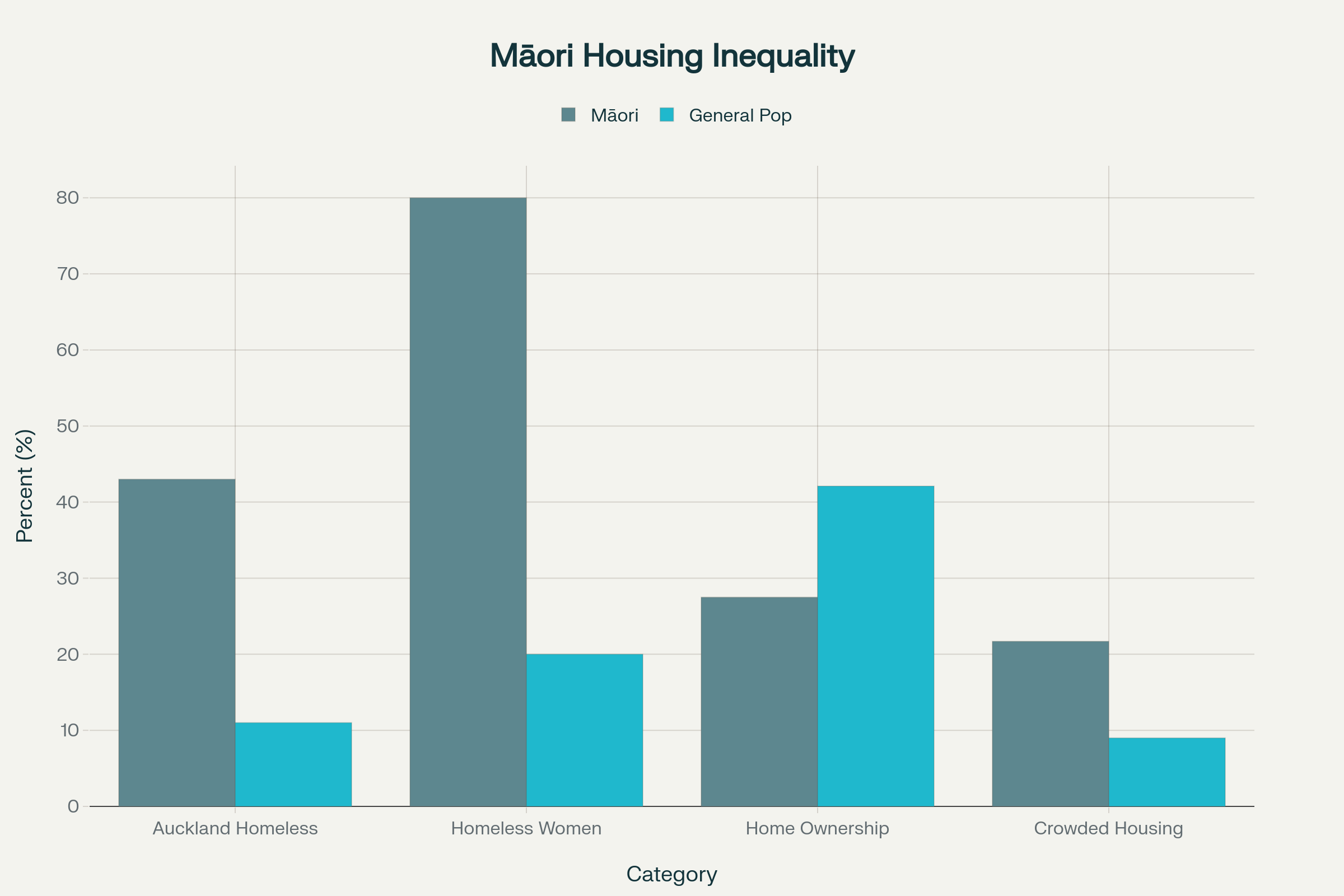
Stark disparities between Māori and general population housing outcomes reveal systemic inequality in New Zealand's housing system
These statistics represent more than housing market failure; they document ongoing colonial violence. The housing crisis is "due to a lack of societal resolution" and treating housing as "an investment rather than a human right"12. This commodification of shelter serves the settler colonial project by making indigenous peoples strangers in their own land.
The gentrification celebrated as "improvement" has devastated Māori and Pacific communities. Large-scale brownfield developments in Auckland "take place in neighbourhoods that rank highly in the index of relative deprivation"8, creating what researchers describe as "state-led gentrification with vast ramifications for low-income residents"8.
The Auckland Unitary Plan's removal of Māori cultural protections enables this dispossession. The Independent Māori Statutory Board appealed the plan specifically because it "rejected provisions that provided some protection to sites deemed to have value and significance to Māori"13. This systematic erasure of tangata whenua rights facilitates the conversion of ancestral whenua into speculative commodities.
Chris Bishop's Neoliberal Agenda
Housing Minister Chris Bishop emerges from this analysis as a key architect of neoliberal housing policy designed to serve developers and speculators at the expense of working-class communities. Bishop's plan to "flood the market with affordable land" involves removing council powers over urban boundaries and development standards14, effectively allowing developers to operate without community oversight.
The Minister's rhetoric about "decoupling housing from economic strength" quoted approvingly in the RNZ article5 represents standard neoliberal dogma that portrays speculation as economically neutral rather than a deliberate wealth transfer mechanism. Bishop has announced plans to give the government "power to override councils on housing" if their decisions might impact "economic growth, development or employment"15.
This centralisation of power serves corporate interests while undermining local democracy and indigenous rights. Bishop's policies represent "Wellington officials determining what is right for our area"16 and ignore community concerns about protecting fertile land and maintaining neighbourhood character.
The Speculative Economy Driving Inequality
The housing "success" celebrated in mainstream media depends entirely on a speculative economy that enriches property owners while impoverishing renters and would-be homeowners. Research shows that 97 percent of property speculators in Auckland don't earn cash returns equivalent to term deposits17, proving they invest solely for tax-free capital gains.
This speculation has created a "wealthy hand-to-mouth" class of property owners who appear affluent but are actually vulnerable to economic downturns18. Meanwhile, rising house prices have made inequality worse by shutting low and middle-income earners out of the property market19.
The banking sector plays a crucial role in facilitating this exploitation. Banks "aid and abet housing speculation" by providing easy credit to property investors while viewing residential investment as "extremely safe"3. This creates a feedback loop where speculation drives up prices, making it impossible for working families to compete.
Gentrification as Colonial Violence
The densification and "improvement" celebrated in Auckland represents a sophisticated form of colonial violence that displaces existing communities while enriching developers and property speculators. Gentrification "begins with the disinvestment of capital" and creates "economic rewards based on private ownership of housing for profit"20.
Research on Glen Innes reveals how this process operates in practice. The "rebranding" of the area involves "large numbers of low-income tenants, including many Māori and Pacific people, being moved out, passed on, and in the case of many elderly, passed over"20. This constitutes what geographer David Harvey calls "accumulation by dispossession."
The impacts extend far beyond individual displacement. Gentrification pressure results in "a loss of housing options for growing sections of the community" and "effects on the psychological health and support networks of displacees"21. For Māori, this represents a continuation of historical land confiscation through market mechanisms.
Broader Implications for Tāmaki Makaurau
The housing "success" narrative serves to legitimise a fundamentally unjust system while obscuring its colonial foundations. The property bubble has "produced profound impacts on New Zealand society" with home ownership dropping from 74% to 65% between 1986 and 201322. Current trends suggest homeownership will fall below 50 percent within 25 years23.
This transformation creates what economists call a "rental society" dominated by corporate landlords and property speculators. For Māori, this represents a return to conditions resembling the colonial period when Māori faced discrimination from landlords and difficulty accessing private housing24.
The celebration of statistical improvements in affordability rankings masks the ongoing crisis facing working-class families. Even with recent changes, house-price-to-income ratios remain "worse than at any time prior to 2016"5, while experts acknowledge Auckland is "nowhere near affordable"5.
The narrative of Auckland's housing affordability "improvement" represents a carefully constructed fiction designed to serve the interests of property speculators, developers, and the settler colonial state. While economists celebrate moving from impossibly unaffordable to merely severely unaffordable, Māori and working-class communities continue to face displacement, homelessness, and exclusion from their ancestral whenua.
This crisis demands recognition that housing policy in Aotearoa operates as a continuation of colonial dispossession. The Auckland Unitary Plan, far from representing progress, systematically removed Māori rights and cultural protections to facilitate speculative development. Minister Chris Bishop's neoliberal agenda promises to accelerate this dispossession by overriding local democracy and community opposition.
True housing justice requires dismantling the speculative economy that treats shelter as a commodity rather than a human right. This means confronting the banking sector's role in facilitating speculation, implementing genuine affordability measures based on need rather than market forces, and centering indigenous rights in all housing policy.
The alternative to this colonial neoliberal system already exists in Māori housing traditions based on collective ownership, environmental sustainability, and community wellbeing. Papakāinga development and iwi-led housing initiatives point toward housing systems that serve people rather than profit.
For those who find value in exposing these colonial and neoliberal narratives, I humbly ask you to consider a donation or koha to support this mahi. The account details are HTDM: 03-1546-0415173-000. I understand these are challenging economic times for whānau, so please only contribute if you have the capacity and wish to do so.
Māori housing justice is not a statistical improvement in affordability rankings. It is the restoration of tangata whenua rights to their ancestral whenua and the recognition that decent shelter is a fundamental human right, not a speculative commodity.
Kia kaha.
Ivor Jones
The Māori Green Lantern
References