
“Australian High Court Victory Exposes the Racist Sham of Crown Land "Ownership"“ - 3 September 2025
Paddington Bowling Club Win Reveals How White Capital Fights Indigenous Rights With Million-Dollar Legal Wars
Kia ora koutou katoa (Greetings to you all).
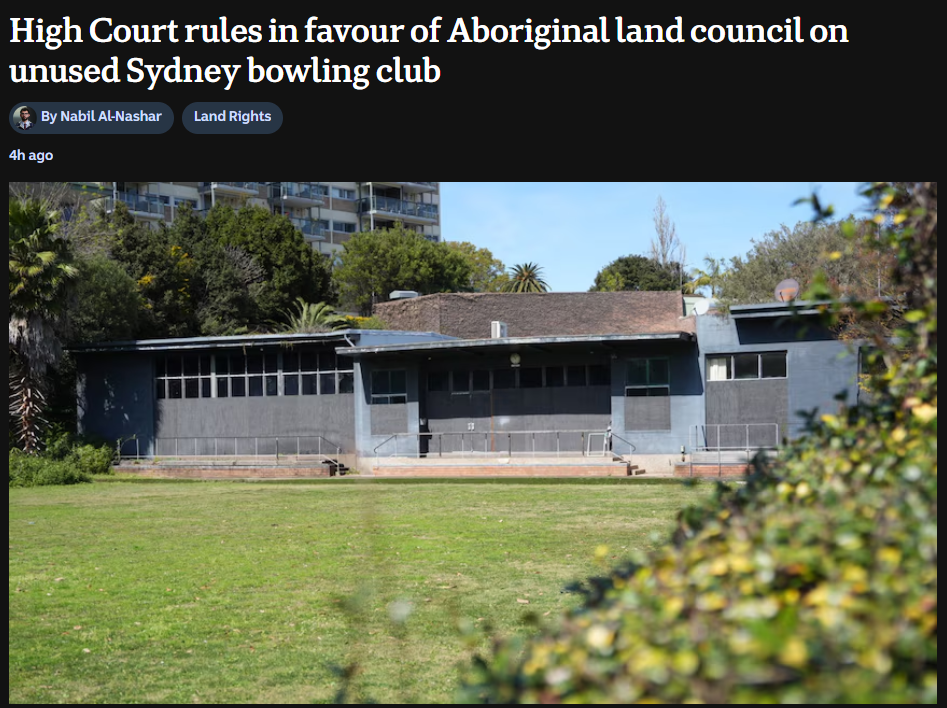
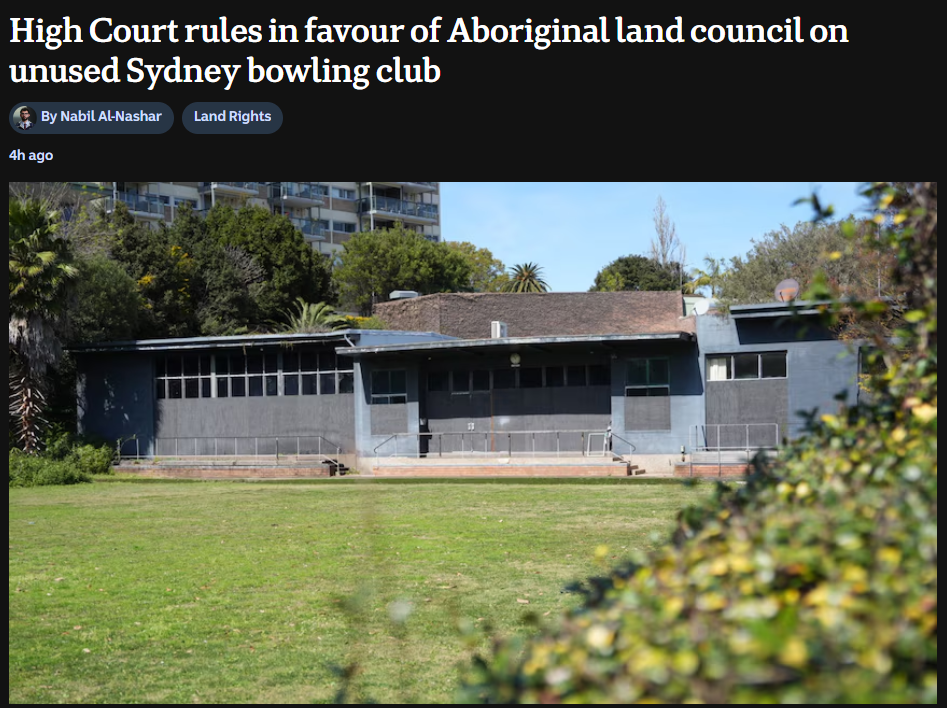
The corporate vultures who feast on stolen Aboriginal land just got served a brutal reality check by the High Court of Australia, and the entitled tears are flowing like a burst water main. After fifteen years of legal warfare costing millions, the La Perouse Local Aboriginal Land Council has finally reclaimed the abandoned Paddington Bowling Club site, exposing the racist foundations of Australia's property system and the neoliberal machinery that protects white wealth at every turn.
This victory isn't just about one bowling club – it's about dismantling the colonial fiction that Crown "ownership" of Indigenous land is legitimate, and revealing how the capitalist legal system weaponizes technicalities to deny justice to First Nations people while protecting corporate profits.
Background - The Stolen Land Industrial Complex
To understand this victory, we must first acknowledge what the white establishment desperately tries to hide: every square meter of Australian soil is stolen Aboriginal land, held through the violence of colonialism and maintained through the violence of capitalism. The Aboriginal Land Rights Act 1983 was created not from generosity, but as damage control – a pathetic attempt to compensate for two centuries of genocide, dispossession, and cultural destruction.
The Act allows Aboriginal Land Councils to claim Crown lands that are unused, but the process is deliberately designed to favor the colonizer. Since 1983, Aboriginal people have lodged nearly 55,000 land claims across NSW, yet only received 168,438 hectares – a pathetic 0.2% of the state. Meanwhile, over 38,000 claims remain undetermined, creating a bureaucratic purgatory that serves the colonial state perfectly.
The La Perouse Local Aboriginal Land Council, established in 1984 as one of the founding land councils, represents the community at Kamay (Botany Bay) – the very place where Captain Cook's invasion began in 1770. The bitter irony that this community had to fight through white courts for fifteen years to reclaim a tiny piece of their ancestral country speaks volumes about Australia's commitment to "reconciliation."
When Corporate Greed Meets Indigenous Rights
The Paddington Bowling Club case perfectly illustrates how neoliberal capitalism and white supremacy work hand-in-hand to deny Indigenous rights. The site was leased to Paddington Bowling Club in 2010 for 50 years at the bargain rate of $52,000 annually, but the club ceased operations in 2015, leaving the valuable inner-Sydney site deliberately derelict.
Rather than return unused Crown land to its traditional owners as the law intended, the site was transferred to Quarry Street Pty Ltd, a company with connections to controversial businesswoman Jan Cameron. Cameron, formerly Australia's fourth-richest woman and founder of Kathmandu, was convicted in 2023 for failing to disclose share purchases worth $14 million and sentenced in 2024.
The corporate strategy was transparent: warehouse the land while fighting Aboriginal claims through every possible legal avenue, burning millions in legal fees rather than accept Indigenous rights. When the NSW Aboriginal Land Council lodged their claim in 2016, the company immediately began a scorched-earth legal campaign that would span nearly a decade.
This matters to Māori because it exposes the same colonial playbook used across the Pacific – tie Indigenous communities up in endless legal battles, drain their resources, and protect white capital at all costs. The parallels to New Zealand's foreshore and seabed theft, the Marine and Coastal Area Act, and ongoing Treaty settlement delays are unmistakable.
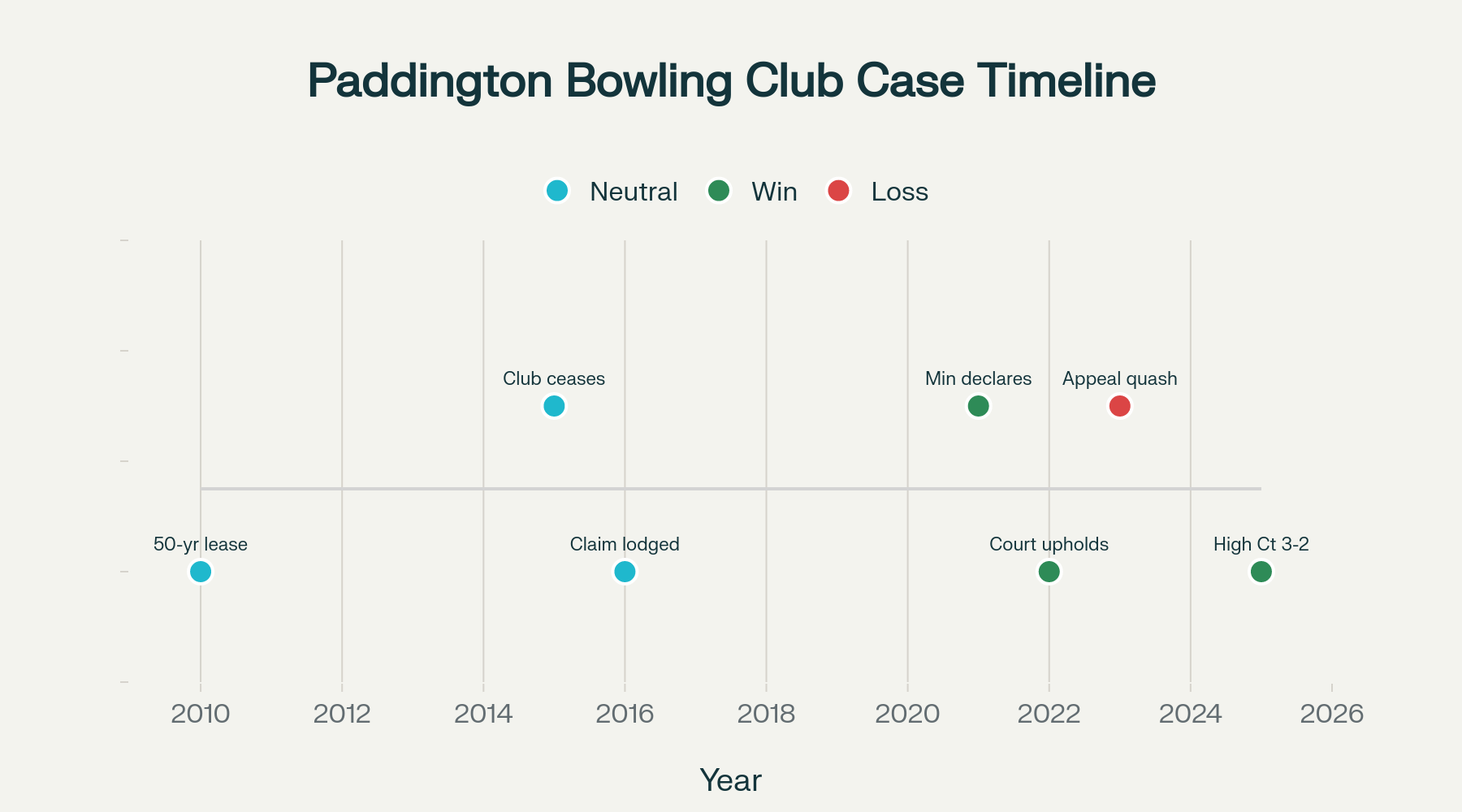
Legal Timeline: Paddington Bowling Club Land Rights Battle (2010-2025)
Corporate Colonialism and the Weaponization of "Use"
The central legal question became a masterclass in colonial gaslighting: what constitutes "use" of Crown land? Under Section 36 of the Aboriginal Land Rights Act, land cannot be claimed if it is "lawfully used or occupied". The corporate defenders argued that simply paying rent – $52,000 annually on land worth millions – constituted "use," even while the site rotted unused for a decade.
This argument reveals the fundamental racism embedded in Australian property law. For Aboriginal people, "use" means spiritual connection, cultural practice, caring for country, and maintaining relationships with ancestral lands spanning 65,000 years. For white corporations, "use" apparently means paying a token rent while deliberately neglecting a site to prevent community access.
The High Court's majority – Chief Justice Stephen Gageler, Justice Jayne Jagot, and Justice James Edelman – correctly identified this racist double standard. They ruled that "use" must mean "substantive physical use of the land," not merely holding a lease. The dissenting justices Michelle Gordon and Simon Steward, predictably, sided with the corporate interests.
The decision exposes how the legal system has been deliberately structured to protect white capital. Planning Minister Rob Stokes's 2021 determination that the land was "claimable" was immediately challenged by Quarry Street Pty Ltd, which took the matter through every available court. When the Land and Environment Court upheld Stokes's decision, the company appealed to the NSW Court of Appeal, which shamefully reversed the decision in 2023.

Abandoned Paddington Bowling Club showing years of deliberate neglect by corporate leaseholder
The pattern is always the same: Aboriginal communities win at lower courts based on evidence and law, then corporate interests use their superior resources to appeal until they find sympathetic judges willing to prioritize property rights over human rights. It took the highest court in Australia to finally deliver justice, and even then only by a 3-2 margin.
Hidden Networks of Neoliberal Extraction
The Paddington case reveals the intricate web of corporate interests, political connections, and legal strategies that protect white wealth while denying Indigenous rights. Rob Stokes, the planning minister who declared the land claimable in 2021, was no progressive hero – he was a Liberal Party politician who lost the leadership race to Dominic Perrottet in October 2021.
Stokes's decision came during the dying days of the Gladys Berejiklian government, which collapsed amid ICAC corruption investigations. The timing wasn't coincidental – progressive decisions on Aboriginal land rights are often made by outgoing conservative governments as political cover, knowing the legal battles will outlast their tenure.
The connection to Jan Cameron reveals another layer of corporate colonialism. Cameron's business empire, built on outdoor equipment marketed to wealthy white adventurers, collapsed spectacularly in 2012 with $165 million in debts to unsecured creditors. Yet somehow, she or her associated companies maintained control over prime Sydney real estate while fighting Indigenous land rights.
The site's history stretches back to 2008, when a NSW Liquor and Gaming Authority inquiry investigated corruption allegations involving the bowling club. Despite these corruption findings, the Crown Lands Department quietly transferred control to CSKS Holdings, connected to the Sanchez family with their own controversial development history.

High Court of Australia where Aboriginal land rights finally achieved justice
This network of corporate failures, corruption allegations, and political connections protecting a derelict site while Aboriginal people fought for justice encapsulates everything wrong with Australia's property system. The same patterns repeat across Indigenous communities worldwide – corporate interests use legal warfare to exhaust Indigenous resources while protecting stolen wealth.
The Neoliberal Assault on Indigenous Rights
This case must be understood within the broader context of neoliberalism's assault on Indigenous rights. Since the 1980s, neoliberal governments have prioritized market-oriented reforms, privatization, and deregulation – policies that inevitably harm Indigenous communities. Crown land privatization serves the dual purpose of generating government revenue while permanently removing land from potential Aboriginal claims.
The Aboriginal Land Rights Act itself was a compromise designed to appear progressive while maintaining white control. The legislation only applies to Crown land, not the vast private estates stolen during colonization. It requires land to be "unused" – a standard that mysteriously doesn't apply to white farmers who receive millions in drought subsidies for barely productive land, or mining companies that destroy country while paying minimal royalties.
The 38,257 undetermined claims represent a bureaucratic bottleneck that serves the colonial state perfectly. The Auditor-General noted in 2022 that at current processing rates, it would take 22 years to resolve the backlog – a deliberate strategy to outlast claimants and protect Crown assets.
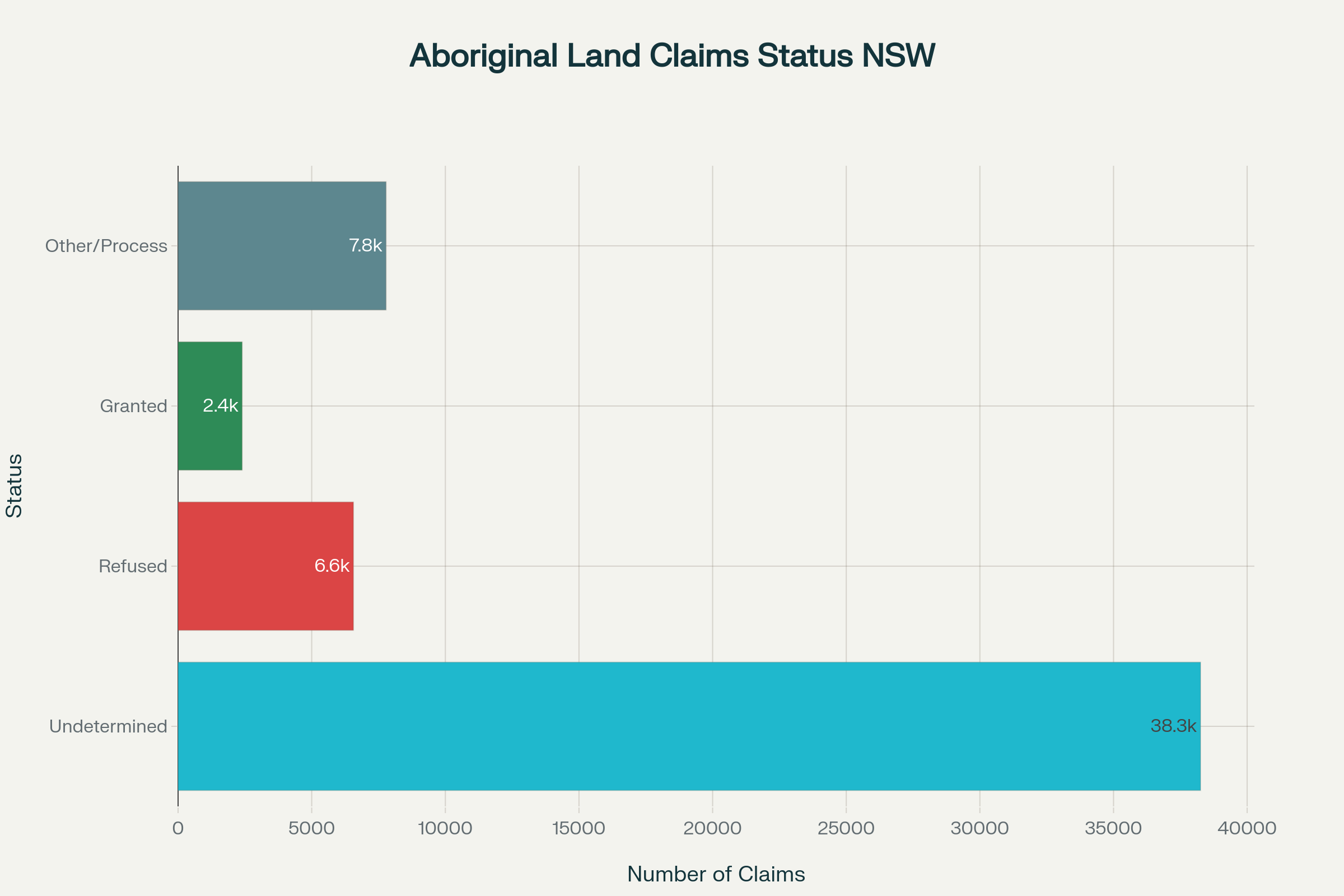
Aboriginal Land Claims Status and Land Return Statistics for NSW under the Aboriginal Land Rights Act 1983
The financial disparities tell the story. While Aboriginal communities fight for scraps, corporate interests spend millions on legal fees to deny them basic justice. The recent Gumatj Clan victory in the High Court, securing potential $700 million compensation for mining damage, represents one of the first substantial awards after decades of tokenistic compensation.
Revolutionary Implications for Indigenous Rights
NSW Aboriginal Land Council chair Raymond Kelly correctly identified this as "a win for common sense and justice for Aboriginal people" that "sends a message right across the country". The decision establishes crucial precedent that mere rent payment cannot constitute "use" of land, potentially accelerating the resolution of thousands of outstanding claims.
The ruling specifically undermines the Court of Appeal's 2023 decision that "lawful use" could be established simply through lease agreements. This colonial interpretation would have rendered the Aboriginal Land Rights Act meaningless, allowing any corporation to warehouse Crown land indefinitely while paying token rent.
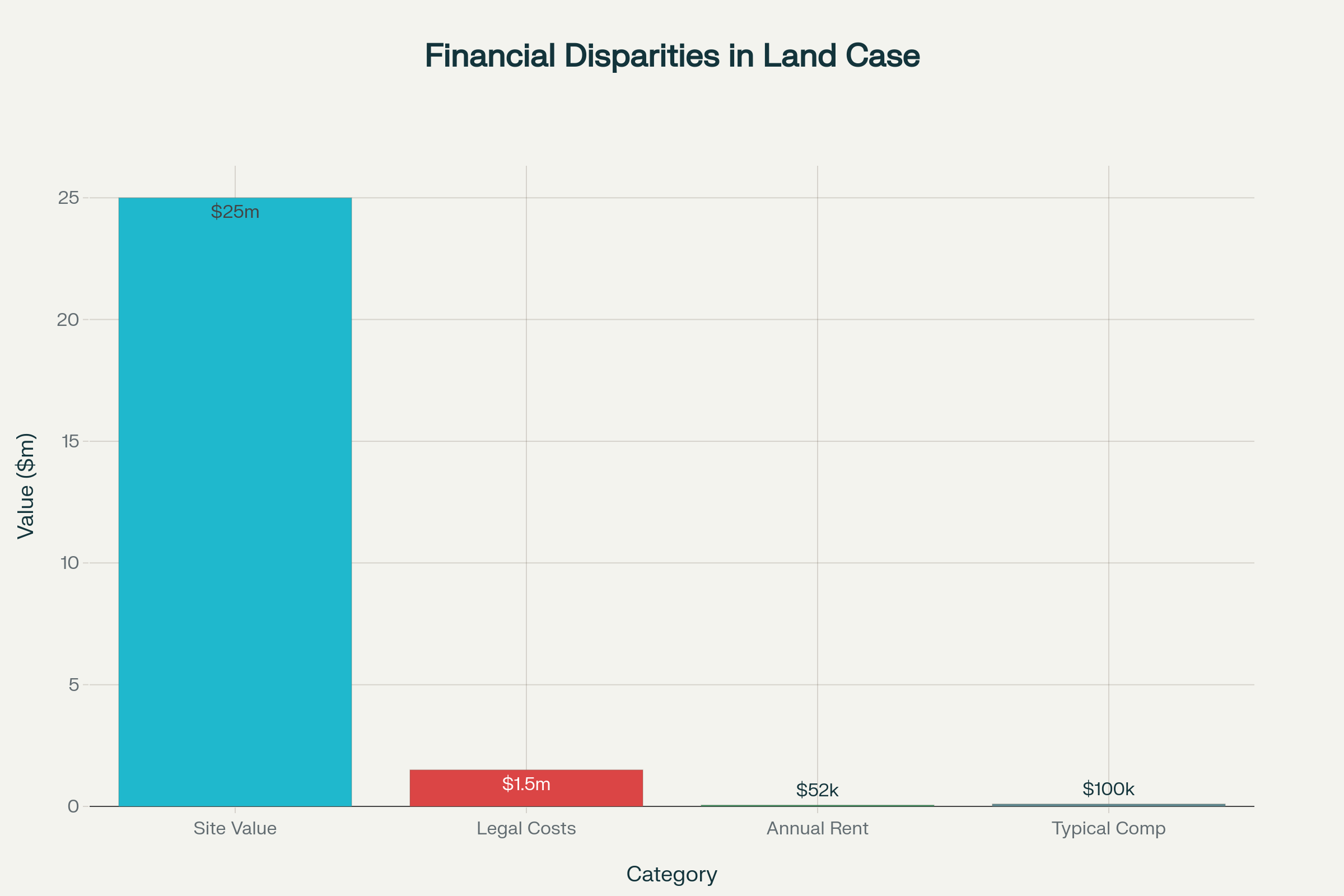
Financial Stakes in Paddington Bowling Club Dispute - Millions at Stake vs Minimal Aboriginal Compensation
For Māori communities watching from across the Tasman, this victory provides tactical lessons for challenging similar colonial strategies. The emphasis on "substantive physical use" aligns with Indigenous concepts of kaitiakitanga and connection to whenua that transcend Western property concepts. The decision validates what Indigenous communities have always known – that spiritual and cultural connection to land represents the deepest form of "use."
Independent MP Alex Greenwich's support demonstrates rare political courage, though his celebration that "this site has been disrespected by the current leaseholders and left derelict for far too long" understates the deliberate strategy involved. This wasn't neglect – it was economic warfare against Indigenous communities.
The Broader War Against Indigenous Sovereignty
The Paddington victory occurs against a backdrop of escalating attacks on Indigenous rights across Australia. Far-right campaigns against Voice to Parliament, co-governance arrangements, and treaty processes reveal how white supremacists mobilize economic fear-mongering to protect colonial structures. The "one law for all" rhetoric deliberately obscures how current laws were designed by and for white colonizers.
The 30,000 undetermined Aboriginal land claims across NSW represent a massive transfer of wealth that terrifies the establishment. Each successful claim removes valuable real estate from potential privatization and corporate exploitation, explaining why governments deliberately underfund the claims process.
The international context matters. Across the Pacific, similar legal battles are expanding Indigenous rights, from Whanganui River personhood to massive compensation awards like the Nelson Tenths case potentially worth billions. The colonial establishment recognizes these victories threaten the entire foundation of their wealth accumulation.

La Perouse Local Aboriginal Land Council members celebrating their historic High Court victory

The Māori Green Lantern Fighting Misinformation And Disinformation From The Far Right
Justice Delayed But Not Denied
The Paddington Bowling Club victory exposes the fundamental contradictions of Australian colonialism. For fifteen years, corporate interests spent millions fighting Aboriginal communities for the right to warehouse unused land while denying its traditional owners basic justice. The High Court's 3-2 decision – razor-thin even at the highest level – reveals how deeply embedded white supremacy remains within the legal system.
The victory validates Raymond Kelly's observation that this represents "common sense and justice", but the broader war continues. With 30,000 undetermined claims potentially accelerated by this precedent, the colonial establishment will undoubtedly develop new strategies to protect their stolen wealth.
For Indigenous communities across the Pacific, this victory demonstrates the power of sustained legal resistance combined with community organizing. The La Perouse Local Aboriginal Land Council's fifteen-year battle proves that colonial courts can occasionally deliver justice, though always grudgingly and at enormous cost to Indigenous communities.
The fight for land rights remains inseparable from the broader struggle against neoliberal capitalism and white supremacy. Every successful Indigenous land claim chips away at the colonial foundation of extraction and exploitation that defines settler societies.
As we celebrate this victory, we must remember that true justice requires the complete dismantling of colonial property relations and the restoration of Indigenous sovereignty. The High Court gave back one small piece of stolen country – the real work of decolonization continues.
Ngā mihi nunui ki a koutou katoa (Great thanks to you all).
The Māori Green LanternIvor Jones, Te Arawa/Ngāti Pikiao
Readers who find value in exposing colonial injustice and supporting Indigenous rights are invited to consider a koha/donation: HTDM: 03-1546-0415173-000. The MGL understands these tough economic times for whānau, so please only contribute if you have capacity and wish to support the cause of truth and justice.