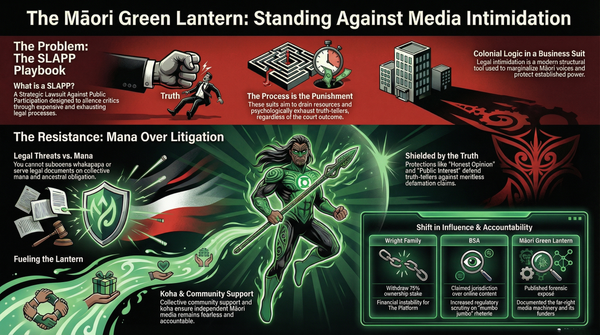
"Back to Basics, Back to Brutality: How a "Hodgepodge" of Bills Became the Most Coordinated Assault on Māori Rights, Workers, and Democracy in a Generation" - 13 February 2026
The coalition calls it "back to basics." Strip the euphemism and what remains is a legislative assembly line: each bill feeds the next, each deletion enables the next erasure, and by the time the House rises, the public service will serve the minister—not the people, not the Treaty, not the future.

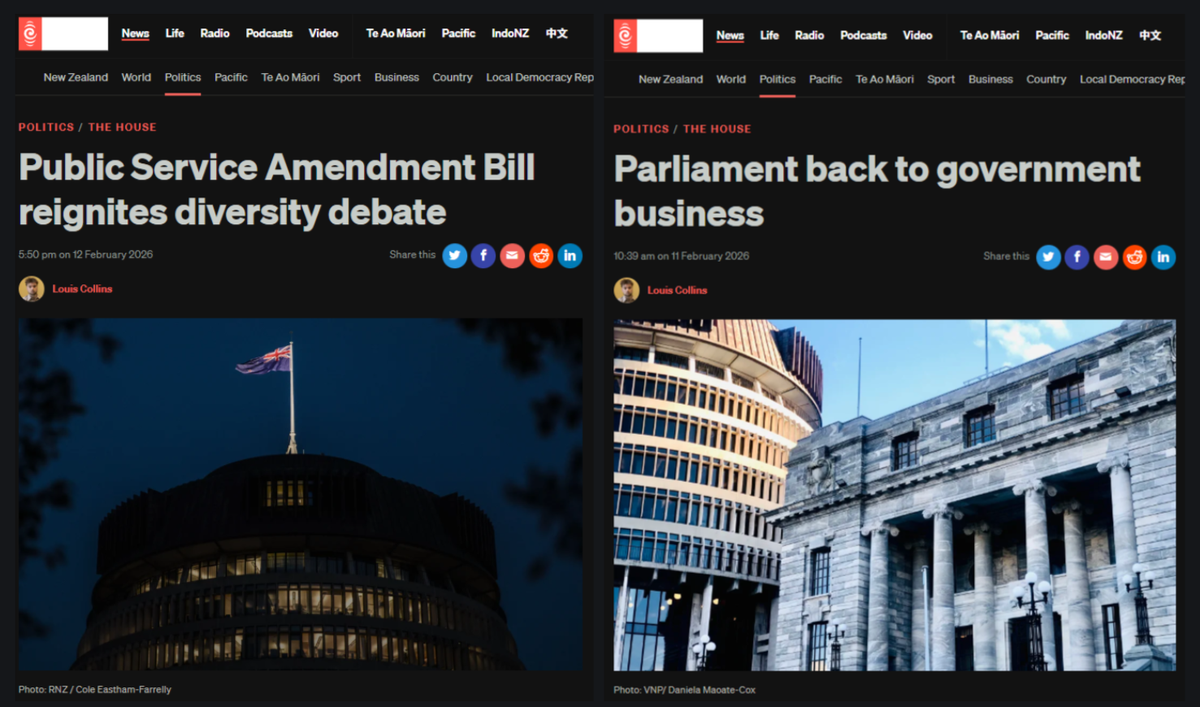
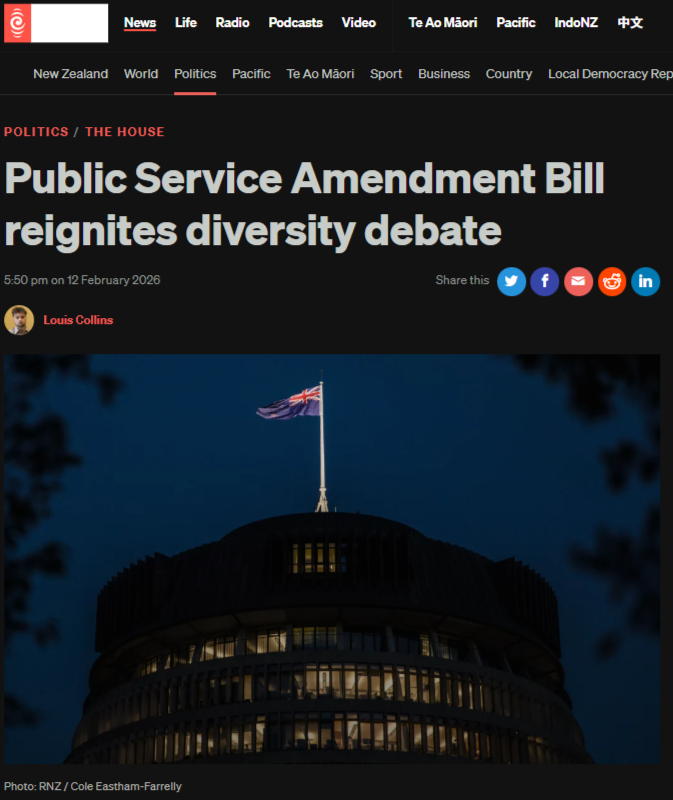
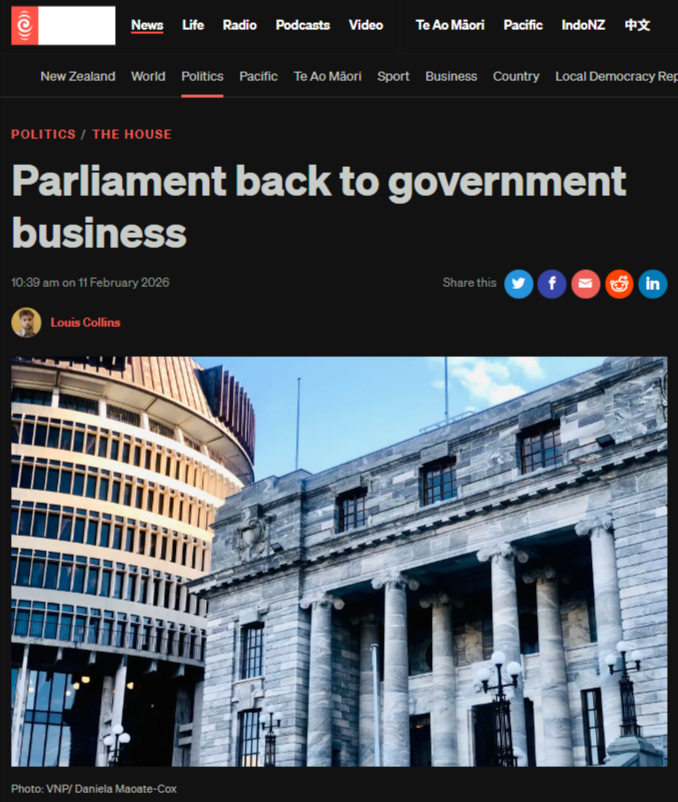
https://www.rnz.co.nz/news/political/586460/parliament-back-to-government-business; https://www.rnz.co.nz/news/political/586699/public-service-amendment-bill-reignites-diversity-debate
Mōrena Aotearoa,
The Hodgepodge Is the Programme
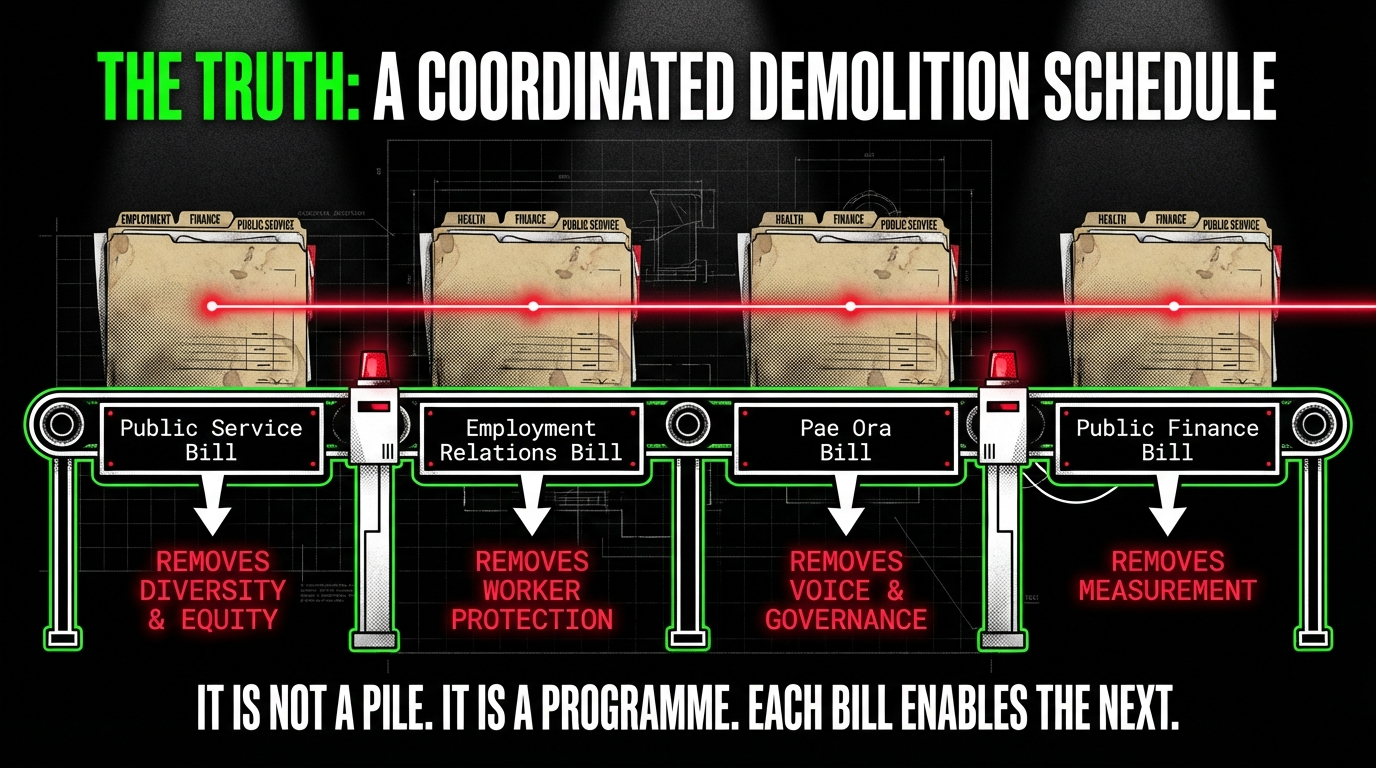
RNZ describes the parliamentary sitting week as "a hodgepodge of bills at different stages of their legislative journey"—and that innocuous framing is the first act of political camouflage. This is not a miscellaneous pile. It is a coordinated demolition schedule. Line up the bills and the through-line screams:
- The Public Service Amendment Bill: strips diversity obligations, pay equity, long-term insights, and hands chief executive appointments to ministers.
- The Employment Relations Amendment Bill: introduces a salary threshold for personal grievance claims, scraps the 30-day rule protecting new employees under collective agreements, and guts contractor protections—all three opposition parties strongly opposed.
- The Pae Ora (Healthy Futures) Amendment Bill: restructures Health New Zealand with "all three opposition parties opposed, citing particular concerns about the role of Māori voices in the health sector".
- The Public Finance Amendment Bill: removes the requirement for Treasury to produce a wellbeing report—the only legislative mechanism forcing government to account for whether spending actually improves lives.
- The Health and Safety at Work Amendment Bill: "reduces the bureaucratic and financial burden on businesses associated with complying with regulations"—which is corporate for "less accountability when workers get hurt."
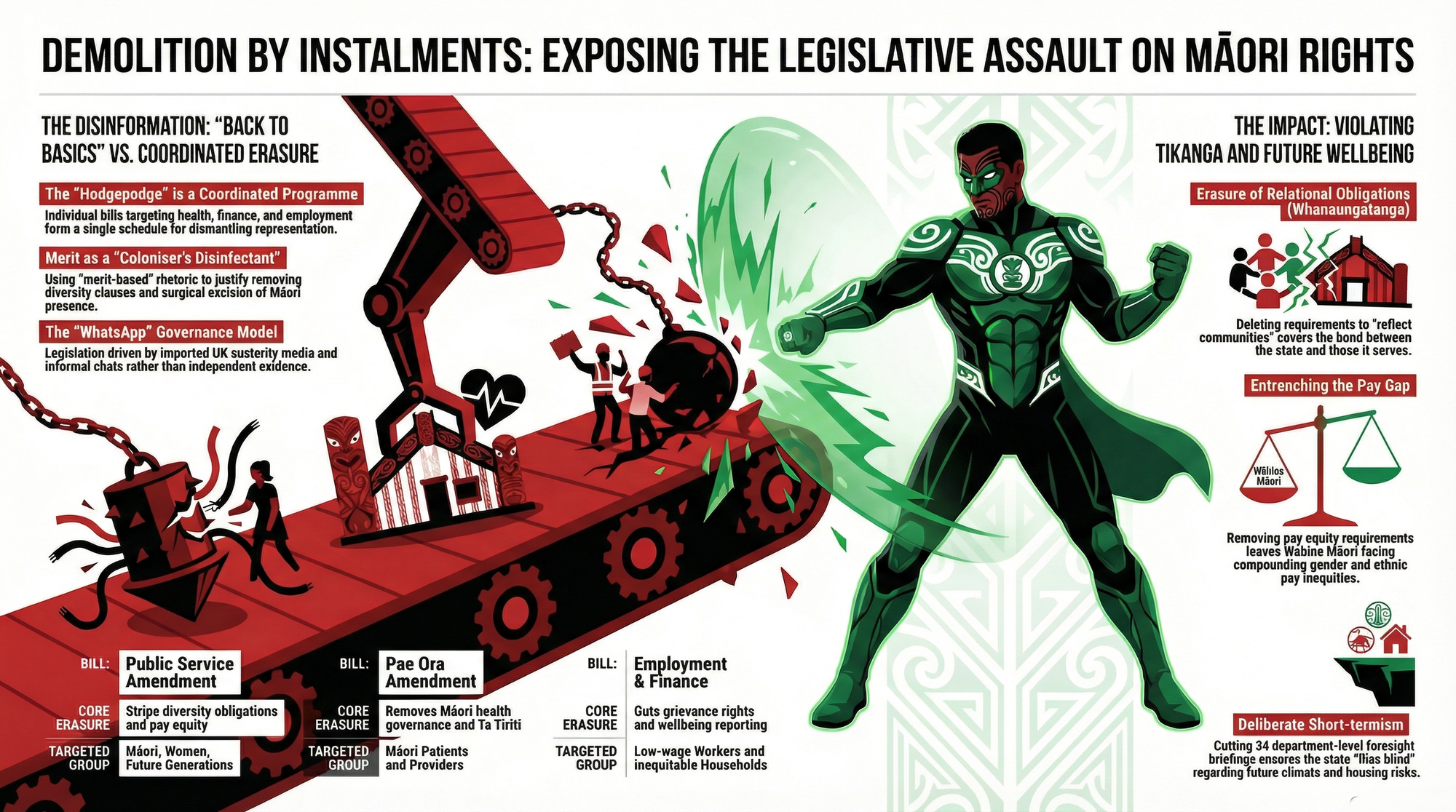
Each bill targets a different load-bearing wall of the same building: representation, accountability, equity, worker protection, Māori voice. RNZ reports them as separate legislative items. They are not. They are a single programme delivered in instalments.
How The Schedule Enables The Public Service Gutting
The first RNZ article is the logistics report: what's on the conveyor belt this week. The second RNZ article is the close-up on the most poisonous item coming off that belt: the Public Service Amendment Bill.
The connection is not incidental—it is architectural. Consider:
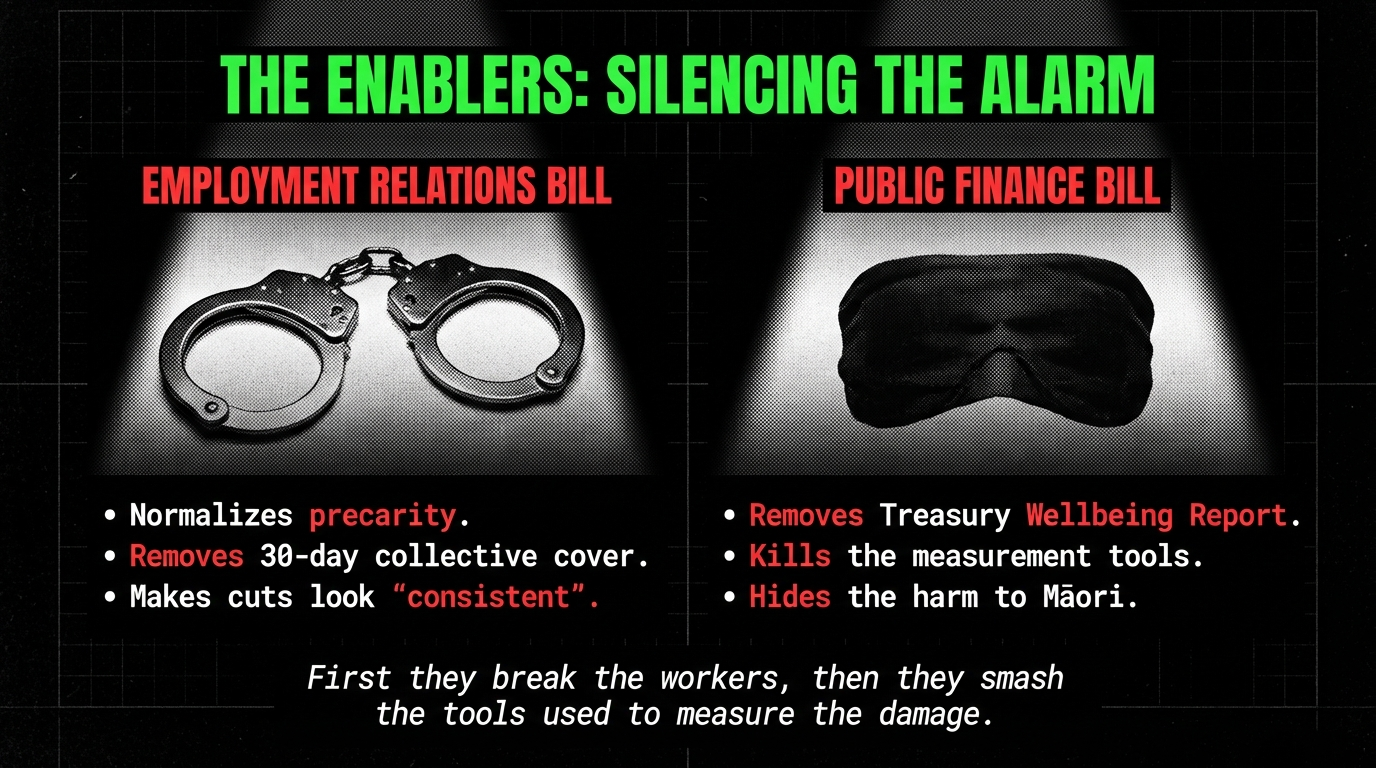
1. The Employment Relations Bill softens the ground the Public Service Bill ploughs. When you strip workers' grievance rights in the private sector (salary threshold for unjustified dismissal claims at $200,000, scrapping the 30-day rule), you establish a new baseline: work is precarious, employment is a privilege, and the employer—not the employee—holds the moral high ground. Once that logic is normalised, removing diversity and pay equity obligations from the public service doesn't look radical anymore. It looks like "consistency."
2. The Public Finance Bill kills the measurement the Public Service Bill makes irrelevant. The Public Service Amendment Bill removes long-term insights briefings from 34 departments, leaving only one from DPMC. The Public Finance Bill removes the wellbeing report from Treasury. Together, they ensure no one is required to measure whether these changes harm people—because the instruments of measurement are being dismantled alongside the obligations they track. As the NZ Council of Christian Social Services warned: "The removal of the wellbeing requirements reduces the visibility of the impacts of Government spending across different communities—particularly those experiencing inequity, such as Māori, Pasifika, disabled people, and low-income households".
3. The Pae Ora Bill mirrors the Public Service Bill—in health. The Public Service Bill strips "reflect the communities it serves" from the public service. The Pae Ora Bill strips Māori governance from the health system, reducing Iwi-Māori Partnership Boards to advisory roles and removing Te Tiriti obligations from health legislation. Opposition MPs called it "devastating" to Māori aspirations, and Dr Rawiri Keenan labelled it "ethnocide". The PSA's Kaihautū Māori, Janice Panoho, stated: "What they call 'streamlining' is in fact the deliberate sidelining of Māori voices from decisions about Māori health".
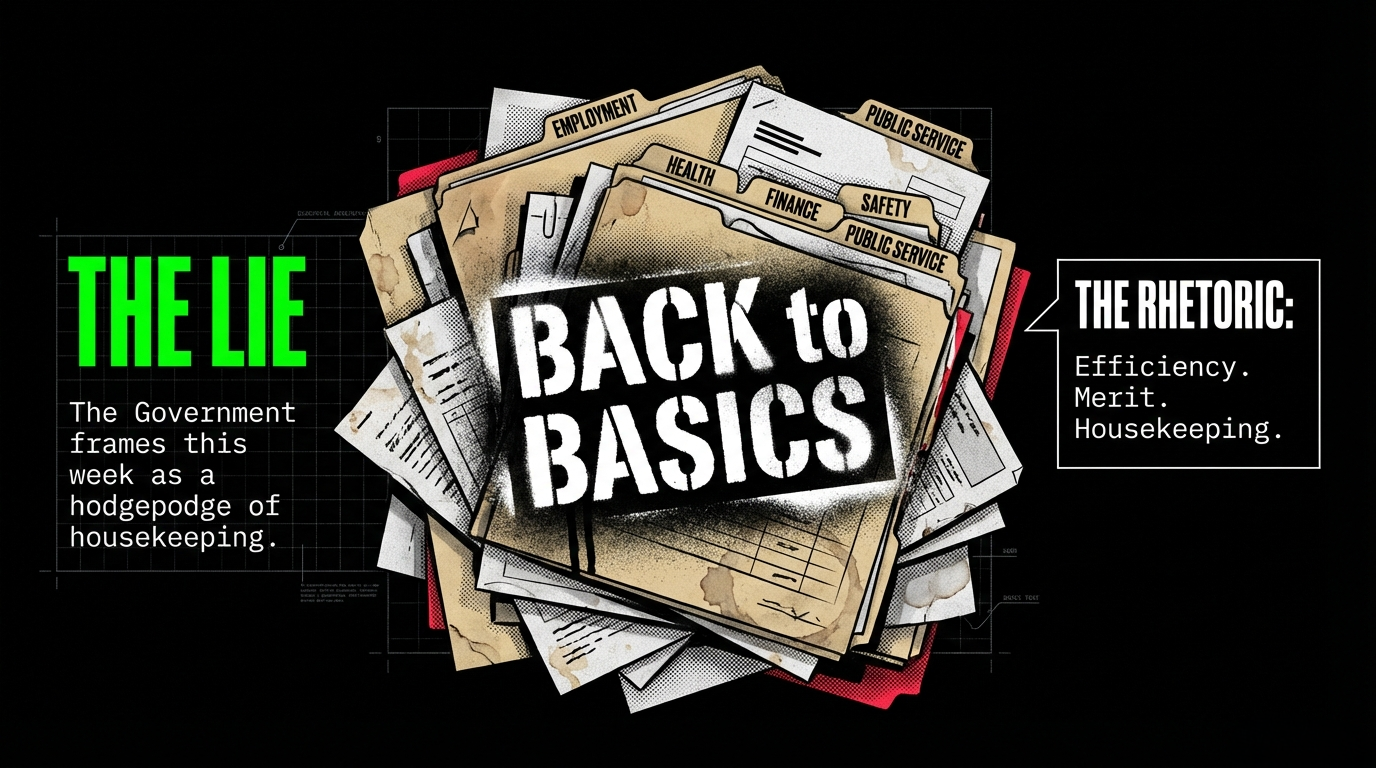
The pattern is identical across every bill: remove Māori-specific obligations, call it "neutrality." Remove equity mechanisms, call it "merit." Remove long-term accountability, call it "efficiency." The RNZ schedule article is the menu. The Public Service article is the main course. But you are meant to eat both without noticing they came from the same kitchen.
The Public Service Bill: A Legal Ritual of Erasure
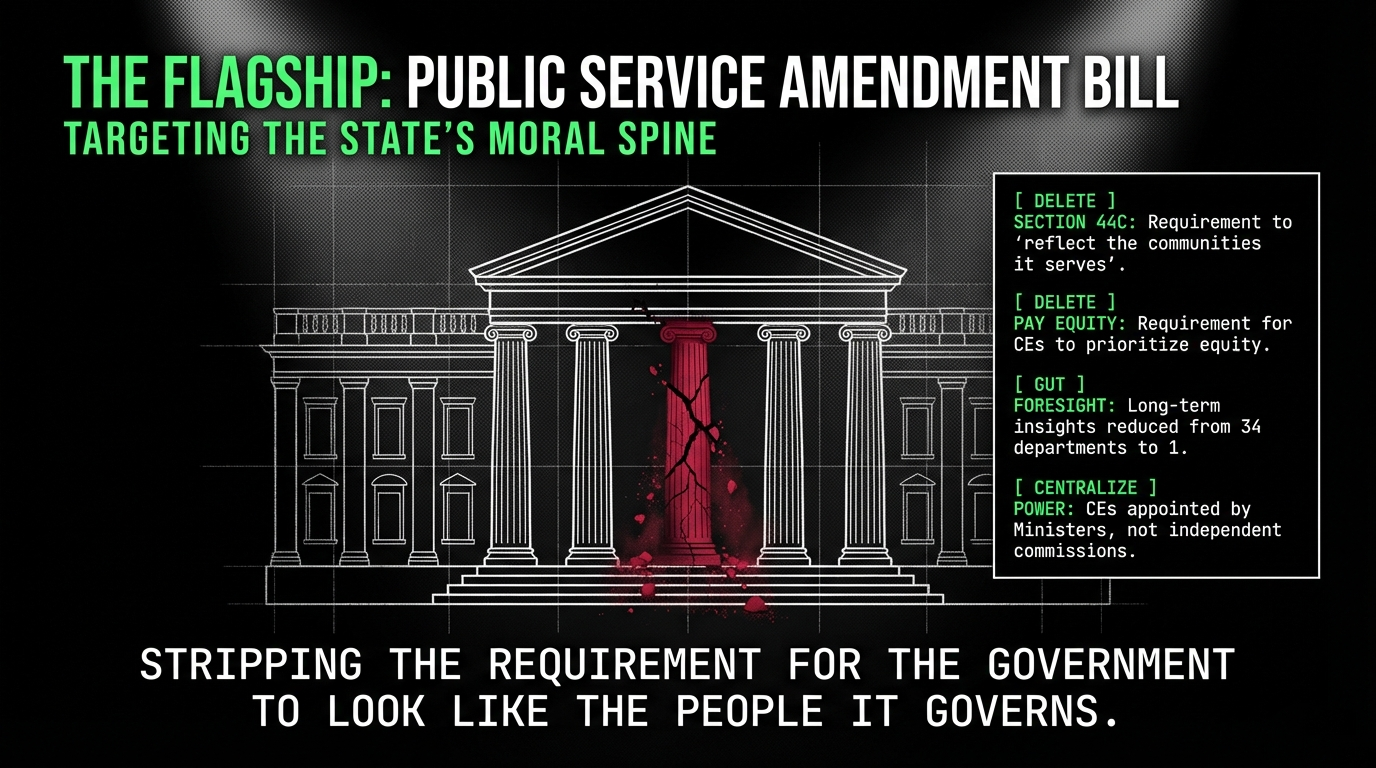
The Public Service Amendment Bill strips out four things simultaneously, and that simultaneity is the design:
Removing the requirement that the public service "reflect the communities it serves": The current Act (Section 44c) requires the Public Service Commission to "work with public service leaders to develop a highly capable workforce that reflects the diversity of the society it serves and to ensure fair and equitable employment." The bill replaces that with "work with public service leaders to develop a highly capable workforce and to promote the good employer requirements in this Act". The diversity clause—and the equity clause—are surgically excised.
Removing pay equity employment policy requirements: Chief executives will no longer be required to have employment policies recognising the importance of pay equity.
Gutting Long-term Insights Briefings: 34 departments lose the requirement to produce them. Only DPMC retains the obligation. The state loses its capacity for foresight across housing, health, climate, education, and Māori wellbeing.
Ministerial appointment of chief executives: CEs must reapply and be appointed by the relevant minister in office—a structural invitation to politicise the public service.
Judith Collins calls this "back to basics". Ayesha Verrall calls it what it is: "I could not think of a more limited, small-minded, managerial, hopeless vision of our democracy than this bill".
"Merit" as a Coloniser's Disinfectant
The coalition frames diversity as the enemy of merit—as if Māori presence in the public service can only be explained by cheating. The removal of diversity provisions was explicitly a coalition agreement between National and NZ First. NZ First's own bill text states its purpose plainly: amend Section 44 to "remove the Public Service Commissioner's duty to develop a workforce that reflects societal diversity" and repeal Section 75 entirely, which mandates promoting diversity and inclusiveness. Winston Peters frames this as the "war on woke".
Labour's Camilla Belich demolished the pretence at select committee: "There was not one single example that any of the advisers could give us as to a situation where someone hadn't been appointed on the basis of merit". Not one. The government is legislating against a phantom—and the real target is Māori presence.
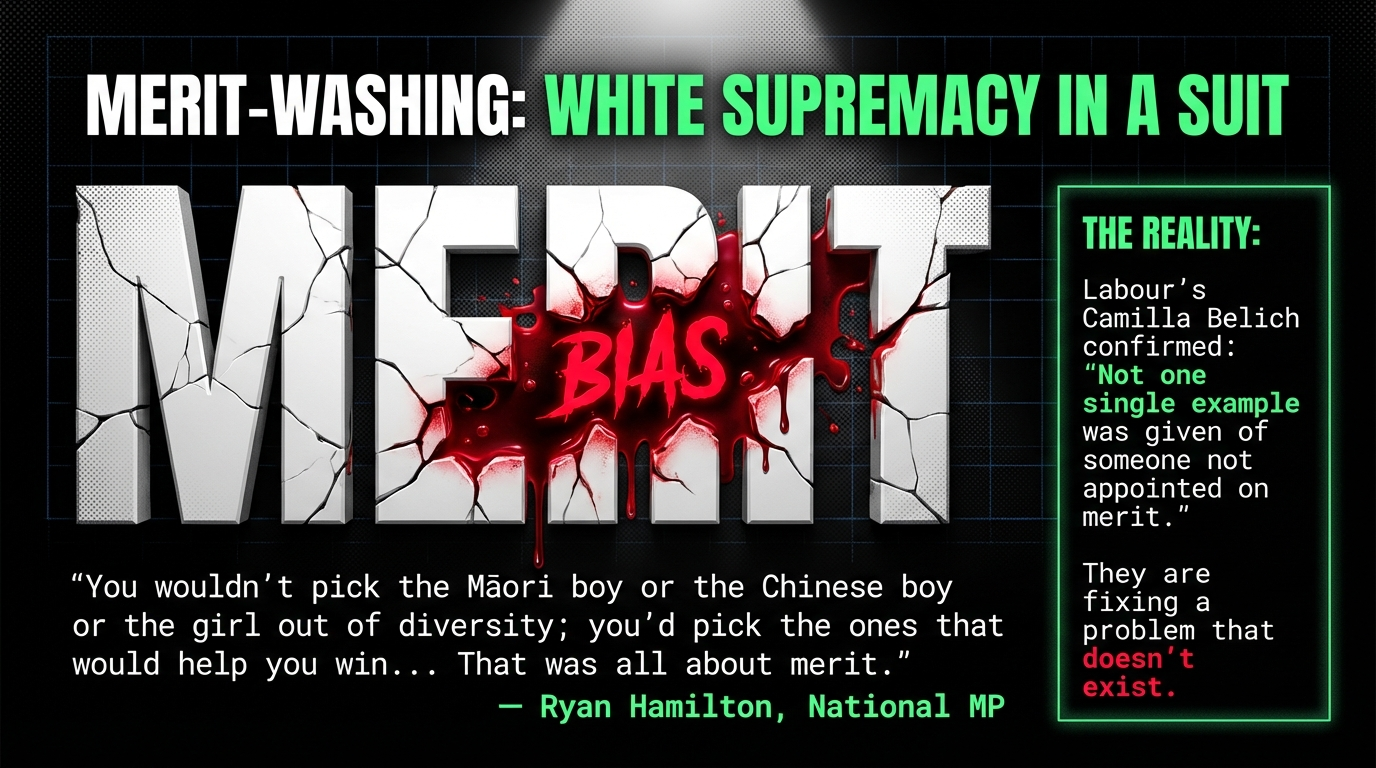
Then came National MP Ryan Hamilton's contribution to the second reading debate—a moment that should haunt every New Zealander who believes in basic dignity: "When I was at school and we'd play sports in primary school, you'd pick two captains organically amongst yourselves, and then you'd choose who you wanted on your team. You wouldn't pick the Māori boy or the Chinese boy or the girl out of diversity; you'd pick the ones that would help you win the game. That was all about merit".
Read that again. A sitting Member of Parliament—legislating changes to how the public service employs people—used a schoolyard analogy in which "the Māori boy," "the Chinese boy," and "the girl" are the examples of people you would not pick. This is not a gaffe. This is the ideology made audible. This is merit-washing: the conviction that the default human—the one you would pick—is white and male, and everyone else requires justification.
Even the Public Service Commissioner, Sir Brian Roche—who is no radical—has confirmed that all appointments were already merit-based: "that has never changed". Deputy PM Winston Peters suggested diversity quotas were affecting the public service; Judith Collins herself said "she was not aware of any". The government is passing a law to fix a problem its own minister says does not exist.
The Collins-Roche Axis: WhatsApp Governance
The leaked WhatsApp messages between Judith Collins and Public Service Commissioner Sir Brian Roche—obtained under the OIA and reported by NZ Herald—reveal the ideological pipeline behind the legislation. Collins sent Roche British Telegraph articles about "underperforming civil servants to be pushed out" under Keir Starmer's UK reforms. Roche replied: "This all makes a lot of sense and isn't too different from the situation we face".
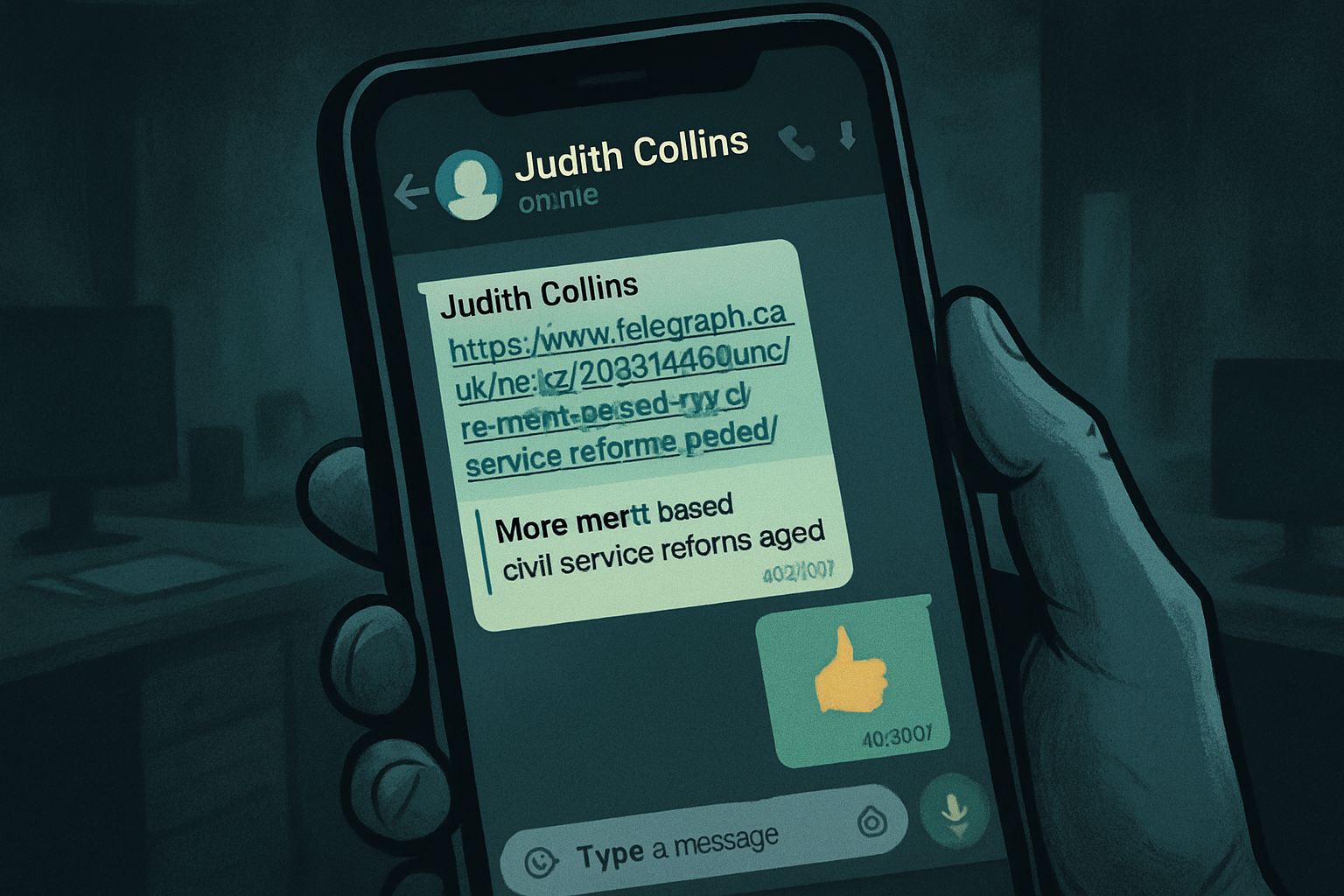
Collins suggested creating "a central registry of all employees and those working as consultants". She proposed embedding clauses in employment contracts to crack down on perceived inefficiency. The Commissioner—meant to be independent of political direction—gave her a thumbs-up.
This is not a minister asking for independent advice. This is a minister feeding UK austerity media to the Commissioner and receiving ideological alignment in return. The Public Service Amendment Bill didn't come from evidence. It came from a WhatsApp thread and imported Tory talking points.
The Coordinated Assault: Bill by Bill, Right by Right
Map the parliamentary sitting week against what it destroys:
This is not a hodgepodge. This is a programme. Every bill feeds the same logic: obligations to people are red tape; obligations to employers and ministers are governance.
Tikanga Impact: What the Western Mind Must Understand
Tikanga is not "diversity flavouring." It is an operating system—how relationships are ordered, how obligations are honoured, how power is restrained, how mana is upheld. When the Crown deletes "reflect the communities it serves" from statute, it is not being neutral—it is choosing whose humanity counts as "normal."
The Public Service Commission's own DEI guidance explicitly ties DEI to delivering for communities, representation, closing pay gaps (including Māori pay gaps), cultural competence, and celebrating tikanga and te reo Māori. The DEI progress update names representation and inclusion as essential to being equipped to engage with iwi and communities and to improving services and outcomes.
So the western translation is simple: imagine deleting "informed consent" from medical ethics, then claiming it is "back to basics." That is what this government does to tikanga-based obligations—removing the safety rails, then blaming the injured for bleeding.
Every bill in this parliamentary week violates foundational tikanga:
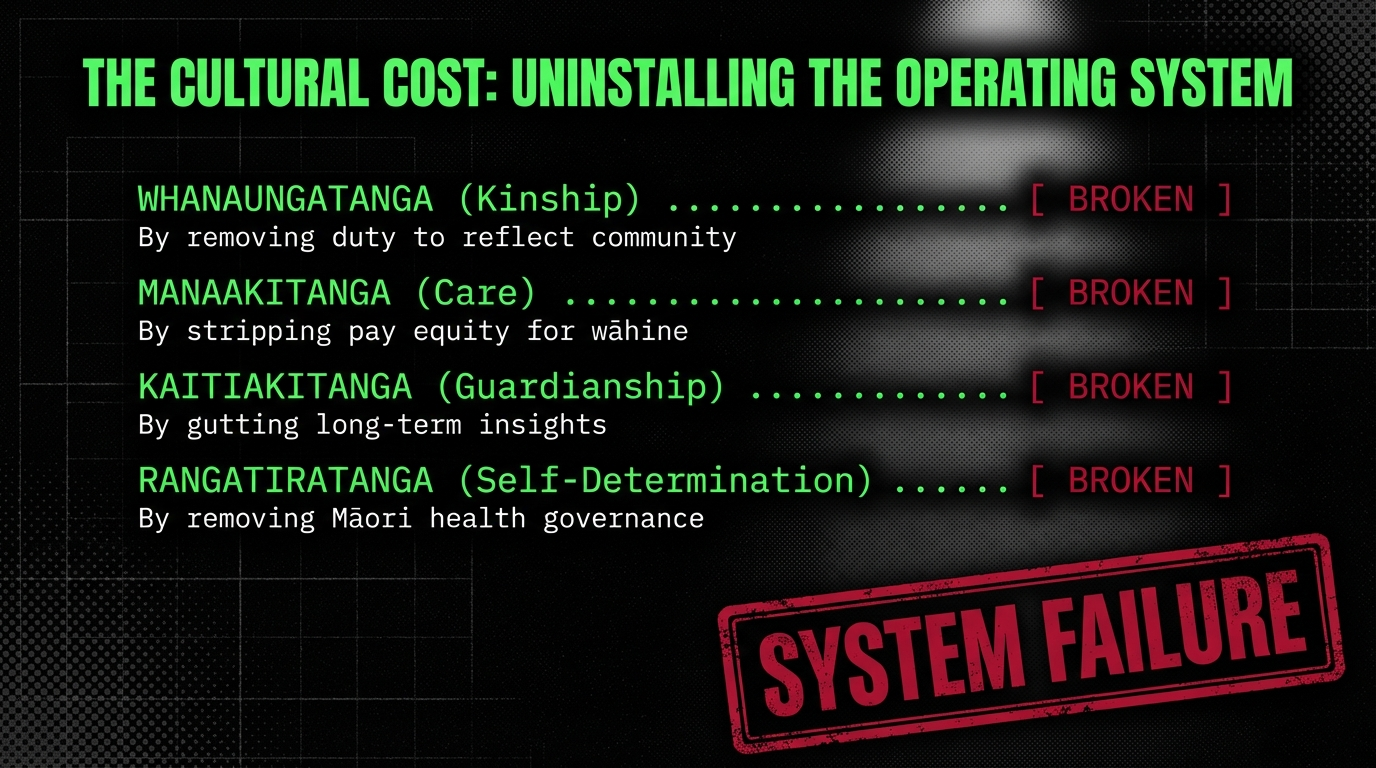
Whanaungatanga (Kinship): Removing "reflect the communities it serves" severs the relational obligation between state and people. The Employment Relations Bill severs the relational obligation between employer and worker. The Pae Ora Bill severs the relational obligation between health system and iwi.
Manaakitanga (Care and Respect): Stripping pay equity shows contempt for the mana of wāhine Māori and all women. Removing worker grievance rights shows contempt for the vulnerable.
Kaitiakitanga (Guardianship): Gutting long-term insights and wellbeing reporting abandons the state's kaitiaki duty to future generations.
Rangatiratanga (Self-Determination): Every bill in this sitting block reduces Māori authority—over health, over public service composition, over employment conditions.
Kotahitanga (Unity): The rhetoric of "merit vs. diversity" manufactures division. Ryan Hamilton's schoolyard analogy makes it explicit: in his world, the Māori boy is the one you don't pick.
Three Examples for the Western Mind
Example 1: "Reflect the Communities" → Worse Decisions, Worse Services
The Point: Removing the expectation of representation is a recipe for policy blind spots—because lived experience disappears from the room while decisions still target those communities.
Three Concrete Harms:
- The Commission's own DEI guidance links representation and inclusion to being better equipped to engage with iwi and communities. Delete the obligation, and you get a public service that designs Māori policy without Māori input—the very pattern the Waitangi Tribunal has condemned across health, education, and child protection.
- The Pae Ora Bill does this simultaneously in health: opposition MPs warned it strips "the ability to shape local investment decisions, monitor system performance, and lead improvement actions", which means Māori health outcomes—already 7-8 years shorter life expectancy—will worsen with no legislative mechanism to course-correct.
- In the Employment Relations Bill, removing the 30-day rule means new Māori workers entering unionised workplaces lose the protection of collective agreements for their first month—precisely when they are most vulnerable to exploitation.
Quantified Harm: Māori are 16.5% of the population but historically underrepresented in public service leadership. The DEI framework was the mechanism for tracking and closing that gap. No obligation means no tracking means no accountability means no change.
Solution Pathway: Lock representation and cultural competence obligations into law and agency performance expectations—not as aspirational text, but as enforceable statutory requirements with published annual reporting. Reinstate the diversity clause in Section 44c and extend it to require specific Tiriti/tikanga impact assessments for all workforce policy changes.
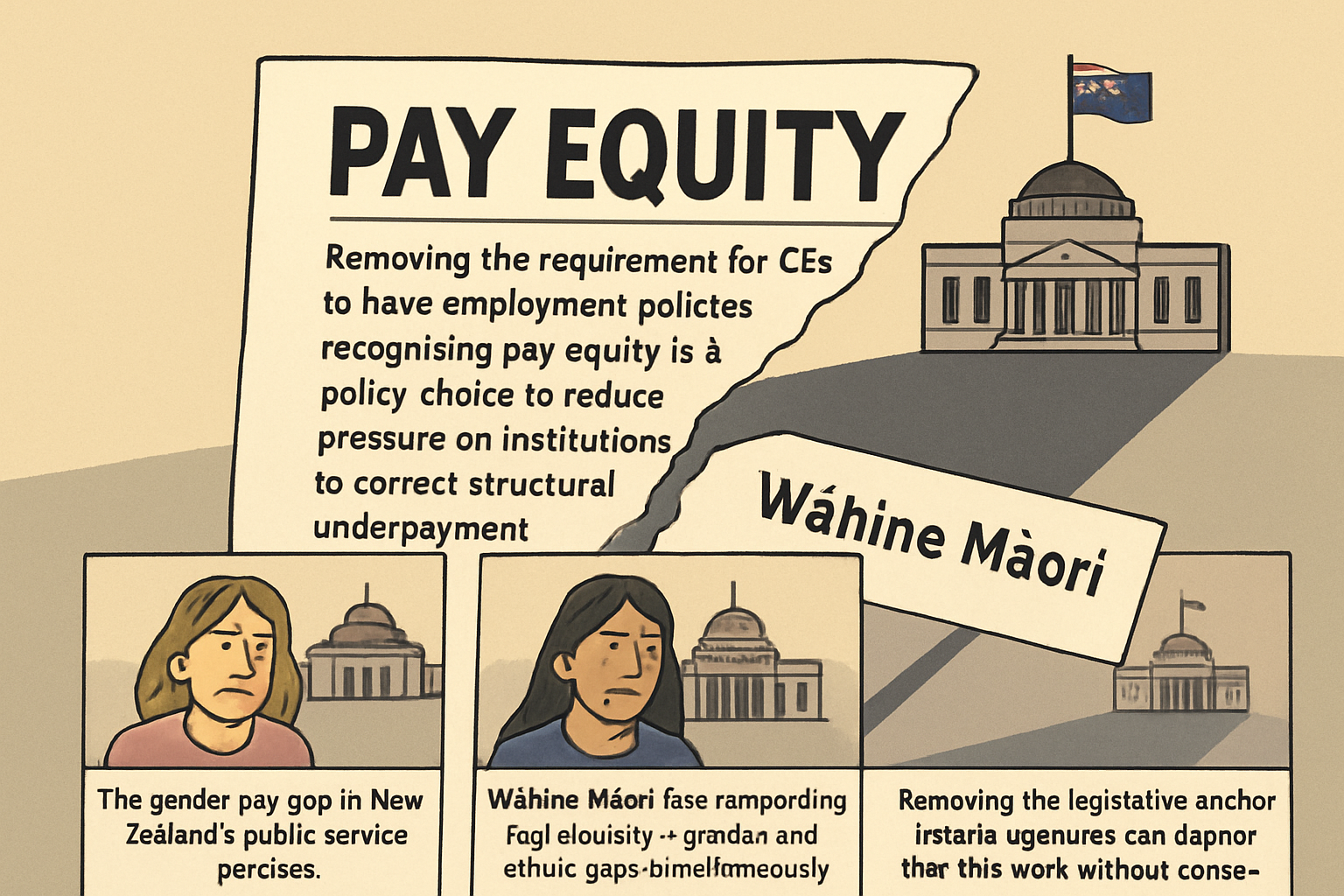
Example 2: Pay Equity Stripped → Women and Wāhine Māori Pay the Bill
The Point: Removing the requirement for CEs to have employment policies recognising pay equity is a policy choice to reduce pressure on institutions to correct structural underpayment.
Three Concrete Harms:
- The gender pay gap in New Zealand's public service persists. The DEI framework's Kia Toipoto work programme specifically targets gender and ethnic pay gaps. Removing the legislative anchor means agencies can deprioritise this work without consequence.
- Wāhine Māori face compounding pay inequity—gender and ethnic gaps simultaneously. The Ministry for Pacific Peoples' own DEI plan explicitly targets these intersecting gaps. Without statutory backing, such plans become optional.
- Pay equity struggles have a long and painful history in Aotearoa, from caregivers to nurses to teachers—largely feminised workforces, disproportionately Māori and Pacific.
Quantified Harm: Every year without enforceable pay equity policy entrenches existing gaps. The Public Service Commission's own data tracks these gaps annually. Remove the obligation, and the data itself becomes discretionary—you stop measuring what you stop caring about.
Solution Pathway: Reinstate enforceable pay equity policy expectations. Require annual publication of agency-level pay-gap data disaggregated by ethnicity and gender. Make non-compliance a performance management issue for chief executives—not a voluntary aspiration.
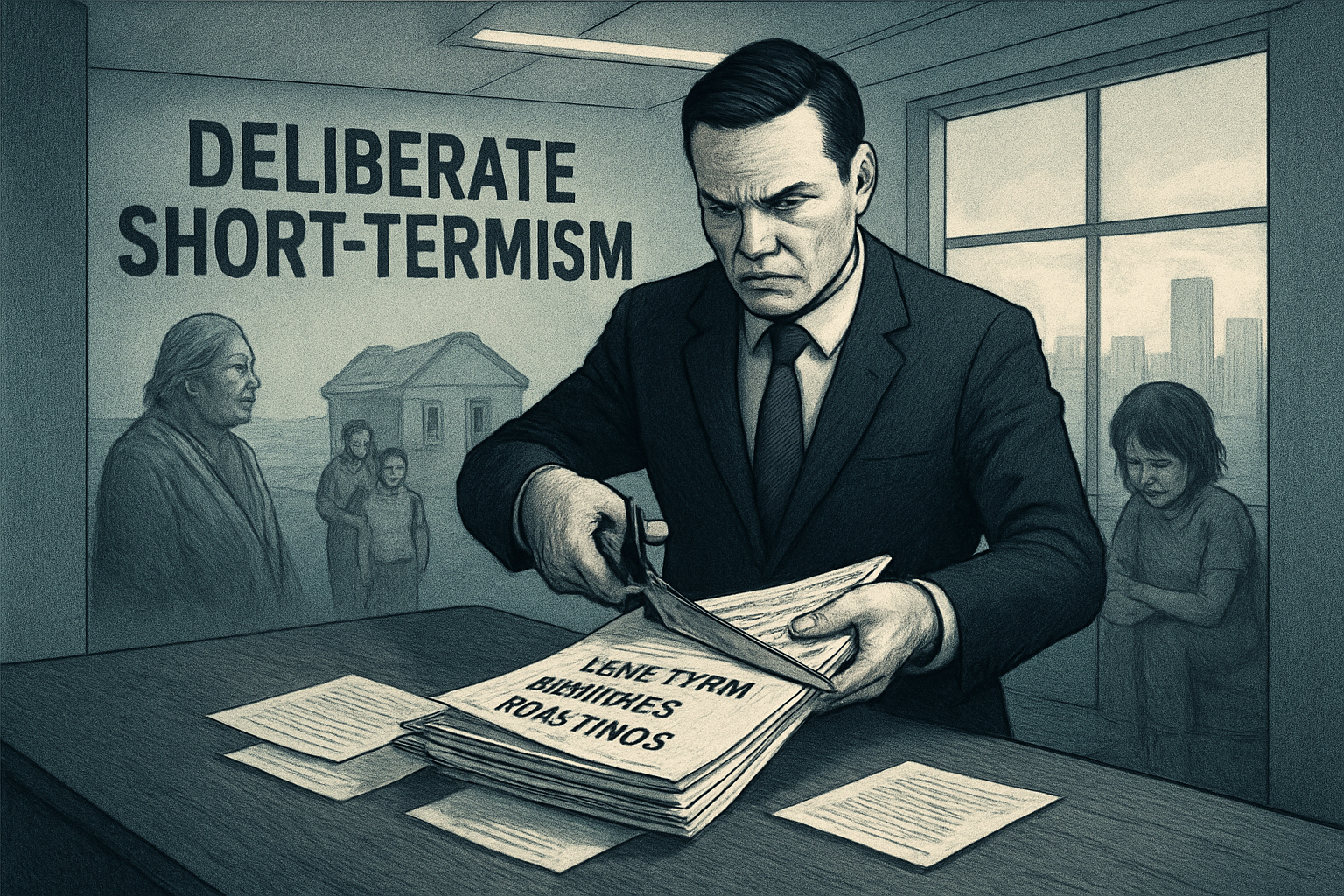
Example 3: Long-term Insights Briefings Gutted → Deliberate Short-termism
The Point: Scrapping Long-term Insights Briefings for 34 departments and leaving only one from DPMC is intentional blindness—cutting the state's capacity to plan for future risks. Combined with the Public Finance Bill's removal of the Treasury wellbeing report, the government ensures no one is required to look ahead at the consequences of what they are doing right now.
Three Concrete Harms:
- Housing: the Ministry of Housing and Urban Development warned the Regulatory Standards Act could "lead to greater fragmentation of land/whenua Māori, be a barrier to pooling resources for collective good and further entrench the negative housing outcomes that currently exist". Without a long-term insights briefing from HUD, this trajectory goes unmonitored.
- Climate: Aotearoa faces escalating climate risk. Long-term insights briefings from environment and infrastructure agencies are the mechanism for identifying future risks. Cutting them means the government flies blind into floods, droughts, and sea-level rise—harms that fall disproportionately on coastal Māori communities.
- Child welfare: as documented in previous Māori Green Lantern analysis, the coalition has already cut $46.579 million from Oranga Tamariki and defunded 190 community providers. Without long-term insights from MSD, no one tracks the downstream devastation.
Quantified Harm: The NZCCSS submission on the Public Finance Bill warns directly: removing wellbeing requirements "reduces the visibility of the impacts of Government spending across different communities—particularly those experiencing inequity, such as Māori, Pasifika, disabled people, and low-income households".
Solution Pathway: Retain department-level long-term insights briefings. Require specific Tiriti/tikanga impact lenses within them. Restore the Treasury wellbeing report with mandatory disaggregated reporting for Māori, Pacific, and disabled communities.
The Deeper Pattern: Managerialism as White Supremacy in a Suit
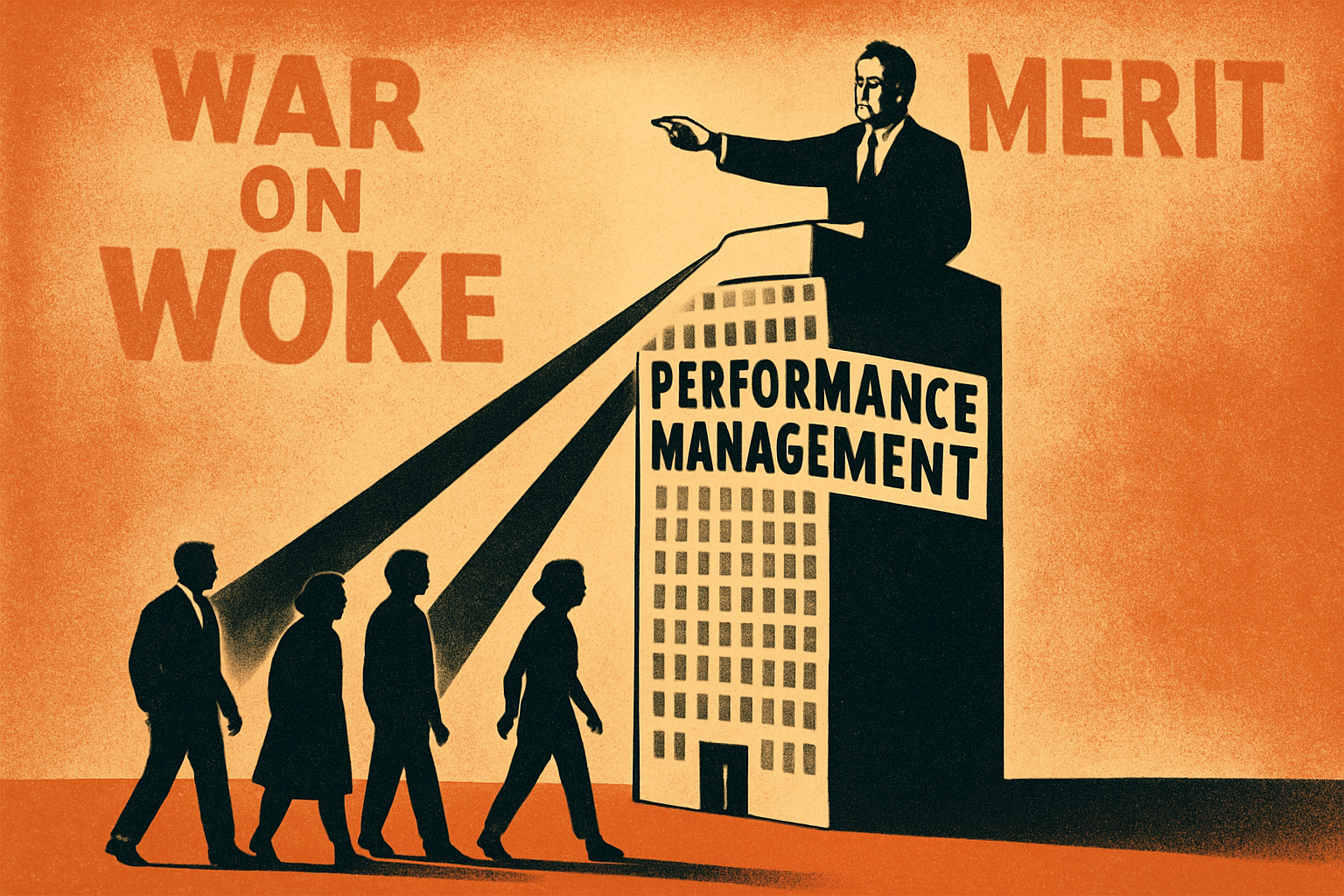
The Public Service Bill reframes the public service as a corporate hierarchy: CEs forced to reapply, appointed by the minister of the day. That is how political neutrality erodes—not with a coup, but with "performance management" language and appointment leverage. Sir Brian Roche himself acknowledged in 2025 that ministers already had "significant say" over appointments and that the existing powers were "sufficient". Yet the bill expands those powers anyway.
The culture-war theatre is the delivery vehicle: Winston Peters frames DEI as a front in NZ First's "war on woke". NZ First's own bill text sought to repeal Section 75 entirely and strip diversity from CE appointment panels. Andy Foster told the House it is "even more important to make sure that we have a public service which is professional"—as if professionalism and diversity are competitors rather than allies.
And Ryan Hamilton's schoolyard analogy is not a one-off embarrassment. It is the ideology made visible. In his world, merit is what happens when you don't pick "the Māori boy or the Chinese boy or the girl". That is the unconscious architecture of the bill: the default human is white, male, and unencumbered by history.
Metaphor: The Crown as a Contractor with a Chainsaw
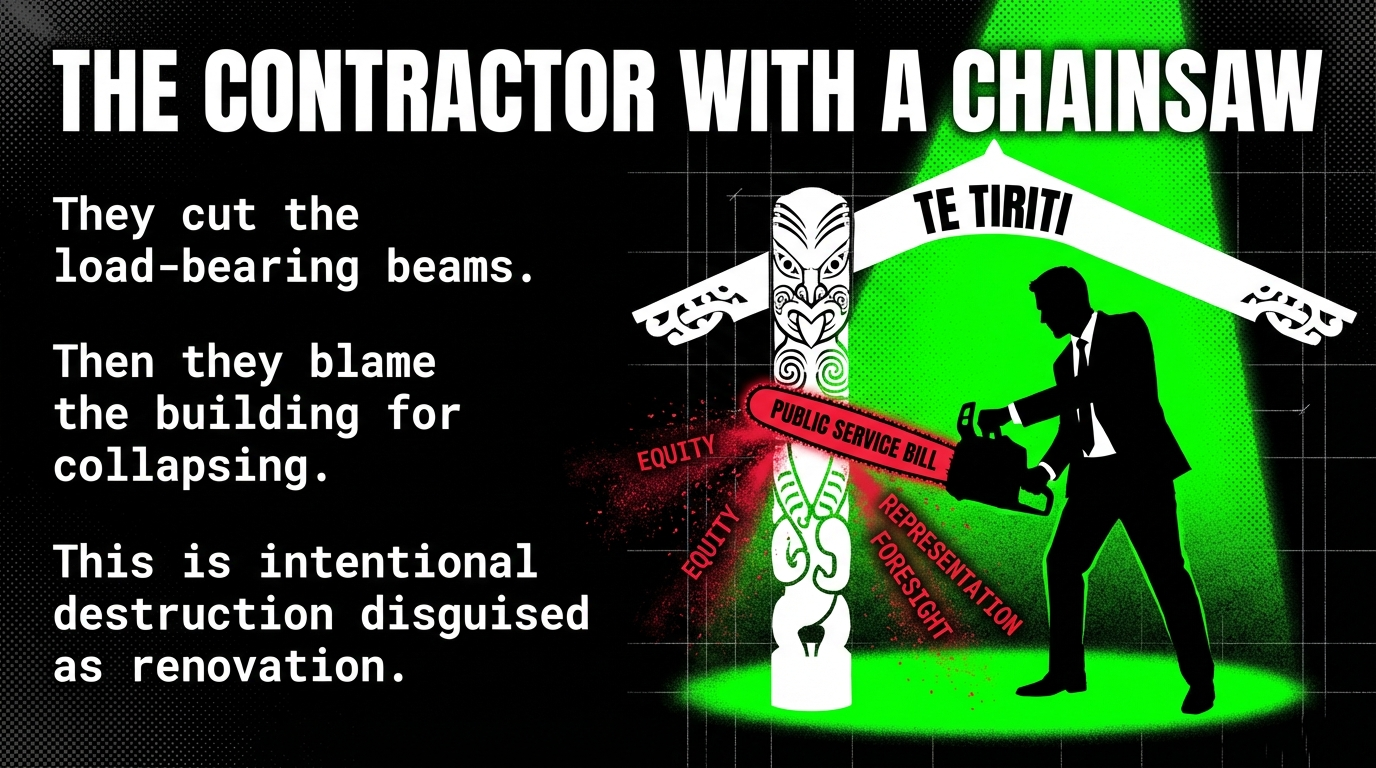
This coalition behaves like a demolition contractor hired by donors, arriving at the public service with a chainsaw and a clipboard. The clipboard says "merit" and "basics." The chainsaw hits the load-bearing beams: representation, pay equity, long-term public interest, tikanga capability, worker protection, Māori health governance, wellbeing measurement.
Then they stand back—hard hats clean, hands clean, consciences empty—and tell the country the collapse proves the building was "inefficient."
But the blueprint is visible. The parliamentary schedule is the delivery order. The Public Service Bill is the flagship demolition. The Employment Relations Bill weakens the workers who might resist. The Pae Ora Bill guts Māori voice in health. The Public Finance Bill destroys the instruments that would measure the wreckage. The Health and Safety Bill loosens the rules on who gets hurt.
This is not governance. This is a coordinated teardown. And every bill is connected to every other bill by the same ideological thread: the state exists to serve capital, not people; ministers, not communities; the comfortable, not the vulnerable.
Related Māori Green Lantern Kaupapa (Previous Essays)
This essay belongs to the same line of fire as earlier Māori Green Lantern investigations into the coalition's anti-Māori agenda and neoliberal capture:
- "Kia ora, my name is Ivor Jones, The Māori Green Lantern…" (Substack) — establishing the framework for exposing misinformation and the coalition's dismantling of Māori rights.
- "Recolonisation by Stealth" (Substack) — documenting the coordinated nature of anti-Māori policy, including the Section 7AA repeal, Oranga Tamariki budget cuts, and the Atlas Network connections driving the coalition's ideological programme.
- "The Trojan Horse: Weaponising Aotearoa's Constitution Against Māori" (Substack) — exposing how the Regulatory Standards Act and Treaty Principles Bill constituted a coordinated constitutional assault on Te Tiriti.
- "Banking Backroom Deals: How Corporate Interests Capture…" (Substack) — tracing the financial networks funding the coalition's corporate agenda.
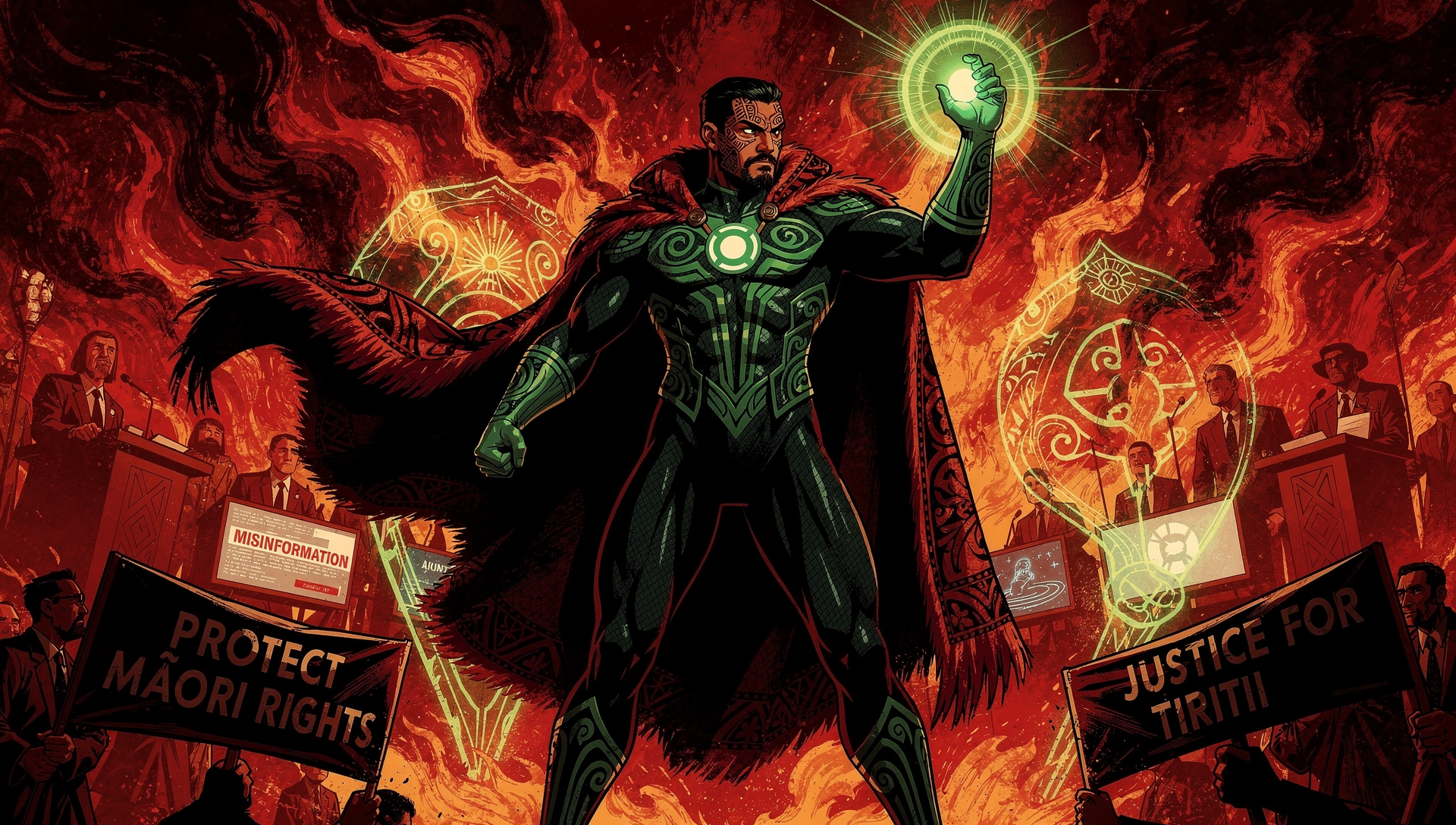
The pattern—erase Tiriti obligations, call it "neutral," punish anyone who names it—stays the same across portfolios. This Public Service Amendment Bill is simply the latest blade.
He Wero — A Challenge
To Māori communities: This is not one bill. It is five bills moving simultaneously across health, employment, public finance, public service, and workplace safety—all targeting the same thing: your voice, your rights, your presence. Organise accordingly. Submit on every bill. Flood every select committee.
To public servants: You are being told diversity is the enemy of merit by politicians who cannot produce a single example of a non-merit appointment. Your Commissioner confirmed all appointments are already merit-based. Refuse the lie. Document the consequences of these changes.
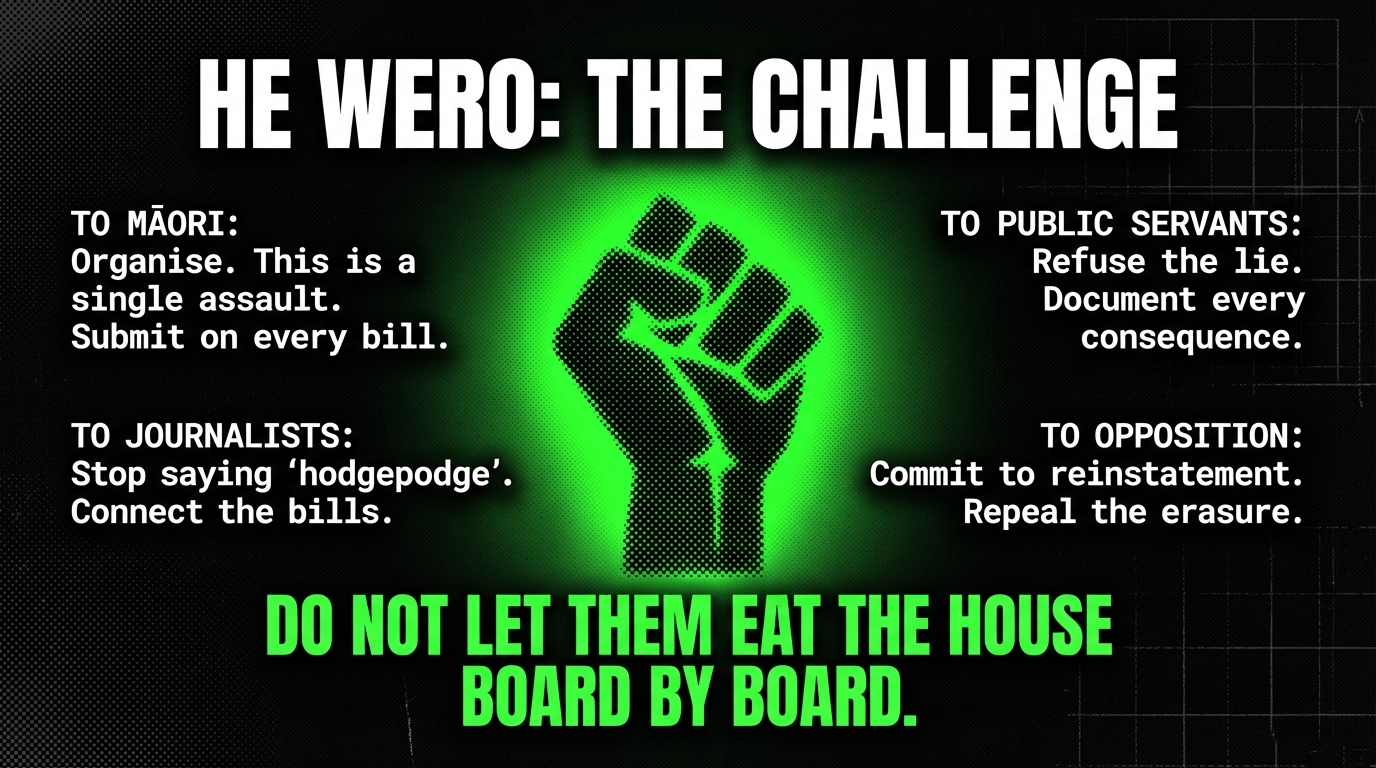
To journalists: Stop reporting this as a "hodgepodge." It is a programme. Map the connections between bills. Trace the coalition agreements that mandate each deletion. Ask Ryan Hamilton if he would say "you wouldn't pick the Māori boy" to a classroom full of tamariki.
To the opposition: Ayesha Verrall named it correctly: "I could not think of a more limited, small-minded, managerial, hopeless vision of our democracy than this bill". Now build the alternative. Commit to reinstating Section 44c's diversity clause, restoring long-term insights, and legislating enforceable pay equity. And commit to it publicly, before the election, with no wriggle room.
Koha Consideration
Every koha for this piece is a direct refusal to let the Crown delete Māori from the machinery of decision-making while calling it "merit," "basics," and "neutrality"—as exposed in the Public Service Amendment Bill coverage by RNZ and the parliamentary schedule that reveals the coordinated programme.
It signals that whānau will fund the accountability this government dismantles bill by bill—when they strip diversity from the public service, pay equity from chief executives, wellbeing from Treasury, Māori voice from health, and grievance rights from workers. Every koha signals that rangatiratanga includes the power to fund our own truth-tellers when the state funds only its own silence.

Kia kaha, whānau. Stay vigilant. Stay connected. And if you are able, consider a koha to ensure this voice continues.
If you are unable to koha, no worries! Subscribe or follow The Māori Green Lantern on Substack or Ghost, kōrero and share with your whānau and friends—that is koha in itself.
Three pathways exist:
For those who wish to support this mahi directly with a koha (voluntary contribution):
Koha — Support
For those who wish to receive essays directly and support through subscription:
Subscribe to The Māori Green Lantern
For those who prefer direct bank transfer:
HTDM, account number 03-1546-0415173-000

Nāku noa, nā
Ivor Jones The Māori Green Lantern Fighting Misinformation And Disinformation From The Far Right
Transparency
Tools used: RNZ page retrieval, public web search, file search for prior related material, NZ Parliament bill tracker, Treasury cabinet papers, Public Service Commission DEI guidance and reporting material.
Date of research: 13 February 2026 (NZDT).
Key sources consulted: RNZ – Parliament back to government business; RNZ – Public Service Amendment Bill reignites diversity debate; NZ First DEI repeal bill text; NZ Herald – Collins-Roche WhatsApp messages; Te Tiratu – Pae Ora Amendment Bill; PSA – Māori marginalised by Pae Ora changes; Te Kāhui Hauora rejection; NZCCSS – Public Finance Bill submission; Treasury – Public Finance Amendment Bill cabinet paper; Te Kawa Mataaho – DEI guidance; 1News – Sir Brian Roche on politicisation; RNZ – Public service redundancies 865; RNZ – Commissioner won't rule out absorbing ministries; Cabinet paper – Public Service Act amendments; Māori Green Lantern essays on Substack.
Unverifiable within available sources: Specific prior Māori Green Lantern posts on Ghost addressing this specific Public Service Amendment Bill could not be located via indexed search during this research run; Substack items were reliably retrievable (links included above).