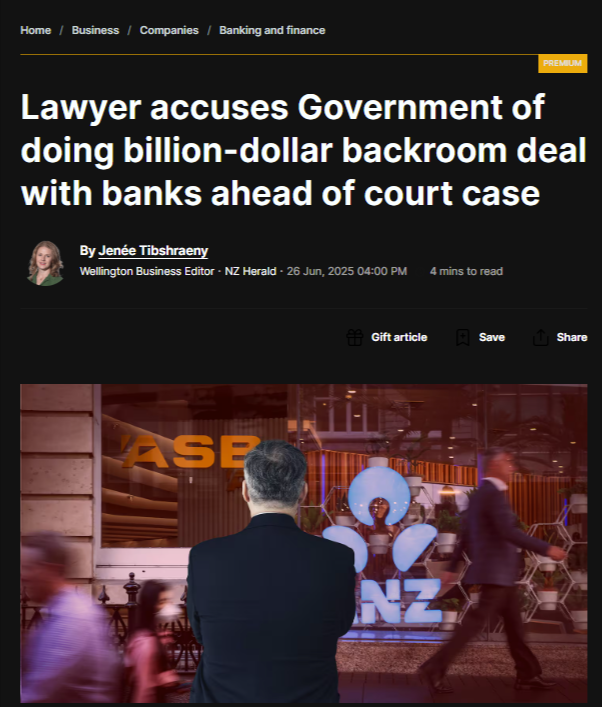
"Banking Backroom Deals: How Corporate Interests Capture Government Policy at the Expense of Everyday Kiwis" - 26 June 2025
Corporate Cronies and Legislative Larceny
Tēnā koutou katoa - Greetings to all.
The title of this essay says it all - we have witnessed the most brazen example of corporate capture in recent memory, where the New Zealand Government has retrospectively changed laws to protect two Australian-owned mega-banks from paying what they owe to over 170,000 Kiwi customers. This is not democracy; this is oligarchy in action1.
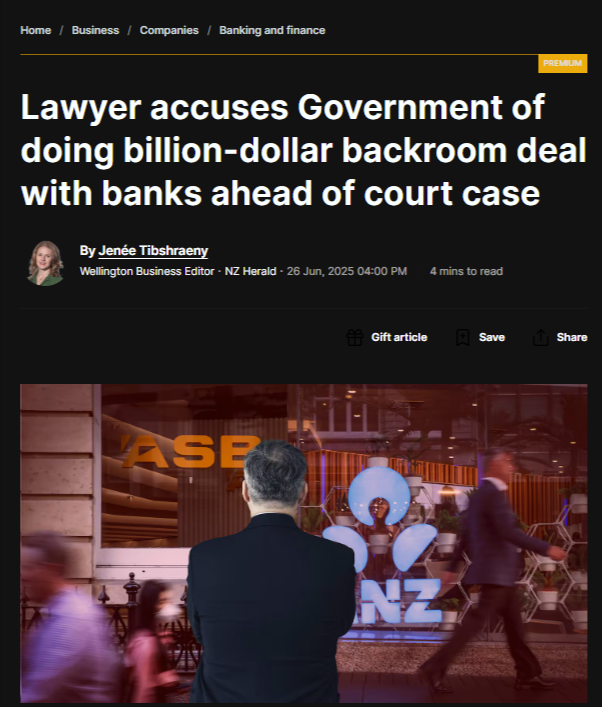
The Credit Contracts and Consumer Finance Amendment Bill represents everything wrong with our political system - a government more interested in protecting foreign banks than standing with working families. When our lawmakers conspire with corporate criminals to rob people of their rightful compensation, we must ask: whose interests do they really serve1?
This analysis will expose the unholy alliance between the National-led government and banking giants ANZ and ASB, revealing how neoliberal ideology has captured our democratic institutions and turned them against tangata whenua and working people alike.
Background
The Legal Framework and Māori Context
The Credit Contracts and Consumer Finance Act 2003 was designed to protect consumers from predatory lending practices through mandatory disclosure requirements2. Under section 17, lenders must provide key information before contracts are signed, while section 99(1A) imposes severe penalties for non-compliance - borrowers are not liable for interest and fees during any period of disclosure breach3.
This protective framework matters deeply for Māori communities, who face systemic barriers in accessing fair financial services. Research by the Reserve Bank acknowledges that "Māori face persistent barriers to accessing capital, many of which stem from market failures or imperfections"4. When banks fail to provide proper disclosure, they particularly harm whānau who already struggle with financial literacy and fair access to credit5.
The historical context cannot be ignored. Financial colonisation has been a key tool of dispossession since European colonisation began. Today's banking system continues this legacy, with Australian-owned banks extracting billions in profits while failing to serve Māori communities adequately6.
The Banking Breach Scandal
Between 2015 and 2019, ANZ and ASB breached their disclosure obligations to over 170,000 customers1. ANZ used a faulty calculator that provided incorrect interest calculations, while ASB completely failed to disclose loan variations to 73,000 customers7. These were not minor technical errors but fundamental failures that violated consumer protection laws.
The Commerce Commission investigated and found both banks liable under section 99(1A), which required them to forfeit all interest and fees charged during the period of non-compliance8. This penalty exists for good reason - it creates real consequences for banks that fail to provide transparency to borrowers.
Lawyer Scott Russell launched a class action representing more than 150,000 affected customers, successfully arguing through the Supreme Court that victims should be automatically included rather than having to opt in9. The potential liability was estimated at hundreds of millions of dollars, with the Reserve Bank modelling worst-case scenarios of up to $13 billion across the entire banking sector10.
The Backroom Deal
Rather than face accountability, the banks embarked on a sophisticated lobbying campaign to change the law retrospectively. The sequence of events reveals the depth of corporate capture:
In June 2024, Scott Russell approached MBIE officials asking if they would consider retrospective changes to the law. Officials immediately responded that this would be "inappropriate"1. Four days later, the New Zealand Banking Association contacted then-Minister Andrew Bayly urging exactly such retrospective changes11.
Suddenly, MBIE began investigating the changes the banks wanted. In September, officials met with ANZ and ASB to discuss the matter1. The public was never consulted. Russell was never invited to present the customers' perspective.
By March 2025, the Credit Contracts and Consumer Finance Amendment Bill was introduced to Parliament with retrospective provisions that would dramatically reduce the banks' liability12. The Reserve Bank had conveniently produced modelling showing potential system-wide risks, despite acknowledging that ANZ and ASB could absorb the penalties without existential threat13.

Corporate Capture in Plain Sight
This saga exemplifies what economist George Stigler called "regulatory capture" - when industries co-opt the regulatory process to serve their interests rather than the public good14. The pattern is unmistakable: banks ask for retrospective law changes, get rejected, lobby the minister directly, and suddenly officials are investigating exactly what the banks want.
Former Minister Andrew Bayly's role deserves particular scrutiny. After initially being told retrospective changes were inappropriate, the Banking Association's direct approach to him triggered a complete reversal11. This is how oligarchy operates - when democratic processes fail to deliver the desired outcome, corporate interests simply go over the heads of officials to sympathetic politicians.
The timing is especially damaging to the government's credibility. Documents show the regulatory impact statement was finalised on 5 March 2024, just a week after Bayly's resignation13. The incoming minister Scott Simpson inherited a fait accompli designed by his predecessor in consultation with bank lobbyists.
Violation of Democratic Principles
Retrospective legislation that affects ongoing court cases represents one of the most serious breaches of the rule of law. The New Zealand Law Society's submission makes this clear, warning that the bill "should not pass in its current form" because it violates fundamental principles of justice15.
The Legislation Act 2019 explicitly states that "Legislation does not have retrospective effect"16. The New Zealand Bill of Rights Act 1990 also prohibits retroactive penalties. Yet the government is proceeding anyway, putting corporate profits ahead of constitutional principles.
Dr Duncan Webb's analysis exposes the constitutional outrage: "The role of Parliament is to make law – it is the role of the courts to interpret that law and apply it in any given instance." When Parliament retrospectively changes laws to benefit litigants in ongoing cases, it "usurps the court's role" and breaches the separation of powers13.
Impact on Māori and Working Families
This corporate welfare for foreign banks comes at the direct expense of working families, including many Māori whānau who were victims of the banks' disclosure failures. The class action represents 170,000 ordinary Kiwis seeking justice for corporate misconduct8.
The neoliberal framing of this issue reveals deep ideological bias. Officials worried about "prudential risks" to the banking system while dismissing the harm to families who were overcharged due to bank negligence17. This reflects the same market fundamentalism that has driven inequality in Aotearoa since the 1980s reforms18.
Māori are disproportionately affected by such financial injustice. Already facing barriers to fair banking services, retrospective law changes that favour banks over consumers compound existing inequities4. When the state intervenes in markets, it should protect the vulnerable, not enrich the powerful.

The Neoliberal Smokescreen
The government's justification for this intervention exposes the hypocrisy of neoliberal ideology. For decades, we have been told that markets are efficient and government intervention distorts outcomes. Yet when banks face the consequences of their own failures, suddenly massive state intervention is justified to protect them.
The Reserve Bank's modelling of potential $13 billion system-wide impacts serves as convenient cover for what is essentially corporate welfare10. If other banks face similar liabilities, they should either pay the penalties they owe or face market discipline through insolvency proceedings. Socialising their losses while privatising their profits is the opposite of free market principles.
This selective intervention reveals neoliberalism's true purpose - not to create free markets, but to use state power to benefit capital at the expense of labour. When working people need help, we are told the market must be allowed to work. When banks need help, retrospective legislation materialises overnight.
Wider Pattern of Corporate Privilege
This banking scandal fits a broader pattern of corporate capture under the current government. From fast-track resource consents that bypass environmental protections to tax cuts funded by cuts to public services, the coalition consistently prioritises business interests over public welfare19.
The influence of the Business Roundtable and other corporate lobby groups is evident throughout government policy. Their ideology of market fundamentalism has captured Treasury, MBIE, and other agencies that should serve the public interest14. When officials automatically investigate what banks want while dismissing consumer advocates, we see this capture in action.
Māori Values and Corporate Accountability
From a Māori worldview, this corporate behaviour violates fundamental values of manaakitanga (hospitality and care for others) and utu (balanced exchange)20. Banks took money from customers while failing to provide required information - this creates an imbalance that must be corrected.
Tino rangatiratanga (self-determination) also requires that Māori have fair access to financial services without exploitation20. When banks fail in their duties and then use political influence to avoid consequences, they undermine Māori economic sovereignty and self-determination.
The principle of kaitiakitanga (guardianship) demands that those with power use it responsibly to protect others, not exploit them21. The government's role should be as kaitiaki of the public interest, not enabler of corporate greed.
Implications
Broader Democratic Decline
This episode represents more than banking policy - it signals the complete capture of democratic institutions by corporate interests. When laws can be changed retrospectively to benefit specific companies in ongoing litigation, we no longer have the rule of law but the rule of money.
The precedent is chilling. Any corporation facing legal liability can now point to this case and demand similar treatment. The message to ordinary citizens is clear: justice is for sale, and you cannot afford it.

Economic Justice and Inequality
The retrospective law change will cost affected families hundreds of millions of dollars while protecting foreign-owned banks' profits22. In the midst of a cost-of-living crisis, the government prioritises Australian shareholders over Kiwi families struggling to pay their mortgages.
This compounds New Zealand's inequality crisis, which has worsened dramatically since the neoliberal reforms began18. When the state intervenes to protect corporate profits while cutting support for working families, it accelerates the concentration of wealth and power.
Colonial Continuity
For Māori, this represents continuity with historical patterns of dispossession through legal manipulation. Just as colonial governments changed laws to facilitate land theft, today's government changes laws to facilitate financial exploitation23.
The fact that both major banks are Australian-owned adds another layer of colonial extraction. Profits flow offshore while losses are socialised through retrospective legislation that protects foreign capital at local expense.
The Verdict is Clear
This retrospective law change represents one of the most brazen examples of corporate capture in recent New Zealand history. The government has abandoned its duty to protect consumers in favour of protecting foreign bank profits through legislative manipulation that violates constitutional principles.
The process - secret meetings with banks, exclusion of consumer voices, and retrospective changes to benefit specific litigants - exposes how democracy has been captured by corporate interests. When officials immediately reject consumer requests but enthusiastically investigate identical requests from banks, we see whose interests really matter.
A Call for Resistance
This attack on consumer rights and democratic principles demands resistance. The select committee process provides one avenue for public opposition, but broader action is needed to challenge corporate capture of our democratic institutions.
Māori values of tino rangatiratanga and manaakitanga demand that we stand with the 170,000 families being robbed by this retrospective legislation. Their struggle is our struggle - a fight for economic justice against corporate colonialism.

Moving Forward
The time has come to reclaim our democracy from corporate capture. This means challenging neoliberal ideology, strengthening consumer protections, and ensuring that those with economic power cannot simply buy legislative changes when market discipline threatens their profits.
We must also centre Indigenous values and perspectives in economic policy, recognising that current arrangements reproduce colonial patterns of extraction and exploitation. True decolonisation requires economic sovereignty as much as political sovereignty.
The banking scandal reveals the urgent need for transformation - not just of financial regulation, but of power structures that allow corporate interests to override democratic will. Until we address these deeper issues, ordinary families will continue to pay the price for corporate greed while shareholders and executives escape accountability.
Readers who find value in my content and wish to support the cause are welcome to consider a donation/koha to support this work: HTDM: 03-1546-0415173-000. The MGL understands these tough economic times for whānau so please only contribute a koha if you have capacity and wish to do so.
Mauri ora - life force be with you all.
Ivor Jones
The Māori Green Lantern
The Māori Green Lantern exposes misinformation, white supremacy, racism, and neoliberalism from the far right, grounding analysis in Māori values and spirituality to serve as kaitiaki for truth and justice.
- https://ppl-ai-file-upload.s3.amazonaws.com/web/direct-files/attachments/2123776/f783420b-3dee-4c1e-913c-737a40846d11/Lawyer-accuses-Government-of-doing-billion-dollar-backroom-deal-with-banks-ahead-of-court-case-NZ-Herald.pdf
- https://www.consumerprotection.govt.nz/general-help/consumer-laws/credit-contracts-and-consumer-finance-act
- /content/files/assets/659c836053/discussion-paper-section-99-1a-cccfa-pfd.pdf
- https://www.rbnz.govt.nz/hub/news/2025/05/examining-maori-access-to-capital-market-failures
- https://www.1news.co.nz/2021/08/11/only-a-fifth-of-kiwis-know-their-rights-when-taking-out-loans/
- /content/files/__data/assets_file/0023/343643/he-kohinga-kc58drero-summary-of-views-expressed-at-the-wc481nanga-on-30-october-2023.pdf
- https://www.nzherald.co.nz/business/companies/banking-finance/proposed-consumer-finance-law-change-could-quash-massive-class-action-against-anz-and-asb-banks/TYHDDHB36NBZFNGPW3PNLUZKVQ/
- https://www.1news.co.nz/2025/05/29/national-accused-of-putting-needs-of-banks-before-everyday-kiwis/
- https://www.thelawyermag.com/nz/news/general/russell-legal-leads-the-charge-in-massive-class-action-against-anz-and-asb/312231
- https://www.nzherald.co.nz/business/companies/banking-finance/why-govt-made-a-retrospective-law-change-affecting-a-bank-class-action-against-asb-and-anz/T74BQZE7GJDHTP5KKNQKTV3GPQ/
- https://nzba.org.nz/why-govt-made-a-retrospective-law-change-affecting-a-bank-class-action-against-asb-and-anz/
- https://www.minterellison.co.nz/insights/relief-for-consumer-lenders
- https://www.linkedin.com/pulse/whats-wrong-little-bit-retrospectivity-dr-duncan-webb-pofbf
- https://ojs.victoria.ac.nz/pq/article/view/6821
- /content/files/assets/Law-Reform-Submissions/credit-contracts-and-consumer-finance-amendment.pdf
- https://www.nzherald.co.nz/the-listener/new-zealand/law-society-retroactive-laws-real-time-consequences/SBYY7XF4UNH7VDTJKDDQJNGZB4/
- /content/files/assets/60329c3fed/regulatory-impact-statement-section-99-1a.pdf
- https://journals.sagepub.com/doi/pdf/10.1177/0306396820923482
- https://www.rnz.co.nz/news/national/521812/climate-strategy-as-useful-as-teats-on-a-bull-greenpeace-says
- https://teara.govt.nz/en/te-tiriti-o-waitangi-the-treaty-of-waitangi/page-2

- https://openaccess.wgtn.ac.nz/articles/thesis/The_impact_of_the_Wairau_Affray_on_the_New_Zealand_Company_settlement_of_Wellington_1843_to_1846/20833081
- https://pplx-res.cloudinary.com/image/private/user_uploads/2123776/2f57fe50-a738-4cfc-9bb2-6c6d166ee27f/Lawyer-accuses-Government-of-doing-billion-dollar-backroom-deal-with-banks-ahead-of-court-case-NZ-Herald-06-26-2025_08_24_PM.jpg
- https://www.nzherald.co.nz/business/companies/banking-finance/lawyer-accuses-government-of-doing-billion-dollar-backroom-deal-with-banks-ahead-of-court-case/IJKUGVVXUJDB5FTBIHIUDNTWT4/.
- /content/files/article/download/11925/17047.pdf
- /content/files/index-php/per/article/download/2559/2298.pdf
- /content/files/index-php/per/article/download/2955/6344.pdf
- /content/files/index-php/wslhr/article/download/148/346.pdf
- https://www.nzherald.co.nz/business/companies/banking-finance/lawyer-accuses-government-of-doing-billion-dollar-backroom-deal-with-banks-ahead-of-court-case/IJKUGVVXUJDB5FTBIHIUDNTWT4/
- https://www.nzherald.co.nz/business/companies/banking-finance/is-there-method-to-the-governments-madness-making-a-retrospective-law-change-that-will-help-anz-and-asb-defend-themselves-in-court/KCMZGQ45QFEPZORR2X46GE47K4/
- https://www.rnz.co.nz/news/political/499093/act-s-business-plan-removing-january-holiday-putting-minimum-wage-on-hold
- /content/files/webcontent/document/20138/mightyriverpower.pdf
- https://www.fma.govt.nz/business/legislation/cccfa/
- https://www.bellgully.com/insights/cccfa-cofi-update-major-reforms-offer-simplification-and-a-few-new-challenges/
- https://www.rnz.co.nz/news/political/526828/consultation-on-open-banking-open-electricity-begins
- /content/files/webcontent/document/201322/lombard.pdf
- https://www.nzherald.co.nz/business/economy/official-cash-rate/big-banks-face-24b-bill-from-the-taxman/LLGTHHZQ3R4N26ZV74JRAIH55I/
- https://www.nzherald.co.nz/business/companies/banking-finance/new-tech-bill-will-allow-consumers-to-share-data/VDCILDOBMJEDLAXVLAQNEXRWYA/
- https://www.minterellison.co.nz/insights/changes-to-financial-services-regulation-announced
- /content/files/dmsdocument/30026-financial-services-reforms-further-decisions-proactiverelease-pdf.pdf
- https://www.mdpi.com/2813-9372/1/2/10
- https://harmreductionjournal.biomedcentral.com/articles/10.1186/s12954-022-00613-9
- http://wje.org.nz/index.php/WJE/article/view/256
- https://journals.sagepub.com/doi/10.1177/00048674221106668
- https://journals.sagepub.com/doi/10.1177/25148486231217891
- https://teara.govt.nz/en/national-party/page-3
- https://teara.govt.nz/en/labour-party/page-4
- https://www.nzherald.co.nz/the-listener/books/best-intentions-the-reasons-leftist-governments-cant-build-infrastructure/63TBIX3MSJDMDEMWRHQX5DMSEI/
- https://www.nzherald.co.nz/the-listener/politics/the-1984-revolution-part-ii-crash-and-burn/OHU6BHNJB5D4BLKBIWS3DPN7V4/
- https://teara.govt.nz/en/biographies/6a6/andersen-gordon-harold-bill
- https://www.saanz.net/wp-content/uploads/2024/04/Roper_Neoliberalism-in-New-Zealand_NZS-391_pp-39-59.pdf
- https://en.wikipedia.org/wiki/Colonial_Bank_of_New_Zealand
- /content/files/wp-content/uploads/2024/02/neoliberalism.pdf
- https://teara.govt.nz/en/kawanatanga-maori-engagement-with-the-state/page-1
- https://teara.govt.nz/en/nation-and-government/page-1
- https://www.nzherald.co.nz/nz/politics/pm-jacinda-ardern-to-front-post-cabinet-press-conference-after-poll-labour-party-conference/OD2OUSHCPVHXZMQ2GQYJNWUMBA/
- https://www.nzherald.co.nz/the-listener/books/should-nz-decolonise-its-economy/3WHCMY77JRBB7KVPQJVHYVBYEM/
- https://www.linkedin.com/posts/hetangatadigitalmedia_ivor-jones-them%C4%81origreenlantern-activity-7262692083554045952-YNFz
- https://www.linkedin.com/posts/hetangatadigitalmedia_ivor-jones-them%C4%81origreenlantern-activity-7269867386231488514-53nv
- https://papers.ssrn.com/sol3/papers.cfm?abstract_id=2824292
- /content/files/sites/default/files/2019-06/rbnz-safeguarding-future-financial-system-2b.pdf
- https://www.nzherald.co.nz/business/companies/banking-finance/class-action-launched-against-asb-and-anz-banks/26USJSCM3TBGXYFFVXOVQ6RSJQ/
- /content/files/webcontent/document/201334/telecom.pdf
- https://www.rnz.co.nz/news/business/452568/anz-asb-face-class-action-over-refunds-for-150-000-customers
- https://www.1news.co.nz/2021/09/29/multimillion-dollar-claim-launched-against-banks-asb-and-anz/
- /content/files/dmsdocument/30628-financial-services-reforms-policy-approvals-and-approval-of-the-credit-contracts-and-consumer-finance-amendment-bill-for-introduction-proactiverelease-pdf.pdf
- http://www.laneneave.co.nz/news-events/new-bill-aims-to-foster-more-balanced-consumer-credit-market/
- https://rvh.co.nz/commercial-disputes/class-action/
- /content/files/webcontent/document/201340/nonbank.pdf
- https://businessdesk.co.nz/article/news-in-brief/class-action-lawyer-accuses-govt-of-behind-the-scenes-deal-with-banks
- https://nzba.org.nz/new-zealand-proposes-law-change-to-deliver-cba-anz-major-legal-win/
- https://www.semanticscholar.org/paper/d2dd24036dee513eae96b3cd174cb009985b5b5f
- https://www.cambridge.org/core/product/identifier/S0748081400000266/type/journal_article
- http://www.jstage.jst.go.jp/article/jila/72/5/72_5_829/_article/-char/ja/
- https://journals.sagepub.com/doi/10.1177/0306396820923482
- https://teara.govt.nz/en/international-economic-relations/print
- https://www.nzherald.co.nz/the-listener/politics/1984-revolution-the-rise-of-rogernomics-and-how-it-still-shapes-nz-lives/XN63LYQ37BCPFK3PNKCKCAT63I/
- https://www.rnz.co.nz/news/national/514868/financial-mentoring-services-sound-warning-over-wind-back-of-lending-regulations
- https://teara.govt.nz/en/business-failures-and-corporate-fraud/print
- /content/files/11-numer/bruce-curtis---class--neoliberalism-and-new-zealand.pdf
- https://www.greenpeace.org/aotearoa/story/placing-the-current-new-zealand-government-into-context/
- https://comcom.govt.nz/__data/assets/pdf_file/0023/65183/comcom-cccfactguideforthecreditindustry.pdf
- https://www.eastonbh.ac.nz/2010/08/new-zealands-great-banking-crisis/
- https://www.nzherald.co.nz/kahu/treaty-principles-bill-we-all-have-tino-rangatiratanga-the-right-to-self-determine-not-only-maori-david-seymour/SKSNCSI7HZDNRIPPPPKI5AFNIA/
- https://teara.govt.nz/en/document/4216/the-three-articles-of-the-treaty-of-waitangi
- https://teara.govt.nz/en/principles-of-the-treaty-of-waitangi-nga-matapono-o-te-tiriti-o-waitangi/page-5
- https://twitter.com/htdm
- https://www.instagram.com/themaorigreenlantern/
https://themaorigreenlantern.maori.nz