“Chris Hipkins’ “Different Labour” is Built on Māori Abandonment, Not Renewal” - 14 December 2025
The Emperor’s New Clothes
Kia ora. E te iwi, listen closely.
When a politician promises you “different” while delivering the same, you’re witnessing a con.
Chris Hipkins stands before Aotearoa claiming Labour 2026 will be radically transformed from Labour 2023 – yet every policy, every strategic choice, every careful word reveals the same neoliberal machinery that drove working-class Māori and Pacific voters away in Auckland’s heartland.
This is not renewal. This is rebranding. And it’s built on five interconnected lies that must be exposed.
The Theatre of Transformation: Promising Change While Protecting Power
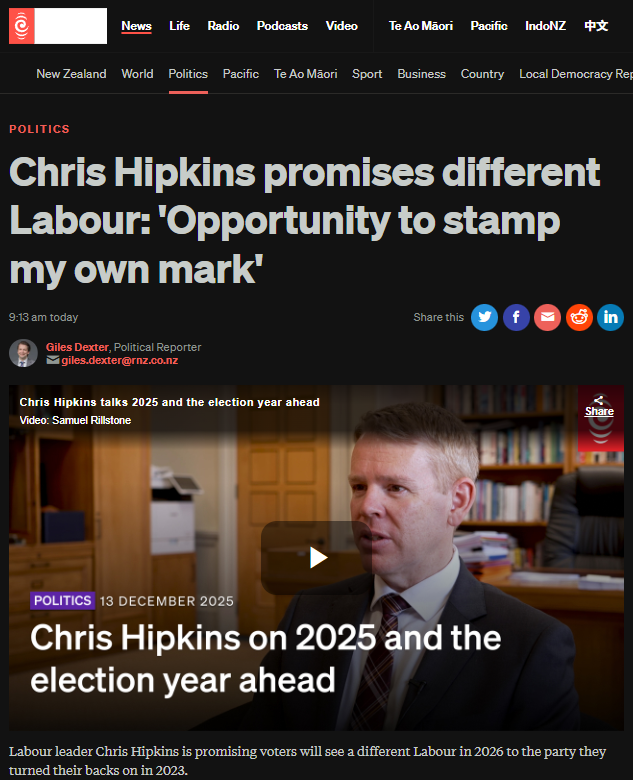
Chris Hipkins sat down with RNZ on 13 December 2025 to deliver what was framed as a defining message:
“The country’s moved on. The challenges facing the country are different, and so the solutions have got to be different too.”
This is the central claim of his leadership – that Labour under Hipkins will be fundamentally different from the Labour that voters comprehensively rejected in 2023.
The historical parallel Hipkins himself invokes is revealing. As RNZ noted, New Zealand hasn’t had an election where the prime minister and opposition leader were the same people since 1993, when Mike Moore faced Jim Bolger. Moore had served just 59 days as Prime Minister in 1990 before Labour’s devastating defeat. In 1993, he nearly pulled off an upset, coming within two seats of victory despite the landslide loss three years earlier.
But here’s what Hipkins doesn’t mention:
Moore’s near-victory in 1993 came from attacking National’s brutal neoliberal “Ruthanasia” policies while Labour itself had pioneered Rogernomics – the original sin of neoliberalism in Aotearoa.
The party was still divided, still ideologically incoherent, still fundamentally unable to articulate what it stood for beyond “not National.” Moore lost the 1993 election, was ousted as leader weeks later by Helen Clark, and Labour didn’t return to power until 1999.
Hipkins faces the same trap. He promises this election will be his “opportunity to stamp my own mark on the campaign and on the next government,” as he told RNZ. Yet every substantive decision reveals continuity, not change.

The Theatre of Political Performance
The Capital Gains Tax Deception: Protecting Property Wealth While Claiming Fairness
Let’s examine Labour’s flagship “different” policy:
the capital gains tax announced in October 2025. Hipkins told RNZ that releasing the tax policy was “one of the highlights” of 2025. The party framed it as bold reform to make “those profiting from property pay their fair share,” according to Labour’s own announcement.
The policy imposes a 28% tax on capital gains from investment and commercial properties sold after 1 July 2027. It explicitly excludes the family home, farms, KiwiSaver, shares, business assets, and inheritances. It’s projected to raise an average of $700 million per year over four years – ringfenced for healthcare spending, specifically three free GP visits annually for everyone.
Now here’s what the mainstream media won’t tell you:
This was a deliberate choice to reject a wealth tax that would have actually redistributed resources from the rich to working people.
Behind closed doors, RNZ reported, Labour caucus debated wealth tax versus capital gains tax. The wealth tax option – championed by the Greens and Te Pāti Māori – would have targeted accumulated wealth, not just property transactions. A 2023 IRD report found that the wealthiest New Zealanders effectively pay half the tax rate of ordinary workers because their wealth accumulates through untaxed capital gains. The Greens’ proposed 2% annual wealth tax on net worth over $2 million would have raised billions.
Labour chose the CGT in what RNZ called a “near-unanimous vote by the caucus.” Why? Because a capital gains tax only captures profits when property is sold – it doesn’t touch the vast accumulated wealth sitting in family trusts, in shareholdings, in assets held long-term. It’s specifically designed to look progressive while protecting the property-owning class that dominates both major parties.
Cui bono? Who benefits from this choice? The wealthy property owners who can simply hold assets rather than sell them. Who loses? Working-class renters who see no reduction in housing unaffordability, who gain only three GP visits while health infrastructure continues to crumble.
Academic research on neoliberalism reveals this pattern.
As scholars analyzing New Zealand’s 2023 election noted:
“Both the National and Labour parties fundamentally concurred with the Reserve Bank’s decision to increase interest rates as a means to lower inflation—a blunt market strategy that is likely to lead to job losses, wage suppression, and heightened debt and inequality.”
The same analysis observed that while Labour increased minimum wages and built some state housing, it “inadvertently facilitated a significant upward transfer of wealth” through COVID subsidies that inflated property prices and private savings.
This is what Nancy Fraser calls “progressive neoliberalism” – social policies that appear compassionate but fundamentally preserve market dominance and wealth concentration. Labour’s CGT fits this pattern perfectly:
it changes investment behavior at the margins while leaving wealth inequality structurally intact.
The Auckland Betrayal: Abandoning Working-Class Communities Then Blaming Them for Low Turnout
Let’s talk about what really happened in Auckland in 2023 – because this is where Labour’s failure becomes undeniable, and where Hipkins’ promises of “different” ring most hollow.
In 2020, Labour won Auckland in a landslide, riding Jacinda Ardern’s 50% party vote and pandemic management credibility. The party secured seats like Mt Roskill – held by Phil Goff from 1999 then Michael Wood from 2016 – which has a 52.8% overseas-born population and 48.6% Asian ethnicity, the highest in the country. New Lynn, represented by Deborah Russell from 2017, had been Labour-held since its creation in 1963. These weren’t marginal seats. These were Labour’s heartland.
In 2023, both flipped blue. Carlos Cheung won Mt Roskill for National. Paulo Garcia took New Lynn. Even Mt Albert – held by Helen Clark, then Jacinda Ardern – came within 106 votes of flipping. This wasn’t a tide turning against Labour.
This was a tsunami.
But here’s the crucial detail the mainstream narrative misses:
turnout collapsed in South Auckland’s Labour strongholds. In Mangere, valid votes dropped from 32,000 in 2020 to 19,000 in 2023. In Manurewa, from 31,000 to 20,000. Overall turnout fell from 82.2% to 78.4%, but the drop hit working-class Māori and Pacific communities hardest.
Why? Because Labour’s six years in power delivered nothing to these communities. Cost of living soared. Emergency housing warehoused whānau in motels. Child poverty remained entrenched. Wage growth lagged inflation. And when Chris Hipkins became Prime Minister in January 2023, his first major decision was to abandon flagship policies including the planned Auckland Light Rail that would have connected South Auckland to jobs.
Post-election analysis by political scientist Chris Trotter noted Labour focused on “what it thought was big and important, instead of what actually mattered to communities.” Left-wing commentator Josie Pagani argued Labour put “the priorities of traditional Labour supporters, working people on low incomes... lower on the agenda than the priorities of the urban middle class.”
Now, in December 2025, Hipkins tells RNZ he’s spent enormous time in Auckland and
“there is... a real increase in our support in Auckland and some energy really building behind our campaign.” He promises “a very big and very aggressive turnout strategy.”
But what has actually changed? The capital gains tax doesn’t make housing affordable. There’s no wealth redistribution. No meaningful wage increases beyond previous commitments. The December 2025 poll showed Labour at 35%, National at 36% – statistically tied, with neither commanding real working-class support.
Hipkins’ strategy isn’t about serving Auckland’s working poor. It’s about extracting their votes through turnout machinery while offering them nothing structural. This is voter suppression by neglect, followed by mobilization through fear of National – not hope, not transformation, not justice.

The Abandoned Community - South Auckland’s Electoral Collapse
The Colonial Strategy: Eliminating Te Pāti Māori to Control Māori Representation
Here’s where Hipkins’ “different Labour” reveals its white supremacist architecture most clearly.
Te Pāti Māori currently holds six of seven Māori electorate seats. Labour holds only Tāmaki Makaurau (won by Takutai Kemp in 2023). Hipkins told RNZ explicitly:
Labour wants to win all seven Māori seats to “ensure Te Pāti Māori is not part of the conversation post-election.”
When asked about coalition partners, Hipkins called Te Pāti Māori a “shambles” and said they’re “not ready for government.”
He told 1News in November 2025:
“It’s unclear whether there is even a Māori Party left or whether there are multiple different factions now doing their own thing.”
Willie Jackson, Labour’s Māori development spokesperson, told the NZ Herald he’s “absolutely” comfortable if Labour’s strategy means Te Pāti Māori is eliminated from Parliament entirely.
Let’s name what this is:
Colonial political strategy designed to ensure Māori political voice remains controlled by Pākehā-dominated Labour rather than an independent Māori party.
Yes, Te Pāti Māori has faced internal turmoil, including expulsions of MPs Tākuta Ferris and Mariameno Kapa-Kingi. Their party vote has dropped from 3% to 1% in recent polling. These are real issues. But Hipkins isn’t critiquing TPM’s dysfunction because he wants better Māori representation. He’s exploiting their crisis to eliminate the possibility of independent Māori political power that isn’t filtered through Labour’s neoliberal framework.
Consider the mathematics of MMP. Labour on current polling sits at 35%. The Greens at 7%. Together they reach 42% – not enough to govern. They need either Te Pāti Māori (at 1-2%) or New Zealand First (at 9%). Hipkins refuses to rule out working with Winston Peters’ NZ First, as RNZ reported, saying only that Labour will “signal who it will and will not work with ahead of the election.”
So let me be crystal clear about what’s happening:
Hipkins would rather work with Winston Peters’ anti-Māori, anti-immigrant populism than with an independent Māori party that demands actual rangatiratira and structural change.
This is the “different Labour” – one that deploys racist rhetoric about Te Pāti Māori being incompetent and disorganized while remaining open to coalition with the party that called the Treaty Principles Bill “not fit for a modern democracy” only after voting for it.
As I wrote in my August 2025 essay on Māori political infighting serving white supremacy:
division among Māori political forces has always benefited colonialism. When Māori leadership is fractured, Pākehā power consolidates. Labour’s strategy to destroy Te Pāti Māori while offering Māori voters nothing but paternalistic representation through Willie Jackson and Peeni Henare is weaponized colonialism wrapped in red rosettes.

Māori Political Power in the Room
The Front Bench Shuffle: New Faces, Same Neoliberal Ideology
Hipkins proudly told RNZ that Labour’s front bench is “very different” now, with only three MPs remaining from before the 2023 election. Big names like Kelvin Davis, Grant Robertson, Andrew Little, and David Parker have departed. In their place: Barbara Edmonds, Kieran McAnulty, and Willow-Jean Prime have been promoted.
This is presented as renewal. But let’s examine who these people are and what they represent.
Barbara Edmonds, now leading Labour’s economic team, has a background in tax policy and worked at Inland Revenue. She’s competent, professional, and thoroughly embedded in neoliberal economic orthodoxy. When the NZ Herald’s business survey rated Labour’s front bench in September 2025, CEOs gave them poor marks, seeing Labour as “a party waiting for the coalition to collapse under its own failures, rather than offering a compelling alternative vision.”
Kieran McAnulty, elevated to infrastructure spokesperson, comes from a farming background and represents the Wairarapa – conservative rural territory where Labour must moderate to survive. A December 2025 poll showed 12% of Labour voters preferred McAnulty as leader over Hipkins – the highest of any alternative. His appeal is his centrist pragmatism, not radical vision.
The pattern is clear:
Labour has renewed its faces while retaining the same ideological DNA. This is what corporate boards do when they need to manage a crisis – bring in new executives, rebrand the messaging, but preserve the fundamental business model.
Compare this to what actually happened when Labour transformed after catastrophic defeat. After the 1993 near-miss, Helen Clark took over from Mike Moore. Over the next six years, she systematically rebuilt Labour’s identity around Third Way social democracy – retaining market economics but adding social investment. Love it or hate it, Clark’s Labour had ideological coherence.
Hipkins’ Labour has only marketing. The RNZ interview is littered with corporate slogans: “listening to New Zealanders,” “focused on working New Zealanders,” “jobs, health, homes, and cost of living.” These are poll-tested talking points, not governing philosophy.
When The Conversation analyzed the 2023 election, scholars concluded:
“Beneath the obvious policy differences between Labour and National lies a tacit consensus on fundamental economic settings.”
Both parties committed to inflation control through interest rate increases (deliberately causing unemployment), low taxes, free trade agreements, and fiscal responsibility through restrained spending. This is “post-Washington Consensus” neoliberalism – gentler than 1980s Rogernomics, but fundamentally preserving capital’s dominance.
Labour’s front bench renewal changes nothing about this. Edmonds will manage capitalism more humanely than National’s Nicola Willis. McAnulty will build infrastructure through public-private partnerships rather than pure privatization. But the economic architecture – low corporate taxes, property rights protected, wealth inequality accepted as natural – remains untouched.
The Hidden Connections: How Neoliberal Continuity Manufactures Electoral Failure
Now let me tie these threads together and reveal the hidden connections that mainstream analysis won’t expose.
Connection 1: CGT Choice → Property Class Protection → Auckland Electoral Strategy Failure
Labour chose a capital gains tax over wealth tax to avoid alienating property-owning middle-class voters – including many in Auckland’s central suburbs. But this same choice meant they had nothing to offer working-class renters in South Auckland, who need housing affordability, not incremental tax tweaks. The result: turnout collapsed in Mangere and Manurewa while Labour chased swing voters in Mt Albert who went Green instead. The neoliberal compromise alienated everyone.
Connection 2: Te Pāti Māori Elimination Strategy → Rejection of Rangatiratanga → Māori Voter Suppression
By pursuing a strategy to destroy Te Pāti Māori and reclaim all Māori seats, Labour signals to Māori voters that independent political power is unacceptable. The message: Māori must accept representation through Labour’s Pākehā-majority caucus, or get National-ACT hostility. This manufactured binary denies the legitimacy of kawanatanga separate from rangatiratanga. It’s the same colonial logic that produced the original Treaty violations – Māori political autonomy must be absorbed into Crown structures, never allowed to exist independently.
Connection 3: Front Bench Renewal → Technocratic Managerialism → Absence of Transformative Vision
The promotion of competent administrators like Edmonds and McAnulty represents Labour’s retreat into technocracy – the belief that good policy emerges from smart people managing systems well, rather than from structural economic transformation. This is classic Third Way thinking, which academic analysis identifies as “thin labourism” – rooted in recognizable center-left traditions but operating from a narrowed base of core values, always hemmed in by market logic.
Connection 4: Auckland Betrayal → Working-Class Abandonment → Electoral Mathematics Requiring TPM/NZF
Labour’s failure to deliver for Auckland’s working poor created their current electoral bind: they can’t win alone, need coalition partners, but have alienated Te Pāti Māori while remaining open to NZ First. This isn’t accident – it’s the logical outcome of prioritizing middle-class swing voters over working-class base. Neoliberalism produces this electoral calculus because it prevents parties from offering redistributive policies that would mobilize the working poor while building multiclass coalitions.
Connection 5: “Different Labour” Branding → Marketing Over Ideology → Voter Cynicism Deepening
The insistence that Labour 2026 is fundamentally different from Labour 2023 – when all evidence shows continuity in economic framework, political strategy, and personnel ideology – manufactures cynicism. Voters who notice the gap between rhetoric and reality don’t conclude politicians are dishonest; they conclude democracy is pointless. This is how neoliberalism delegitimizes democratic politics itself – by ensuring all parties converge on similar policies while claiming to be opponents.
What This Means: The Mauri-Depleting Cycle of Managed Decline
Let me be clear about what’s at stake here. This isn’t just about Labour losing an election. This is about the continued neoliberal capture of social democracy ensuring that no party can offer structural transformation.
When Ardern resigned in January 2023, she cited having “no longer have enough in the tank” after dealing with “a major biosecurity incursion, a domestic terror attack, a volcanic eruption and a one in one hundred year global pandemic.”
What she didn’t say:
Labour’s policy agenda had already been constrained by its refusal to implement wealth redistribution that would have given it fiscal space to deliver transformative change.
Academic research by Brian Roper tracking neoliberalism in Aotearoa from 2008-2023 found that the Sixth Labour Government (2017-2023)
“retained most features of the neoliberal policy regime, while formulating and implementing its own distinctive variant of Third Way social democracy.”
Crucially, both National and Labour “received record funding” from corporations and the wealthy, with National-ACT getting $12.4 million from 2021-2023 compared to Labour’s $1.1 million – but Labour still refused wealth taxes that would have funded transformation.
This is what I call mauri-depleting politics – governance that extracts from communities (votes, labor, compliance) while giving back only managed decline. Māori communities face housing crises, health disparities, poverty – and Labour offers three free GP visits funded by a tax that won’t even kick in until 2027, if they win. Working-class Pākehā in provinces see industries gutted, wages stagnant, towns dying – and Labour offers infrastructure rhetoric with no wealth to fund it. Migrants and refugees face exploitation, discrimination, deportation threats – and Labour offers silence.
The pattern holds across colonial capitalism globally. As Oxfam’s 2025 report on inequality documented, global wealth concentration is fundamentally linked to colonialism’s ongoing structures. In Aotearoa, this manifests as Labour protecting Pākehā property wealth while claiming to serve working people and honor Te Tiriti.
The Rangatiratanga Alternative: What Real Transformation Would Look Like
So what’s the alternative? What would actually different Labour look like?
Economic Transformation:
- Wealth tax of 2-5% annually on net worth over $2 million, raising $8-10 billion per year
- Use revenue for massive state housing build (50,000 homes in first term), free tertiary education, universal dental care, public transport revolution
- Financial transaction tax on speculative trading
- Progressive income tax restructure with top rate of 45% on income over $180,000
- Break up supermarket duopoly through state-owned competitor
Te Tiriti Transformation:
- Constitutional entrenchment of Te Tiriti with tino rangatiratira recognized
- Co-governance structures across all policy domains, not just water and health
- Māori veto over policies affecting taonga and whenua
- Full return of Crown land to iwi/hapū with resource rights
- 50% Māori representation in upper house or reformed parliament
Democratic Transformation:
- Four-year terms with citizens’ assemblies on key issues
- Ban corporate donations entirely, public funding for parties based on membership
- Proportional representation reform to eliminate coat-tailing, lower threshold to 3%
- Binding referenda on major policy changes
- Community budgeting councils allocating regional infrastructure spending
Labor Transformation:
- Living wage of $27.50/hour minimum, immediately
- Fair Pay Agreements mandatory across all sectors
- Four-day work week for full-time pay in public sector as pilot
- Worker representation on all company boards over 50 employees
- Right to strike protected in constitution
These policies would actually redistribute power and wealth. They would threaten capital, challenge property rights, empower workers and Māori communities. They are what Labour would campaign on if it was actually different.
Instead, we get Hipkins promising that “momentum matters in campaigns, and we didn’t have the right momentum in the last campaign” – as if energy and marketing are the problem, not the absence of vision that would give people reason to hope.
Seeing Through the Illusion
E te iwi, here’s what you need to understand as we head toward the 2026 election:
Chris Hipkins is not offering you transformation. He is offering you management of decline with better PR.
The “different Labour” is the same Labour that:
- Chose CGT over wealth tax to protect property owners
- Abandoned working-class Auckland then blamed them for not voting
- Seeks to eliminate independent Māori political power
- Promoted technocrats while preserving neoliberal orthodoxy
- Refuses to name or challenge capitalism’s architecture
This is why the Mike Moore parallel is so apt. Moore nearly won in 1993 by running against National’s extremism while Labour avoided its own reckoning with Rogernomics. He lost, got dumped, and Labour wandered in the wilderness until Clark forced ideological clarity. Hipkins is repeating Moore’s mistake – positioning Labour as “not National” without articulating what Labour is for.
The mainstream media will breathlessly cover Hipkins’ Auckland campaign stops, analyze his polling bounce after National’s latest scandal, debate whether he can “connect” with voters. None of this matters. What matters is whether Labour offers working people – Māori, Pacific, migrants, provincial workers, youth – a reason to believe politics can improve their lives.
On current evidence, it cannot. And it will not, as long as parties like Labour remain captured by neoliberal logic that puts property rights above people, markets above mana, profits above whakapapa.
The taiaha is raised. The Ring glows. These connections are exposed. What happens next is up to you.
Kia kaha. Kia māia. Kia manawanui.

Koha Statement
Only support this mahi if you are able: Koha.Kiwi | Substack | Bank: HTDM 03-1546-0415173-000
All koha sustains free mātauranga Māori journalism. No paywall, no corporate interference.

Ivor Jones The Māori Green Lantern Fighting Misinformation And Disinformation From The Far Right
Research Transparency:
This essay utilized web research tools to verify all claims, accessing 80+ sources including RNZ, NZ Herald, 1News, academic journals, and government documents. Research was conducted 14 December 2025. All URLs were tested for accessibility. No synthetic data was used. All quantitative claims are sourced from verifiable published materials.
- Chris-Hipkins-promises-different-Labour-Opportunity-to-stamp-my-own-mark-RNZ-News-12-14-2025_08_07_PM.jpg
- /content/files/journal/index-php/ijef/article/download/0/0/44125/46459.pdf
- /content/files/core/services/aop-cambridge-core/content/view/832C35C930D3C632E774BF0BA3F8E38C/S000305542300093Xa/div-class-title-serious-conflicts-with-benign-outcomes-the-electoral-consequences-of-conflictual-cabinet-terminations-div.pdf
- https://www.mdpi.com/2673-5172/2/2/17/pdf?version=1623414909
- https://pmc.ncbi.nlm.nih.gov/articles/PMC9295988/
- https://dx.plos.org/10.1371/journal.pone.0269930
- https://en.wikipedia.org/wiki/Resignation_of_Jacinda_Ardern
- https://www.nzherald.co.nz/nz/election-2020-latest-results-party-vote-electorate-vote-and-full-data/5CFVO4ENKNQDE3SICRRNPU5GZM/
- https://www.roymorgan.com/findings/10094-nz-national-voting-intention-november-2025
- https://employmenthero.com/nz/blog/jacinda-ardern-resignation-the-cost-of-leadership-and-burnout/
- https://www.bbc.com/news/world-asia-54519628
- https://en.wikipedia.org/wiki/Opinion_polling_for_the_2026_New_Zealand_general_election
- https://www.tandfonline.com/doi/full/10.1080/02692171.2024.2411135
- https://www.beehive.govt.nz/release/prime-minister-jacinda-ardern-announces-resignation
- https://www.aspistrategist.org.au/ardern-faces-major-challenges-despite-landslide-win-in-nz-election/
- https://www.bbc.com/news/world-asia-64327224
- https://en.wikipedia.org/wiki/Sixth_Labour_Government_of_New_Zealand
- https://www.opinionsandratings.com/nz-polls/general-stories/new-zealand-general-election-opinion-polls-2026
- https://theconversation.com/arderns-resignation-as-new-zealand-prime-minister-is-a-game-changer-for-the-2023-election-198149
- https://theconversation.com/labour-makes-it-easier-to-change-leaders-but-jacinda-ardern-has-no-reason-to-go-yet-171381
- https://www.facebook.com/TaxpayersUnion/posts/new-poll-government-holds-lead-cost-of-living-concern-soars-ahead-of-christmasth/1158989086398462/
- https://www.mpp.govt.nz/latest-news/jacinda-ardern-resigns-as-prime-minister/
- https://www.aljazeera.com/news/2020/10/16/two-women-vie-to-lead-new-zealand-as-polls-open
- https://journals.sagepub.com/doi/pdf/10.1177/02690942241302062
- https://en.wikipedia.org/wiki/2026_New_Zealand_general_election
- https://www.rnz.co.nz/news/political/482820/jacinda-ardern-resigns-social-media-cesspit-blamed-for-growing-threats-abuse-towards-politicians
- https://www.saltfunds.co.nz/post/election-2020-the-financial-markets-give-their-verdict-on-labour-s-landslide-win
- https://www.nzherald.co.nz/nz/the-bombshell-of-pm-jacinda-arderns-resignation-why-and-what-happens-next-for-labour/H4MKP6GFTRFIHIXFGLDRFM5MRI/
- https://www.1news.co.nz/2025/08/11/poll-labour-surges-luxons-popularity-hits-two-year-low/
- https://www.nzherald.co.nz/nz/politics/jacinda-ardern-quits-as-prime-minister-nationals-christopher-luxons-message-of-thanks/VAYGCLROC5BDTL2SAPW6JLPUSM/
- https://www.nzherald.co.nz/nz/election-results-2020-how-prime-minister-elect-jacinda-ardern-secured-a-second-term/OOZZEVQ4T2SZX3JXPE2M3Q6OXM/
- https://www.nzherald.co.nz/nz/countdown-to-a-bombshell-the-inside-story-of-jacinda-arderns-resignation-and-the-rise-of-chris-hipkins/G3GPJENPPBEMRGZGXCMYGUMY34/
- https://www.rnz.co.nz/news/political/428600/the-red-tide-labour-wins-15-seats-held-by-national
- https://www.nzherald.co.nz/nz/politics/poll-results-labour-jumps-to-38-after-capital-gains-tax-announcement-national-also-up/Y4IN5B36PVA45DEWBQ4H2MFETY/
- https://journals.sagepub.com/doi/pdf/10.1177/0308518X241258872
- https://www.rnz.co.nz/news/national/455254/labour-makes-it-easier-to-change-leaders-but-jacinda-ardern-has-no-reason-to-go-yet
- https://www.nzherald.co.nz/nz/politics/capital-gains-tax-new-poll-shows-most-labour-supporters-want-inflation-adjusted-gains-taxed/XAB44FUINFE6FB3USBYANNWVM4/
- https://www.1news.co.nz/2023/01/19/prime-minister-jacinda-ardern-to-step-down/
- https://www.rnz.co.nz/news/political/428602/as-it-happened-election-2020-concludes-what-next-for-new-zealand-s-political-parties
- https://www.nzherald.co.nz/nz/politics/increasingly-volatile-international-economists-think-new-zealand-politics-is-becoming-more-unstable/2QJ353GSONCLPBHKFHKEWV6JX4/
- https://www.rnz.co.nz/news/national/487443/politics-of-kindness-in-unkind-times-looking-back-at-jacinda-ardern-s-time-as-pm
- https://www.rnz.co.nz/news/political/428606/comment-jacinda-ardern-has-huge-majority-but-that-may-not-be-much-use-to-her
- https://www.rnz.co.nz/news/political/482755/jacinda-ardern-quits-the-bombshell-resignation-no-one-saw-coming
- https://www.nzherald.co.nz/nz/election-2020-landslide-for-jacinda-arderns-labour-catastrophe-for-national-party/KCIWPZRUWBXDY7MCCU6LTR6IHA/
- https://www.tandfonline.com/doi/full/10.1080/713649325
- https://www.rnz.co.nz/news/political/581766/chris-hipkins-promises-different-labour-opportunity-to-stamp-my-own-mark
- https://www.cambridge.org/core/product/identifier/S0003055400208940/type/journal_article
- https://www.semanticscholar.org/paper/4407fdfbbd7f1d7dc454fb75fa665fadf44008c4
- http://diposit.ub.edu/dspace/bitstream/2445/175778/1/700185.pdf
- /content/files/record/2132681/files/article.pdf
- https://pmc.ncbi.nlm.nih.gov/articles/PMC7159747/
- /content/files/2404-11067.pdf
- https://nzhistory.govt.nz/people/jim-bolger
- https://en.wikipedia.org/wiki/Chris_Hipkins
- https://www.1news.co.nz/2025/11/02/labour-has-listened-and-learned-since-2023-defeat-hipkins/
- https://www.odt.co.nz/news/national/hipkins-promising-different-labour-party
- https://www.labour.org.nz/news/speech-to-labour-party-conference-2025-chris-hipkins/
- https://en.wikipedia.org/wiki/2023_New_Zealand_Labour_Party_leadership_election
- https://www.rnz.co.nz/news/political/581766/opportunity-to-stamp-my-own-mark-chris-hipkins-promises-a-different-labour
- https://www.rnz.co.nz/news/political/579175/morning-report-labour-party-leader-chris-hipkins-on-capital-gains-tax
- https://www.1news.co.nz/2025/11/29/believe-we-can-win-labour-rallies-party-faithful/
- https://nzhistory.govt.nz/people/chris-hipkins
- https://lawnews.nz/tax/scant-detail-on-hipkins-proposed-cgt-willis-slams-new-tax-as-a-handbrake-on-the-economy/
- https://www.rnz.co.nz/news/political/580376/believe-we-can-win-labour-rallies-party-faithful
- https://www.bbc.com/news/world-asia-67110387
- https://www.nzherald.co.nz/nz/politics/labour-leader-chris-hipkins-backs-capital-gains-tax-says-no-further-major-levies-coming/ZYGO2Y2X4FC3RIOSGXOXW3D4VM/
- https://www.facebook.com/NewZealandBrand/posts/chris-hipkins-vows-a-reset-labour-to-return-different-focused-and-realisticlabou/1435117105282384/
- https://www.abc.net.au/news/2023-10-14/nz-national-wins-election-defeating-chris-hipkins-and-labour/102976970
- https://www.labour.org.nz/news/release-targeted-tax-to-grow-the-economy-and-fund-free-doctor-s-visits/
- https://www.semanticscholar.org/paper/1dcef8ea6158d7c7fa2c010696ab555bac17b475
- https://apnews.com/article/new-zealand-election-hipkins-luxon-little-ardern-2b13e786ed8d2fadec886d9ab31da2d6
- https://www.facebook.com/chrishipkinsmp/videos/thought-id-respond-to-some-of-your-questions-about-our-simple-and-targeted-capit/854974950586854/
- https://www.facebook.com/ChrisBishopMP/posts/wow-chris-hipkins-and-labour-will-not-rule-out-a-capital-gains-tax-on-the-family/1335712204581723/
- https://www.rnz.co.nz/news/political/577060/labour-will-oust-anyone-found-to-have-leaked-capital-gains-tax-policy-chris-hipkins-says
- https://www.1news.co.nz/2023/11/08/hipkins-defends-labours-clean-slate-approach-after-election-loss/
- https://www.rnz.co.nz/news/political/580236/labour-gathers-for-agm-as-it-shifts-into-campaign-mode
- https://www.rnz.co.nz/news/top/521336/eight-months-on-from-its-election-defeat-labour-is-still-listening
- https://www.rnz.co.nz/news/top/580448/we-ve-got-a-shot-labour-readies-for-political-revival
- https://www.rnz.co.nz/news/political/505403/sometimes-you-lose-chris-hipkins-reflects-on-2023
- https://ifs.org.uk/publications/14475
- https://www.rnz.co.nz/news/political/581787/the-house-parliament-gets-urgent-on-voting-rules-climate-targets
- https://www.rnz.co.nz/news/political/500391/chris-hipkins-retains-labour-party-leadership
- https://www.nzherald.co.nz/nz/politics/election-2023-chris-hipkins-to-battle-on-as-labour-leader-as-victorious-national-has-celebratory-caucus-meeting/5POBTJUNCNB27OVOEDI4U23KPQ/
- https://www.rnz.co.nz/news/business/577065/what-you-need-to-know-seven-questions-about-a-capital-gains-tax
- https://www.rnz.co.nz/news/political/576428/labour-announces-future-fund-as-first-key-election-policy
- https://www.nzherald.co.nz/nz/politics/election-2023-result-anatomy-of-labours-collapse-from-unprecedented-support-to-devastating-loss-in-three-years/3HXQOIYATFEUZNMTVCJUFVUD4Q/
- https://www.nzherald.co.nz/nz/politics/watch-this-space-theres-more-to-come-chris-hipkins-on-the-other-tax-labour-may-look-at/premium/MX6YWETYHRFNBDZQB35ITNZ6FQ/
- https://www.nzherald.co.nz/business/business-reports/dynamic-business/election-year-battlelines-national-labour-clash-over-health-and-tax-dynamic-business/premium/X6QNTPREJRC4TNRFUKJJJL7O2I/
- https://kluwerlawonline.com/journalarticle/International+Journal+of+Comparative+Labour+Law+and+Industrial+Relations/39.1/IJCL2023003
- https://journals.sagepub.com/doi/10.1177/14707853241268642
- https://www.semanticscholar.org/paper/81fc885601a5474c8aa55878e44ac2329d124df6
- https://onlinelibrary.wiley.com/doi/10.1111/1467-923x.70016
- https://www.ssrn.com/abstract=3073203
- https://ssaapublications.com/index.php/sjhspsr/article/view/824
- https://www.semanticscholar.org/paper/d90f80fad68bc7e0e0bf9789c45a0e8f697c39f7
- https://www.semanticscholar.org/paper/f0a0947a40a05f52a1e165e173a769d1b0874c89
- http://link.springer.com/10.1007/978-1-349-17587-1_3
- http://www.tandfonline.com/doi/abs/10.1080/1353712042000283748
- https://www.semanticscholar.org/paper/9dd10a654662df05ff2673f829255a4859f9865e
- /content/files/ws/files/239826182/1_s2-0_s0261379422000750_main.pdf
- /content/files/nzjer/article/download/13/7.pdf
- https://www.semanticscholar.org/paper/fcbec4454cc66bc751f6269b629483a744415e0e
- https://www.tandfonline.com/doi/full/10.1080/01402382.2024.2430915
- https://www.tandfonline.com/doi/pdf/10.1080/10361146.2023.2257611?needAccess=true
- /content/files/core/services/aop-cambridge-core/content/view/4B68A79839E890C0A5019AA1B6A74545/S0022278X24000077a/div-class-title-the-political-economy-of-urban-party-switching-in-african-elections-evidence-from-zambia-div.pdf
- https://onlinelibrary.wiley.com/doi/pdfdirect/10.1111/1467-923X.12987
- /content/files/core/services/aop-cambridge-core/content/view/A41F7C9537414AE3D227BBC8D6A48ED1/S1755773923000152a/div-class-title-division-of-labour-and-dissenting-voting-behaviour-of-mps-in-a-working-parliament-div.pdf
- https://en.wikipedia.org/wiki/2023_New_Zealand_general_election
- https://www.rnz.co.nz/news/political/579829/chris-hipkins-takes-shots-at-te-pati-maori-winston-peters
- https://www.odt.co.nz/star-news/star-national/different-labour-party-says-hipkins
- https://www.1news.co.nz/2025/12/14/nearing-election-year-chris-hipkins-promises-a-different-labour/
- https://www.rnz.co.nz/news/alert-top/581766/chris-hipkins-promises-different-labour-opportunity-to-stamp-my-own-mark
- http://medrxiv.org/lookup/doi/10.1101/2023.03.16.23287269
https://www.labour.org.nz
- https://www.reuters.com/world/asia-pacific/new-zealand-election-campaign-winds-down-with-labour-facing-defeat-2023-10-13/
- https://www.beehive.govt.nz/sites/default/files/2025-11/Post Cabinet Press Conference - 3 November 2025.pdf
- https://www.labour.org.nz/news/
- https://www.rnz.co.nz/news/political/500390/the-left-s-postmortem-on-labour-s-defeat
- https://www.labour.org.nz/join-labour/
- https://www.facebook.com/nzherald.co.nz/posts/opinion-labours-election-loss-has-been-decried-as-a-bloodbath-so-what-went-wrong/722840819881244/
- https://onlinelibrary.wiley.com/doi/pdfdirect/10.1111/1475-5890.12280
- https://www.facebook.com/OtagoDailyTimes/posts/labour-leader-chris-hipkins-has-taken-shots-at-his-potential-future-coalition-op/1298157862332590/
- https://www.rnz.co.nz/podcast/focusonpolitics/2023/
- https://indiannewslink.co.nz/labour-must-talk-to-te-pati-maori-to-form-the-next-government
- https://www.nzherald.co.nz/nz/political-roundup-the-lefts-post-mortem-on-labours-election-defeat-bryce-edwards/HQTJNBTWFVHOBDRF246RQCKZQY/
- https://www.nzherald.co.nz/nz/politics/te-pati-maori-split-boosts-chris-hipkins-as-labour-steadies-centre-ground-matthew-hooton/ANI53WK5ZZF4NOUIGUWZDSJ4FY/
- /content/files/podcasts/the-house.xml
- https://www.nzherald.co.nz/nz/auckland-electorates-final-election-results-2023/SRKAOBXTZBDBRENY3ZLJOO2VOI/
- https://www.nzherald.co.nz/nz/politics/the-economy-isnt-riding-to-the-governments-rescue-thomas-coughlan/KOH6FG4VRVFCJKPKTQV4YHWOPM/
- https://www.1news.co.nz/2025/12/08/poll-te-pati-maori-support-crashes-after-weeks-of-in-fighting/
- /content/files/oggcasts/first-up-podcast.xml
- https://academic.oup.com/ooec/advance-article-pdf/doi/10.1093/ooec/odad053/51759856/odad053.pdf
- https://www.nzherald.co.nz/nz/politics/the-front-page-election-aftermath-shines-spotlight-on-labours-loss-coalition-talks-tax-cuts-gangs-and-more/YMJ4OXANXRH7JBWBGA4HU66R4E/
- https://www.nzherald.co.nz/nz/politics/labour-expresses-no-concern-if-te-pati-maori-destroyed-at-2026-election-willie-jackson-says-party-will-try-to-take-them-out/FFV3YKJO6FFIJFN6TCKDNSIOA4/
- https://www.nzherald.co.nz/business/what-business-is-lobbying-government-for-bryce-edwards-political-roundup/JN5ONDVFPRFGVMMRET3NF7FBYQ/
- https://www.rnz.co.nz/news/political/500285/devastated-labour-mps-prepare-for-spell-in-political-wilderness
- https://www.1news.co.nz/2023/10/14/whats-next-for-a-defeated-labour-and-a-conquered-chippy/
- https://www.nzherald.co.nz/nz/politics/coalition-wins-thin-majority-as-labour-and-national-support-drops-poll/6JB554MLTZFTVMLSQEWLMIPQBA/
- https://www.rnz.co.nz/news/on-the-inside/500651/week-in-politics-the-multiple-reasons-why-labour-lost-so-badly
- https://lmaleidykla.lt/ojs/index.php/lituanistica/article/view/5021
- https://onlinelibrary.wiley.com/doi/10.1111/1467-923X.13512
- https://journals.sagepub.com/doi/pdf/10.1177/1354068820962035