“Colonials: Fashion Week's White Supremacist Social Club” - 26 August 2025
Colonising Haute Couture Since 1840.
Tēnā koutou katoa. Greetings to you all. Colonising Haute Couture Since 1840.
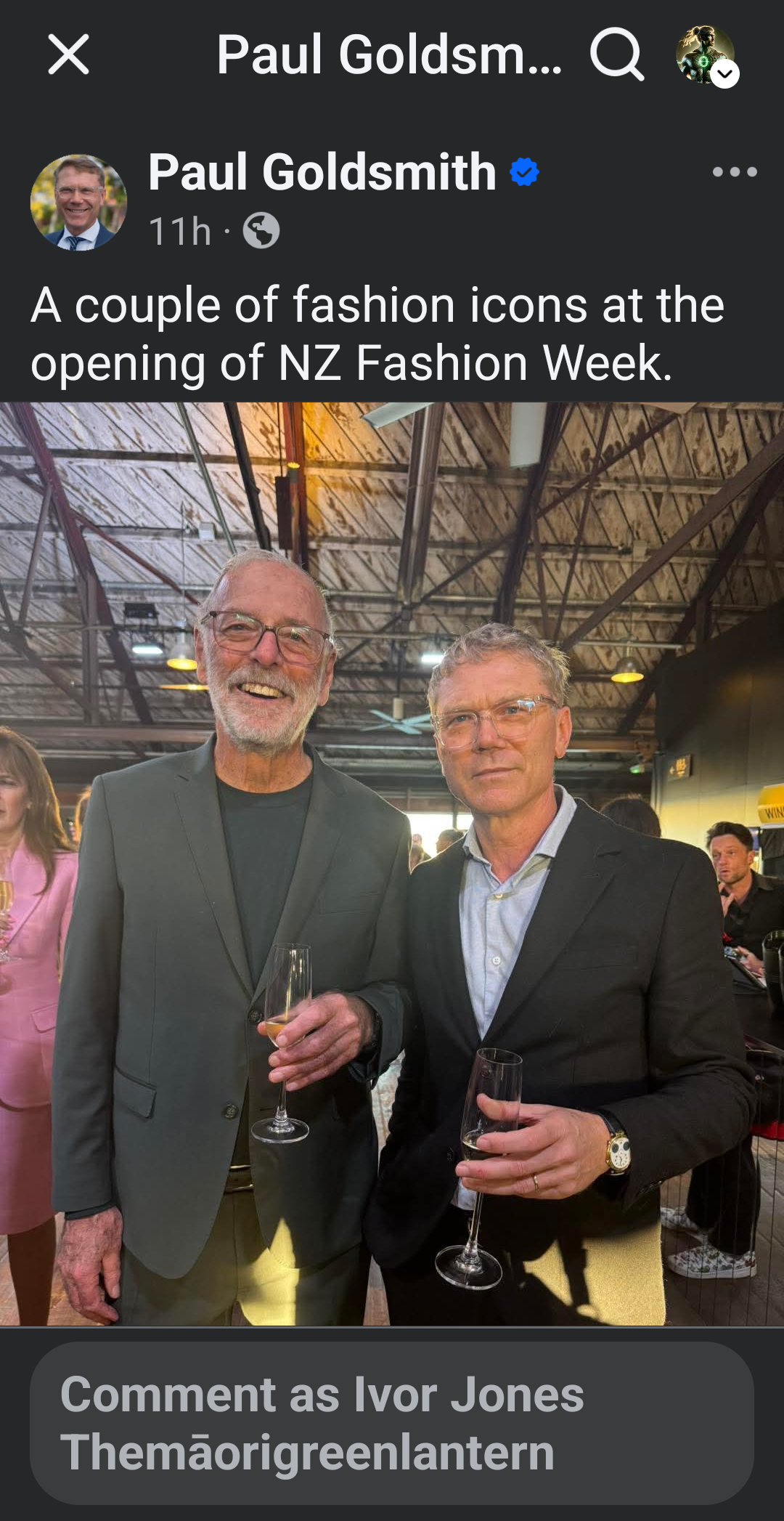
The recent photograph of Wayne Brown and Paul Goldsmith posing like fashion icons at New Zealand Fashion Week's opening reveals everything rotten at the heart of this country's power structure. Two aging white supremacists, champagne flutes raised in celebration, toasting their continued dominance while Indigenous voices remain marginalised. This image captures not just a social moment, but the very essence of how colonisation perpetuates itself through elite spaces and cultural institutions.
https://www.facebook.com/share/p/1D9dCN7rXp/
Background Context
Wayne Brown, Auckland's 76-year-old mayor, has built his political brand on divisive rhetoric targeting Pacific and Māori communities. His recent comments calling Pacific councillors "Pacific victims" when they outperformed him in meeting attendance demonstrates the racist undertones that define his leadership. Paul Goldsmith, the Treaty Negotiations Minister who declared colonisation was "on balance" good for Māori, represents the intellectual wing of colonial apologia, consistently undermining Indigenous rights while maintaining a veneer of respectability.
New Zealand Fashion Week operates as one of those elite spaces where the powerful network, cement relationships, and exclude others. The opening ceremony at Shed 10, featuring celebrities like Taika Waititi walking the runway in designer pieces, creates an exclusive social hierarchy where access equals influence. This is where policy gets made over champagne, where cultural appropriation gets normalised through "fashion", and where the colonial elite congratulates itself on its sophistication.
The Issue at Stake
This photograph matters because it exposes how white supremacy operates in modern Aotearoa through cultural and social institutions. While Indigenous communities struggle with housing crises, health disparities, and ongoing Treaty breaches, these two men toast their success at an event that appropriates Māori concepts like "Kahuria" while systematically excluding tangata whenua voices from meaningful participation.
Brown's documented pattern of racist rhetoric, including his vulgar comments about female councillors and systematic targeting of Pacific representatives, demonstrates active hostility toward diversity. Goldsmith's role in halting Treaty settlements over "sovereignty clauses" shows his commitment to maintaining colonial dominance through legal mechanisms. Together at Fashion Week, they represent the intersection of local and national power structures that perpetuate systemic racism.
Analysing the Colonial Performance
The choice to attend Fashion Week's opening reveals how these men understand power relationships. This is not casual social networking but strategic positioning within New Zealand's cultural elite. Fashion Week operates as a legitimising institution where corporate sponsors, media figures, and politicians gather to reinforce existing hierarchies while appropriating Indigenous aesthetics for commercial purposes.
Wayne Brown's presence particularly galls given his recent attacks on Pacific councillors who actually outperformed him in meeting attendance. His willingness to publicly call them "Pacific victims" while schmoozing at elite social events exposes the racist double standard where brown people face scrutiny for every action while white power brokers enjoy unquestioned privilege.
Paul Goldsmith's attendance demonstrates how colonial ideology adapts to contemporary settings. Rather than crude racial epithets, modern colonisation operates through cultural spaces where Indigenous concepts get commodified while Indigenous people get excluded. His comments about colonisation bringing "literacy" and "democracy" to Māori reveal ignorance about pre-colonial Māori society and demonstrate the ongoing intellectual violence of colonial narratives.
The champagne toast captured in this photograph symbolises celebration of a system built on stolen land, exploited labour, and cultural destruction. While Brown cuts funding for community services that disproportionately serve Māori and Pacific families, he finds resources for fashion week networking. While Goldsmith stalls Treaty settlements that would provide some redress for historical injustices, he celebrates colonial "achievements" at cultural events.
This behaviour aligns perfectly with white supremacist tactics that mask underlying power dynamics through performances of sophistication and culture. Fashion Week provides perfect cover for these relationships because it appears apolitical while actually reinforcing existing power structures through exclusive access and corporate gatekeeping.
The timing reveals deliberate provocation. As Pacific councillors face Brown's public attacks for their advocacy work, he poses for glamorous photos at exclusive cultural events. As Goldsmith blocks Treaty settlements that would provide material redress for colonial theft, he celebrates in spaces that commodify Indigenous aesthetics for profit. This demonstrates the calculated cruelty of contemporary colonisation.
Neoliberal Fashion as Cultural Weapon
Fashion Week exemplifies neoliberal ideology by transforming culture into commodity while obscuring the political relationships that enable such transformation. The event promotes "emerging designers" and "cultural diversity" while remaining fundamentally controlled by corporate sponsors and elite gatekeepers. This creates an illusion of accessibility while maintaining actual exclusion.
The contrast between their Fashion Week appearance and their policy positions reveals the fundamental callousness of neoliberal governance. While Māori and Pacific communities face disproportionate impacts from housing crises and health disparities, these two men toast their success at luxury cultural events funded by the same corporate interests they serve in their official roles.
Goldsmith's role as Treaty Negotiations Minister makes his Fashion Week appearance particularly offensive. While stalling settlements that would provide some material redress for historical injustices, he celebrates in spaces that commodify Indigenous aesthetics. This demonstrates how cultural appropriation operates as ongoing colonisation, extracting value from Indigenous culture while denying Indigenous people control over their own narratives.
Implications for Tangata Whenua
This photograph crystallises everything wrong with contemporary race relations in Aotearoa. Two powerful white men, both documented opponents of Indigenous rights, celebrating together while Indigenous communities face ongoing marginalisation. Their presence at Fashion Week, an event that appropriates Māori concepts while excluding Māori voices from power, demonstrates how cultural institutions perpetuate colonisation.
The broader implications extend beyond individual personalities to systemic issues. Brown's mayoralty has consistently prioritised corporate interests over community needs, particularly affecting Māori and Pacific communities in South Auckland. Goldsmith's ministerial role enables him to block Treaty settlements while maintaining colonial legal structures that deny Indigenous sovereignty.
Their alliance represents the convergence of local and national power structures that maintain white supremacy through seemingly legitimate institutional channels. Fashion Week provides perfect cover because it appears culturally progressive while actually reinforcing existing hierarchies through exclusive access and corporate sponsorship models.
The Māori Green Lantern fighting misinformation and disinformation from the far right
Conclusion
This photograph captures two aging colonials toasting their continued dominance in a space built on appropriated Indigenous culture. Wayne Brown and Paul Goldsmith represent everything toxic about New Zealand's power structure: the racist rhetoric, the cultural appropriation, the systematic exclusion of Indigenous voices, and the celebration of colonial "achievements" while Indigenous communities struggle with ongoing injustices.
Their Fashion Week appearance reveals how white supremacy adapts to contemporary settings, using cultural sophistication to mask brutal political realities. While they sip champagne at exclusive events, Māori and Pacific families face housing crises, health disparities, and ongoing Treaty breaches. This is colonisation in designer clothing, white supremacy with a cultural veneer.
The solution requires dismantling these networks of power and privilege that operate through cultural institutions like Fashion Week. Until tangata whenua control their own narratives and hold real power over their ancestral lands, events like this will continue serving as celebration spaces for ongoing colonisation.
Te Munga Kaitahi, The Māori Green Lantern
Readers who find value in this analysis and wish to support continued exposure of white supremacist networks are welcome to consider a koha to HTDM: 03-1546-0415173-000. The MGL understands these are tough economic times for whānau, so please only contribute if you have capacity and wish to do so.