"Cultural Genocide in Plain Sight” - 20 August 2025
How the Coalition's Calculated Dismantling of Te Reo Māori Reveals the True Face of White Supremacy in Aotearoa
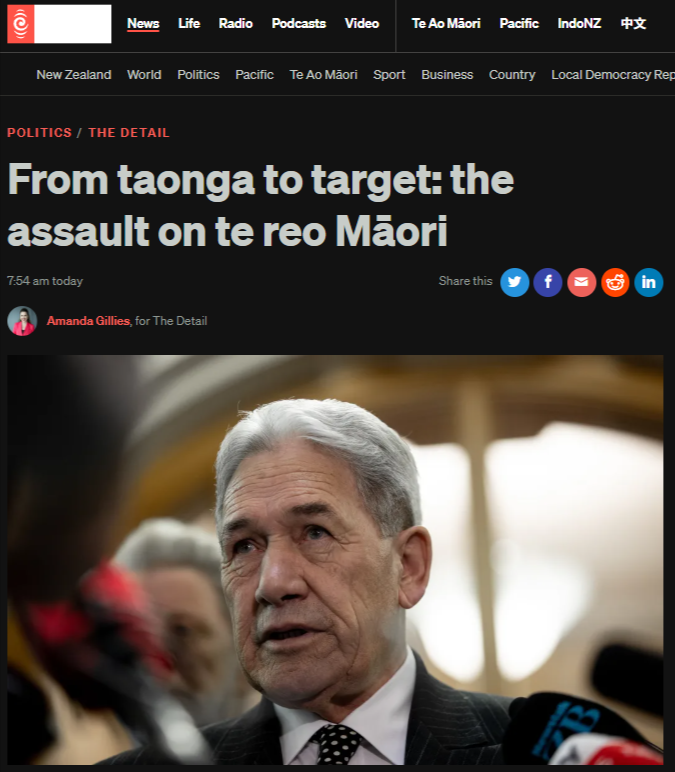
Tēnei au, ko Ivor Jones, The Māori Green Lantern, te kaitiaki whakakore pōhēhē, te kaiwhakatōhea i te teka me ngā haukoti.
The coalition government's systematic assault on te reo Māori isn't political maneuvering—it's cultural warfare in its most insidious form. What we're witnessing is nothing less than a calculated campaign to complete the colonization project that began in 1840, executed with the cold precision of ideologues who understand that language is the soul of a people.
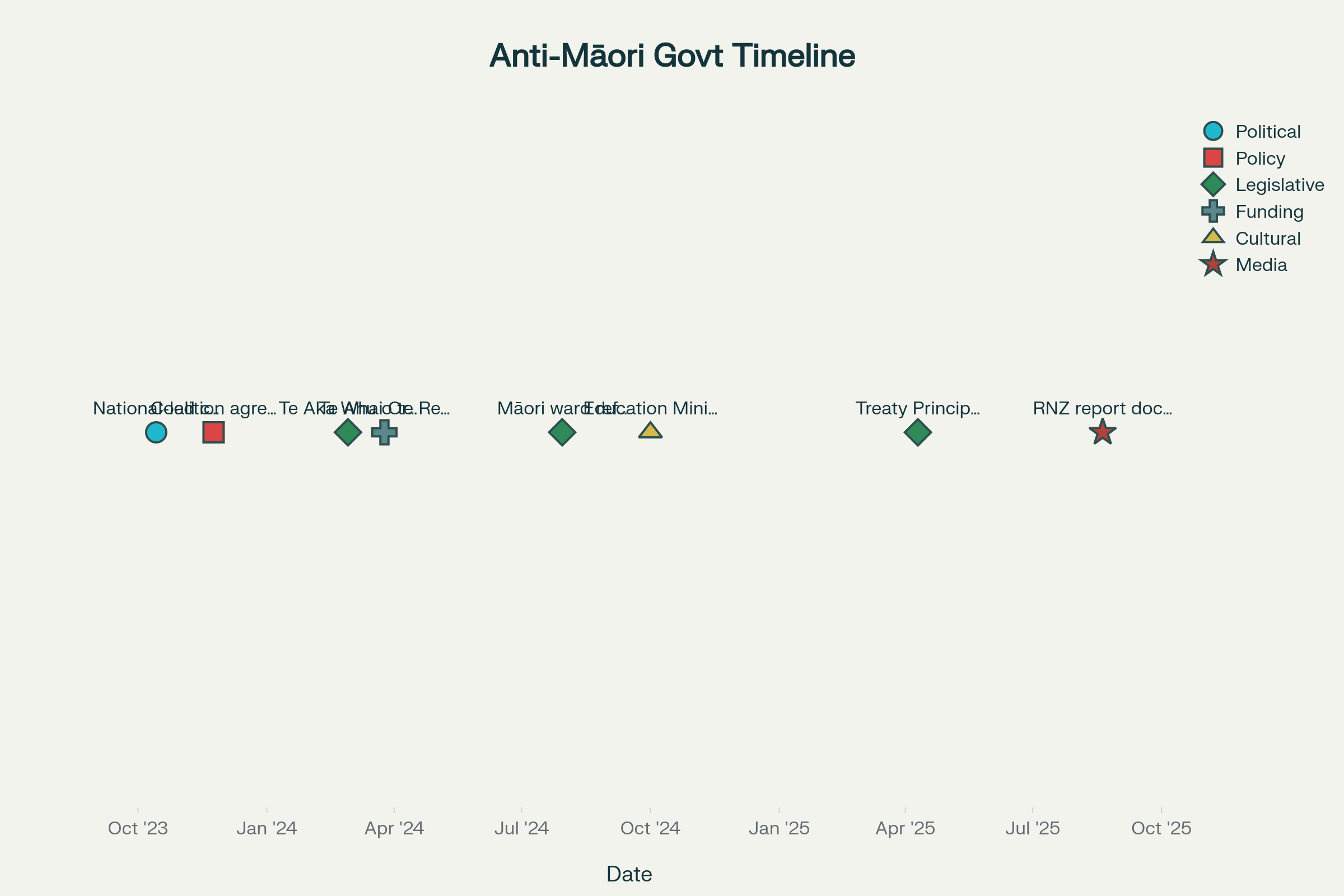
Coalition Government's Anti-Māori Policy Timeline: From Election to Destruction
Background
Te reo Māori, our first language, our taonga tuku iho, stands today under unprecedented attack from a coalition government that has made its contempt for tāngata whenua crystal clear. This isn't about policy differences or democratic debate—this is about the deliberate erasure of Māori cultural identity through legislative violence and bureaucratic suffocation.
The current National-ACT-NZ First coalition came to power through a series of backroom deals that explicitly committed them to rolling back decades of progress toward biculturalism. These aren't accidental oversights or unfortunate side effects—they are the deliberate fulfillment of campaign promises made to voters who were told that Māori had gotten "too much" and needed to be put back in their place.
The Te Aka Whai Ora (Māori Health Authority) was disestablished under parliamentary urgency within months of the coalition taking office, eliminating decades of Māori advocacy for independent health leadership. This was followed by cuts of $30 million to Te Ahu o te Reo Māori teacher training programs, directly attacking the pipeline of educators who could nurture te reo in our schools.
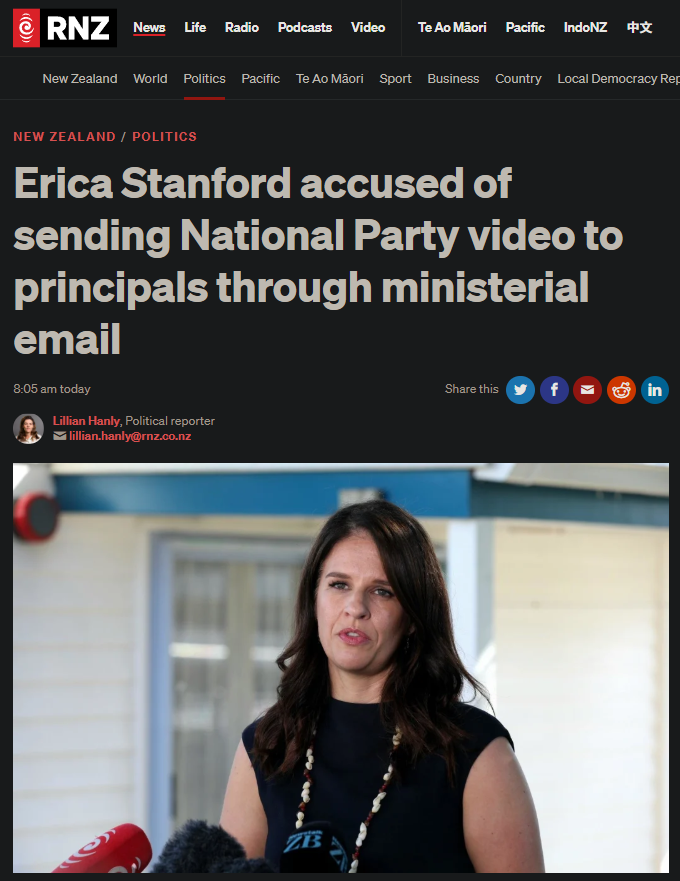
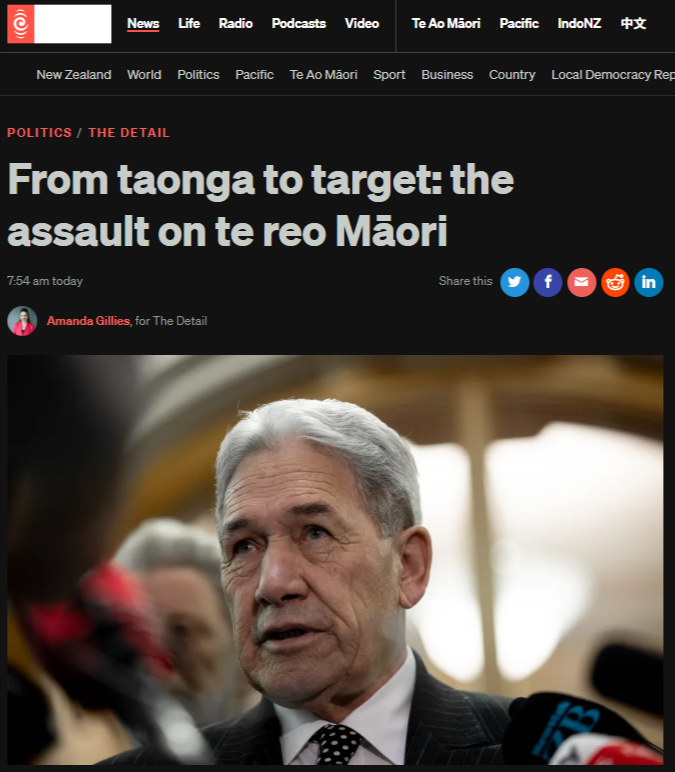
Understanding te reo Māori requires acknowledging it as more than just words—it is te mauri, te whakapapa, te wairua of our people. When Educational Minister Erica Stanford removes te reo from children's books, she's not improving literacy—she's implementing cultural genocide with a bureaucrat's signature.1news
The Pattern of Destruction
The evidence is overwhelming and undeniable. This government has waged war on te reo Māori from multiple fronts simultaneously, revealing a coordinated strategy that could only have been planned in advance.
The Legislative Assault
When National Party leader Christopher Luxon admitted Crown-Māori relations are "probably worse" under his government, he wasn't expressing regret—he was acknowledging the successful implementation of his coalition's anti-Māori agenda. The Treaty Principles Bill, despite its eventual defeat, served its true purpose: legitimizing racist rhetoric and emboldening those who view Māori rights as unfair privilege.rnz+1
The coalition agreements explicitly committed to making English an official language while undermining te reo, mandating that all public service departments have their "primary name" in English and communicate primarily in English unless specifically related to Māori. This isn't about practicality—it's about symbolic domination, ensuring that te reo remains marginalized in all official spaces.rnz
The Funding Strangulation
The $30 million cut to te reo teacher training represents a direct attack on the ability of Māori children to learn their ancestral language. As Waikato-Tainui leader Tukoroirangi Morgan stated, this demonstrates the government has declared war on te reo speaking Māori children, moving beyond mere policy disagreement to active hostility toward our tamariki.From-taonga-to-target-the-assault-on-te-reo-Maori-RNZ-News-08-20-2025_12_16_PM.jpg
These cuts came at precisely the moment when Statistics New Zealand data showed a 48.7 percent increase in iwi members who could hold everyday conversations in te reo. The timing reveals the true motivation: not educational improvement but deliberate cultural suppression designed to halt the revival of our language.From-taonga-to-target-the-assault-on-te-reo-Maori-RNZ-News-08-20-2025_12_16_PM.jpg
The Bureaucratic Suffocation
Education Minister Erica Stanford's removal of te reo from children's reading books represents perhaps the most cynical aspect of this assault. When questioned about removing basic kupu like 'marae', 'kai', and 'hongi' from books for five-year-olds, Stanford blamed the media for not covering her other te reo initiatives. This deflection reveals the calculated nature of her actions—she knew exactly what she was doing and prepared talking points to defend it.1news
The decision affected 13 books in development and potentially impacts the reprinting of 27 existing books containing te reo. This systematic removal of te reo from early childhood education represents long-term cultural engineering designed to ensure future generations of New Zealand children grow up with minimal exposure to Māori language and culture.rnz
The International Dimension
The coalition's contempt for international accountability became clear when Foreign Minister Winston Peters responded dismissively to UN concerns about the government's anti-Māori policies. While Peters' official response was more diplomatic than ACT leader David Seymour's aggressive initial letter, the substance remained clear: this government rejects international oversight of its treatment of indigenous people.nzherald
The coalition agreements explicitly state that the government "does not recognise the United Nations Declaration on the Rights of Indigenous Peoples (UNDRIP) as having any binding legal effect on New Zealand". This represents a deliberate repudiation of international indigenous rights frameworks, sending a clear message that New Zealand under this coalition considers itself above global standards for the treatment of indigenous peoples.rnz
The Māori Response
The response from Māori communities has been unprecedented in its unity and determination. The National Hui for Unity called by Kiingi Tuheitia brought together 10,000 people in a display of solidarity not seen in generations. This wasn't political theater—it was the activation of indigenous resistance networks that had been building quietly for years.nzherald
When Ngāpuhi leaders walked out of the National Iwi Chairs Forum meeting with the Prime Minister, they sent an unmistakable message about the breakdown of the Crown-Māori relationship. Te Rūnanga o Ngāpuhi Chair Mane Tahere's statement that they "cannot and will not sit in this room in silence while this government continues to run roughshod over our people" represents a fundamental shift in Māori political strategy.rnz
The National Iwi Chairs Forum's resolution to exclude government representatives from future meetings demonstrates that iwi leadership has moved beyond polite engagement to active resistance. When Marama Royal of Ngāti Whātua Ōrākei told government ministers "it feels like we are being attacked," she wasn't expressing hurt feelings—she was diagnosing political reality.1news
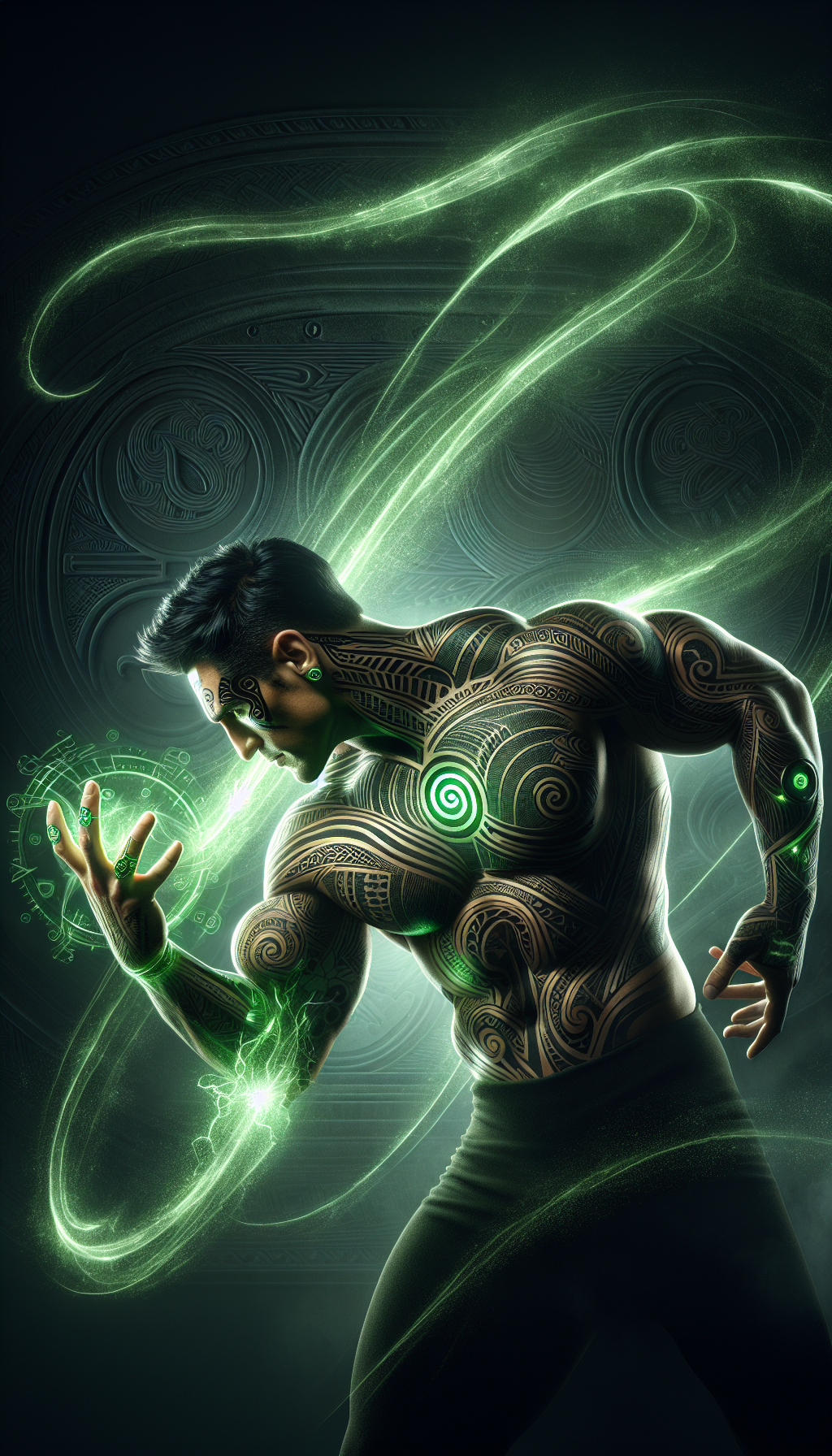
The Māori Green Lantern fighting misinformation and disinformation from the far right
The Hidden Connections
The coordination between coalition partners reveals careful planning rather than spontaneous policy development. ACT leader David Seymour's long-standing opposition to co-governance provided the ideological framework, while New Zealand First leader Winston Peters supplied the populist rhetoric about "elite Māori" and racial privilege. National Party leader Christopher Luxon enabled both, trading away Māori rights for coalition stability.1news+1
The timing of policy announcements reveals strategic coordination designed to maintain constant pressure on Māori communities. The Treaty Principles Bill was introduced knowing it would fail, serving its real purpose of legitimizing anti-Māori discourse and providing cover for other attacks on indigenous rights.1news
When Waitangi Tribunal reports condemned government policies as breaches of Te Tiriti, the government simply ignored them, demonstrating contempt not just for Māori rights but for New Zealand's own legal and constitutional processes.maoriparty
The Implications for Our People
The assault on te reo Māori represents more than policy disagreement—it's the attempted completion of the colonial project through cultural destruction. When Associate Professor Awanui Te Huia warns that government policies "embolden racist positions and treat the irrational as rational", she's identifying the dangerous normalization of white supremacist ideology in mainstream political discourse.waikatotainui
The psychological impact on Māori communities cannot be understated. When our children are told their language is "too confusing" for other children to learn alongside, when our place names are anglicized, when our cultural expressions are erased from public life, the message is clear: you don't belong here, your culture has no value, your people have no future.
This connects to broader patterns of neoliberal destruction, where everything of value—language, culture, land, relationships—becomes subordinate to market efficiency and colonial control. The coalition's simultaneous attacks on worker rights, environmental protections, and social services reveal the common thread: the prioritization of capital and colonial power over all forms of life and community.
Call to Action
The time for polite engagement has ended. This coalition government has declared war on te reo Māori, on tāngata whenua, on the very possibility of genuine biculturalism in Aotearoa. Their actions reveal them as the spiritual heirs of those who implemented the Native Schools Act, who punished our tīpuna for speaking te reo, who sought to "kill the Indian, save the man."
We must respond with the full force of our collective power. Support Te Pāti Māori's resistance efforts. Defend te reo in your whānau, your communities, your workplaces. Challenge every attempt to normalize the government's cultural violence.rnz
The revitalization of te reo Māori is one of our greatest achievements as a nation, proof that colonization is not inevitable or irreversible. But it requires our active protection and nurturing, especially in the face of those who would destroy it out of fear, hatred, and ideological obsession.
Kaua e rongo ki a rātou. Our language will survive. Our culture will survive. Our people will survive. But only if we stand together and fight for what is ours by right, by birth, by the promise of Te Tiriti that this government seeks to betray.
Ko au ko The Māori Green Lantern, kaitiaki o te pono.
Readers who find value in this analysis and wish to support this kaupapa of exposing white supremacy and neoliberal destruction are welcome to contribute a koha: HTDM: 03-1546-0415173-000. I understand these are challenging economic times for whānau, so please only contribute if you have capacity and wish to do so.
Noho ora mai rā.