“Deconstructing Damien Grant's Neoliberal Attack on Education” - 31 August 2025
When Convicted Fraudsters Lecture Us on Academic Standards

Kia ora whānau.
When a convicted fraudster turned insolvency practitioner teams up with Atlas Network-affiliated think tank researchers to attack our universities, we're witnessing more than just academic critique - we're seeing a calculated assault on Indigenous knowledge systems and collective wellbeing disguised as educational reform.

The Māori Green Lantern logo representing Indigenous kaitiaki values and justice
Damien Grant's recent diatribe in Stuff represents a masterclass in neoliberal propaganda, weaponizing selective data to advance an agenda that serves corporate interests while systematically undermining Māori educational aspirations. This isn't about academic standards - it's about maintaining colonial control over knowledge systems that might challenge white supremacist power structures.
Background: The Players in This Colonial Theatre
Grant's attack relies heavily on research from Dr James Kierstead, a researcher at The New Zealand Initiative who migrated from Oxford and Stanford's elite academic circles to become a mouthpiece for free-market ideology. Kierstead's research on "grade inflation" provides the academic veneer for Grant's broader assault on public education - classic neoliberal tactics of using credentialed voices to legitimize market fundamentalism.
The New Zealand Initiative itself emerged from the merger of the Business Roundtable and neoliberal advocates, serving as New Zealand's primary vehicle for Atlas Network ideology. This global network of corporate-funded think tanks systematically promotes policies that benefit wealthy elites while disguising their agenda as academic research and policy expertise.
Grant's own background adds bitter irony to his moral lecturing. Sentenced to 30 months in prison for fraud at age 26, Grant was involved in a multi-million dollar share-dealing scam that he describes with disturbing nostalgia as "intellectually very interesting because you're operating against the state." His rehabilitation narrative would be compelling if it weren't being used to attack the very educational institutions that could provide similar second chances to Māori youth.
Manufacturing Crisis to Justify Market Solutions
Grant's argument follows a predictable neoliberal playbook: identify perceived problems in public institutions, blame systemic factors like "kindness" and "empathy," then imply market-based solutions are necessary. His anecdote about a law graduate unable to cite cases beyond the famous "snail in a coke bottle" case becomes the foundation for sweeping claims about educational failure.

The chart above clearly demonstrates the 13 percentage point increase in A-grades from 22% to 35% between 2006-2024 that Kierstead's research documents. While Grant presents this as evidence of declining standards, he systematically ignores the complex factors driving these changes, particularly the impact on Māori students who face structural barriers throughout their educational journey.
The timing of this attack is no coincidence. As universities struggle with funding cuts and market pressures, Grant and his neoliberal allies are preparing the narrative groundwork for further privatization. Their critique of "grade inflation" provides perfect justification for implementing "rigorous" market-based assessment systems that inevitably disadvantage Indigenous students and working-class communities.
Exposing the Neoliberal Academic Industrial Complex
The Atlas Network Connection
Grant's collaboration with Kierstead represents a textbook example of how the Atlas Network operates through seemingly independent academic research. The New Zealand Initiative, as an official Atlas partner, receives funding from major New Zealand corporations to produce research that advances free-market ideology under the guise of objective scholarship.
Kierstead's academic credentials - Oxford, Stanford, classical studies - provide the perfect cover for neoliberal advocacy. His transition from academia to The New Zealand Initiative mirrors the broader corporatization of knowledge production where elite institutions train researchers who then legitimize policies benefiting their corporate funders.

Atlas Network as global octopus of corporate-funded think tanks spreading neoliberal ideology
The Manufacturing of Educational Crisis
The "grade inflation" narrative serves multiple neoliberal objectives simultaneously. By focusing on rising grades rather than educational access or cultural responsiveness, Grant and Kierstead redirect attention away from the massive achievement gaps facing Māori students.
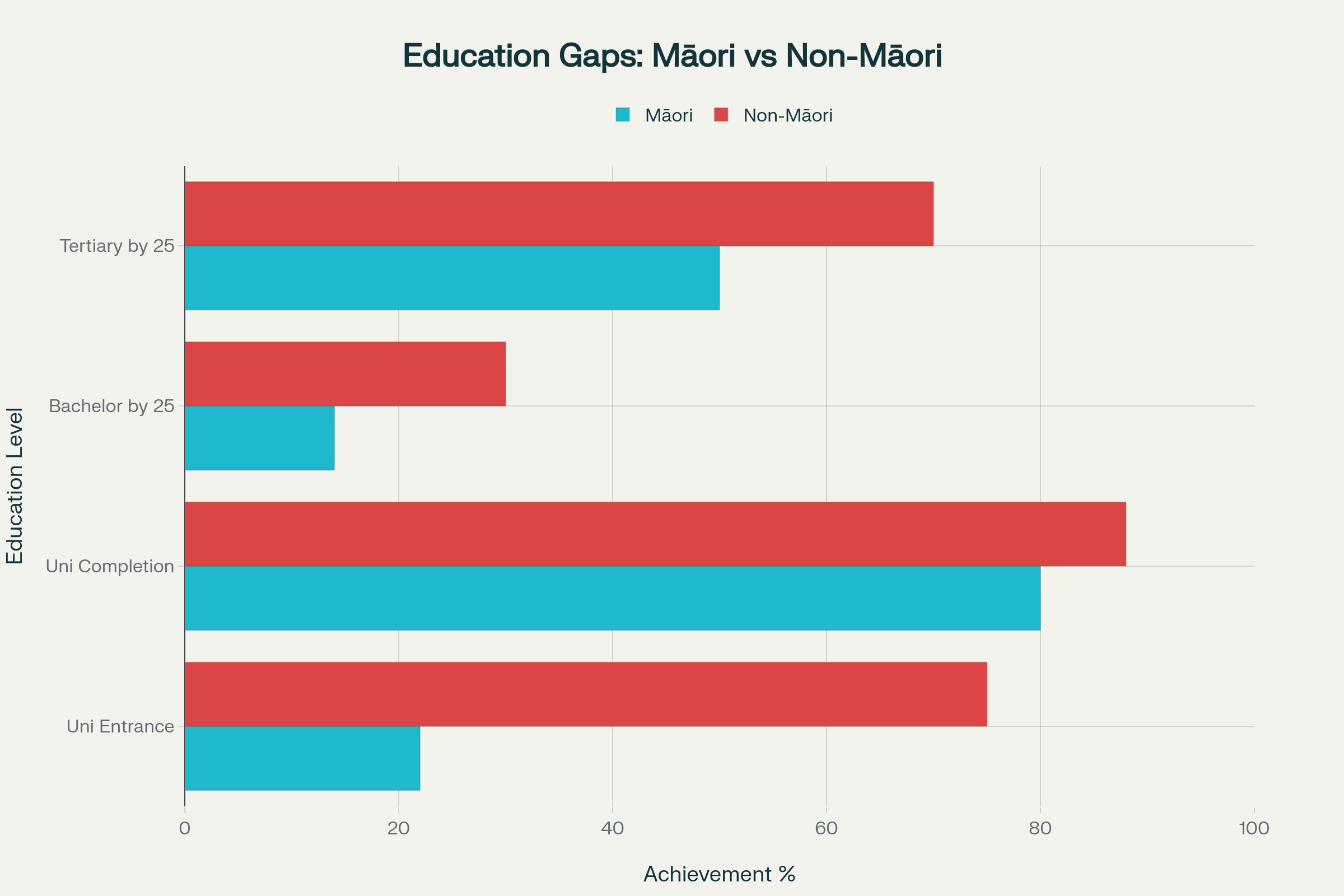
Educational achievement gaps showing stark disparities between Māori and non-Māori students across education levels
This starkly illustrates these disparities: only 22% of Māori students achieve University Entrance compared to 75% of non-Māori, yet Grant's analysis completely ignores this structural inequality.
The research conveniently omits critical context about why grades might be rising. During COVID-19, universities implemented compassionate grading policies recognizing the extraordinary challenges students faced. For Māori students, who are disproportionately affected by poverty and systemic barriers, these policies represented rare acknowledgment of structural disadvantage.

Manufacturing educational crisis through corporate manipulation of academic data and narratives
Weaponizing Academic Credibility Against Indigenous Knowledge
Grant's attack on "empathy" in grading reveals the colonial mindset underlying neoliberal education philosophy. The principle of aroha - love and compassion - is fundamental to Māori worldviews and pedagogical approaches. By framing empathy as educational weakness, Grant attacks the very values that could make universities more responsive to Māori learning needs and cultural frameworks.
The irony is devastating: a convicted fraudster lecturing universities about integrity while promoting research that systematically ignores the educational apartheid facing Māori students. Grant's narrative positions individual "merit" as the sole valid measure of educational success, completely erasing the collective disadvantage created by colonial education systems designed to assimilate rather than empower Māori learners.
Revealing the Hidden Connections: Corporate Capture of Educational Discourse
The Business Roundtable Legacy
The New Zealand Initiative's corporate DNA traces directly to the Business Roundtable, the neoliberal organization that championed the 1990s privatization agenda that devastated Māori communities. Roger Douglas and Ruth Richardson's "mother of all budgets" eliminated state housing support and privatized billions in public assets, creating the housing crisis that now crushes Māori whānau with intergenerational poverty.
Grant's insolvency business directly profits from this system of manufactured scarcity. As principal of Waterstone Insolvency, he literally makes money from business failures - the inevitable casualties of the deregulated economy he champions in his opinion columns. The contradiction is breathtaking: a man whose livelihood depends on corporate collapse lecturing us about institutional failure.
Atlas Network's Global Assault on Indigenous Rights
The Atlas Network's influence extends far beyond New Zealand, consistently opposing Indigenous rights and environmental protections worldwide. Academic research reveals how Atlas-affiliated organizations have historically promoted "psychological race science" and deployed "assertions about the unequal mind" to attack political-economic equality. Their opposition to Indigenous sovereignty isn't accidental - it's central to their corporate agenda.
In New Zealand, this manifests through systematic attacks on Treaty partnerships and co-governance arrangements. The Regulatory Standards Bill championed by Atlas-connected politicians like David Seymour explicitly promotes "equal treatment before the law" - code for eliminating Māori-specific programs and Treaty protections that address historical injustices.
The Academic-Corporate Revolving Door
Grant's partnership with Kierstead exemplifies how neoliberal ideology captures academic institutions. Universities, starved of public funding and forced to compete for students-as-customers, become vulnerable to corporate influence through "research partnerships" and industry-friendly academics. Kierstead's migration from elite universities to corporate think tank work represents this broader pattern of knowledge production serving capital rather than community wellbeing.
The grade inflation research itself serves corporate hiring needs by providing "objective" justification for bypassing university credentials in favor of private assessment systems. As Grant notes, employers "now discount academic transcripts in favour of private assessments" - creating new markets for corporate testing while undermining public educational achievements.
The Māori Education Reality: Systematic Exclusion Disguised as Standards
Structural Barriers Hidden Behind Individual Blame
Grant's analysis systematically ignores the massive structural barriers facing Māori students throughout their educational journey. Research consistently shows that unconscious bias from teachers affects Māori performance, creating achievement gaps that compound through each level of education.
When Grant dismisses universities for being "kind," he's attacking the very accommodations that begin to address centuries of educational exclusion. For Māori students who enter universities despite systematic disadvantage, supportive grading policies represent rare acknowledgment of the additional barriers they've overcome. Grant's "meritocracy" ignores that the playing field was never level to begin with.
The Success of Kaupapa Māori Education
The data Grant ignores tells a powerful story about Indigenous educational approaches. Students in kaupapa Māori schools achieve University Entrance at 41% compared to just 24% in mainstream schools, despite serving predominantly low socio-economic communities. These schools demonstrate that when education centers Māori values and knowledge systems, students thrive academically.
Yet Grant's analysis completely ignores this success, focusing instead on abstract concerns about "grade inflation" that conveniently support arguments for educational privatization. The neoliberal agenda requires public education to appear failing to justify market solutions, even when evidence shows Indigenous-led approaches outperform colonial education models.
University Funding and the Commodification of Students
Grant's attack on universities obscures the real cause of educational problems: chronic underfunding and the marketization of education itself. Universities forced to treat students as revenue sources rather than learners inevitably compromise educational integrity to maintain enrollment numbers.
The "grade inflation" Grant condemns is often universities' response to impossible funding pressures created by neoliberal policies. When institutions lose funding for failing to retain students, compassionate grading becomes a survival strategy rather than academic weakness. Grant's solution - further marketization through private assessments - would only intensify these perverse incentives.
Implications: The Corporate Capture of Educational Discourse
Grant's piece represents more than individual opinion - it signals a coordinated campaign to reshape public understanding of educational quality in ways that serve corporate interests. By positioning himself as a reformed criminal concerned about integrity while promoting research from corporate-funded think tanks, Grant manufactures credibility for arguments that would otherwise be recognized as self-serving corporate propaganda.
The broader implications extend to Treaty relationships and Indigenous sovereignty. Educational institutions represent critical sites where Māori knowledge systems and worldviews can flourish or be suppressed. Grant's attack on "empathy" and cultural responsiveness in grading directly threatens mātauranga Māori approaches that center collective wellbeing over individual competition.
For Māori communities, Grant's arguments provide ammunition for further cuts to equity programs and Treaty-based educational initiatives. His narrative that universities are "failing" because they're "too kind" to struggling students directly contradicts Indigenous values of aroha and manaakitanga that should guide educational relationships.
The international context reveals this as part of a global neoliberal assault on Indigenous education. From Australia's cashless welfare cards targeting Aboriginal communities to Canada's residential school legacy, corporate interests consistently attack Indigenous educational approaches that might challenge colonial knowledge systems or economic extraction.

The Māori Green Lantern Fighting Misinformation And Disinformation From The Far Right
Defending Indigenous Knowledge Against Corporate Colonization
Grant and Kierstead's academic-corporate alliance represents the sophisticated evolution of colonial control - replacing overt violence with manufactured research and policy narratives that serve the same function: maintaining white supremacist power structures while providing plausible deniability about racist intent.
Their focus on "grade inflation" while ignoring massive Māori achievement gaps reveals the fundamental dishonesty underlying neoliberal educational discourse. They're not concerned about academic standards - they're threatened by educational institutions becoming more responsive to Indigenous needs and worldviews.
The way forward requires recognizing Grant's arguments as corporate propaganda disguised as educational concern. Real educational integrity means centering Indigenous knowledge systems, addressing structural racism, and prioritizing collective wellbeing over individual competition. It means rejecting the false choice between "academic rigor" and cultural responsiveness.
As kaitiaki of knowledge and justice, we must expose how corporate-funded research manufactures crises to justify further privatization and cultural assimilation. Grant's piece isn't educational analysis - it's a calculated attack on Indigenous intellectual sovereignty wearing the mask of academic concern.
The universities Grant attacks aren't failing because they show kindness to struggling students. They're struggling because neoliberal policies have systematically underfunded public education while creating market pressures that distort educational relationships. The solution isn't more privatization and corporate assessment systems - it's fully funding public education and centering Indigenous knowledge systems that understand learning as collective responsibility rather than individual competition.
Our mokopuna deserve educational institutions that honor both academic excellence and aroha, that recognize Indigenous knowledge as equally valid to Western academic traditions, and that measure success through community wellbeing rather than corporate convenience. Grant's vision would create exactly the opposite: educational apartheid disguised as meritocracy.
For those who find value in exposing these colonial deceptions, please consider supporting this mahi with a koha to HTDM: 03-1546-0415173-000. The MGL understands these are challenging economic times for whānau, so please only contribute if you have the capacity and wish to support Indigenous resistance to corporate colonization.
Kia kaha, kia māia, kia manawanui.
Ivor Jones
The Māori Green Lantern