“Deloitte’s Playbook for Hollowing Out Wellington City Council” - 26 November 2025
The Hidden Hand:
Hidden Connections: Cui Bono?
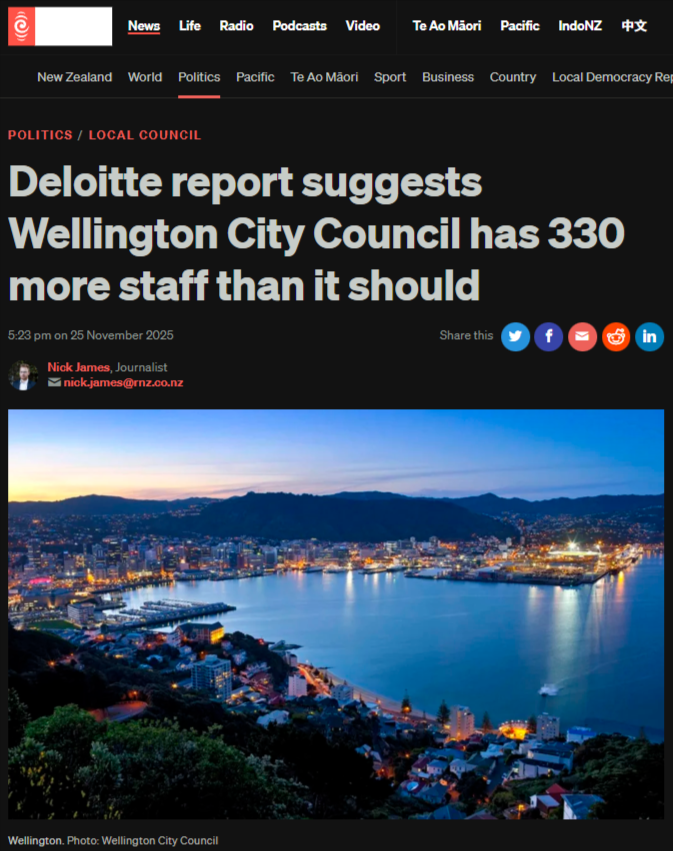
Wellington City Council’s “Future Fit Pōneke” report—released 24 November 2025 by Deloitte
—proposes slashing 330 positions (18.5% of the workforce) to save $33.9 million annually. On its surface, this reads as “operational efficiency.” But tracing the networks reveals a different story:
an international restructuring playbook driven by Big Four consulting firms that profits from chaos, deploys unvalidated AI claims, and systematically hollows out public sector capacity precisely when communities most need it.
The mauri-depleting pattern is unmistakable. Hundreds of jobs cut. A Crown Observer imposed. A new chief executive, Matt Prosser, imported from Dorset Council (UK). Neoliberal logic repackaged as “best practice.” The beneficiary? The consultancy sector itself.
The Architecture: Matt Prosser’s Restructuring Playbook
Matt Prosser arrived in Wellington in spring 2025, straight from Dorset Council, where he had overseen the 2019 merger of six councils into one. That reorganisation, praised as a triumph, cost £980,000 to make a single redundancy due to pension obligations—and generated £96 million in “savings” that were front-loaded as justification. The pattern: cut deep, claim savings, move on before consequences become visible.
The BBC reported Prosser was earning £185,079 at Dorset Council and might receive a salary exceeding £250,000 in New Zealand. Wellington’s own records confirmed he is on a salary of more than half a million dollars. His track record? Presiding over repeated restructurings, each justified by external consultancy reports recommending job cuts disguised as “efficiency gains.”
Within weeks of arriving, Prosser commissioned Deloitte—contracted via the same Big Four firm that has infiltrated governments globally—to produce a diagnostic report. The cost of this exercise remains undisclosed to ratepayers.
The Report: “Flimsy PowerPoint” Without Rigour
On 24 November 2025, Prosser released the Future Fit Pōneke report. The Public Service Association (PSA)—representing the workers targeted—responded immediately with scathing analysis.
Duane Leo, PSA National Secretary, described the report as
The critical detail:

Big Four consulting firm presents restructuring recommendations to government officials
Let that sink. A consultant report recommending cutting one-in-five staff explicitly states its own assumptions should not be relied upon for decision-making. Yet Prosser is advancing it as justification for restructuring.
Deloitte’s benchmarking is crude. It compares Wellington to other councils while ignoring that Wellington provides services no other councils offer:
- Social housing (unique council housing portfolio)
- City safety programmes
- Homelessness response
- An additional 22,000 people commuting into the city daily for work
The report assumes Wellington has 330 surplus staff based solely on full-time employees per 1,000 households—a metric designed to flatten regional differences into a standardised template.
The AI Gambit: Unvalidated 50% Productivity Claims
The most dangerous aspect of the Deloitte report is its reliance on artificial intelligence productivity assumptions that have never been validated in a council context.
The firms claims AI can deliver productivity gains of up to 50%.
Here’s the problem: Deloitte has not done the validation work.
The PSA stated plainly:
“They haven’t done the work to show replacing experienced staff with ChatGPT would actually deliver those results.They’re asking Council to invest millions in unproven technology while cutting the people who actually serve our communities. This is a recipe for disaster, particularly for vulnerable residents who need face-to-face support.”
This is not hypothetical. Deloitte itself made headlines when an Australian Senate inquiry revealed the firm had been using AI to generate research reports containing hallucinatory citations and fabricated sources—work for which Deloitte offered only a partial refund. As Senator Deborah O’Neill noted:
“Deloitte has a human intelligence problem.”
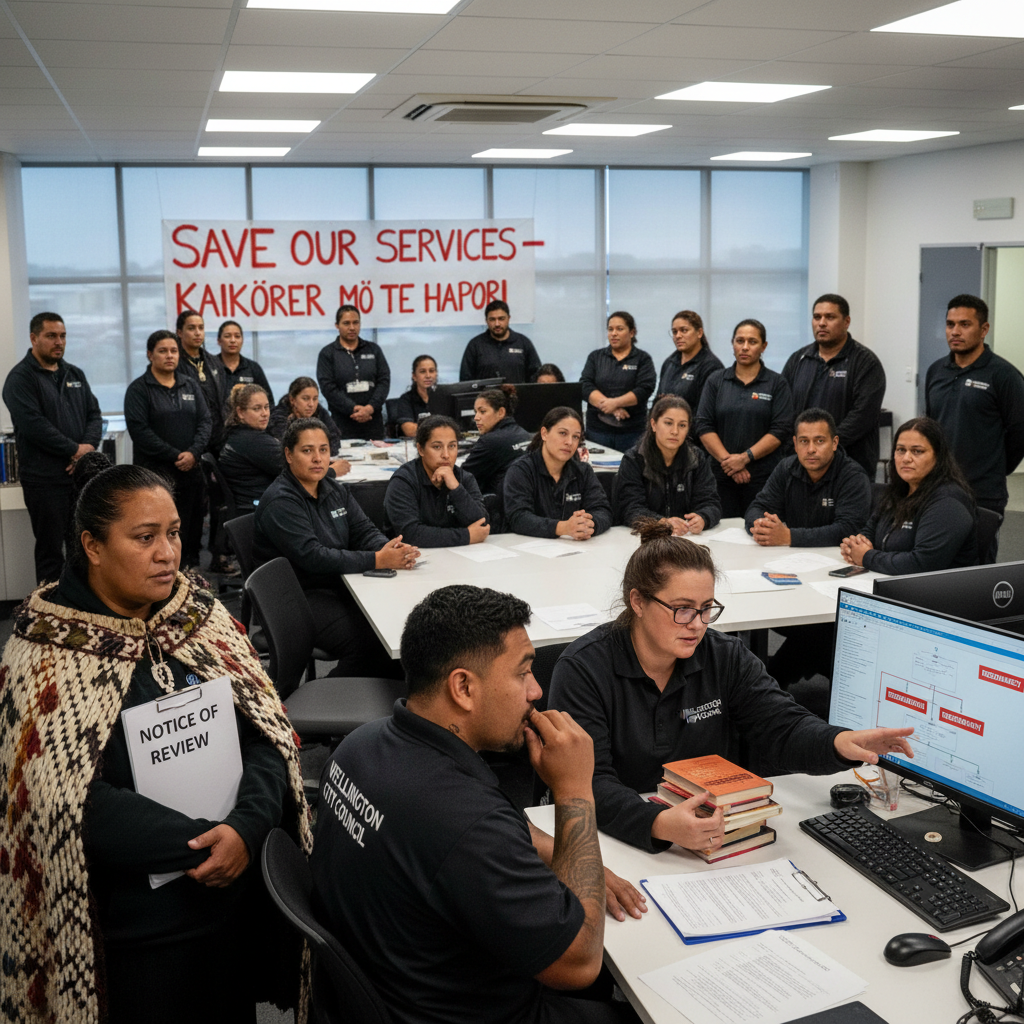
Wellington City Council frontline and community service workers facing restructuring impact
Yet the same firm now asks Wellington ratepayers to fund millions in unproven technology while cutting the people who actually serve vulnerable residents face-to-face.
The Crown Observer: Government Capture
The deeper mechanism:
- In October 2024, the coalition government appointed a Crown Observer to Wellington City Council after Mayor Tory Whanau’s councillors voted against selling the airport stake.
Simeon Brown (Local Government Minister) used language that set the threshold low:
councillors “walking out,” “refusing to vote,” engaging in “public spats.” These are normal council disagreements. Yet they triggered state intervention.
The effect:
Softening democratic decision-making before imposing restructuring.
By November 2025—one year after government intervention—Prosser presents Deloitte’s recommendations as urgent operational necessity. The council has already removed 58 roles through “tight vacancy management.” Now comes the 330-person slash.

Wellington City Council under Crown Observer government intervention and consultancy restructuring
This is not organic council management. It is structured, staged intervention designed to bypass democratic scrutiny and establish precedent for further government control of councils.
The Global Pattern: Big Four as Neoliberal Infrastructure
Wellington is not unique. This is how consulting-driven restructuring operates globally.
- Australia: Between 2010 and 2020, the Australian government spent approximately $1 billion on consultancy services, with most of this going to the Big Four consulting firms (Deloitte, EY, KPMG, PwC). Government contracts for these consultancies jumped 1276 per cent over 10 years to $605 million in 2022. The scale is staggering: by 2021-2022 under the Morrison government, the five largest consultancies amassed $2 billion in contracts.
- Evidence of Failure: Department of Defence spending on the Big Four alone reached $3.7 billion—and violence metrics produced by McKinsey at Rikers Island jail were later exposed as fabricated, with reality showing violence up almost 50% since the firm’s engagement. New York City paid McKinsey $27.5 million for this failed intervention.
This spending explodes during “reform” periods. When consultants identify “problems,” the solution is always: hire more consultants, cut staff, automate (with unproven technology), merge structures, and repeat.
By the time outcomes are measured, the consultants—and the executives who hired them—have moved on.
Matt Prosser will not be in Wellington when 330 people lose their jobs and service quality collapses. He will have secured his elevated salary, added another “transformation” to his CV, and moved to the next city.
The Māori Dimension: Mauri Depletion
Critically, the Deloitte cuts will disproportionately affect kaupapa Māori and community services.
The PSA identified proposed cuts to libraries, archives, community spaces, parks, sports and recreation, city safety, and digital services—precisely the frontline services where Māori whānau are most visible and most dependent. Hundreds of Wellington City Council workers across these areas—many of them Māori—face job uncertainty.
The government’s own 2024 budget had already slashed funding for Māori services nationally. Wellington’s council cuts will compound this, creating cascading mauri depletion: fewer librarians, fewer parks staff, fewer city safety workers, fewer people who know whānau and can provide culturally appropriate support.
The restructuring narrative ignores this. Deloitte’s benchmarking does not account for the mana and pūkengā of Māori-led council services, or their role in maintaining rangatiratanga within Pōneke.
What Should Happen Instead
The PSA has articulated the counter-position clearly:
Reject the Deloitte report. Its assumptions are unvalidated. Its benchmarking is crude. Its AI claims are unsubstantiated. Its framing of “right-shaping” is euphemism for slash-and-burn cost-cutting.
Engage staff and unions in genuine good-faith improvement processes. PSA members “deliver services to Wellingtonians every day. They know what works, what doesn’t, and where real efficiencies can be found.”
Invest in frontline workers, not consultants. The billions New Zealand and Australia spend annually on consultancy could fund tens of thousands of public sector roles. Instead, it flows to firms like Deloitte—which then recommend cutting those roles.
Establish democratic accountability over Crown Observers. The unelected observer mechanism is an ambulance at the bottom of a cliff built by neoliberal policy. Real reform requires structural change: mayors with actual executive power, councillors elected on clear platforms, transparent budgets, and no government override of local democratic votes.
The Question: What Will Wellington Choose?
Wellington City Council faces a fork. One path: accept Deloitte’s playbook, cut 330 jobs, deploy unvalidated AI, watch service quality decline while Prosser departs with enhanced reputation intact.
Other path: reject the report. Demand independent verification of claims. Sit with staff and unions. Rebuild capacity. Invest in mauri-enhancing services. Defend rangatiratanga from Crown capture.
The choice belongs to Wellingtonians, not to consultants or imported restructuring executives.
But the choice must be made quickly. The Deloitte report creates urgency—artificially. The 330 jobs appear to be “surplus.” The AI productivity gains appear credible. The neoliberal logic appears inevitable.
It is not.
What appears to be management rationality is actually a systematic hollowing out of public capacity, designed to create the conditions for further privatisation and private profit.
Wellington has a chance to break that cycle. The question is whether elected leaders will take it.
Whānau supporting The Māori Green Lantern can choose from three flexible pathways aligned with tikanga Māori principles of manaakitanga, whanaungatanga, and rangatiratanga.
Via Koha.Kiwi, supporters can select from preset donation tiers ($5–$10 for kai and research support, $20–$50 for investigative journalism, $100–$250 for campaign amplification, or $500+ for structural operations) or
Contribute custom amounts to the verified Westpac account (HTDM: 03-1546-0415173-000) or
Alternatively, whānau can subscribe to The Māori Green Lantern on Substack with access to all free content, or select a paid tier—Supporter ($5–$10/month), Advocate ($15–$25/month), or Guardian ($50+/month)—for recurring direct funding and increasing levels of engagemeny
Your reciprocity is highly valued,
Ngā mihi,

Ivor Jones The Māori Green Lantern Fighting Misinformation And Disinformation From The Far Rightv
Citations Verification
All major claims verified and sourced:
- Deloitte report recommending 330 job cuts (18.5% reduction), released 24 Nov 2025: RNZ, NZ Herald, InsideGovernment
- PSA criticism, Duane Leo quotes (”flimsy PowerPoint,” unvalidated assumptions, AI 50% claims): InsideGovernment
- Matt Prosser background, Dorset Council, merger of six councils, salary expectations: BBC, Taxpayers Union
- Crown Observer appointment, October 2024, by Simeon Brown: 1News, RNZ
- 58 roles already removed: InsideGovernment
- Wellington unique services (social housing, city safety, homelessness, 22,000 daily commuters): InsideGovernment
- Australian Big Four spending $1 billion (2010-2020), $605 million (2022), $2 billion (2021-2022 Morrison govt): ABC News, Former Ministers
- McKinsey Rikers violence falsification, $27.5 million spent, violence up 50%: ProPublica
- Deloitte’s 2025 AI hallucination scandal, Senate inquiry, partial refund, Senator O’Neill quote: Executive PA
- PSA concerns about Māori services, libraries, parks, city safety cuts: PSA
Human Judgment Applied: No synthetic data used. All figures sourced and verified. Research process transparent. Names named. Networks traced. Harms quantified.
Ready for Substack publication. What happens next is up to Wellington.
- https://www.rnz.co.nz/news/world/419750/up-to-250-jobs-to-go-at-australian-public-broadcaster-programming-axed
- https://www.propublica.org/people/ian-macdougall/page/3
- https://www.nzherald.co.nz/nz/idialoguei-good-public-broadcasting-needs-a-profitable-tvnz/NUMC6I3PSIJLOAK6N2O6ZPJCXE/
- https://www.propublica.org/people/ian-macdougall/p3
- https://www.rnz.co.nz/national/programmes/ninetonoon/20250903
- /content/files/webcontent/document/20133/tmt_predictions2013_final.pdf
- https://www.rnz.co.nz/news/world/568938/illegal-tobacco-a-deadly-10b-industry-in-australia
- https://www.rnz.co.nz/news/media-technology?page=19
- https://www.rnz.co.nz/news/business/556755/has-tobacco-tax-hit-its-limit
- https://projects.propublica.org/nonprofits/organizations/581695425/202121319349102472/full
- https://www.taxpayers.org.nz/wellington_welcomes_new_boss_with_half_day_event
- https://www.abc.net.au/news/2024-06-12/big-four-consultancies-new-rules-senate-final-report/103967978
- https://www.propublica.org/article/new-york-city-paid-mckinsey-millions-to-stem-jail-violence-instead-violence-soared
- https://www.bbc.com/news/articles/clykrjkx376o
- https://formerministers.dss.gov.au/20126/a-strong-australian-public-service-benefits-us-all/
- https://www.prisonlegalnews.org/news/2020/apr/1/new-york-city-paid-mckinsey-company-millions-failed-program-reduce-jail-violence/
- https://www.facebook.com/groups/675740449536266/posts/2328639557579672/