“Dismantling the Myth: New Zealand's Education System is Not "Great" — It's Failing” - 23 July 2025
The "Great" Delusion: Ministry's Own Documents Reveal the Truth
Mōrena koutou katoa,
New Zealand's government has perpetuated a dangerous fiction about the country's education system, repeatedly claiming it ranks among the world's best while international evidence reveals a starkly different reality. Internal ministry documents, leaked international rankings, and comprehensive OECD data expose systematic government deception about educational performance, equity, and infrastructure. This analysis comprehensively dismantles the government's misleading narratives using empirical evidence and international comparisons.
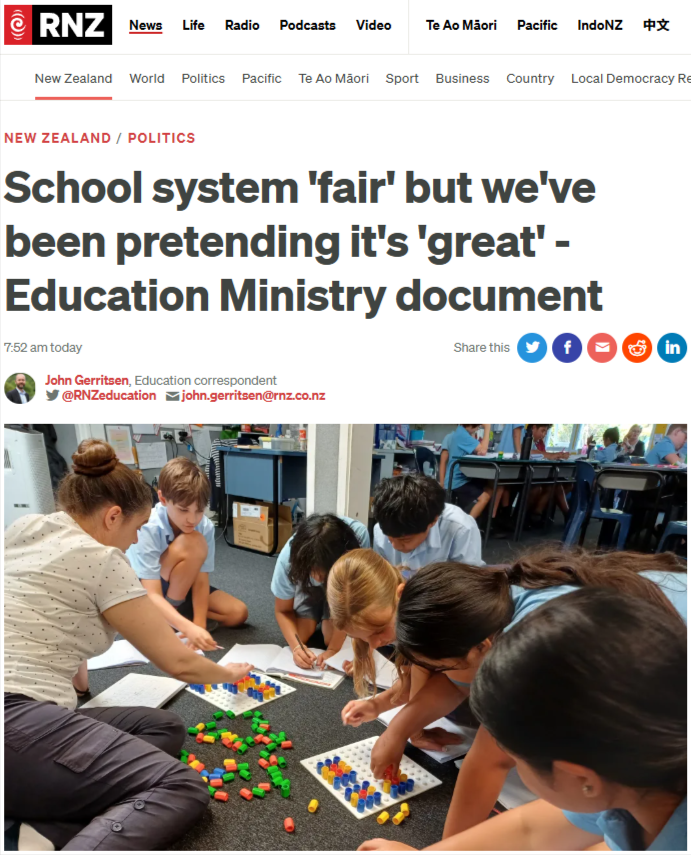
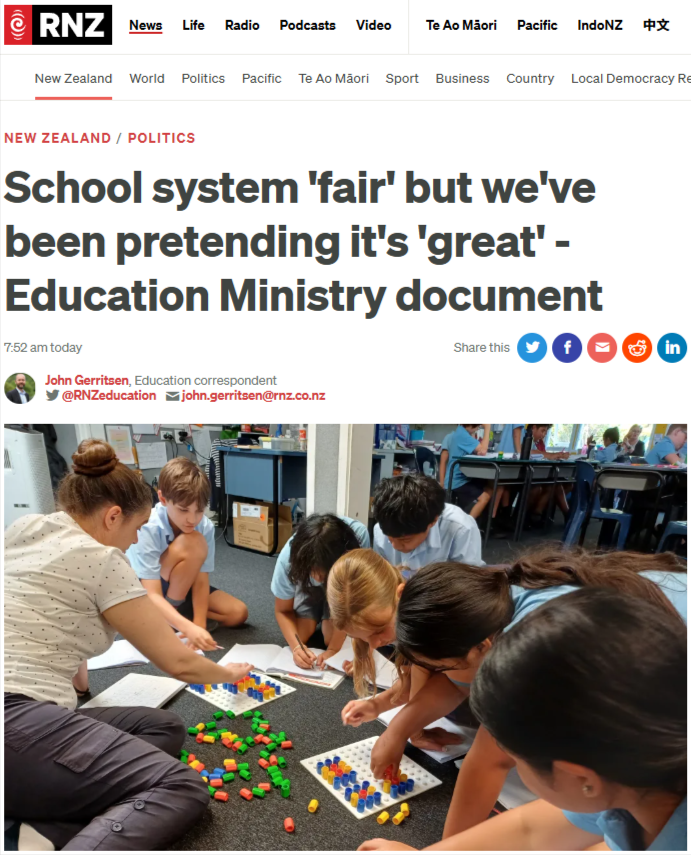
The most damning evidence against government claims comes from the government itself. An internal 2023 Education Ministry document, leaked to RNZ, explicitly states that "our data suggests that the New Zealand education system would be defined at the top of FAIR by McKinsey 2010 yet we have been behaving as if it is GREAT"1. This internal admission directly contradicts years of public statements claiming world-class educational performance.
The McKinsey ranking system, used by education ministries worldwide, places New Zealand in the "fair" category alongside Armenia and Greece — not the "great" category the government publicly claims. Australia, New Zealand's closest comparable neighbor, ranks as "low in the good ranking," a full tier above New Zealand's actual performance. This represents a fundamental misrepresentation of New Zealand's educational standing that has persisted across multiple governments and education ministers.
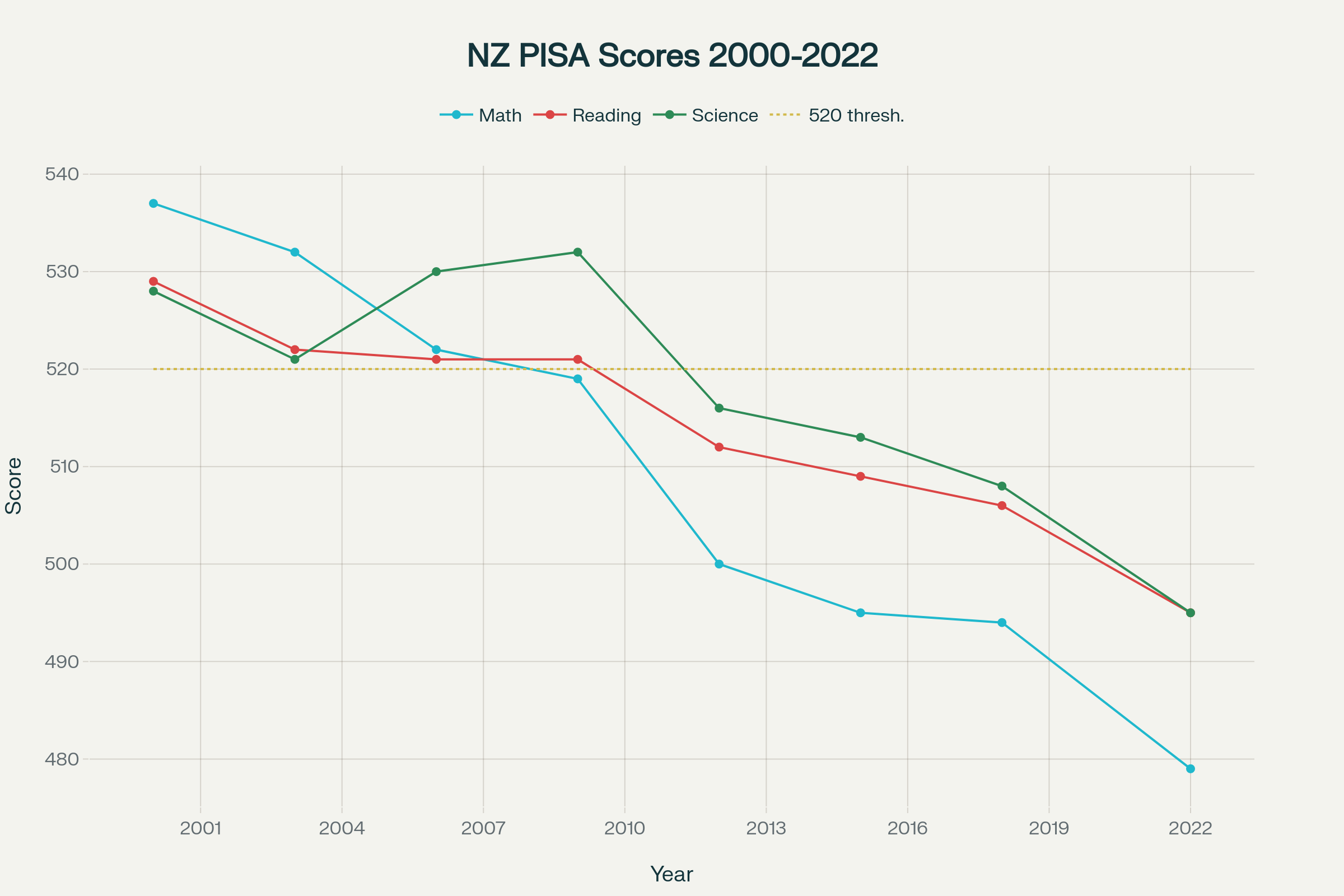
New Zealand's Declining PISA Performance: From "Great" to "Fair" (2000-2022)
The government's own experts acknowledge this deception has harmful consequences. The ministry document warns that "some schools with strong networks, resources, and accountabilities manage to perform well with minimal system supports but many of those carrying the weight of high needs and complex issues struggle. Teacher and learners both struggle". This admission reveals that while privileged schools maintain performance standards, the system fails vulnerable students — exactly the opposite of the equitable excellence the government claims to deliver.
International Test Results: Dramatic Decline from Excellence to Mediocrity
PISA Performance: The Stark Numbers
New Zealand's performance in the Programme for International Student Assessment (PISA) tells a devastating story of educational decline that government rhetoric cannot obscure. The country's mathematics scores have plummeted from 537 points in 2000 (third globally) to just 479 points in 2022 — a catastrophic 58-point decline equivalent to nearly three years of lost learning23. This represents one of the steepest declines in OECD history.
Subject2000 Score2022 ScoreDeclineGlobal Ranking 2022Mathematics23537479-58 points23rdReading23529501-28 points10thScience23528504-24 points11th
The government consistently touts New Zealand's "top 10" reading performance while deliberately omitting the mathematics ranking of 23rd — below countries including Estonia, Ireland, and Germany43. Even more dishonestly, the Ministry of Education acknowledges that New Zealand's results are "likely to be skewed upwards...equivalent to up to a 10-point bias in the scores" due to low participation rates2. Accounting for this bias, New Zealand's mathematics performance likely falls to 469 points, below the OECD average of 472 points5.
The Equity Crisis: Bottom Tier Performance
While the government claims commitment to educational equity, international evidence exposes New Zealand as among the world's worst performers for educational fairness. The UNICEF report on educational inequality ranks New Zealand 33rd out of 38 developed countries — firmly in the bottom tier for educational equity6. This represents a fundamental failure of the education system to serve all students fairly.
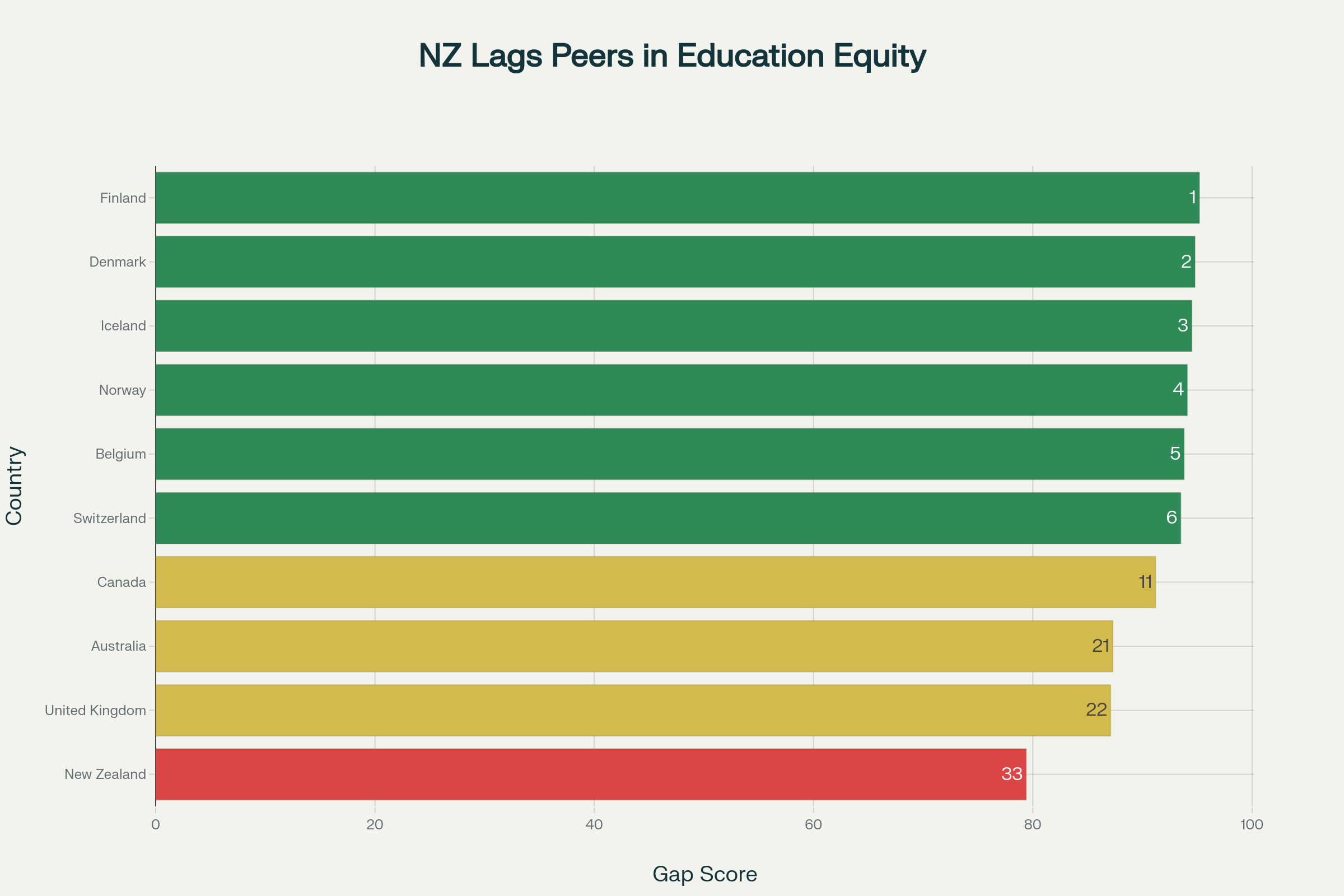
Educational Equity Crisis: New Zealand Ranks Among Worst for Fairness in Developed World
The data reveals systematic inequities that the government downplays or ignores entirely:
- Māori students are 1.36 times more likely to leave school without University Entrance compared to European students7
- Pacific students have university entrance non-attainment rates of 70%, compared to just 25% for Asian students7
- Only one-third of Māori and Pacific students attend school regularly, compared to half of European students7
Auckland University professor Stuart McNaughton, an expert in curriculum and pedagogy, directly contradicts government claims: "It is an unfair system and we have a real problem with our equity profile". This academic assessment aligns with international findings that government ministers consistently ignore in public statements.
Funding Failure: Below Average Investment Despite High GDP Share
Per-Student Spending: Lagging Behind Comparable Nations
Government claims of adequate education funding crumble under OECD scrutiny. New Zealand spends US$11,119 per student annually across all education levels — significantly below the OECD average of US$12,647 and ranking 24th out of participating countries89. This funding shortfall becomes more stark when compared to similar economies:
CountrySpending Per Student (USD)Difference from NZOECD RankAustralia811,929+$810 (+7%)19thUnited Kingdom812,188+$1,069 (+10%)17thCanada1013,500++$2,381+ (+21%)~12thOECD Average812,647+$1,528 (+14%)—
The funding gaps are even more pronounced at specific education levels. New Zealand spends US$8,967 per primary student compared to the OECD average of US$11,914 for public institutions — a 25% shortfall that directly impacts classroom resources, teacher-student ratios, and educational outcomes8.
Despite government claims of prioritizing education, research by the Tertiary Education Union found that "in 2019, direct public spending per student in New Zealand was 24.9% lower than the OECD average"11. This systematic underfunding contradicts political rhetoric about education being a national priority.
The Teacher Shortage Crisis: Ministry Incompetence Exposed
Perhaps no issue better illustrates government education failures than the teacher shortage crisis. The Ministry of Education's 2023 forecast predicted teacher surpluses for 2024 and 2025, but a corrected 2025 forecast revealed a shortage of 1,250 teachers — a staggering error that principals describe as validating their warnings121314.
Principals Federation president Leanne Otene stated: "Regions across the country have been telling the ministry there is a teacher supply issue and we shouldn't have had to do that. It should have been quite clear in 2023"1314. The ministry's forecasting failure occurred because officials failed to account for negotiated non-contact time increases — an extraordinary oversight that demonstrates institutional incompetence.
The shortage has forced schools to:
- Combine classes and cancel specialized subjects1314
- Recruit teachers from overseas at premium costs1314
- Use "Limited Authority to Teach" permissions for unqualified staff1314
- Ask retired teachers to return to work1314
Curriculum Chaos: Policy "Flip-Flopping" Destroys System Stability
The Endless Reform Cycle
One of the most damaging aspects of New Zealand's education governance is the constant policy reversals that occur with each change of government. Principals Federation president Leanne Otene describes this as "flip-flopping every time there's a change of government," preventing the workforce from properly embedding any curriculum and seeing meaningful improvement in student outcomes.
The pattern reveals systematic policy instability:
- National Standards (2010-2017): Introduced by National government, heavily criticized by educators, removed by Labour government1516
- Curriculum "Refresh" (2017-2023): Labour government initiative to modify existing curriculum framework15
- "Back to Basics" (2023-present): National government promises to "rewrite" curriculum again, returning to standardized testing approaches1716
This constant upheaval has created what education experts describe as reform fatigue. The ministry document acknowledges this damage: "We have never been given an opportunity as a workforce to embed a curriculum and to really ensure that our workforce is confident and competent in the curriculum document".
Evidence-Free Policy Making
The government's curriculum policies consistently lack empirical support. Auckland University professor Stuart McNaughton warns that the recently-introduced primary English curriculum "over-prescribed how the youngest children should be taught to read because years of evidence showed different children needed different approaches". Despite this expert criticism, the government continues implementing prescriptive policies without adequate research foundation.
National's education spokesperson Erica Stanford promotes year-by-year curriculum prescription, claiming it will reduce teacher workload and improve outcomes17. However, education research consistently demonstrates that such rigid approaches undermine teacher professionalism and fail to address diverse student needs — exactly the problems that created New Zealand's equity crisis.
International Comparisons: Missing from Elite Education Systems
Absent from Global Excellence Rankings
While the government claims New Zealand has a "world-class" education system, international ranking systems consistently omit New Zealand from their elite categories. The World Population Review 2024 education rankings place New Zealand 15th globally — respectable but far from the "world's best" status claimed by politicians18.
More significantly, analyses of the world's most improved education systems by McKinsey & Company and other international consultancies focus on countries like Singapore, Finland, Canada, and Estonia — not New Zealand192021. These studies examine systems that achieved sustained improvement over decades, revealing that New Zealand lacks the characteristics of genuinely excellent education systems.
Singapore and Finland, frequently cited as global education leaders, achieved their status through approaches fundamentally different from New Zealand's. Singapore emphasizes rigorous academic standards and highly selective teacher recruitment2223. Finland prioritizes equity, teacher professionalism, and minimal standardized testing2425. New Zealand attempts neither approach consistently, resulting in mediocrity rather than excellence.
The Australia Comparison: Falling Behind Our Nearest Neighbor
Australia provides the most relevant comparison for New Zealand's education system due to similar demographics, economic development, and educational structures. The comparison reveals New Zealand's underperformance across multiple metrics:
- Mathematics: Australia 487, New Zealand 479 (-8 points)
- Reading: Australia 498, New Zealand 501 (+3 points)
- Science: Australia 507, New Zealand 504 (-3 points)
- Australia: Higher per-student spending, better teacher retention
- New Zealand: Below OECD average spending, teacher shortage crisis
The McKinsey education system classification places Australia in the "good" category while ranking New Zealand as merely "fair" — a significant gap between neighboring countries with similar starting conditions.
The Equity Disaster: Systematic Failure of Vulnerable Students
Māori and Pacific Achievement Gaps
New Zealand's education system produces some of the worst ethnic achievement gaps in the developed world, contradicting government claims of equitable outcomes. The Tertiary Education Commission warns that "if the sector keeps doing what it has been doing, there will be no to little change in Māori and Pacific tertiary achievement"28. This represents a systematic failure that has persisted for decades despite numerous government initiatives.
The statistics reveal the extent of educational inequity:
Ethnic GroupUniversity Entrance AchievementRegular School AttendanceTertiary Completion (6 years)European72875%50%62%+Asian775%+59%65%+Māori72822% (non-attainment: 78%)33%<50%Pacific72830% (non-attainment: 70%)33%<50%
These gaps have remained largely unchanged despite hundreds of targeted interventions over decades. The Tertiary Education Commission concludes that these "well-intentioned interventions have been a distraction from a focus on system-wide approaches"28 — a damning indictment of government education policies.
Socioeconomic Segregation
The OECD identifies New Zealand as having one of the most socioeconomically segregated education systems among developed countries29. Private schools and wealthy school zones concentrate advantaged students, while high-needs schools struggle with inadequate resources and unstable staffing.
Research by the New Zealand Institute of Economic Research quantifies this inequality's economic impact: "underserved learners" could miss out on $11 billion in wages over 30 years, representing more than $500,000 per person in lifetime earnings30. This systematic disadvantage perpetuates intergenerational poverty and contradicts fundamental principles of educational equity.
Policy Prescription vs. Innovation: The Wrong Reform Direction
The Over-Prescription Trap
The ministry's internal document reveals confusion about curriculum prescription levels, acknowledging both under-prescription and over-prescription risks. Under-prescription leaves "decisions with schools and teachers who do not always have the capacity or expertise to select appropriate content or approaches". However, over-prescription "may contribute to curriculum overcrowding and a focus on coverage rather than meaningful learning".
Despite this nuanced understanding, current government policy pushes toward maximum prescription — exactly the approach that failed in 2007. The document warns that "prescribed curricula are also liable to become outdated and require monitoring and support to stay up-to-date", yet politicians ignore this expert advice.
Auckland University's Stuart McNaughton warns that excessive prescription risks "undermining the agency of the teacher, which is a great risk in a system that prides itself on innovation and expertise". International research consistently demonstrates that high-performing education systems balance prescription with teacher professionalism — a balance New Zealand has never achieved.
Learning from International Success
Countries with genuinely excellent education systems demonstrate approaches New Zealand could adopt but refuses to consider:
Finland's Success Formula2425:
- Highly qualified teachers (master's degree requirement)
- Minimal standardized testing
- Strong school autonomy with professional accountability
- Focus on equity over competition
Singapore's Achievement Model2223:
- Rigorous teacher selection and training
- Clear academic progression standards
- Strong system coherence with local flexibility
- Evidence-based policy development
New Zealand's approach incorporates neither model effectively, resulting in the worst of both worlds: insufficient teacher quality with excessive bureaucratic interference, and unclear standards with inequitable outcomes.
Confronting Educational Reality
The evidence comprehensively debunks government claims about New Zealand's education system. Internal ministry documents admit the system is "fair" rather than "great," international rankings place New Zealand outside elite education systems, and PISA results show dramatic performance declines from previous excellence to current mediocrity236.
The government's systematic misrepresentation of educational performance has profound consequences. By claiming success while ignoring equity crises, funding shortfalls, and curriculum instability, politicians prevent the honest assessment necessary for genuine improvement. Students — particularly Māori, Pacific, and socioeconomically disadvantaged learners — pay the price for this deception through reduced opportunities and lifetime disadvantage.
New Zealand's education system faces a choice: continue the destructive cycle of political rhetoric and policy flip-flopping, or acknowledge reality and commit to evidence-based reform. The international examples of Finland, Singapore, and other successful systems demonstrate that excellence is achievable — but only through sustained, honest effort rather than political spin.
The stakes could not be higher. With educational inequity increasing and international performance declining, New Zealand risks creating a generation of students unprepared for economic and social challenges3028. Only by abandoning the "great" mythology and confronting educational reality can the country begin building a genuinely world-class education system worthy of all its students.
Until then, claims of educational excellence remain what the government's own experts privately acknowledge them to be: dangerous delusions that serve political interests while failing New Zealand's children.
Ivor Jones The Māori Green Lantern
- https://ppl-ai-file-upload.s3.amazonaws.com/web/direct-files/attachments/2123776/86bf8205-e221-4cca-ac51-25ede57336fb/School-system-fair-but-we-ve-been-pretending-it-s-great-Education-Ministry-document-_-RNZ-News.pdf
- https://www.rnz.co.nz/news/national/567719/school-system-fair-but-we-ve-been-pretending-it-s-great-education-ministry-document
- https://www.rnz.co.nz/news/national/504020/nz-records-worst-ever-pisa-international-test-results-amid-global-decline
- https://www.rnz.co.nz/news/national/564600/where-new-zealand-universities-rank-internationally
- https://www.rnz.co.nz/news/national/404762/nz-teenagers-hit-new-lows-in-reading-maths-and-science-tests
- /content/files/webcontent/document/201315/techreport.pdf
- https://www.nzherald.co.nz/nz/new-zealand-universities-climb-world-ranking-table-auckland-universitys-ranking-highest-in-14-years/JPZLKGMWVZF7JA4SHZL3XCWYHI/
- https://www.rnz.co.nz/news/national/504035/student-hunger-bad-teachers-revealed-in-latest-pisa-tests-showing-dip-in-nz-teens-scores
- /content/files/webcontent/document/201524/oecd-economic-survey-of-nz-visa4.pdf
- https://www.rnz.co.nz/news/national/530242/three-new-zealand-universities-drop-in-international-rankings
- https://www.nzherald.co.nz/gisborne-herald/news/nzs-worst-ever-pisa-results-global-falls/6HWWTVS4N5A5VMWH4G4BQ6IQKA/
- https://www.nzherald.co.nz/business/building-an-enterprising-culture/CVZ3VB4NCAKQNWFDNRUDTIAWOE/
- https://www.rnz.co.nz/news/national/559899/more-high-achieving-teens-heading-overseas-after-finishing-school
- /content/files/wp-content/uploads/2024/05/top-50-new-zealand-high-school-rankings-2024.pdf
- https://gpseducation.oecd.org/CountryProfile?primaryCountry=NZL&treshold=10&topic=PI
- https://www.mckinsey.com/~/media/mckinsey/industries/public%20and%20social%20sector/our%20insights/how%20the%20worlds%20most%20improved%20school%20systems%20keep%20getting%20better/how_the_worlds_most_improved_school_systems_keep_getting_better.pdf
- https://worldpopulationreview.com/country-rankings/education-rankings-by-country
- https://www.schoolnews.co.nz/2023/12/pisa-2022-an-analysis/
- https://fordhaminstitute.org/national/commentary/how-worlds-most-improved-systems-keep-getting-better
- https://gpseducation.oecd.org/CountryProfile?primaryCountry=NZL&treshold=10&topic=EO
- https://www.mckinsey.com/~/media/mckinsey/industries/public%20and%20social%20sector/our%20insights/how%20the%20worlds%20best%20performing%20school%20systems%20come%20out%20on%20top/how_the_world_s_best-performing_school_systems_come_out_on_top.pdf
- https://www.wisemove.co.nz/post/understanding-the-new-zealand-education-system
- https://www.rnz.co.nz/news/national/537421/universities-call-for-increase-in-equity-funding-for-students-in-bottom-quintile-of-ncea
- https://www.1news.co.nz/2025/02/03/what-can-nz-learn-from-singapores-high-performing-maths-education/
- https://www.rnz.co.nz/news/political/508170/government-urged-to-tackle-disparities-for-maori-pacific-and-disabled-students
- https://www.nzherald.co.nz/nz/we-dont-know-how-lucky-we-are/GXPTEWWK7BGDNSW7RDO5A2J3RQ/
- https://www.rnz.co.nz/news/political/498375/watch-act-promises-tender-process-for-failing-schools-stricter-early-childhood-education
- https://www.rnz.co.nz/news/national/475633/the-school-looking-worst-hit-by-equity-funding-changes-and-why-it-is-not-complaining
- https://www.nzherald.co.nz/nz/your-views-earlier-views-on-ncea/MZMXXV7PPM7X4DEJUOJHBWEX6I/
- /content/files/webcontent/document/201716/pisa-student-wellbeing.pdf
- https://www.1news.co.nz/2023/03/26/more-prescriptive-curriculum-helps-neurodiverse-students-national/
- https://www.rnz.co.nz/news/political/567719/school-system-fair-but-we-ve-been-pretending-it-s-great-education-ministry-document
- https://www.rnz.co.nz/news/national/492769/all-new-zealand-universities-have-risen-in-latest-international-ranking
- https://www.humanium.org/en/educational-inequities-for-marginalized-students-in-new-zealand/
- https://www.education.gov.au/system/files/documents/document-file/2020-12/good-to-great-schools.pdf
- https://www.oecd.org/pisa/aboutpisa/Golden_e-book_1_example.pdf
- /content/files/wp-content/uploads/2017/08/bolton-educational-equity-in-new-zealand-successes-challenges-and-opportunities-.pdf
- /content/files/content/dam/ethz/special-interest/mtec/edusys-dam/documents/factbook-education-system-australia.pdf
- /content/files/content/dam/oecd/en/publications/reports/2017/09/oecd-handbook-for-internationally-comparative-education-statistics_g1g7f9d1/9789264279889-en.pdf
- https://pubmed.ncbi.nlm.nih.gov/37722675/
- /content/files/2024/educational-outcomes/docs/educational-outcomes.pdf
- https://www.linkedin.com/pulse/comparative-analysis-education-australia-oecd-david-adssc
- /content/files/content/dam/oecd/en/publications/reports/2004/04/oecd-handbook-for-internationally-comparative-education-statistics_g1gh420d/9789264104112-en.pdf
- https://www.oecd.org/en/publications/curriculum-overload_3081ceca-en/full-report.html
- https://www.auckland.ac.nz/en/news/2024/12/18/the-education-system-is-broken-for-maori.html
- https://www.rnz.co.nz/news/national/369779/nz-among-worst-ranked-for-inequality-in-education-report
- https://www.nzherald.co.nz/nz/underserved-learners-miss-out-on-billions-in-lost-wages-nzier-analysis-finds/ISSIIEVKPJZSEG64LGJG7VGZUU/
- /content/files/webcontent/document/201414/progress.pdf
- https://www.nzherald.co.nz/business/icolin-jamesi-treasury-points-up-flaws/7IMQZBUZGQVD737HZBMA5JWF2M/
- https://www.nzherald.co.nz/nz/race-gap-exposed-in-ncea-results/A3XVOM6C4PS4FPQMII4MIY67QI/
- https://www.nzherald.co.nz/nz/nz-universities-ranked-among-worlds-best-again/EAZLN2AK7GPCLNZYHFWXOXAKQ4/
- https://www.nzherald.co.nz/business/economy/cool-reception-for-government-vision/E7NHKMLADDZKCIZB54AM6BXERQ/
- https://www.rnz.co.nz/news/national/456792/commission-pans-attempts-to-close-maori-pacific-achievement-gap
- https://www.rnz.co.nz/news/national/505858/nz-report-card-2023-near-the-top-of-the-class-in-some-areas-bottom-in-others
- /content/files/webcontent/document/201716/wellbeing-nz-report.pdf
- https://www.nzherald.co.nz/world/economists-rank-global-problems/2LXVU4ZGBFTAN55XX2ANJT3OCU/
- /content/files/webcontent/document/201651/nzcer-national-standards-report.pdf
- https://www.weforum.org/stories/2018/09/10-reasons-why-finlands-education-system-is-the-best-in-the-world/
- https://www.academia.edu/6579854/OECDs_PISA_A_Tale_of_Flaws_and_Hubris
- https://papers.iafor.org/submission81756/
- https://www.lunduniversity.lu.se/lup/publication/5469230
- https://www.taylorfrancis.com/chapters/edit/10.4324/9781003255215-10/conclusion-ant%C3%B3nio-teodoro
- /content/files/sites/default/files/learning-equity-requires-more-equality-learning-goals-and-achievement-gaps.pdf
- https://en.wikipedia.org/wiki/Programme_for_International_Student_Assessment
- https://vocal.media/education/top-countries-have-the-best-education-system
- https://journals.sagepub.com/doi/pdf/10.1177/1478210316652024
- /content/files/wp-content/uploads/papers/ece2024/ece2024_81756.pdf
- https://www.educationcounts.govt.nz/home
- https://www.qahe.org/article/comparing-education-systems-notable-countries-with-strong-education-systems/
- https://www.nzherald.co.nz/nz/new-zealand-still-lags-behind-on-per-student-education-spending/76OLESEGIHSY7TIYA7XCBFWMXI/
- https://www.1news.co.nz/2025/02/21/new-report-highlights-scale-of-potential-teacher-shortage-in-coming-years/
- https://www.1news.co.nz/2024/02/12/is-the-cost-of-private-school-worth-it/
- https://www.1news.co.nz/2023/03/22/national-to-rewrite-the-curriculum-for-kids-luxon/
- https://www.rnz.co.nz/news/national/476004/how-nz-education-compares-to-other-oecd-countries
- https://www.rnz.co.nz/news/national/542599/principals-unions-disappointed-by-1250-teacher-shortfall
- https://www.rnz.co.nz/news/national/475270/schools-to-learn-of-funding-changes-as-new-equity-index-replaces-deciles
- https://www.rnz.co.nz/news/political/486649/analysis-teachers-need-a-lot-of-things-another-curriculum-rewrite-isn-t-one
- https://www.nzherald.co.nz/nz/oecd-annual-education-report-how-new-zealand-compares-to-other-countries/NHW3VK3Q6EWAUHWLWOHCG6FDGA/
- https://www.rnz.co.nz/news/national/504823/more-than-enough-primary-teachers-from-next-year-ministry-says
- https://www.rnz.co.nz/national/programmes/afternoons/audio/2018708868/the-history-of-new-zealand-s-private-schools
- https://www.rnz.co.nz/news/political/486588/union-and-labour-criticise-national-s-new-curriculum-policy
- /content/files/content/dam/oecd/en/publications/reports/2024/09/education-at-a-glance-2024-country-notes_532eb29d/new-zealand_c7cb0f91/bd699319-en.pdf
- https://www.indexmundi.com/facts/new-zealand/indicator/SE.PRM.PRIV.ZS
- https://www.hindustantimes.com/india-news/panel-suggests-sweeping-education-policy-reforms/story-dcksyzDIw9B5wLP3Din5WI.html
- /content/files/Content/EAGCountryNotes/eag2023_cn_nzl.pdf
- https://www.rnz.co.nz/news/top/542599/principals-unions-disappointed-by-1250-teacher-shortfall
- https://www.ceicdata.com/en/new-zealand/education-statistics/nz-school-enrollment-primary-private--of-total-primary
- https://www.cbc.ca/news/canada/newfoundland-labrador/howell-education-change-pause-1.7463975
- /content/files/documents/public_expenditure_on_education_-_final.pdf
- https://www.odt.co.nz/news/national/major-teacher-shortages-likely-after-ministry-error
- https://www.fraserinstitute.org/sites/default/files/CantheMarketSaveOurSchoolsNewZealand.pdf
- https://m.scoop.co.nz/stories/PA0810/S00036/nationals-education-policy-flip-flops-again.htm
- /content/files/reports-and-media/reports/research-notethe-state-of-schooling/document/705.pdf
- https://www.rnz.co.nz/news/national/501335/schools-international-reading-maths-results-likely-to-be-skewed-ministry
- /content/files/webcontent/document/201341/innovationindex.pdf
- https://www.rnz.co.nz/news/national/504412/nz-students-report-more-negative-behaviour-in-classrooms-than-oecd-counterparts-survey
- https://www.nzherald.co.nz/business/new-zealand-needs-to-destroy-tall-poppy-syndrome-jamie-beaton/Q7QUV46J75B5LDXXTIFXKUJ5CU/
- https://www.1news.co.nz/2023/06/04/high-schools-offering-alternative-qualifications-to-ncea-on-the-rise/
- https://www.rnz.co.nz/news/national/515829/how-bad-at-reading-are-new-zealand-children
- https://www.nzherald.co.nz/the-listener/business/whats-the-wait-why-we-need-to-act-now-on-ai/43DEAVN3OVG6FEOHHJIDFZMYI4/
- https://www.rnz.co.nz/news/national/518698/world-university-rankings-auckland-university-remains-top-in-the-country
- https://www.nzherald.co.nz/nz/nz-youth-losing-out-in-health-education-jobs/MBR3NA2OLKF7EQPGTORAGQP2G4/
- https://www.educationcounts.govt.nz/__data/assets/pdf_file/0015/224601/PISA-2022-summary-report.pdf
- /content/files/static/54247a57e4b08e3d52eb03df/t/54422592e4b0d342bffaa150/1413621138886/a_quick_guide_to_the_mckinsey_report.pptx
- https://www.rnz.co.nz/news/national/340343/nz-ranks-first-for-digital-world-skills
- /content/files/content/dam/oecd/en/publications/reports/2023/11/pisa-2022-results-volume-i-and-ii-country-notes_2fca04b9/new-zealand_30baae78/33941739-en.pdf
- https://www.mckinsey.com/industries/education/our-insights/spark-and-sustain-how-school-systems-can-improve-learning-at-scale
- https://www.newstalkzb.co.nz/news/education/new-zealand-universities-climb-world-ranking-table-auckland-university-s-ranking-highest-in-14-years/
- https://www.theglobaleconomy.com/New-Zealand/pisa_reading_scores/
- https://www.mckinsey.com.br/industries/education/our-insights/transforming-schools-an-entire-system-at-a-time
- https://www.odt.co.nz/news/national/nz-pupils-failing-core-subjects-oecd-test-shows
- https://www.nzherald.co.nz/nz/both-sides-of-national-standards-debate-claim-victory-over-report/ZKRHRHEF5AHGLEAS6PHOU3LQDU/
- https://www.rnz.co.nz/news/national/486506/fully-prescribed-curriculum-not-the-answer-to-problems-in-education-expert
- https://www.nzherald.co.nz/the-listener/new-zealand/school-daze-sweeping-changes-planned-for-nzs-education-system/D4333B34ERGYVCZP5JFC5ZLQNE/
- https://melbourneinstitute.unimelb.edu.au/outlook/assets/2002/MarksGary-and-AinleyJohn.pdf
- https://www.oecd-ilibrary.org/education/oecd-handbook-for-internationally-comparative-education-statistics_9789264279889-en;jsessionid=X05RHh_jrbTCS7x50lLDI1Gv8XyXrRtGo1qNbxHg.ip-10-240-5-58
- https://research.acer.edu.au/cgi/viewcontent.cgi?article=1001&context=nswcurriculumreview
- /content/files/wp-content/uploads/2019/09/2022_eacott_workshopfindingsreport.pdf
- https://www.oecd.org/en/publications/education-at-a-glance-2024_c00cad36-en.html
- /content/files/sites/default/files/downloads/1314bib.pdf
- https://www.1news.co.nz/2024/02/26/ncea-provisional-data-achievement-drops-as-much-as-8/
- https://www.rnz.co.nz/news/national/497301/disagreement-over-how-to-tackle-the-education-crisis-or-if-it-even-exists
- /content/files/webcontent/document/201320/towards-better-local-regulation1.pdf
- https://www.nzherald.co.nz/nz/nz-education-becoming-more-equal-as-rich-students-slip-more-than-poor-students/FUOGFF5KSK2QESFIWFRBHHLCGE/
- https://theconversation.com/pisa-education-rankings-are-a-problem-that-cant-be-solved-24933
- /content/files/wp-content/uploads/papers/ece2024/ece2024_81756.pdf?t=8
- https://qz.com/1759598/finland-has-the-most-efficient-education-system-in-the-world
- https://pmc.ncbi.nlm.nih.gov/articles/PMC7994297/
- https://www.nzherald.co.nz/nz/schools-at-breaking-point-and-funding-change-will-make-it-worse-says-primary-teachers-union/GBY22ZG6SMFDDNFAIGP4KHPXWU/
- https://www.rnz.co.nz/news/national/480840/chance-of-secondary-school-teacher-shortage-in-2023-oversupply-for-primary-schools
- https://www.rnz.co.nz/news/national/516813/doubts-about-value-results-from-charter-schools-education-figures
- https://www.1news.co.nz/2024/04/29/govt-plans-fundamental-changes-with-education-goals/
- https://www.nzherald.co.nz/nz/kiwi-students-pay-seventh-highest-fees-in-oecd/DZHDUDZOOBJ5CG55WFK2P4774Q/
- https://www.rnz.co.nz/news/national/436279/teacher-shortage-schools-make-do-but-it-s-not-going-to-last
- https://www.nzherald.co.nz/nz/the-secrets-of-our-highest-performing-low-decile-schools/CDQFSBSSQZUEIOOKX2V3XMMQCQ/
- https://www.1news.co.nz/2023/12/28/changes-in-store-after-education-faced-another-year-of-disruption/
- https://edmontonjournal.com/news/local-news/we-need-to-be-sure-that-this-is-not-change-for-changes-sake-the-politics-of-a-school-curriculum-overhaul
- https://www.rnz.co.nz/news/national/542546/schools-could-be-short-1250-teachers-this-year-ministry-of-education-warns
- https://www.newstalkzb.co.nz/on-air/mike-hosking-breakfast/audio/guy-pascoe-independent-schools-of-nz-ceo-on-parents-making-significant-sacrifices-to-send-their-kids-to-private-school/
- https://www.rnz.co.nz/news/political/510386/school-truancy-will-leave-80-year-shadow-of-negative-effects-seymour-warns