“Education Minister's War on Te Reo Māori: When Settler Colonialism Attacks Our Tamariki” - 14 August 2025
Cultural Annihilation Through Reading Bans
Kia Ora, Ko Ivor Jones ahau. Greetings, I am Ivor Jones
Stanford's Phonetic Fascism: How Colonial Ghosts Still Haunt Our Classrooms
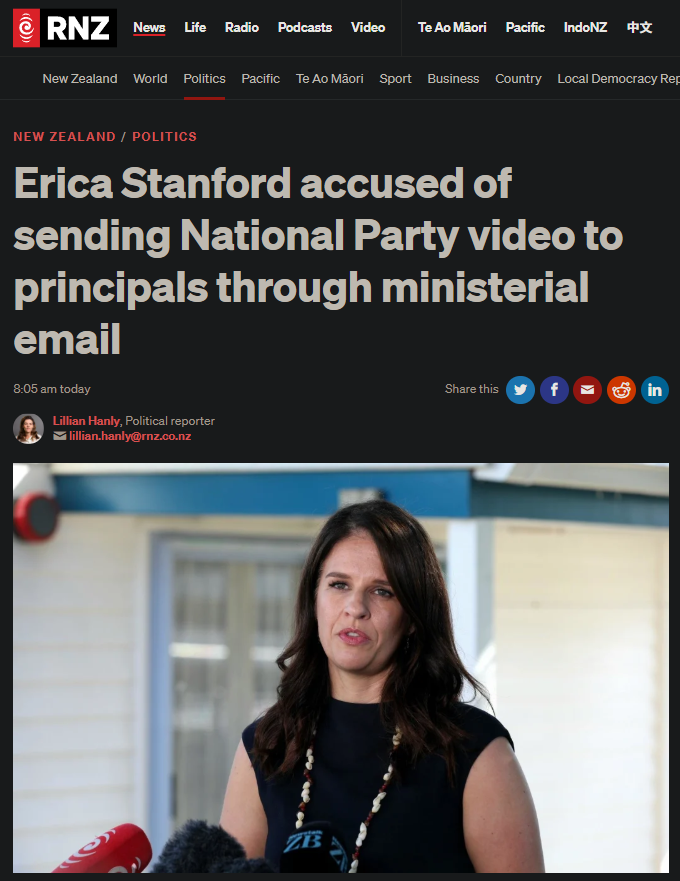
This latest move by Education Minister Erica Stanford to strip te reo Māori from children's reading books is not just another policy decision - it's a calculated act of educational violence that connects directly to the colonial playbook used to destroy Indigenous languages worldwide. When Stanford claims she's worried five-year-olds might be "confused" by Māori words, she's recycling the same racist logic that drove the Native Schools Act of 1867, wrapped in the false legitimacy of "structured literacy."
The deeper conspiracy here isn't just about reading methods - it's about who gets to decide what counts as legitimate knowledge in our education system, and how supposedly "neutral" educational policies become weapons against Indigenous ways of being.
Background
Understanding this assault requires grasping three interconnected systems of oppression operating in contemporary New Zealand: educational colonialism, neoliberal capture of pedagogy, and the systematic erasure of Indigenous knowledge systems.
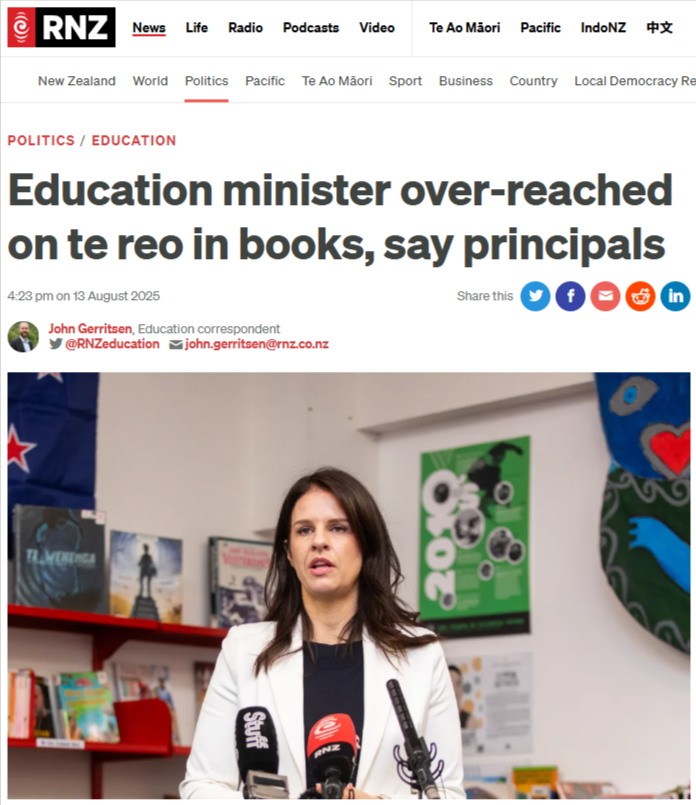
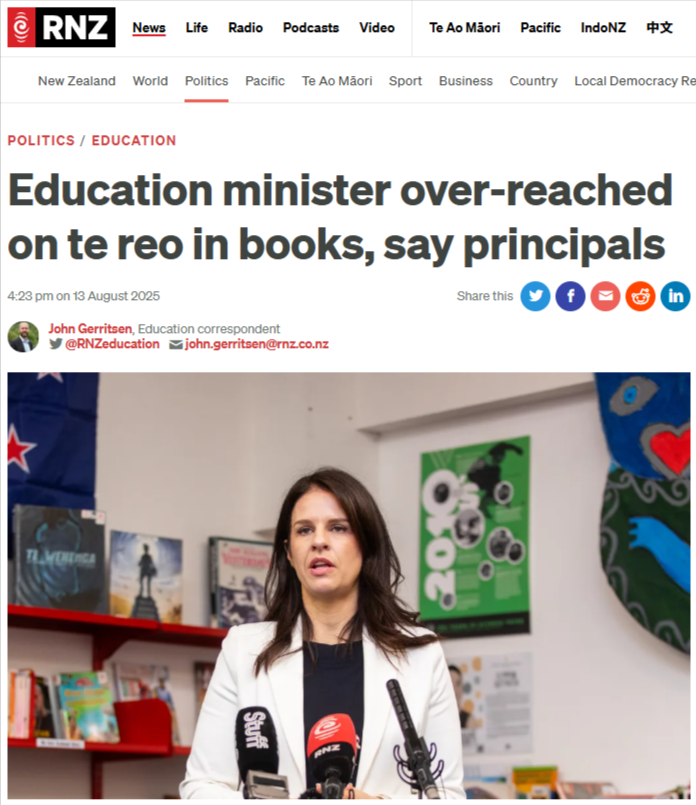
Stanford holds degrees in Political Science and minoring in Māori Studies, making her actions even more calculated. She knows exactly what she's doing. Her political trajectory from Murray McCully's office to Education Minister represents the continuity of National Party assimilationist politics, where Māori culture is viewed as an obstacle to be managed rather than a taonga to be protected.Education-minister-over-reached-on-te-reo-in-books-say-principals-_-RNZ-News.pdf
The Ready to Read Phonics Plus series contains about 78 books, with approximately 30 including kupu Māori - excluding character names. Stanford's October decision affects only 12 future books, but the precedent it sets threatens the entire foundation of bicultural education in New Zealand.
The Ministry document revealed Stanford made the decision in October because she was worried five-year-olds would be confused by Māori words. This reasoning echoes word-for-word the colonial justifications used in 1847 when Governor George Grey prioritized English instruction, claiming it was for Māori children's own good.rnz
The specific controversy centers on the book "At the Marae," which contained six Māori words including everyday terms like karakia, wharenui, koro, hongi, karakia and kai. These are words that reflect everyday language used in classrooms and communities, yet Stanford's ministry claimed they presented "decoding challenges within the phonics sequence."cambridge
What makes this particularly insidious is the manufactured crisis around "structured literacy." National has mandated this approach from 2025, using declining literacy rates as justification for educational authoritarianism. But literacy experts have challenged the decision, stating there's absolutely no evidence to suggest children are finding this reader confusing.jjpp.jsgp+1
This matters because it represents a systematic pattern. Stanford's government has already taken $30 million from Te Ahu o te Reo Māori, scrapped resource teachers of Māori, and deprioritised Te Tiriti o Waitangi in the curriculum. Each decision appears minor individually but collectively represents the slow strangulation of Indigenous education rights.pressto.amu
Stanford's justification that English words aren't used in Māori-immersion classes so Māori words shouldn't appear in English-medium readers reveals her fundamental misunderstanding of New Zealand's supposed commitment to biculturalism. As Rawiri Wright from the runanganui for kura kaupapa Māori pointed out, English-medium schools are supposed to be places where both official languages are recognised.rnz
The Colonial Playbook Never Ended
Stanford's actions represent a direct continuation of colonial education policies designed to destroy Indigenous languages. The Education Ordinance 1847 mandated English instruction and excluded Māori from the curriculum. The Native Schools Act 1867 established government-controlled schools where "from the outset the priority was the teaching of English". By 1890, education policy aimed to ensure that Māori children who arrived speaking their own language had it replaced by English.journals.sagepub+1
The results were devastating: while 90% of Māori schoolchildren could speak Māori in 1913, only 26% could do so in 1953. This wasn't accidental - it was the intended outcome of deliberate policies designed to create what Governor Grey called "brown Britons."semanticscholar
Historical research shows that colonial authorities actively suppressed indigenous languages by implementing policies that prohibited their use in schools. Indigenous children were compelled to learn and internalize the colonial language at the expense of their native languages and cultural heritage, contributing to the erosion of indigenous identities.semanticscholar
Stanford's decision follows this exact pattern. She's using the authority of her office to eliminate te reo Māori from educational materials, claiming it's for children's benefit while actually serving the deeper agenda of linguistic assimilation.
"Structured Literacy" as Neoliberal Trojan Horse
The "structured literacy" movement represents the neoliberalisation of pedagogy - the reduction of complex cultural and educational processes to standardised, measurable units that can be controlled from Wellington. It's being mandated without proper consultation with educators who understand their students' needs.jurnal.staibsllg
Professor Gail Gillon from Better Start Literacy Approach said there's "absolutely no evidence to suggest children are finding this reader confusing". University of Waikato linguistics senior lecturer Julie Barbour explained that Māori's writing system is one of the least problematic of any language, with nearly perfect correspondence between sounds and letters.Litexperts
Yet Stanford ignores this expert advice in favour of her ideological agenda. The ministry's own document warned that discontinuing Māori words "may result in a negative response and media attention" - showing they knew this was controversial but proceeded anyway.
This connects to broader patterns of educational authoritarianism. Teachers have consistently opposed one-size-fits-all mandates, understanding that effective pedagogy requires flexibility and cultural responsiveness. But Stanford's approach treats teaching as a technical exercise where Indigenous knowledge can be eliminated through policy directive.jurnal.staibsllg
The Politics of Professional Expertise
Principals' Federation president Leanne Otene was clear: "The people who should be making decisions about the resources that are used in classrooms are teachers. They're the ones who are selecting the books to teach the children how to read". This represents a fundamental challenge to ministerial overreach - the idea that politicians should micromanage classroom resources.rnz
Stanford's intervention reveals the hollowness of National's supposed support for "school choice" and local decision-making. When schools and teachers choose to include te reo Māori, suddenly centralized control becomes necessary. The hypocrisy is staggering - National promotes charter schools as giving "educators greater autonomy" while simultaneously dictating which words can appear in reading books.tandfonline
Te Akatea president Bruce Jepsen called the decision "racist and white supremacist," drawing direct parallels to "the Education Ordinance Act of 1847 and the Native Schools Act of 1867". This isn't hyperbole - it's historically accurate analysis of how educational policies have been used as tools of cultural genocide.cambridge
The Intersections of Race, Class and Educational Control
Stanford's background reveals the class dynamics at play. Born Erica Louise Poppelbaum to a Dutch immigrant father, educated at University of Auckland in politics, she represents the settler elite that has always benefited from Indigenous dispossession. Her political views sit on the "progressive side of National," meaning she supports liberal social issues while maintaining conservative economic and cultural hierarchies.journals.sagepub
Her work producing reality TV shows like "Noise Control" and "Last Chance Dog" before entering politics reveals a comfort with surveillance and control that now manifests in educational authoritarianism. The mindset that creates entertainment from policing working-class communities translates easily into policing Indigenous knowledge in schools.journals.sagepub
The timing is also significant. Anti-Māori sentiment has been rising, with disinformation networks shifting focus to issues like co-governance after the anti-mandate protests. Stanford's decision feeds into these currents, providing policy legitimacy for racist sentiment about Māori "taking over" education.journals.uclpress+1
Revealing Hidden Connections
The deeper connections here run through the networks of National Party politics, corporate education interests, and settler colonial ideology. Stanford worked for four years in Murray McCully's office - the same McCully who was Foreign Minister during National's systematic attacks on Indigenous rights internationally, including opposing UN Declaration on the Rights of Indigenous Peoples.journals.sagepub
Stanford describes McCully as her mentor, calling him "a political master". This mentorship represents the transmission of settler colonial knowledge across generations of National politicians. McCully's approach to international relations - supporting settler colonial projects globally while maintaining plausible deniability - now manifests in Stanford's educational policies.journals.sagepub
The "structured literacy" movement itself has corporate backing from educational publishers and testing companies that profit from standardisation. When reading becomes reduced to measurable phonics skills, it creates markets for approved materials while eliminating culturally responsive teaching that can't be packaged and sold.
Stanford's simultaneous roles as Education and Immigration Minister also reveal the intersection of these policy areas. Immigration policy shapes who gets to be "New Zealander," while education policy shapes what "New Zealand knowledge" looks like. Together, they maintain settler dominance by controlling both demographic composition and cultural content.
Implications
This decision represents more than the removal of some Māori words from children's books. It signals the systematic re-colonisation of New Zealand education, using the false authority of "evidence-based" policy to eliminate Indigenous knowledge systems.
The impact on Māori whānau is profound, as Principals' Federation president Leanne Otene noted: "There will be some very upset whanau, parents of children who want their children to see themselves in these books". This isn't just about language - it's about belonging, identity, and the right to exist as Māori in Aotearoa.rnz
The precedent is dangerous. If te reo Māori can be eliminated from reading books because of "phonetic confusion," what's next? Māori place names? Māori cultural concepts? The logic of assimilation has no natural stopping point once it begins.
This connects to global patterns of Indigenous language suppression. Colonial consequences for Indigenous languages worldwide have followed similar patterns of forced assimilation through education systems. Stanford's actions place New Zealand firmly within this settler colonial tradition, abandoning any pretense of genuine partnership or biculturalism.journals.uclpress

The Māori Green Lantern fighting misinformation and disinformation from the far right
Stanford's assault on te reo Māori in children's books represents the continuity of colonial education policies designed to eliminate Indigenous languages and ways of knowing. Her use of "structured literacy" as justification reveals how supposedly neutral educational policies become weapons against Indigenous communities.
The resistance from educators, principals, and Māori communities shows that this battle is far from over. But we cannot rely solely on professional expertise or liberal appeals to "balance." This is fundamentally about power - who controls knowledge, whose voices matter, and whether Indigenous peoples have the right to exist as Indigenous within the education system.
The colonial project never ended - it just got better at hiding behind the language of child welfare and educational standards. Stanford's phonetic fascism must be recognised for what it is: another chapter in the ongoing war against te reo Māori and Indigenous ways of being.
We need more than opposition - we need systematic decolonisation of educational structures, the return of control to Indigenous communities, and the recognition that te reo Māori belongs everywhere in this country, especially in our schools.
Nāku iti nei, nā Ivor Jones, The Māori Green Lantern
For readers who find value in my analysis of educational colonisation and resistance to Indigenous rights, please consider supporting this kaupapa with a koha to HTDM: 03-1546-0415173-000. The MGL understands these are challenging economic times for whānau, so please only contribute if you have capacity and wish to do so.