“Executive Paradise, Local Scapegoats: Why New Zealand Is Reforming the Wrong Part of Government” - 28 November 2025
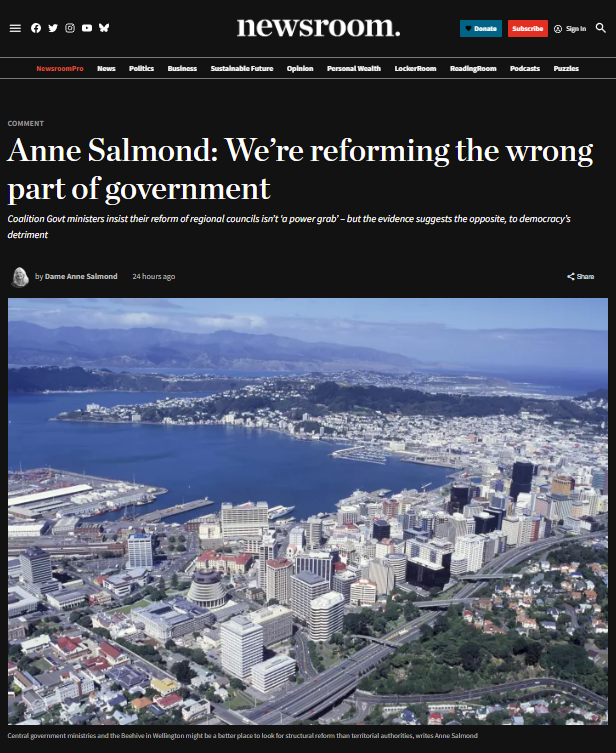
The coalition government is attacking the democratic foundations of local communities while leaving untouched—indeed, expanding—an executive branch that constitutional scholars describe as an “executive paradise”.
This contradiction is what Dame Anne Salmond warns about in her analysis of the November 2025 regional council overhaul.
The reforms announced just this week would abolish elected regional councillors and replace them with boards of mayors, many of whom could be Crown-appointed commissioners. Critically, Māori constituencies and partnership arrangements are being scrapped. Yet while local democracy shrinks, the central executive has bloated to abnormal size.
Salmond’s case is devastating:
New Zealand has three times as many ministerial portfolios and nearly twice as many departments as comparable countries like Norway, Finland and Iceland.
The tiny nations that work best globally devolve power outward and downward. Aotearoa is doing the opposite:
concentrating power in the Beehive while starving local bodies of democratic legitimacy.
1. “Executive Paradise”: Why Our Constitution Is Weak
New Zealand’s constitution is famously unwritten and easily amended. There is no supreme law that courts can use to strike down legislation. Parliament is sovereign—which sounds democratic until you realise that a government with majority control of Parliament can do almost anything.
The machinery is simple and dangerous: Ministers drawn from the majority party or coalition can dominate the House of Representatives. When a single party held majority seats (1930s–1990s), the executive ruled nearly unchecked. Constitutional lawyer and former Prime Minister Geoffrey Palmer termed this regime an “executive paradise”—a system where the executive branch enjoys minimal restraint from other branches of government or constitutional safeguards.
Following the 1984–87 Muldoon constitutional crisis, a series of reforms attempted to bridle this power: the Official Information Act 1982, the Bill of Rights 1990, and crucially, the Mixed Member Proportional electoral system adopted in 1996. MMP typically requires governments to negotiate with multiple parties, fragmenting executive control.
Yet the core problem remains. New Zealand lacks the checks common to other democracies: no federal system, no upper house, no codified supreme law, no directly elected head of executive. These absences matter. In a 2025 interview, leading constitutional scholar Professor Dean Knight noted that “most checks on executive power in our system are political in character, rather than legal”, meaning they depend on good behaviour and convention rather than enforceable law.
The central government in Wellington holds the whip. Local democracy is one of the few remaining brakes on its power—and that is precisely what the coalition is dismantling.
2. The Evidence: New Zealand Over-Governs at the Centre, Under-Governs Locally
According to the New Zealand Initiative, New Zealand has 81 ministerial portfolios, 28 ministers and 43 departments—three times as many portfolios and nearly twice as many departments as comparable countries. This complexity is abnormal.
Compare Aotearoa with peer democracies:
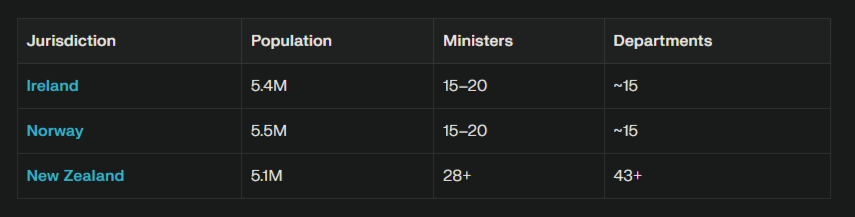
The New Zealand Initiative concludes:
Yet the coalition government, rather than consolidate this bloat, is attacking local democracy.
Meanwhile, voter engagement with local democracy is collapsing. Turnout in council elections fell from 56% in 1989 to just 42% in 2022. Regional council turnout similarly declined from 56% to 43% over the same period. Trust in local government councillors is the lowest of all public institutions surveyed by the OECD—just 45%, compared with 73% for police and 65% for courts.
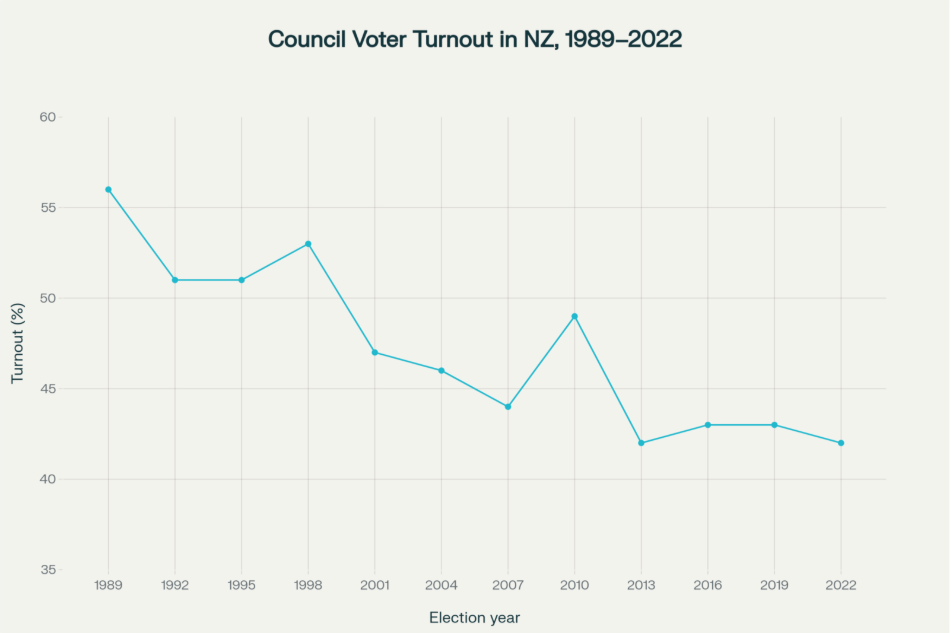
Voter turnout in New Zealand council elections has fallen from the mid‑50s in 1989 to just over 40 percent in 2022.
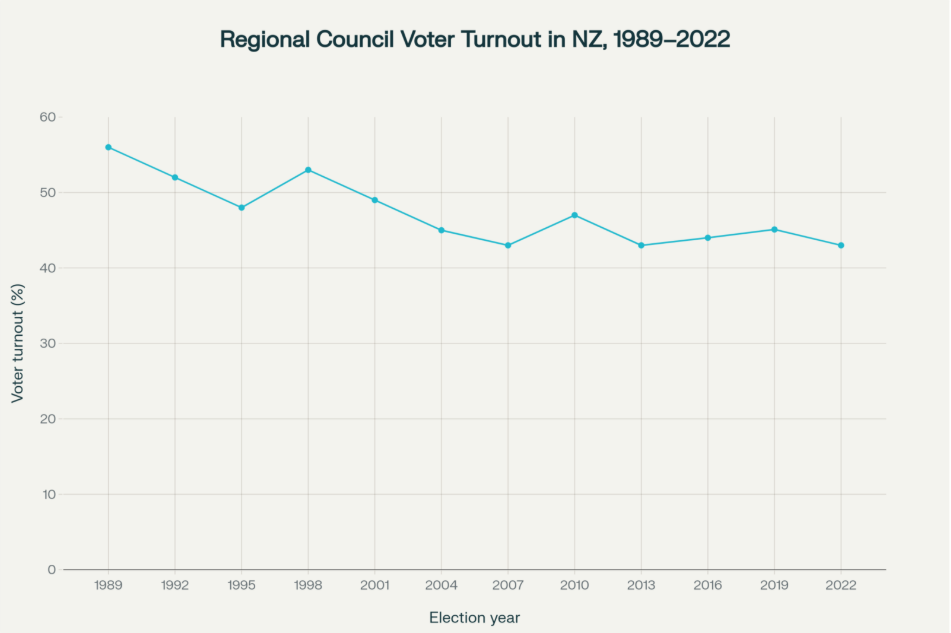
Turnout in regional council elections has fallen from the mid‑50s to the low‑40s since 1989.
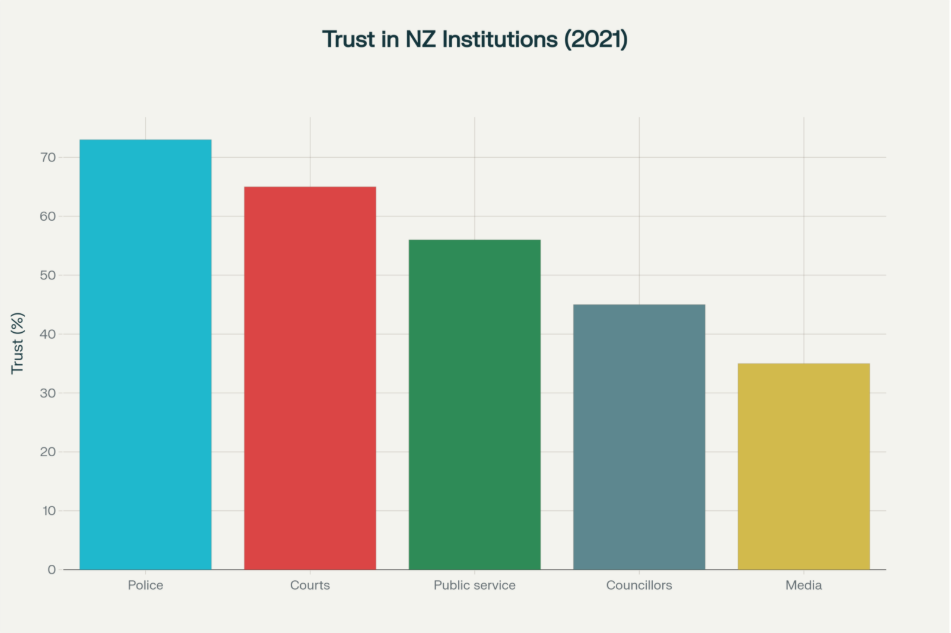
Police and courts enjoy higher trust than the public service; trust in local government councillors and media lags behind.
The coalition’s answer? Strip away elected regional councillors. Replace them with mayors (who may themselves be outvoted by appointed commissioners). Cut Māori electoral representation. The result will be even less democratic legitimacy, deeper alienation, and greater concentration of power in the hands of appointed technocrats—most of them ultimately accountable to the beehive, not to voters.
3. How Other Successful Small Democracies Actually Devolve Power
This is where Salmond’s comparative analysis cuts to the bone. Norway has 15 counties and 356 municipalities; Finland has 19 regional councils and 308 municipalities; Iceland has 8 regions and 62 municipalities; Switzerland has 26 cantons and over 2,000 communes.
New Zealand? 11 regional councils and 53 district councils. We have fewer local bodies than countries with comparable or smaller populations. And this centralisation did not start with the coalition—it began in 1989, when the Fourth Labour government’s neoliberal reforms amalgamated 249 municipalities into 14 regions and 73 territorial authorities.
The critical question Salmond poses:
Did the 1989 reforms deliver healthier, more efficient governance? Have we seen prosperous, thriving communities? High quality infrastructure? Better education and health services?
Evidence suggests not. Following the 1989 local government reform, New Zealand saw capital spending by local authorities fall below the depreciation of existing assets—a 1987–1996 period of sustained under-investment from which we have never fully recovered. Local government turnout has plummeted since 1989. And the Nordic countries—with their smaller, more numerous local bodies and stronger devolution—consistently rank among the world’s best-governed and happiest societies.
Yet Aotearoa’s coalition continues the reverse path:
further centralisation, fewer elected representatives, more Crown appointees. The government’s justification—that councils have “lacked fiscal discipline”—ignores the structural starvation of local investment since 1989 and the Crown’s repeated off-loading of unfunded mandates.
4. The Real Target: Māori Representation and Treaty Partnership
The November 2025 proposals are not neutral administrative efficiency. They are explicitly designed to narrow Māori influence.
The government is scrapping elected Māori constituencies on regional councils. Legal scholar and Māori rights expert Dr Hirini Kaa has warned this is “a concerted effort to narrow Māori influence at every level of governance”. Former Labour leader Andrew Little called the revamp a “pretty serious attack” on Treaty rights.
This is authoritarianism dressed as streamlining. Remove Māori electoral voice. Replace elected councillors with appointees. Concentrate power in the executive. The net effect is a government that can move faster—and faster away from democratic scrutiny and Treaty obligation.
5. The Deeper Risk: Authoritarianism Without Guardrails
In a landmark RNZ analysis, constitutional scholar Dean Knight and others have raised alarms about whether New Zealand’s constitutional guardrails are adequate against authoritarian drift. The system relies on “political checks” not legal ones—on politicians’ restraint, not on structural limits.
When a government:
- Controls a majority of Parliament (via MMP negotiations)
- Faces a unicameral legislature with no upper house to block
- Can amend the constitution by simple majority
- Can pass legislation with urgency to skip normal scrutiny
- Can concentrate environmental and planning powers in three ministerial hands (via fast-track legislation)
- Is now stripping local democracy and Māori representation
—then the political guardrails matter enormously. And they are failing.
6. What Should Actually Be Reformed
If the goal is truly better governance, Salmond’s alternative is clear: reform the executive, not local democracy.
The coalition could:
- Consolidate the 43 departments into 15–20, as comparable nations have done
- Reduce the 28+ ministers to 15–20
- Devolve service delivery and decision-making to strengthened local bodies
- Restore Māori electoral voice and partnership mechanisms
- Codify constitutional protections (as scholars including Geoffrey Palmer have urged)
- Subject major legislation to proper parliamentary scrutiny rather than urgency procedures
Instead, the coalition is doing the opposite. It is shrinking the only layer of democracy close to people and place, while the beehive’s ministerial maze expands unchecked.
7. Why This Matters Now
Democratic systems are not robust by default. Historians and anthropologists studying how democracies collapse note that authoritarian drift begins with the erosion of local power, the removal of minority representation, and the concentration of executive decision-making.
Aotearoa has constitutional weaknesses. We lack the written safeguards that protect democracies elsewhere. Our politicians have shown appetite for rapid, urgent legislation that bypasses scrutiny. Our executive is already abnormally large and complex.
In this context, what we need is stronger local democracy, more visible and accountable decision-making at the level of communities, and real partnership with Māori. What we are getting is the opposite.
The coalition is reforming the wrong part of government. And the whānau paying the price will be rural and provincial New Zealand—the communities least able to lobby the beehive, least resourced to challenge centralised mandates, most dependent on elected representatives who actually live in their region.
The Stakes
As Salmond writes, the question is not efficiency. It is:
“Or is this an attempt by an increasingly autocratic executive to further consolidate its power?”
The evidence points to the latter. We are watching the slow hollowing of local democracy while the central executive expands unchecked. This is the trajectory of authoritarian systems. And Aotearoa—without strong constitutional guardrails, with collapsing civic engagement, with a bloated and unaccountable executive—is more vulnerable than most to this drift.
The task of whānau concerned with rangatiratanga and democracy is clear: resist the narrative that local bodies are the problem. They are not. They are one of the few remaining brakes on an increasingly autocratic centre. Defend them. Strengthen them. And demand that real reform target where the power actually sits—the executive branch in Wellington, not the councils in Hamilton, Rotorua, Dunedin and Christchurch.

Ivor Jones The Māori Green Lantern Fighting Misinformation And Disinformation From The Far Right
Koha:
- Only Support this mahi if you are able: Koha.Kiwi | Substack | Bank: HTDM 03-1546-0415173-000
All koha sustains free mātauranga Māori journalism. No paywall, no corporate interference.
- https://onlinelibrary.wiley.com/doi/pdfdirect/10.1111/j.1468-0491.2010.01508.x
- https://www.auckland.ac.nz/en/news/2024/01/17/how-to-split-a-society.html
- https://www.rnz.co.nz/news/political/559172/democratic-guardrails-is-nz-safe-from-authoritarianism
- https://www.reddit.com/r/nzpolitics/comments/1c14181/anne_salmond_nz_is_a_democracy_not_a_company/
- /content/files/assets/speechpapers/25-08-21-lucinda-lecture-final.pdf
- https://www.facebook.com/groups/httpswww.mauihectorsdolphins.org.nzfbclidiwz/posts/4702076849933308/
- /content/files/wp-content/uploads/2015/06/palmer-constitutional-culture.pdf
- https://teara.govt.nz/en/constitution/print
- https://teara.govt.nz/en/constitution/page-8
- https://teara.govt.nz/en/religion-and-society/page-3
- https://teara.govt.nz/en/ideas-in-new-zealand/page-6
- /content/files/anzsw/article/download/223/294.pdf
- https://teara.govt.nz/en/political-values/page-2
- https://teara.govt.nz/en/new-zealand-identity
- https://teara.govt.nz/en/artwork/36556/rural-paradise
- https://teara.govt.nz/en/biographies/4b33/birchfield-constance-alice
- https://teara.govt.nz/en/biographies/4a23/atmore-harry
- https://science.lpnu.ua/law/all-volumes-and-issues/volume-12-number-3-47-2025/functional-features-activities-main
- http://dro.dur.ac.uk/16705/1/16705.pdf
- /content/files/journal/index-php/ijbm/article/download/6625/5229.pdf
- https://www.tandfonline.com/doi/full/10.1080/09540962.2025.2451695
- https://www.mdpi.com/2076-0760/12/8/462/pdf?version=1692442505
- https://www.tandfonline.com/doi/pdf/10.1080/03003930.2015.1050093?needAccess=true
- https://www.tandfonline.com/doi/full/10.1080/09540962.2022.2126644
- https://pmc.ncbi.nlm.nih.gov/articles/PMC7616782/
- https://www.tandfonline.com/doi/pdf/10.1080/21582041.2023.2233931?needAccess=true&role=button
- /content/files/index-php/apsdpr/article/download/30/29.pdf
- https://waateanews.com/2025/07/08/dame-anne-salmond-and-the-david-seymour-takedown/
- /content/files/assets/Uploads/About-us/Faculties-and-schools/Faculty-of-Law/wlr/waikato-law-review-volume-30.pdf
- https://www.linkedin.com/posts/anne-salmond-7ba77543_anne-salmond-were-reforming-the-wrong-part-activity-7399534937110130688-wfsQ
- https://www.facebook.com/groups/degrowthanz/posts/1228148565452407/
- /content/files/jnzs/article/download/9892/8707/16363.pdf

- https://journals.sagepub.com/doi/pdf/10.1177/02690942241302062
- https://www.linkedin.com/posts/anne-salmond-7ba77543_anne-salmond-new-zealanders-deserve-better-activity-7353128697949769728-mG5a
- https://www.facebook.com/groups/aotearoanzhistory/posts/1029792725509756/
- https://www.nzcer.org.nz/system/files/journals/ECF 2025 online first Mitchell et al..pdf
- https://teara.govt.nz/en/biographies/3n5/ngata-apirana-turupa
- https://teara.govt.nz/en/biographies/3s1/salmond-john-william
- https://www.nzherald.co.nz/nz/politics/regulatory-standards-bill-group-of-prominent-kiwis-including-former-prime-minister-issue-open-letter-against-david-seymour-legislation/WGL7ACLHPFADJHOUIMDU4POPV4/
- https://www.nzherald.co.nz/nz/politics/audrey-young-rating-the-maiden-speeches-of-new-mps/572XLHPOEBGBHA55COM4MYTS6Q/
- https://www.nzherald.co.nz/nz/how-christopher-luxon-is-rebranding-the-national-party/275KH3LTOVZG7AHAMC27RMV6MI/
- /content/files/podcasts/ourchangingworld.xml
- https://www.rnz.co.nz/news/political/468615/how-christopher-luxon-is-rebranding-the-national-party
- https://www.tandfonline.com/doi/pdf/10.1080/25741292.2018.1425086?needAccess=true
- /content/files/podcasts/culture-101.xml
- https://www.ssrn.com/abstract=3354296
- https://www.semanticscholar.org/paper/fcb00e9bdb0db9576f1b997143295e602c0c3e4c
- https://journals.sagepub.com/doi/10.1258/135581905774424483
- https://www.jstor.org/stable/976734?origin=crossref
- https://www.semanticscholar.org/paper/f058884602ebbcbe81404852b8d8d422b2a371a6
- https://www.semanticscholar.org/paper/f8714931dcc69a7fc36676b638a5976e7008267c
- http://link.springer.com/10.1007/978-1-349-24576-5_4
- https://www.semanticscholar.org/paper/e2dcbe13e0dfd91229cfbfd493578d1b3a8ff8f1
- https://www.semanticscholar.org/paper/b19d26e58e56f95bc389be16cc31fba2d7edc64f
- https://www.nzinitiative.org.nz/reports-and-media/opinion/hayeks-real-bastards/
- https://www.semanticscholar.org/paper/cd75df30419b25e65a09884853d04d837554a2c5
- /content/files/bitstream/10419/205584/1/twp2006-08.pdf
- /content/files/bitstream/10419/268085/1/1761427962.pdf
- https://onlinelibrary.wiley.com/doi/10.1111/newe.12393
- https://pmc.ncbi.nlm.nih.gov/articles/PMC7159747/
- /content/files/bitstream/10419/205626/1/twp2013-02.pdf
- /content/files/journals/index-php/cjlg/article/download/1889/2032.pdf
- https://www.sng-wofi.org/country_profiles/new_zealand.html
- https://archive.nordregio.se/Metameny/About-Nordregio/Nordic-working-groups/nwgcityregions/Administrative-municipal-and-regional-reforms/
- https://www.nzinitiative.org.nz/reports-and-media/reports/unscrambling-government-less-confusion-more-efficiency/
- https://theconversation.com/nz-governments-enjoy-an-executive-paradise-a-longer-parliamentary-term-wont-change-that-251139
- https://oag.parliament.nz/2014/assets/part3.htm
- https://kluwerlawonline.com/journalarticle/European+Public+Law/23.1/EURO2017007
- https://www.nzinitiative.org.nz/reports-and-media/reports/cabinet-congestion/
- /content/files/sites/default/files/2024-05/pc-inq-bup-sub-020-new-zealand-council-for-infrastructure-development-attachment-one.pdf
- /content/files/regional_policy/sources/policy/analysis/kn-07-22-144-en-n.pdf
- /content/files/assets/DirectoryFile/oia-2024-0009-information-request-regarding-the-number-of-ministries-new-zealand-has-vs-those-countries-with-gdp-ppp-per-capita-over-60k-international-dollars.pdf
- /content/files/media/lspjbm2a/does-size-matter.pdf
- /content/files/webcontent/document/201328/ltfs-13-aof.pdf
- /content/files/webcontent/document/201341/innovationindex.pdf
- https://teara.govt.nz/en/cabinet-government/page-1
- https://natlib.govt.nz/he-tohu/korero/interview-with-dame-anne-salmond
- https://www.nzherald.co.nz/nz/politics/regional-councils-arent-being-abolished-territorial-authorities-are-being-amalgamated-eventually-thomas-coughlan/premium/XM7IRBVPCVD7DJ55JCWU6XSXHI/
- https://teara.govt.nz/en/cabinet-government/print
- /content/files/webcontent/document/201251/localgovt.pdf
- https://teara.govt.nz/en/premiers-and-prime-ministers/print
- https://www.nzherald.co.nz/nz/winston-peters-on-labours-plan-for-a-capital-gains-tax/6VHF2M4YLT4UZL5RYFAOLWNJHE/
- https://teara.govt.nz/en/foreign-policy-and-diplomatic-representation/print
- https://www.nzherald.co.nz/business/phil-barry-of-tdb-advisory-on-its-most-recent-financial-results/HWFEEIPJH4H76CX3YWX65C452Y/
- /content/files/public-law/publications/nz-journal-of-public-and-international-law/previous-issues/volume-14-issue-2-december-2016/palmer.pdf