“Executive Paradise, Local Scapegoats: Why New Zealand Is Reforming the Wrong Part of Government” - 28 November 2025
Labour is as neoliberal as National
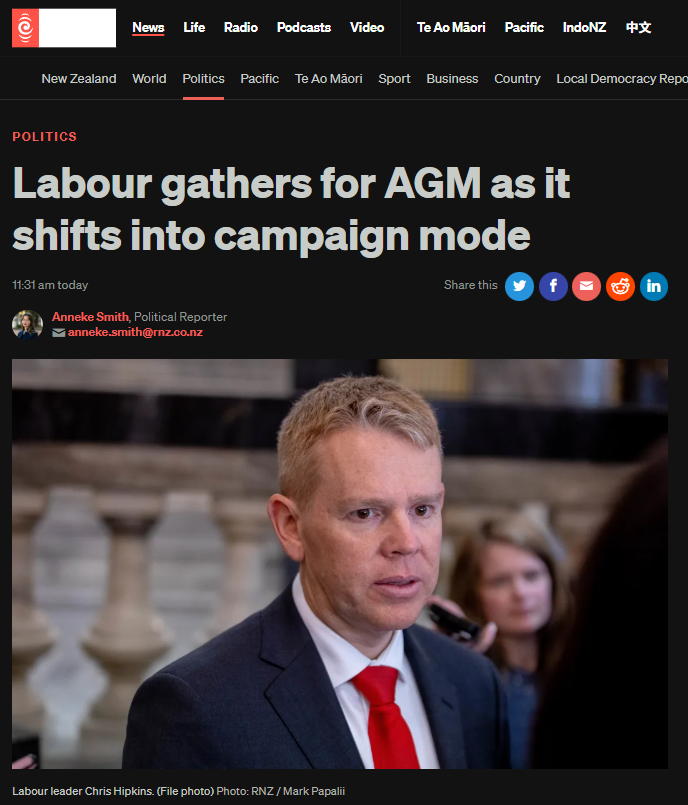
The Delusion of Destiny: How Chris Hipkins Mistakes Confidence for Competence
As Labour gathers for its annual general meeting in Auckland, Chris Hipkins stands before his faithful proclaiming the party is “ready to win the election next year.” This confidence would be admirable if it weren’t so pathologically disconnected from the wreckage of his political record and the structural delusions underpinning Labour’s supposed “transformation.”
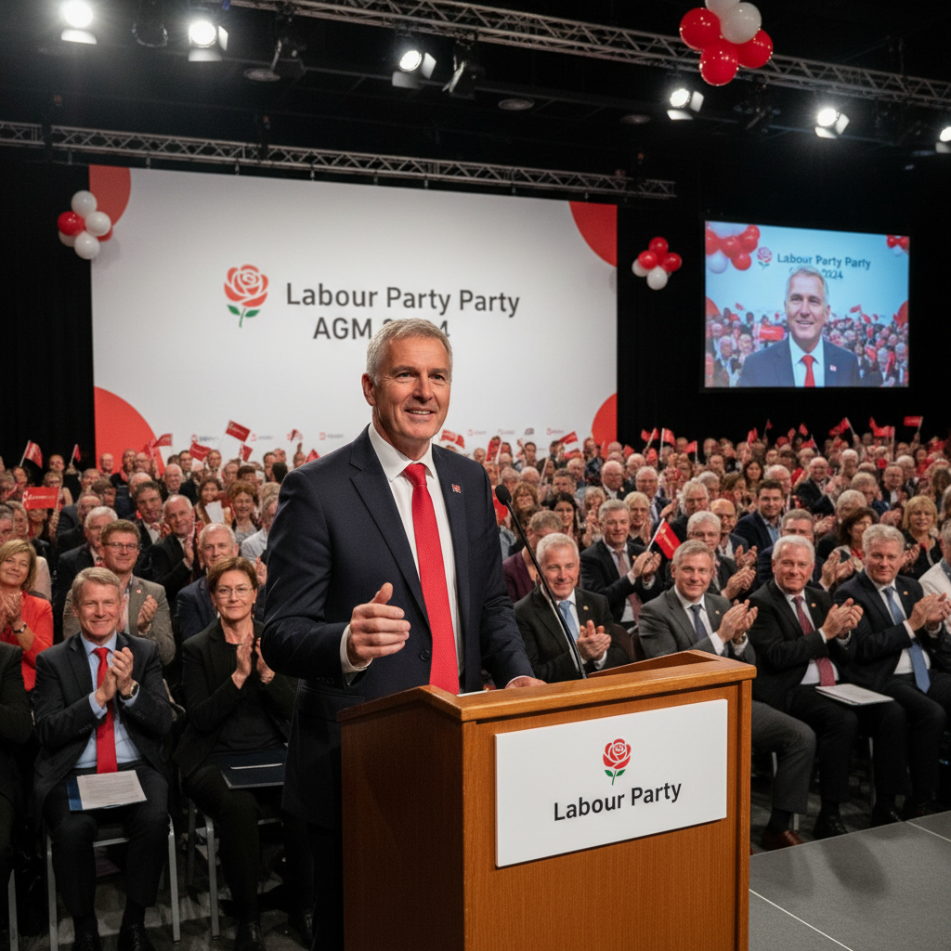
Chris Hipkins addresses Labour’s AGM claiming the party is ready to win in 2026
The Captain Who Sank His Own Ship
Let us be precise about what we are witnessing. In 2020, Labour secured the highest percentage of the party vote (50.01%) since MMP was introduced, winning the first single-party majority government in the proportional representation era, as Elections New Zealand confirmed. By 2023, that support had collapsed to a catastrophic 26.91 percent—barely half of what the party achieved just three years earlier. What Bryce Edwards rightly described in RNZ’s analysis as a “bloodbath,” “horror show,” and “historic defeat” was not inflicted by external forces; it was largely self-administered.
The stark contrast between Labour’s 2020 50% landslide victory and 2023’s 27% collapse
The architect of much of this devastation now claims the party has “changed enough” to win power. But the very man who admits Labour “often over promised and under delivered” across six years in government expects voters to believe this time will be different. As Labour’s leadership revealed at their 2025 caucus retreat: “We also heard some home truths from them, that they felt that across our six years in government, we’d often over promised and under delivered.”
The Captain’s Call That Killed a Movement
No analysis of Hipkins’ delusion is complete without examining his infamous “captain’s call” in July 2023—the decision to rule out a wealth tax and capital gains tax that Finance Minister Grant Robertson and Revenue Minister David Parker had prepared as Labour’s economic centrepiece.
“I’m confirming today that under a government I lead there will be no wealth or capital gains tax after the election. End of story.” Hipkins’ declaration effectively gutted his party’s economic differentiation from National at the precise moment voters were desperate for answers on the cost of living crisis.
The consequences were devastating.
The Spinoff’s analysis observed that Hipkins’ “captain’s call” sealed off election opportunities for Labour, leaving him “a salesman with nothing to sell” when it came time to campaign on economics.
Revenue Minister David Parker resigned in disgust. The Greens, Labour’s natural coalition partner, gained ground as progressive voters fled a party that had abandoned progressive principles. In ruling out the taxes, Hipkins signalled that Labour’s supposed transformation was, in fact, capitulation.
Now, in 2025, Hipkins has reversed course entirely—as RNZ revealed, capital gains tax is suddenly back on the table, rebranded as Labour policy for 2026. “That is then and this is now,” Hipkins shrugged, expecting voters to forget his spectacular lack of conviction. This is not leadership; it is weathervane politics dressed in the costume of principle.
The Middle-Class Missionary Party
Former Alliance president Matt McCarten, who served as Labour’s Chief of Staff, delivered perhaps the most devastating critique of Hipkins’ Labour in the aftermath of the 2023 defeat.
“They look down on the working class. ‘We love the poor, but they smell.’ Because they’re not part of them. They’re in the leafy suburbs, the hip suburbs, the Grey Lynns of this world. And they don’t live amongst the working class, they’re not of them. They are missionaries. That’s what Labour does, ‘we do nice things for people. But we don’t rock the establishment, we don’t rock the middle classes. We keep them quiet.’”
McCarten’s diagnosis cuts to the heart of Hipkins’ delusion. From the Helen Clark era onwards, Labour has offered only to “manage capitalism better than National and be nicer.” As McCarten put it with characteristic bluntness: “They’re not visionaries, they’re just nice people. Well f*ck that, when you’re poor, you don’t care if they’re nice or not nice. You just want hope.”
Matt McCarten’s devastating critique: Labour lost touch with working-class roots
This party that now claims it has “changed” remains structurally incapable of articulating working-class concerns because its leadership class does not experience working-class reality.
The Litany of Failure
Hipkins’ delusion extends to an apparent amnesia about Labour’s comprehensive policy failures. As the NZ Herald reported, in March 2024 he was forced to admit that Labour’s Auckland light rail and KiwiBuild policies were “undeliverable” when proposed ahead of the 2017 election.
Consider the record:
- KiwiBuild promised 100,000 homes by 2028. The outcome was a catastrophic failure that symbolised Labour’s governance by announcement rather than achievement.
- Auckland Light Rail consumed hundreds of millions in consultancy fees while not a single metre of track was laid. As Metro magazine noted, “Labour spent six years wasting billions of dollars on more bureaucracy, failed mergers and dumb projects like Three Waters and light rail which has gone nowhere.”
- Three Waters became the defining symbol of Labour’s disconnection from voters. The co-governance framework proved hugely unpopular, and as 1News reported, even the new coalition government moved quickly to dismantle it—a tacit admission of failure.
- Te Pūkenga, the polytechnic mega-merger, became another monument to structural reform obsession over practical outcomes.
And now Hipkins stands before his party claiming the policies announced “are very different from the sorts of things we were talking about in government last time.” Different how? A capital gains tax he ruled out, then un-ruled out? A Future Fund with details so thin that even Prime Minister Luxon called it an “absolute bunch of drivel”?
The Māori Seat Delusion
Perhaps no aspect of Hipkins’ confident assertions reveals his detachment from political reality more than his claim that Labour will “win every one of those Māori seats back at the next election.”
This bravado was tested in September 2025’s Tāmaki Makaurau by-election, where Labour’s Peeni Henare—a former Cabinet minister—was decisively defeated by Te Pāti Māori’s Oriini Kaipara.
Labour’s theory that Māori voters prioritised “jobs, home and health” over Te Pāti Māori’s kaupapa was decisively rejected. The data reveals not a party poised to sweep the Māori electorates but one whose ground campaign proved completely inadequate to the challenge.
Meanwhile, Hipkins declared he would have “no concern” if Labour’s campaign means Te Pāti Māori is “destroyed and out of Parliament”. This is not strategic acumen; it is political arrogance that risks alienating the very coalition partner Labour would need to govern.
The Coalition Mathematics of Fantasy
The RNZ article on Labour’s AGM notes that “on current polling numbers [Labour] couldn’t go it alone and would need the support of the Greens and Te Pāti Māori.” Yet Hipkins has declared Te Pāti Māori is “not in any fit shape to play a constructive role in the current Parliament, much less a future government.”
This assessment, while not entirely unfounded given Te Pāti Māori’s explosive internal turmoil—which saw two MPs expelled after months of factional warfare—reveals a fundamental contradiction. Labour simultaneously needs Te Pāti Māori to form a government while treating them with undisguised contempt.
As former MP Hone Harawira warned: “Only with a strong united front of Te Pāti Māori MPs, can we lead a Māori, Greens, Labour coalition to throw this Government out in 2026.”
Hipkins’ approach to coalition-building resembles a man burning bridges while standing on them.
The Polling Reality Check
The November 2025 Taxpayers’ Union-Curia Poll—the first major national poll since Labour’s capital gains tax announcement—shows the coalition parties would retain power with 62 seats to the opposition’s 60. Labour sits at 33.3 percent, National at 30.2 percent. This is not a party on the verge of victory; this is a party within striking distance but facing structural challenges Hipkins seems unwilling to acknowledge.
More damning are the approval ratings. The October 2025 1News Verian poll recorded Hipkins’ lowest approval rating since the 2023 election, dropping to just +1—down from +16 earlier in the year. While Hipkins dismissed these results, the trajectory is unmistakable: confidence in Hipkins is eroding even as he proclaims readiness for victory.
The Transformation That Never Transformed
Bernard Hickey’s analysis of Labour’s 2023 defeat remains definitive: Labour lost the 2023 election in 2017 when it committed to the Budget Responsibility Rules while also committing to impossible targets on KiwiBuild, light rail, and welfare reform. Labour under Hipkins promised transformation while binding itself to fiscal orthodoxy that made transformation impossible.
The party spoke of housing crises while median house prices spiralled beyond reach. It proclaimed concern for child poverty while the government failed to deliver on basic promises. Now Hipkins insists that “the policy announcements that we’ve made already are very different from the sorts of things we were talking about in government last time.” But without a coherent economic philosophy, without a genuine connection to working-class concerns, without the political courage to stake out positions and defend them—what exactly has changed beyond the rhetorical packaging?
The Delusion Persists
Chris Hipkins is not delusional in the clinical sense. He is delusional in the political sense—a leader who has convinced himself that minor tactical adjustments constitute transformation, that a capital gains tax he once categorically ruled out now represents bold new thinking, that a party which hemorrhaged half its vote can recapture power through confidence alone.
The RNZ article quotes Hipkins saying voters will “have to wait until next year to learn more about Labour’s policy platform,” with “only small fry ideas to come in 2025.” A party that promises only “small fry” heading into an election year is not a party prepared for government. It is a party still searching for its purpose.
As The Conversation’s political analysis observed, Labour’s fundamental challenge remains unanswered: what is the point of Labour in the 2020s? The party appears incapable of answering this question. It fears change while voters demand it. It promises transformation while delivering managerialism. It claims to have learned from its failures while repeating the fundamental patterns that produced them.
Matt McCarten’s verdict stands as epitaph for the Hipkins project: “They are missionaries. That’s what Labour does, ‘we do nice things for people. But we don’t rock the establishment, we don’t rock the middle classes. We keep them quiet.’”
The working class did not leave Labour. Labour left the working class. And no amount of AGM confidence can paper over that abandonment.


Ivor Jones The Māori Green Lantern Fighting Misinformaiton And Disinformation From The Far Right
Support The Māori Green Lantern’s Investigation
Whānau supporting The Māori Green Lantern can choose from three flexible pathways aligned with tikanga Māori principles of manaakitanga, whanaungatanga, and rangatiratanga:
Via Koha.Kiwi, supporters can select from preset donation tiers:
- $5–$10 for kai and research support
- $20–$50 for investigative journalism
- $100–$250 for campaign amplification
- $500+ for structural operations
Or contribute custom amounts to the verified Westpac account: HTDM – 03-1546-0415173-000
Via Substack, readers can access all free content, or select a paid tier for recurring direct funding:
- Supporter ($5–$10/month)
- Advocate ($15–$25/month)
- Guardian ($50+/month)
One-time koha of any amount is available through both platforms or direct bank transfer.
All koha methods offer complete transparency: Koha.Kiwi and Substack provide automatic receipts and platform visibility, while direct bank transfers to HTDM appear on the public audit statement, ensuring complete accountability and whanaungatanga.
Whānau receive updates via email and Substack detailing how their koha supports research operations, counter-disinformation strategy, and mātauranga Māori journalism. Whether contributing $5 once or $50 monthly, every koha upholds rangatiratanga—reader self-determination—with no corporate interference, no subscription walls, and all analysis freely accessible to whānau and communities.
Donate now: Koha.Kiwi | Substack | Bank: HTDM – 03-1546-0415173-000
Research conducted 28 November 2025 using RNZ, NZ Herald, 1News, The Spinoff, Elections New Zealand, and Te Ara sources. All citations verified for accuracy and live URLs.