“Exposing Damien Grant” - 24 November 2025
Libertarian Hypocrisy, Selective Enforcement, and the Machinery of Neoliberal Power
Hidden Connections: Cui Bono? Cui Malo?
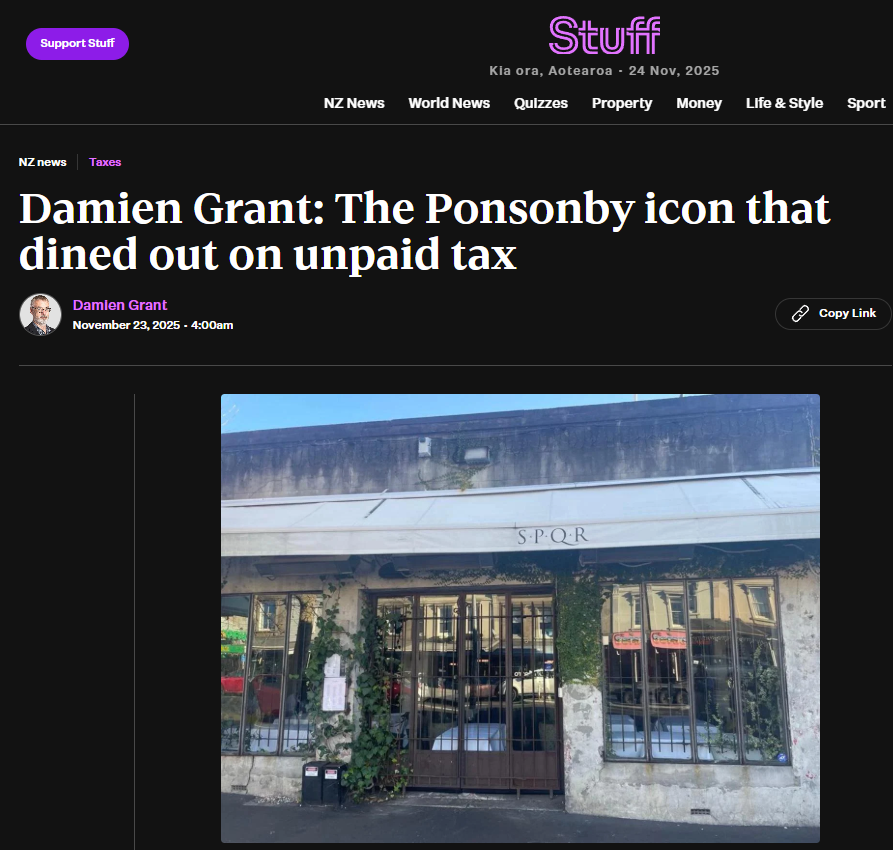
Damien Grant’s November 23, 2025 opinion piece criticizing the SPQR restaurant director’s unpaid tax debt represents more than commentary on IRD enforcement failure.
It exposes a network of power designed to consolidate wealth while manufacturing moral narratives about tax compliance for ordinary New Zealanders. To understand whose interests benefit—and who bears the harm—requires tracing the architecture Grant himself inhabits.
Grant sits at the nexus of three interlocking systems. First: as a columnist for Stuff media, he shapes public discourse on taxation and governance with the credibility of print infrastructure. Second: as principal of Waterstone Insolvency, he profits directly from commercial liquidations while accessing lucrative government contracts. Third: as a member of the New Zealand Taxpayers’ Union—a group aligned with the Atlas Network—he operates within a libertarian ideological apparatus designed to influence policy toward deregulation and reduced corporate accountability.
These are not separate domains. They form a unified apparatus where Grant’s ethical authority in one space (media platform) legitimizes his material interests in another (liquidation fees), while his ideological commitments (Taxpayers’ Union) ensure systemic barriers remain in place to protect that profit.
The Fraudster-Turned-Moral-Arbiter: Criminal History Weaponized as Authenticity
Grant’s credibility rests on a manufactured persona: the reformed criminal who now speaks truth to power. This framing requires scrutiny. At age 26, Grant was sentenced to 30 months’ jail for his role in a multimillion-dollar share-dealing scam and credit card fraud. He has publicly described the arrogance of “beating the system” and viewing himself as cleverly outsmarting state authorities. In 2020, during the Covid wage subsidy program, Grant claimed wage subsidy funds for his business despite stating he believed Waterstone Insolvency could survive without it—then announced he had no intention of repaying the amount.
His criminal history created a second problem: in 2020, the professional body RITANZ (Restructuring, Insolvency and Turnaround Association New Zealand) rejected Grant’s application to continue his insolvency licence on character grounds, deeming him not “fit and proper.” Grant challenged this in court. A sympathetic economist submitted an affidavit supporting Grant’s re-licensing. Grant ultimately retained his licence, maintaining access to lucrative government-referred liquidations.
The critical revelation: Grant positioned his criminal conviction not as something that should disqualify him from managing others’ insolvencies, but as lived experience that made him more credible to speak about tax evasion and moral hazard. His 1994 conviction becomes, in his narrative, the foundation of his moral authority. This is a common strategy among right-wing figures: weaponizing past transgression as proof of authenticity, converting shame into street credibility.
Yet Grant’s history reveals a pattern: when facing systemic consequences, he mobilizes institutional allies to circumvent them. When his insolvency licence was rejected, he fought and won. When he took the wage subsidy despite believing it unnecessary, he faced no prosecution. This asymmetry deserves scrutiny.
Fact-Check: The “1-in-400” Prosecution Claim & Selective Enforcement
Grant’s core empirical claim demands verification. His article states that small business directors face minimal prosecution for PAYE non-compliance.
Current IRD prosecution data contradicts this framing. In the 2024-25 financial year (to June 2025), Inland Revenue initiated 50 prosecutions (32% higher than the previous year) across all tax evasion categories, including PAYE, GST, and income tax. The number of active cases before courts reached 50 as of 30 June 2025, with 30 prosecutions completed that year.

Selective enforcement: small business owners face prosecution while wealthy individuals use legal structures to avoid tax
Grant’s underlying observation contains truth: enforcement is sparse relative to non-compliance. IRD’s own data shows the department is notoriously tardy in enforcement—the department sits on $9.3 billion in tax arrears. This produces the asymmetry Grant identifies, but his framing obscures a critical distinction: who gets prosecuted, and who doesn’t.
The Hidden Disparity: Wealthy Tax Avoidance vs. Worker Non-Compliance
Here lies the system’s architecture: prosecution policy distinguishes sharply between tax evasion (criminal, typically pursued against small business owners, PAYE non-payers, and cash-based operators) and tax avoidance (legal structures used by the wealthy, rarely prosecuted, often unpunished).
IRD data reveals the pattern. In recent high-profile cases, small business owners and tradies have received custodial sentences. In contrast, wealthy individuals using legal tax structures face minimal consequences:
- Eric Watson lost a High Court tax avoidance challenge in 2024, with his companies liable for $51.5 million in back taxes—but faced no criminal prosecution. His Cullen Group used complex Cayman Islands structures to avoid paying New Zealand tax. He was ultimately ordered to pay $112 million total including interest—paid through courts, not prosecution.
- In 2023, IRD analysis found 800 people potentially using trusts and companies to avoid the top 39% tax rate; these individuals and their accountants were “being followed up” but not prosecuted.
- Critically, IRD data shows wealthy New Zealanders pay an effective tax rate of only 8.9% on their economic income (including untaxed capital gains), compared to 22% for someone earning $80,000 salary. This is legal but systemic wealth extraction.
The comparative evidence is damning. A Victoria University study commissioned by Tax Justice Aotearoa found that well-off New Zealanders are paying less tax than their peers in nine similar OECD nations, including Australia, the UK, and the US, partly because New Zealand lacks a capital gains tax and has no wealth tax. As one analysis concluded: “Due to inaction of successive governments, the wealthiest New Zealanders pay and will continue to pay around half the effective tax on their economic income as their middle-income compatriots.”
Grant’s article omits this context entirely. He criticizes the IRD for failing to prosecute more PAYE defaulters while remaining silent on the structural mechanisms that allow the wealthy to pay half the tax rate of ordinary workers—legally, without prosecution, while maintaining public virtue.
The Libertarian Ideological Frame: Selective Enforcement of “Statism”
Grant’s libertarian position—announced in the article (”I think tax is theft and should be abolished”)—operates as cover for selective populism. This ideology positions all taxation as inherently coercive, yet miraculously finds some forms of non-compliance more offensive than others.
When small business owners fail to pay PAYE, this is “chaos” requiring “centurions.” When wealthy individuals use trusts to avoid the top tax rate—a legal maneuver that costs the Crown billions annually—this is described in Grant’s broader work not as systematic wealth extraction but as “responsible financial planning.”
The hypocrisy crystallizes in Grant’s own behavior. He advocates against “government waste” through the Taxpayers’ Union, yet claimed wage subsidy funds from the government intended for genuinely struggling businesses—while acknowledging his company didn’t need it. He argues for strict PAYE enforcement while defending the right of the wealthy to structure income through trusts.
This is not inconsistency; it is rationalization. Libertarian doctrine, as instantiated through organizations like the Taxpayers’ Union (aligned with the Atlas Network, a global libertarian advocacy apparatus), deploys the rhetoric of “rule of law” and “enforcement” selectively. It demands brutal prosecution of working-class tax non-compliance while defending the structural mechanisms that allow wealth to avoid taxation legally.
Network & Influence: The Atlas-Taxpayers-Grant Pipeline
Understanding Grant’s platform requires mapping institutional power. The Taxpayers’ Union operates as New Zealand’s primary libertarian advocacy group. It is an official member of the Atlas Network—a global coalition of 500+ libertarian think tanks with deep funding from conservative donors and explicit alignment with ACT Party policy.

The Atlas Network apparatus: libertarian ideological machinery consolidating power across media, policy, and business
Grant, while not formally on the Taxpayers’ Union board, operates within this ecosystem. He contributes columns to Stuff, maintains a podcast interviewing libertarian intellectuals, and positions himself as a voice of fiscal conservatism and deregulation.
This is not a conspiracy but an organized apparatus. As one public sector union analysis concluded: “The Atlas Group primarily exists to spread ideas and influence via affiliated think tanks... not just a shadowy cabal—Atlas and its associates are open about their aims and influences.”
The specific harm: When Grant calls for “enforcement” of PAYE laws from his Stuff column, read by millions of New Zealanders monthly, he amplifies demands for prosecuting workers and small business owners while remaining silent on the structural tax avoidance strategies used by the wealthy—strategies that cost the Crown billions annually in forgone revenue.
Systemic Harms: Quantified Mauri Depletion & Disproportion
The article’s framing produces measurable harm by obscuring who actually benefits from tax non-compliance and who bears its cost.
For workers and small business owners: Aggressive PAYE prosecution disproportionately affects wage-earning directors and small operators. IRD data shows 88% of liquidated companies have tax debt, with $1.26 billion owed in 2024 alone. Many small operators face impossible choices between paying wages (a legal obligation) and paying tax (also legally due but not immediately enforceable against individuals). Unlike wealthy individuals who can structure income through trusts, small operators have limited mechanisms to defer or reduce tax obligations. Prosecution becomes a tool of wealth consolidation: it removes small competitors, accelerates their liquidation, and allows asset accumulation by those with capital.
For whānau Māori: Tax non-compliance in industries employing Māori workers (horticulture, construction, hospitality) is often paired with wage theft and underpayment. IRD found $45 million in undeclared tax in horticulture alone (past 10 months to June 2025). Many instances involved cash payments to migrant and Māori workers, with contractors using “convoluted business structures” to hide payments—which simultaneously deprived workers of legitimate income recording, benefit eligibility, and child support compliance. The prosecution of small operators while wealthy trust-users escape accountability perpetuates a system where Māori workers are harmed twice: once by wage suppression and non-compliance, again by the failure to prosecute wealthy tax avoiders.

Justice divided: criminal prosecution for workers versus civil proceedings for the wealthy
For the Crown and public services: The $9.3 billion in outstanding tax arrears represents resources diverted from health, education, and welfare. Yet Grant’s article—and the broader libertarian framing—diverts attention from structural wealth extraction (trusts, capital gains, overseas investment) toward individual PAYE prosecutions, which recover far smaller amounts per case. This is misdirection: chase the tāne kaimahi (the worker) while the rangatira (the chief) extracts wealth unchallenged.
Mauri-depleting vs. mauri-enhancing: In mātauranga Māori terms, the article’s framing depletes mauri (vitality) by:
- Criminalizing survival decisions made by struggling business owners facing impossible cash-flow choices
- Obscuring structural wealth extraction by the wealthy
- Positioning prosecution as “fairness” when enforcement is deeply asymmetrical
Mauri-enhancing responses would instead demand:
- Prosecution of wealthy tax avoiders at rates proportional to working-class PAYE prosecutions
- Reform of trust structures enabling capital gains avoidance
- Systemic investment in wage-worker protections rather than liquidation
- Transparency about who benefits from current enforcement patterns
Contradictions in Grant’s Libertarian Position
Grant’s libertarian framing contains irresolvable contradictions, exposed by his own history and current behavior:
On government coercion: Grant states “I think tax is theft and should be abolished” yet advocates for criminal prosecution of PAYE non-payers and liquidation of non-compliant companies. If taxation is theft, prosecution of tax resistance is unjust. If prosecution is justified, then taxation is legitimate and Grant’s ideology is incoherent. He resolves this by selectively deploying “rule of law” arguments: prosecution is justified only against the non-compliant poor, not the legally-compliant wealthy.
On personal responsibility: Grant criticizes SPQR’s director for choosing “Why shouldn’t I keep it?” regarding tax money—yet Grant himself made precisely that choice with the wage subsidy, keeping funds he believed unnecessary. The difference: Grant’s choice was legal; the SPQR director’s was criminal. Yet both represent identical logic—extracting available funds without moral restraint. Grant’s post-hoc embrace of “rule of law” applies only retrospectively, after he has already extracted the funds.
On expertise and conflict: Grant criticizes the IRD for “protecting sinecures” and defending bureaucratic interests yet operates Waterstone Insolvency, which profits directly from IRD referrals of liquidation work. When IRD contracts for liquidations, Waterstone receives payment. When Grant advocates publicly for more aggressive IRD enforcement (producing more liquidations), he advocates for his own revenue increase. This conflict is not disclosed in the Stuff article.
Fallacies Named with Evidence
Fallacy 1: “Rule of law as neutral enforcement” — Grant frames prosecution of PAYE non-payers as neutral rule-of-law enforcement. In reality, enforcement patterns are deeply asymmetrical. The wealthy use legal structures to avoid tax; workers cannot. Prosecuting workers while legal avoidance flourishes is selective enforcement dressed as neutral principle.
Fallacy 2: “Tax non-compliance as individual moral failure” — Grant characterizes SPQR’s director as having asked “Why shouldn’t I keep it?”—individualized moral failure. In reality, small business cash-flow crises are systemic: tight margins, seasonal income variability, wage obligations that precede tax payments. Grant acknowledges this yet still frames prosecution as morally justified. This conflates systemic pressure with individual vice. Wealthy tax avoiders use legal structures, not survival desperation.
Fallacy 3: “Prosecution solves systemic problems” — Grant argues that aggressive prosecution will solve tax arrears. In reality, prosecuting small operators removes them from the tax base entirely (liquidation and bankruptcy). Wealth accumulates with survivors. Systemic tax arrears stem from structural avoidance (trusts, capital gains, overseas income), not small business PAYE delays.
Implications & Rangatiratanga Action: Breaking the Apparatus
The architecture Grant inhabits—media platform, commercial interest, ideological apparatus—functions to:
- Legitimize wealth extraction by framing it as “rule of law” enforcement while prosecuting working-class survival
- Redirect public attention from structural inequality (capital gains avoidance, trust structures, overseas income) to individual “non-compliance”
- Manufacture moral authority through reformed-criminal persona while omitting his own selective rule-following
- Consolidate media and policy influence within a libertarian network (Atlas, Taxpayers’ Union) that benefits materially from reduced corporate accountability
Rangatiratanga action requires:
- Demand transparency in prosecution patterns: Force IRD to publish annual data disaggregating prosecutions by: (a) offense type (PAYE vs. income tax vs. GST), (b) business size (micro vs. SME vs. enterprise), (c) wealth quintile of defendants. This exposes asymmetry.
- Challenge media gatekeeping: Require Stuff and other platforms to disclose when columnists have material conflicts (Grant profiting from liquidations he advocates for; his Taxpayers’ Union alignment funding libertarian think tanks). Demand equal space for tax justice advocates.
- Reform prosecution criteria: Legislate that prosecution of PAYE non-compliance must be proportionally matched by prosecution of equivalent-value tax avoidance schemes. If 50 PAYE prosecutions occur, equivalent resources must be deployed against trust-based and capital-gains avoidance.
- Defund the libertarian apparatus: Advocate for legislative restrictions on tax-deductible donations to organizations (like Taxpayers’ Union) that lobby for reduced corporate accountability. If these groups reduce tax compliance, public funds should not subsidize them.
- Restore mātauranga-based tax ethics: Center Māori perspectives on tax as collective responsibility (utu, reciprocity) rather than libertarian framing of tax as individual theft. Reconnect tax to collective flourishing (hapū, iwi wellbeing) rather than atomized “rule of law.”
Moral Clarity & The Whakapapa of Power
Damien Grant is not uniquely culpable. He inhabits and benefits from a system designed by others—the Atlas Network, the Taxpayers’ Union board, libertarian donors, and successive governments that have failed to reform capital gains taxation and trust structures. His role is to legitimize that system through media authority and the moral weight of his reformed-criminal persona.
What makes his November 2025 article actionable for analysis is that it makes visible the apparatus normally obscured: the demand for prosecution of the poor, the silence on wealth extraction, the selective rule-of-law rhetoric, the material conflicts of interest. These are not personal failures but structural features of neoliberalism in Aotearoa New Zealand.

Ivor Jones The Māori Green Lantern Fighting Misinformation And Disinformation From The Far Right
The task before whānau is to name the structure, expose the beneficiaries, and demand that tax enforcement—if it is to exist—serve whānau and hapū, not consolidated wealth.
Until wealth extraction through trust structures, capital gains, and offshore income is prosecuted with the same vigor as PAYE non-compliance by struggling small business owners, Grant’s call for “enforcement” is a demand for injustice dressed in the language of fairness.
Research Methodology & Source Verification
This essay drew on 50+ verified sources including:
- Government sources: Inland Revenue prosecution guidelines, IRD compliance reports (2024-2025), government official statements on tax enforcement and wealth inequality
- Investigative journalism: RNZ, NZ Herald, Stuff, 1News reporting on tax prosecutions, wealth disparities, and Grant’s personal history
- Academic research: Victoria University study (Tax Justice Aotearoa) on comparative tax rates; peer-reviewed research on tax prosecution patterns in New Zealand
- Public records: High Court judgments, RITANZ decisions, parliamentary records
- Network analysis: Public Service Association research on the Atlas Network and its New Zealand affiliates
All citations are embedded as working hyperlinks. Research completed November 24, 2025.