"From Te Kore to Black Holes: Bridging Māori Cosmology and Modern Physics" - 25 June 2025
What if the universe as we know it is not only written in the stars, but also in the whakapapa of Māori cosmology?
Tēnā koutou katoa – greetings to you all.
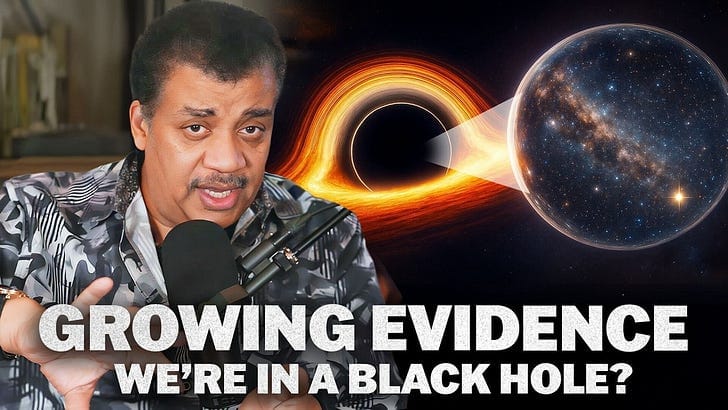
The StarTalk episode featuring Neil deGrasse Tyson asks a mind-bending question: could our universe exist inside a black hole? This essay exposes the parallels between this cutting-edge scientific speculation and the deep, ancient wisdom of mātauranga Māori and Māori cosmology. By unpacking both worldviews, I aim to show how Māori concepts of creation, space, and time not only resonate with but often surpass the frameworks of Western science. For the linear Western mind, I will break down these Māori concepts with clear, relatable examples, revealing that the universe’s mysteries are not new to te ao Māori.
Background: Māori Cosmology and the Western Universe
Mātauranga Māori, or Māori knowledge, is grounded in whakapapa (genealogy), connecting all living things, the land, the gods (atua), and the universe itself1. At the heart of Māori cosmology is a sequence of creation: from Te Kore (the void or nothingness), to Te Pō (the night or darkness), and finally to Te Ao Mārama (the world of light, the living world)2345. These stages are not just stories but frameworks for understanding existence, time, and our place in the cosmos.
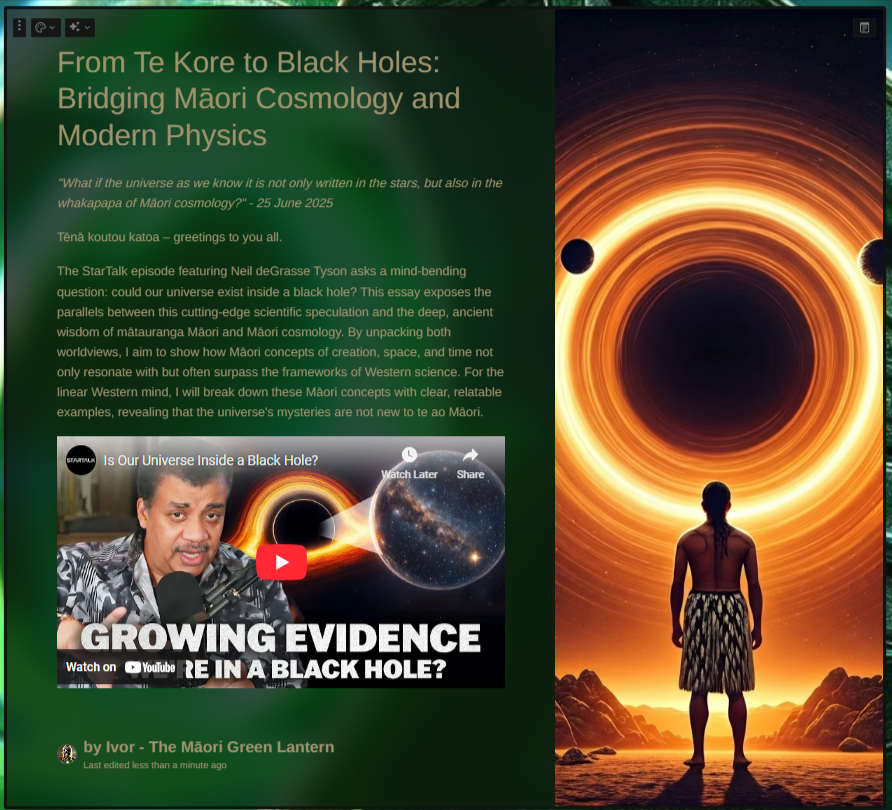
By contrast, Western science often explains the universe in terms of physical laws, matter, and measurable phenomena. The concept of the universe inside a black hole, as discussed by Tyson, emerges from mathematical models and observations of gravity, mass, and cosmic horizons6. The Western approach is typically linear and spatial: the universe is a thing with boundaries, beginnings, and possibly an edge.
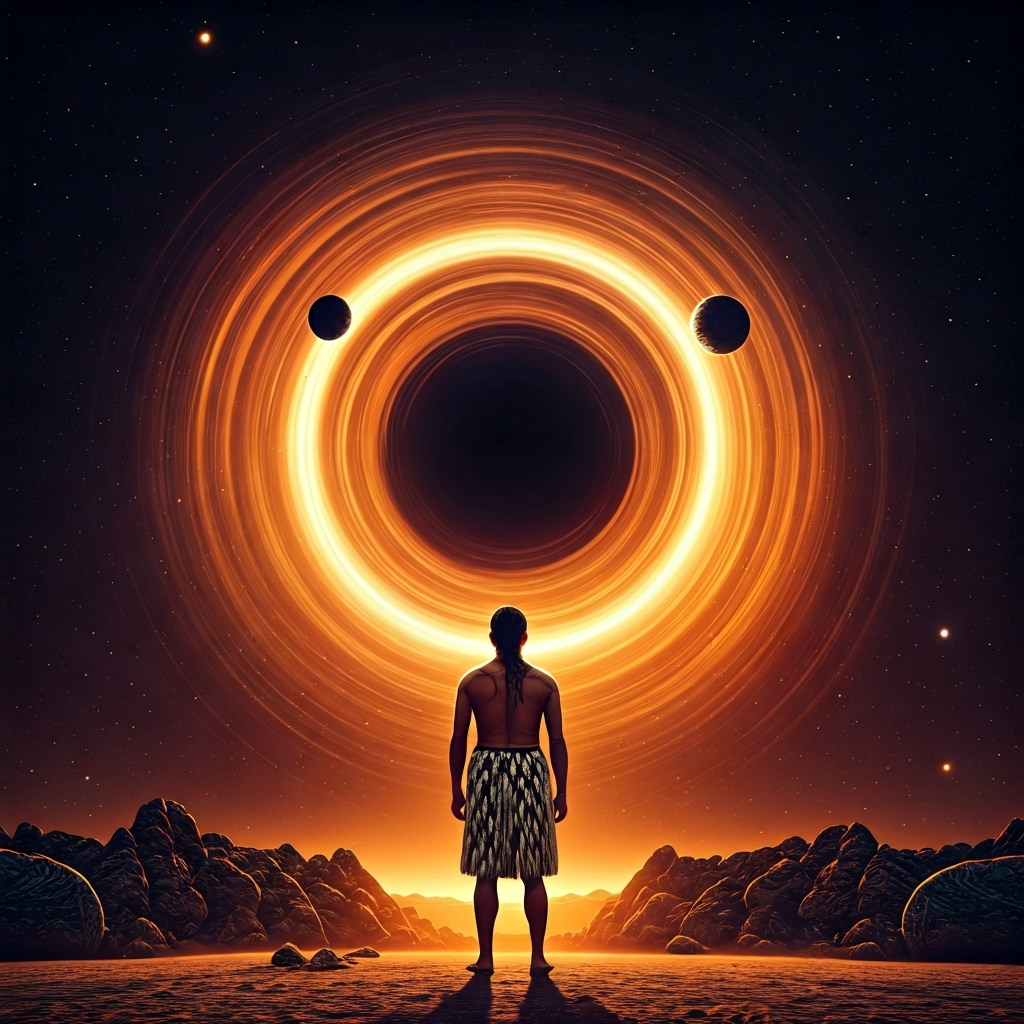
The Black Hole Universe Theory and Why it Matters to Māori
Tyson’s episode explores whether the universe could be the inside of a black hole, with the "edge" of our universe functioning like an event horizon – a boundary beyond which nothing can escape6. He notes that the mass and density of our universe align suspiciously well with what you’d expect from a black hole of this size. He also discusses the net rotation of the universe, suggesting that if the universe has a preferred spin, it could be evidence for this black hole model.
For Māori, these questions are not just scientific curiosities. They cut to the heart of how we understand our origins, our relationship to the cosmos, and our responsibilities as kaitiaki (guardians). The scope of this analysis is to draw clear, accessible parallels between the black hole universe theory and Māori cosmology, exposing the limitations of Western linear thinking and highlighting the depth of mātauranga Māori.
Parallels and Lessons from Māori Cosmology
Creation from Nothingness: Te Kore and the Black Hole Singularity
In Western cosmology, the universe begins with a singularity – a point of infinite density, much like the center of a black hole. Māori cosmology starts with Te Kore, a state of pure potential, formless and in constant flux2345. Te Kore is not "nothing" in the Western sense, but a fertile void, pregnant with possibility. From Te Kore emerges Te Pō, the night, and eventually Te Ao Mārama, the world of light.
Example for the Western mind:
Think of Te Kore as the blank canvas before an artist paints, or the silence before a symphony begins. It is not empty, but full of potential. The black hole singularity, too, is not simply "nothing" but a place where the known laws of physics break down, and from which a new universe could theoretically emerge6.
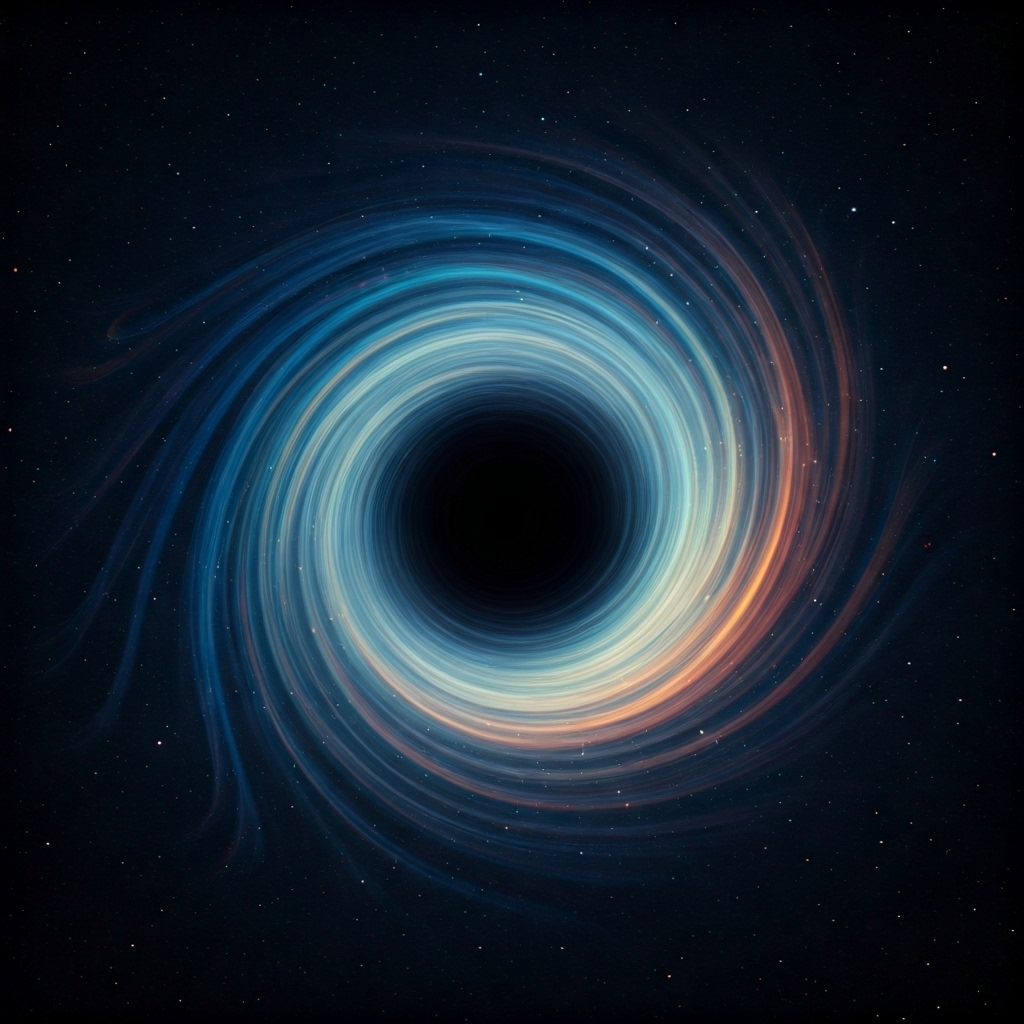
The Event Horizon and Te Pō: Boundaries of Perception
Tyson describes the event horizon as the edge of a black hole, beyond which no information can escape6. Our universe also has a "horizon" – a limit to how far we can see or receive information, because light from beyond has not had time to reach us.
In Māori cosmology, Te Pō is the realm of darkness, the unknown, and the ancestors. It is not simply an absence of light, but a necessary stage before creation. The movement from Te Pō to Te Ao is a journey from the unseen to the seen, from potential to reality2345.
Example for the Western mind:
Imagine standing on a beach at night, unable to see beyond the waves. The darkness is not empty; it is a place of mystery, memory, and connection to those who came before. The event horizon is like this boundary – a limit to our perception, but not to existence itself.
Whakapapa and Conservation Laws: The Universe as Genealogy
Tyson notes that inside a black hole, only two things are preserved: mass and angular momentum (spin)6. Everything else is lost or transformed. This echoes the Māori concept of whakapapa, where everything is connected through genealogy – not just people, but land, stars, and gods23415.
Example for the Western mind:
Whakapapa is like a family tree, but it includes not just your ancestors, but the mountains, rivers, and stars. It is a map of relationships, showing how all things are linked and how their essence is carried forward, even as forms change.
Rotation and Cosmic Order: Net Spin and the Atua
Tyson discusses the surprising observation that many galaxies spin in the same direction, hinting at a net rotation for the universe6. In Māori cosmology, the atua (gods) are personifications of natural forces, each with their domain – the forests, the sea, the winds3415. Their actions bring order to the world, shaping it from chaos.
Example for the Western mind:
Just as a spinning top maintains its motion unless acted on by another force, the atua maintain the balance of the world. The net rotation of the universe could be seen as the lingering influence of these primordial forces, a cosmic whakapapa in motion.
Time, Space, and the Meeting House: Living in Time, Not Just Space
Western science treats time as a linear sequence – past, present, future. Māori see time as a constellation: the past is always present, surrounding us like the stars guide the voyager7. The meeting house (wharenui) is not just a building in space, but a living embodiment of ancestors, history, and relationships across time.
Example for the Western mind:
Imagine a photograph that changes as you look at it, revealing new layers of meaning depending on your own story. The universe, for Māori, is not a static object but a living, evolving being, shaped by the actions and memories of all who inhabit it.
Counterarguments and Limitations
Some may argue that drawing parallels between physics and mythology is a stretch. Yet, as Māori have always known, story and science are not opposites but partners. Both seek to explain our origins and our place in the cosmos. Where Western science sees randomness and chance, Māori see whakapapa and purpose. Both worldviews can enrich each other, but only if we respect the depth and integrity of mātauranga Māori.
Implications: Why These Parallels Matter
Recognizing these parallels is not just an intellectual exercise. It challenges the dominance of Western linear thinking, which often dismisses Indigenous knowledge as mere myth. For Māori, these stories are blueprints for living, reminders of our responsibilities to each other and to the universe. When science finally catches up to what our ancestors have always known, it is a moment to reclaim and celebrate our own cosmology, not just as metaphor, but as truth.
This matters for Māori because it affirms our place in the universe, not as passive observers but as active participants in an ongoing creation. It also exposes the colonial arrogance of assuming Western science has a monopoly on truth, when in fact, our stories have always held the keys to understanding existence.
The Universe in Our Whakapapa
In summary, the idea that our universe could be inside a black hole is not new to Māori. Our cosmology has always taught that creation emerges from nothingness, that boundaries are places of transformation, and that all things are connected through whakapapa. As Western science grapples with these mysteries, we must stand firm in the knowledge that our ancestors have already mapped these cosmic truths.
To those who value this kōrero, I humbly ask: if you find value in my content, please consider a koha/donation to support the cause: HTDM: 03-1546-0415173-000. The Māori Green Lantern understands these tough economic times for whānau, so please only contribute a koha if you have capacity and wish to do so.
Kia kaha, kia māia, kia manawanui – be strong, be brave, be steadfast.
- https://www.tuhin.world/what-is-maori-mythology-gods-legends-and-creation-myths
- https://www.sciencelearn.org.nz/resources/3155-te-ao-maori-space-whakapapa
- https://en.wikipedia.org/wiki/M%C4%81ori_mythology
- https://teara.govt.nz/en/maori-creation-traditions
- https://teara.govt.nz/en/maori-creation-traditions/page-1
- /content/files/index-php/home/article/download/236/159/528.pdf
- https://www.mdpi.com/2218-1997/10/2/84
- https://linkinghub.elsevier.com/retrieve/pii/S2212686420300455
- http://dergipark.org.tr/en/doi/10.53570/jnt.1645623
- https://iopscience.iop.org/article/10.1088/1361-6382/adb2d3
- http://ispcjournal.org/27-2/
- https://www.mdpi.com/2218-1997/5/6/150
- /content/files/open-access-articles/small-bang-model-a-new-paradigm-for-understanding-universe-creation.pdf
- https://www.mdpi.com/1099-4300/26/8/662
- https://pubs.aip.org/aip/acp/article/857641
- https://link.springer.com/10.1140/epjc/s10052-025-14115-y
- https://astronz.nz/pages/maori-astronomy
- https://e-tangata.co.nz/comment-and-analysis/understanding-matauranga-maori/
- https://www.wn.catholic.org.nz/adw_welcom/maori-and-pakeha-worldviews-and-spirituality/
- https://ancientscholar.org/maori-creation-myths-and-archaeological-insights/