“Ghost‑Written Science, Glyphosate, and Crown Complacency” - 19 December 2025
Why Kaupapa Māori Demands Better Than Bayer’s Version of “Safe”
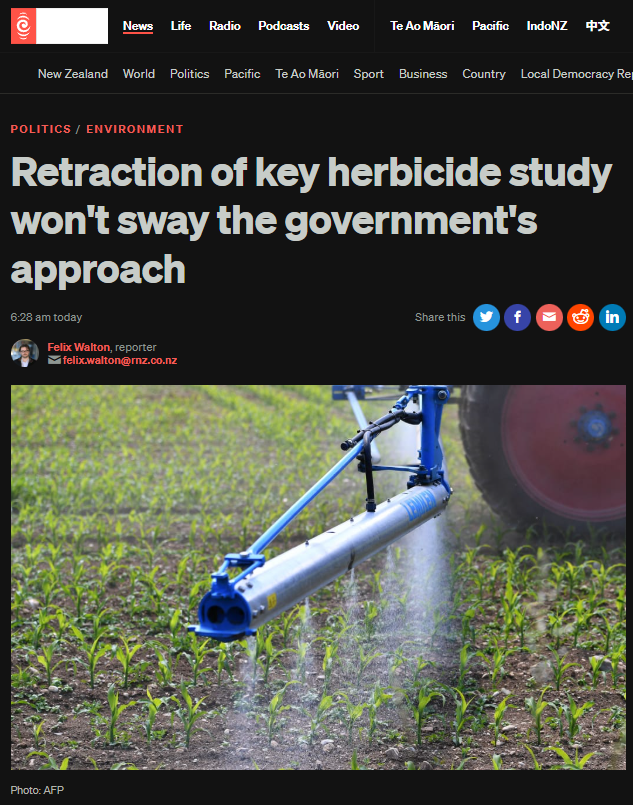
Government agencies in Aotearoa are still backing glyphosate as “safe” even after a cornerstone safety review has been formally retracted for corporate ghost‑writing, as reported by RNZ. That is not neutral science. That is regulatory faith in a system already shown to be structurally captured by agribusiness interests. For Māori, whose whenua, wai and tinana bear the brunt of industrial spraying, this stance is a direct challenge to tino rangatiratanga over health and environment, and a textbook case of how neoliberal governance treats mauri as collateral damage.
Background: One “Authoritative” Review, Twenty‑Five Years of Policy
The RNZ report outlines how a 2000 review by Gary Williams, Robert Kroes and Ian Munro became a globally “authoritative” source on glyphosate safety, only for court documents in 2017 to reveal that Monsanto staff had substantially ghost‑written it, as summarised by RNZ. The paper sat in the top 0.1 percent of most‑cited glyphosate studies and helped shape policy worldwide according to researcher Alexander Kaurov, who pushed for the retraction while investigating corporate influence on science, as described by RNZ.
Only in 2025, after Kaurov directly wrote to the journal editor, was the paper finally retracted, with the journal confirming no one had previously asked, as reported by RNZ.
In other words:
for a quarter‑century, regulators and industry relied on a key “independent” review that was in fact co‑produced by the manufacturer, and no one in the formal system thought to demand formal correction until one independent scientist pushed.
In response to the retraction, the Environmental Protection Authority (EPA) insists that its decisions are unaffected and that there are “no grounds” to reassess glyphosate, pointing instead to more recent data and international consensus as justification, as outlined by EPA manager Shaun Presow in RNZ. NZ Food Safety echoes this, saying current residue limits are backed by international data and the World Health Organization, which it claims show “very low health risk” when glyphosate is used as directed, again reported by RNZ.
At the same time, Bayer (now Monsanto’s owner) defends its role in the Williams paper, describing its contribution as below authorship level and “appropriately disclosed” in acknowledgements, while emphasising that thousands of studies over 50 years support glyphosate safety and that regulatory bodies worldwide consider it non‑carcinogenic when used as directed, as stated in Bayer’s response quoted by RNZ.

Corporate Ghost-Writing and Scientific Corruption
What Mātauranga Māori Sees That Regulators Refuse To
From a kaupapa Māori lens, several truths sit in tension:
- A ghost‑written, retracted study was structurally embedded in the global evidence pyramid for glyphosate, shaping policy settings that directly affect Māori communities, as explained by Kaurov in RNZ.
- The EPA and NZ Food Safety respond not by treating this as a signal of systemic vulnerability, but by minimising its relevance and re‑asserting trust in the same international systems and evidence networks that failed to detect or correct the problem for 25 years, as shown in statements reported by RNZ.
- Bayer frames its own ghost‑writing as a technicality while leaning heavily on “consensus” and volume of studies, even though the RNZ report notes that the Williams paper sits at the base of a large tower of subsequent research, meaning the bias is potentially upstream and structural, as described by RNZ.
Mātauranga Māori treats mauri as indivisible:
harm to soil, waterways and kai is harm to people and whakapapa. A regulatory culture that treats ghost‑written science as a non‑event is a mauri‑depleting system. It constructs safety not as a relational, precautionary commitment to tangata and taiao, but as a statistical story that can be continuously maintained so long as the right institutions repeat it.

Māori Whenua Under Chemical Assault
Hidden Connection 1: Ghost‑Writing as Structural, Not “One Bad Paper”
Kaurov’s work started as an investigation into corporate influence on science, not glyphosate per se, and the Williams paper was selected as a case study in a broader project on ghost‑writing, as reported by RNZ. He then discovered that despite court evidence of Monsanto’s substantial authorship, the paper had never been retracted until he requested it directly from the journal, which he says was the first such request the editor had received, as relayed by RNZ.
This exposes two linked systems:
- Corporate strategies to infiltrate and shape the scientific record through hidden authorship, which is what Kaurov explicitly set out to study, according to RNZ.
- A journal and regulatory ecosystem that can absorb such compromised work for decades without self‑correcting, needing an outside researcher to trigger basic accountability, as shown by the editor’s admission, reported by RNZ.
From a Māori perspective, this is not a neutral technical glitch. It is a breach of whakapono (trust) and a breach of kaitiakitanga (duty of care) by institutions that claim authority over what counts as “safe” in our environment. If the “brick at the bottom of the pyramid” is corrupted, as Kaurov describes in RNZ, then the entire edifice of evidence and regulation built upon it is suspect, particularly for communities who never consented to be sprayed in the first place.
Hidden Connection 2: Regulatory Deference to International Consensus as a Shield
Shaun Presow of the EPA stresses that the Williams paper “has not been used” in decision‑making, noting that it was referenced only once in a 2016 report as part of a broad overview, and insists that EPA’s 2024 decision that there are no grounds to reassess glyphosate remains valid based on “large amounts of more recent data” that are publicly available, as set out in his comments to RNZ. NZ Food Safety likewise relies on international bodies such as the WHO to justify current residue limits, stating that these authorities agree glyphosate poses “very low health risk” when correctly used, as reported by RNZ.
This reveals a classic pattern:
- When corporate bias in the science record is exposed, regulators retreat into the rhetoric of “multiple studies” and “international consensus” rather than confronting how that consensus might itself be shaped by the original ghost‑written work. The RNZ article explains how “a lot of science since 2000 has been built on top of this review,” in Kaurov’s words, meaning the contamination is upstream and potentially replicated across newer studies and assessments, as described by RNZ.
- By refusing to reassess glyphosate despite acknowledging the retraction as “noteworthy”, the EPA effectively signals that no amount of evidence of corporate interference will trigger precaution unless it is already baked into the same international datasets it defers to, as indicated in Presow’s comments in RNZ.
For Māori, this is a structural conflict with Te Tiriti‑consistent practice. A Tiriti‑honouring regulator would treat evidence of ghost‑writing in a key paper as a red flag demanding independent reassessment, particularly given the disproportionate exposure of rural Māori communities and kāinga near sprayed whenua. Instead, agencies choose to sit behind overseas institutions that have their own histories of regulatory capture, as noted in the global debate around glyphosate safety summarised in RNZ.
Hidden Connection 3: Corporate Narrative Control Disguised as Technical Clarification
Bayer’s spokesperson argues that Monsanto’s involvement did not “rise to the level of authorship” and was “appropriately disclosed” in acknowledgements, while pointing to two prior inquiries (including the European Food Safety Authority) that had found the paper appropriate, as reported in RNZ. They then pivot to the volume and duration of glyphosate research—“thousands of studies” over 50 years—with most allegedly free of Monsanto involvement, claiming that leading regulatory bodies agree glyphosate is not carcinogenic and safe when used as directed, again quoting RNZ.
This is a textbook example of corporate narrative framing:
- Define ghost‑writing as a minor technicality rather than a fundamental breach of scientific integrity. Bayer’s language minimises Monsanto’s role even though Kaurov’s investigation and court documents previously highlighted substantial ghost‑writing, as covered in RNZ.
- Invoke prior regulatory “inquiries” and the weight of numbers (“thousands of studies”) to overshadow the core issue: if a highly cited foundational review was partly written by the company whose product it evaluates, then the network of subsequent research, meta‑analyses and regulatory summaries built upon it is potentially shaped by that initial bias, as Kaurov warns in the same RNZ piece, when he compares the Williams paper to a brick at the base of a pyramid in RNZ.
From a Māori standpoint, this framing is mauri‑depleting because it recasts a kōrero about integrity and power as a technical dispute over authorship thresholds. It marginalises the lived realities of whānau exposed to sprays, replacing their experience with abstracted regulatory reassurance.

The Pyramid of Compromised Evidence
Hidden Connection 4: The Precautionary Principle vs. “Probably It Will Be Fine”
Kaurov uses the metaphor of pulling out a brick at the bottom of a pyramid: a lot of science since 2000 has been built on the Williams review; removing it may be “fine” for now, but if a few more such bricks are pulled, there will be a problem, as he explains in RNZ. That “probably it will be fine” phrase is doing heavy work. It encapsulates the difference between Western regulatory pragmatism and a Māori ethic of kaitiakitanga.
A Māori‑centred precautionary stance would say: if corporate ghost‑writing has been proven in one of the most influential glyphosate papers, the onus shifts to proving that other key pieces of evidence are not similarly compromised. It would prioritise independent reassessment and the voices of affected communities. In contrast, the EPA and NZ Food Safety treat the retraction as a minor correction that does not disturb the overall “consensus”, as indicated by their decision not to reassess glyphosate and their continued reliance on international bodies, all documented by RNZ.
This clash is not theoretical. It shapes whether rural Māori, marae, kura and papakāinga near sprayed land are treated as taonga requiring active protection or as acceptable risk margins in a cost‑benefit calculus designed around agribusiness convenience.
Hidden Connection 5: Who Bears the Risk When Regulators Refuse to Reassess?
The RNZ report does not list specific communities, but it makes clear that glyphosate is “the most popular herbicide on the planet” and widely used, which is precisely why Kaurov chose it as a case study, as quoted in RNZ. The EPA’s decision not to reassess—despite acknowledging the retraction as a reminder to be careful—means that status quo practices remain in place, as stated explicitly in Presow’s comments in RNZ.
In Aotearoa, status quo agricultural and roadside spraying disproportionately affects:
- Rural communities, including Māori living near farm blocks, forestry lands and transmission corridors.
- Hapori who rely on gathered kai, water sources and whenua that may be exposed to repeated herbicide application.
Yet their risk profile is decided in reference to international bodies and studies whose foundations include a now‑retracted, ghost‑written review. With no reassessment, Māori communities are effectively told to keep trusting a system that has already admitted systemic failure in at least one key node, as documented by Kaurov and the retraction coverage in RNZ.
This is not merely an epistemic injustice (whose knowledge counts) but a distributive one (who takes the hit when knowledge is wrong). Māori, already at the sharp end of environmental injustices, are again placed in the position of passive recipients of risk.
Implications: Quantifying Harm in a System Built to Under‑Count It
The RNZ article itself focuses on the integrity of the scientific record and regulatory responses rather than specific health data, but several implications are clear.
First, the fact that a ghost‑written, industry‑influenced paper could sit among the top 0.1 percent of citations on glyphosate—as reported by Kaurov in RNZ—means downstream analyses, meta‑reviews and policy‑summaries may have systematically understated risk. Second, regulators’ reliance on those same networks of studies and international verdicts to justify non‑reassessment amplifies that under‑counting, as revealed by the EPA and NZ Food Safety’s statements in RNZ.
For Māori, this means that any attempt to quantify harm must start by accepting that the baseline datasets have been curated in ways that structurally favour “safety” narratives. Ghost‑writing is not just about one paper; it is about which outcomes get published, which analyses get amplified, and which communities’ experiences are recognised or dismissed. The retraction is a rare moment where the machinery slips enough for the public to see inside, as documented through Kaurov’s investigation in RNZ.
What Tino Rangatiratanga Requires Now
A Tiriti‑consistent, kaupapa Māori response to this situation would not be satisfied with “the consensus remains glyphosate is safe.” It would demand:
- An independent reassessment of glyphosate in Aotearoa, explicitly accounting for the retracted Williams review and investigating other key studies for corporate influence, rather than assuming the rest of the evidence base is clean. The RNZ reporting already provides a prima facie case that such an audit is necessary, given the paper’s influence and proven ghost‑writing, as shown in RNZ.
- A regulatory framework that embeds mātauranga Māori, precaution and community testimony—not just international consensus—into decisions about chemical use on whenua and kai. The EPA’s own admission that the retraction reminds them to “be careful when considering information” is a weak starting point; a stronger response would treat Māori as partners and kaitiaki, not as afterthoughts, as suggested by the need for more than perfunctory acknowledgements in the RNZ‑reported statements in RNZ.
- Transparent disclosure whenever corporate actors are involved in research that informs regulatory policy, including clear labeling of conflicts of interest and mechanisms for communities to challenge and review such evidence.
Kaitiaki of Truth vs. Corporate “Consensus”
The RNZ article on the retraction of the Williams glyphosate study exposes a system where corporate ghost‑writing can shape the scientific record for decades, regulators respond with minimal course‑correction, and the most affected communities are expected to accept “very low risk” assurances built on compromised foundations, as traced through Kaurov’s investigation, EPA’s stance, and Bayer’s defence in RNZ.
For Māori, this is yet another arena where tino rangatiratanga and kaitiakitanga collide with neoliberal logics that prioritise agricultural productivity and regulatory consensus over mauri. Being kaitiaki of truth here means refusing to let a retraction be treated as a minor footnote. It means insisting that when a brick at the bottom of the pyramid is rotten, the entire structure gets inspected—not just patched.
Until regulatory agencies shift from “probably it will be fine” to a truly precautionary, Te Tiriti‑honouring stance, Māori will continue to live in landscapes governed by someone else’s risk tolerance, justified by someone else’s ghost‑written science.
Koha statement
Only Support this mahi if you are able: Koha.Kiwi | Substack | Bank: HTDM 03-1546-0415173-000
All koha sustains free mātauranga Māori journalism. No paywall, no corporate interference.

Ivor Jones The Māori Green Lantern Fighting Misinformation And Disinformation From The Far Right