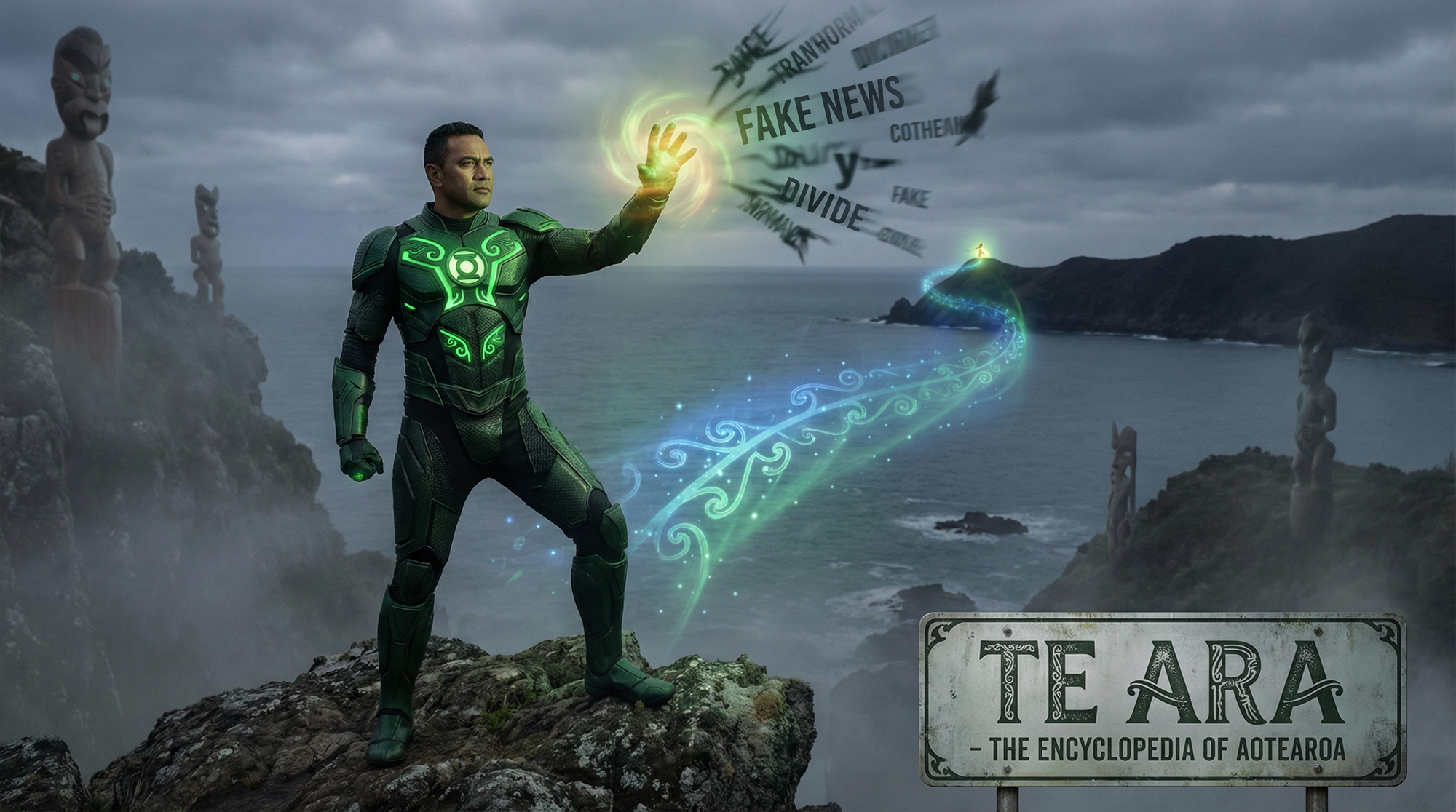
"HE WAKA KOTAHI, HE HINAKI HOU: LABOUR'S NEOLIBERAL MASK AND THE MĀORI VOTES THEY ARE HUNTING" - 15 March 2026
National swings the taiaha at your face. Labour smiles and slowly bleeds you out. Both leave you on the ground. Only one asks you to thank them for it — then sends Willie Jackson to collect your vote
Kia ora Aotearoa,
Thank you for visiting this space.
HE KUPU WHAKATAKI — THE OPENING TRUTH
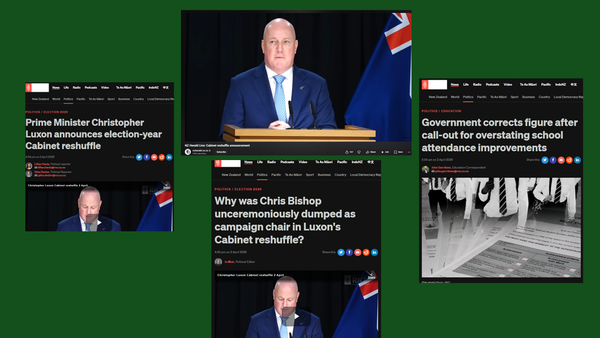
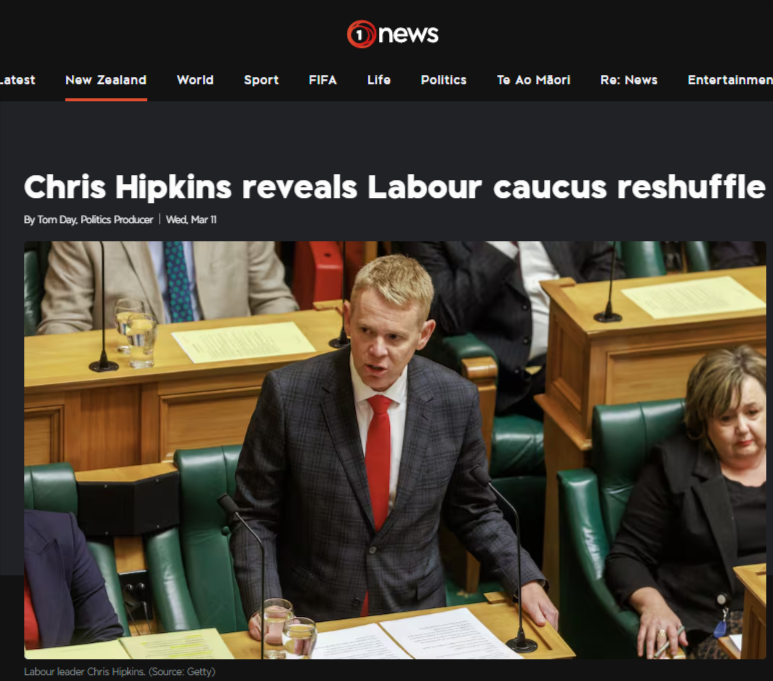
Eight months before the 2026 election, Chris Hipkins reshuffled his Labour caucus on March 11 and asked Māori Aotearoa to believe something it has been asked to believe every three years since 1935: this time is different.
It is not different. The faces have changed. The architecture has not. What follows is the documented, verified, whakapapa-grounded case that Labour is not the antidote to National's poison — it is the same poison in a smaller dose, administered with better bedside manner, and what Hipkins calls a "reshuffle" is nothing more than the annual rebaiting of the hinaki — the eel trap — before harvest season.
This essay names the trap. It maps its weaving. And it asks the only question that matters: how many more times will the tuna enter the same vessel?
KO TE RĀPOPOTOTANGA — THE SUMMARY
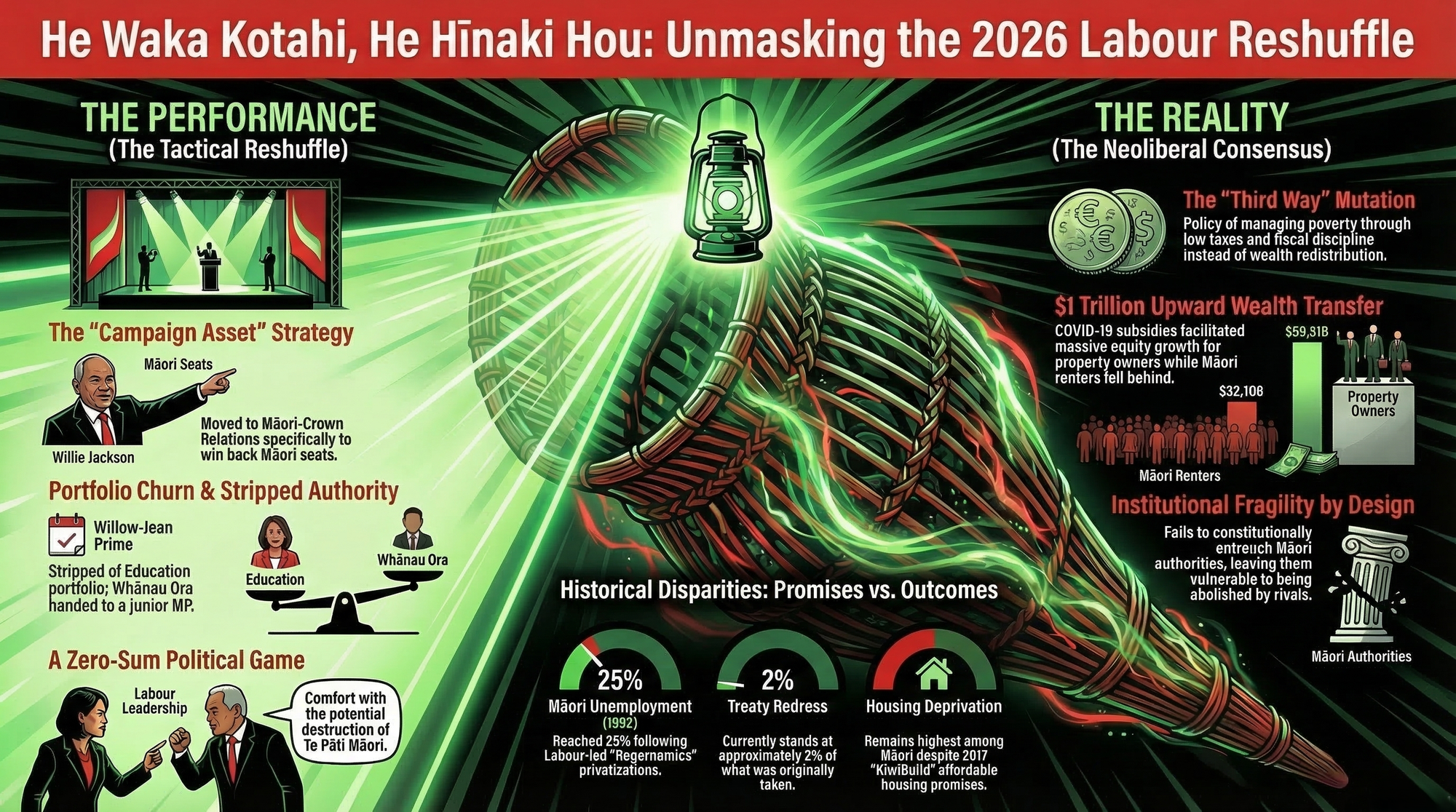
Labour has governed Aotearoa for fourteen of the past thirty-nine years and in that time has produced no structural change in the conditions under which Māori are born, educated, housed, imprisoned, or die.
This reshuffle deploys Willie Jackson as an explicit electoral campaign asset for the Māori seats, strips Willow-Jean Prime from the lead Education portfolio, hands Whānau Ora to a junior MP as a career stepping-stone, and buries the departure of two of Labour's most senior Māori MPs — Peeni Henare and Adrian Rurawhe — beneath optimistic press releases.
Beneath all of it lies a forty-year-old truth that Massey University political scientist Toby Boraman documented at RNZ: Labour and National share the same "underlying neoliberal consensus" — the same refusal of redistribution, the same management of poverty rather than its elimination, the same protection of the wealth structures that dispossession built. The reshuffle changes the paddlers. It does not change the waka. And this waka has always been heading toward the same place.
The Deep Dive Podcast
Listen to a lively conversation between two hosts, unpacking and connecting topics in the sources of this essay
KO TE TŪĀHUATANGA — THE SHAPE OF THE LIE
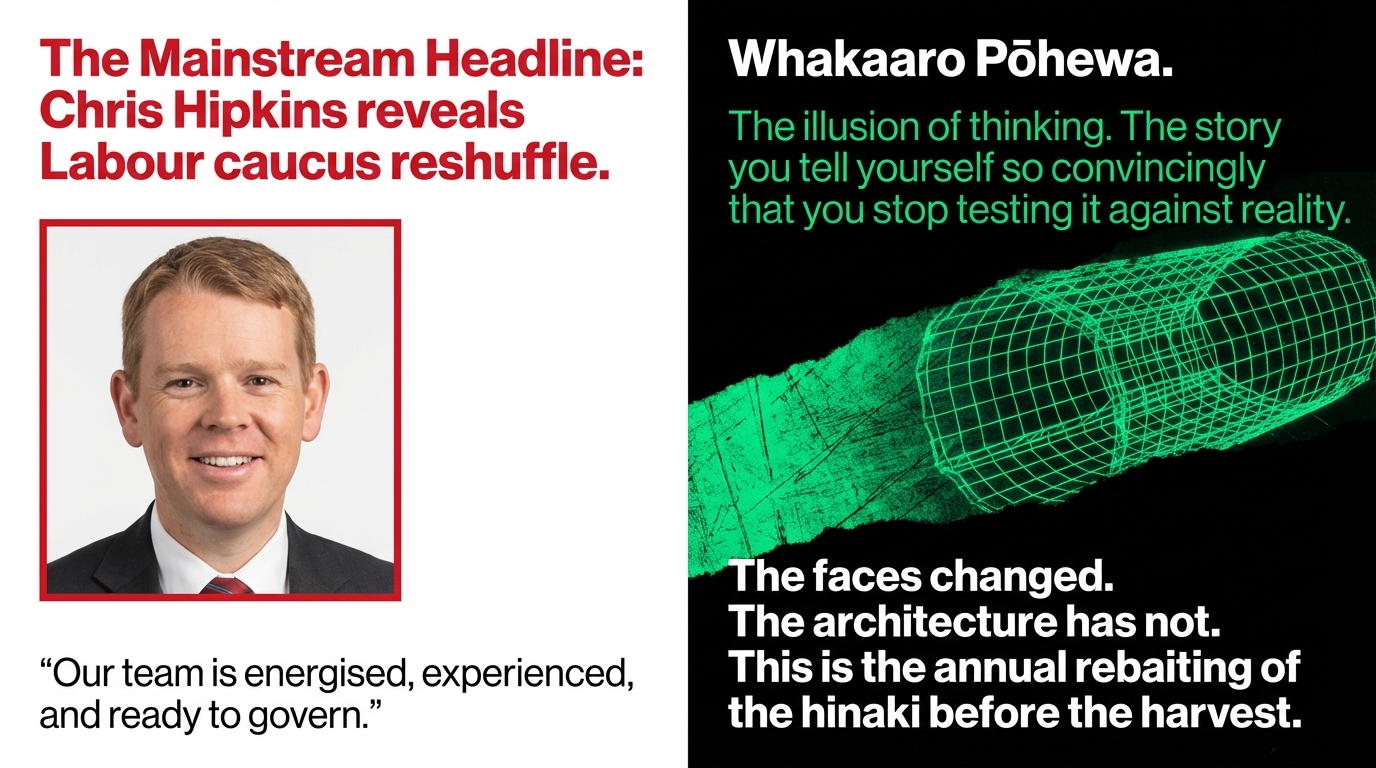
There is a concept in te ao Māori called whakaaro pōhewa — the illusion of thinking. The trap you build in your own mind. The story you tell yourself so convincingly that you stop testing it against reality.
For ninety years, the whakaaro pōhewa that has most consistently devastated Māori political sovereignty is this one: Labour is different.
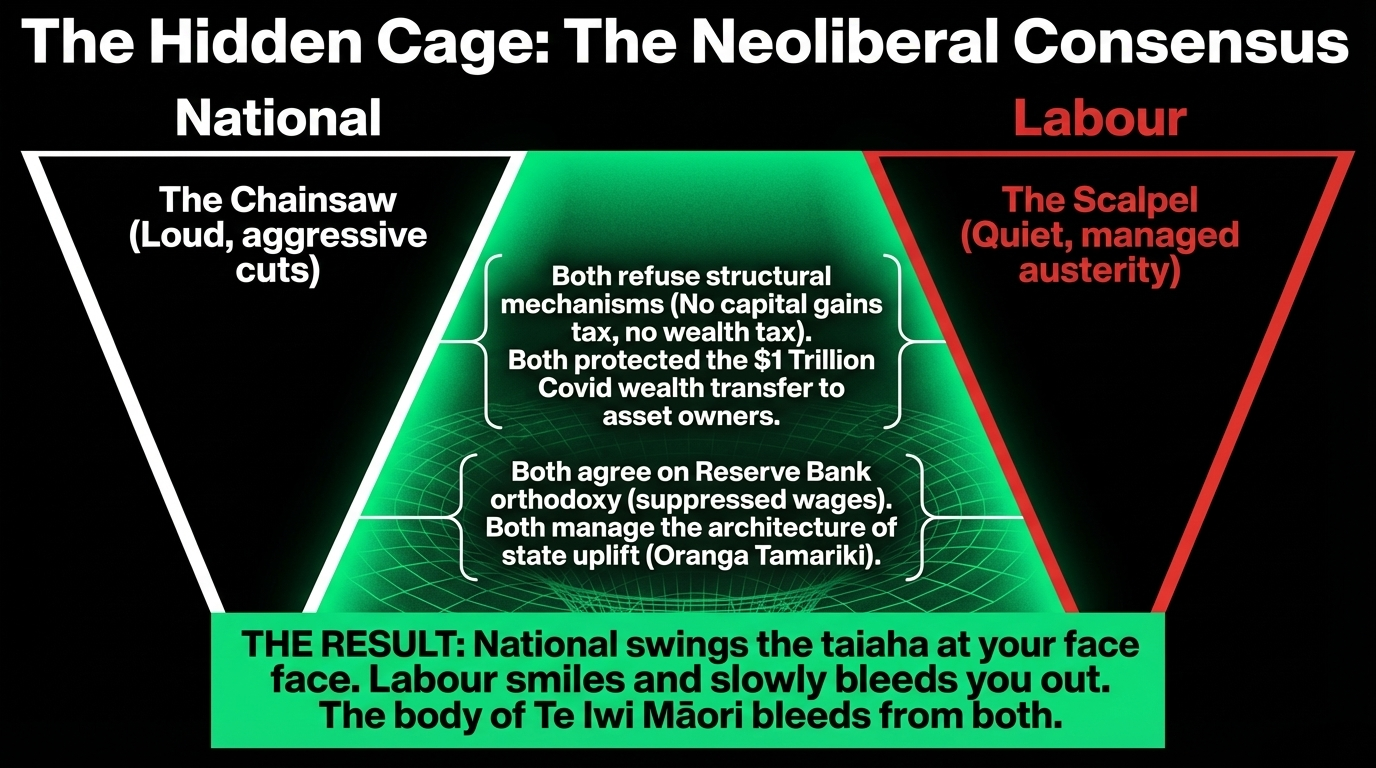
It is not. As Boraman documented at RNZ, both Labour and National operate within the same "underlying neoliberal consensus" — low taxes, free trade, deregulated business, and above all: fiscal discipline that keeps wealth with those who already hold it. Hipkins called his own brand "radical incrementalism." Boraman names it accurately: "austerity by stealth." National cuts loudly with a chainsaw. Labour cuts quietly with a scalpel. The body of te iwi Māori bleeds from both instruments.
There is an old form of fishing in te ao Māori called the hinaki — the eel trap.
You weave it carefully. You bait it with precision. You place it in the current where the tuna run. The tuna smells the bait, enters the vessel, and cannot find its way out. It is caught not by force, but by the architecture of the trap itself.
The March 2026 Labour reshuffle is not a departure from this architecture. It is its highest expression: reshuffling Māori faces to win Māori seats for a party that has never — in six years of MMP-era government — fundamentally altered the conditions under which Māori live, die, are incarcerated, or lose their children to the state.
KO ROGERNOMICS — HE HĪTORI KUA KORE E WAREWARETIA
To understand why this reshuffle is theatre, you must understand whose theatre it is and who built the stage.
As Te Ara chronicles, the Fourth Labour Government elected in 1984 did not merely drift toward free-market economics — it sprinted. Roger Douglas and Richard Prebble privatised state assets, slashed welfare, introduced GST, and deregulated with a ferocity that would have embarrassed Thatcher. This was not National. This was Labour. The architects of the most catastrophic economic experiment ever conducted on the bodies of Māori and working-class Aotearoa carried red membership cards.
As The Spinoff's Rogernomics analysis documents, Māori had been disproportionately employed in government-run industries — precisely the industries privatised under that Labour government. By 1992, Māori unemployment had reached 25% against an overall rate of 10%. As Greenpeace Aotearoa's structural analysis confirms, both National and Labour "embraced neoliberalism in direct contradiction to their election promises" — fracturing their own bases while entrenching the economic conditions that made Māori poverty permanent. Treaty settlement redress today stands at approximately 2% of what was taken. The party that built that wound is the same party now asking Māori to trust Willie Jackson.
This is not ancient history. This is whakapapa. The DNA of every Labour economic decision since 1984 carries the gene sequence of Rogernomics, modified for palatability but not transformed in structure.
KO TE "THIRD WAY" — HE ARA KORE TIKANGA
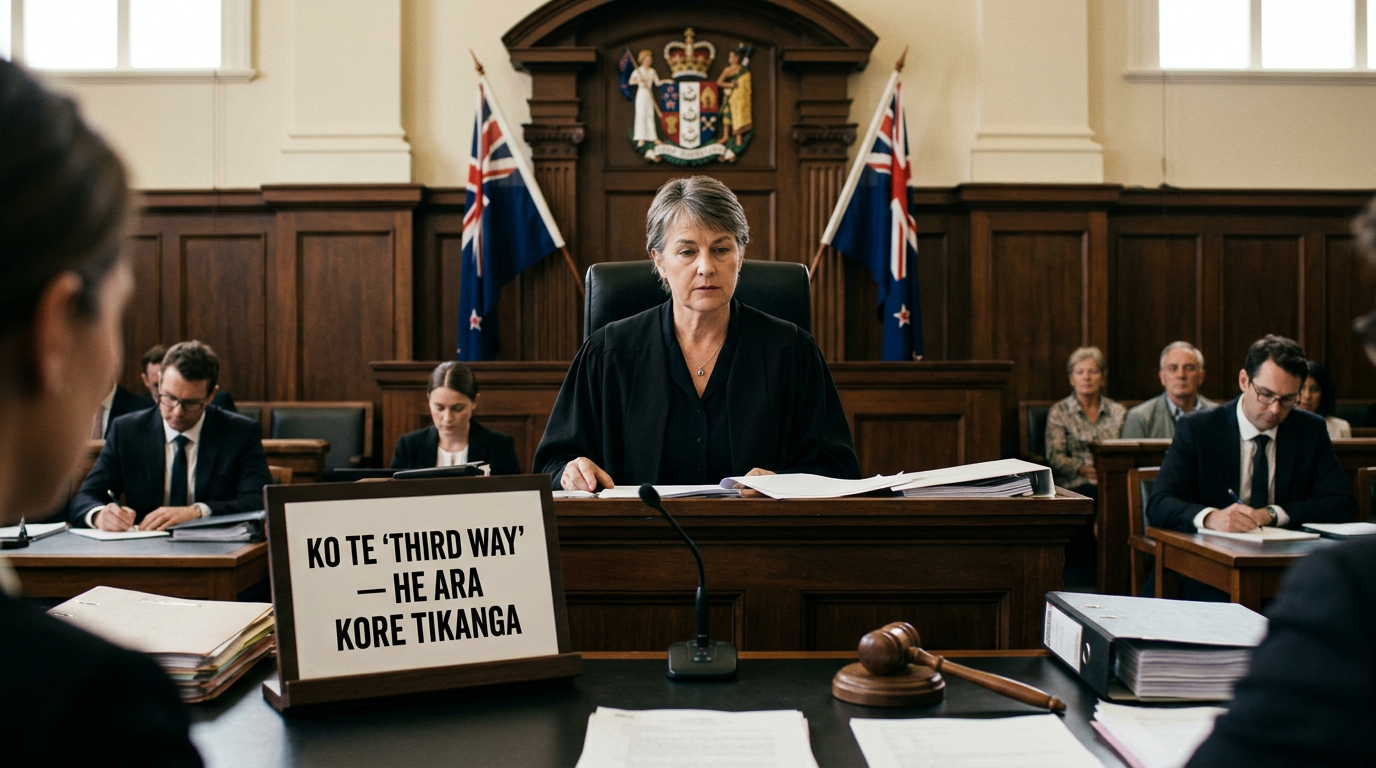
When confronted with the Rogernomics legacy, Labour's defenders invoke the Clark and Ardern governments as evidence of redemption. Boraman's analysis published at RNZ is surgical in response: Labour since 1999 has adopted the "third way" mutation — which accepts some government intervention in markets but never redistributes wealth. It manages poverty. It does not end it.
Three facts demolish Labour's "we are different" mythology forever:
- Both Ardern and Hipkins explicitly ruled out a capital gains tax — the single most powerful mechanism to reduce the intergenerational wealth gap between Pākehā and Māori. Not deferred. Not complexified. Refused.
- The US Heritage Foundation — the global temple of free-market absolutism — still ranked New Zealand fifth in its global Index of Economic Freedom during Labour's tenure. When your fiercest ideological opponents rank you as one of the world's freest markets, you do not get to claim you challenged the market.
- Labour's Covid wage subsidy, as Boraman cites from Bernard Hickey's analysis, facilitated an upward wealth transfer of approximately NZ$1 trillion, primarily through boosted house prices. Māori, overrepresented in rentals and underrepresented in property ownership, watched that trillion accumulate in other people's equity.
The Māori Green Lantern has previously documented this identical pantomime in The NZ Neoliberal Pantomime: Why Every Major NZ Party Serves the Same Masters, published 5 March 2026 — just six days before Hipkins announced this reshuffle. The timing is its own indictment.
KO TE ĀHUA O TE HINAKI — THE SHAPE OF THE TRAP
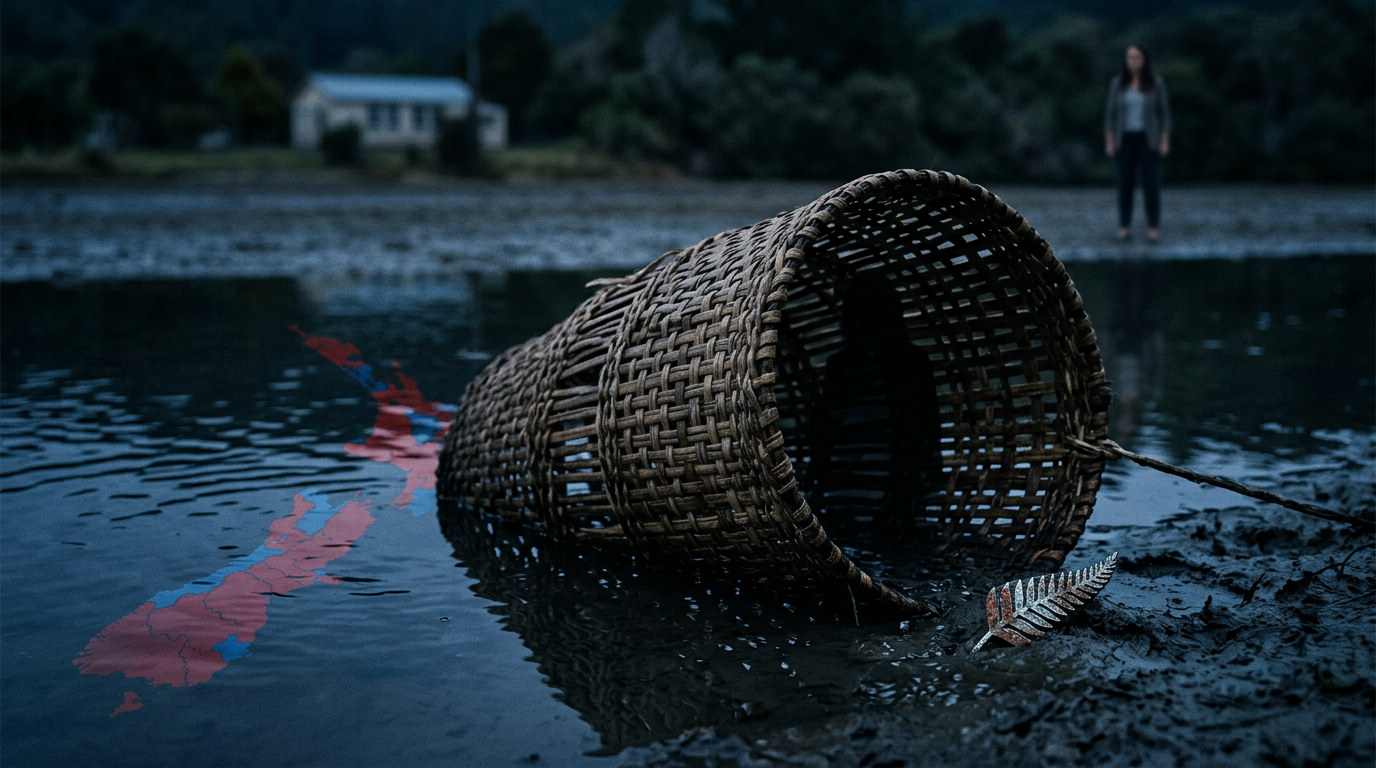
Now examine what Hipkins built with those departures and what it actually means.
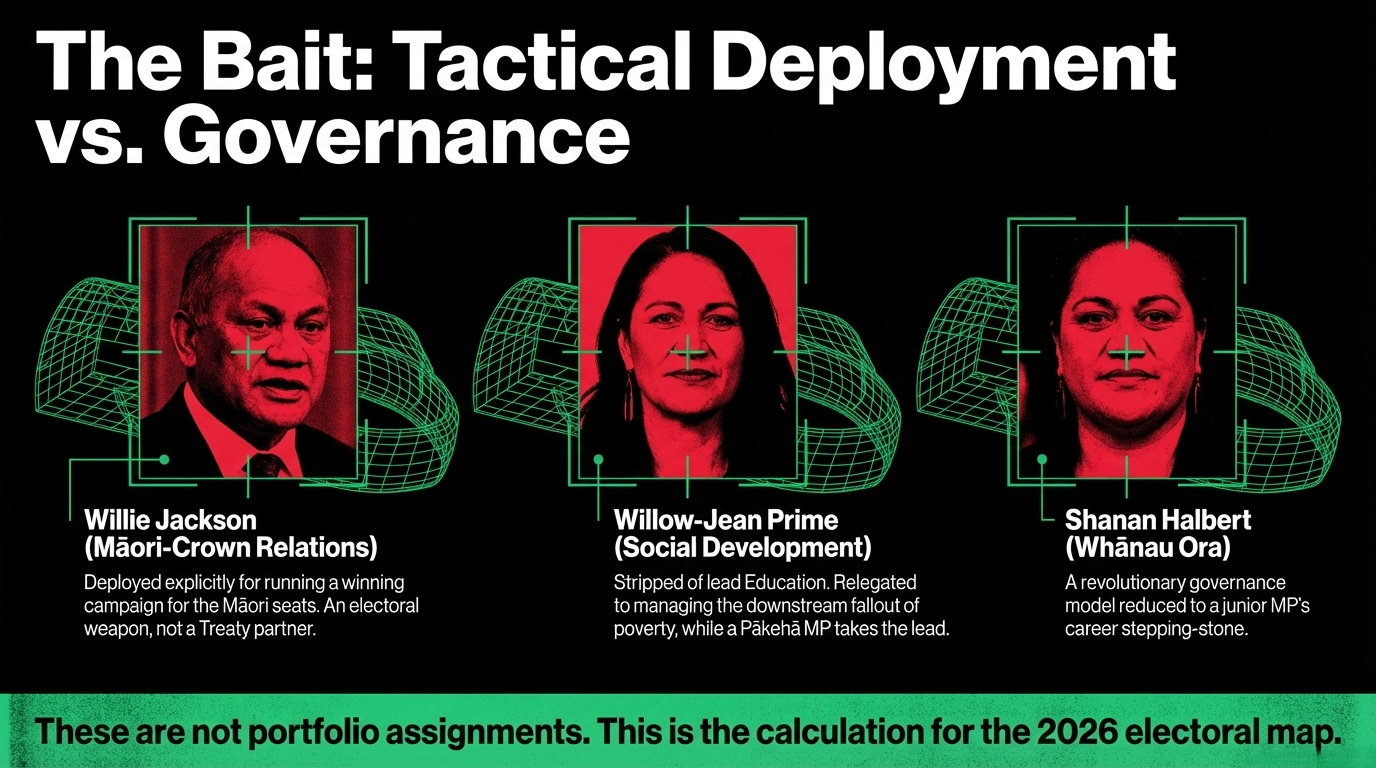
As RNZ confirmed, Willie Jackson has been moved to Māori-Crown Relations. Hipkins was explicit about the reason. Jackson's role, in the leader's own words, is "running a winning campaign for the Māori seats this year." Not serving Māori. Not advancing Māori wellbeing. Not honouring Te Tiriti. A winning campaign. Jackson has not been deployed as a kaitiaki of Māori interests. He has been deployed as a kaitiaki of Labour's electoral map.
It gets worse. As the NZ Herald revealed in November 2025, Labour's Chris Hipkins expressed no concern if its campaign to win Māori seats results in Te Pāti Māori being destroyed and removed from Parliament. Jackson confirmed he is "absolutely comfortable" with that outcome. Read that sentence at full volume. The party asking for your vote is openly comfortable with destroying the only party in Parliament that exists specifically to serve Māori interests — as a means of taking those interests' seats. This is not a coalition partner. This is a predator wearing a partner's clothing.
Meanwhile, as RNZ confirmed, Willow-Jean Prime — a Māori woman — has been stripped of the Education portfolio and handed Social Development. She retains "Associate Education (Māori)" — the crumbs at the edge of someone else's table. The full education portfolio goes to Pākehā Ginny Andersen — the third Labour MP to hold the role in just over a year. Three education spokespeople in twelve months. This is not governance. This is churn with better press releases.
Then there is Shanan Halbert receiving Whānau Ora as a portfolio "gain" — handed to a junior MP as a career stepping-stone. Whānau Ora, conceived by Tariana Turia as a revolution in how the Crown delivers for Māori, reduced to a resume line.
KO TE TIKANGA I TAKAHIA — TIKANGA TRANSLATED FOR THE WESTERN MIND
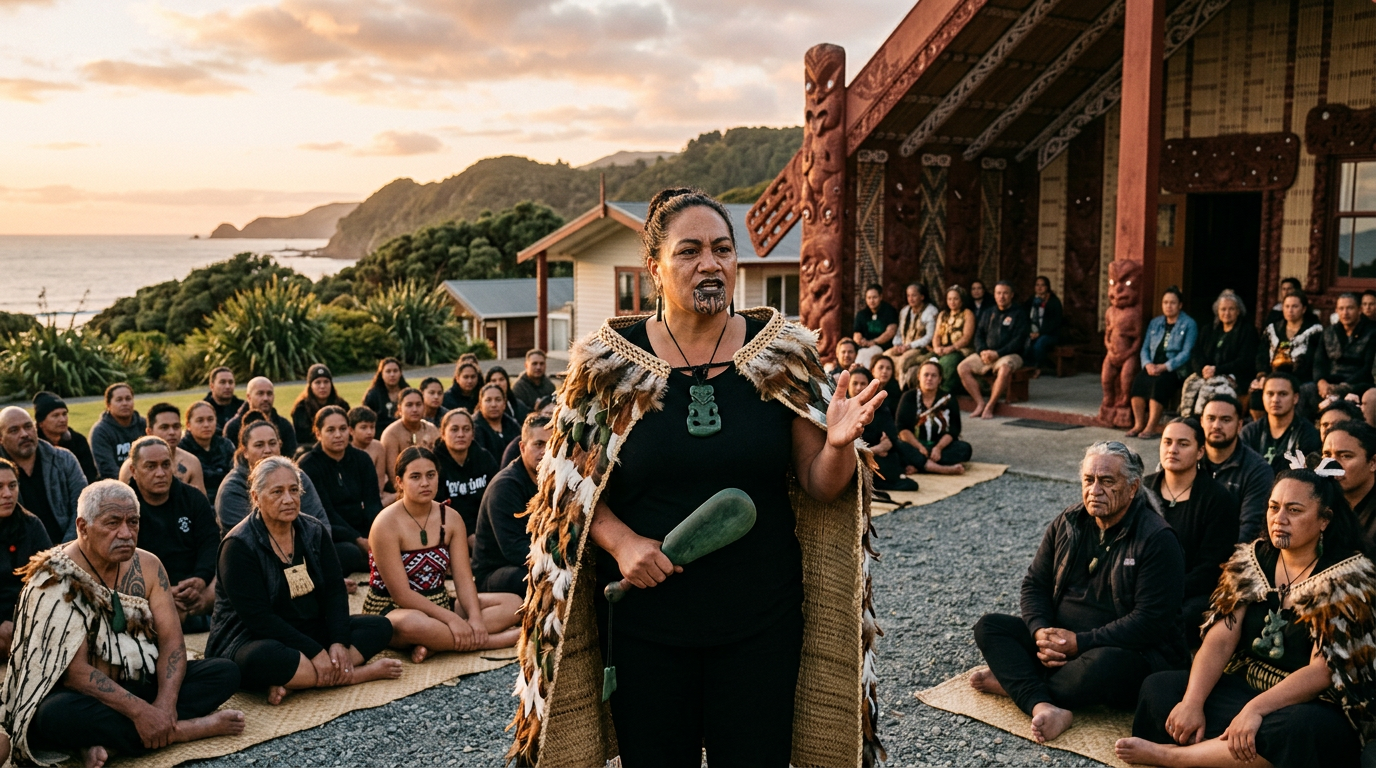
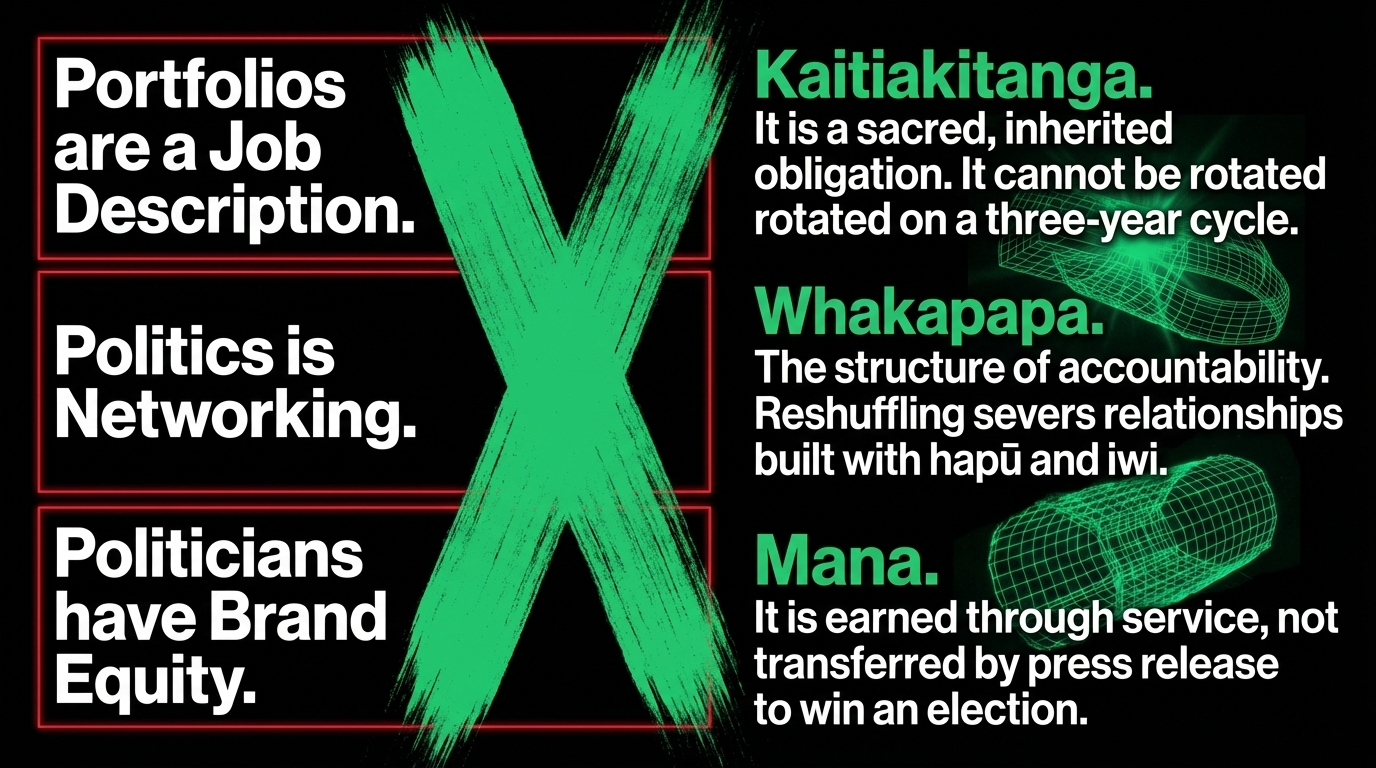
For those raised in liberal democratic tradition, a cabinet reshuffle is administrative — portfolios are job descriptions, MPs are policy managers. That frame will not help you understand why this reshuffle is tikanga-violating. Three translations are required.
Kaitiakitanga is not a job description. It is a sacred, inherited obligation. In te ao Māori, those who hold roles of guardianship do not rotate in and out on electoral cycles. Their authority derives from relationship, demonstrated service, and whakapapa with the people they protect. When you reshuffle Māori portfolios eight months before an election because you want to win seats, you are not practising kaitiakitanga. You are performing it. And Māori can tell the difference between the real fire and the projection of its light on the wall.
Whakapapa is not networking. It is the structure of all accountability. Every Labour Māori portfolio carries a whakapapa — a lineage of promises, engagements, and relationships built over years with hapū, iwi, and urban Māori authorities. When you shuffle those portfolios for tactical electoral reasons, you sever those relationships. The new portfolio holder must introduce themselves. The communities must begin again. The western equivalent: imagine appointing a new hospital director every year and asking patients why healthcare outcomes haven't improved.
Mana is not brand equity. It cannot be transferred by press release. Willie Jackson's mana is real. It has been built across decades of advocacy and direct kōrero with Māori communities. But Labour cannot deploy that mana as an institutional electoral tool without diminishing it. When Māori voters see Jackson explicitly framed by his own leader as a campaign asset — not a policy architect, not a Treaty partner — some will recognise exactly what is being done. The Spinoff's analysis from February 2026 names it precisely: the new generation of Māori voters "challenges politicians," does "not default to loyalty," and expects accountability. This reshuffle delivers none.
NGĀI TATU — THREE QUANTIFIED PROOFS THE RESHUFFLE MEANS NOTHING
One: KiwiBuild — The Housing Catastrophe That Exposes Everything
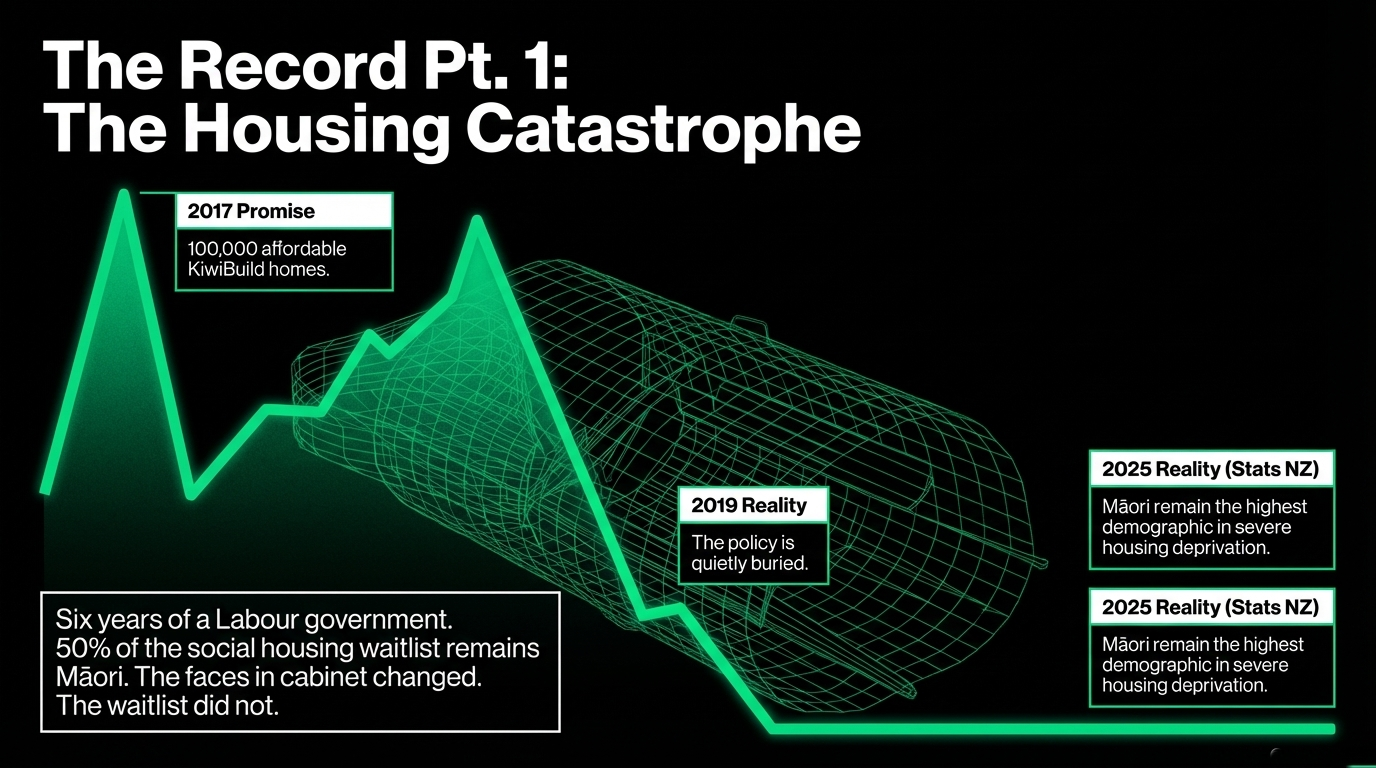
In 2017, Labour campaigned on 100,000 affordable homes in ten years. Māori were 50% of the social housing waitlist — documented by The Dig's analysis of Labour's housing policy. That promise was the centrepiece of Labour's claim to be different from National.
By 2019, Labour had quietly buried KiwiBuild. As 1News's Jack Tame documented, Labour came to power with an ambitious agenda and "struggled to live up to the spirit of those promises." That is the politest description possible. Māori families on the housing waitlist did not receive polite descriptions. They received nothing. By the time Stats NZ published its Housing in Aotearoa 2025 report, severe housing deprivation remained highest among Māori and Pacific peoples. Six years of Labour government. Outcomes structurally unchanged. And now in this reshuffle, Willow-Jean Prime receives Social Development — the portfolio that manages the downstream crisis of Labour's housing failure — while a Pākehā MP holds Education. The faces changed. The waitlist did not.
The solution: Labour must commit, before a single Māori electorate campaign begins, to a binding Māori housing programme with independent Māori-led oversight, published targets, and automatic Crown accountability if those targets are missed. Not a brochure. A mechanism.
Two: Te Aka Whai Ora — Created, Celebrated, and Left Defenceless
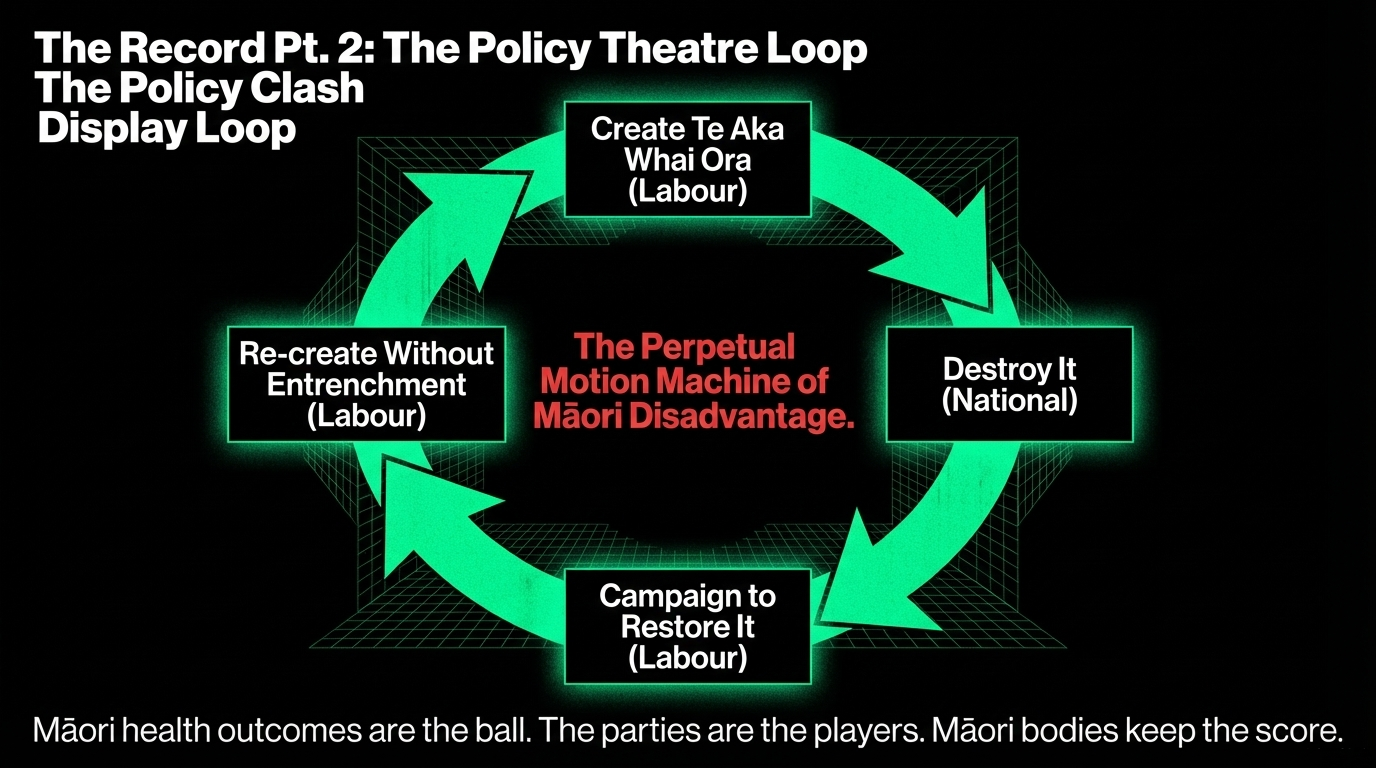
Labour created Te Aka Whai Ora — the Māori Health Authority — in 2022. It was presented as transformational. Then National abolished it in 2023 within months of taking power. And Labour's response? As RNZ reported on Labour's March 2025 economic team announcement, Labour announced it would restore Māori health structures — with no binding mechanism, no structural protection, no constitutional entrenchment to prevent the next National government doing exactly the same again.
This is the neoliberal lite formula in its clearest expression: create without protecting, promise without entrenching, and when the institution is destroyed, campaign on restoring it. The perpetual motion machine of Māori policy theatre. Create. Destroy. Promise. Create. Destroy. Promise. Māori health outcomes are the ball. Labour and National are the players. Māori bodies keep the score. As Greenpeace Aotearoa's analysis confirmed, the Clark Labour government similarly "made limited progress on rolling back neoliberalism" while leaving the structural conditions of Māori disadvantage intact. The 2026 reshuffle installs no structural protection for Māori health in Labour's shadow portfolio. Just a Māori face. Same result.
The solution: Any restored Māori health authority must be constitutionally entrenched — embedded in legislation requiring a supermajority to overturn, with an independent Māori board whose members cannot be dismissed by a minister.
Three: The Māori Seats — Democracy or Extraction?
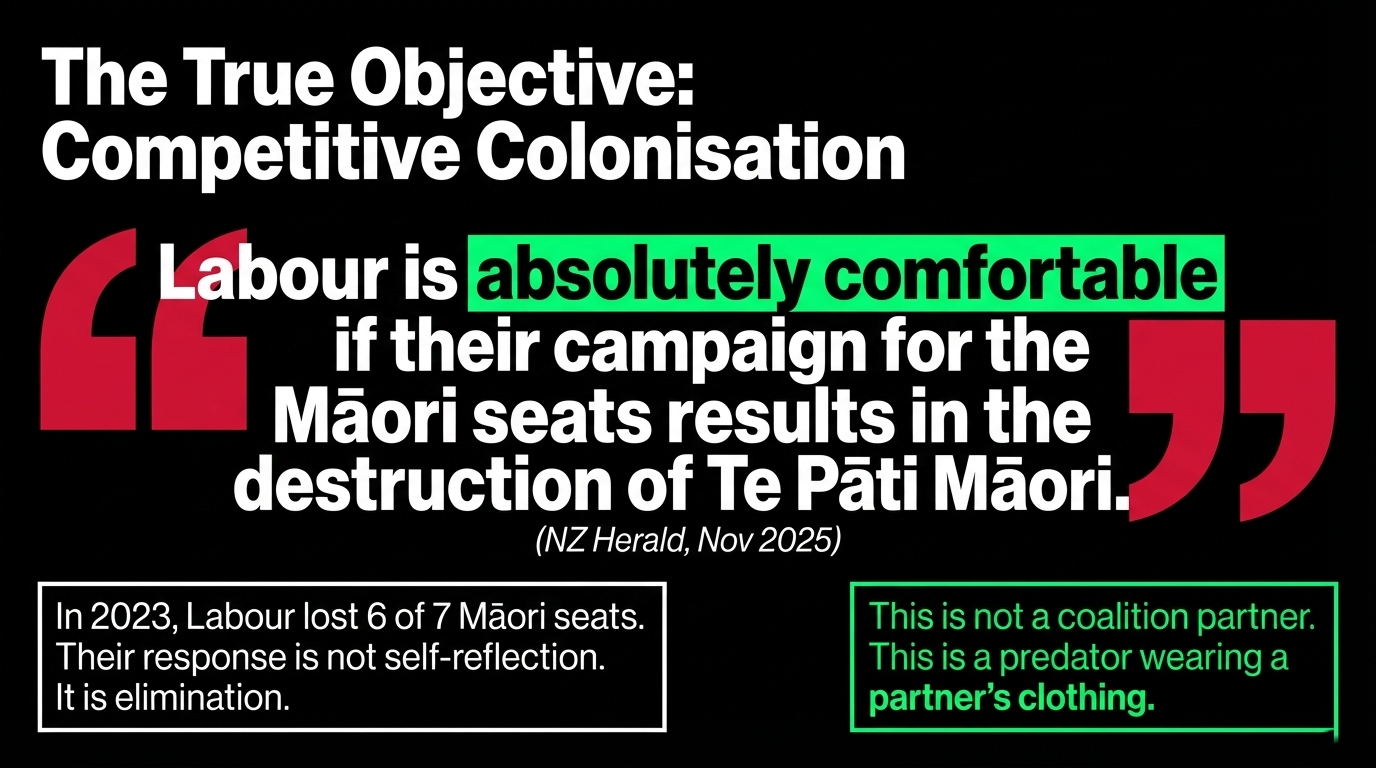
As confirmed by RNZ, Labour lost six out of seven Māori seats in 2023. In the Tāmaki Makaurau by-election that followed, as Te Ao News documented, Te Pāti Māori's Oriini Kaipara defeated Peeni Henare with 6,031 votes to 3,093 — almost two to one. Labour's response was not to ask what Māori needed. Its response, as the NZ Herald documented, was to announce it would campaign "vigorously" to win back those seats with explicit comfort expressed at Te Pāti Māori's destruction as a collateral outcome.
Hipkins told 1News he won't rule out working with NZ First — the party he himself called "pure racism" — while simultaneously asking Māori to trust him with Māori-Crown Relations. You cannot negotiate Te Tiriti in good faith while keeping Winston Peters — who is campaigning for a referendum to abolish the Māori seats — as a coalition option. That is not political pragmatism. That is a betrayal in plain sight, documented, verified, and already on the record.
The solution: Before Labour campaigns in a single Māori electorate, it must publish a full Te Tiriti audit of its 2017–2023 governing record — promises made, outcomes delivered, gaps unmeasured — and commit to an independent, Māori-led accountability mechanism for any future Labour government. Not a review. A mechanism with teeth.
KO TE WĀHI I TŪTAHI AI TE HUARAHI — WHERE THE ROADS MEET
Here is what National and Labour share that no reshuffle, no press release, and no Māori face in any portfolio can change.
They share the architecture of the state that removes Māori children. Oranga Tamariki — rebranded, reformed, reviewed, restructured across every government of the last two decades — still disproportionately removes Māori children. As Te Ara's documentation of ethnic inequalities makes plain, the structural disadvantages Māori face in housing, income, and employment directly feed state intervention in whānau. Labour managed this system. National is cutting it. Neither party has proposed dismantling the conditions that make it necessary.
They share the Reserve Bank orthodoxy. As Boraman's RNZ analysis documents:
"Both National and Labour essentially agreed with the Reserve Bank hiking interest rates to bring down inflation — a crude market discipline likely to cause redundancies, suppress wages, and increase debt and inequality."
Māori, overrepresented in insecure employment and rental markets, pay disproportionately every time the Reserve Bank engineers a recession. Māori unemployment rises first and falls last. Labour watched this and called it economic management.
They share the refusal of structural redistribution. A capital gains tax. A wealth tax. A genuine living wage. Binding Te Tiriti fiscal obligations. Any mechanism that would move wealth from where it accumulated through colonial dispossession toward where it was taken from — as Boraman confirms, "governments do not intervene to genuinely redistribute wealth. Instead, they act to temporarily support business during crises." Both major parties have refused every structural redistribution instrument. The architecture is identical.
NGĀ HONONGA HUNA — FIVE VERIFIED HIDDEN CONNECTIONS
Connection One — The Cycle of Māori MP Deployment: The reshuffle follows identical logic to the March 2025 reshuffle when Jackson was moved from Broadcasting to Social Development. Labour cycles Māori MPs through portfolios not based on expertise or community relationship but based on where they are most electorally useful. The portfolio changes. The calculation — Māori faces for Māori seats — never does.
Connection Two — Manufactured Vacuums: Both Peeni Henare and Adrian Rurawhe departing in the same electoral cycle strips Labour's Māori caucus of institutional memory precisely when it needs it most. As Henare himself confirmed to RNZ, Labour has a documented pattern of "forcing out" Māori. Those departures create the vacuums that justify the tactical reshuffling that follows.
Connection Three — The Bifurcated Portfolio Pattern: Willow-Jean Prime retains "Associate Education (Māori)" while losing the lead role. As Te Ara's history of Māori representation documents, Māori have historically remained "an uneven share" of parliamentary power despite nominal inclusion. Labour is not innovating — it is repeating the Crown's oldest pattern: You may have your part. We will keep the whole.
Connection Four — The Destruction Strategy: As Waatea News documented at Labour's November 2025 AGM, Labour confirmed it would contest all seven Māori electorates, positioning them as central to the 2026 strategy. Combined with the NZ Herald revelation that the party is "absolutely comfortable" with Te Pāti Māori's destruction as a consequence — this is not coalition politics. This is competitive colonisation of Māori political space.
Connection Five — The Polling Numbers Frame Everything: As 1News reported, National is polling in the high twenties — the lowest in modern history. Labour smells government. And when Labour smells government, Māori portfolios get reshuffled, Māori faces get deployed, and Māori communities get promised what they have been promised every three years since 1935. The pressure of polling drives this reshuffle far more than any genuine reckoning with Māori communities. As the Regulatory Standards Bill analysis at RNZ revealed, the Waitangi Tribunal has already found the current government's legislation would "bind governments forever to the neoliberal logic of economic freedom" — and Labour's response is to offer different management of that same logic, not its dismantling.
KO TE WHAKAARO WHAKAMUTUNGA — THE ONLY VERDICT THE EVIDENCE PERMITS
The Māori Green Lantern does not despise Labour MPs as individuals. Willie Jackson has fought for Māori in spaces most would not enter. Willow-Jean Prime carries lived experience that should be at the centre of education policy, not its margins. Peeni Henare served with dignity in a system designed to consume him.
But institutions corrupt even principled people when those institutions have never been forced to genuinely transform.
And Labour as an institution has, for over a century, treated the Māori vote as a resource to be extracted, a seat to be won, a face to be placed — not a partnership to be honoured, not a Treaty obligation to be fulfilled, not a debt that can never be fully repaid but must be continuously and honestly worked toward. As Te Pāti Māori co-leader Debbie Ngarewa-Packer told RNZ, the difference her party offers is "Māori leadership" that does not have to "settle for politically palatable" policies — "a movement that wasn't stifled by non-Māori views." That is the direct inverse of what this Labour reshuffle delivers.
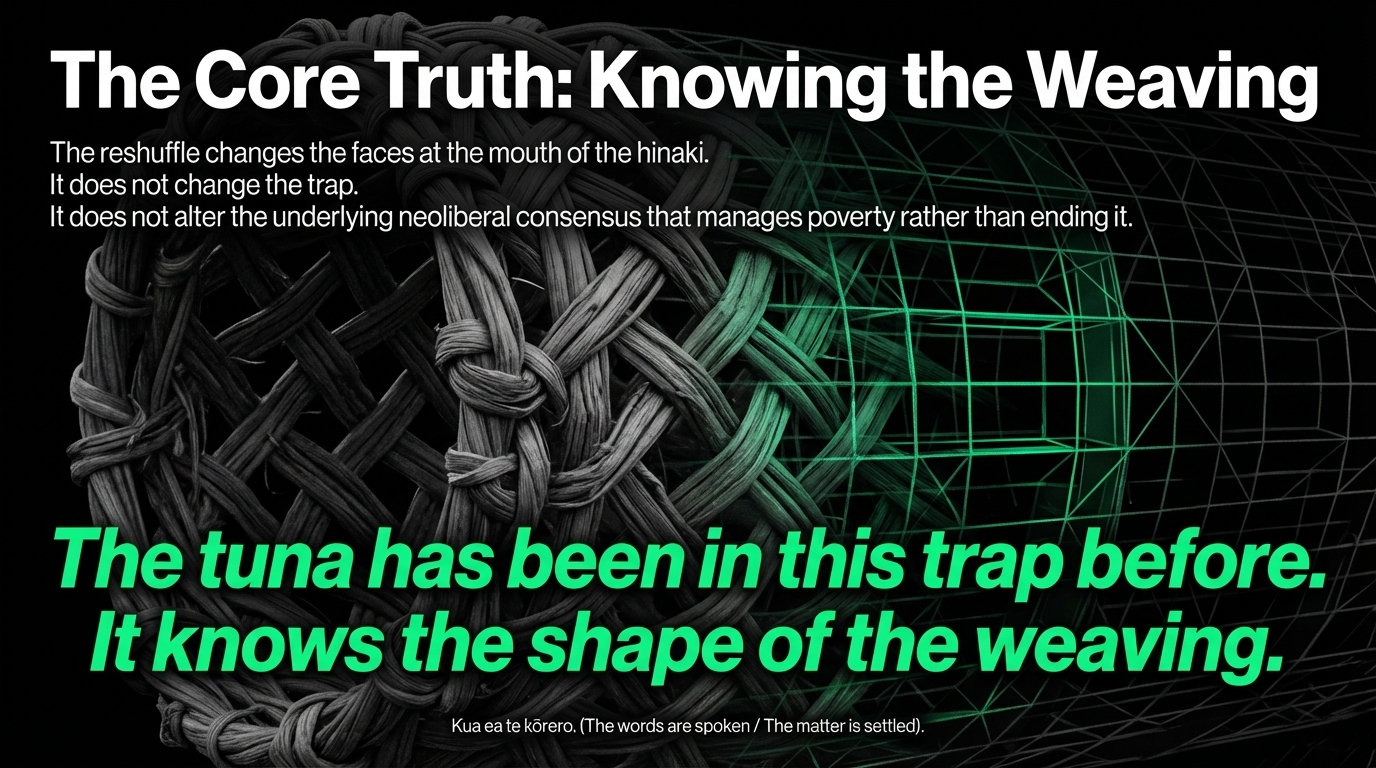
This reshuffle changes the faces at the mouth of the hinaki. It does not change the hinaki. And as Boraman concludes at RNZ: "Beneath those apparent ideological differences there remains an underlying neoliberal consensus." National cuts with enthusiasm. Labour cuts with regret. The cut lands in the same place.
The hinaki has new weaving. The architecture is identical. The tuna has been in this trap before. It knows the shape of the weaving.
Kua ea te kōrero.
KO TE KOHA — FUND THE ACCOUNTABILITY THEY WILL NEVER COMMISSION THEMSELVES

While Labour deploys Willie Jackson as an electoral weapon in the Māori seats and openly celebrates the possible destruction of Te Pāti Māori as collateral gain — this mahi continues. Naming the trap. Mapping its weaving. Publishing it for whānau without paywall, without party filter, and without the editorial hand of any institution that has ever needed Māori votes to survive.
Every koha to this work is a direct act of rangatiratanga. It signals that the communities being targeted by Labour's reshuffle calculator can fund their own truth-tellers — that Māori accountability does not depend on the goodwill of the same institutions being held to account. Willie Jackson has been given a brief: win the Māori seats. Who is watching whether he does it in service of the people, or in service of the party? That is the question this publication will continue to ask, reshuffle after reshuffle, election after election, until the answer changes or the architecture falls.
Support this mahi directly with a koha:
Koha — Support the Māori Green Lantern
Receive essays directly and support through subscription:
Subscribe to the Māori Green Lantern
Direct bank transfer: HTDM — 03-1546-0415173-000
If koha is not possible right now — no worries at all. Subscribe. Share this essay with your whānau. Kōrero about it at your table. In a media landscape where both major parties employ communications teams to manage their narratives, your transmission of this analysis through your networks is itself an act of rangatiratanga no press release can replicate.
Kia kaha. Kia māia. Kia manawanui.

Ivor Jones The Māori Green Lantern Fighting Misinformation And Disinformation From The Far Right
Research Tools Used: search_web, fetch_url | Date of Research: 15 March 2026 | Primary Sources: RNZ (Boraman neoliberal analysis), Te Ara (Labour Party history, ethnic inequalities, Māori representation), The Spinoff (Rogernomics 40-year analysis; Māori seats generational analysis), NZ Herald (Labour Māori seats destruction statement), 1News (Hipkins reshuffle announcement; NZ First coalition), Waatea News (Labour AGM Māori seats strategy), Te Ao News (Tāmaki Makaurau by-election results), Stats NZ (Housing Aotearoa 2025), The Dig (Māori housing policy), Greenpeace Aotearoa (neoliberal structural analysis), Waitangi Tribunal (Regulatory Standards Bill report) | Transparency Note: The NZ$1 trillion wealth transfer figure is attributed to Bernard Hickey via Boraman's RNZ analysis. Treaty settlement redress at approximately 2% figure sourced from The Spinoff's Rogernomics analysis — a widely cited approximation; precise figures vary by land valuation methodology used.