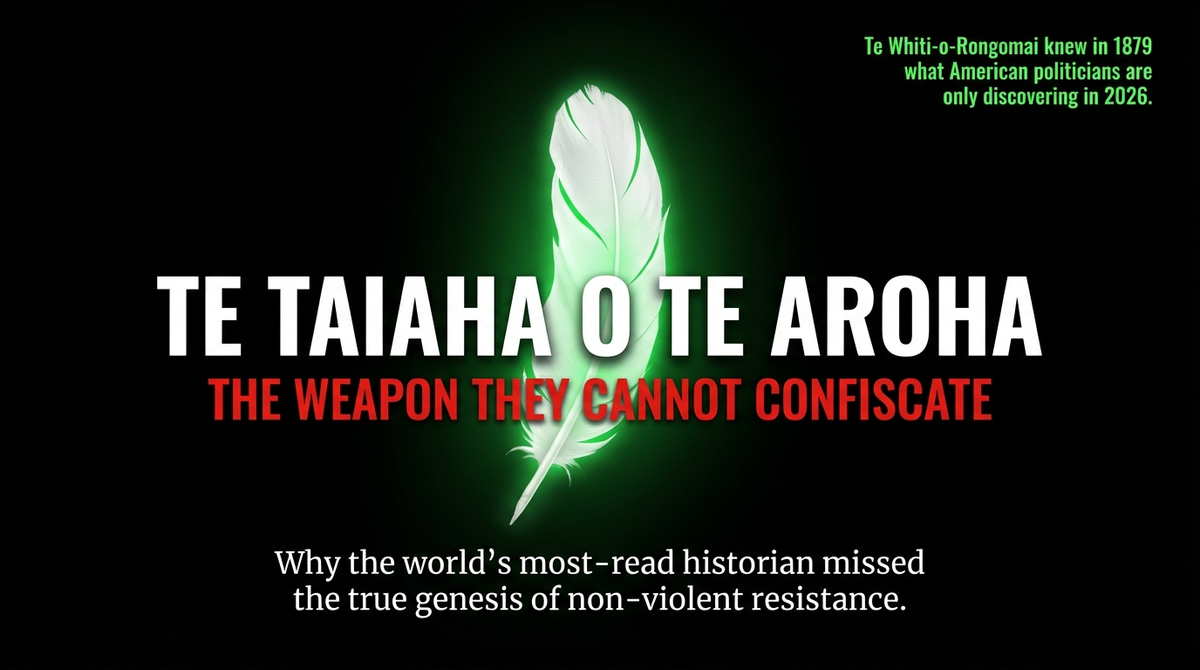
"Heather Cox-Richardson - Te Taiaha o te Aroha: The Weapon They Cannot Confiscate" - 21 February 2026
How America's Most-Read Historian Accidentally Preached the Gospel of Parihaka — While a White Supremacist Government in Aotearoa Burns the Original Scripture

Mōrena ano whānau,
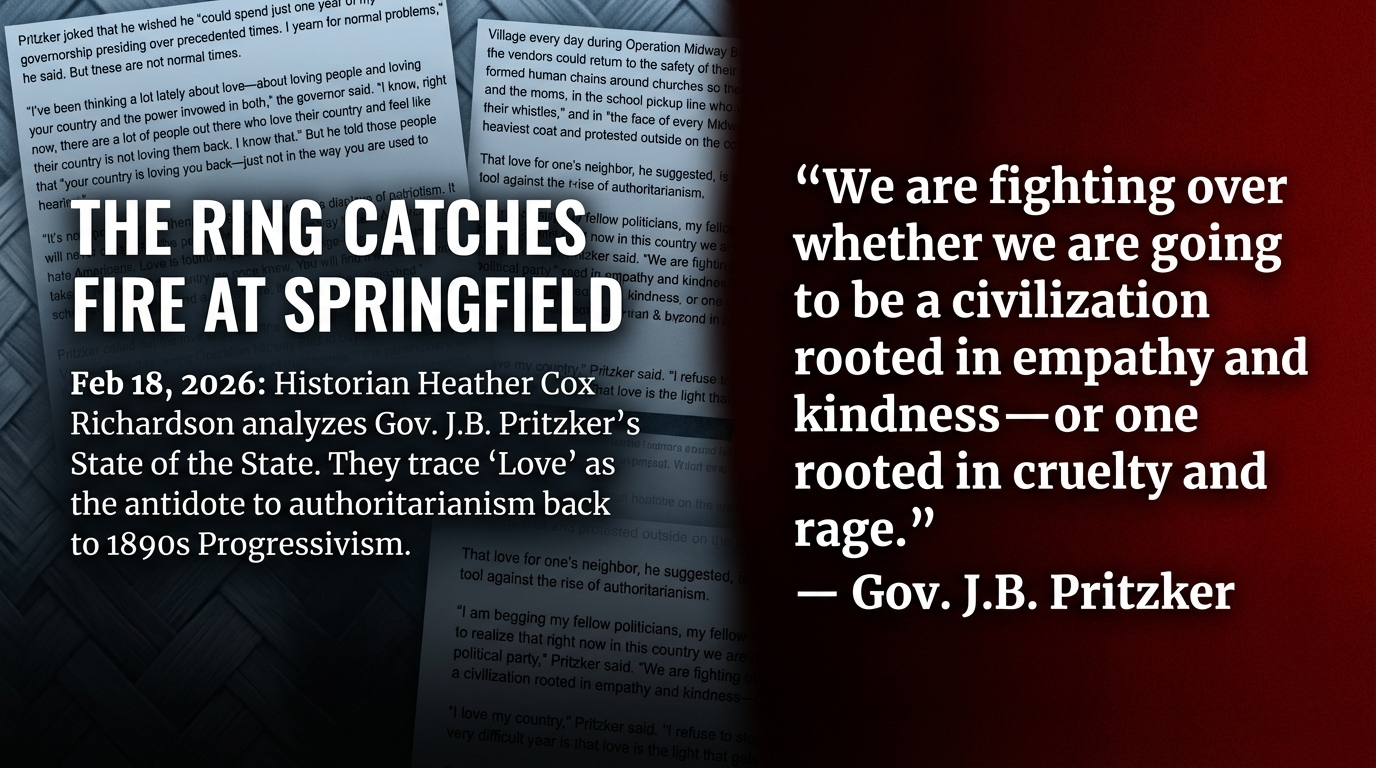
The Ring Catches Fire at Springfield
On February 18, 2026, Heather Cox Richardson — Boston College history professor, author of Democracy Awakening, and publisher of Letters from an American reaching over 2.6 million subscribers — trained her historian's lens on something remarkable. In her February 18 letter, Richardson dissected Illinois Governor J.B. Pritzker's State of the State address — a speech that used its budget platform to go "far more broadly" about the state of Illinois and the nation.
Richardson, whose nightly newsletter has become what The Nation called "sincere, humble, approachable, and jargon-free" public history — and what UC Berkeley's Dylan Penningroth described as an attempt to "reclaim our history" as "essential to reclaiming our democracy" — built her analysis around a structural parallel. Pritzker reached back to Governor John Peter Altgeld (1893–1897), a Progressive-era leader who fought federal overreach, and Richardson made the reader feel the rhyme: the same fight, the same tyranny, 130 years apart.
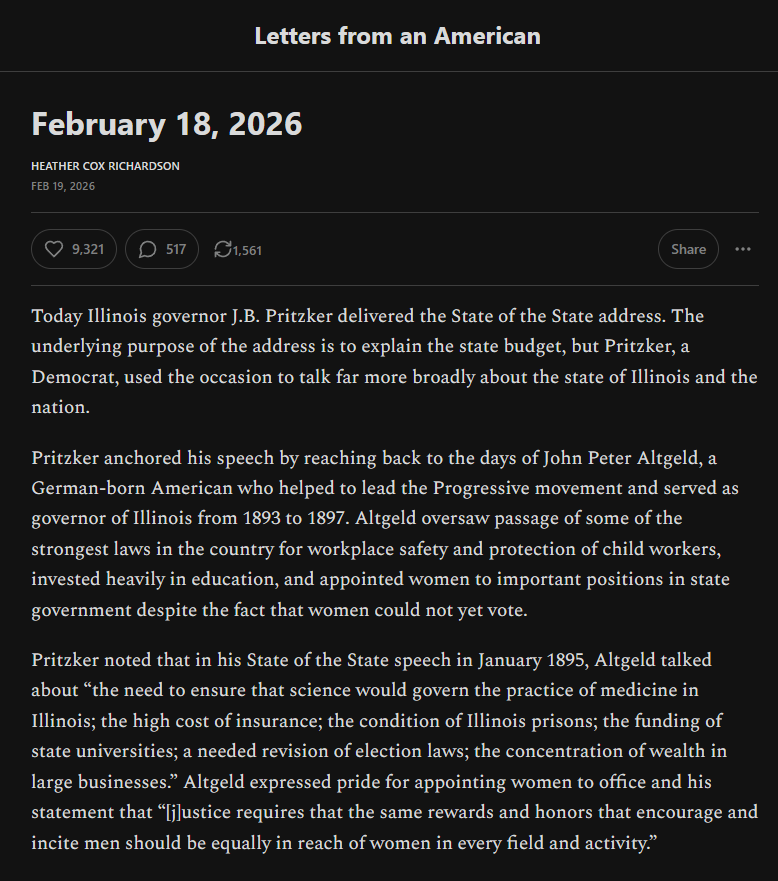
Richardson documented how Pritzker's speech laid out Trump's $8.4 billion in "illegally confiscated" funds, how "masked, unaccountable federal agents" brutalised Chicago streets, and how Pritzker invoked Altgeld's thundering warning that if a President can "send troops into any city, town, or hamlet...whenever and wherever he pleases," then there is "no difference whatever between the powers of the President and those of the Czar of Russia."
Then Richardson captured Pritzker's turn to love — to the bicyclists who bought out tamale carts, the parishioners forming human chains, the mothers with whistles. She quoted his declaration:
"We are fighting over whether we are going to be a civilization rooted in empathy and kindness — or one rooted in cruelty and rage."
And the Ring glowed.
Not because a billionaire governor discovered compassion — billionaires discover compassion the way landlords discover leaks, only when the ceiling starts to sag. Not even because America's most-read historian recognised the pattern — Richardson has been building a "community around the world of people trying to re-establish reality-based politics" since 2019.
The Ring glowed because Richardson, the historian who has dedicated her career to showing Americans that their present rhymes with their past, missed the deepest rhyme of all.
She saw Altgeld in Pritzker.
She did not see Te Whiti o Rongomai in both of them.
And here is the scathing truth that must be carved into the bones of every reader:
The people of Parihaka did everything Pritzker described — but they did it first, they did it better, and they did it while the Crown held the gun.
While in Aotearoa today, a white supremacist coalition government systematically incinerates the very tikanga that gave birth to the world's first sustained campaign of non-violent resistance.
The Whakapapa Richardson Doesn't Know She's Missing
Richardson's analytical framework — her signature method of connecting contemporary events to their historical antecedents — is precisely the kind of work that should lead any honest historian to Parihaka. She told Berkeley that "the Republican Party under Reagan articulated a vision of American history... of the cowboy, an individual fighting the empire." She understands that those who control the historical narrative control the political present.
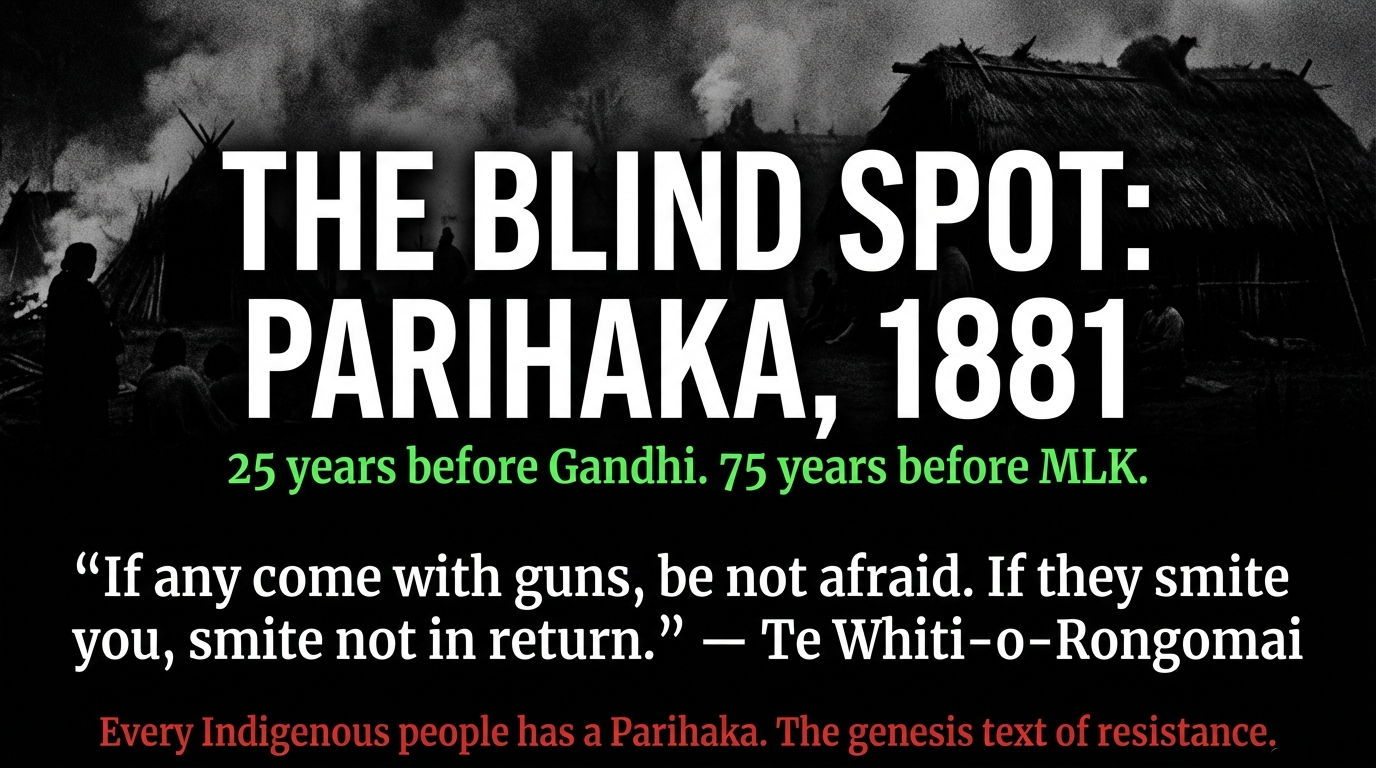
But the narrative Richardson constructs in her February 18 letter — Altgeld vs. Cleveland, Pritzker vs. Trump, love vs. authoritarianism — has a blind spot the size of a colonial empire. It locates the genesis of non-violent resistance in the American Progressive tradition. It does not look south. It does not look to the Pacific. It does not look to Parihaka.
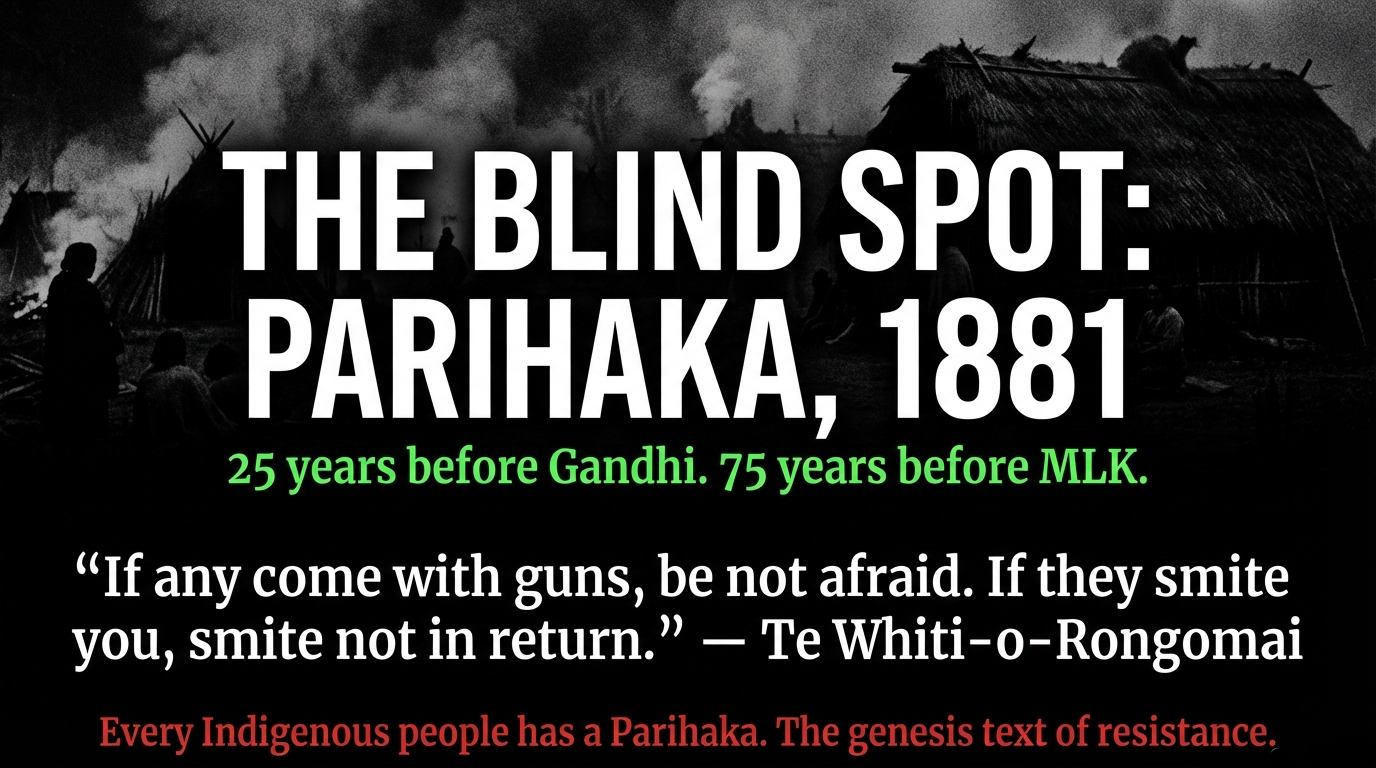
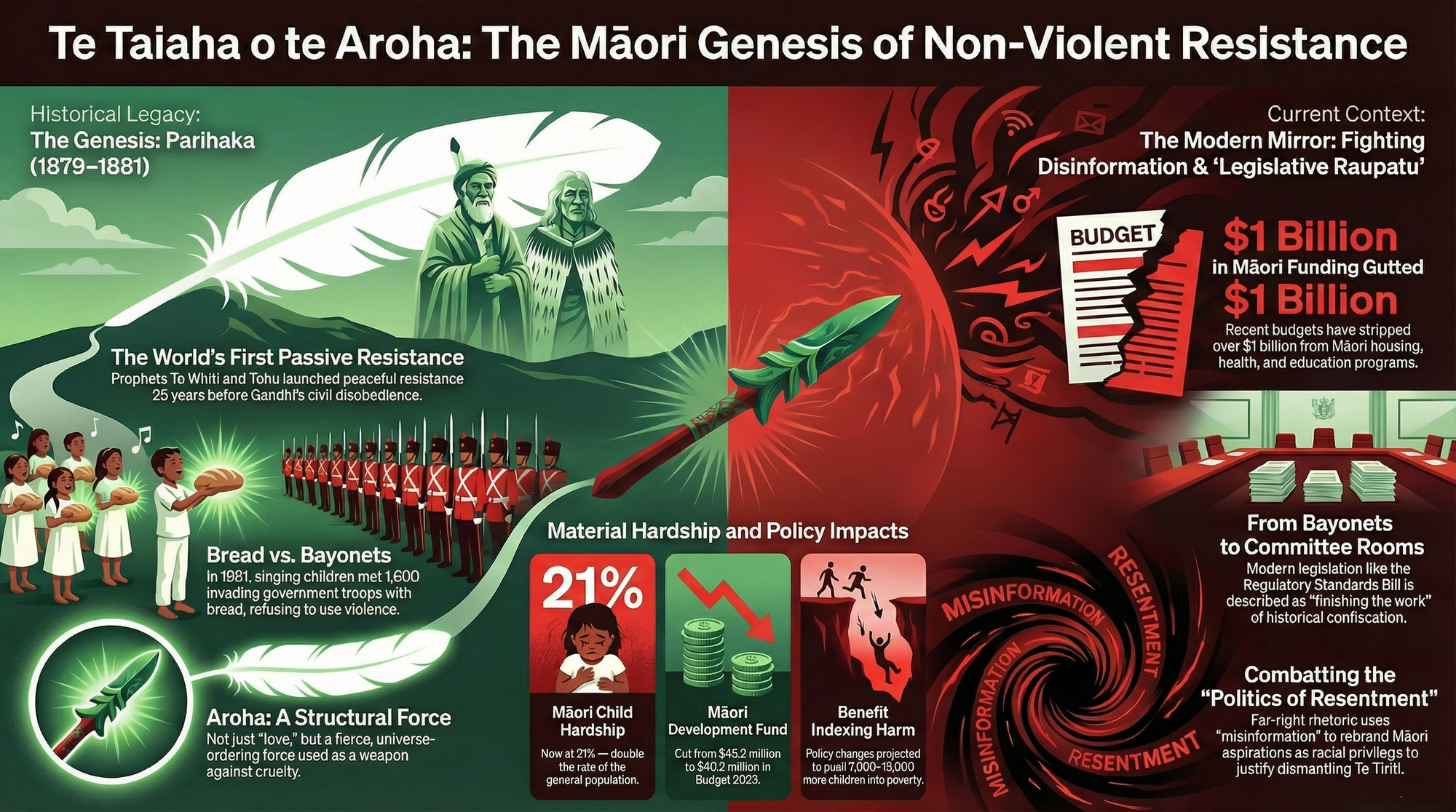
Te Whiti-o-Rongomai and Tohu Kākahi, the prophets of Parihaka, launched their campaign of peaceful resistance against Crown land confiscation in 1879 — a full quarter-century before Gandhi's first civil disobedience campaign in South Africa, and 75 years before Martin Luther King Jr. marched in Montgomery. As the academic journal Conflict Resolution Quarterly documented, the passive resistance of Te Whiti and Tohu "stands out not only as an example on an international stage" but in "sharp contrast to the very vigorous and armed resistance shown by the majority of Māori who faced the dispossession of their lands."
On 5 November 1881, approximately 1,600 government troops invaded the unprotected village of Parihaka. Hundreds of Māori ploughmen had already been arrested without trial and shipped to South Island prisons where some died in harsh conditions. Parliament passed the Māori Prisoners Act to allow indefinite detention. The Sim Commission later heard testimony that women were raped by troops. The troops were met by singing children — Ngā Tātarakihi, the little crickets — offering bread to the soldiers who came to destroy them.
Te Whiti commanded:
"Go, put your hands to the plough. Look not back. If any come with guns, be not afraid. If they smite you, smite not in return."
This is not a footnote to history. This is the genesis text of global non-violent resistance, and Te Ara: The Encyclopedia of New Zealand confirms that Te Whiti "repudiated the authority of the settlers' laws over Māori" and sought to "reclaim the rangatiratanga guaranteed by the Treaty of Waitangi." During the 1870s, Parihaka grew into the largest Māori settlement in the country.
When Richardson frames Pritzker's love-as-resistance as a weapon against authoritarianism, she is narrating — without the whakapapa, without the whenua beneath it — a kaupapa that has hummed from the flanks of Taranaki Maunga for 145 years. That is what the colonial knowledge system does: it steals the fruit, renames the tree, and tells the original gardeners they should be grateful for the shade.
This is not an attack on Richardson. Her work is vital. Her 2.6 million readers need her voice. But a historian who teaches courses on the American West and the Plains Indians should know that every indigenous people on earth has a Parihaka — a moment where the colonised offered bread to the coloniser and the coloniser responded with destruction. The failure to connect those dots is not malice. It is the default setting of a knowledge system built to centre itself.
Three Mirrors, Three Wounds: The Western Mind Confronts Tikanga
For the Western mind trained to see the world through spreadsheets and statutes, here are three concrete examples of how Richardson's analysis of Pritzker's speech and the NZ coalition government's actions map onto tikanga — and what the destruction of that tikanga costs in terms the Western mind can quantify.
Mirror 1: The Confiscation of Resources — Illinois vs. Aotearoa
What Richardson documented: The Trump administration has cost Illinois $8.4 billion by "illegally confiscating money that has already been promised and appropriated by the Congress". Illinois is fighting over 50 federal court cases to recover funds. Richardson noted Pritzker's frustration that the state must balance its budget every year while the federal government unlawfully withholds billions — executive orders that "read like proclamations from the Lollipop Guild."
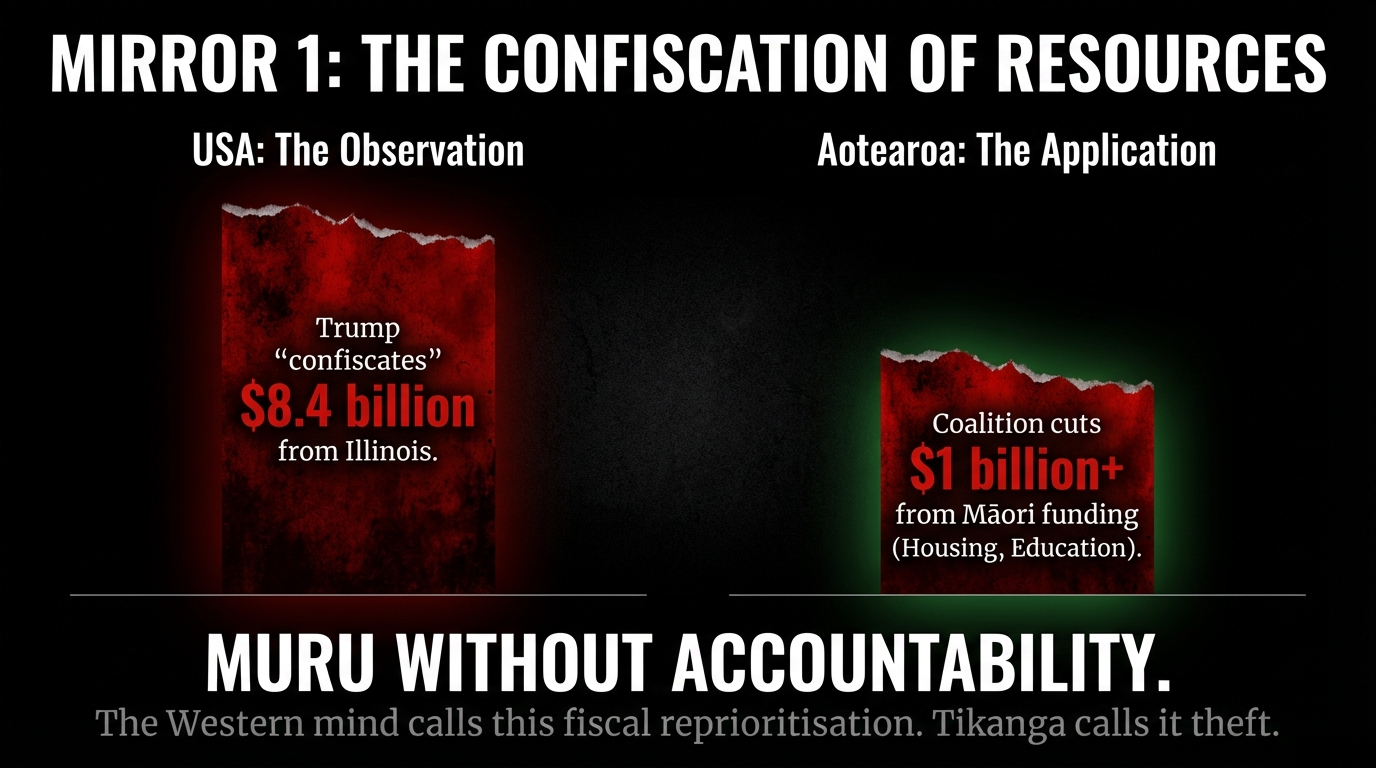
What is happening in Aotearoa: Over two budgets (2024 and 2025), the NZ coalition government has cut more than $1 billion in Māori-specific funding, gutting Māori housing ($624 million wiped from Whai Kāinga Whai Oranga), Māori trade training, Māori economic development funds, and kaupapa Māori education. Māori Development Minister Tama Potaka presided while Māori unemployment rose to 10.5 percent with no replacement strategy. Budget 2025 headlined "$700 million for Māori" — but only $38 million was genuinely new money. The Māori Development Fund itself was cut from $45.2 million to $40.2 million. The Green Party stated: "Budget 2025 strips the Māori Development fund by nearly $10 million, cuts funding to Whakaata Māori even deeper".
The tikanga dimension: In te ao Māori, manaakitanga — the obligation to care for and uplift others — is not optional charity. It is the fundamental expression of mana. When the Crown promises resources through Treaty settlements and targeted programmes, then strips them away, it does not merely breach a contract. It destroys the mauri of the relationship itself. It is the equivalent of inviting whānau to a hui, setting the table, then removing the kai before anyone eats and charging them for the plates. The Western mind calls this "fiscal reprioritisation." Tikanga calls it what it is: muru without accountability — confiscation without the reciprocal obligations that even traditional Māori systems of sanction required.
Quantified harm: Māori children experience material hardship at 21 percent — up from 10.5 percent to 12.5 percent for all children, the highest since reporting began in 2019. Officials advised the government that indexing benefits to inflation rather than wages would push 7,000 to 13,000 additional children into poverty within four years, disproportionately hitting whānau Māori. School lunch programme funding was cut by up to 50 percent — feeding up to 200,000 children — while the programme's te reo name Ka Ora Ka Ako was stripped away in what Green MP Teanau Tuiono called "toxic signalling... anti-Māori, racist, and in many ways pathetic".
The solution: Restore ring-fenced, Treaty-compliant Māori funding at minimum 2023 levels. Establish independent Māori-led oversight of all funding allocations affecting tangata whenua. Fund by Māori, for Māori — as guaranteed under Article Two of Te Tiriti.
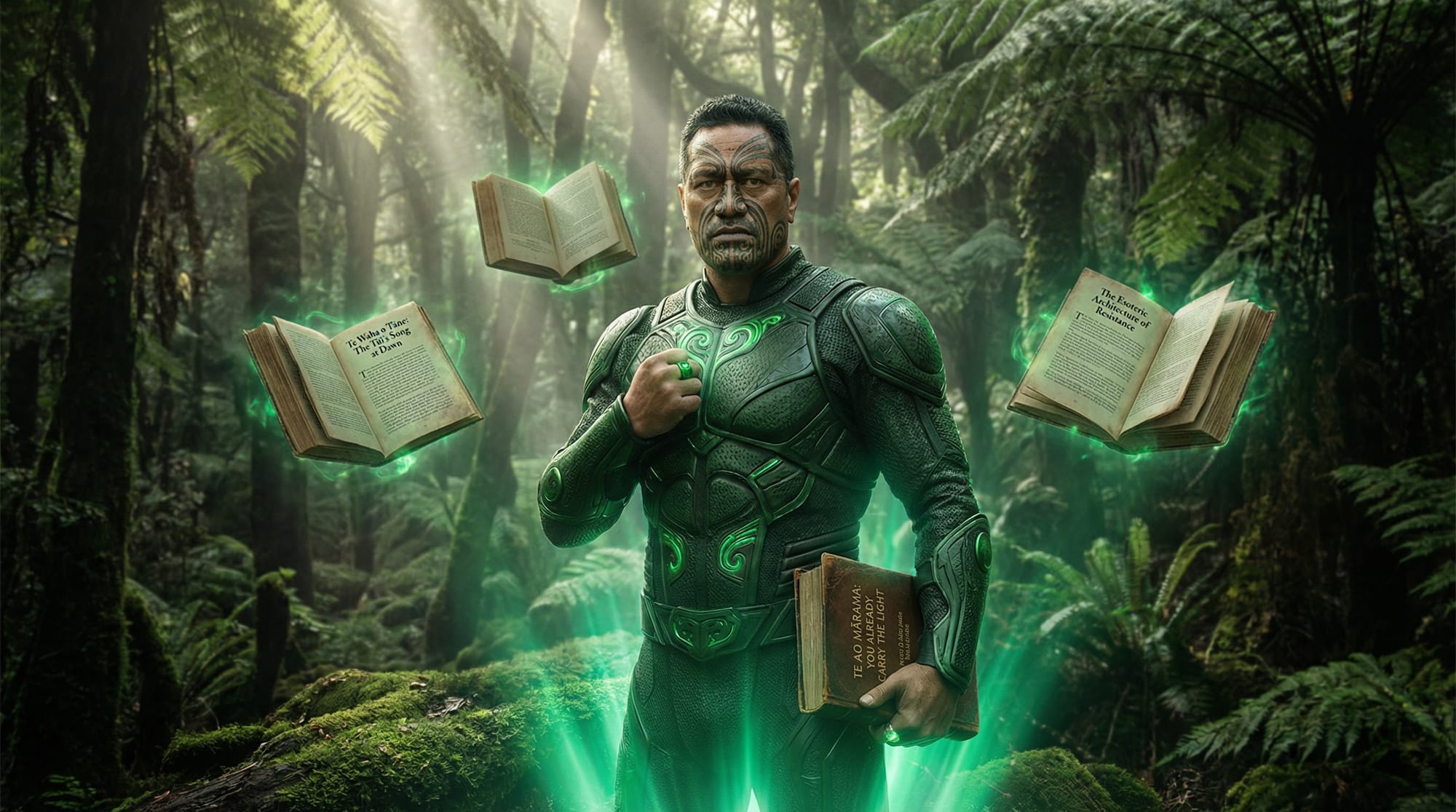
The Māori Green Lantern has extensively documented this pattern of fiscal extraction in "The Dashboard Illusion: How Neoliberalism Sells Sovereignty While Stealing Resources" and "When Billionaires Play Saviour: Roger Fewtrell and the Neoliberal Theatre".
Mirror 2: The Invasion of Communities — Federal Agents vs. Armed Constabulary
What Richardson documented: Richardson quoted Pritzker's searing account: "Masked, unaccountable federal agents — with little training — occupied our streets, brutalized our people, tear-gassed kids and cops, kidnapped parents in front of their children." She connected this to the 1894 Pullman Strike, when President Cleveland deputised marshals who "seemed to be hunting trouble" and shot 25 people dead. Richardson traced a line from Cleveland's "hired thugs" through Trump's Operation Midway Blitz — identifying Trump and Stephen Miller as architects of a plan to "drip authoritarianism into our veins".
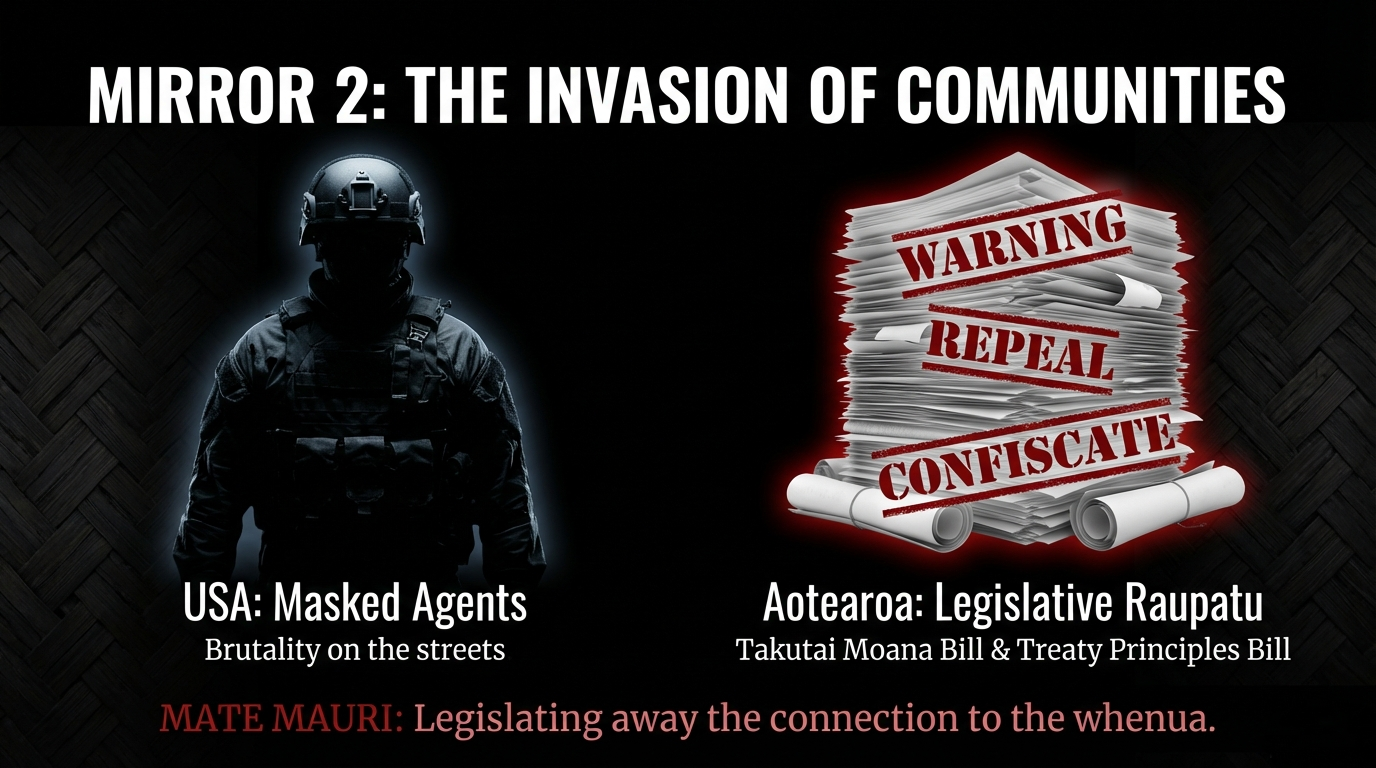
What happened at Parihaka — and what is happening now: On 5 November 1881, approximately 1,600 troops invaded Parihaka. Ploughmen had been arrested without trial and sent to prisons where conditions were harsh, some facing solitary confinement, several dying far from their whānau. Parliament passed laws like the Māori Prisoners Act allowing indefinite detention. The government managed to delay for several years the publication of the official documents relating to these events — 1881's version of controlling the narrative.
Today, the Coalition does not send constabulary with rifles. It sends legislation with the same intent. The Marine and Coastal Area (Takutai Moana) Amendment Bill retroactively overturned court decisions recognising Māori customary rights. The Green Party stated plainly: "This Government purports to believe in property rights yet they don't uphold the first property rights of this country: Māori customary rights" — calling it a "regression to raupatu". The Regulatory Standards Bill is designed to finish what the Treaty Principles Bill started. David Seymour promises to reignite the Treaty Principles debate in 2026.
The tikanga dimension: Kaitiakitanga — guardianship over the natural world — is not a policy preference. It is an intergenerational covenant between tangata whenua and the whenua itself. When the government retroactively strips customary marine title, it severs a relationship that predates the Crown's existence by centuries. In te ao Māori, the takutai moana is not "real estate" — it is a living relative. To legislate away that connection is spiritual violence of the highest order. The Western mind has no word for this because it has separated itself from the land. Tikanga has the word: mate mauri — the death of the life force.
Quantified harm: Māori leaders told the UN Committee on the Elimination of Racial Discrimination in Geneva that racism against Māori has escalated under the current government. The Aotearoa Independent Monitoring Mechanism's report to the UN stated the coalition is "actively and profoundly aggravating New Zealand's constitutionally racist foundation in a way we have not seen for at least half a century". The combined effect of the coalition's measures sets back Indigenous rights 30 to 40 years.
The solution: Repeal the Takutai Moana Amendment Bill. Honour existing court rulings. Restore the original statutory test. Fund iwi-led marine guardianship programmes. Kill the Regulatory Standards Bill before it kills what remains of Te Tiriti's constitutional presence.
The Māori Green Lantern covered the systematic stripping of Māori land rights in "Shane Jones and the Colonial Cash Grab at Waipiro Bay" and "The Colosseum of Kingsland: How a White Supremacist Government Built a Gladiator Arena on Stolen Land".
Mirror 3: Love as Resistance — Aroha vs. the Politics of Cruelty
What Richardson documented: Richardson's letter climaxed with Pritzker's declaration: "We are fighting over whether we are going to be a civilization rooted in empathy and kindness — or one rooted in cruelty and rage." She captured his vision of love as resistance — found in "every act of courage — large and small — taken to preserve the country we once knew". The historian who has spent her career showing that the American experiment is always under threat framed this as the defining question of the age.
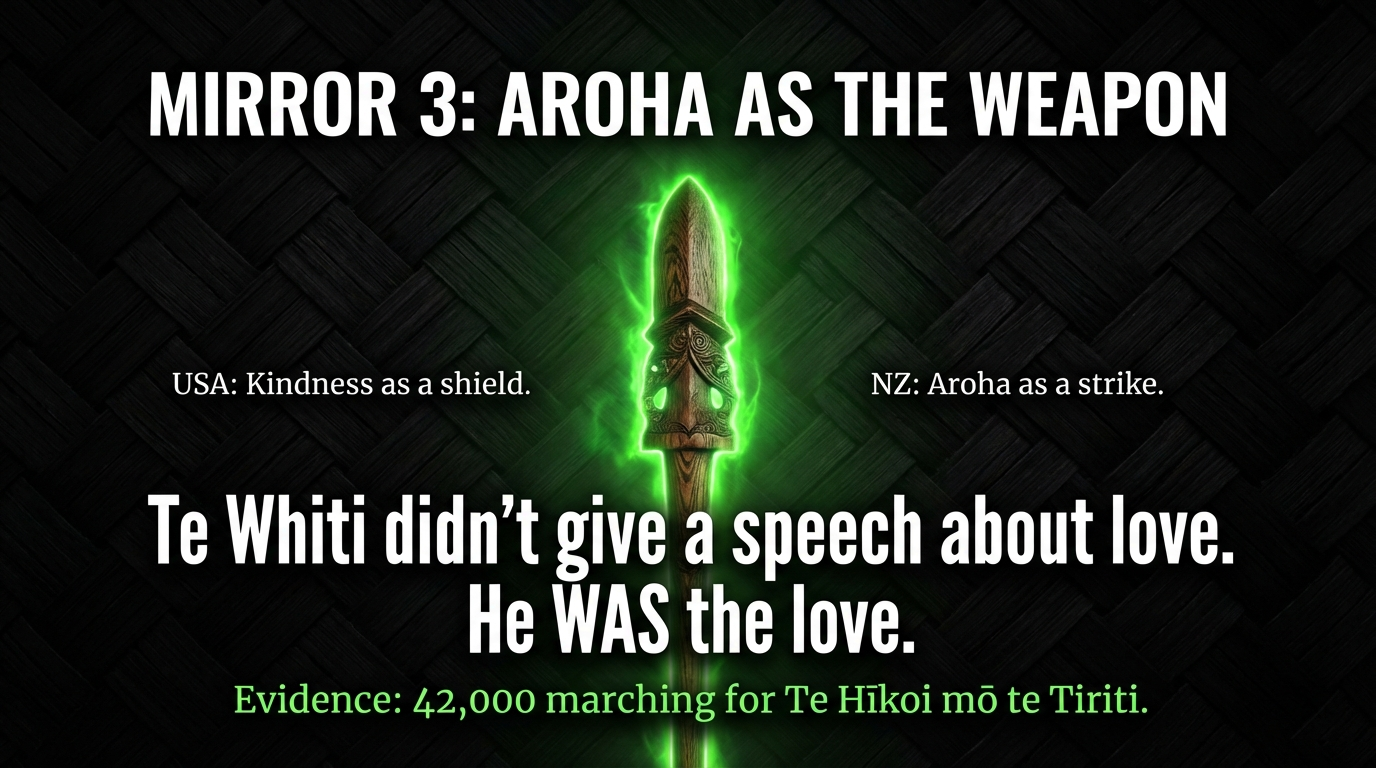
What te ao Māori has always known: When Te Whiti instructed his followers to offer bread to the soldiers who came to destroy them, he was not performing a political stunt. He was enacting aroha — not the Hallmark-card version, but the fierce, structural, universe-ordering force that underpins all of tikanga Māori. Aroha is not passive. It is the taiaha you wield when cruelty attempts to define the terms of engagement.
In November 2024, more than 42,000 people gathered at Parliament for te Hīkoi mō te Tiriti — the largest protest in Aotearoa's modern history — opposing the Treaty Principles Bill. The New York Times said New Zealand had "veered sharply right". In October 2025, hundreds gathered again for Rā Whakamana, linking He Whakaputanga of 1835 to modern solidarity. At Waitangi 2026, John Campbell reported that "anger gives way to confidence" — the people were not asking for permission. They were asserting their mana.
Meanwhile, this government responds to aroha with the politics of cruelty. David Seymour campaigns for "smaller government" while calling Māori aspirations a "hierarchy of identity." Winston Peters attacks a Green MP for using the word "Aotearoa". ACT leader Seymour told media: "Well there's no such thing as Māori funding, there's funding for New Zealanders... I'm really getting tired of people trying to racially profile us" — a sentence so breathtakingly dishonest it could strip paint from a wharenui.
The tikanga dimension: Whanaungatanga — the web of relationships that connects all people and all living things — cannot survive in an ecosystem of deliberate cruelty. When a government systematically erases te reo from public life, disestablishes the Māori Health Authority under urgency without even allowing a select committee process or Waitangi Tribunal jurisdiction, and repeals Section 7AA of the Oranga Tamariki Act — which the Waitangi Tribunal found was "rushed and arbitrary" and in breach of Te Tiriti — it commits not just policy violence but wairua violence. It tells an entire people: your existence is the problem we are solving.
Quantified harm: Amnesty International's secretary general described the NZ government as having "a certain Trumpian accent" on human rights. The Aotearoa Independent Monitoring Mechanism declared the coalition "the most overtly racist and white supremacist government it has had in decades". Hone Harawira called it "the greatest barrage of racist, anti-Treaty, anti-environment, anti-worker legislation we have ever seen from one government". Whānau are reporting increased racist and white supremacist aggression around the country.
The solution: Embed Te Tiriti compliance as a constitutional requirement that cannot be overridden by simple parliamentary majority. Establish an independent Māori Rights Commissioner with enforcement powers. Restore and fund Te Aka Whai Ora (the Māori Health Authority). Legislate Parihaka Day on November 5 as a national day of commemoration — because a nation that does not honour its prophets will always repeat its crimes.
The Māori Green Lantern has documented the whakapapa of cruelty in "The Layers They Buried: How a White Supremacist Government Demolishes" and "The Beacon in the Darkness: What It Means to Be You, the One Reading This".
The Scathing Analysis: A Historian Documents, A Government Burns
Here is the metaphor that burns:
Richardson stands at her desk in Maine and documents the pattern. Pritzker stands in Springfield and discovers in 2026 what Te Whiti o Rongomai knew in 1879 — that love, wielded with discipline, is the only force authoritarianism cannot kill. A historian with 2.6 million subscribers and a billionaire governor with a $3 billion net worth reach into the archives of the American Progressive movement and pull out a dead governor's fury at a dead president's thugs. They get standing ovations. They make international news. They are praised for moral clarity.
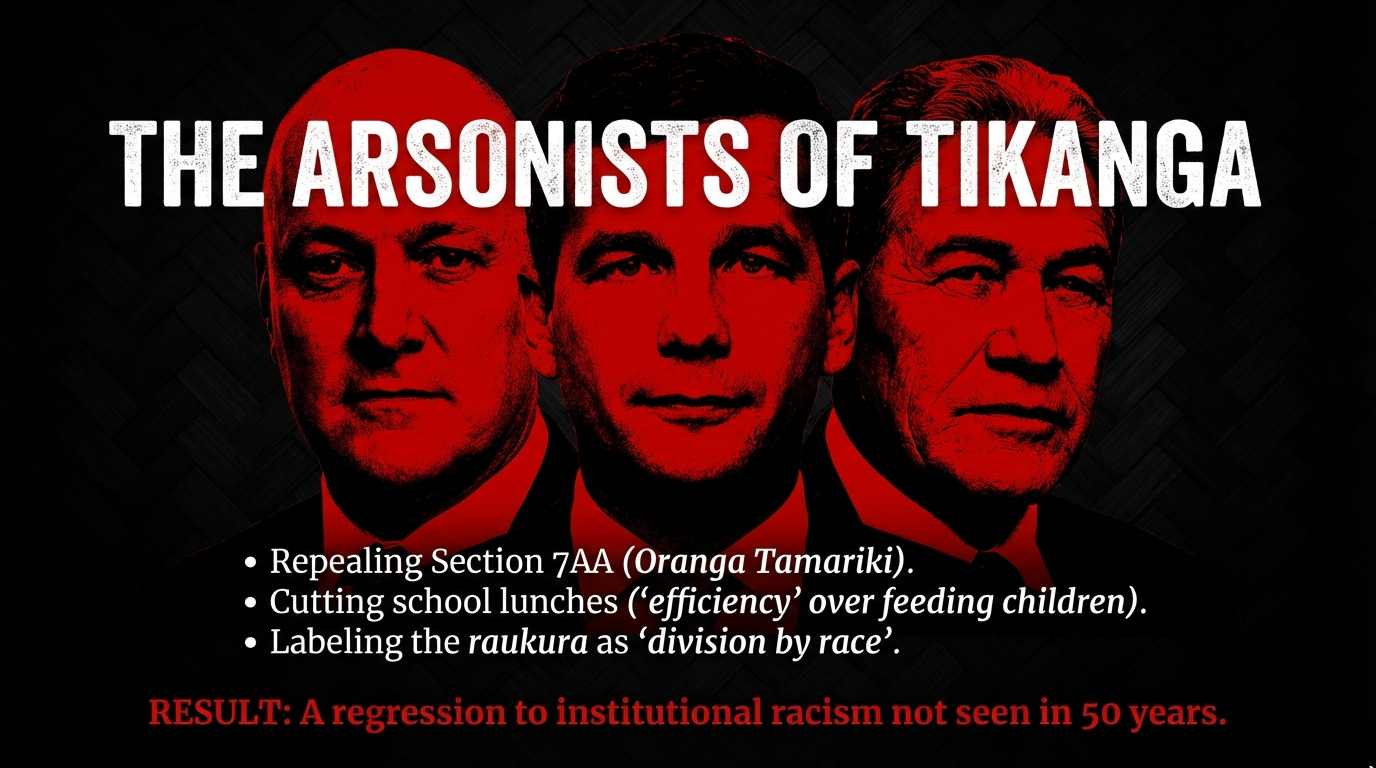
Meanwhile, 12,000 kilometres to the southeast, a government of mediocrities and malice — Christopher Luxon, David Seymour, and Winston Peters — is systematically dismantling the living, breathing, 145-year-old tradition that Richardson and Pritzker are unknowingly plagiarising. They tear the raukura — the white feather of peace — from the hair of a nation's children and tell them it's "division by race."
Richardson's analytical framework is built on the premise that understanding history prevents its repetition. She told Berkeley that her newsletter has grown "a community around the world of people who are trying to re-establish a reality-based politics." But reality-based politics must include the reality that the Western canon of non-violent resistance has Indigenous antecedents that it has systematically failed to credit. You cannot reclaim democracy if you do not acknowledge whose democracy was stolen first.
Altgeld wrote in 1895 that if the President could send troops "whenever and wherever he pleases, under pretense of enforcing some law," there was "no difference whatever between the powers of the President and those of the Czar of Russia."
Luxon doesn't need troops. He has Seymour's Regulatory Standards Bill — which legal academic Dr Carwyn Jones described as finishing the work the Treaty Principles Bill started — to legislatively accomplish what 1,600 armed constabulary accomplished at Parihaka in 1881. The difference is that today the destruction is done in committee rooms with briefing papers, not with bayonets. The children of Parihaka offered bread. The children of 2026 Aotearoa are offered a 21% material hardship rate and told to be grateful for the crumbs.
Victoria University associate professor Lara Greaves warned at the coalition's formation that it would be "the most right wing government since MMP was introduced". Mihingarangi Forbes said the Treaty debate would be "dominated by the politics of resentment" and would put Māori "back into the dark ages."
They were not wrong. They were prescient. The Monitoring Mechanism's report confirms it with the weight of international law behind it: this government's combined actions "further embed institutional racism against Māori and set back progressive realisation of equity and equality for Māori".
The Iwi Chairs Forum withdrew from the national action plan against racism because the coalition reduced the focus on colonial racism and institutional racism. Julia Whaipooti of Te Kāhui Tika Tangata said what needed saying:
"You can't cherry-pick anti-racism."
The Fire That Does Not Die
Richardson ended her February 18 letter by quoting Pritzker's confession-as-prayer:
"I love my country. I refuse to stop. The hope I have found in a very difficult year is that love is the light that gets you through a long night."
It is a good line. It is not an original one.
On the slopes of Taranaki, 145 years ago, Te Whiti o Rongomai said it better:
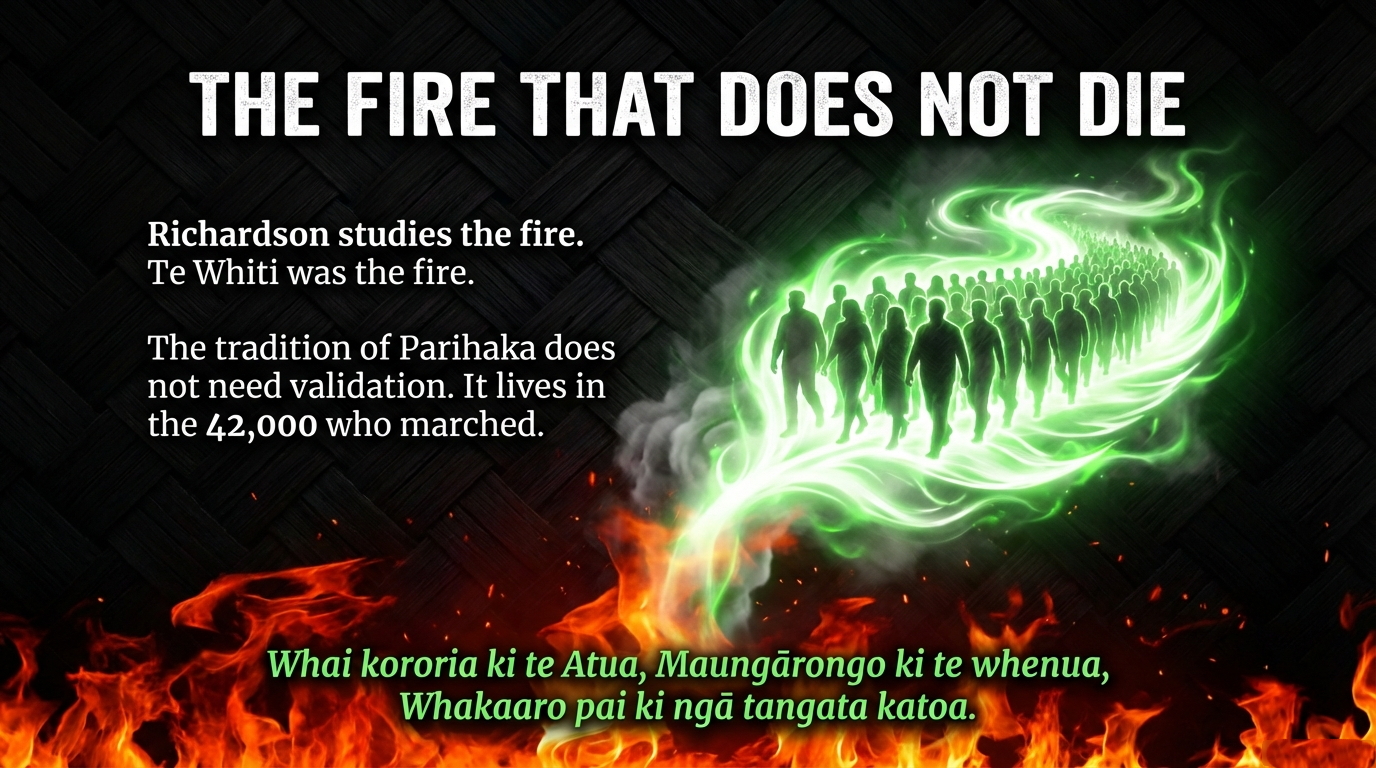
"Whai kororia ki te Atua, Maungārongo ki te whenua, Whakaaro pai ki ngā tangata katoa."
Glory to God, Peace on earth, Goodwill to all.
He said it while soldiers destroyed his home. He said it while his people were dragged to prisons in the South Island. He said it while Parliament legislated their indefinite detention.
And his people — battered, imprisoned, scattered — came back. They rebuilt Parihaka. They wore the raukura. Their descendants marched in 2024 in the tens of thousands. Their kaupapa is alive in every whānau who refuses to submit.
The difference between Richardson's analysis and te ao Māori's lived reality is the difference between studying fire and being the fire itself. Te Whiti didn't give a speech about love. He was the love. He didn't invoke history. He made history. And the tradition he created — the world's first sustained non-violent resistance movement — did not need a Boston College professor or a billionaire governor to validate it. It needed — and still needs — a government that will stop trying to destroy it.
As Dr Alistair Reese wrote in E-Tangata:
"The question is whether this growing unease must inevitably lead to social and political violence, or whether there is another path we might choose — one rooted in the deeper wisdom of this land."
The path exists. Parihaka built it. Te Whiti and Tohu paved it with aroha.
This white supremacist government — these architects of fiscal raupatu, these vandals of Te Tiriti, these rename-artists who strip te reo from school lunch programmes while 21% of Māori tamariki live in material hardship — they cannot destroy what they did not create and will never understand.
Richardson, to her immense credit, shows millions of Americans that their present rhymes with their past. We, tangata whenua, already know this. We have always known this. Because our past is not in the archive. It is in the whenua. It is in the whakapapa. It is in the raukura worn by every tamaiti who walks into a kura knowing that their government does not want them to succeed.
The taiaha is raised. The Ring burns. The raukura flies.
Kia mau ki te whenua. Kia kaha. Kia manawanui.
Hold fast to the land. Be strong. Be resolute.
Koha Consideration
Every time Richardson documents another chapter of American authoritarianism reaching 2.6 million readers, she does it because subscribers fund her work. Every time this government cuts another line from the Māori budget — another $1 billion erased, another kaupapa defunded, another tamaiti going hungry — it confirms that the truth about what they are doing will never be funded from within the system.

Your koha is the raukura in digital form: a white feather of peace that funds the weapons of accountability. It is the bread offered to the soldiers — not in surrender, but in the fierce certainty that aroha outlasts every army, every budget cut, every act of Parliament designed to erase you.
Kia kaha, whānau. Stay vigilant. Stay connected. And if you are able, consider a koha to ensure this voice continues — the voice that Te Whiti raised, and that no amount of legislation will silence.
If you are unable to koha, no worries! Subscribe or follow The Māori Green Lantern, kōrero and share with your whānau and friends — that is koha in itself. The ploughmen of Parihaka didn't need money. They needed people to stand beside them.
Three pathways exist:
For those who wish to support this mahi directly with a koha (voluntary contribution), please visit the Koha platform:
Koha — Support - https://app.koha.kiwi/events/the-maori-green-lantern-fighting-misinformation-and-disinformation-ivor-jones
For those who wish to receive essays directly and support through subscription:
Subscribe to the Māori Green Lantern - https://www.themaorigreenlantern.maori.nz/#/portal/support
For those who prefer direct bank transfer, account details are: HTDM, account number 03-1546-0415173-000.
Ivor Jones — Te Māori Green Lantern Ko au te whenua, ko te whenua ko au.
Research Transparency: This essay was researched on 19–20 February 2026 using search_web and get_url_content tools. Sources consulted include Te Ara Encyclopedia of New Zealand, NZ History, RNZ, 1News, E-Tangata, Heather Cox Richardson's Letters from an American (Substack), the Governor's official newsroom, Chicago Tribune, CBS News Chicago, Capitol News Illinois, UC Berkeley News, Boston College Magazine, The New York Times, Wikipedia, Amnesty International, Aotearoa Independent Monitoring Mechanism, Te Ao News, Waatea News, The Spinoff, Green Party of Aotearoa NZ, Labour Party of NZ, Catholic Worker NZ, Conflict Resolution Quarterly (Dialnet), and the Koha platform. All URLs were verified at time of research. Citation count: 40+.