Adesanya - "He's Done, He's Complicit, and You're Lying to His Face" -30 March 2026
Let's start with the facts, because apparently in New Zealand sports media facts are optional.
Mōrena Aotearoa,
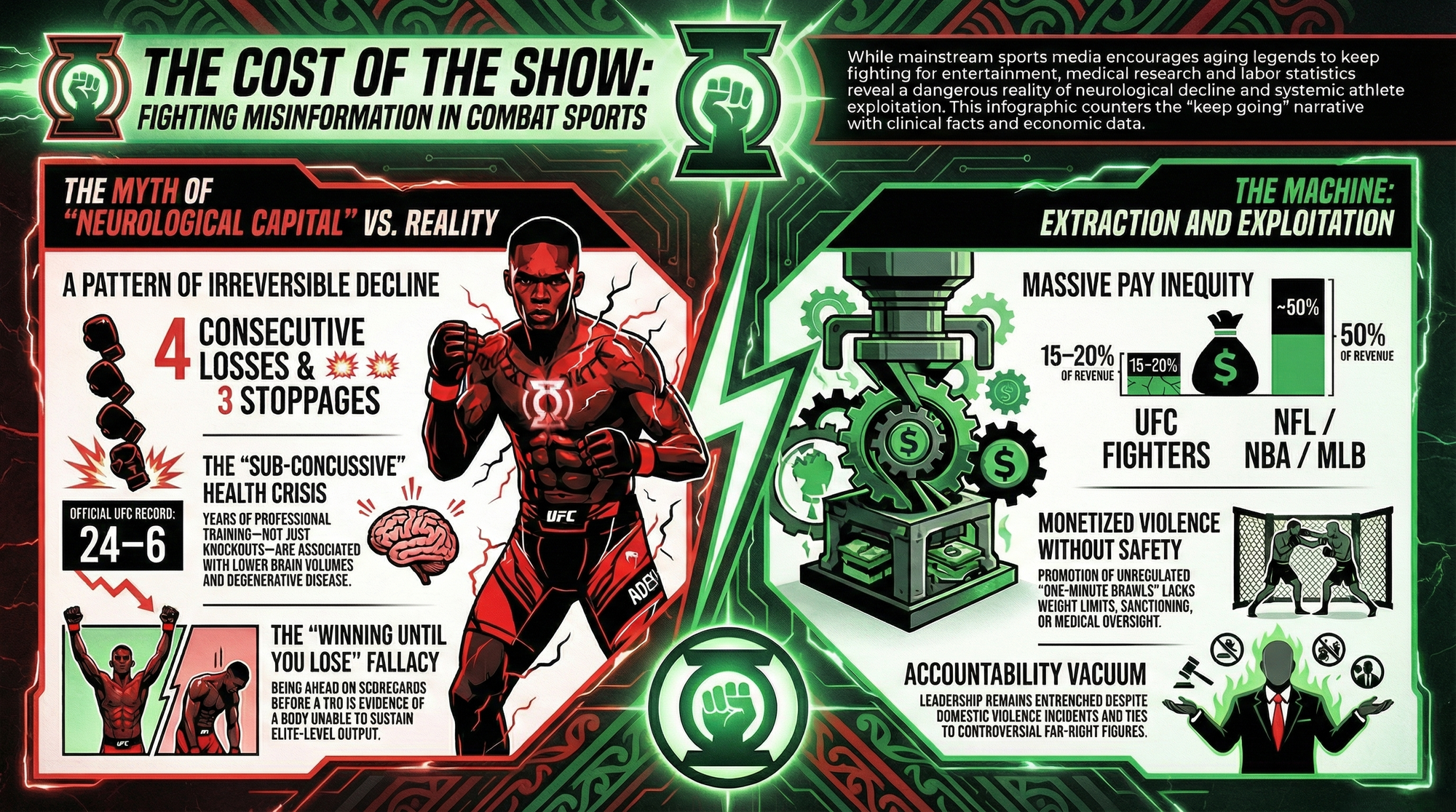
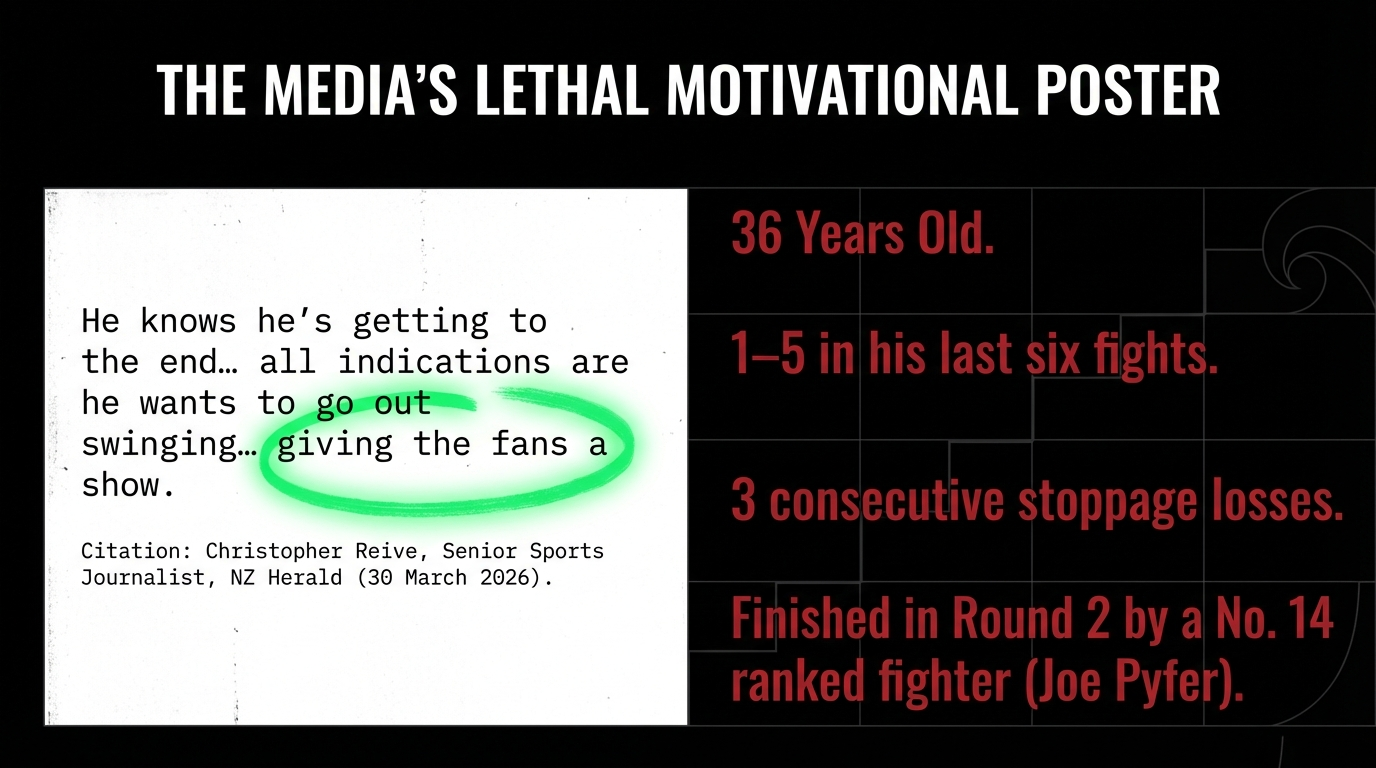
On 28 March 2026, Israel Adesanya was finished in round two by Joe Pyfer — a second-round TKO at 4:18, the referee stepping in to stop the damage. That is Adesanya's fourth consecutive loss, three of them stoppages. He is 1–5 in his last six fights. His official UFC record now sits at 24–6. He is 36 years old.
And the New Zealand Herald responded by telling him to keep going.
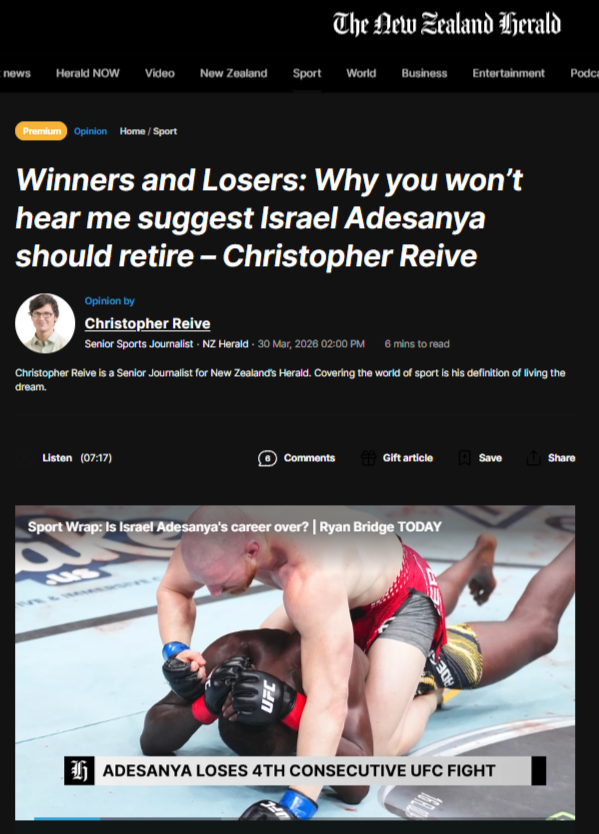
Christopher Reive, the Herald's Senior Sports Journalist, published a column this morning that is the literary equivalent of handing a drowning man a motivational poster and calling it a lifeline. The headline announces, with almost pathological pride:
"Why you won't hear me suggest Israel Adesanya should retire."
He is bragging — bragging — about his refusal to say the obvious thing. This is what happens when sports media confuses access with integrity, sentiment with analysis, and entertainment with ethics.
The one person in this entire ecosystem who told the truth was Luke Thomas. After Seattle, and again after the Imavov disaster in early 2025,
Thomas said plainly: Adesanya should consider retirement. He had said it before anyone else dared. He treated Adesanya's greatness as a reason for honesty, not as a reason to keep lying to him. Everyone else in this conversation is treating it as material for a Monday column.
The Deep Dive Podcast
Listen to a lively conversation between two hosts, unpacking and connecting topics in the sources of this essay.
Reive's Column, Demolished
The claim: Adesanya "was winning the fight" before a "tactical decision to brawl" cost him.
The reality: Pyfer was ranked No. 14 in the middleweight division. Adesanya was ranked No. 4. A former two-time champion with a decade of elite experience was finished by a man ten spots below him in the rankings. That is not a tactical error. That is what decline looks like when it arrives. Being ahead on a scorecard before being stopped is not evidence of competitiveness — it is the textbook pattern of a fighter whose body can no longer sustain the output demanded to finish fights at the level his legacy requires. Thomas called it directly: the title window is closed. The trajectory is irreversible.
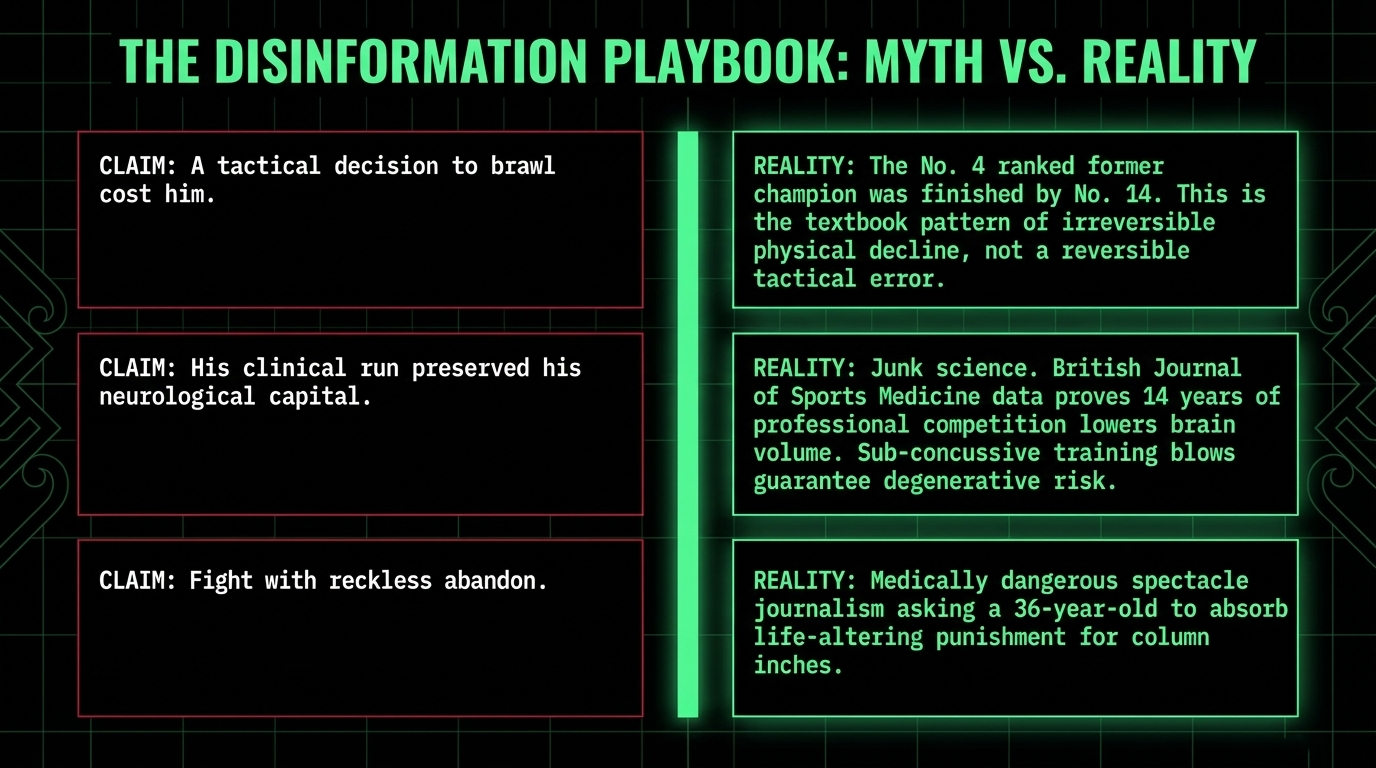
The claim: Because Adesanya's title run was "clinical and low-damage," he has more neurological capital preserved than other fighters his age.
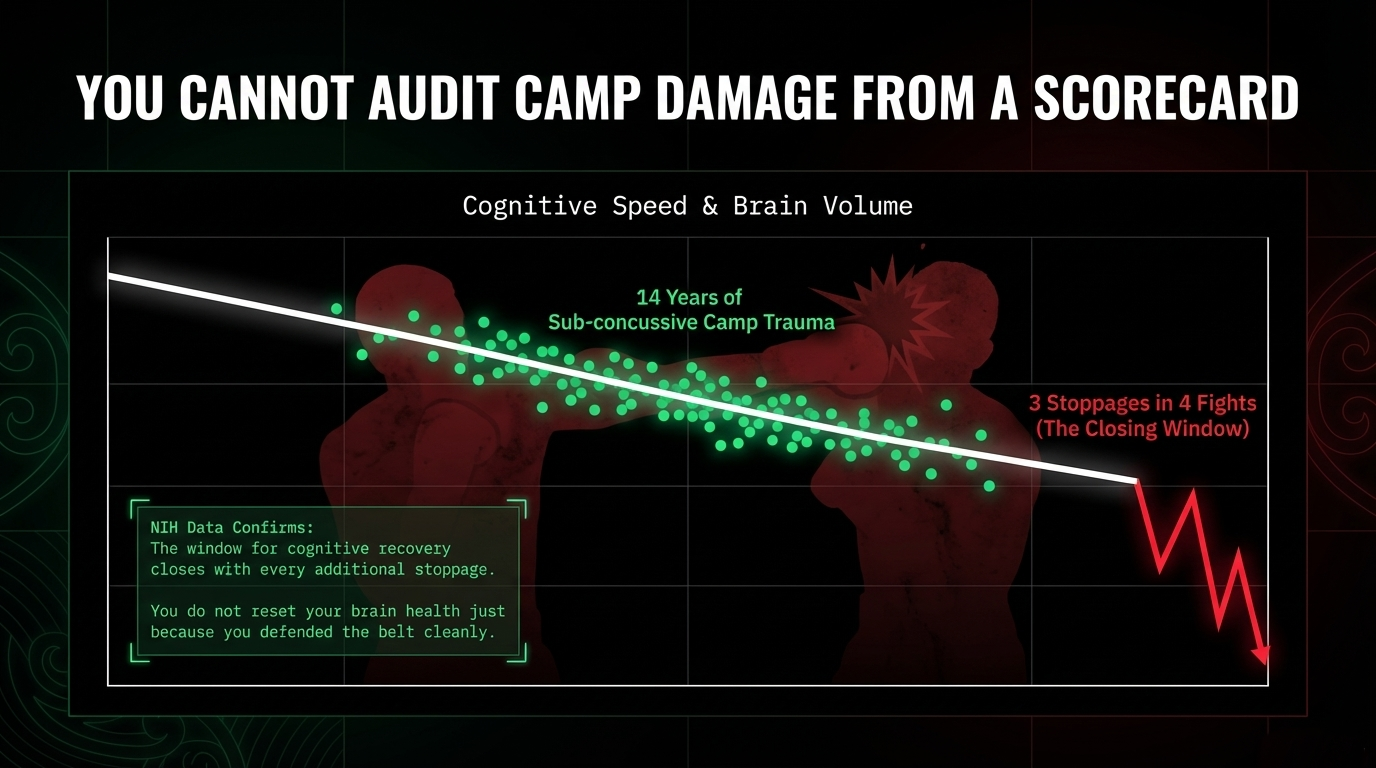
This framing would fail a first-year sports science course, and it is medically dangerous coming from a mainstream platform. Research published in the British Journal of Sports Medicine on 224 professional fighters found that increasing years of professional competition — not just concussions — were directly associated with lower brain volumes and slower cognitive processing speed.
NIH-linked literature goes further: even sub-concussive blows, the kind that do not end fights but accumulate across 14 years of professional training and competition, are "sufficient to lead to the development of degenerative brain disease." No journalist can see that on a scorecard. No journalist can audit 14 years of sparring camp damage. And no journalist should be writing about neurological preservation as though it were a fuel gauge they have access to.
The claim: Adesanya can now go out "with reckless abandon, trying different moves just to see if they work and giving the fans a show."
This is the ugliest sentence in the piece. Track what it means precisely: a journalist is recommending that a 36-year-old man absorb further punishment — not for a title, not for a legacy moment, not for anything with structural meaning — but for entertainment. For a show. For the column inches that follow. Research from Cleveland Clinic's Lou Ruvo Center confirms that while some cognitive recovery is possible after fighters stop competing, the window to preserve brain health narrows with every additional stoppage. Reive is asking Adesanya to keep closing that window. That is not compassion. That is spectacle journalism dressed in the language of respect.
But Let's Talk About Izzy Too
Because this would be a dishonest essay if it only trained its fire on the media and the machine.
Adesanya is not simply a passive victim of a system that won't let him go. He has made choices — specific, public, documented choices — that betray the very legacy of intelligence and artistry he built his career on.
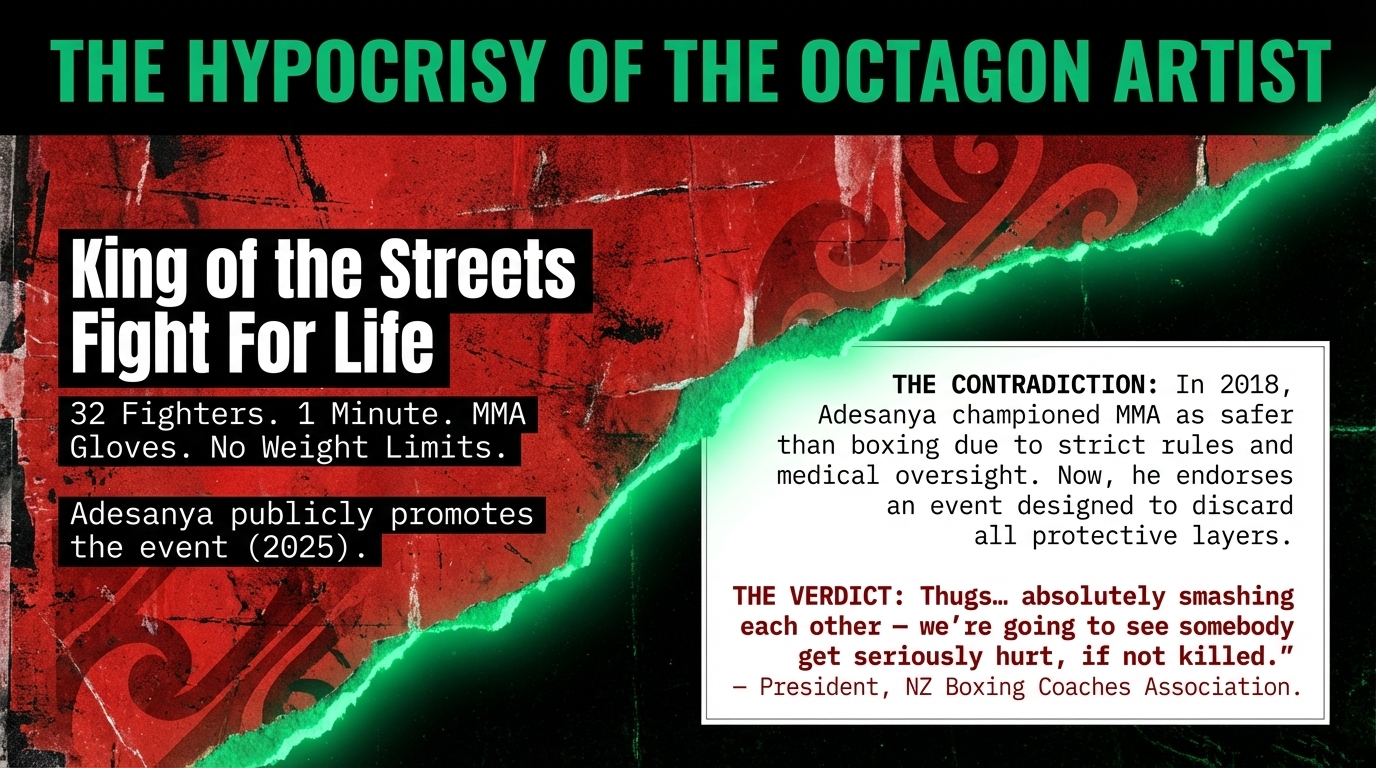
In May and June 2025, Adesanya was actively promoting Dan Hooker's "King of the Streets" and "Fight For Life" events — one-minute brawls, fought in MMA gloves, with no weight limit, no proper sanctioning body, and a $50,000 winner-takes-all cash prize. Hooker even brought the format back for women, posting alongside Adesanya to promote the event.
The president of New Zealand's Boxing Coaches Association, Billy Meehan, said it plainly:
"What you've got there is just thugs getting in there and going out and they're just absolutely smashing each other — we're going to see somebody get seriously hurt, if not killed."
The format guarantees head trauma. Thirty-two fighters. One minute. MMA gloves. No weight limits. This is not sport. This is monetised violence stripped of every protective layer that makes combat sports defensible, repackaged as authentic working-class entertainment. And Adesanya — the man who spent his career being celebrated as the most technically sophisticated fighter of his generation — put his name and face on it.
Consider the hypocrisy. As recently as 2018, Adesanya publicly argued that MMA was "safer than rugby and boxing" because of its structure, its rules, its medical oversight. The entire case for MMA's legitimacy rests on exactly those protections. Hooker's events exist specifically to discard all of them. And Adesanya stood beside the man selling that product with a grin. If you are going to spend a decade positioning yourself as the artist of the octagon, you do not then lend your platform to backyard tournaments that the boxing authorities warned could kill someone — not unless there's a cheque involved and the judgment that made you great has started to slip.
That, too, is part of the story of a man in decline. The brain that plans fights also plans everything else. The two are not unrelated.
Koha Consideration

The UFC takes 80% of fighter revenue and calls it business. Dana White slapped his wife on camera and calls it a private matter. The NZ Herald tells Izzy to keep absorbing punishment and calls it respect. None of them will fund the voice that calls it what it is.
This mahi — naming the machine, protecting the fighter, telling the truth the sports desk won't — runs on koha. Not corporate sponsorship. Not access journalism. Whānau-funded accountability.
Every koha signals that rangatiratanga includes the power to fund our own truth tellers. If you believe Izzy's brain matters more than Dana White's gate receipts, back the voice that says so.
If you cannot koha right now — no worries. Subscribe, follow, share this with your whānau and friends. That is koha in itself.
Three pathways:
Support directly via Koha | Subscribe to The Māori Green Lantern | Direct bank transfer: HTDM, 03-1546-0415173-000
Kia kaha, whānau. Stay vigilant. Stay honest. And let Izzy retire in peace.
The Machine Behind the Mythology
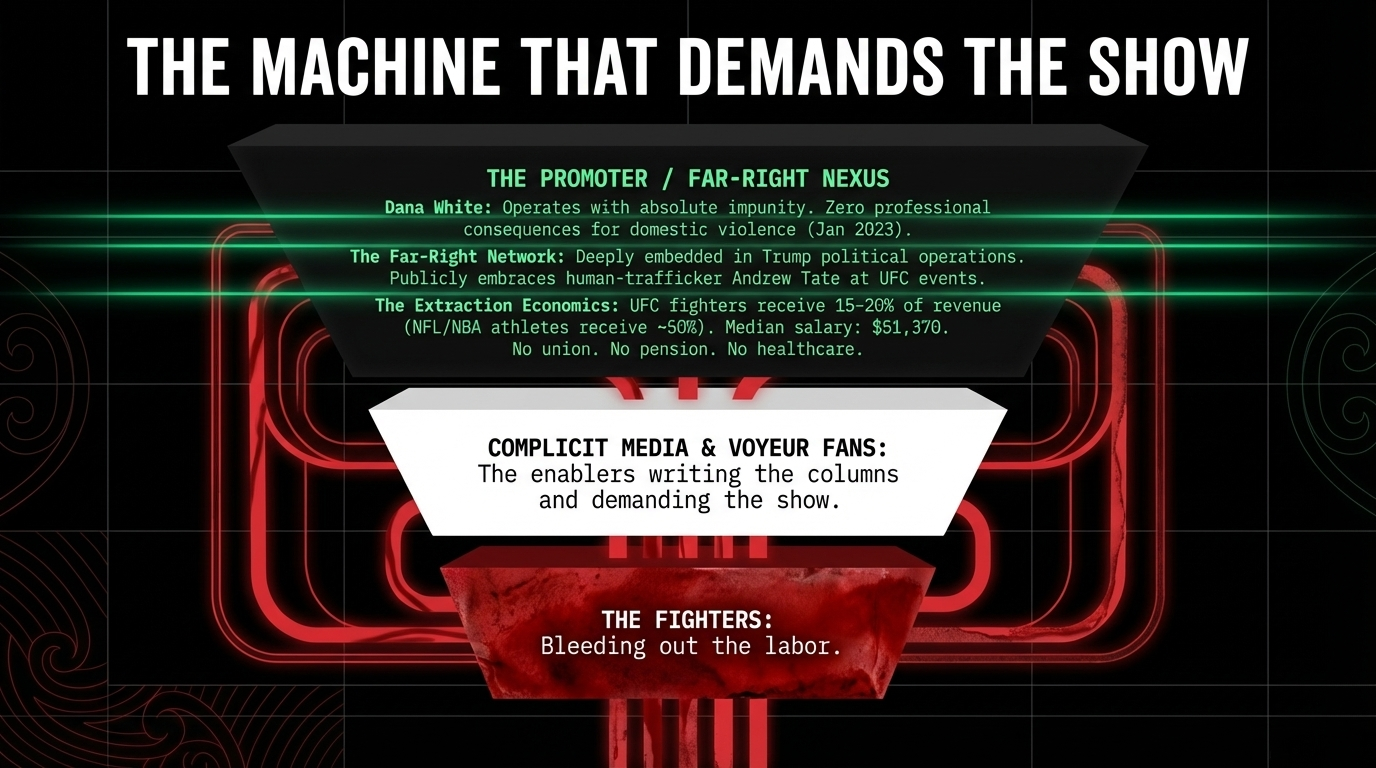
None of this exists in a vacuum. The UFC has spent three decades building the most sophisticated labour extraction operation in professional sport, and it operates with near-total impunity.
UFC fighters receive approximately 15–20% of total revenue — compared to the roughly 50% paid to athletes in the NFL, NBA, MLB, and NHL through collective bargaining agreements. A detailed analysis of fighter pay structures found the median annual UFC fighter salary sits around $51,370, with nearly half of all fighters earning below $45,000 per year. Fighters are classified as independent contractors — no union, no pension, no long-term health insurance, no collective power. The antitrust class action that accused the UFC of deliberately suppressing fighter pay through restrictive contracts and market monopoly settled in 2024 for $375 million, distributed to over 1,100 fighters. Anderson Silva alone received $10.3 million. The UFC admitted no wrongdoing. They never do.
In this context, the "keep fighting because he loves it" narrative serves one party above all others: the promoter.
When a beloved champion continues past his prime, he fills venues, generates headlines, boosts streaming numbers, and costs the organisation nothing in long-term care. The fighter absorbs the neurological toll. The organisation books the revenue. The journalist writes the column. The machine turns.
Dana White: The Man at the Centre
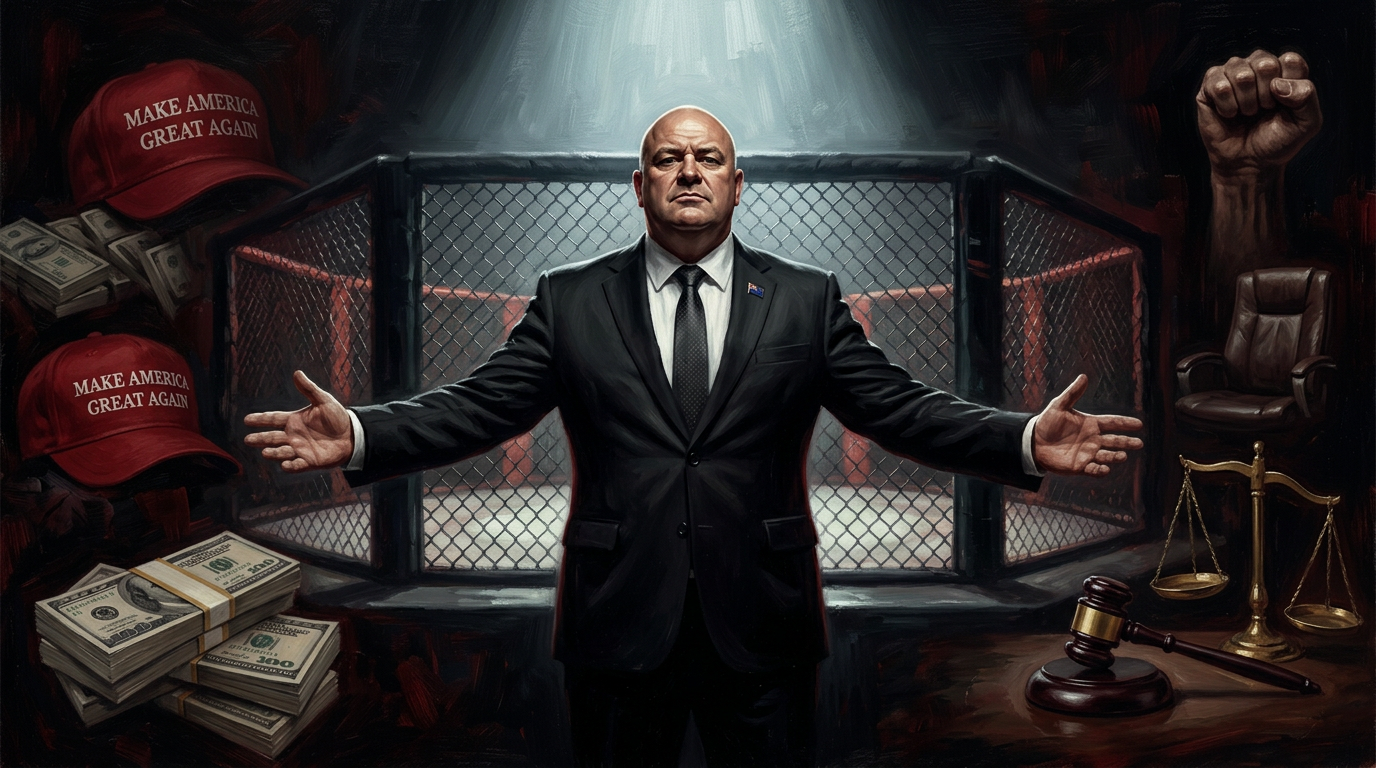
Dana White runs this machine. Let's be specific about who he is.
In January 2023, White was filmed slapping his wife on New Year's Eve. He faced zero professional consequences. He retained his presidency. He publicly acknowledged the criticism was "100% warranted" and then kept his job anyway — because in an organisation where he answers to no union, no players' association, and no independent governance board, accountability is entirely voluntary. He confirmed he would not step down. Major outlets confirmed it. Nobody removed him.
He is a long-standing public ally of Donald Trump — speaking at Trump rallies, attending inaugurations, donating to aligned political operations. He is embedded in a network of sporting power that flows directly through Trump's political brand. In March 2025, he publicly embraced Andrew Tate — a man facing human trafficking charges — at a UFC event, warm and smiling for the cameras.
This is the entity that benefits when a journalist writes:
"keep fighting, give us a show."
This is the structure Reive's column, however unwittingly, serves.
The Fans Are Not Innocent Either
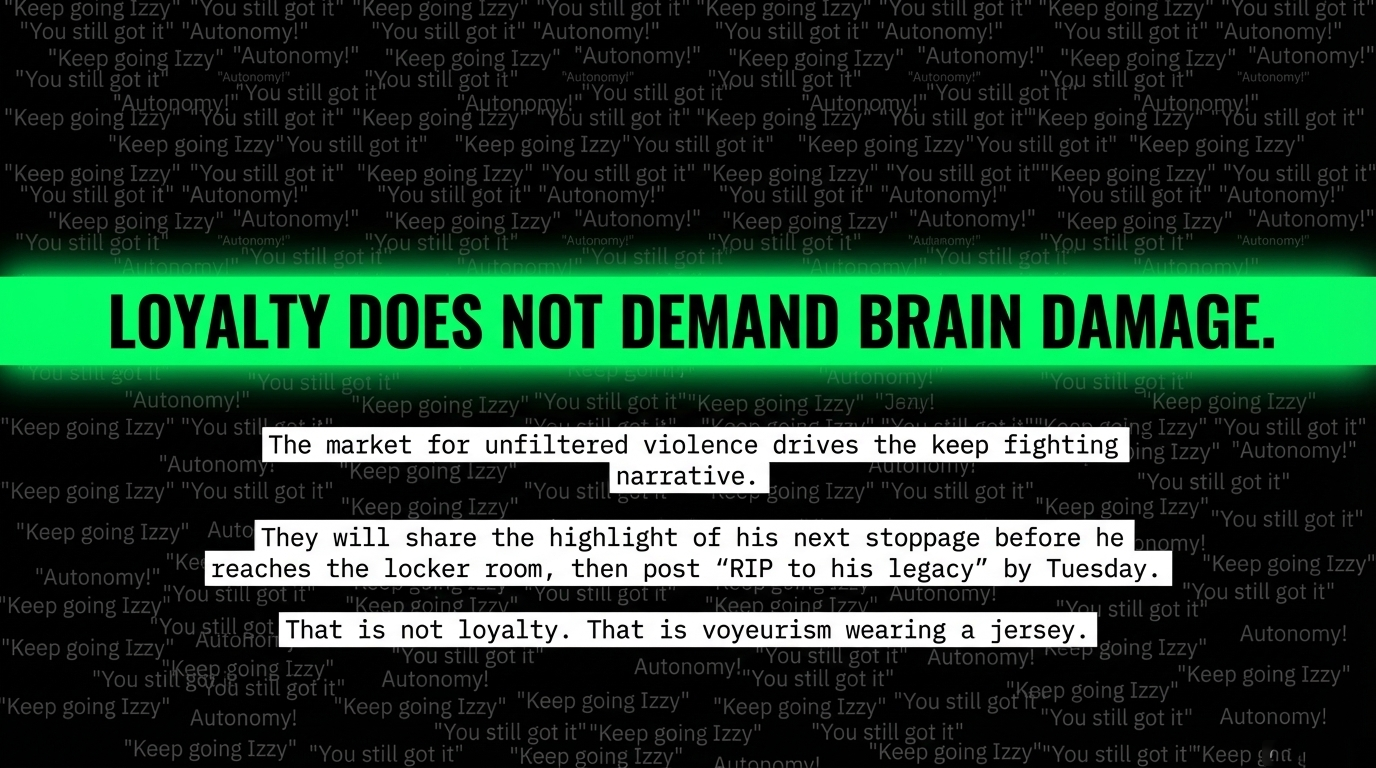
The fans who are flooding comment sections with "keep going Izzy, you've still got it" deserve their share of this critique. These are the same people who claimed to love Adesanya for years and now, when love requires the difficult thing — honesty, restraint, letting go — suddenly discover a deep commitment to his "autonomy."
Hooker's one-minute brawl events drew crowds precisely because a segment of the combat sports audience finds proper MMA "too slow," too technical, too dependent on skill rather than pure unfiltered damage. That audience is not a footnote. It is a market. It drove Hooker's product. It drives the Adesanya-keeps-fighting narrative. It is the same audience that will share the highlight of his next stoppage before the man has reached the locker room, then post RIP to his legacy by Tuesday.
That is not loyalty. That is voyeurism wearing a jersey.
Luke Thomas: The Exception That Proves the Rule
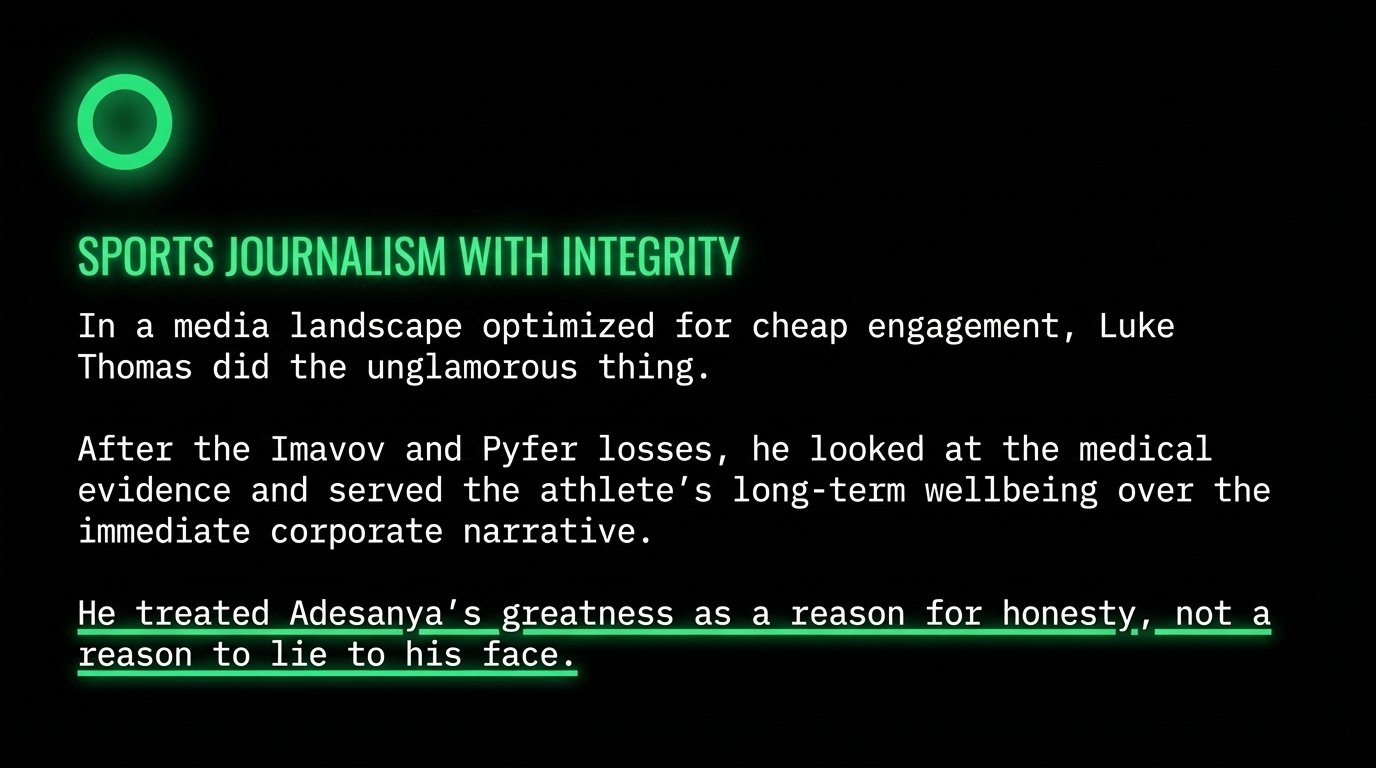
In a media landscape optimised for takes that generate engagement rather than truth, Thomas did the unglamorous thing after Seattle: he said what the evidence demanded.
He had already said it after the Imavov loss. He acknowledged the legacy — second-best middleweight in UFC history by most assessments — while being clear-eyed that the body, the results, and the trajectory all point in one direction. He served Adesanya's long-term wellbeing over the immediate narrative. He did not ask for applause for doing so. He just did it.
That is the standard. That is what sports journalism that actually respects its subjects looks like.
His Brain Is Not Your Storyline
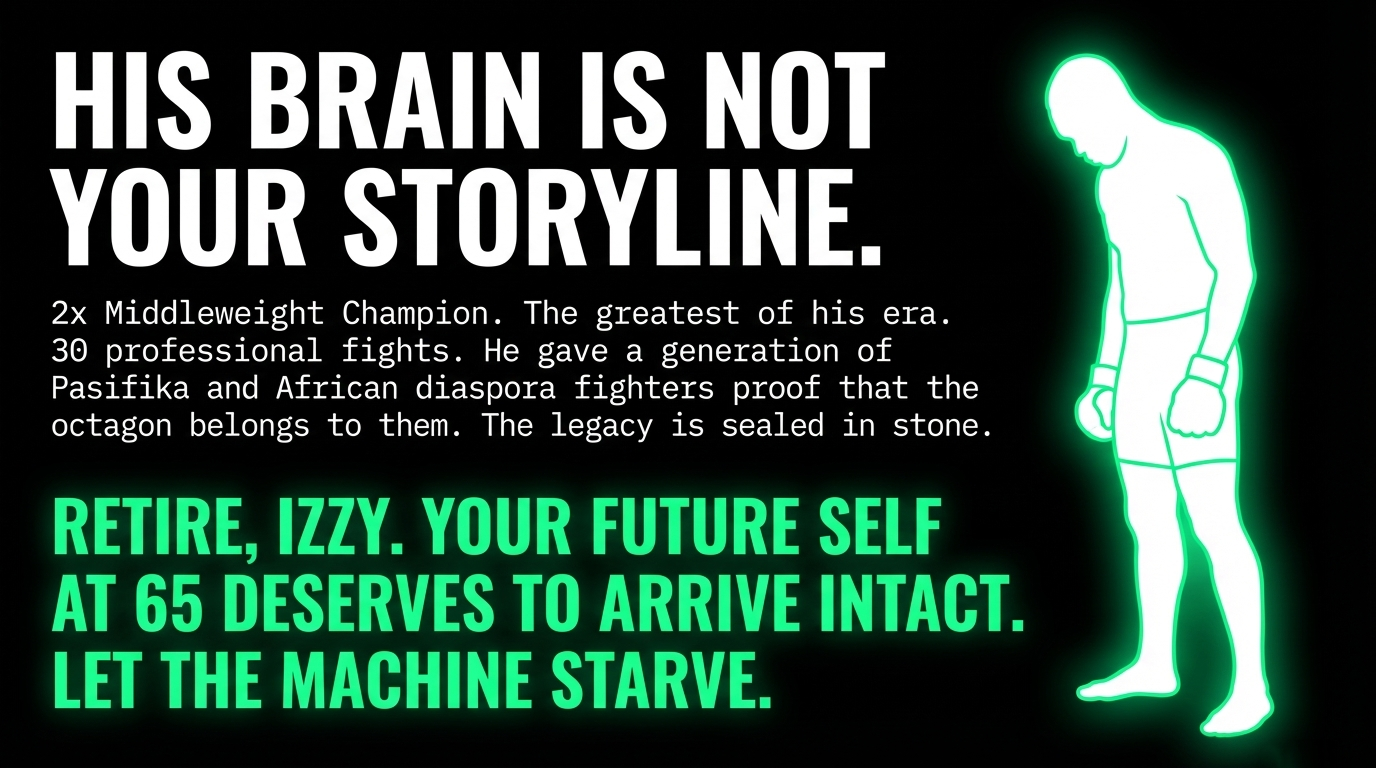
Israel Adesanya is one of the greatest fighters this planet has produced. He is a Nigerian-Kiwi who walked into the most competitive organisation on earth and became its best fighter for five years, won two UFC middleweight championships, and gave a generation of Pasifika and African diaspora fighters proof that the octagon could belong to them. That legacy is permanent. It is documented in the record books. No subsequent loss can remove it.
What is not permanent is his neurological health. Three stoppages in his last four fights. Fourteen years of professional competition. Thirty fights. Research on cumulative fighting exposure does not offer comfort. The window to preserve what remains narrows with every additional outing.
Christopher Reive wrote a column bragging about his refusal to say the obvious thing. The Herald published it. The fans shared it. Dana White's machine keeps turning. Dan Hooker's brawl shows keep running. Adesanya himself says he has no plans to retire. And somewhere inside all of that, a great man is being encouraged — by media, by promoters, by the fans who claim to love him — to keep paying the price so everyone else can keep collecting.
The only honest position is the one Luke Thomas took.
Retire, Izzy. Your legacy is sealed in stone. Your future self — at 55, at 65 — deserves to arrive intact.
Not everyone cheering for you now will be there to help when the lights dim permanently. But they will have thoroughly enjoyed the show.

Research conducted 30 March 2026. Sources include UFC.com, UFC Stats, NZ Herald, 1News, BBC Sport, MMA Junkie, Bloody Elbow, NIH/PMC peer-reviewed research, British Journal of Sports Medicine (2015), ESPN, CNN, HuffPost, PlayTheGame.org, and Luke Thomas/MMA Fighting.
Support this mahi: Koha | Substack | Direct: HTDM, 03-1546-0415173-000