“Honouring Imperialism? A Māori Critique of David Seymour’s Ukrainian Award” - 27 August 2025
When Far-Right Solidarity Masks Colonial Interests
Tēnā koutou katoa (Greetings to you all).
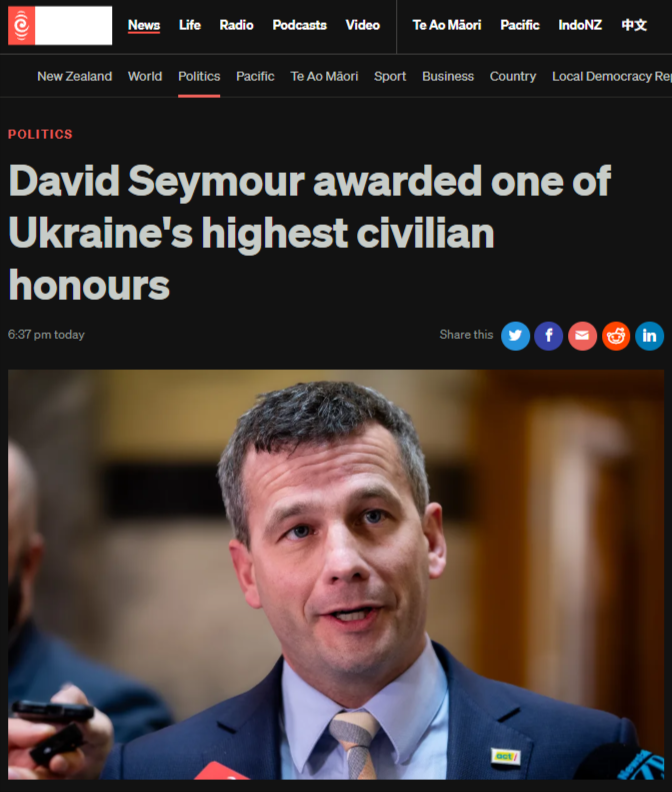
In a world fractured by geopolitical posturing, the decoration of Deputy Prime Minister David Seymour with Ukraine’s Order of Merit feels less like genuine manaakitanga and more like political theatre designed to uplift far-right alliances while sidelining domestic obligations. This essay interrogates how such honours can be weaponised to promote neoliberal militarism and white supremacist narratives, examines hidden continuities of colonial power in symbolic accolades, and asserts a distinctly Māori stance on sovereignty, collective care, and resistance to transactional solidarity.
Background
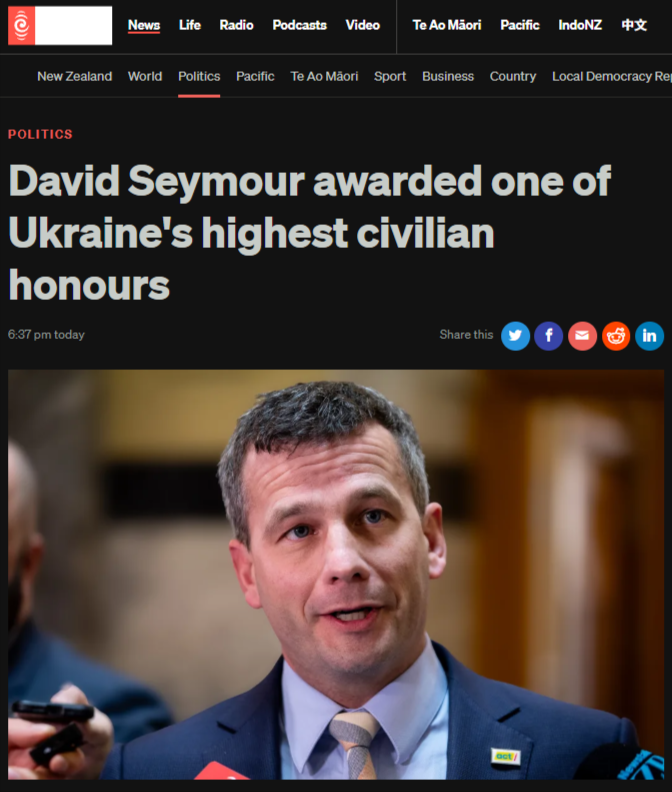
The Order of Merit was established by President Leonid Kuchma in 1996 to reward “outstanding achievements in economics, science, culture, military or political spheres”. Seymour was one of 143 recipients recognised on Ukraine’s most recent list for “supporting state sovereignty and territorial integrity, charitable activity, and promoting the Ukrainian state”. From a Māori perspective, authentic expressions of kotahitanga and manaakitanga must be grounded in reciprocity with sustained community action, not fleeting badges of imperial approval.rnz+1
On its surface, Seymour’s award signals solidarity with a democracy under siege. Yet a deeper look reveals three disturbing dissonances:
Political Instrumentalisation
Seymour’s alignment with Ukraine’s government dovetails neatly with global far-right networks that frame militarism as the ultimate protector of freedom, reinforcing the neoliberal military-industrial complex critiqued by scholars as driving humanitarian crises through “cycles of military pacification and economic immiseration”.scholarlycommons.law.case
Selective Solidarity
While championing Ukraine, Seymour deflects attention from New Zealand’s own Treaty breaches and the Crown’s ongoing appropriation of Māori resources, such as the recent High Court finding on the 1992 Fisheries Settlement. This diversionary tactic positions distant conflicts above pressing domestic redress and environmental guardianship.rnz
Colonial Continuities
By embracing a foreign honour, Seymour repeats the colonial pattern of co-opting Indigenous leaders through imperial decorations—a practice that historically served to delegitimise tino rangatiratanga and assimilate Māori into Crown structures.teara
Māori Values vs. Neoliberal Militarism
Neoliberalism prioritises market solutions and private power, even in contexts of war, demanding military aid as a form of fiscal responsibility rather than collective care. Seymour’s calls to send unused Javelin anti-tank missiles to Kyiv echo earlier appeals by ACT and National figures, adopting an aggressive posture that conflicts with Māori principles of strategic restraint and whanaungatanga (kinship).rnz+2
Rhetoric of “Freedom”
Seymour’s insistence that “if large powers can redraw boundaries anywhere, that threatens our freedom” portrays global order as subject to brute force rather than diplomatic resolution. This framing universalises Pākehā anxieties while erasing Māori struggles for self-determination—an echo of white supremacist narratives that cast equity as reverse discrimination.tandfonline+1
Tokenistic Activism
Seymour’s own admission that he has done “only a few little things, tiny things” in support of Ukraine reveals performative solidarity. Genuine manaakitanga demands long-term commitment: facilitating refuge for displaced families, funding trauma support, and engaging in post-conflict peacebuilding, none of which feature prominently in his public record.rnz
Counterarguments and Rebuttals
Proponents might argue that supporting Ukraine enhances Aotearoa’s international standing. However, Māori praxis urges scrutiny of whose standing is advanced. When the same government rejects meaningful co-governance at home, it prioritises geopolitical capital over Treaty obligations and whānau wellbeing.
Implications
Seymour’s award exemplifies a broader strategy among far-right politicians: leveraging international crises to normalise neoliberal militarism, deflect attention from colonial injustices, and strengthen transnational white supremacist networks. For Māori, this spectacle deepens marginalisation by reinforcing a political culture that values symbolic honours over substantive redress.

The Māori Green Lantern fighting misinformation and disinformation from the far right
David Seymour’s Ukrainian honour is a glossy emblem of how colonial and neoliberal forces exploit the language of solidarity to advance militarism and suppress Indigenous sovereignty. Upholding Māori values demands that Aotearoa resist transactional honours, insist on genuine co-governance, and extend manaakitanga through sustained, community-centred action—both at home and abroad.
Ko te koha, he whakatenatena: please support this kōrero with a koha if you can—HTDM: 03-1546-0415173-000
Ngā mihi nui
Ivor Jones - The Māori Green Lantern