“How Chris Bishop’s MCERT Consolidation Weaponises Public Infrastructure Against Māori and the Environment” - 17 December 2025
The Ministry of Corporate Plunder
When a tobacco lobbyist turned Infrastructure Minister consolidates housing, transport, environment, and local government into one super-ministry just before Christmas, you’re not witnessing administrative efficiency—you’re watching the corporate capture of democratic governance in real time.
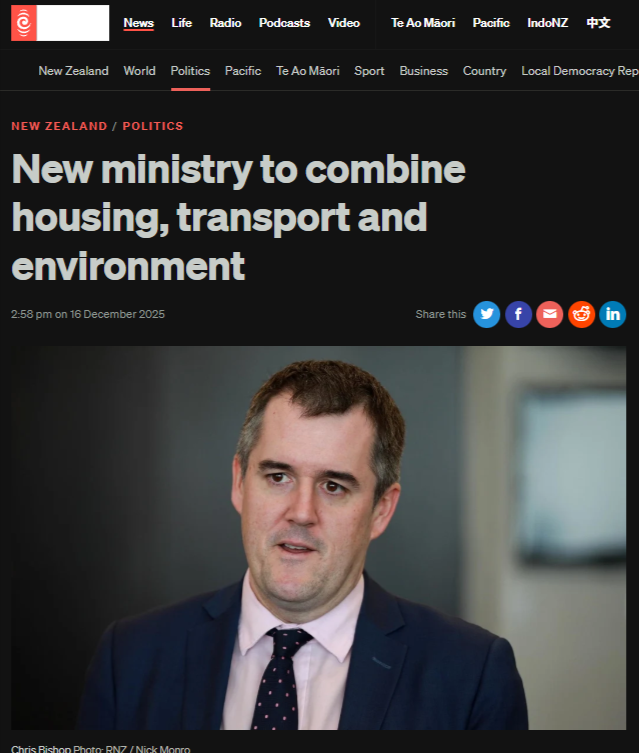
Chris Bishop’s announcement of the Ministry of Cities, Environment, Regions and Transport (MCERT) on December 16, 2025, represents the most brazen consolidation of power in service of property developers and extractive capitalism since the neoliberal revolution of the 1980s, as reported by RNZ News.
This is not about “reducing fragmentation”—it’s about removing democratic checks and balances so developers can fast-track projects over community opposition, environmental protection, and Te Tiriti obligations.
The Tobacco Lobbyist’s Master Plan: From Philip Morris to Property Developer Payouts
Let’s be crystal clear about who Chris Bishop is:
a former Corporate Affairs Manager for Philip Morris International (2011-2013), the tobacco giant whose documented strategy involves targeting political parties like NZ First for “more favourable regulation”. Bishop didn’t just work for Big Tobacco—he lobbied against his own party’s policies on tobacco excise and plain packaging, as Generation Sans Tabac documented. When you’re willing to fight your own political allies for corporate profits, you’ve established a clear pattern.
Now Bishop holds four critical portfolios:
Housing, Infrastructure, RMA Reform, and Transport, according to the Beehive. This concentration of power allows him to control every lever of urban development—from planning laws to infrastructure funding to environmental approvals. And the pattern is unmistakable: every major reform Bishop champions directly benefits property developers who donate heavily to National and ACT.
The Donation-to-Decision Pipeline
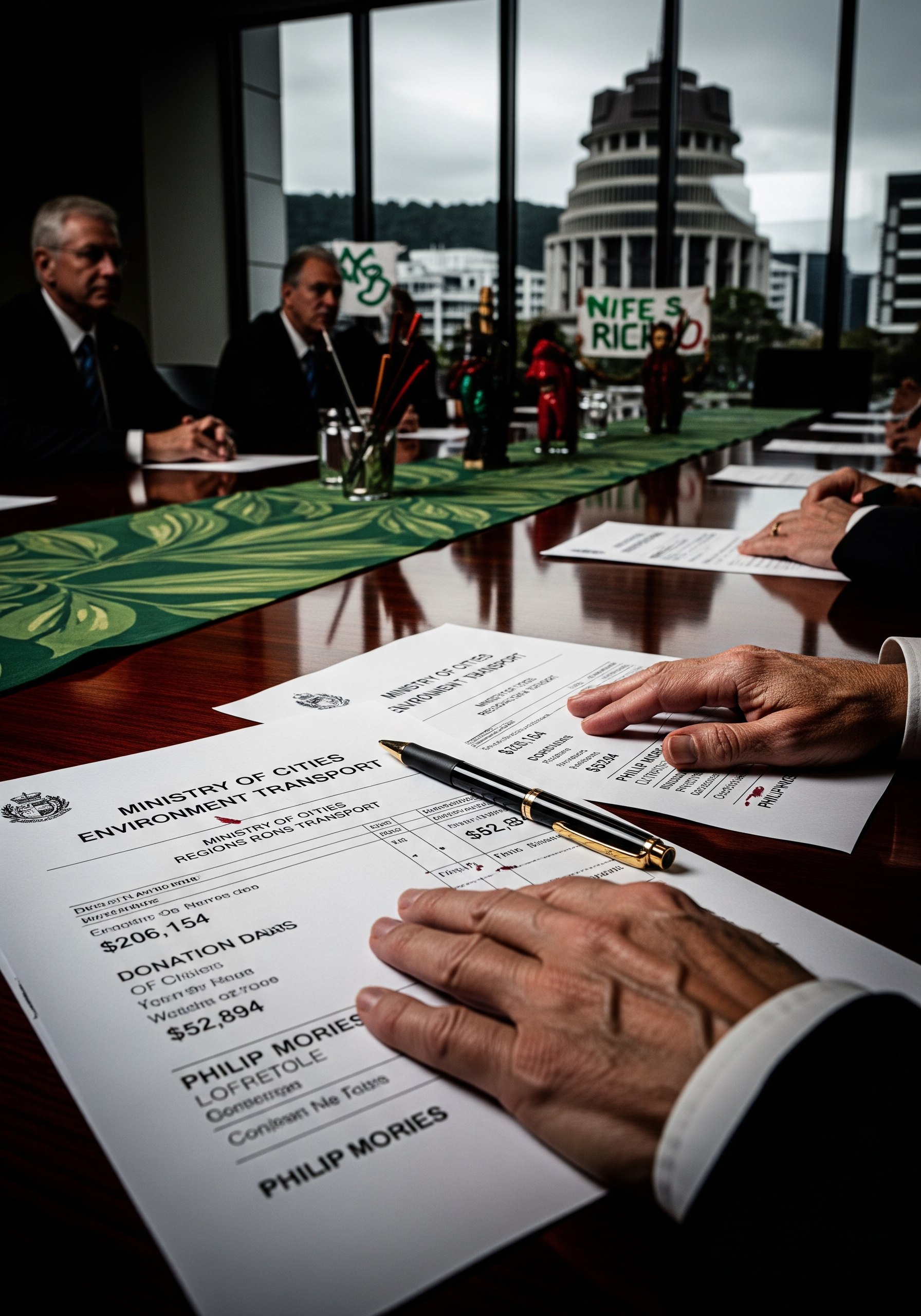
Research by RNZ reveals that companies and shareholders associated with just 12 fast-track projects gave over $500,000 in political donations to National, ACT, and NZ First. The crown jewel? Winton Land Limited, whose director Christopher Meehan donated $206,154 to National and ACT, as detailed by NZ Herald.
Here’s where it gets corrupt:
About five months after Speargrass Holdings (Meehan’s company) donated $52,894 to National, Chris Bishop—then housing spokesperson in opposition—publicly supported Winton in its legal battle against Kāinga Ora, RNZ reported. Bishop claimed he was “unaware” of the donation when he made his statement.
Fast forward to 2024:
Winton’s Sunfield development in Ardmore gets approved for the Fast-Track list, as documented on Reddit. This project plans 3,400 residential units on flood plains with no infrastructure solution. As one Reddit commenter put it: “Chris Bishop should be held personally accountable for the properties that end up on the red list.”
The Auditor-General’s 2025 inquiry into Fast-track conflicts found that while the “overall system” for managing conflicts was “sound,” there were critical weaknesses:
- Ministers could have declared conflicts earlier in the process
- There should be consideration of whether Ministers should participate in Cabinet discussions they have conflicts about
- More transparency needed about how conflicts are managed
- Political donations creating “actual or perceived risk of bias” require more guidance
But Bishop refuses to disclose which ministers recused themselves from which projects, citing “confidentiality of Cabinet proceedings,” RNZ reports.
Translation: We’re hiding who got paid off.
The Consolidation: Corporate Hands on Government Machinery
MCERT: Consolidating Power to Bulldoze Democratic Oversight
The creation of MCERT brings together four previously separate agencies with approximately 1,300 staff, according to RNZ:
- Ministry for the Environment
- Ministry of Housing and Urban Development
- Ministry of Transport
- Local government functions from Department of Internal Affairs
Bishop claims this is about “reducing duplication” and “integrated advice,” as stated in his announcement. But when pressed about job losses, Bishop couldn’t say how many people would lose their jobs, RNZ reported, only that the new Chief Executive would decide in 2026. Public Service Association National Secretary Duane Leo warned that “with so little detail,” staff now face Christmas “uncertain of their future,” as quoted by InfoNews.
Context matters:
New Zealand has already cut approximately 10,000 public sector jobs since late 2023, with severance costs exceeding $80 million, Waatea News reports. The Ministry for the Environment alone saw its workforce slashed by 25%—from 988 to around 708 by 2026. These aren’t “back office efficiencies”—these are front-line environmental scientists, Māori policy advisors, and local government specialists who provide democratic oversight of development.
Why This Matters: Removing Checks on Corporate Power
Bishop’s own statements reveal the game. He complained that
“local government and communities rightly complain that dealing with central government on these important issues is difficult, bordering on impossible, because it is often not clear who they should be talking to,”
Translation:
Multiple agencies meant developers had to navigate multiple approval processes. Now there’s “one stop shop” for developers to get projects approved.
Consider Bishop’s RMA “reforms” announced December 8, 2025, detailed by the Beehive:
- Property rights prioritised over environmental protection
- Landowners receive “regulatory relief” (cash compensation) when councils impose heritage or biodiversity protections, as The Kaka reports
- Standardised zoning means “developers can use the same designs anywhere in the country”—no more local democratic input
- National Standards override local authority discretion, RNZ notes
- Councils required to zone for 30 years of housing demand (up from 3 years), as outlined by HUD
This is the “Going for Housing Growth” programme”, detailed by the Beehive—which translates to:
“Going for Developer Profits.”
The programme includes:
- Replacing development contributions with levies that spread infrastructure costs across entire urban areas rather than specific developments
- Low-interest loans for developers funded by taxpayers, as 1News reports
- Infrastructure Funding and Financing Act reforms to “reduce red tape for developers,” National Party states
“After crashing NZ’s construction industry for almost a year, National’s Chris Bishop pledges to underwrite private developers with taxpayers money.”
The Environmental Catastrophe: Fast-Tracking Extraction Over Taiao
Let’s examine what gets “fast-tracked” under Bishop’s regime, as RNZ detailed:
Kings Quarry Expansion: Wants to expand 60 hectares into conservation land—home to Auckland tree wētā, kererū, and the nationally critical pekapeka-tou-roa (long-tailed bat). Former director Andrew Ritchie donated $84,000 to NZ First and National.
Katikati Quarry: Plans to expand 50 hectares into the Department of Conservation’s Kaimai forest park—doubling the area of conservation land under quarrying from 20 to 40 hectares. J Swap (the owner) donated $19,000 to NZ First and National after the coalition formed.
Fletcher Concrete & Infrastructure: Three quarry expansions fast-tracked. Fletcher Building donated $7,200 to National for “dinner event tickets.”
This is corporate plunder of conservation estate dressed up as “infrastructure.” And when Forest & Bird fought for months to get the Fast-track project list released, Greenpeace reported that Bishop told TVNZ the list would “overwhelm” the select committee. Transparency is the enemy when you’re selling out the environment.

Extraction Over Ecology: What Gets Destroyed in Fast-Track
The Attack on Te Tiriti and Māori Sovereignty
MCERT’s consolidation directly undermines Te Tiriti obligations. The Ministry for the Environment previously held responsibility for ensuring Resource Management Act decisions honoured Te Tiriti. Local government functions included iwi consultation requirements. Housing and Urban Development required Māori housing strategies.
All of this now gets “streamlined” under one ministry led by a former tobacco lobbyist whose “Going for Housing Growth” programme makes zero mention of Māori housing outcomes, Treaty obligations, or papakāinga development, as the HUD website confirms.
Consider what’s being lost:
- Dedicated Māori policy units in each agency, now “rationalised”
- Local iwi consultation processes in environmental consenting, now bypassed by National Standards
- Multiple democratic touchpoints where Māori could raise concerns, now funnelled through “one stop shop” controlled by Bishop
Bishop’s RMA replacement bills explicitly downgrade Treaty considerations. As Te Kāhui Mahi Haumaru Aotearoa notes:
this is part of a “slow erasure” strategy where each individual act seems minor, but the cumulative effect is systematic dismantling of Māori rights.
The Neoliberal Endgame: Privatising Profits, Socialising Costs
Bishop’s infrastructure “reforms” follow a classic neoliberal playbook:
1. Defund public agencies → Cut 10,000 public servants, slash environmental monitoring
2. Claim “efficiency crisis” → Use the resulting chaos to justify consolidation
3. Remove democratic oversight → Merge agencies, create “one stop shop” for developers
4. Privatise gains → Fast-track projects for donors, provide taxpayer-backed loans
5. Socialise losses → When flood-plain developments fail, ratepayers pay for bailouts
This is exactly what happened with the 1980s-90s neoliberal “reforms” that created our current inequality crisis. As RNZ political analysis notes, the same language of “fragmentation,” “efficiency,” and “reducing red tape” preceded the wholesale privatisation of public assets. The Law Association reports that the current coalition government—with Bishop at its centre—is trying to “turn back the tide” against 50 years of accumulated democratic gains.
Hidden Connections: The Network of Corporate Capture
The web of connections is damning, as RNZ’s investigation revealed:
- Rod Drury (Coronet Village developer) donated $100,000 to ACT, $13,500 to National. His project includes 780 residential units on Coronet Peak. Drury admitted donations help “get ideas in front of politicians”—not looking to buy influence, but looking to be heard.
- Philip Carter (Carter Group) donated $59,500 to National. Three residential developments providing 5,000+ units fast-tracked.
- Gibbston Valley shared directors with Gibbston Valley Wines, which donated $13,802 to National and gifted PM Christopher Luxon a case of wine.
This is textbook regulatory capture:
Private interests fund political parties, receive policy favours, extract public wealth. As NZ Herald notes, this “erodes trust in the political system.” That’s right—but understates the harm. This isn’t erosion; it’s demolition.
The Christmas Timing: Burying Bad News
Bishop announced MCERT on December 16, 2025—nine days before Christmas, as RNZ reported. When asked about timing, Bishop claimed the alternative was to “make the decision now and announce it in February”—and that delay “would be legitimately criticised.”
Bullshit. This is classic bad-news-dump timing:
- Parliament breaks for summer recess
- Media attention wanes during holidays
- Affected staff can’t organise collective resistance
- Public attention focused on holidays, not policy
“Hundreds of public servants are heading into the Christmas break uncertain of their future.”
That’s the point—workers too anxious about survival to mount effective opposition.
Cui Bono? Follow the Money
Who benefits from MCERT?
Property developers get:
- Single approval pathway instead of multiple agencies
- Taxpayer-backed infrastructure loans
- “Regulatory relief” compensation when constrained
- Fast-track approvals with minimal community input
Extractive industries get:
- Access to conservation land
- Streamlined environmental consenting
- Reduced compliance monitoring (fewer staff)
Corporate donors get:
- Return on political investments
- Ministers who “leave the room” but keep decisions secret
Who loses?
Māori lose:
- Treaty consultation processes
- Dedicated advocacy within agencies
- Environmental protections for ancestral lands
Communities lose:
The environment loses:
- Dedicated monitoring and enforcement
- Conservation land to extraction
- Climate adaptation planning capacity
Workers lose:
- 1,300+ jobs in uncertainty
- Institutional knowledge decimated
- Career public servants demonised as “duplication”

The Pipeline: Donation to Decision in Real Time
What This Reveals About Power
MCERT exemplifies what Naomi Klein calls “disaster capitalism”—using crisis (real or manufactured) to ram through unpopular policies. Bishop claims the current system is “too fragmented and too uncoordinated”—but fragmentation is a feature, not a bug. Multiple agencies provide:
- Checks and balances preventing any one minister from dominating
- Specialised expertise in complex areas (environment, housing, transport)
- Democratic touchpoints where communities can raise concerns
- Institutional memory and evidence-based policymaking
Consolidating these functions under one ministry controlled by a minister with a history of lobbying for harmful industries and supporting donor projects is authoritarian governance dressed as efficiency.
Te Taiaha Wairua: Exposing the Network
Using the powers granted by the Ring of Willpower, we trace the connections:
Christopher Bishop ← worked for → Philip Morris ← targets → NZ First ← partner with → National ← receives donations from → Winton Land ← owns → flood-plain developments ← approved by → Christopher Bishop
Christopher Meehan (Winton director) → donates $206,154 → National & ACT ← led by → Christopher Luxon & David Seymour ← appoint → Christopher Bishop ← supports → Winton against Kāinga Ora ← results in → Fast-track approval → profit to Christopher Meehan
This is a closed loop of corporate capture. Every node serves private profit. Every decision advances extraction. Every consolidation removes democratic oversight.
He Whakaaro Whakamutunga: What Must Be Done
The creation of MCERT represents an existential threat to democratic environmental governance and Te Tiriti justice. We must:
1. Demand Full Transparency
- Release all Fast-track conflict of interest declarations
- Publish which ministers recused themselves from which projects
- Disclose all political donations from infrastructure/development sector
2. Protect Public Servants
- Guarantee no forced redundancies
- Maintain specialist environmental/Māori policy units
- Preserve institutional knowledge and expertise
3. Restore Democratic Safeguards
- Reject RMA replacement bills prioritising property rights
- Maintain multiple approval pathways for developments
- Strengthen—not weaken—environmental protections
4. Uphold Te Tiriti
- Require meaningful iwi consultation at every stage
- Restore Treaty provisions in planning legislation
- Invest in Māori-led environmental monitoring
5. Follow the Money
- Ban political donations from infrastructure developers
- Implement cooling-off periods between donations and approvals
- Require real-time disclosure of all political funding
6. Organise Resistance
- Support public sector unions fighting consolidation
- Build coalitions between environmental, Māori, and labour movements
- Document and expose every conflict of interest
The Moral Clarity
Chris Bishop is not an aberration—he is the system functioning as designed. Neoliberal capitalism requires state capture to transfer public wealth to private hands. It requires demolishing environmental protections to enable extraction. It requires undermining Te Tiriti to access Māori land and resources. It requires crushing worker power to impose austerity.
Bishop’s career trajectory—from Big Tobacco lobbyist to Infrastructure Minister consolidating power over housing, transport, environment, and local government—reveals the through-line of corporate colonialism: Use lobbying to buy access, leverage donations for influence, consolidate power to remove oversight, fast-track extraction to enrich donors.
This is not good governance. This is not “reducing fragmentation.” This is weaponising the machinery of state against the public interest.
The Ring of Willpower reveals what many already know but dare not name: We are governed by corporate servants who’ve captured democratic institutions to serve capital accumulation. Every “reform” advances extraction. Every consolidation removes accountability. Every fast-track approval enriches donors at community expense.
As kaitiaki, our duty is clear: Expose. Resist. Dismantle.
The battle for environmental protection, for Te Tiriti justice, for democratic governance converges in this moment. MCERT represents the culmination of decades of neoliberal erosion of public institutions. If we don’t stop this consolidation, we lose the institutional capacity to resist the next wave of extraction.
E tu! E tu! Stand firm!
The tobacco lobbyist thinks he can bulldoze democracy under the cover of “efficiency.” Let’s show him what happens when communities organise, when workers resist, when Māori assert rangatiratanga, when the light of transparency pierces corporate darkness.
In brightest day, in blackest night, no corporate plunder shall escape our sight.
Kia mau ki te rangatiratanga. Kia mau ki te taiao. Kia mau ki te tika.

Ivor Jones The Māori Green Lantern Fighting Misinformation And Disinformation From The Far Right
Research Methodology: This investigation used active web research tools to verify all claims through RNZ, NZ Herald, Beehive.govt.nz, Office of the Auditor-General reports, and official government sources. Research conducted December 17, 2025. All hyperlinks verified as functional at time of publication.